Title here
Summary here

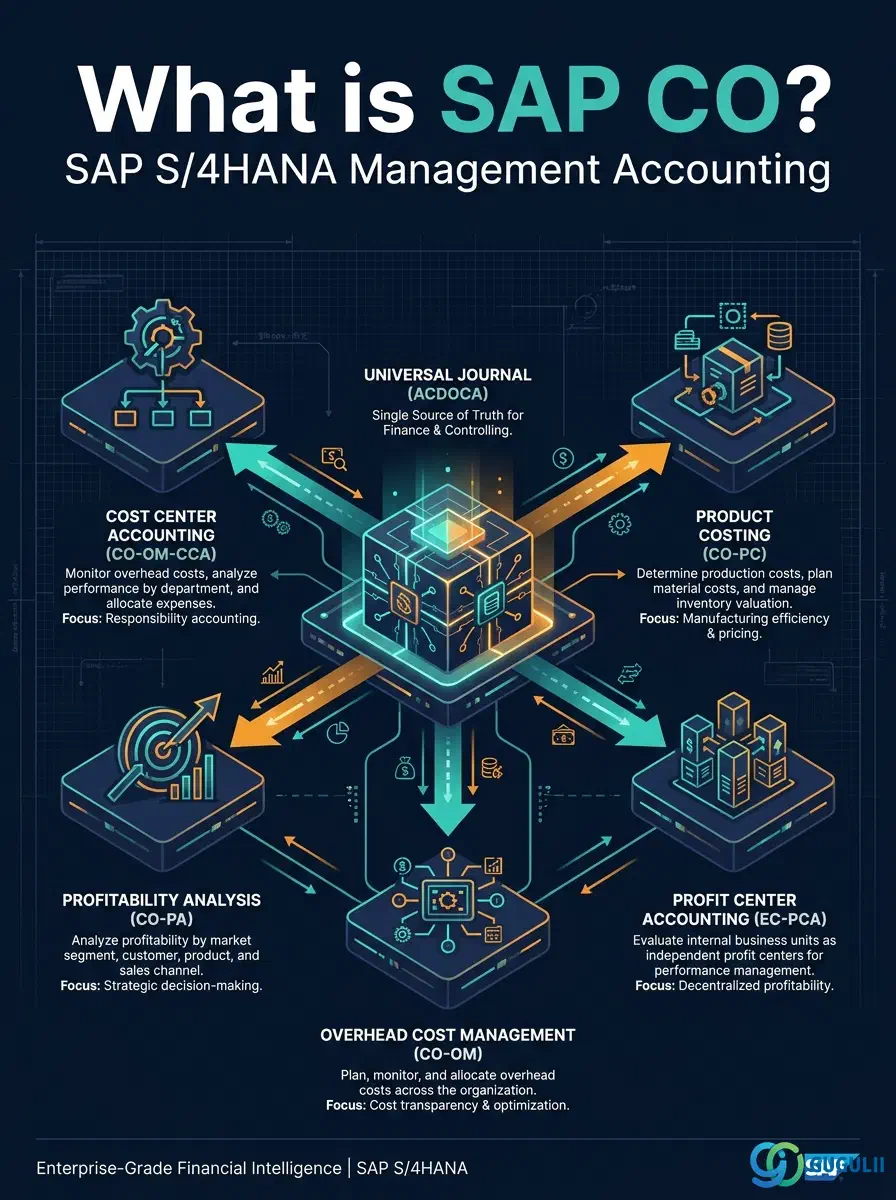
SAP Controlling (CO) is the management accounting component of SAP S/4HANA. Where Financial Accounting (FI) produces statutory reports for external stakeholders—tax authorities, shareholders, regulators—CO focuses entirely on internal reporting: tracking where costs arise, how they flow through the organization, and whether the business is generating acceptable returns by product, customer, and market segment.
In S/4HANA, the technical boundary between FI and CO is dissolved by the Universal Journal (table ACDOCA). Every financial posting—whether it originates in accounts payable, production, or sales—is stored in a single line-item table that carries all the attributes needed for both legal and management reporting simultaneously. Separate reconciliation runs between the FI and CO ledgers are no longer necessary.
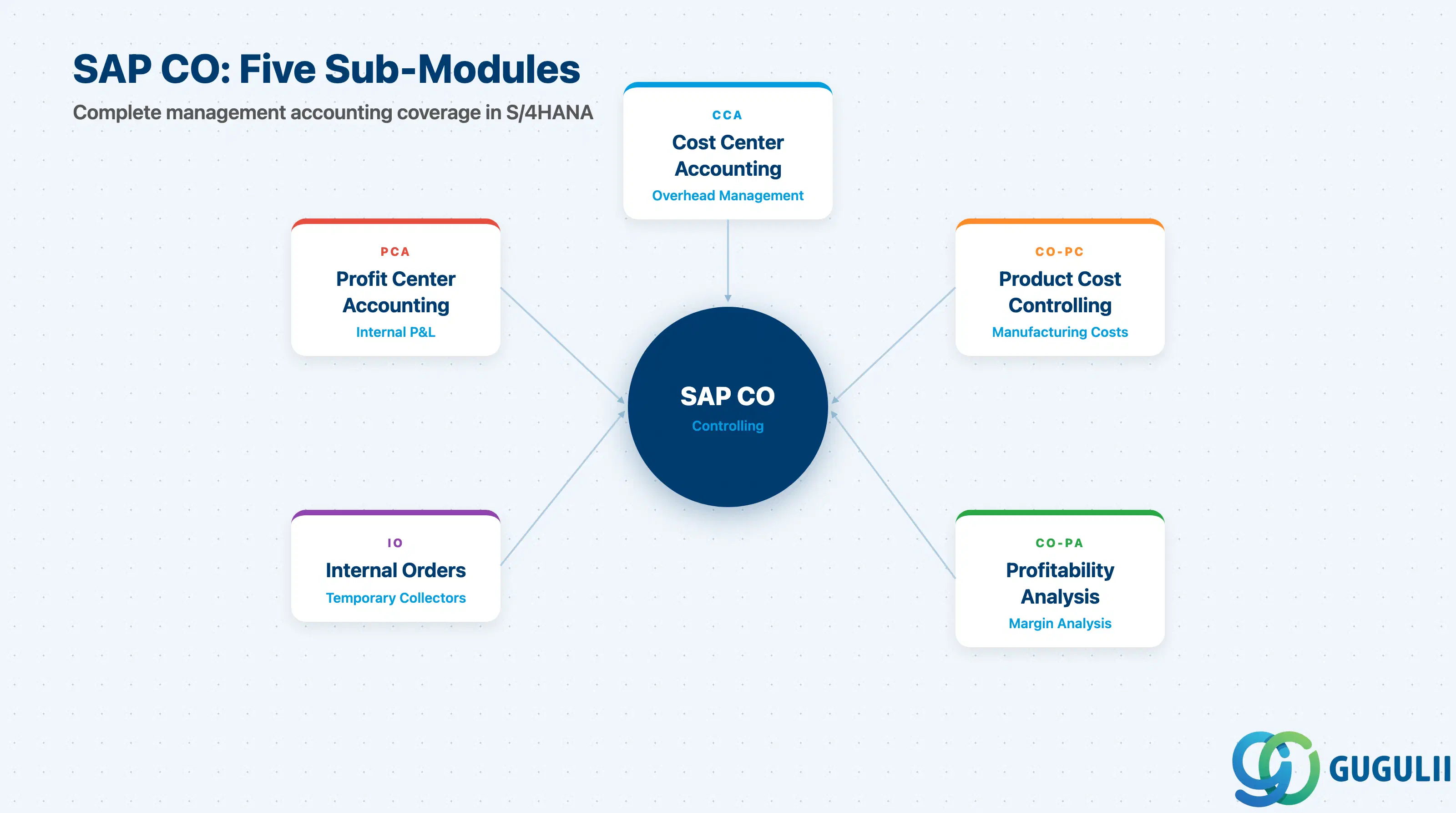
CO consists of five functional areas, each addressing a distinct dimension of management accounting.
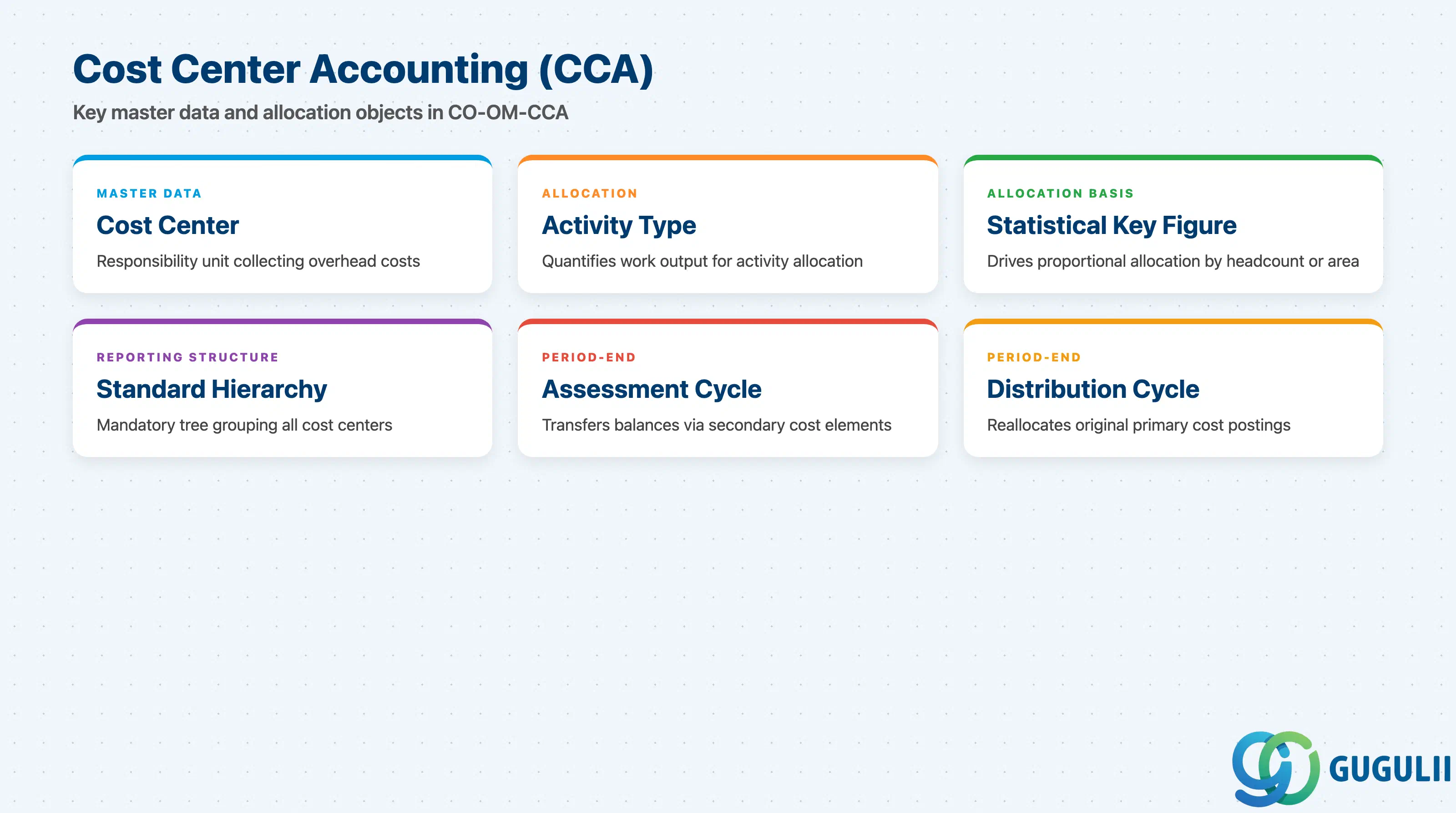
Cost Center Accounting (CO-OM-CCA) is the foundation of overhead cost management. It collects indirect costs on cost centers—organizational units that represent responsibility areas such as a manufacturing department, a maintenance team, or a shared service function—and then allocates those costs to the products or services that consumed them.
| Key Object | Purpose |
|---|---|
| Cost Center | Responsibility unit that collects overhead costs |
| Activity Type | Quantifies work output (machine hours, labor hours) for activity allocation |
| Statistical Key Figure | Basis for proportional allocation (head count, square meters) |
| Standard Hierarchy | Mandatory tree grouping all cost centers in the Controlling Area |
| Assessment Cycle | Transfers cost center balances to other cost centers or CO-PA segments using secondary cost elements |
| Distribution Cycle | Reallocates original primary cost postings (preserving original cost element) to receiver cost centers |
In S/4HANA, cost elements are no longer maintained as separate master data objects. Both primary cost elements (corresponding to G/L accounts for external value flows such as salaries and utilities) and secondary cost elements (used exclusively for internal allocations, assessments, and activity allocations) are now G/L accounts within the Chart of Accounts.
Internal Orders (CO-OM-OPA) are temporary cost collectors used to plan, monitor, and report on specific tasks or activities that have a defined start and end—marketing campaigns, trade fair participation, R&D projects, or capital investment measures that have not yet been capitalized as assets.
| Key Object | Purpose |
|---|---|
| Overhead Order | Collects costs for a specific activity; settles to cost centers or CO-PA |
| Investment Order | Collects costs for capital investment measures; settles to fixed assets |
| Order Budget | Controls spending; availability control issues warnings or errors when budget is exceeded |
| Settlement Rule | Defines receivers (cost center, WBS element, asset, G/L account, CO-PA) and allocation percentages |
When project scope grows complex—multi-level work packages, cross-department dependencies, milestone billing—SAP Project System (PS) with Work Breakdown Structure (WBS) elements replaces Internal Orders as the preferred cost object.
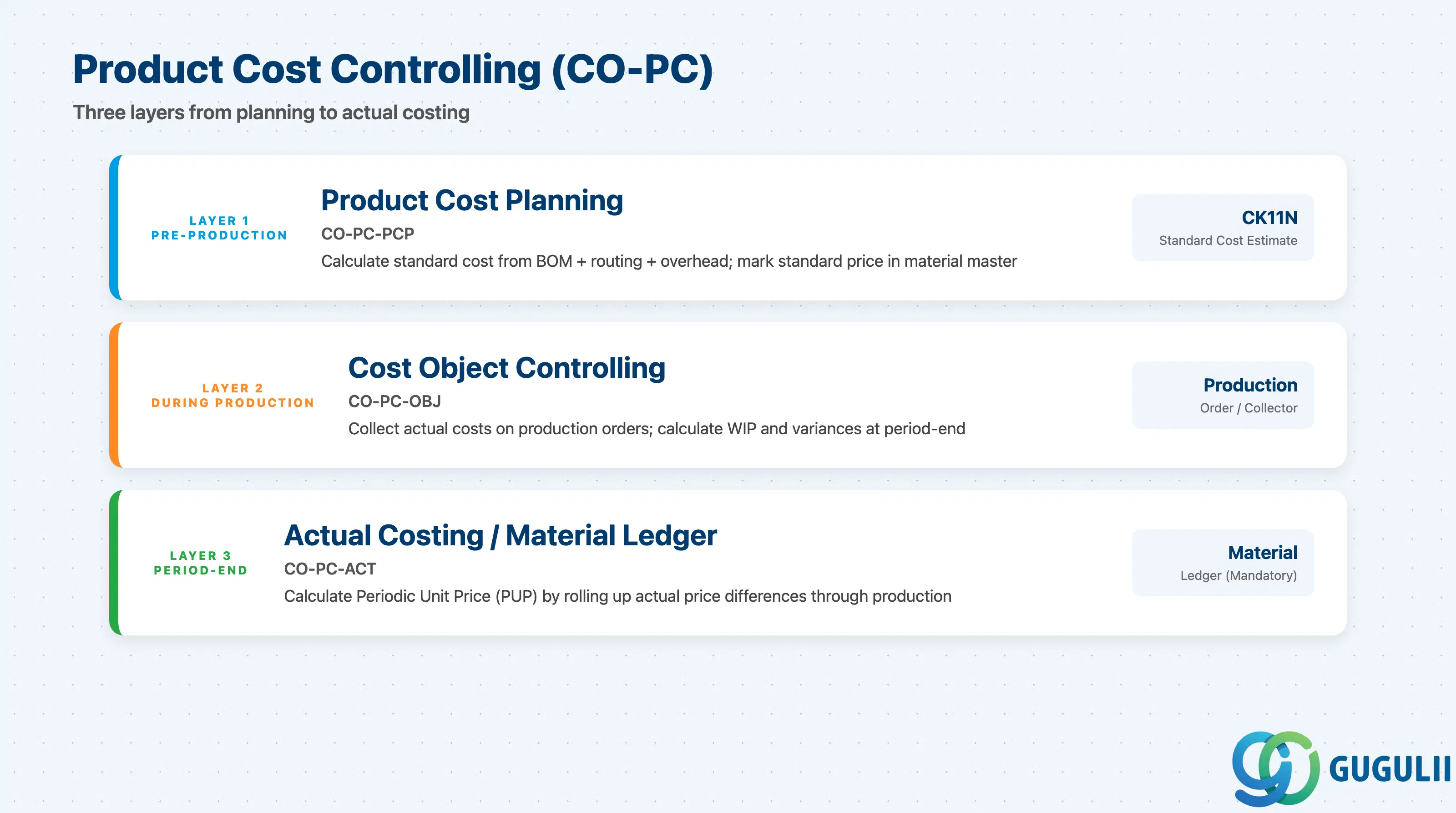
Product Cost Controlling answers the central manufacturing question: what does it cost to produce one unit of a finished good? It operates in three layers.
| Layer | Component | Primary Function |
|---|---|---|
| Pre-production planning | Product Cost Planning (CO-PC-PCP) | Calculate standard cost from BOM + routing + overhead rates; store result as standard price in material master |
| During production | Cost Object Controlling (CO-PC-OBJ) | Collect actual costs on production orders, process orders, or product cost collectors during the production run |
| Period-end valuation | Actual Costing / Material Ledger (CO-PC-ACT) | Calculate Periodic Unit Price (PUP) by rolling up actual price differences through the production structure |
The Standard Cost Estimate (transaction CK11N) is the linchpin of CO-PC. It calculates a multi-level cost rollup—raw materials at their standard price, labor at the planned activity rate, overhead applied via costing sheets—and marks the result as the standard price on the material master. This standard price becomes the reference for inventory valuation and the baseline against which actual production variances are measured.
Material Ledger is mandatory in SAP S/4HANA. Actual Costing—the calculation of the Periodic Unit Price—remains optional, but organizations that require inventory valuation at actual cost (common in process industries and regulated environments) must activate it.
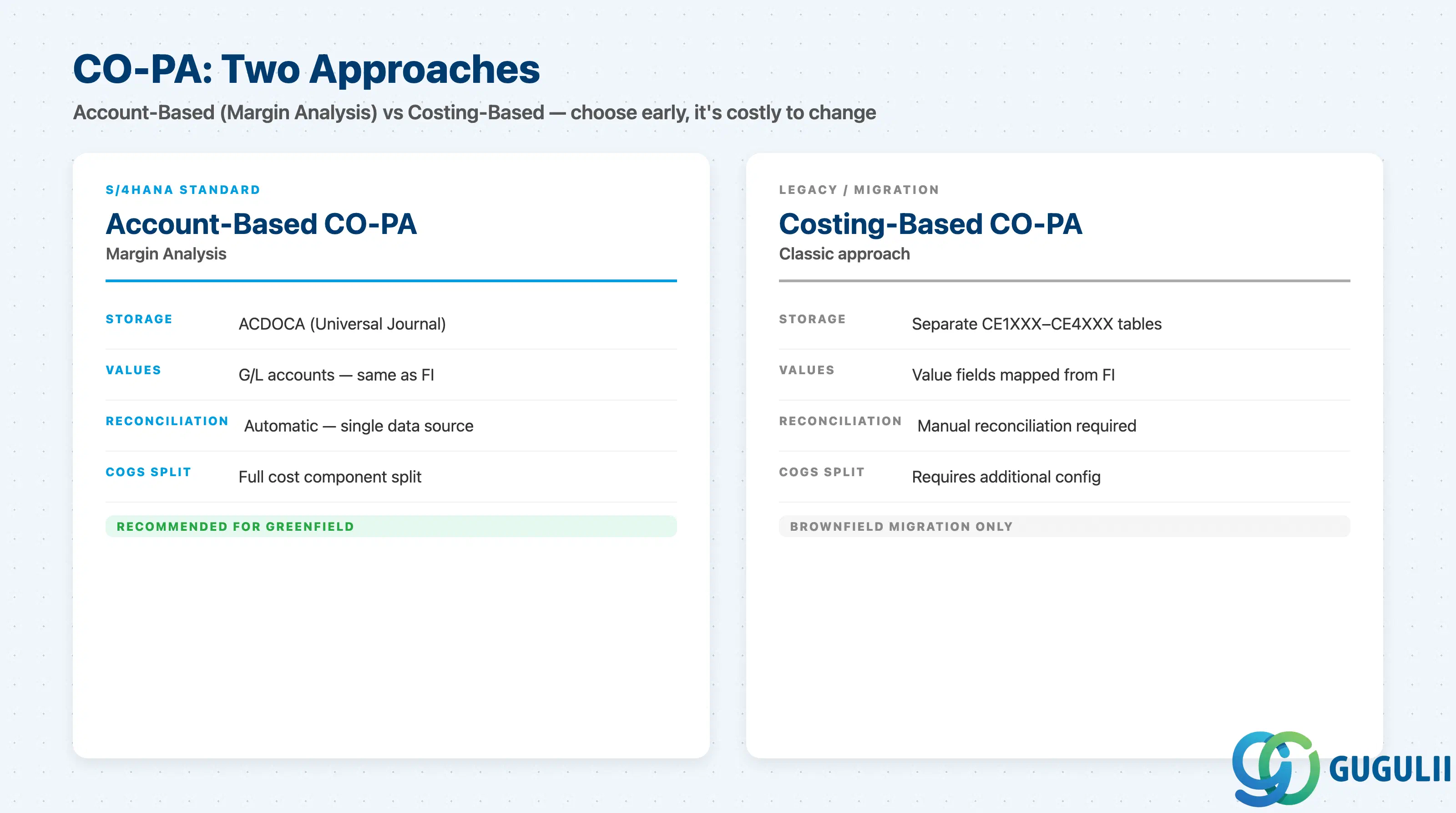
Profitability Analysis provides multidimensional revenue and cost analysis by market segment. A profitability segment is a combination of characteristics such as customer, product, region, distribution channel, and sales organization. CO-PA answers questions like: which product line generated the highest contribution margin last quarter? Which customer segment is unprofitable after accounting for logistics costs?
| Dimension | Account-Based CO-PA (Margin Analysis) | Costing-Based CO-PA |
|---|---|---|
| Data storage | ACDOCA (Universal Journal) | Separate tables CE1XXX–CE4XXX |
| Value representation | G/L accounts | Value fields mapped from FI accounts |
| Reconciliation with G/L | Automatic (same data source) | Manual reconciliation required |
| S/4HANA recommendation | Standard (greenfield: activate only this type) | Legacy support; run in parallel during brownfield migration |
| COGS split visibility | Full cost component split | Requires additional configuration |
For greenfield SAP S/4HANA implementations, SAP recommends activating account-based CO-PA exclusively. The Operating Concern—the highest organizational unit in CO-PA—defines which characteristics are captured and must be designed early because it determines the boundaries of segment-level reporting.
Profit Center Accounting provides a single-dimensional internal P&L view: revenues and costs grouped by profit center. While CO-PA enables multidimensional analysis across any combination of market characteristics, PCA focuses on the organizational dimension—product lines, geographies, business divisions—making it the primary tool for internal segment reporting and transfer pricing.
| Key Object | Purpose |
|---|---|
| Profit Center | Internal business segment (product line, geography, function) |
| Standard Hierarchy | Mandatory tree grouping all profit centers; used for roll-up reporting |
| Profit Center Assignment | Link to cost centers, materials, orders, WBS elements, sales orders |
| Document Splitting | FI feature that extends profit center assignment to balance sheet items |
In S/4HANA, PCA is fully integrated in ACDOCA. The legacy EC-PCA tables (GLPCA, GLPCO, GLPCP) are replaced by ACDOCA-based views. Profit center derivation occurs automatically from the real CO account assignment object (cost center → cost center’s assigned profit center; production order → production order’s profit center) without any separate posting run.
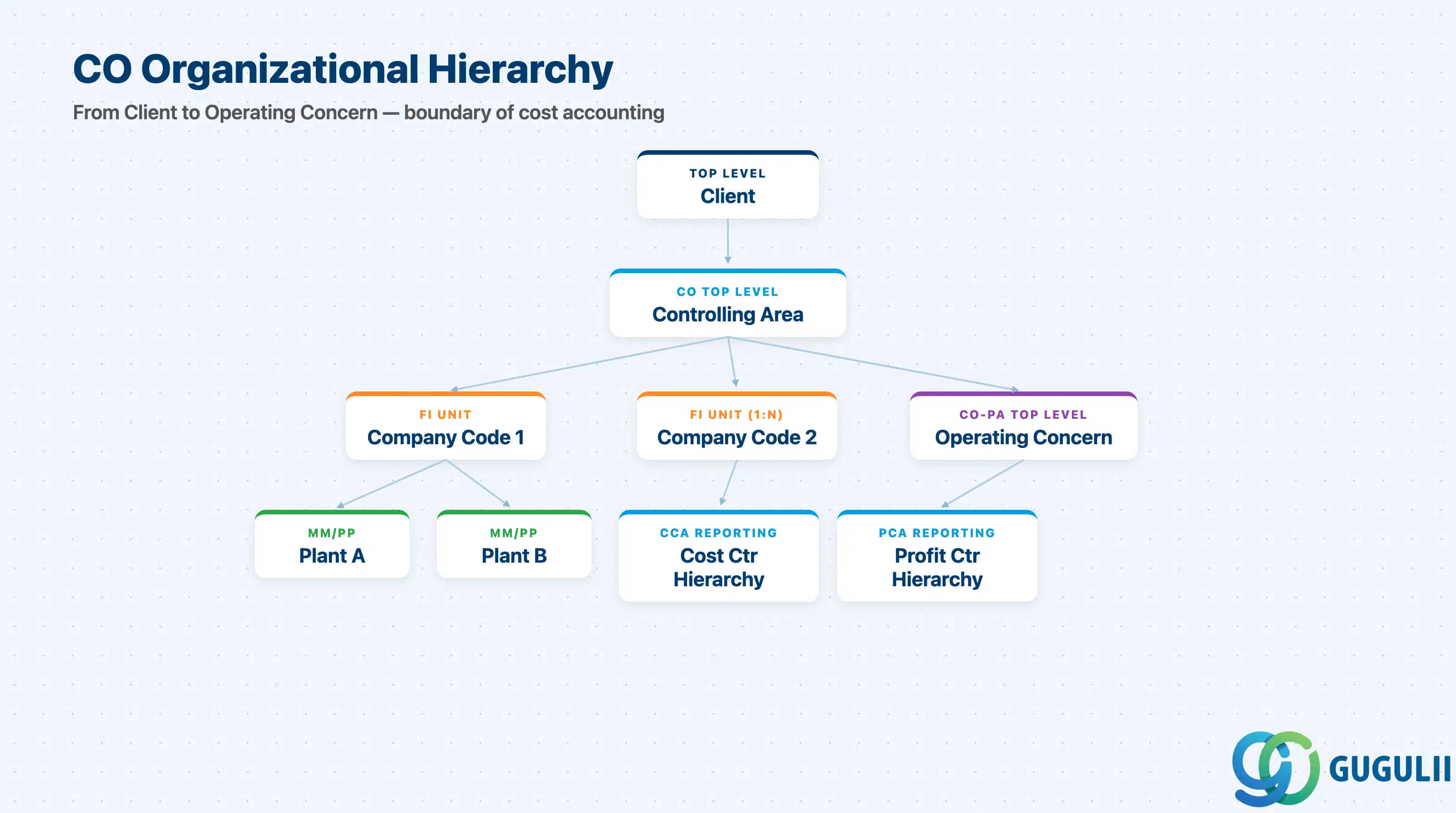
The Controlling Area (COAr) is the central organizational unit in SAP CO. It defines the boundaries of cost accounting: all cost centers, profit centers, internal orders, and CO-PA operating concerns belong to exactly one Controlling Area.
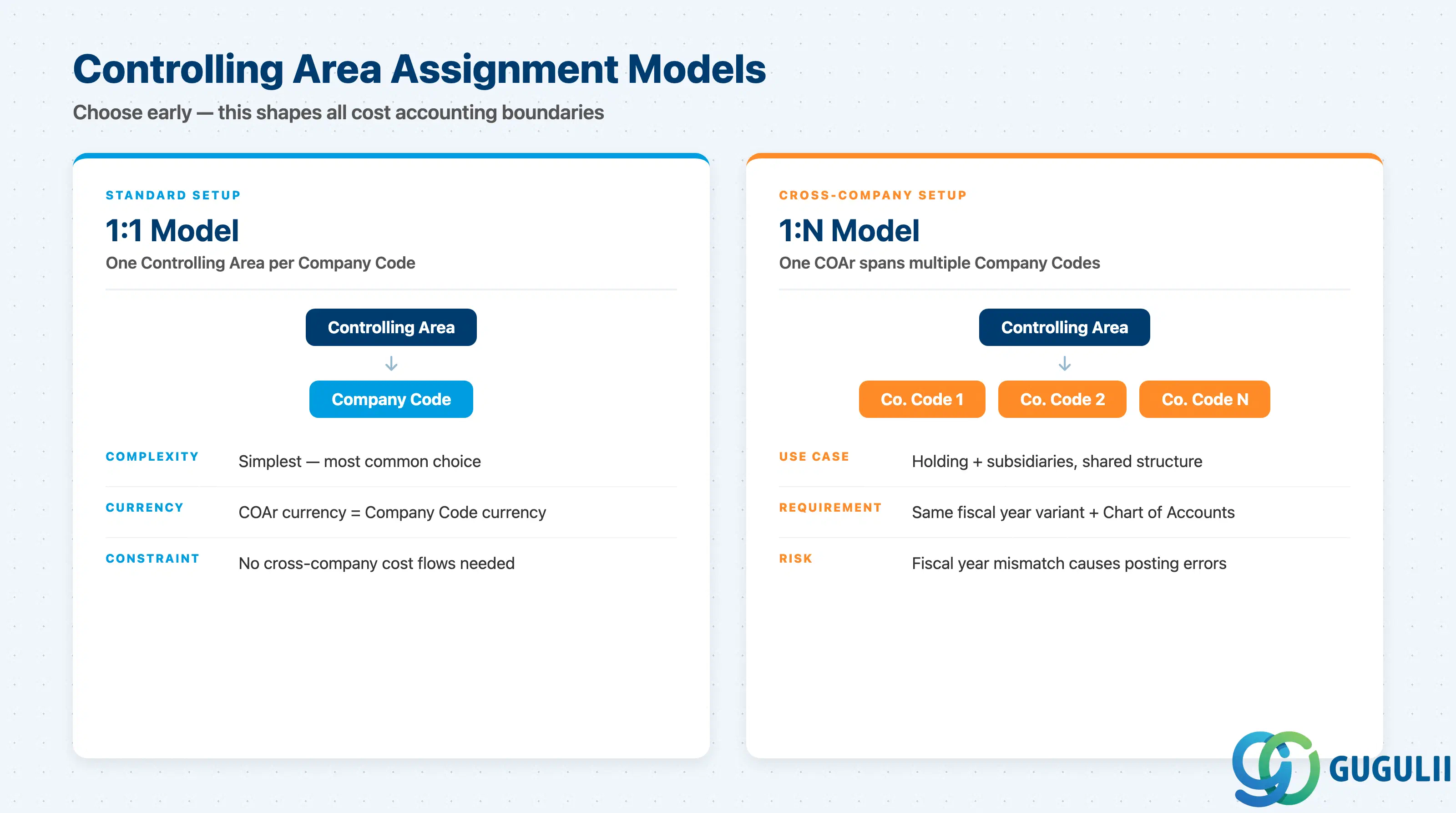
Two assignment models exist, and the choice is one of the most consequential configuration decisions in a CO implementation.
| Model | Description | Key Constraint |
|---|---|---|
| 1:1 (Standard) | One Controlling Area per Company Code | Simplest setup; Controlling Area currency equals Company Code currency |
| 1:N (Cross-Company-Code) | One Controlling Area spans multiple Company Codes | All assigned Company Codes must share the same fiscal year variant and the same operational Chart of Accounts |
The 1:N model is common in organizations with multiple legal entities that share a single management accounting structure—for example, a holding company with regional subsidiaries that use the same product hierarchy and cost center structure. The mandatory alignment of fiscal year variant and Chart of Accounts means that a Company Code with a non-calendar fiscal year cannot be assigned to a Controlling Area that uses a calendar year variant.
Client
└── Controlling Area (CO highest unit)
    ├── Company Code 1 (FI highest unit)
    │   ├── Plant
    │   └── Plant
    ├── Company Code 2  [1:N model only]
    ├── Standard Hierarchy (Cost Centers)
    ├── Standard Hierarchy (Profit Centers)
└── Operating Concern (CO-PA highest unit)Design checkpoint: Confirm fiscal year variant alignment across all Company Codes before finalizing Controlling Area scope. In S/4HANA, a mismatch between the Controlling Area fiscal year variant and an assigned Company Code’s fiscal year variant causes document posting errors that cannot be corrected after go-live without re-configuration.
Additional organizational units within CO:
| Organizational Unit | Level | Purpose |
|---|---|---|
| Controlling Area | CO top level | Cost accounting boundary; spans one or more Company Codes |
| Operating Concern | CO-PA top level | Defines profitability segment dimensions; assigned to Controlling Area |
| Cost Center Standard Hierarchy | CO reporting structure | Groups all cost centers for allocation and reporting |
| Profit Center Standard Hierarchy | PCA reporting structure | Groups all profit centers for internal P&L roll-up |
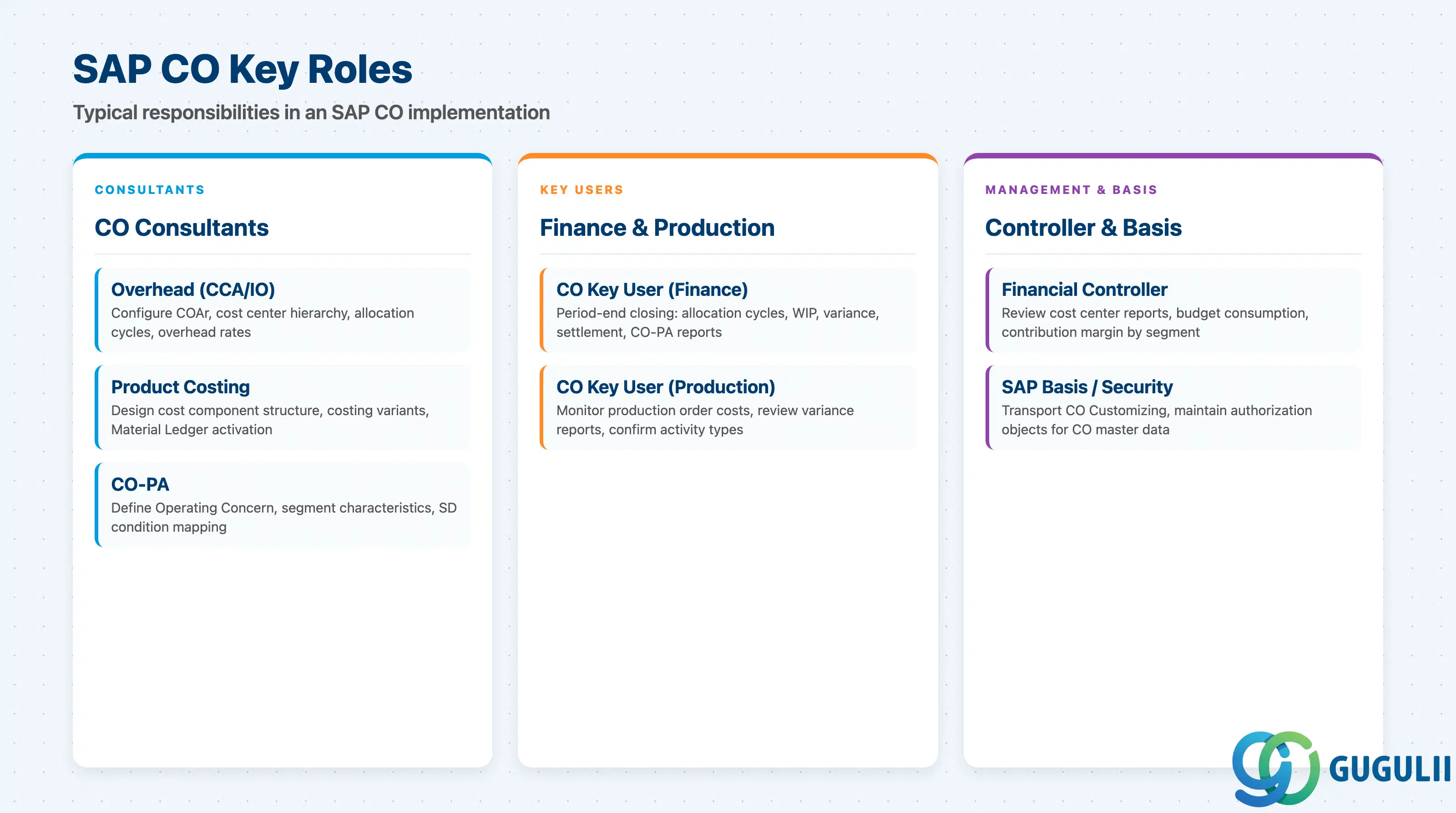
The following roles represent typical functional responsibilities in an SAP CO implementation. In practice, role boundaries overlap significantly in smaller organizations.
| Role | Primary Activities |
|---|---|
| CO Consultant (Overhead) | Configure Controlling Area, cost center hierarchy, activity types, allocation cycles (CCA and IO); define overhead rates in costing sheets |
| CO Consultant (Product Costing) | Design cost component structure, costing variants, and standard cost estimate process (CO-PC-PCP); configure WIP, variance, and settlement (CO-PC-OBJ); activate and configure Material Ledger |
| CO Consultant (CO-PA / Margin Analysis) | Define Operating Concern, profitability segment characteristics, SD condition type mapping, assessment cycles to CO-PA |
| CO Key User (Finance) | Execute period-end closing steps: run allocation cycles, calculate WIP, run variance calculation, execute settlement runs, review CO-PA reports |
| CO Key User (Production) | Monitor production order costs; review variance reports; confirm activity types in PP–CO integration |
| Financial Controller | Review cost center reports, internal orders budget consumption, and contribution margin by profit center and profitability segment |
| SAP Basis / Security | Transport CO Customizing; maintain authorization objects for CO master data and reporting (cost center, controlling area, profit center authorizations) |
SAP Controlling is the management accounting backbone of SAP S/4HANA. Its five sub-modules—Cost Center Accounting, Internal Orders, Product Cost Controlling, Profitability Analysis, and Profit Center Accounting—address the full spectrum of internal cost and revenue management, from individual cost responsibility areas up to multidimensional market segment analysis.
In S/4HANA, the Universal Journal fundamentally changes the technical architecture of CO. The boundary between statutory and management accounting disappears at the data layer: every posting is simultaneously a financial document and a controlling document, stored in ACDOCA with all the attributes both disciplines require. This eliminates reconciliation overhead, accelerates period close, and makes real-time management reporting a practical reality rather than a project in itself.
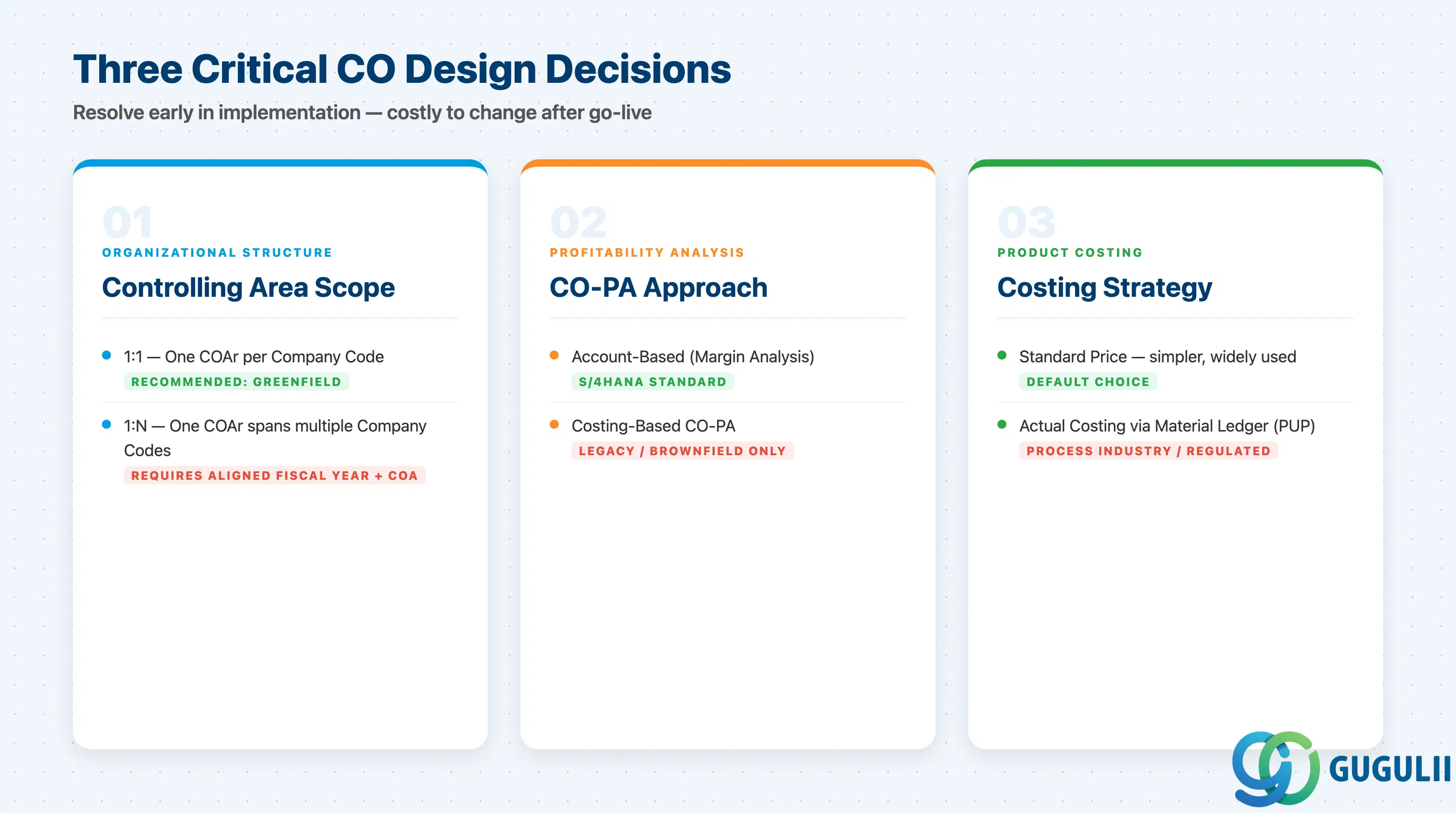
For consultants and key users entering a requirements definition phase, three decisions set the trajectory for the entire CO design: the scope of the Controlling Area (which Company Codes share a single management accounting structure), the CO-PA approach (account-based Margin Analysis, which is the S/4HANA standard, vs costing-based for migration scenarios), and the product costing strategy (standard price control and whether actual costing via Material Ledger’s Periodic Unit Price is needed). Getting these three right early prevents costly redesign later.
The next article in this series covers how CO connects to the wider S/4HANA business process landscape—specifically how the financial closing process orchestrates CO settlement, how SD billing flows data into Margin Analysis, and how PP production confirmations tie activity costs back to standard cost estimates.
| ID | Category | Title |
|---|---|---|
| co-001 | Overview | What is SAP CO? 📍 |
| ID | Category | Title |
|---|---|---|
| co-a01 | Overview | SAP CO Master Data: Overview, Hierarchy & Relationships |
| co-a02-01 | Master Data | SAP CO Material Master |
| co-a03-01 | Master Data | SAP CO Cost Element |
| co-a03-02 | Master Data | SAP CO Cost Element Group |
| co-a04-01 | Master Data | SAP CO Profit Center Group |
| co-a04-02 | Master Data | SAP CO Profit Center |
| co-a05-01 | Master Data | SAP CO Cost Center Group |
| co-a05-02 | Master Data | SAP CO Cost Center |
| co-a05-03 | Master Data | SAP CO Activity Type Group |
| co-a05-04 | Master Data | SAP CO Activity Type |
| co-a05-05 | Master Data | SAP CO Statistical Key Figure |
| co-a06-01 | Master Data | SAP CO Internal Order Group |
| co-a06-02 | Master Data | SAP CO Internal Order |
| co-a07-01 | Master Data | SAP CO Cost Component Structure |
| co-a07-02 | Master Data | SAP CO Costing Variant |
| co-a08-01 | Master Data | SAP CO Operating Concern |
| ID | Category | Title |
|---|---|---|
| co-b01 | Overview | SAP CO Transactions: Process Flow, Hierarchy & Relationships |