Title here
Summary here
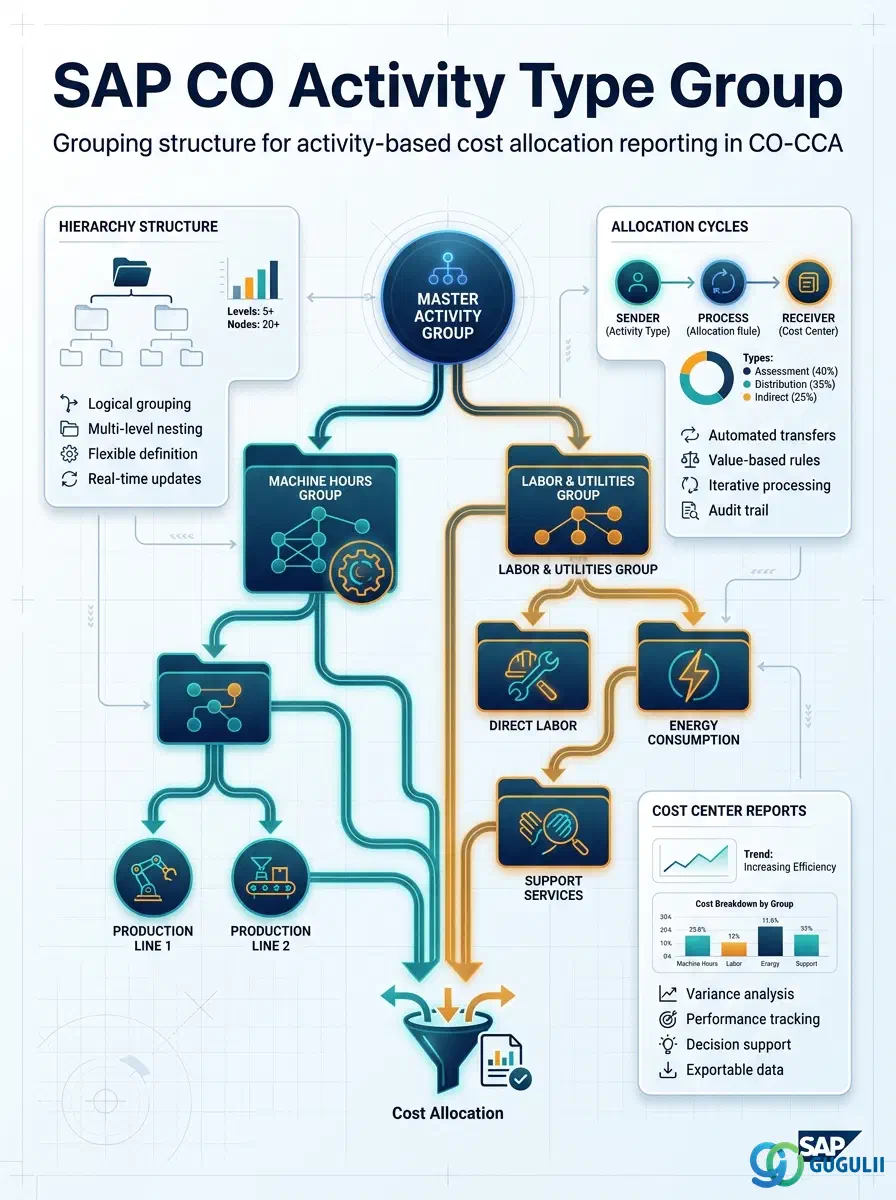
The Activity Type Group is the hierarchical grouping structure that organizes Activity Types for reporting and allocation cycle definitions in SAP Controlling. Activity Types represent the services a Cost Center provides — machine hours, labor hours, kilowatt-hours, setups — and the Activity Type Group organizes these types into logical categories for management reporting, planning, and cycle sender definitions. A well-designed Activity Type Group hierarchy makes activity-based cost allocation reports readable and simplifies period-end cycle configuration.
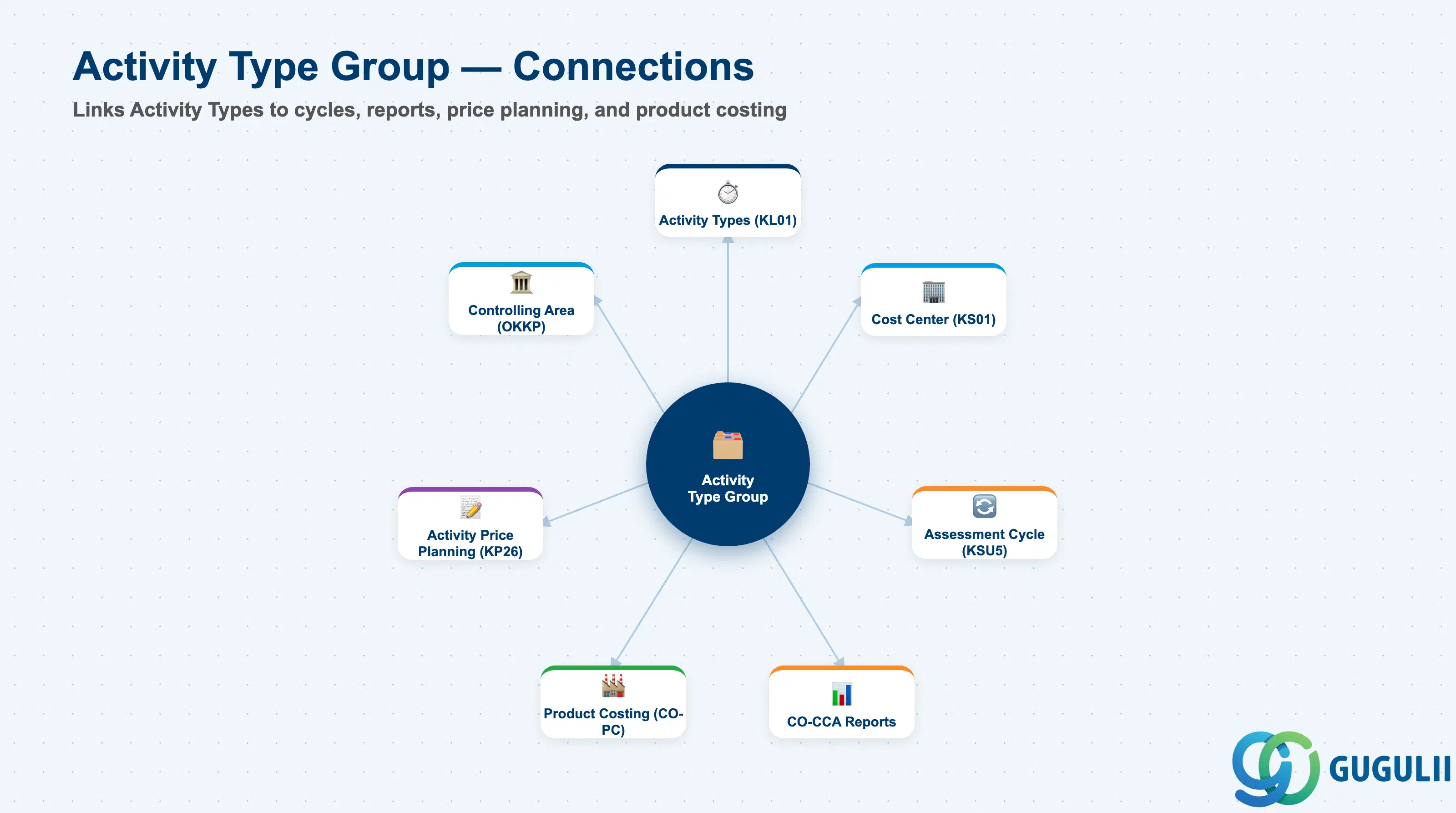
The Activity Type Group is a set object in SAP CO that aggregates Activity Types under a shared label. Like Cost Element Groups and Cost Center Groups, it uses the SETHEADER/SETLEAF/SETNODE framework. Activity Type Groups are used primarily in CO-CCA reports (to show planned and actual activity quantities by category), in activity price planning (bulk price entry by group), and in allocation cycle definitions.
| Aspect | Details |
|---|---|
| Role | Groups Activity Types for report summarization, allocation cycle sender definitions, and activity price planning at category level |
| Modules using it | CO-CCA (activity reports and cycles), CO-PC (product costing — activity rates per group), HR (labor activity type reporting for personnel cost analysis) |
| Transactions | KLH1 (Create Group), KLH2 (Change), KLH3 (Display) |
| Key Tables | SETHEADER (Group header), SETLEAF (Activity Type assignments), SETNODE (Sub-group references) |
| S/4HANA note | Activity Type Group structure and transactions are unchanged from ECC. Groups are used in the same way in S/4HANA. In S/4HANA, the primary use of Activity Type Groups is in Fiori app reporting for activity-based cost analysis. |
| Structure Type | Description | Use Case | Key Behavior |
|---|---|---|---|
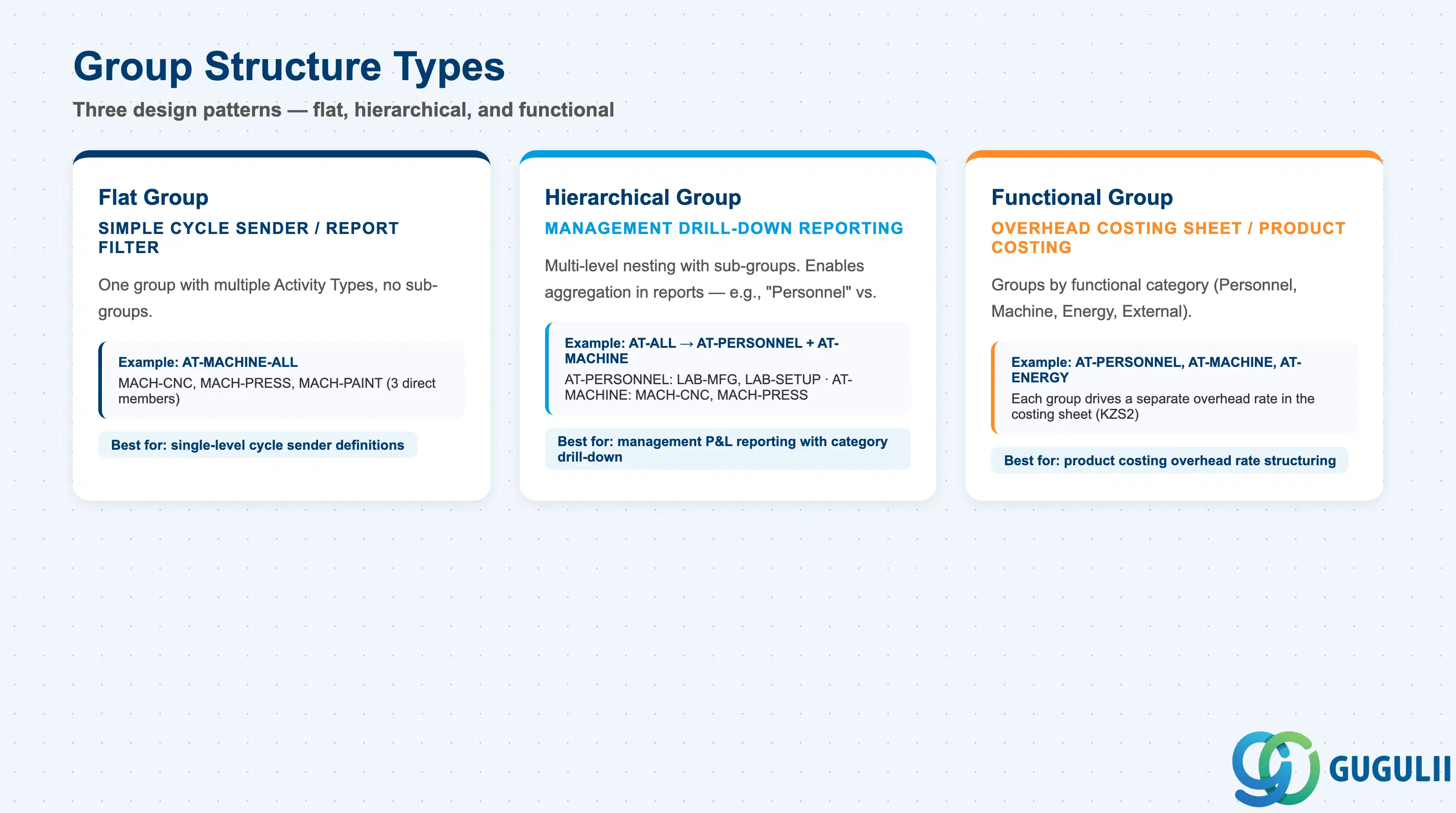
| Flat Group | One group with multiple Activity Types, no sub-groups | Simple cycle sender definition (e.g., “All Machine Activity Types”), quick report filter | Easy to maintain; no summarization levels |
| Hierarchical Group | Multi-level nesting with sub-groups | Management report showing “Personnel Activities” vs. “Machine Activities” with drill-down | Enables aggregation in reports; requires more upfront design |
| Functional Group | Groups Activity Types by functional category (Personnel, Machine, Energy, External) | Overhead costing sheet with rates by activity category | Standard design for product costing overhead calculation |
Design principle: Keep Activity Type Groups simple. Unlike Cost Center Groups (which have a mandatory Standard Hierarchy), Activity Type Groups are entirely optional — create only what is needed for specific reporting or cycle requirements. Over-engineering the Activity Type Group hierarchy creates maintenance burden without proportional reporting benefit.
Activity Type Group is scoped at the Controlling Area level, consistent with the Activity Types it groups.
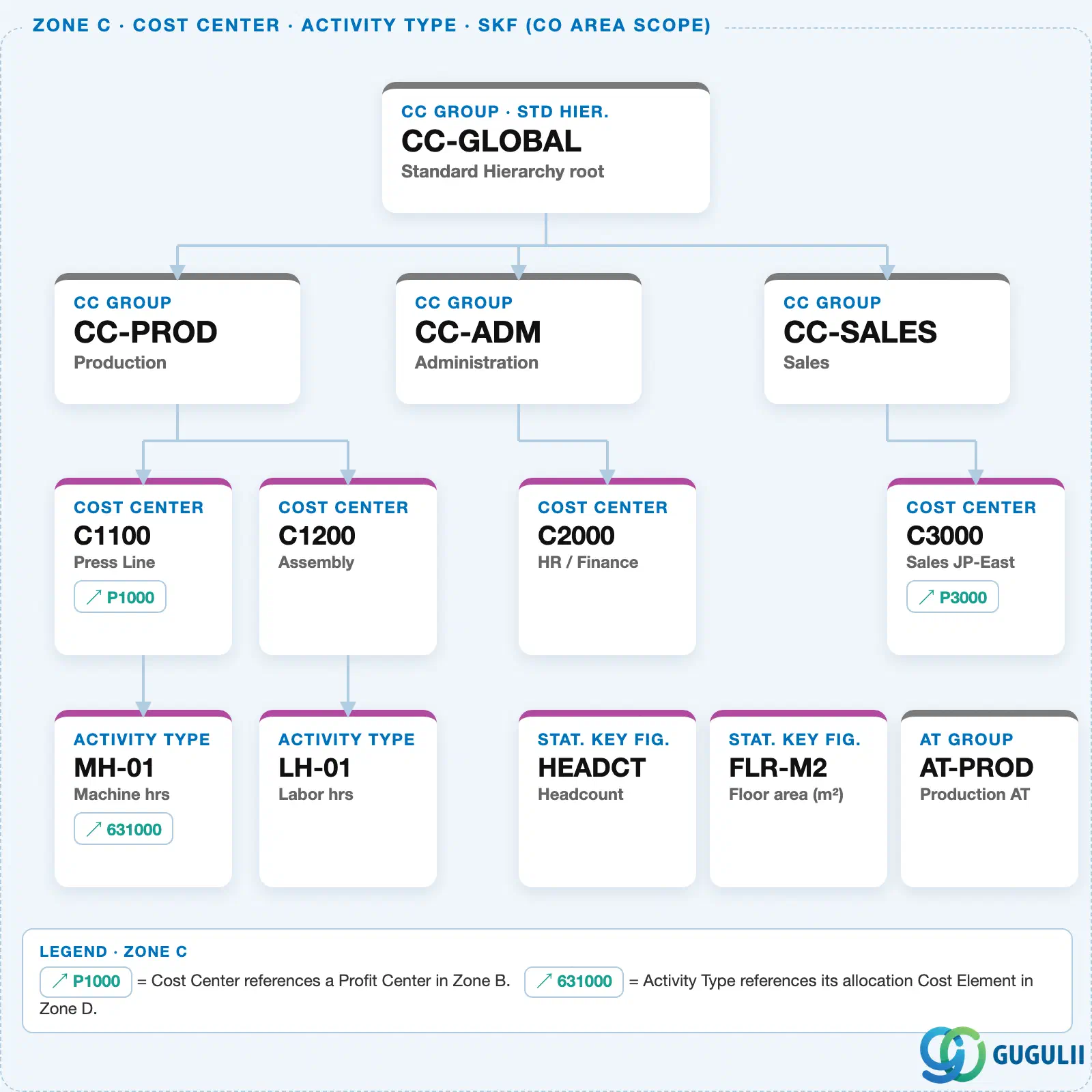
Data hierarchy with a concrete example
Controlling Area 1000
   │
   ├── AT Group "AT-PROD"          Production AT
   │
   └── Cost Center "C1100"         Press Line
          ├── Activity Type "MH-01"   Machine hrs
          └── Activity Type "LH-01"   Labor hrs
Design principle: Activity Type Groups aren’t mandatory — only create them when you need group-level reporting or a cycle sender/receiver definition spanning multiple Activity Types. For implementations with fewer than 20 Activity Types total, selecting them individually in reports is often simpler than maintaining groups.
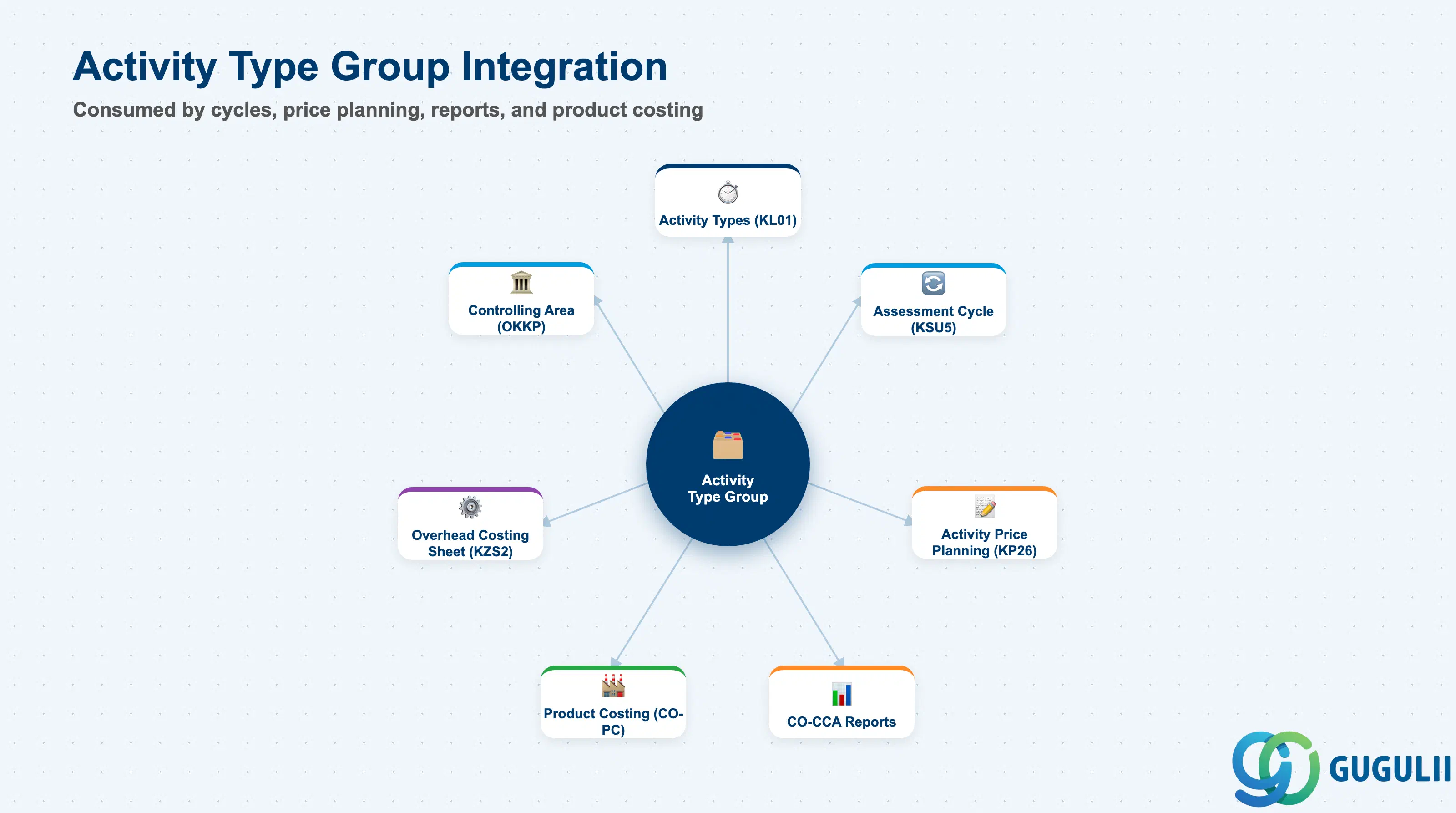
| Object | Relationship | Practical Notes |
|---|---|---|
| Activity Types (KL01) | Group contains Activity Type members | Each member must exist in the same Controlling Area. Groups do not validate that the Activity Types are all assigned to the same Cost Center — a group can span Activity Types from multiple Cost Centers. |
| Assessment Cycle (KSU5) | Activity Type Group as cycle sender definition | When an assessment cycle distributes costs by activity quantity, the Activity Type Group defines which types of activity are in scope for the cycle. |
| Activity Price Planning (KP26) | Planning at group level | Activity prices can be entered or reviewed at Activity Type Group level for budgeting summaries. Individual prices are still maintained per Activity Type per Cost Center. |
| Cost Center Reports | Activity Type Groups in report row structures | CO-CCA reports can use Activity Type Groups to structure the display of planned and actual activity quantities. |
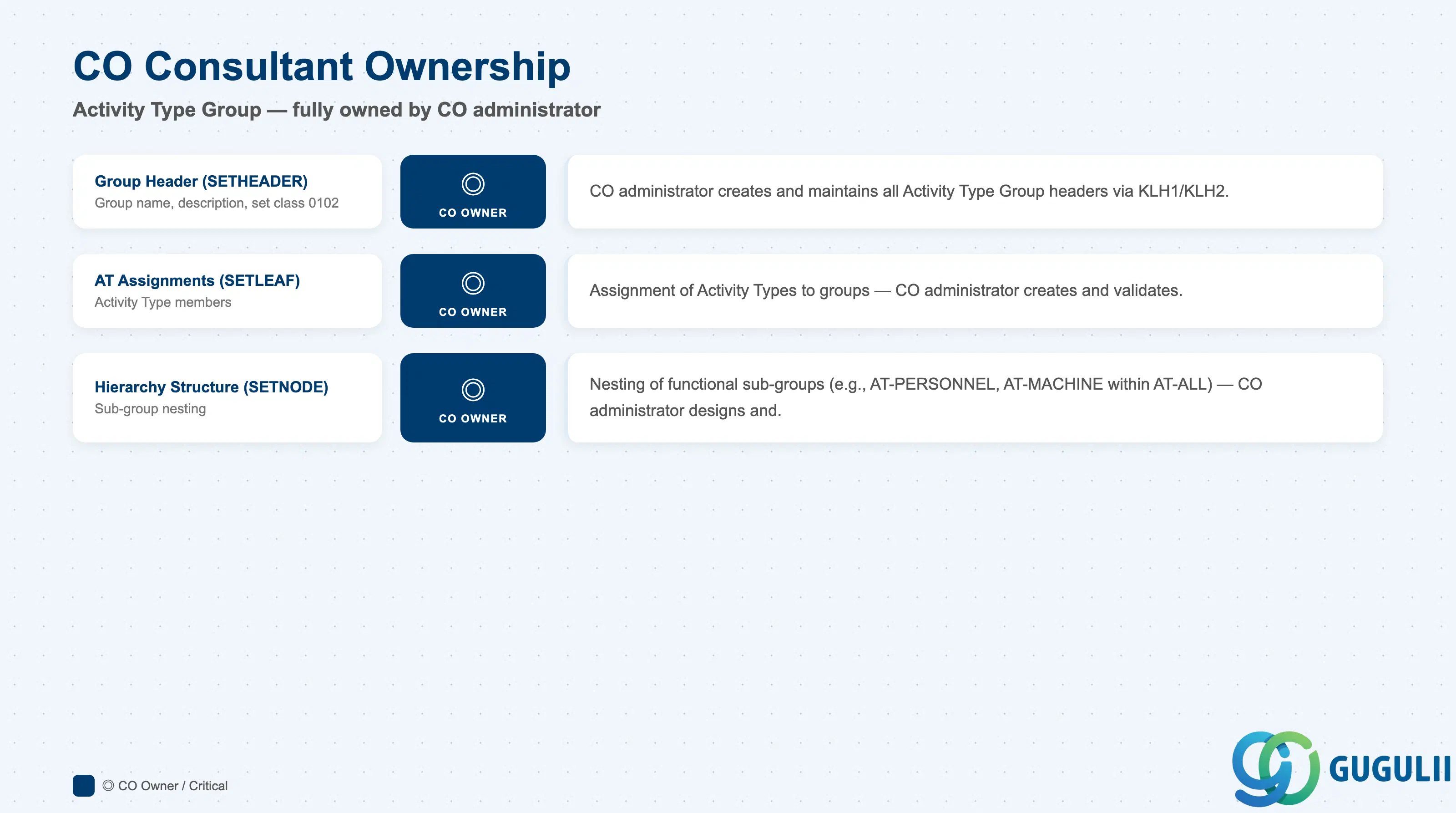
| Data Section | CO Involvement | Notes |
|---|---|---|
| Group Header (SETHEADER) | ◎ Owner | CO administrator creates and maintains all Activity Type Group headers |
| Activity Type Assignments (SETLEAF) | ◎ Owner | Assignment of Activity Types to groups — CO administrator |
| Hierarchy Structure (SETNODE) | ◎ Owner | Sub-group nesting — CO administrator |
Legend: ◎ = Owner / Critical, ○ = Direct involvement
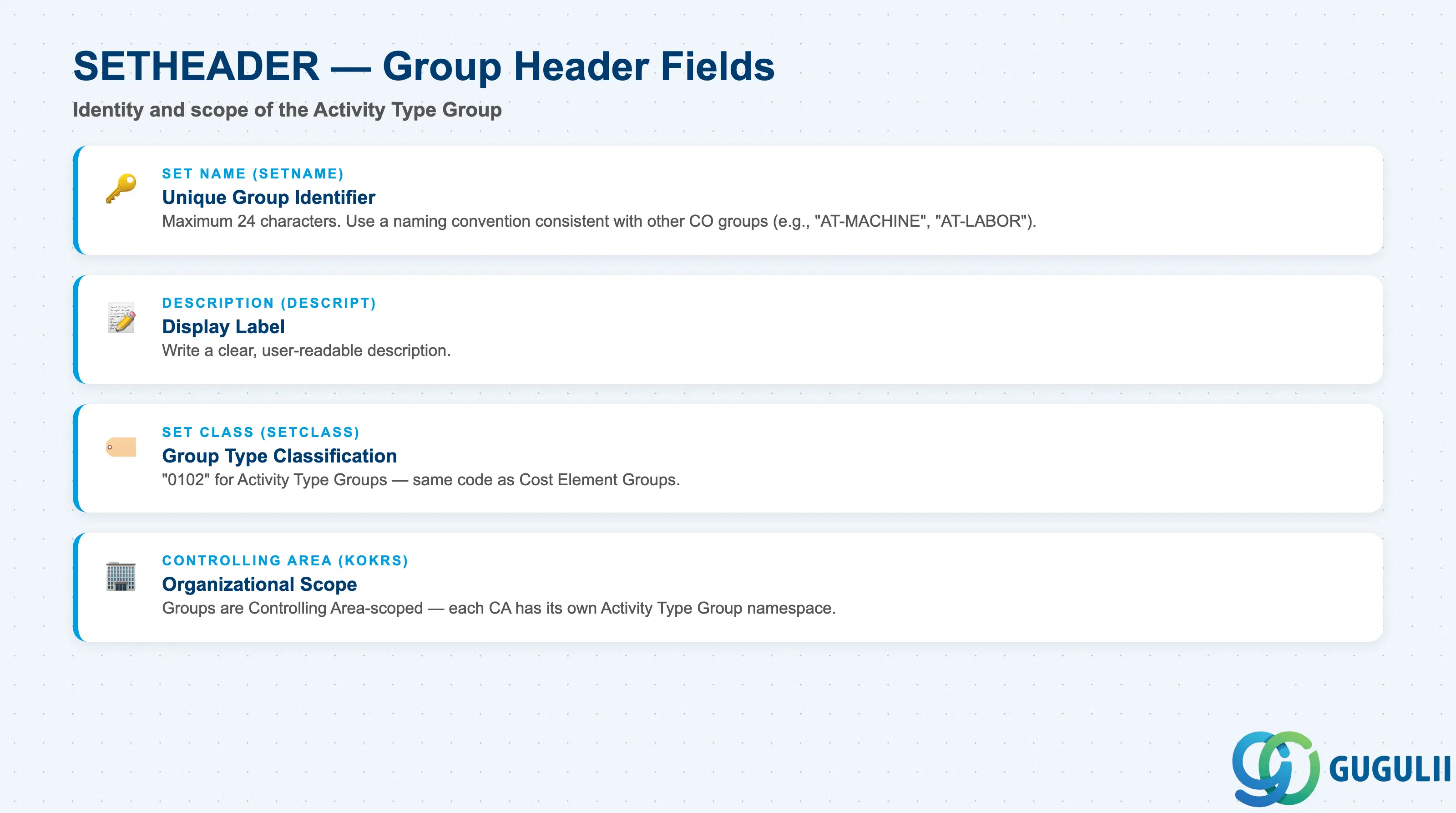
| Field | Description | Practical Usage |
|---|---|---|
| Set Name (SETNAME) | Unique identifier of the Activity Type Group | Maximum 24 characters. Use a naming convention consistent with other CO groups (e.g., “AT-MACHINE”, “AT-LABOR”). The set name is referenced in cycle definitions and report painter row structures — plan the name before creation and avoid changing it after live use. |
| Description (DESCRIPT) | Free-text description of the group | Write a clear, user-readable description. Include the scope (e.g., “All Machine Activity Types — CA 1000”). Visible in group selection dialogs for report filters and cycle configuration. |
| Set Class (SETCLASS) | Internal classification code | “0102” for Activity Type Groups (same as Cost Element Groups). The object type in the leaves distinguishes Activity Type Groups from Cost Element Groups. |
| Controlling Area (KOKRS) | Scoping Controlling Area | Groups are Controlling Area-scoped. Each CA has its own Activity Type Group namespace. |
| Field | Description | Practical Usage |
|---|---|---|
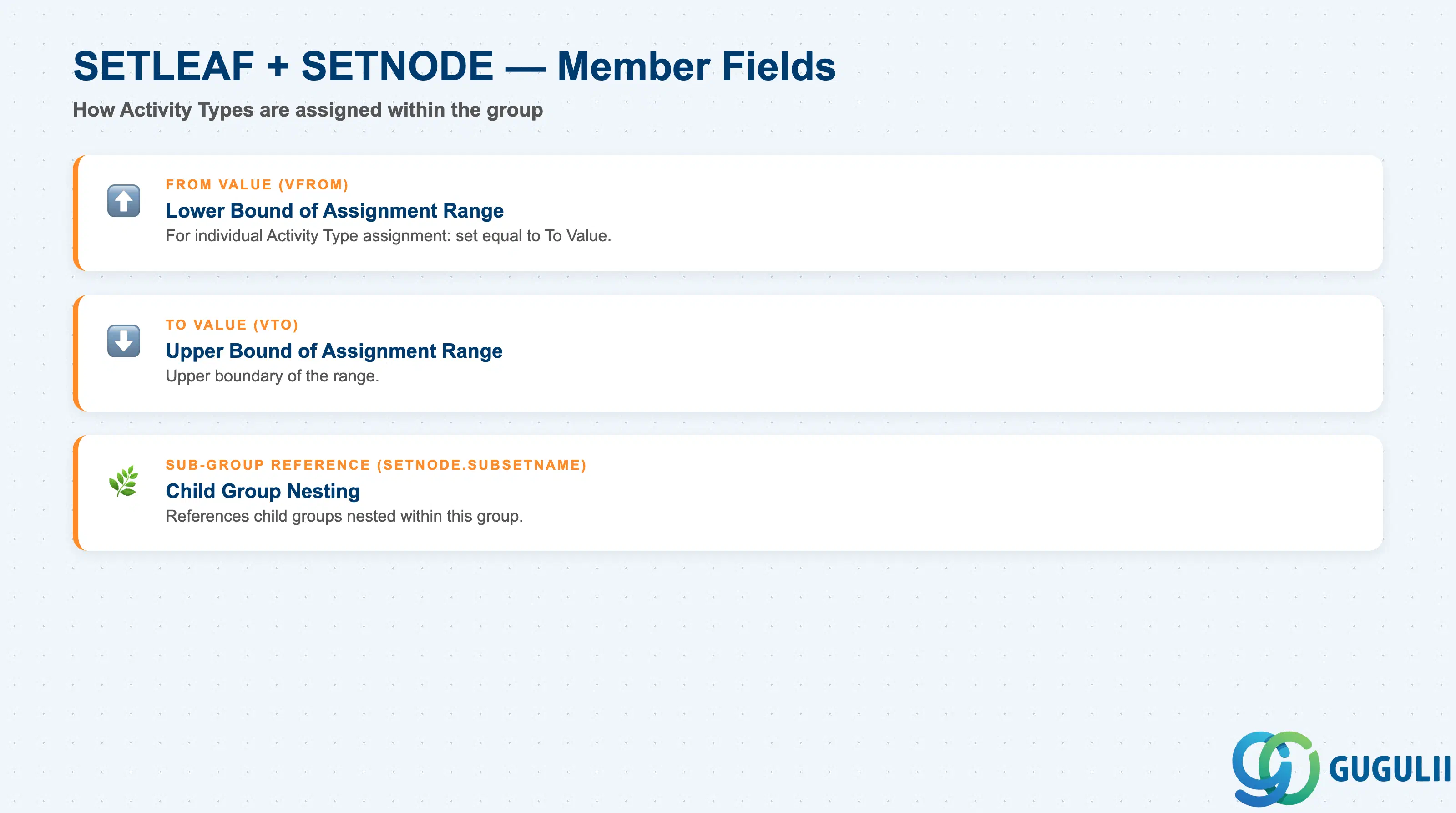
| From Value (VFROM) | Lower bound of Activity Type assignment | For individual Activity Type: same as To Value. For ranges: start of the Activity Type identifier range. Ranges are less common for Activity Types than for Cost Elements or Cost Centers — Activity Types tend to have descriptive alphanumeric identifiers rather than sequential numbers, making ranges impractical. |
| To Value (VTO) | Upper bound of Activity Type assignment | Upper boundary. If the Activity Type identifiers are alphanumeric (e.g., “LAB-MFG”), individual assignments are almost always used rather than ranges. |
| Sub-Group Reference | Child group nested in this group | Enables hierarchical structure. Use when grouping at two levels (e.g., “AT-ALL” containing “AT-PERSONNEL” and “AT-MACHINE” as sub-groups). |
| ID | Category | Title |
|---|---|---|
| co-001 | Overview | What is SAP CO? |
| ID | Category | Title |
|---|---|---|
| co-a01 | Overview | SAP CO Master Data: Overview, Hierarchy & Relationships |
| co-a02-01 | Master Data | SAP CO Material Master |
| co-a03-01 | Master Data | SAP CO Cost Element |
| co-a03-02 | Master Data | SAP CO Cost Element Group |
| co-a04-01 | Master Data | SAP CO Profit Center Group |
| co-a04-02 | Master Data | SAP CO Profit Center |
| co-a05-01 | Master Data | SAP CO Cost Center Group |
| co-a05-02 | Master Data | SAP CO Cost Center |
| co-a05-03 | Master Data | SAP CO Activity Type Group 📍 |
| co-a05-04 | Master Data | SAP CO Activity Type |
| co-a05-05 | Master Data | SAP CO Statistical Key Figure |
| co-a06-01 | Master Data | SAP CO Internal Order Group |
| co-a06-02 | Master Data | SAP CO Internal Order |
| co-a07-01 | Master Data | SAP CO Cost Component Structure |
| co-a07-02 | Master Data | SAP CO Costing Variant |
| co-a08-01 | Master Data | SAP CO Operating Concern |
| ID | Category | Title |
|---|---|---|
| co-b01 | Overview | SAP CO Transactions: Process Flow, Hierarchy & Relationships |