Title here
Summary here

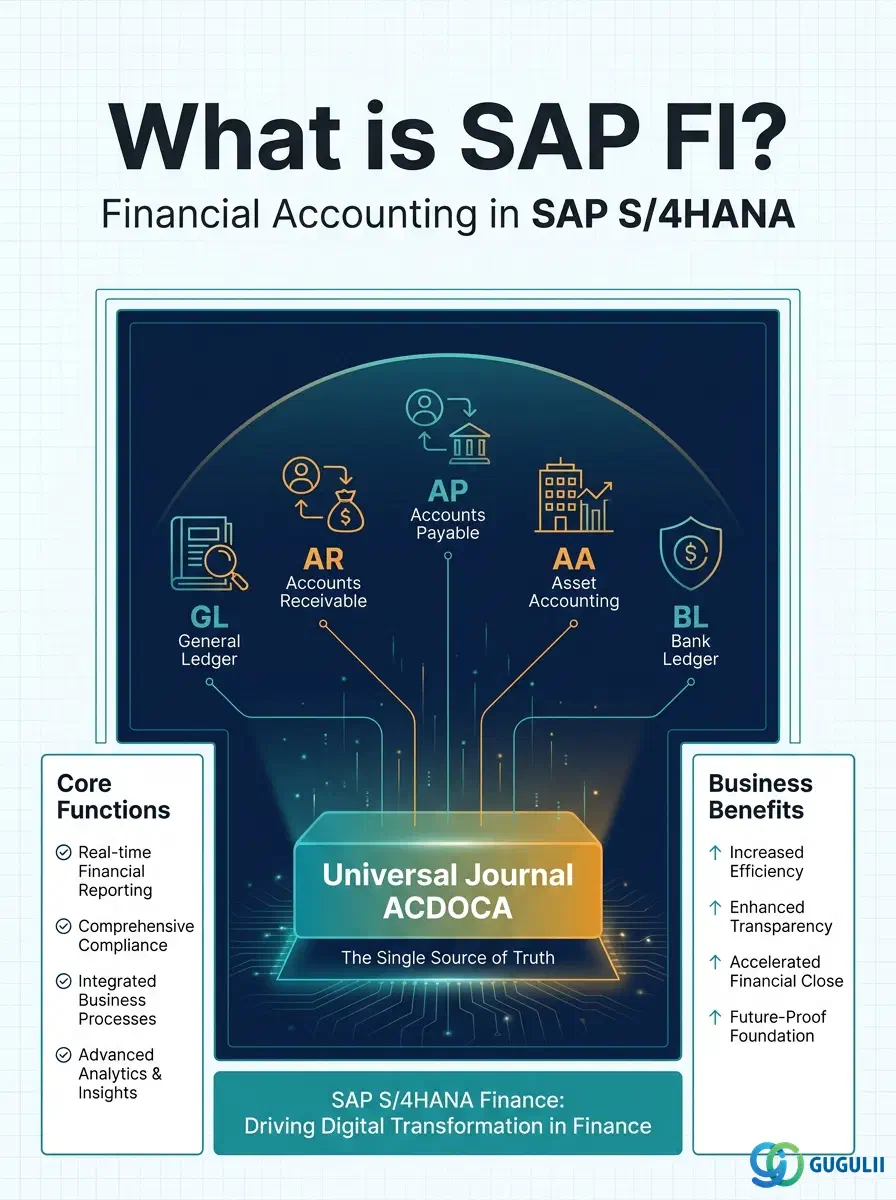
SAP FI (Financial Accounting) manages the recording and reporting of all financial transactions that must appear in legally required financial statements — the balance sheet, profit and loss statement, and supporting disclosures. Every goods movement in MM, every billing document in SD, and every payroll run in HR ultimately produces an FI posting that flows through to the books.
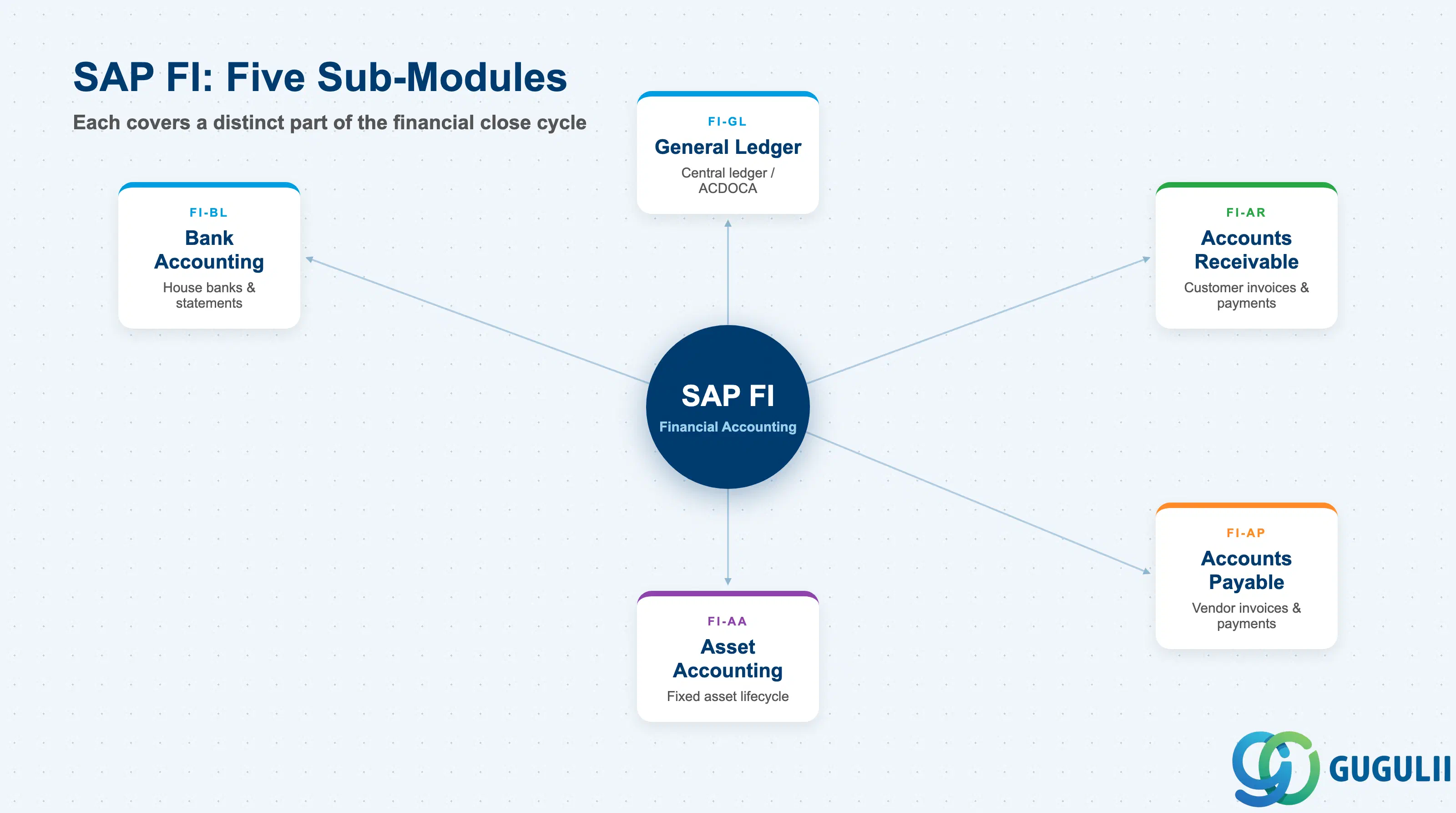
FI is organized into five functional sub-modules, each responsible for a distinct part of the financial close cycle.
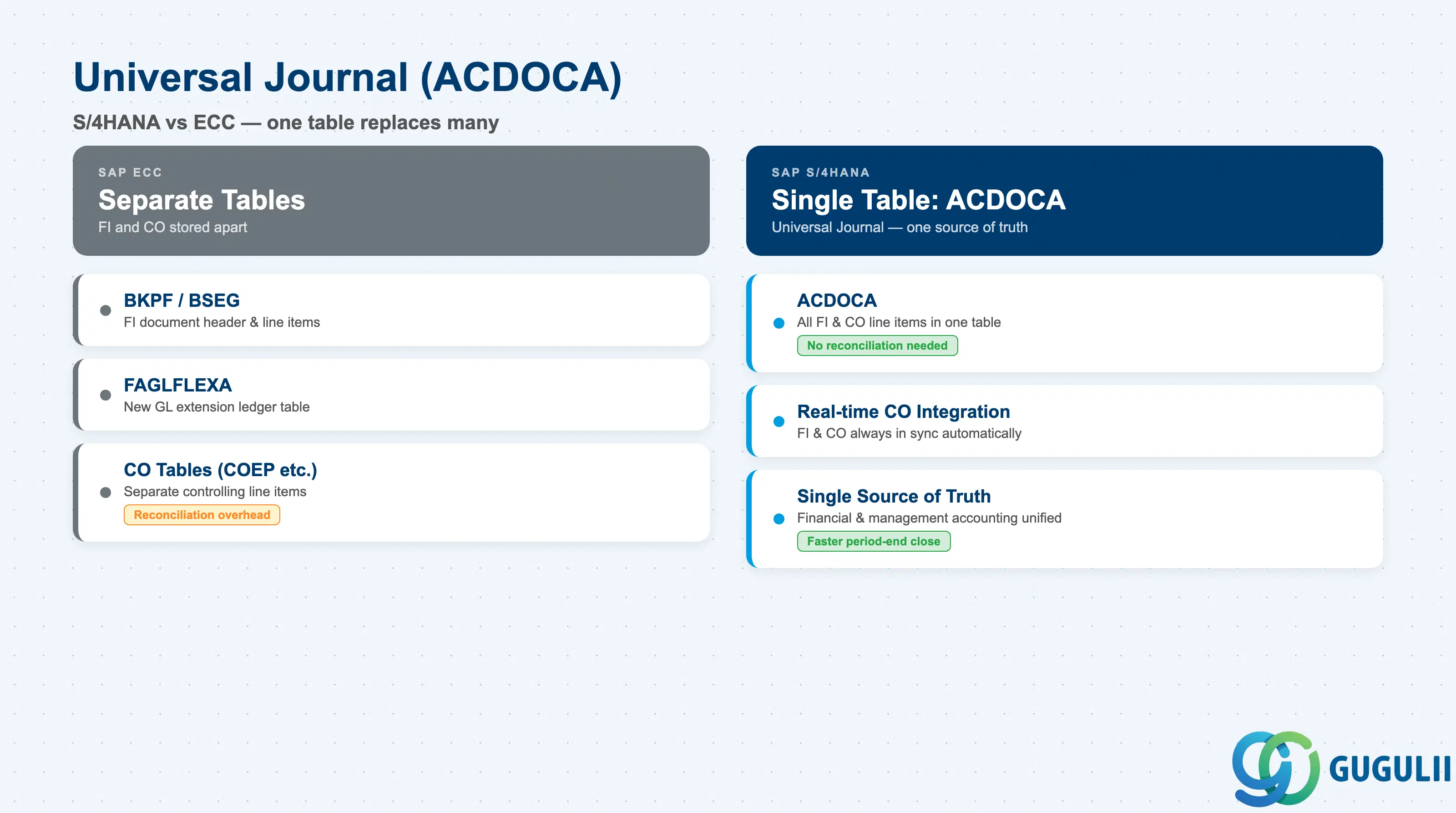
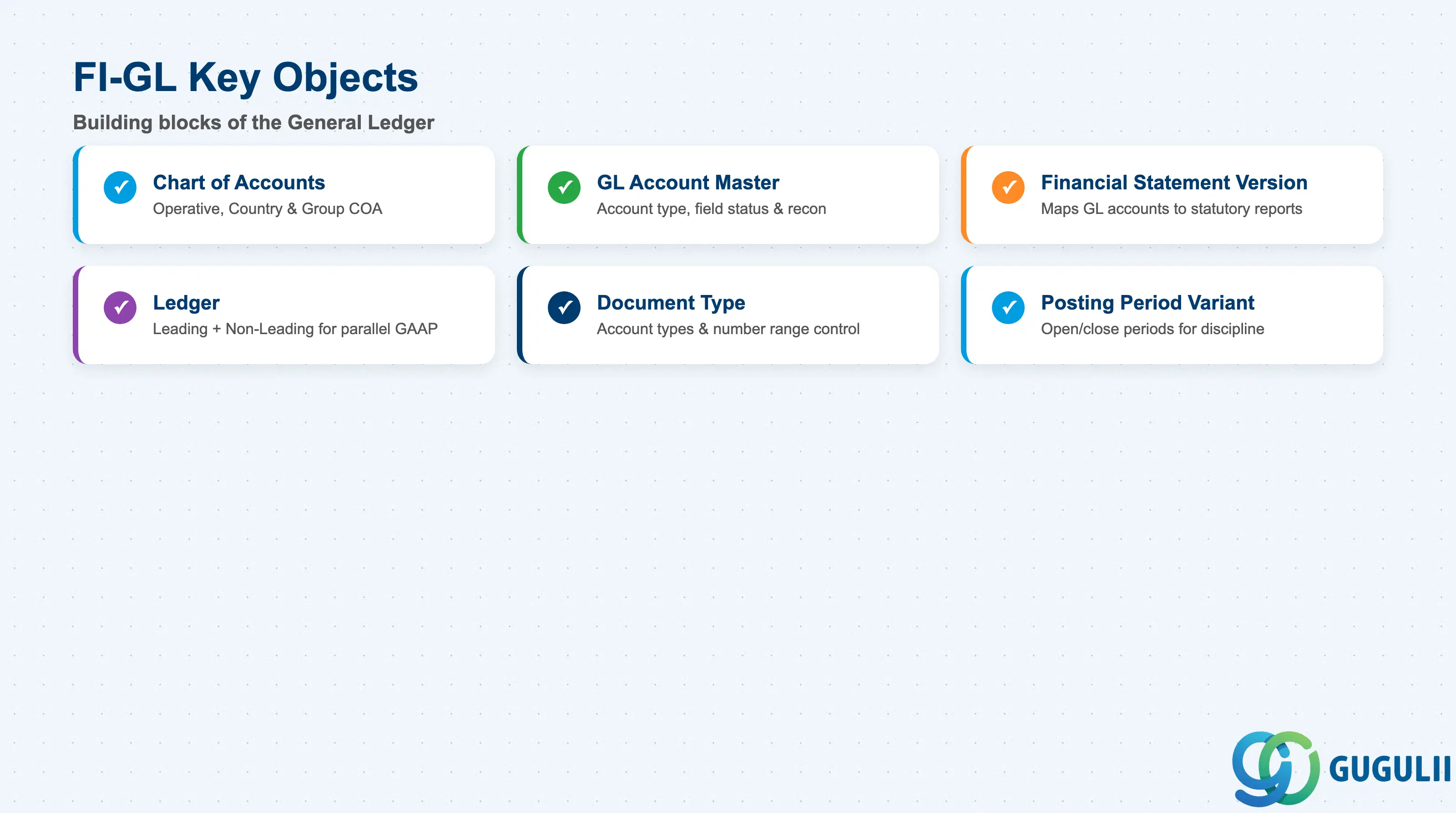
The General Ledger is the central ledger for all FI sub-ledgers. Every financial transaction — whether originated in AR, AP, Asset Accounting, or an integrated module — posts to the GL. In SAP S/4HANA, the Universal Journal (ACDOCA) replaces the separate ledger tables used in ECC (BKPF/BSEG, FAGLFLEXA), making FI-GL the single repository for all financial line items.
| Key Object | Description |
|---|---|
| Chart of Accounts (COA) | Master list of GL accounts used for daily postings (Operative COA), local legal requirements (Country COA), and group consolidation (Group COA) |
| GL Account Master | Individual account definition including account type (balance sheet / P&L), field status group, and reconciliation account assignment |
| Financial Statement Version (FSV) | Reporting structure that maps GL accounts to balance sheet and P&L line items for statutory reporting |
| Ledger | Leading Ledger (primary accounting standard) plus optional Non-Leading Ledgers for parallel accounting (e.g., IFRS + local GAAP) |
| Document Type | Controls which account types a document can post to and determines the number range for document numbering |
| Posting Period Variant | Controls which fiscal periods are open or closed for posting, enforcing period-end discipline |
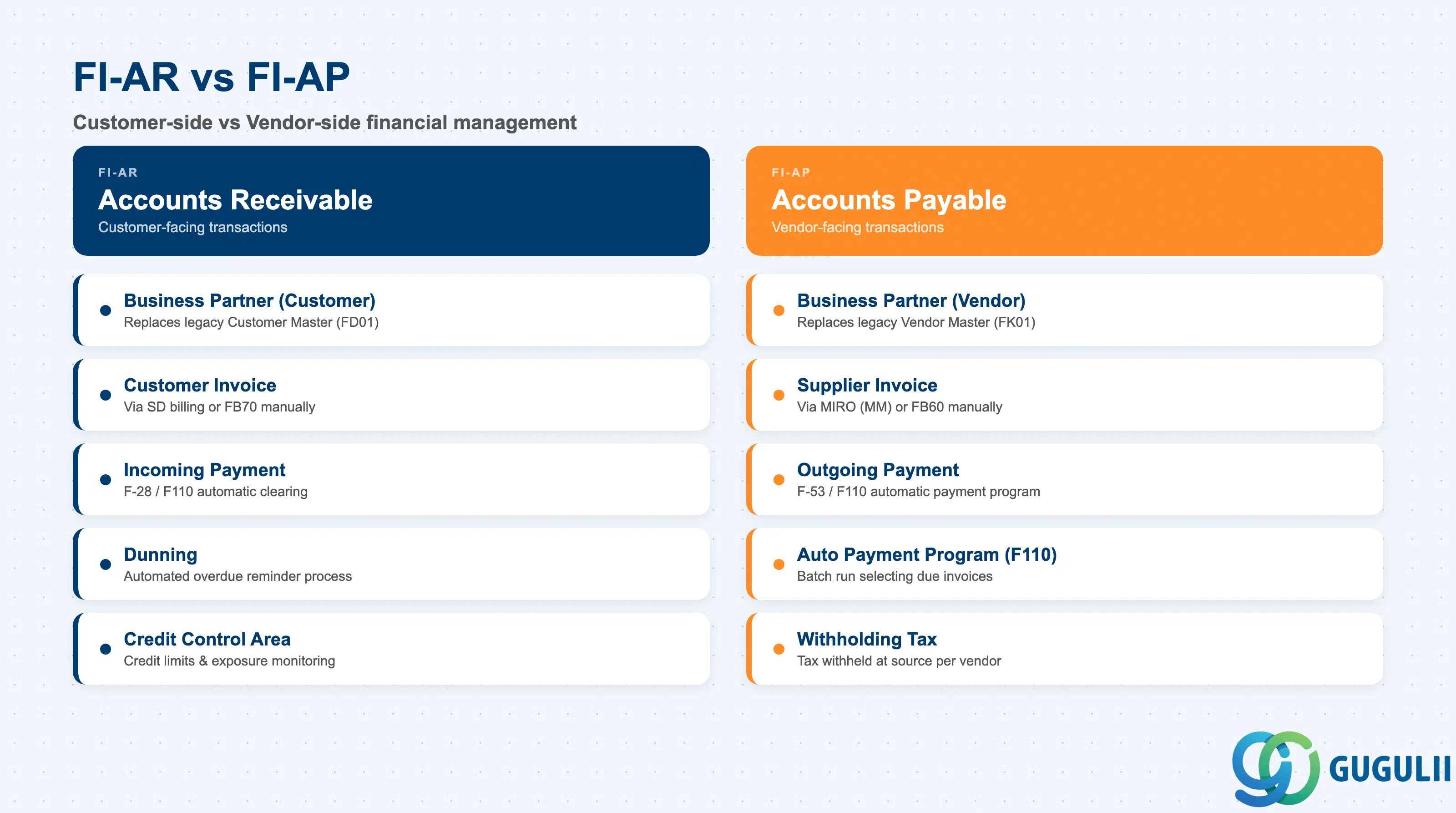
FI-AR manages all customer-facing financial transactions: issuing invoices, receiving and clearing payments, running dunning (reminder) procedures, and monitoring credit exposure.
| Key Object | Description |
|---|---|
| Business Partner (Customer role) | Unified master data object replacing legacy Customer Master (FD01); mandatory in S/4HANA |
| Customer Invoice | Document recording a receivable from a customer, posted via SD billing or manually (FB70) |
| Incoming Payment | Payment received from a customer, applied against open customer invoices (F-28 / F110 automatic clearing) |
| Dunning | Automated reminder process for overdue receivables, configured via dunning areas and dunning levels |
| Credit Control Area | Organizational unit that defines credit limits and monitors customer credit exposure (FD32) |
FI-AP manages all vendor-facing financial transactions: recording purchase invoices, processing outgoing payments, handling withholding tax, and running the automatic payment program.
| Key Object | Description |
|---|---|
| Business Partner (Vendor role) | Unified master data object replacing legacy Vendor Master (FK01); mandatory in S/4HANA |
| Supplier Invoice | Document recording a payable to a vendor, posted via MM invoice verification (MIRO) or manually (FB60) |
| Outgoing Payment | Payment disbursed to a vendor, applied against open supplier invoices (F-53 / F110 automatic payment program) |
| Automatic Payment Program (F110) | Batch payment run that selects due invoices, determines payment method and bank, and generates payment documents |
| Withholding Tax | Tax withheld at source and remitted to tax authorities; configured per vendor and tax type |
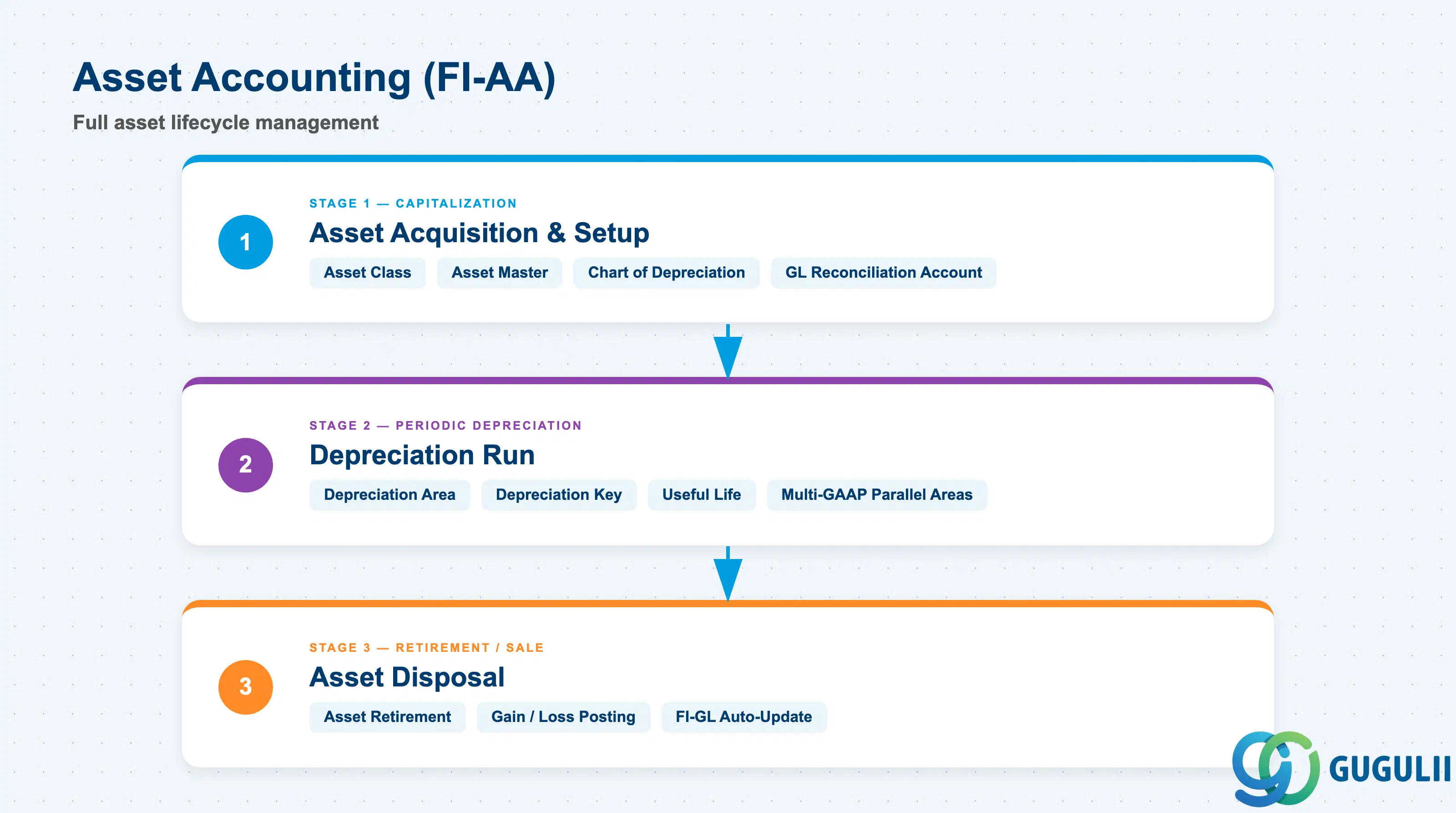
FI-AA manages the complete lifecycle of fixed assets: from capitalization through periodic depreciation to eventual retirement or sale. Asset Accounting posts to FI-GL via reconciliation accounts, keeping the balance sheet in sync automatically.
| Key Object | Description |
|---|---|
| Chart of Depreciation | Country-specific framework defining which depreciation areas are active and how depreciation is calculated |
| Asset Class | Template that pre-assigns G/L accounts, depreciation keys, and useful life defaults for assets of the same type |
| Depreciation Area | Represents a valuation perspective (e.g., book depreciation, tax depreciation, IFRS); parallel areas enable multi-GAAP reporting |
| Asset Master | Individual asset record linked to an asset class, cost center, and company code |
| Depreciation Run | Periodic batch program that calculates and posts planned depreciation across all assets (AFAB in ECC; equivalent Fiori app in S/4HANA) |
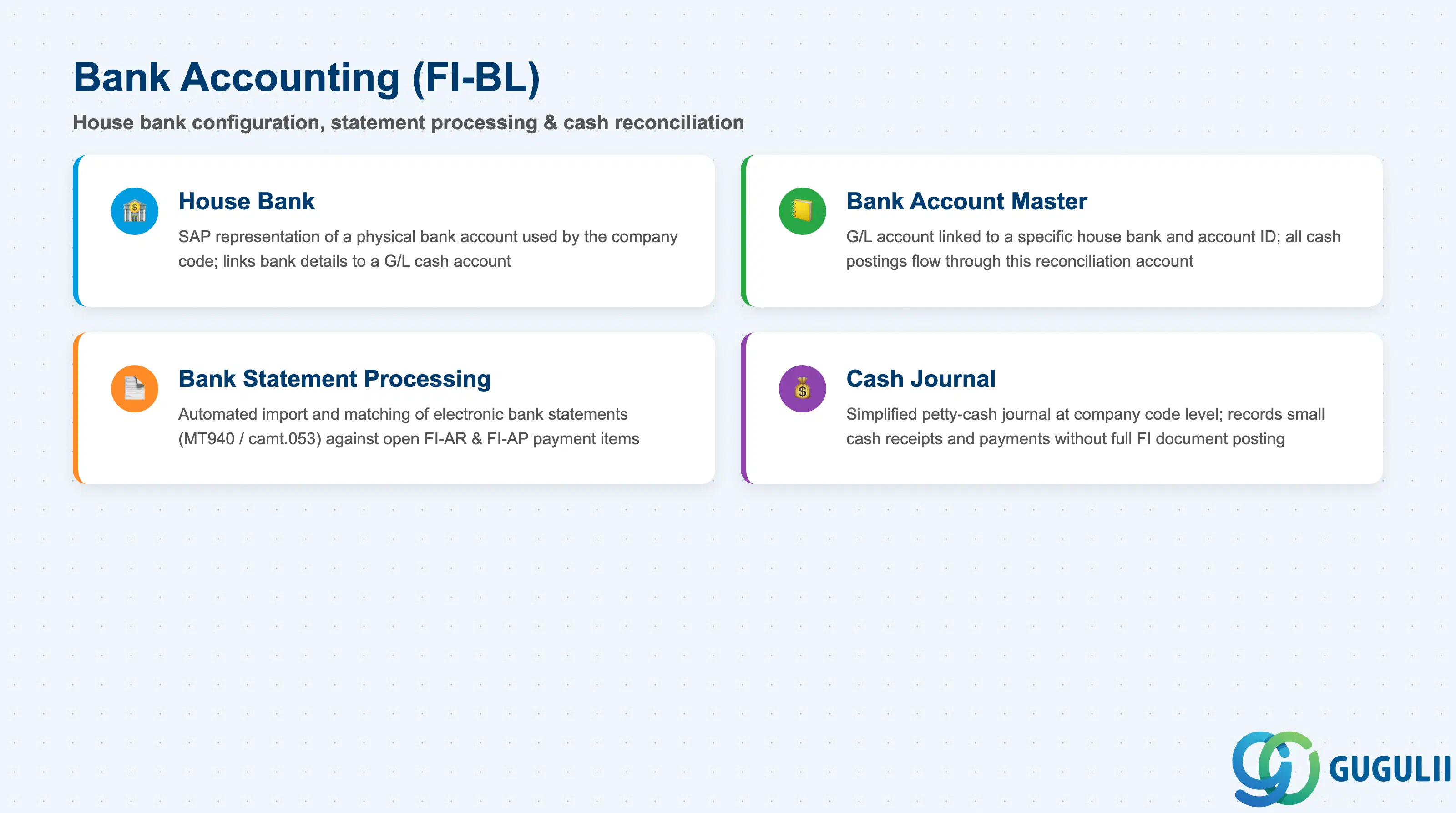
FI-BL manages the bank-side of financial transactions: configuring house banks, processing bank statements, and reconciling cash positions. It integrates with FI-AR for incoming payment clearing and FI-AP for outgoing payment posting.
| Key Object | Description |
|---|---|
| House Bank | SAP representation of a physical bank account used by the company code |
| Bank Account Master | G/L account linked to a specific house bank and account ID for cash posting |
| Bank Statement Processing | Automated import and matching of electronic bank statements against open payment items |
| Cash Journal | Simplified journal for petty cash transactions at a company code level |
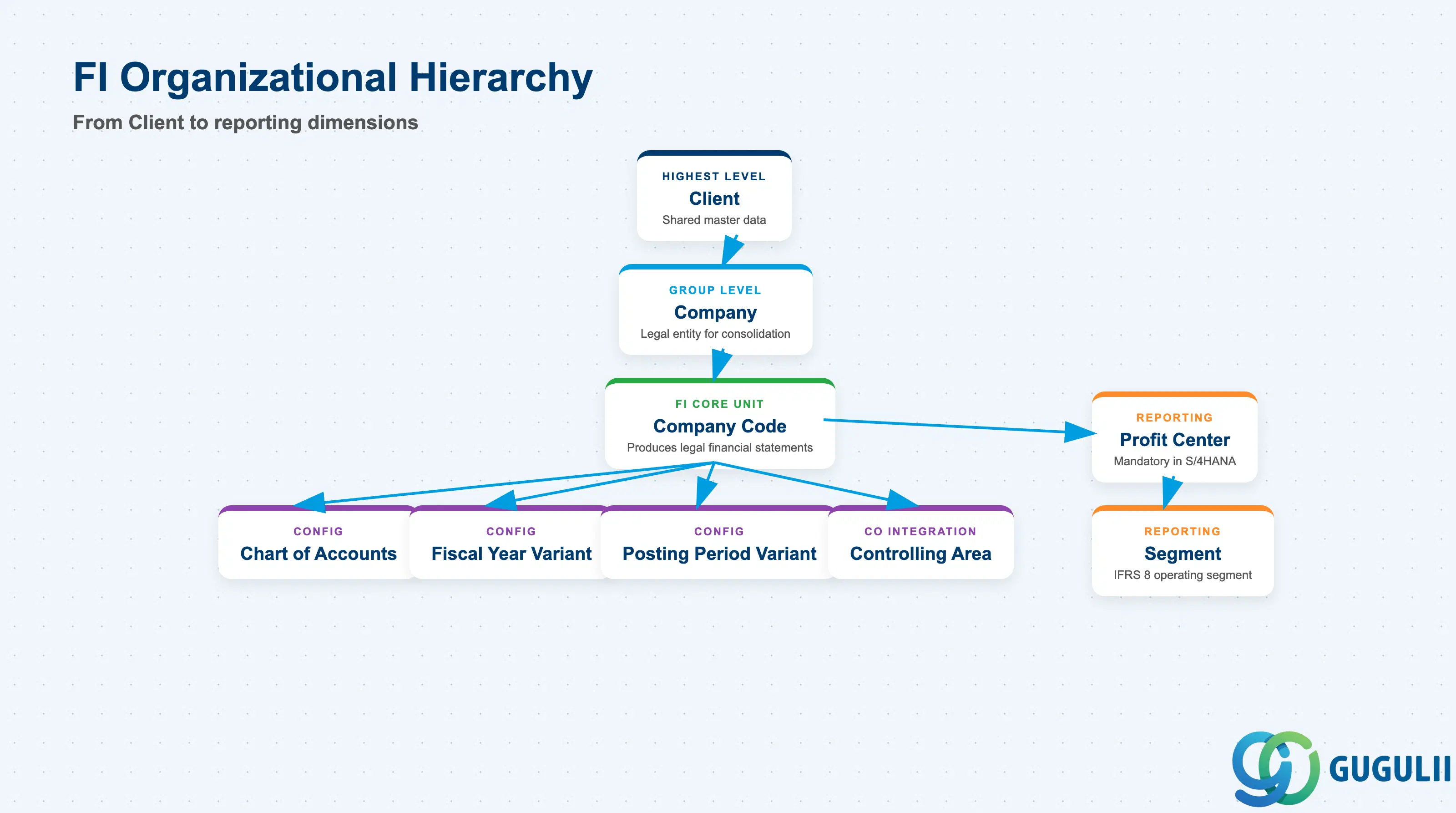
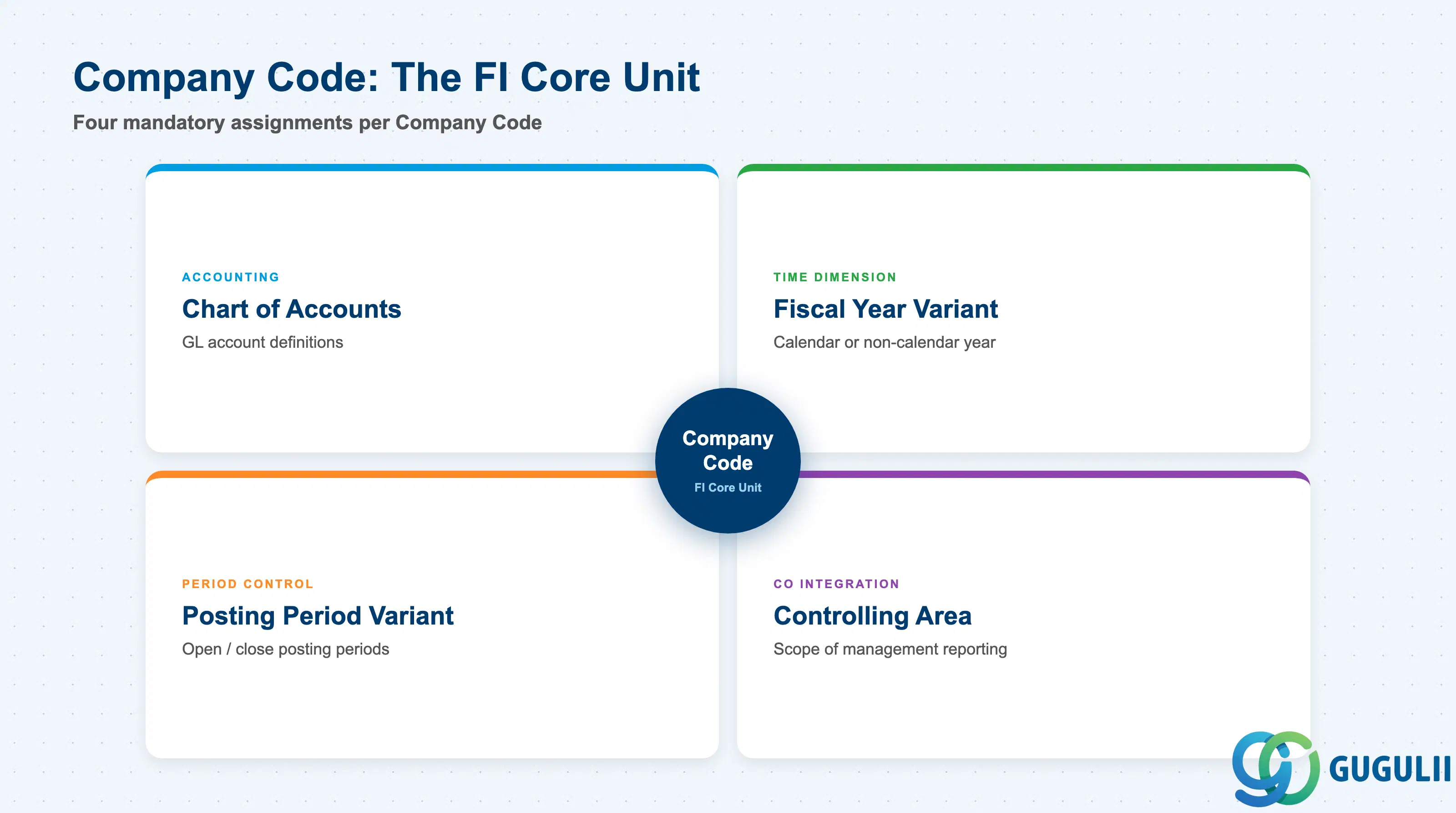
SAP FI uses a layered hierarchy of organizational units. Understanding this hierarchy is essential before any FI configuration begins, because master data, posting parameters, and reporting boundaries are all tied to these units.
| Organizational Unit | Level | Key Characteristics |
|---|---|---|
| Client | Highest | Contains all company codes; shared master data (Business Partners) lives here |
| Company | Group level | Legal entity for group consolidation; one company can contain multiple company codes |
| Company Code | FI core unit | Produces legal financial statements (balance sheet, P&L); has exactly one Chart of Accounts, one Fiscal Year Variant, one Posting Period Variant |
| Business Area | Cross-company | Segment-level reporting unit shared across company codes; not required for S/4HANA segment reporting (Profit Center is preferred) |
| Profit Center | Reporting dimension | Mandatory in S/4HANA for profit center balance sheet reporting; assigned on every posting |
| Segment | Reporting dimension | IFRS 8 operating segment; derived from Profit Center in standard S/4HANA configuration |
| Controlling Area (CO) | CO integration | Groups company codes for cost accounting; defines the scope of management reporting |
The typical relationship in a single-country implementation looks like this:
Client
 └── Company (Group Entity)
      └── Company Code (e.g., 1000 — Japan Operating Company)
           ├── Chart of Accounts (e.g., INT — International COA)
           ├── Fiscal Year Variant (e.g., K4 — Calendar Year)
           ├── Posting Period Variant
           └── Controlling Area (e.g., 1000)
Key design decision: The Company Code is the smallest unit for which a complete set of legal financial statements can be produced. If your client requires separate balance sheets for two entities — even within the same country — each entity needs its own Company Code. Resist the temptation to use Business Areas as a substitute; they do not enforce accounting completeness the way Company Codes do.
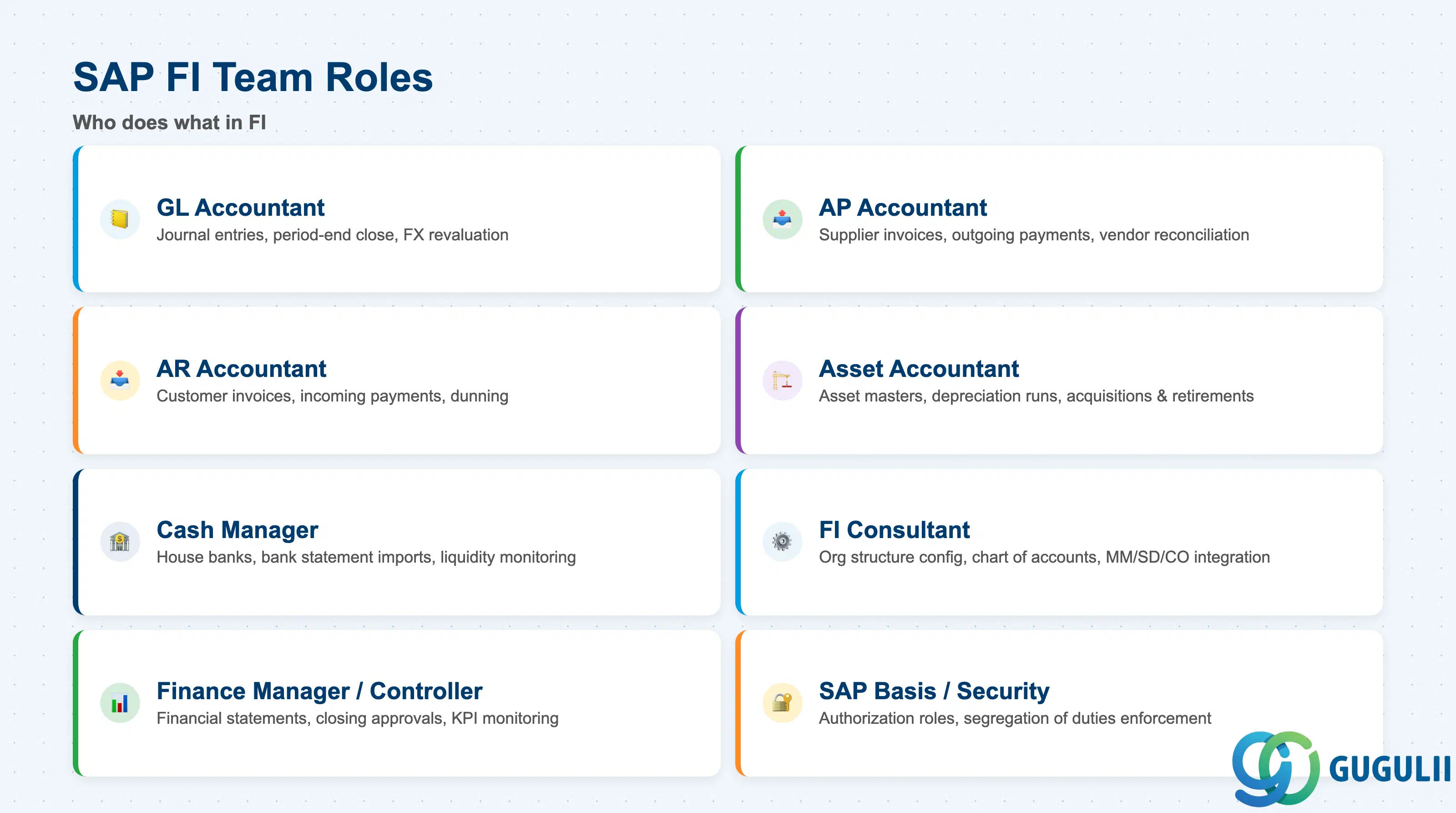
SAP FI touches a broad range of stakeholders. The table below maps the primary roles encountered in a typical FI implementation or operational team.
| Role | Primary Activities |
|---|---|
| GL Accountant | Posts and reviews journal entries; manages period-end closing tasks (accruals, FX revaluation, GR/IR clearing); prepares financial statements |
| AP Accountant | Records Supplier Invoices; processes outgoing payments; monitors open payable items; reconciles vendor statements |
| AR Accountant | Posts customer invoices; processes incoming payments; runs dunning; monitors credit exposure |
| Asset Accountant | Creates and manages asset masters; runs depreciation; processes asset acquisitions and retirements |
| Cash Manager | Configures and monitors house bank accounts; processes bank statement imports; manages liquidity position |
| FI Consultant | Configures organizational structures, chart of accounts, document types, posting period variants; owns integration with MM, SD, and CO |
| Finance Manager / Controller | Reviews financial statements; approves closing entries; monitors key financial KPIs |
| SAP Basis / Security | Manages authorization roles for FI transactions; ensures segregation of duties between posting, approval, and clearing |
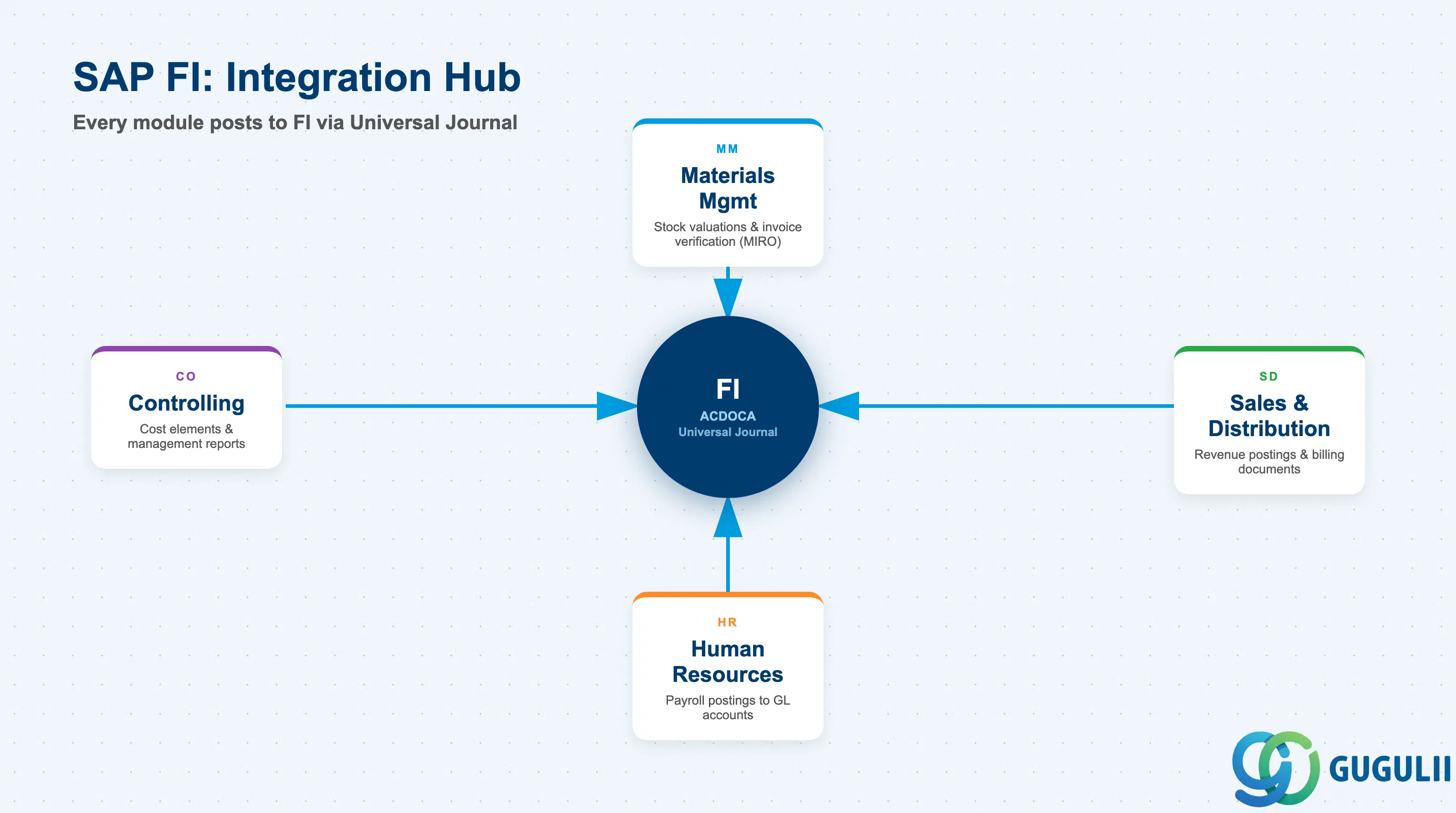
SAP FI is not a standalone ledger — it is the financial foundation into which every other SAP module writes. Materials Management posts stock and invoice valuations to FI; Sales and Distribution creates revenue postings in FI; Controlling reads FI cost elements to populate management reports. In SAP S/4HANA, the Universal Journal (ACDOCA) makes this integration seamless by storing FI and CO line items in a single table, eliminating the reconciliation overhead that was a constant burden in SAP ECC implementations.
The shift to Business Partner and the Universal Journal are the two changes that most affect consultants coming from an ECC background. Understanding these architectural decisions — and the organizational structure that underpins them — is the starting point for any FI project, whether you are implementing from scratch, migrating from ECC, or expanding an existing S/4HANA landscape.
The next L1 article in this series, FI-002, covers Business Processes and Integration — walking through how FI connects with MM, SD, CO, and HR across the full order-to-cash and procure-to-pay cycles.
| ID | Category | Title |
|---|---|---|
| fi-001 | Overview | What is SAP FI? 📍 |
| ID | Category | Title |
|---|---|---|
| fi-a01 | Overview | SAP FI Master Data: Overview, Hierarchy & Relationships |
| fi-a02-01 | Master Data | SAP FI Material Master |
| fi-a03-01 | Master Data | SAP FI Chart of Accounts |
| fi-a03-02 | Master Data | SAP FI G/L Account |
| fi-a04-01 | Master Data | SAP FI Payment Terms |
| fi-a04-02 | Master Data | SAP FI Tax Code |
| fi-a06-01 | Master Data | SAP FI Bank Master |
| fi-a06-02 | Master Data | SAP FI House Bank |
| fi-a07-01 | Master Data | SAP FI Asset Class |
| fi-a07-02 | Master Data | SAP FI Depreciation Key |
| fi-a07-03 | Master Data | SAP FI Asset Master |
| ID | Category | Title |
|---|---|---|
| fi-b01 | Overview | SAP FI Transactions: Process Flow, Hierarchy & Relationships |