Title here
Summary here

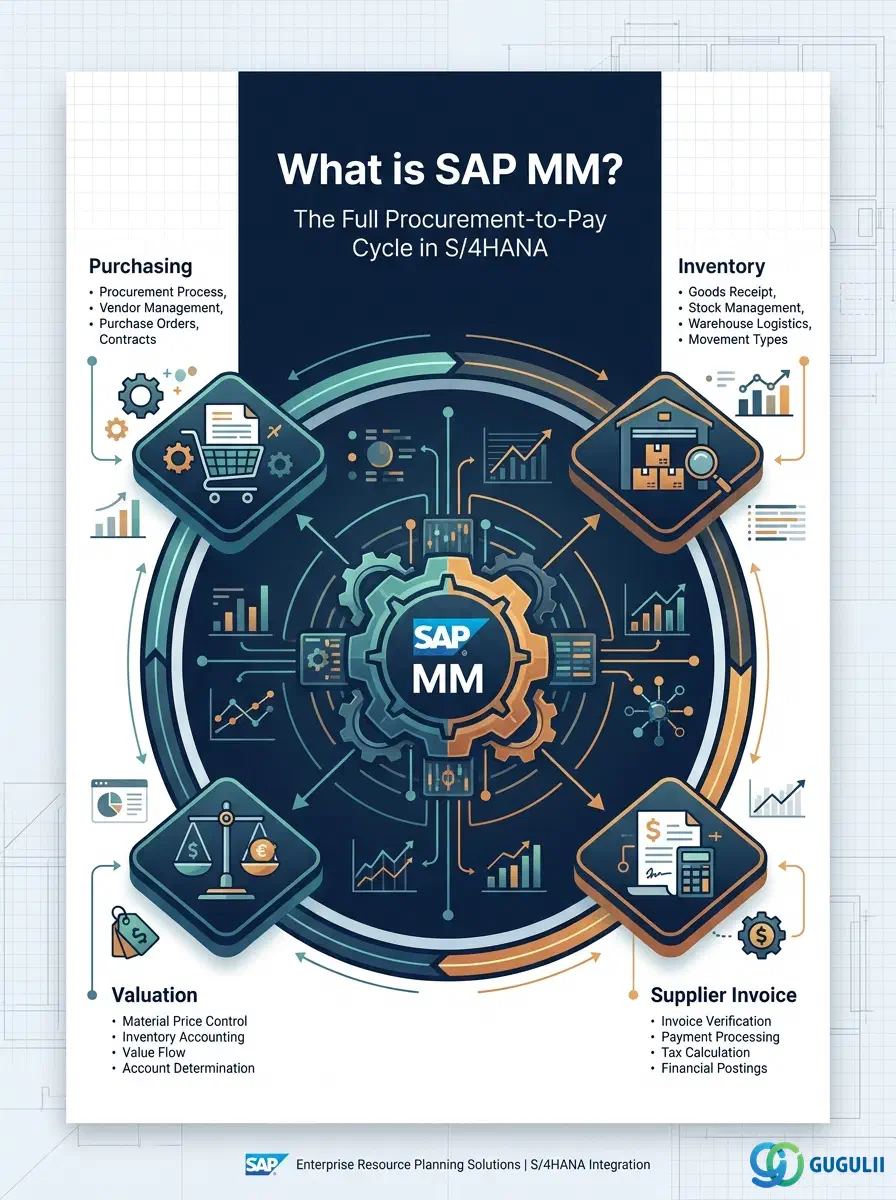
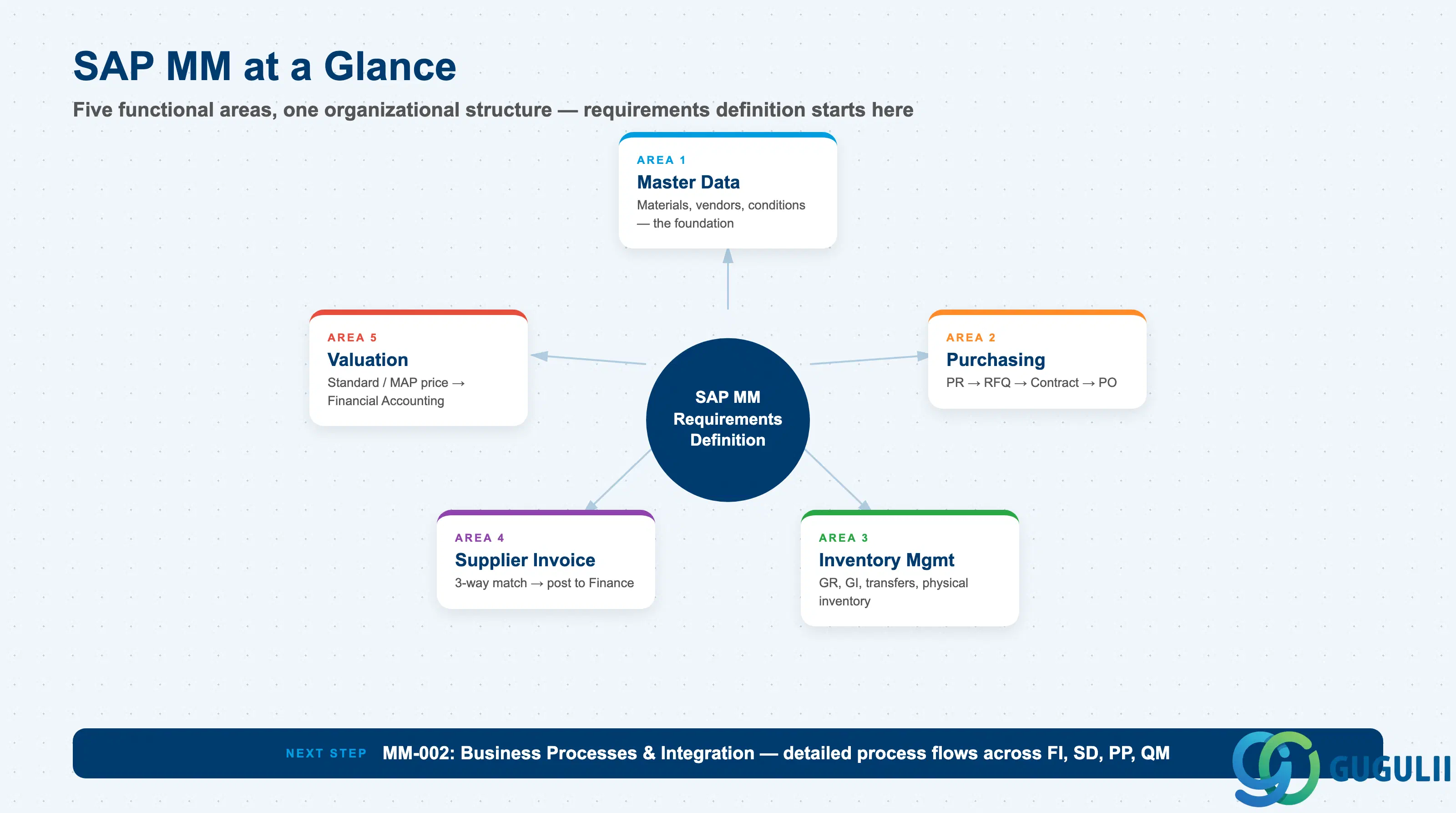
SAP MM is organized into five functional areas. Together they cover the full lifecycle from “we need something” to “we paid for it and the stock is accounted for.”
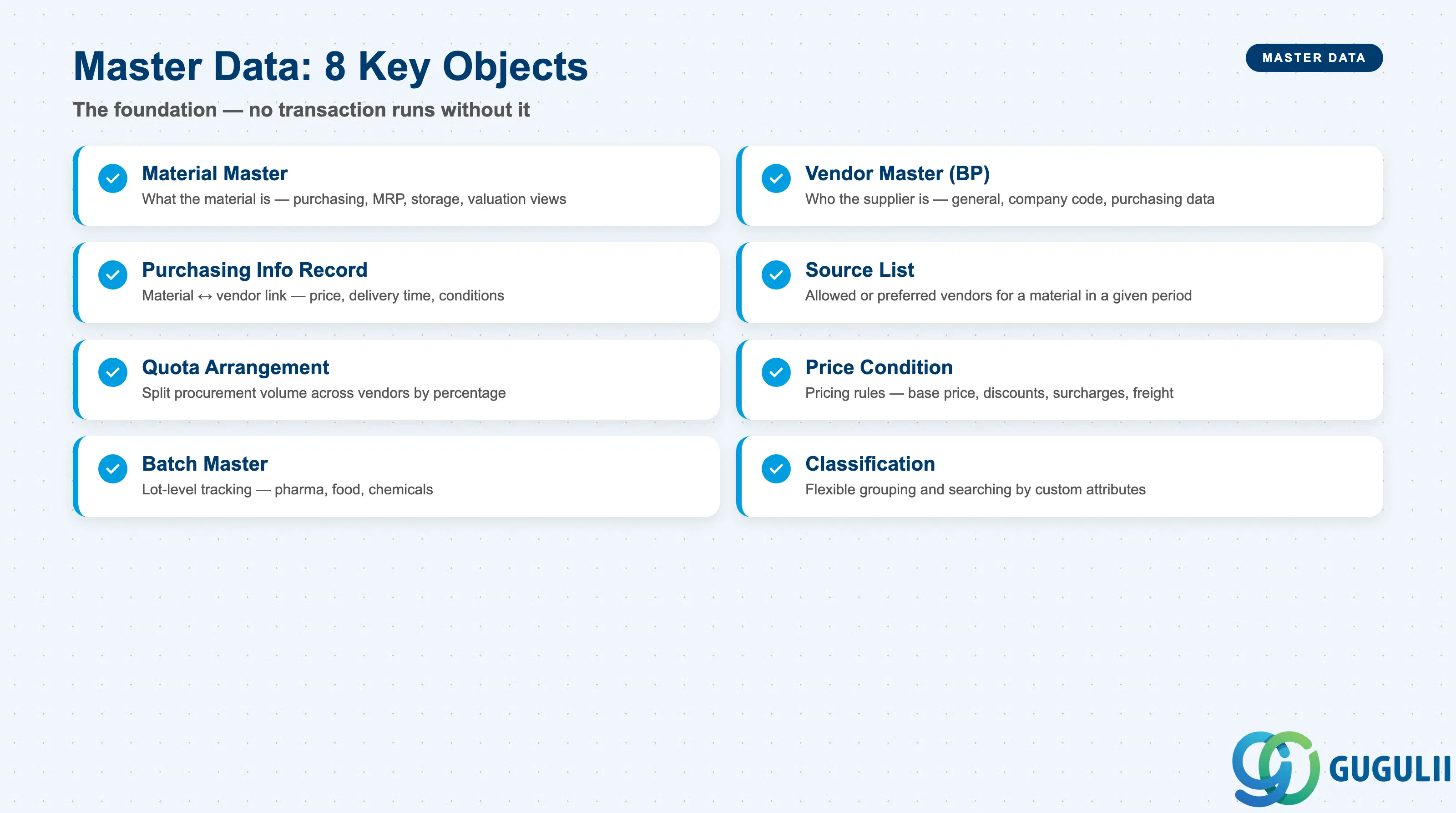
Master data is the foundation. No transaction can run correctly without it.
| Object | Purpose |
|---|---|
| Material Master | Defines what the material is — basic data, purchasing views, MRP views, storage, valuation |
| Vendor Master (Business Partner) | Defines who the supplier is — general data, company code data, purchasing data |
| Purchasing Info Record | Links a material to a vendor — price, delivery time, and conditions |
| Source List | Defines which vendors are allowed (or preferred) for a material in a given period |
| Quota Arrangement | Splits procurement volume across multiple vendors by percentage |
| Price Condition | Stores pricing rules — base price, discounts, surcharges, freight |
| Batch Master | Tracks materials at batch/lot level — required for pharma, food, chemicals |
| Classification (Class & Characteristic) | Enables flexible grouping and searching of materials by custom attributes |
S/4HANA key difference: The Vendor Master (tables LFA1/LFB1) is replaced by Business Partner (BP). Purchasing data is maintained via a dedicated BP role. This is one of the most impactful structural changes for ERP-to-S/4HANA migration projects.
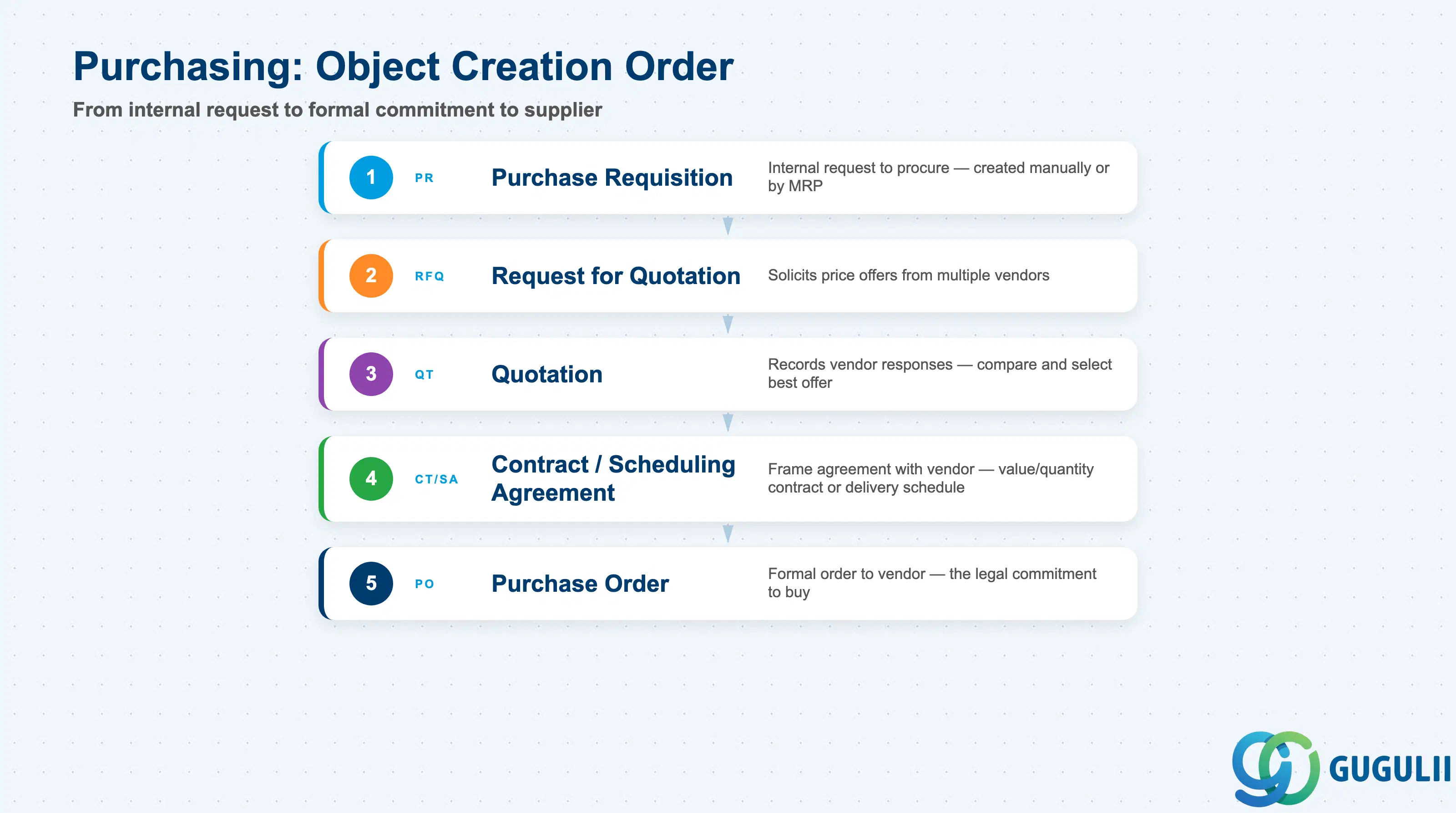
Purchasing manages the process of obtaining materials and services from external suppliers.
| Object | Purpose |
|---|---|
| Purchase Requisition (PR) | Internal request to procure — can be created manually or by MRP |
| Request for Quotation (RFQ) | Solicits price offers from multiple vendors |
| Quotation | Records vendor responses to an RFQ |
| Contract | Long-term agreement with a vendor (value or quantity contract) |
| Scheduling Agreement | Delivery schedule agreed with a vendor for recurring supply |
| Purchase Order (PO) | Formal order to a vendor — the legal commitment to buy |
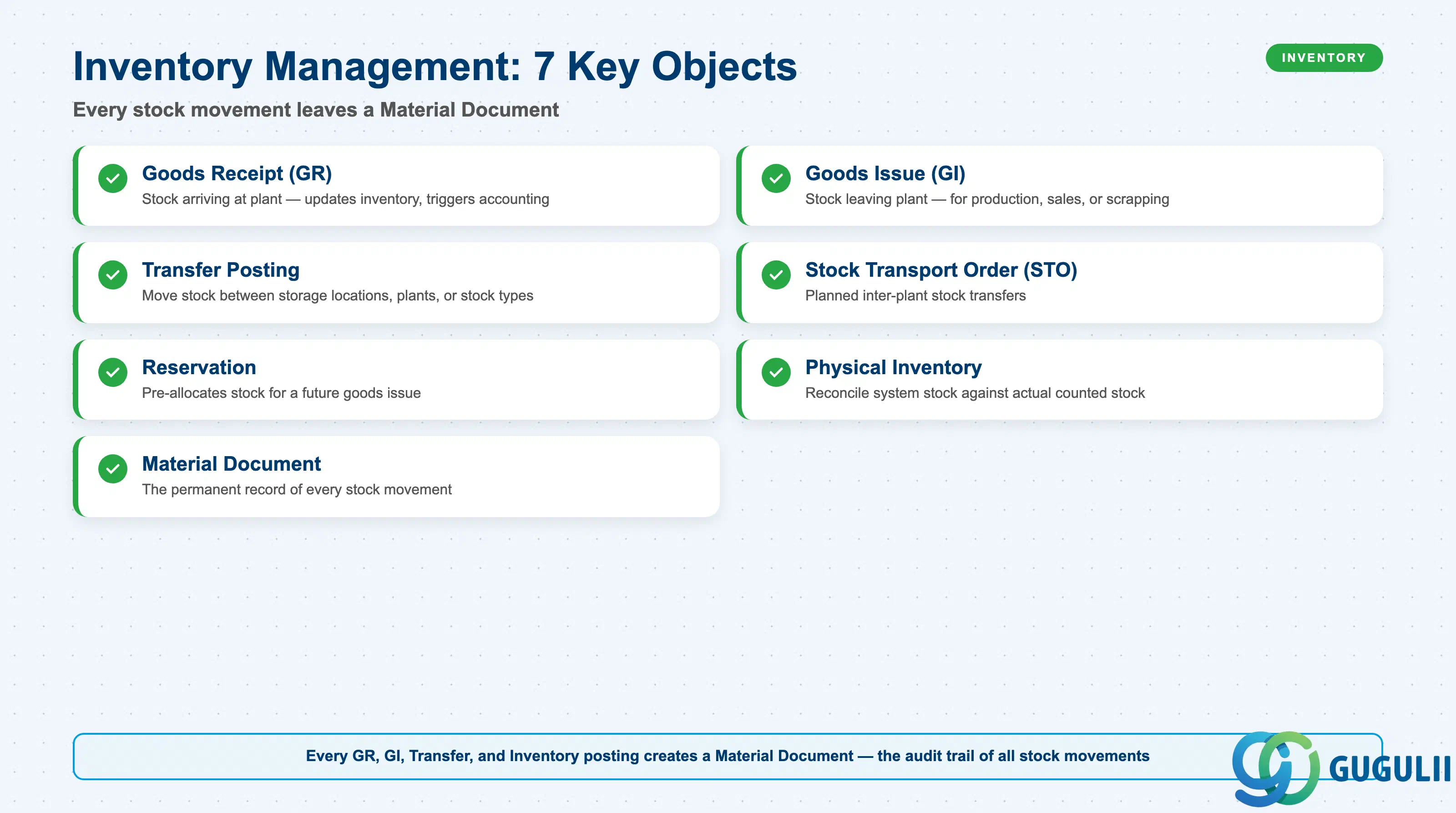
Inventory Management tracks the physical movement and location of stock.
| Object | Purpose |
|---|---|
| Goods Receipt (GR) | Records stock arriving at a plant — updates inventory and triggers accounting |
| Goods Issue (GI) | Records stock leaving a plant — for production, sales, or scrapping |
| Transfer Posting | Moves stock between storage locations, plants, or stock types |
| Stock Transport Order (STO) | Manages planned inter-plant stock transfers |
| Reservation | Pre-allocates stock for a future goods issue |
| Physical Inventory | Reconciles system stock against actual counted stock |
| Material Document | The permanent record of every stock movement |
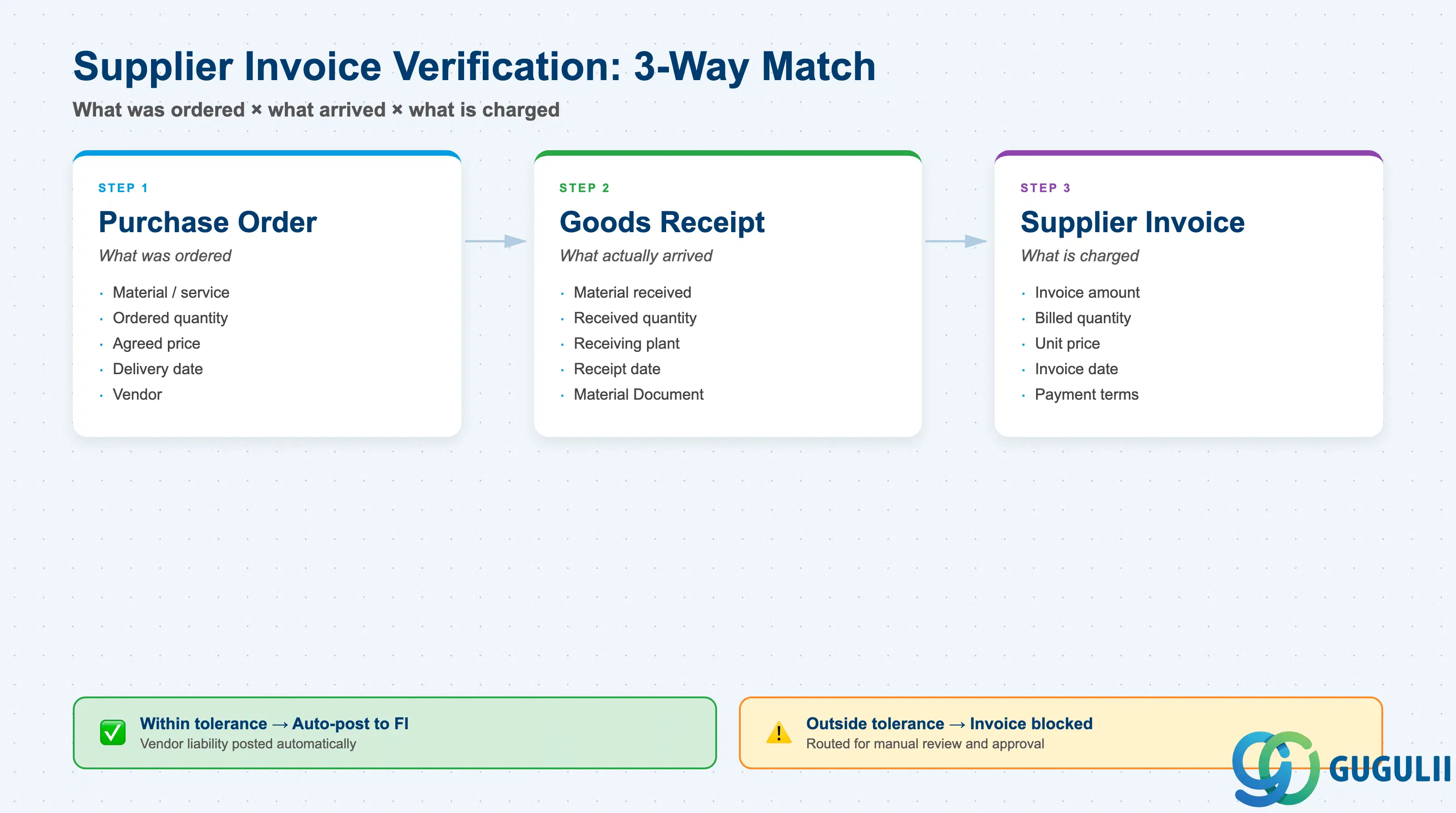
Supplier Invoice Verification (also called Logistics Invoice Verification) ensures that what was ordered and received matches what the supplier is charging.
| Concept | Detail |
|---|---|
| 3-way match | PO (what was ordered) × GR (what arrived) × Supplier Invoice (what is charged) |
| Tolerance check | Configurable limits for price and quantity variance — within tolerance posts automatically |
| Blocking | Invoices outside tolerance are blocked and routed for manual review |
| Credit Memo | Reduces a previous Supplier Invoice (e.g. returned goods) |
| Debit Memo | Charges the supplier for additional costs |
Valuation determines the monetary value of stock and feeds directly into Financial Accounting.
| Concept | Detail |
|---|---|
| Price Control | Standard Price (S) — fixed; Moving Average Price (V) — recalculated on each receipt |
| Material Ledger | Required in S/4HANA; enables actual costing and multi-currency/multi-valuation |
| Price Change | Manual adjustment of standard price |
| Split Valuation | Allows the same material to carry different prices by batch or procurement type |
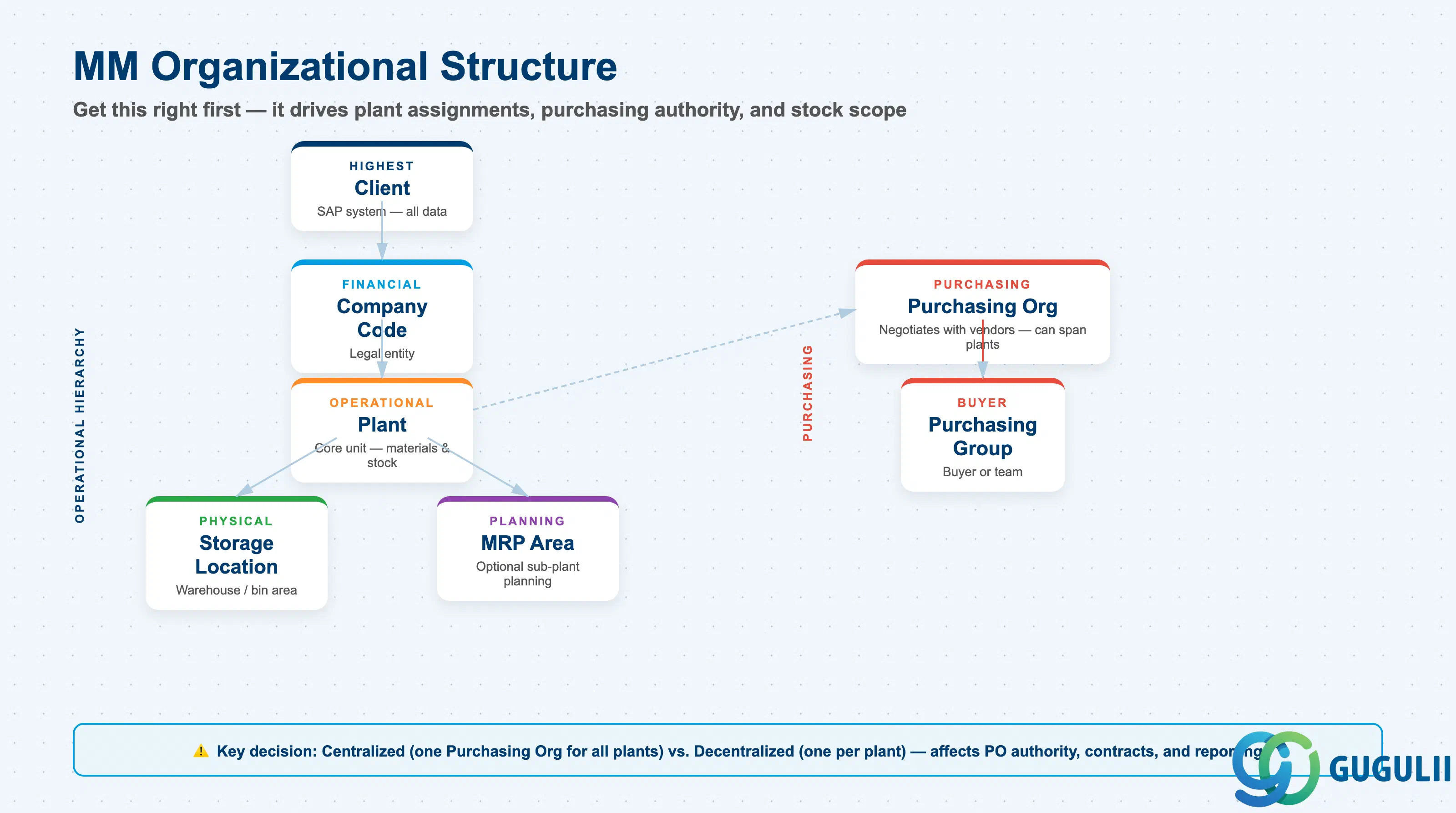
SAP MM is built around a hierarchy of organizational units. Getting this right early is critical — it drives plant assignments, purchasing authority, and stock management scope.
| Unit | Level | Purpose |
|---|---|---|
| Client | Highest | The SAP system itself — all data lives within one client |
| Company Code | Financial | Legal entity for accounting and financial reporting |
| Plant | Operational | The core unit for production, inventory, and procurement — every material and stock belongs to a plant |
| Storage Location | Physical | Sub-unit within a plant — warehouse, rack, or bin area |
| Purchasing Organization | Purchasing | Negotiates and owns contracts with vendors — can span multiple plants |
| Purchasing Group | Purchasing | A buyer or team of buyers responsible for specific categories |
| MRP Area | Planning | Optional — enables independent MRP planning below plant level |
Client
  └── Company Code (legal entity)
        └── Plant (operational unit)
              ├── Storage Location (physical location)
              └── MRP Area (optional planning unit)

Purchasing Organization (can cover one or multiple plants)
  └── Purchasing Group (buyer or team)
Key design decision: Whether to use a centralized purchasing organization (one org covering all plants) or decentralized (one per plant) significantly affects PO authority, reporting, and contract management. This is one of the first decisions to make in requirements definition.
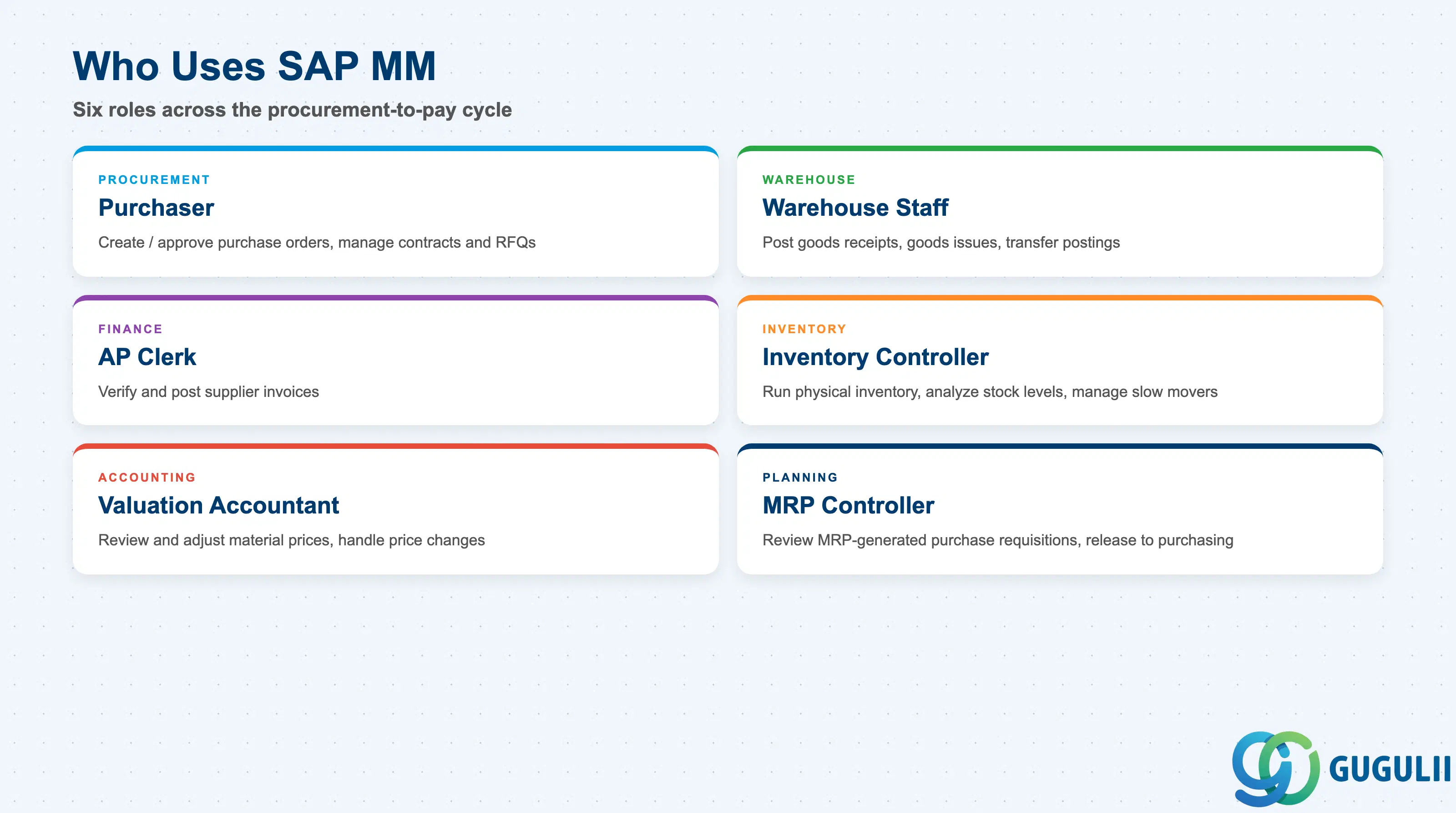
| Role | Primary activities |
|---|---|
| Purchaser | Create/approve purchase orders, manage contracts and RFQs |
| Warehouse Staff | Post goods receipts, goods issues, transfer postings |
| AP Clerk | Verify and post Supplier Invoices |
| Inventory Controller | Run physical inventory, analyze stock levels, manage slow movers |
| Valuation Accountant | Review and adjust material prices, handle price changes |
| MRP Controller | Review MRP-generated purchase requisitions, release to purchasing |
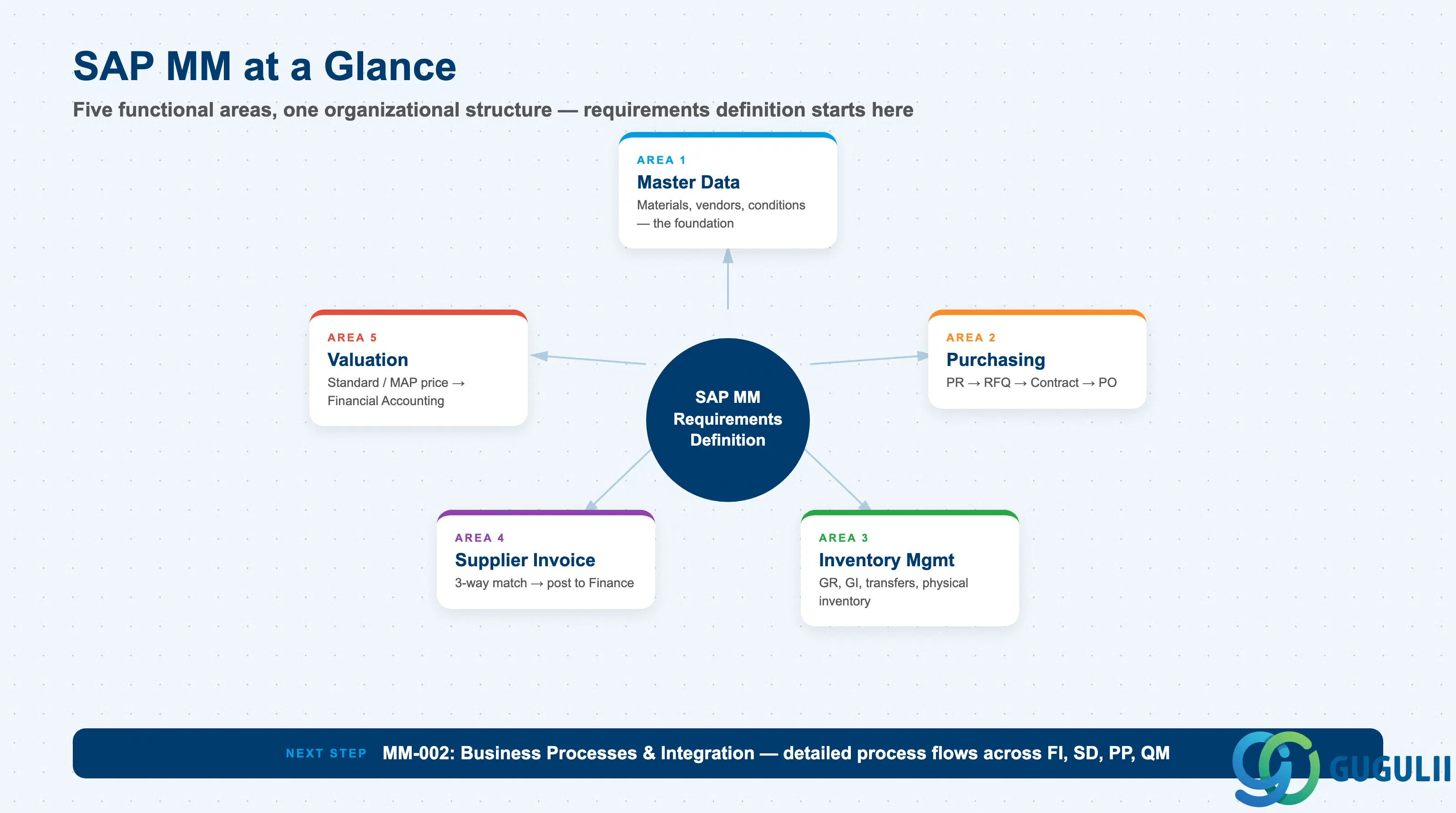
SAP MM covers the full lifecycle from requisition to payment and stock valuation. Its five functional areas — master data, purchasing, inventory management, Supplier Invoice verification, and valuation — define the scope boundary for requirements definition. The organizational structure in Section 2 is the first design decision to lock down before moving into process details.
Next: work through the detailed process flows and integration points in S4-MM-002.
| ID | Category | Title |
|---|---|---|
| mm-001 | Overview | What is SAP MM? 📍 |
| ID | Category | Title |
|---|---|---|
| mm-a01 | Overview | SAP MM Master Data: Overview, Hierarchy & Relationships |
| mm-a02-01 | Master Data | SAP MM Material Master |
| mm-a04-01 | Master Data | SAP MM Class |
| mm-a04-02 | Master Data | SAP MM Characteristic |
| mm-a06-01 | Master Data | SAP MM Purchasing Info Record |
| mm-a05-01 | Master Data | SAP MM Batch Master |
| mm-a06-02 | Master Data | SAP MM Source List |
| mm-a06-03 | Master Data | SAP MM Quota Arrangement |
| mm-a06-04 | Master Data | SAP MM Price Condition |
| ID | Category | Title |
|---|---|---|
| mm-b01 | Overview | SAP MM Transactions: Process Flow, Hierarchy & Module Integration |