Title here
Summary here

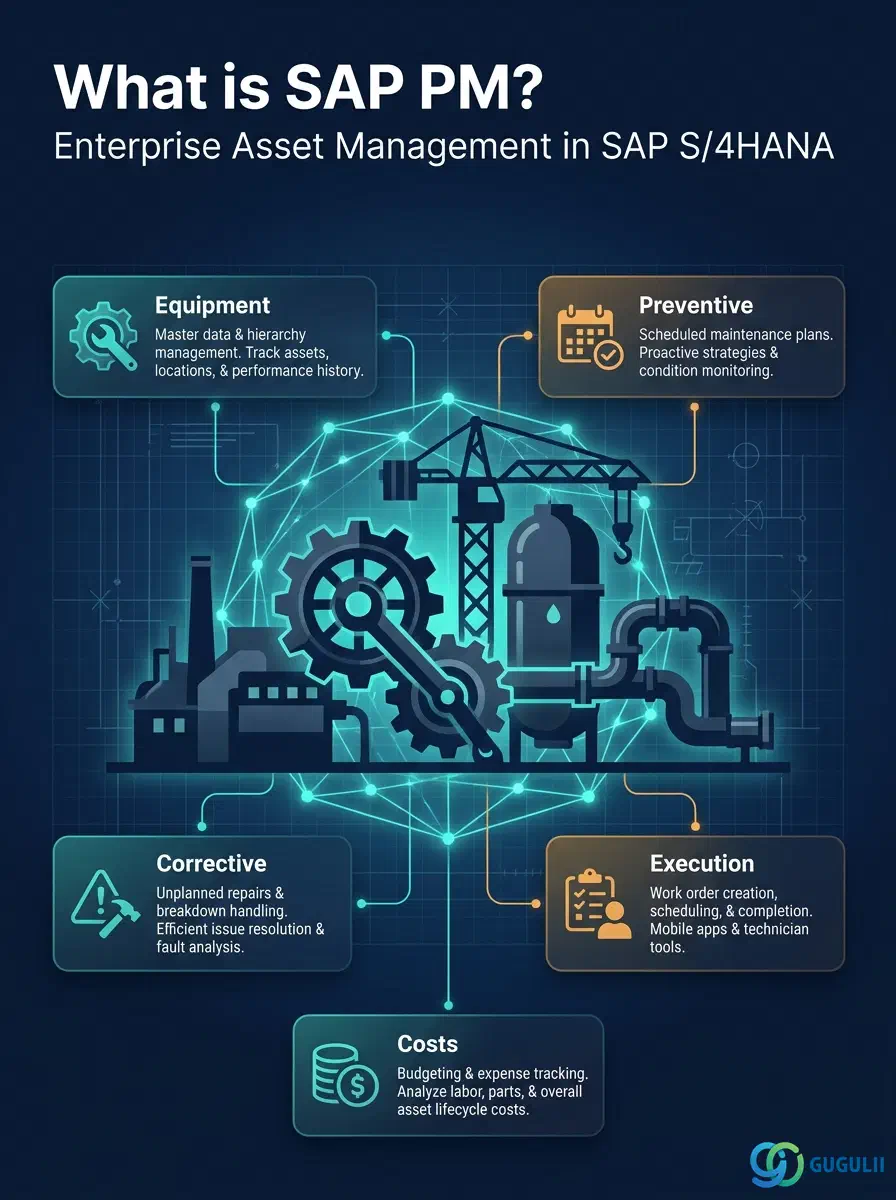
SAP Plant Maintenance (SAP PM) is the module within SAP S/4HANA responsible for managing all maintenance activities performed on an organization’s physical assets. These assets include production machinery, vehicles, buildings, pipelines, measuring instruments, and any other piece of equipment a company needs to keep running.
In SAP S/4HANA, the module is positioned under the broader umbrella of Enterprise Asset Management (EAM), reflecting a strategic shift from reactive repair toward a lifecycle management discipline. The underlying transactional logic and data model, however, are evolutionary from SAP ECC — PM is one of the few modules that did not undergo a major data model redesign in S/4HANA, making it a relatively straightforward technical migration for existing SAP customers.
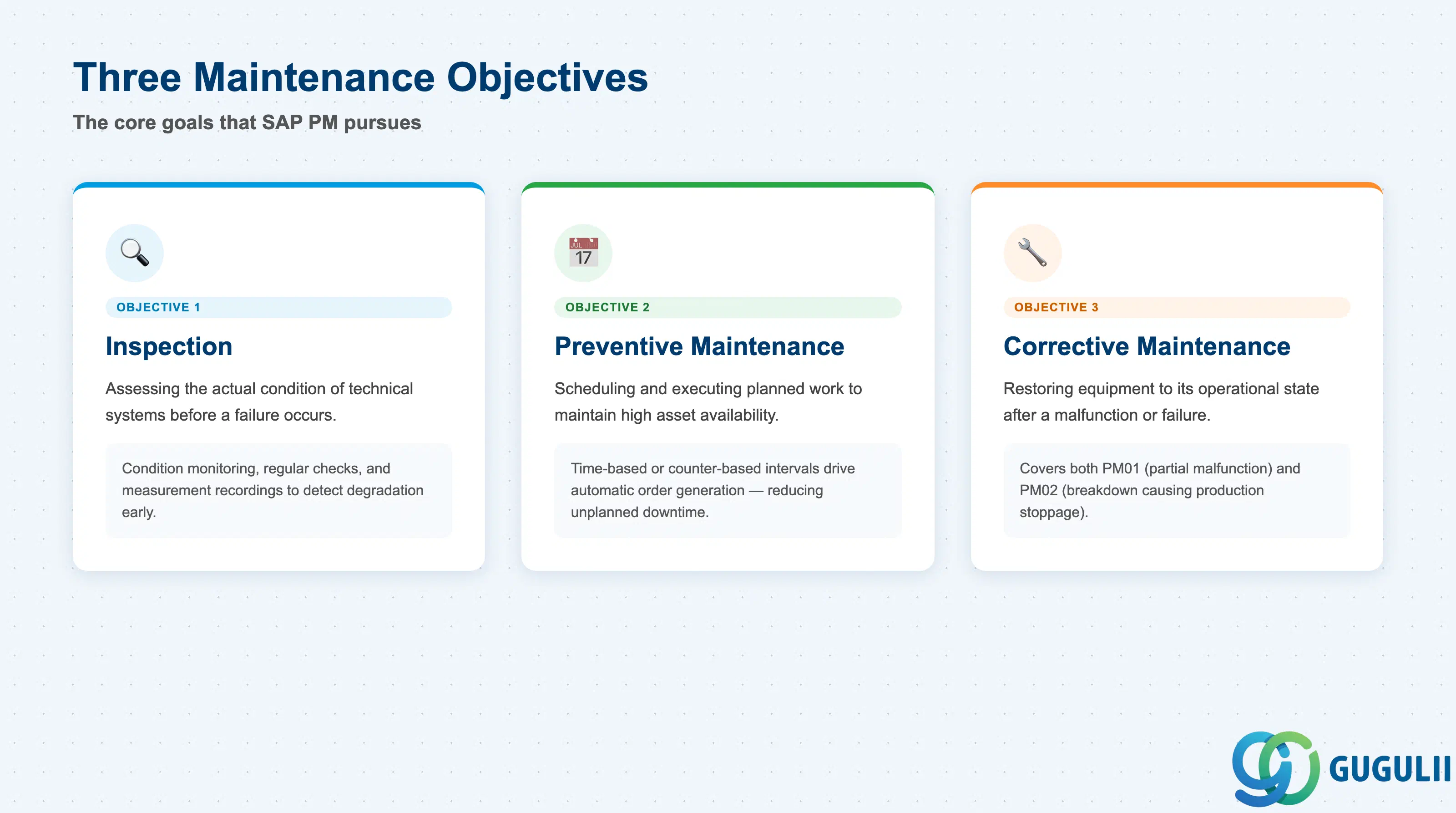
At its core, SAP PM pursues three maintenance objectives:
These objectives map to the five functional domains that practitioners use to organize PM work:
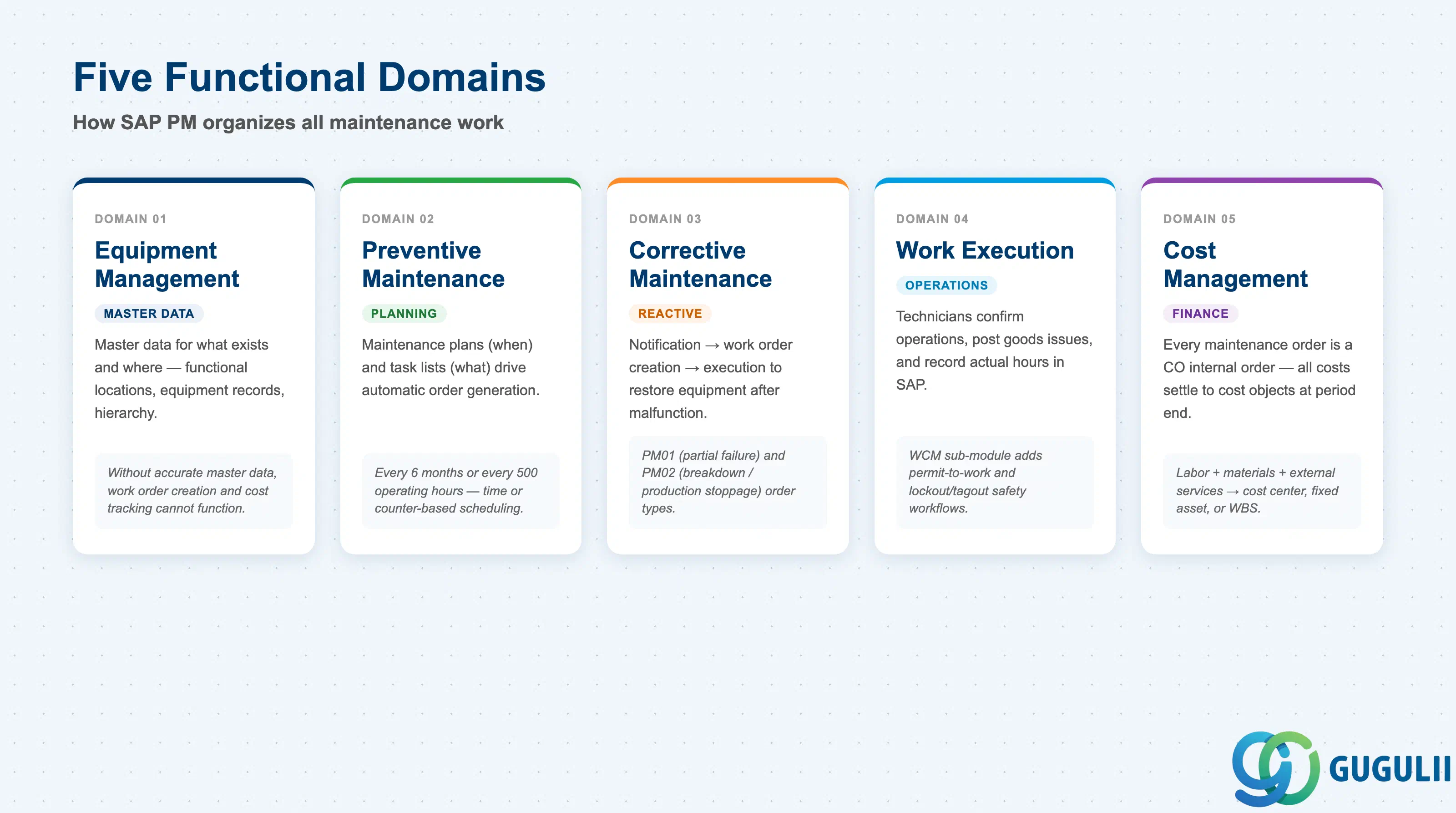
Equipment Management covers the master data that describes what exists and where it is. This includes maintaining functional location records (the physical or functional positions in a plant), equipment master records (the individual assets), classification assignments, serialization, and the hierarchy that links locations to equipment. Without accurate master data, work order creation and cost tracking cannot function correctly.
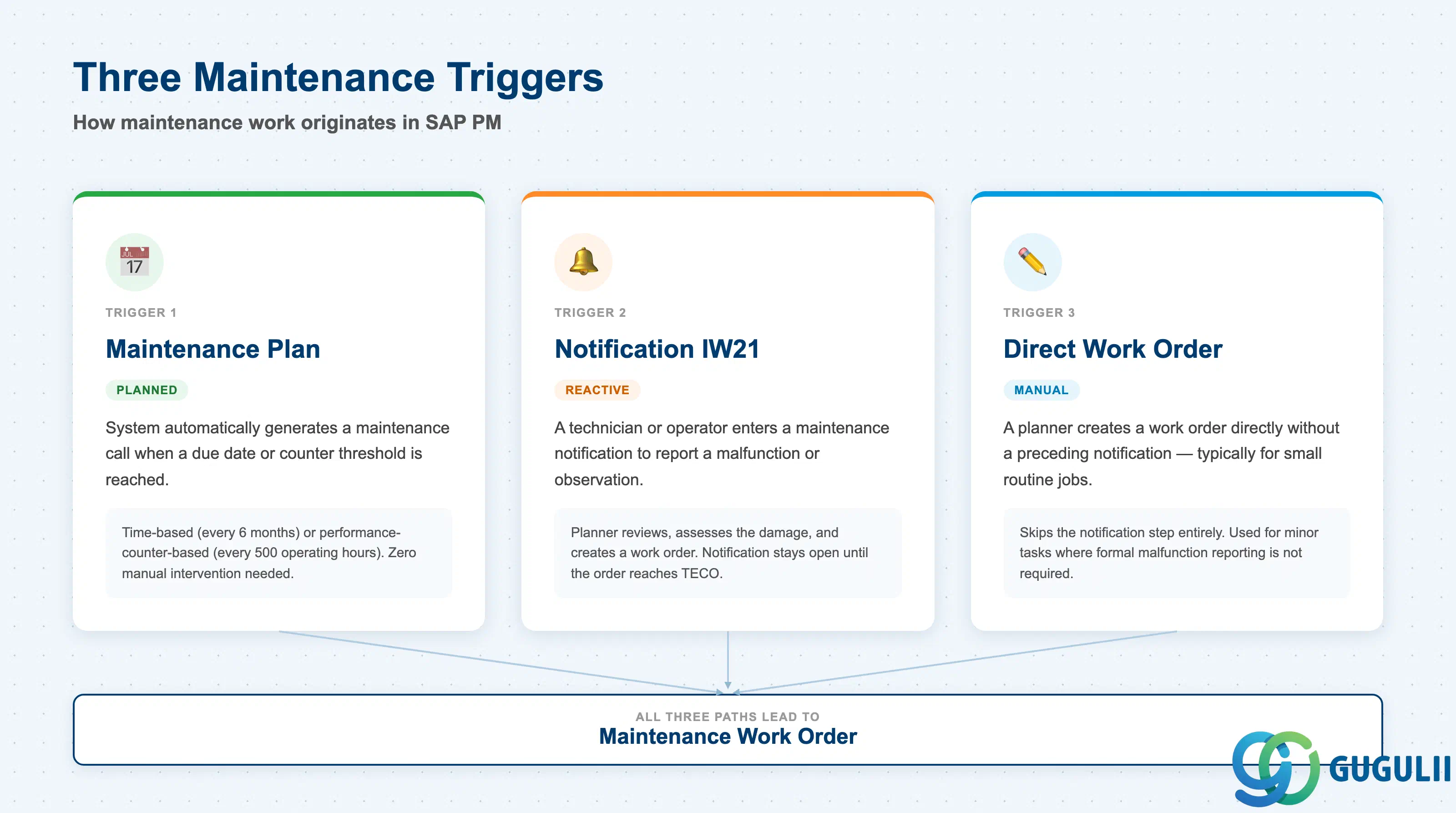
Preventive Maintenance covers the planning and scheduling side of maintenance. Maintenance plans define the when — either based on time intervals (every 6 months) or performance counters (every 500 operating hours). Task lists define the what — the sequence of operations a technician performs. Together, they allow organizations to generate maintenance orders automatically at the right moment, reducing both unexpected breakdowns and over-maintenance.
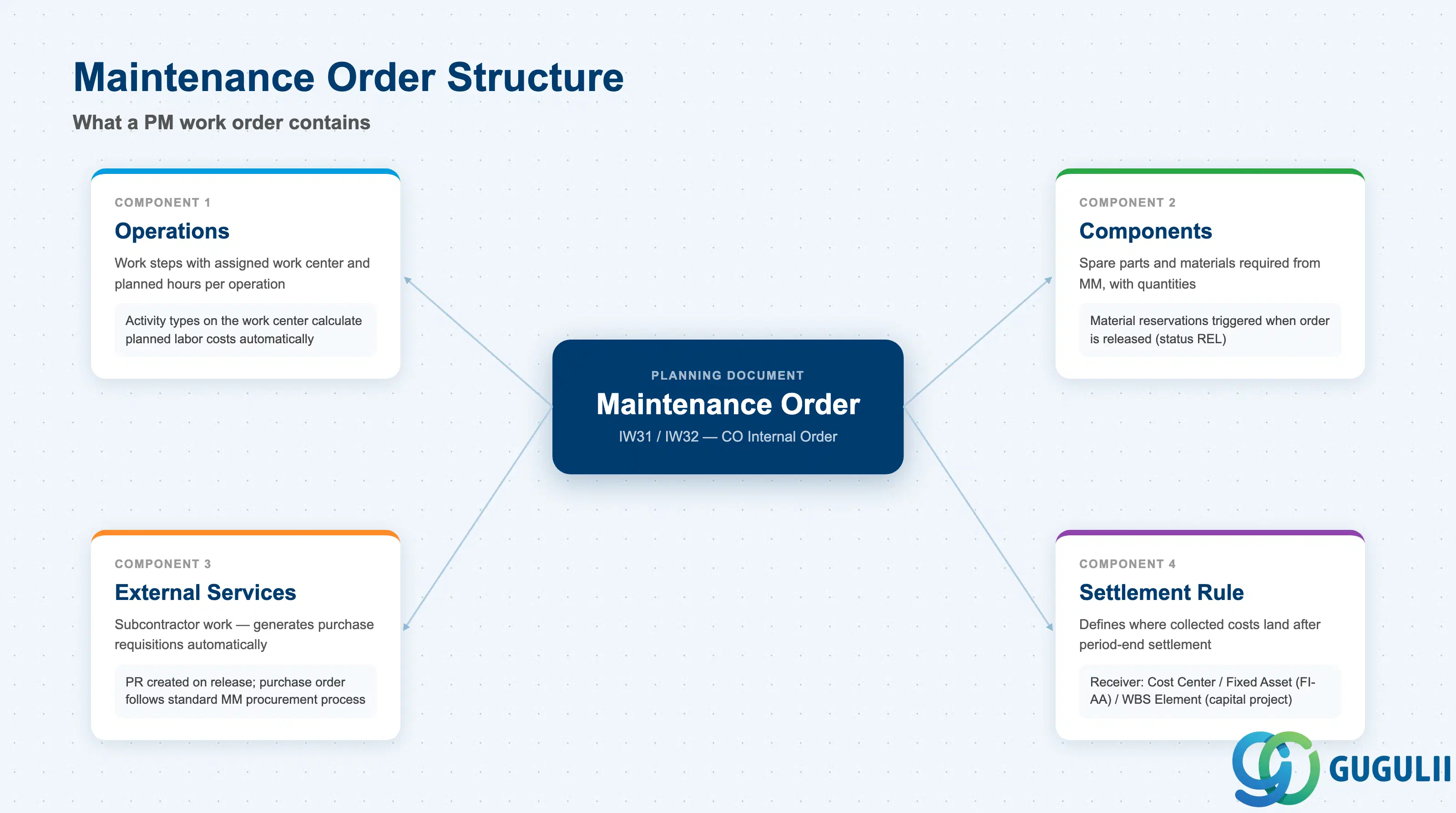
Corrective Maintenance handles the reactive side: something has gone wrong and needs to be fixed. A maintenance notification captures the reported malfunction. A planner evaluates the notification and creates a work order specifying what needs to be done, which resources are needed, and which spare parts should be reserved. The work order is then released to the technician for execution. SAP distinguishes between corrective maintenance (restoring from a partial malfunction) and breakdown maintenance (restoring from total failure causing production stoppage), with separate standard order types PM01 and PM02 respectively.
Work Execution is the operational layer where the planned work meets physical reality. Technicians confirm individual operations on the work order, post goods issues for consumed materials, record actual hours worked, and flag any additional findings. Work Clearance Management (WCM), a sub-module within PM, adds a formal safety permit layer for hazardous work — covering lockout/tagout procedures and permit-to-work workflows before a technician can begin.
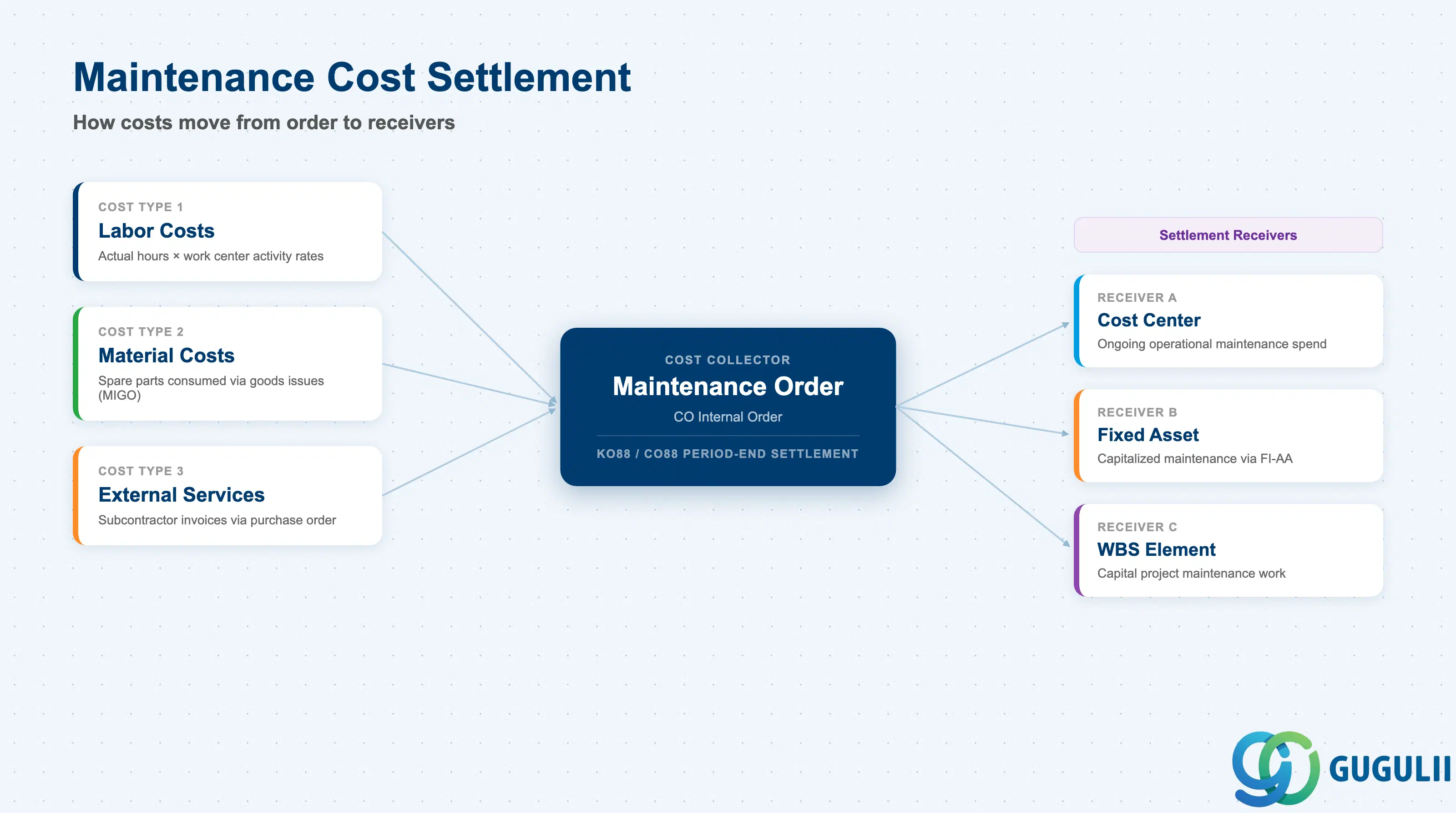
Every maintenance order in SAP PM is simultaneously a Controlling (CO) internal order — a cost collector. Labor costs, material consumption, and external service costs all flow onto the order as actual costs. At period end, a settlement run distributes those collected costs to the designated receiver: a cost center, a fixed asset, or a WBS element on a capital project. This integration with CO and FI-AA (Asset Accounting) gives finance teams full visibility into maintenance spend by asset, plant, and cost category.
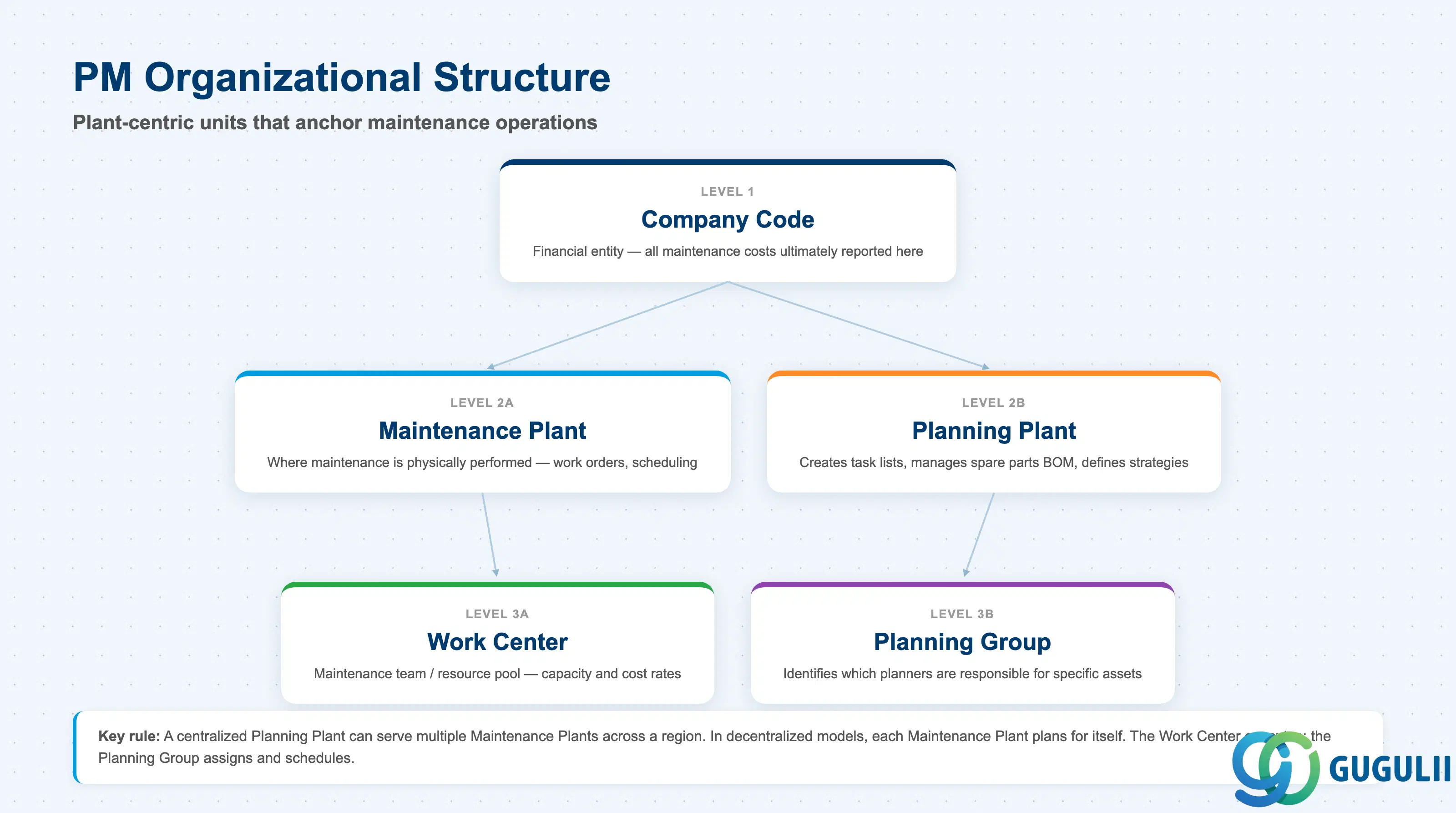
SAP PM operates within a plant-centric organizational model. The key organizational units are:
Maintenance Plant: The plant in which maintenance activities are physically performed. This is the organizational anchor for defining task lists, material planning, scheduling maintenance plans, and creating work orders. A maintenance plant corresponds to a standard SAP plant and inherits the company code assignment from that plant.
Planning Plant: The plant responsible for maintenance planning activities — creating task lists, managing spare parts bills of material, and defining maintenance strategies. In centralized planning models, one planning plant may serve multiple maintenance plants across a country or region. In decentralized models, each maintenance plant plans for itself. A partially centralized model allows certain plants to act as regional planning centers while others remain self-sufficient.
Work Center: The organizational unit that represents a maintenance team or a pool of resources. Work centers carry capacity data (available hours per shift) and are assigned to operations on maintenance orders. Cost rates are defined on the work center activity types, making labor cost calculation on orders automatic.
Maintenance Planning Group: A finer-grained organizational assignment within PM that identifies which group of planners is responsible for an asset or set of assets. This is distinct from the work center — planners assign and schedule work, while work centers execute it.
These organizational units interact with the broader SAP enterprise structure (company code → plant → storage location) and with Controlling (controlling area → cost center hierarchy), ensuring that maintenance costs are captured at the right level for financial reporting.
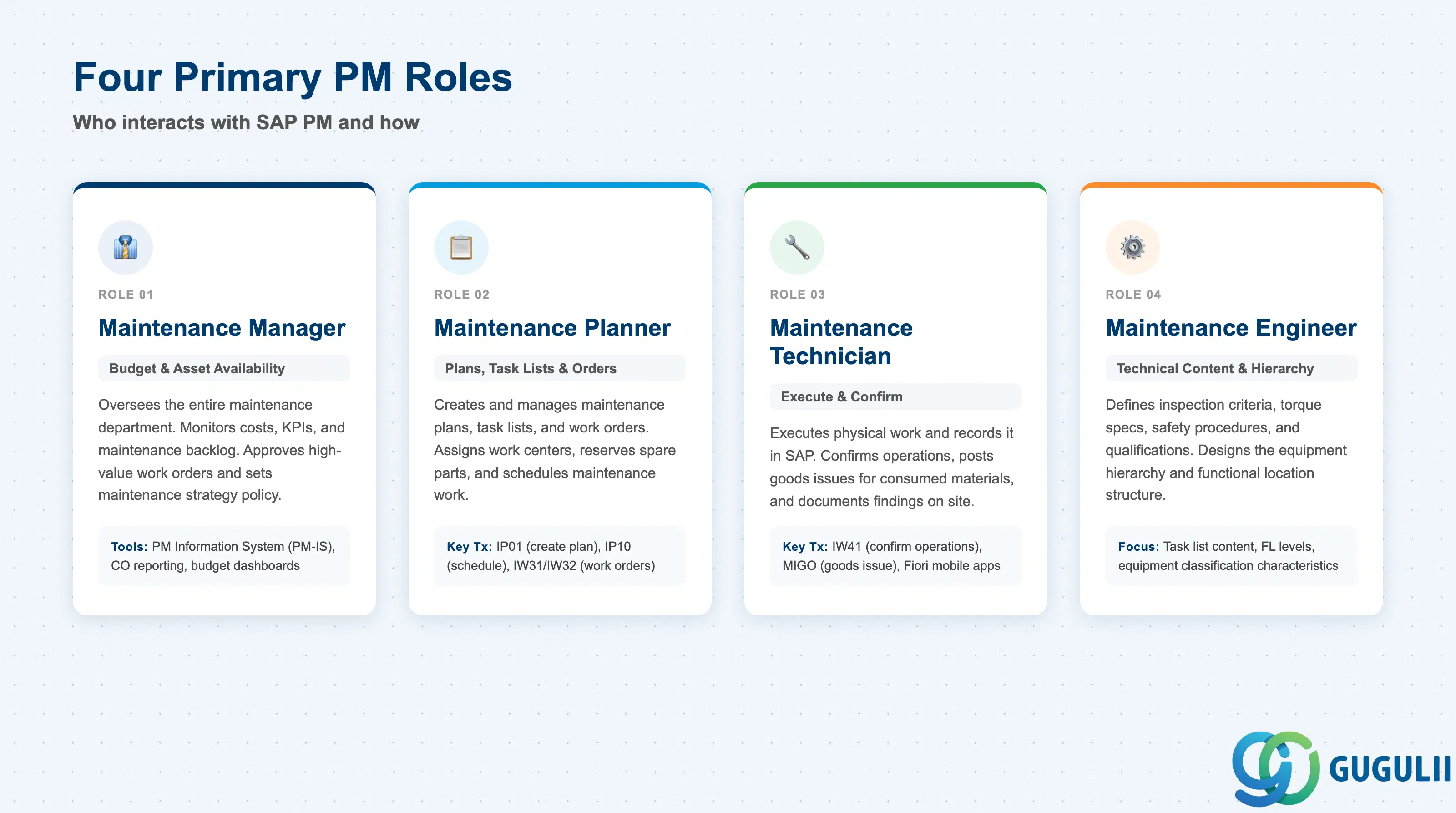
SAP PM involves four primary roles, each interacting with the system at a different stage of the maintenance lifecycle:
Maintenance Manager: Oversees the entire maintenance department. Primary concerns are budget adherence, asset availability rates, and maintenance backlog. In SAP, this role uses the PM Information System (PM-IS) and CO reporting to monitor costs and KPIs. They approve high-value work orders and set policy on maintenance strategies.
Maintenance Planner: Creates and manages maintenance plans, task lists, and work orders. The planner translates maintenance requirements into structured SAP objects: selecting the right task list, reserving spare parts, assigning work centers, and scheduling the work. Key transactions include IP01 (create maintenance plan), IP10 (schedule maintenance plan), and IW31/IW32 (create and modify work orders).
Maintenance Technician: Executes the physical work and records it in SAP. After receiving a work order (or accessing it via a Fiori app on a mobile device), the technician confirms completed operations (IW41), posts goods issues for consumed materials (MIGO), and documents findings. The technician role is the primary consumer of SAP’s Fiori-based mobile maintenance apps in S/4HANA.
Maintenance Engineer: Responsible for the technical content of maintenance plans and task lists — defining inspection criteria, torque specifications, safety procedures, and required qualifications. The engineer also manages the equipment hierarchy design: how many levels of functional location are needed, which assets require individual equipment records, and what classification characteristics should be captured for reporting.
SAP PM is the module that connects physical asset management to the financial and operational systems of an enterprise. Its strength lies not in any single feature but in the integration: a maintenance order that starts as a reported malfunction ends as a settled cost entry in Controlling, with a full audit trail from notification through execution. The module covers five functional domains — Equipment Management, Preventive Maintenance, Corrective Maintenance, Work Execution, and Cost Management — organized around a plant-based structure and supported by four primary roles.
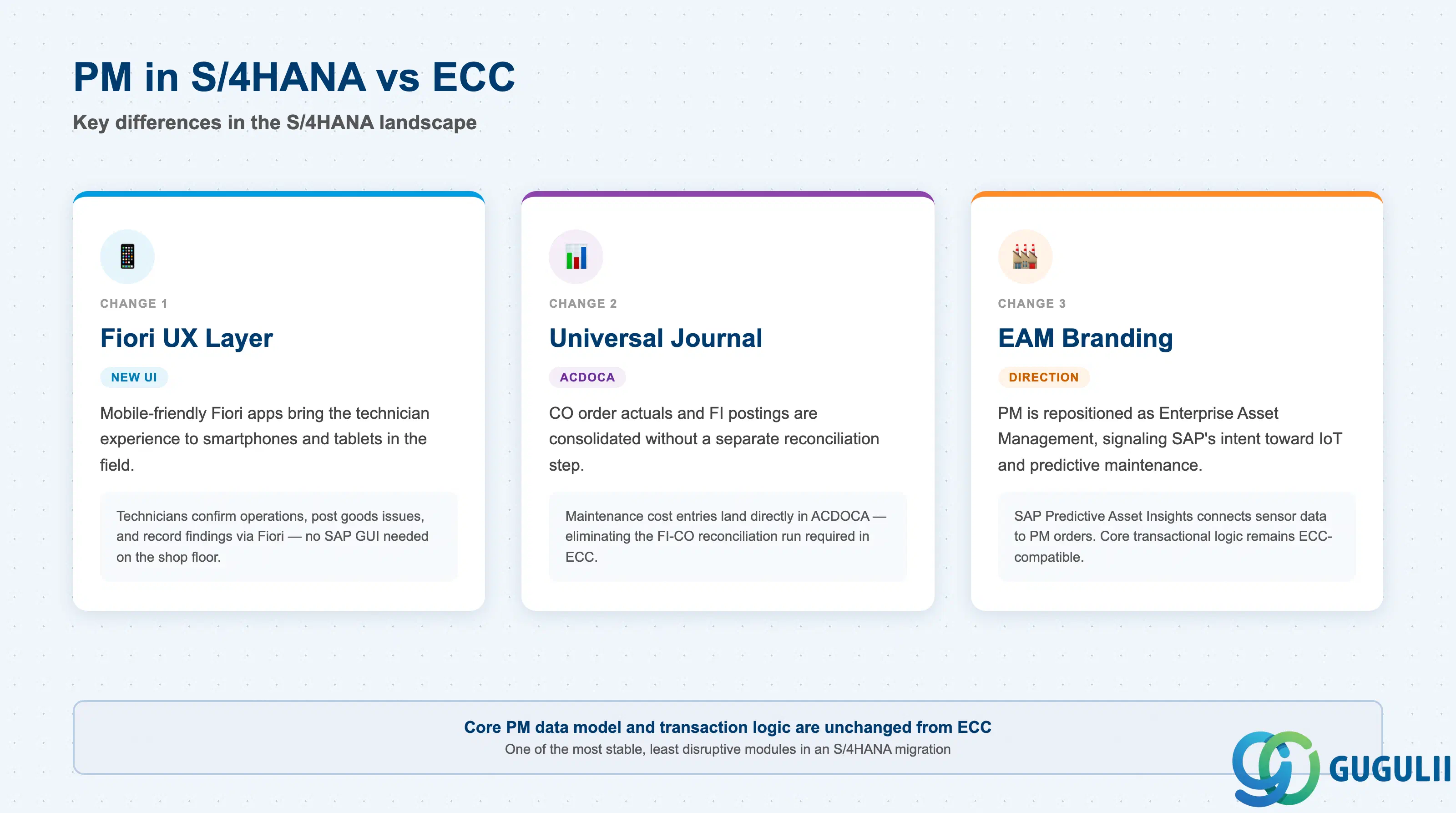
In S/4HANA, the core PM logic is unchanged from ECC. The visible differences are a Fiori UX layer that brings mobile-friendly apps to technicians in the field, the Universal Journal (ACDOCA) consolidating CO order actuals and FI postings without a reconciliation step, and the EAM branding that signals SAP’s intent to extend into IoT-driven predictive maintenance through services like SAP Predictive Asset Insights. For most on-premise S/4HANA implementations, PM remains one of the most stable and least disruptive modules to migrate.
Understanding SAP PM starts with mastering the two foundational master data objects — Functional Locations and Equipment — and the work order lifecycle that connects them to cost settlement. The subsequent articles in this series cover each of those areas in detail.
| ID | Category | Title |
|---|---|---|
| pm-001 | Overview | What is SAP PM? 📍 |
| ID | Category | Title |
|---|---|---|
| pm-a01 | Overview | SAP PM Master Data: Overview, Hierarchy & Relationships |
| pm-a02-01 | Master Data | SAP PM Functional Location |
| pm-a02-02 | Master Data | SAP PM Equipment |
| pm-a03-01 | Master Data | SAP PM Class |
| pm-a03-02 | Master Data | SAP PM Characteristic |
| pm-a04-01 | Master Data | SAP PM Measuring Point |
| pm-a05-01 | Master Data | SAP PM Work Center |
| pm-a06-01 | Master Data | SAP PM Material Master |
| pm-a05-02 | Master Data | SAP PM Task List |
| pm-a05-03 | Master Data | SAP PM Production Resource Tool |
| pm-a06-03 | Master Data | SAP PM Maintenance BOM |
| pm-a07-01 | Master Data | SAP PM Maintenance Item |
| pm-a07-02 | Master Data | SAP PM Maintenance Plan |
| ID | Category | Title |
|---|---|---|
| pm-b01 | Overview | SAP PM Transactions: Process Flow, Hierarchy & Relationships |