Title here
Summary here

Service Products in SAP S/4HANA Service are defined using the Material Master with Material Type DIEN (Service). Unlike physical goods, DIEN materials have no stock management — they represent billable service items such as labor hours, fixed-scope services, and subscription-based maintenance contracts. This article covers the Material Master structure and the key views Service consultants must configure for service product definition.
The Material Master is the central repository that stores all information about every material (item/product) a company handles — raw materials, semi-finished goods, finished products, consumables, and everything else that flows through the enterprise.
| Aspect | Details |
|---|---|
| Role | Single Source of Truth for all material attributes across the enterprise |
| Modules using it | MM (Purchasing, Inventory), PP (Production Planning, MRP, BOM), SD (Sales, Shipping, ATP), WM/EWM (Warehouse Mgmt, Putaway/Pick), QM (Quality Inspection, CoA), FI (Inventory Valuation, Auto Posting), CO (Standard Cost, Variance Analysis), PM (Plant Maintenance, MRO Procurement), PS (Project Procurement, Material Allocation), CS (Customer Service, Spare Parts), EHS (Hazardous Material Mgmt, Environmental Compliance), GTS (Trade Compliance, HS Code, Export Control) |
| Transactions | MM01 (Create) / MM02 (Change) / MM03 (Display) |
| S/4HANA change | Material number length extended from 18 to 40 digits (MATNR field) |
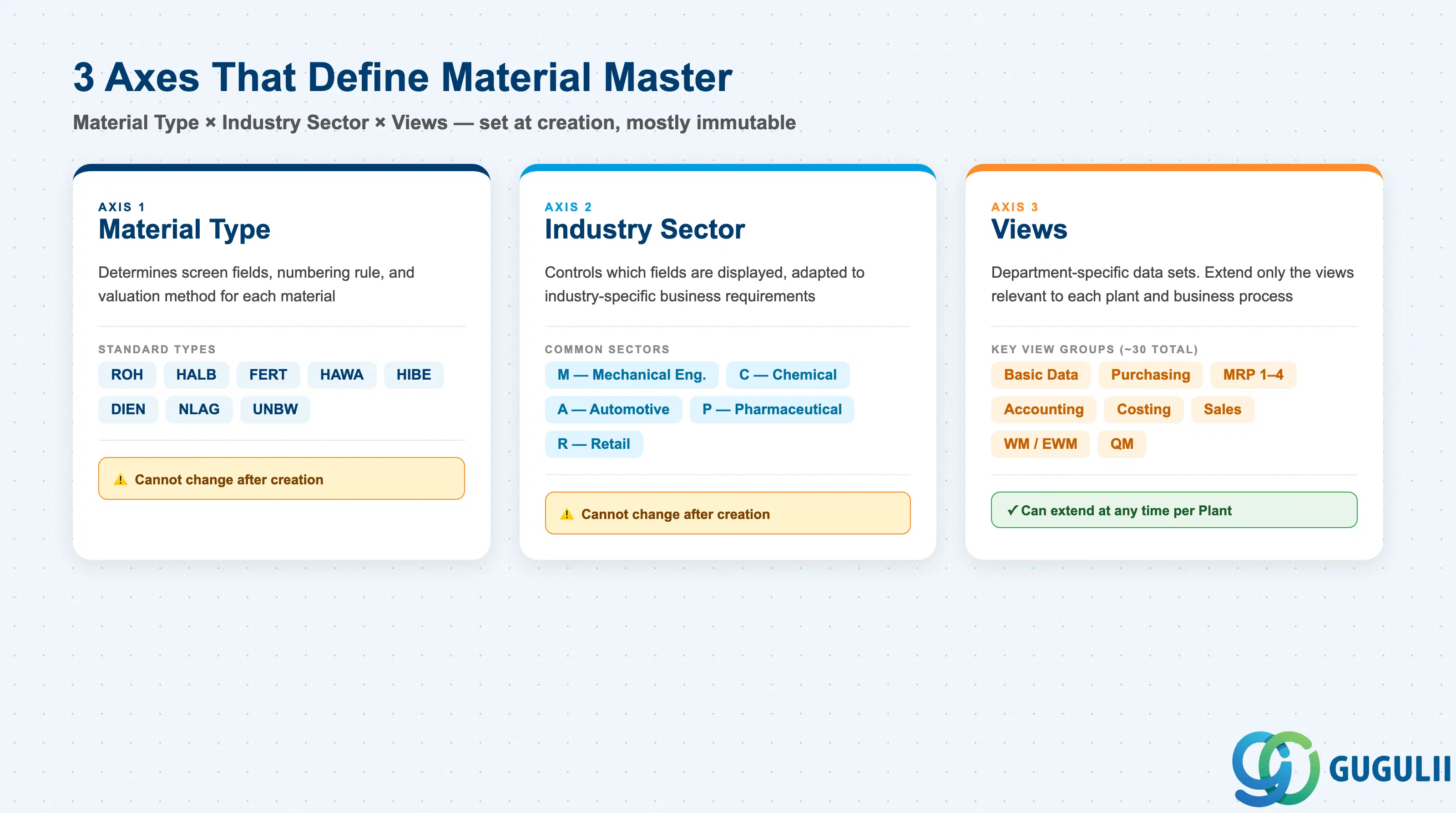
The structure of a Material Master record is determined by the combination of three axes:
| Axis | Description | Examples |
|---|---|---|
| Material Type | Classifies the material. Controls screen layout, number assignment, and valuation method | ROH, FERT, DIEN |
| Industry Sector | Industry branch. Controls which fields are displayed based on industry characteristics | M (Mechanical), C (Chemical), A (Automotive) |
| Views | Data sets organized by department. Only relevant views need to be extended | Basic Data, Sales, Accounting |
Important: Once created, Material Type and Industry Sector cannot be changed as a general rule. Lock these in during design.
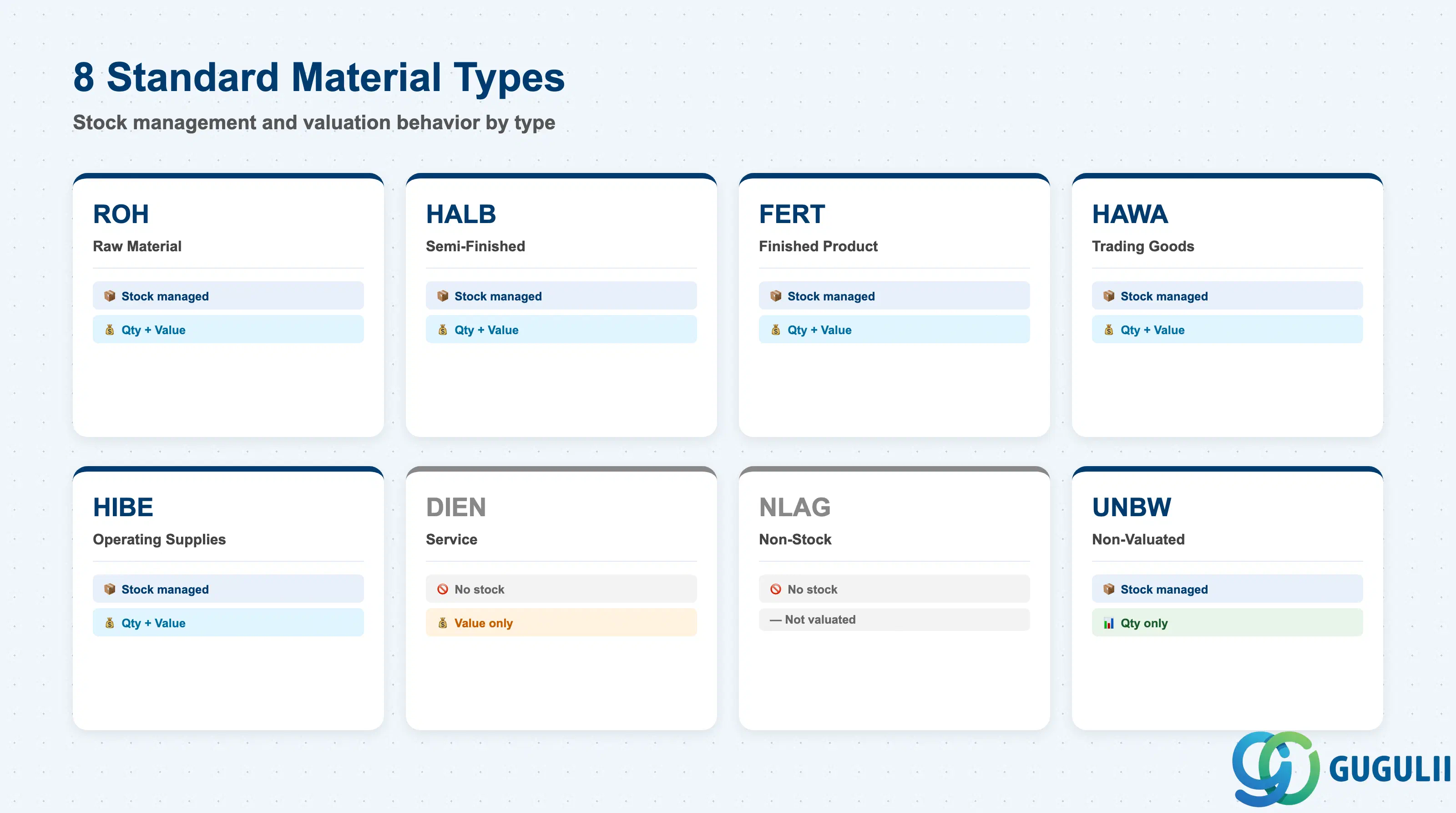
| Code | Name | Use Case | Stock-Managed | Qty / Value |
|---|---|---|---|---|
| ROH | Raw Material | Input materials | Yes | Both |
| HALB | Semi-Finished | Internally produced intermediates | Yes | Both |
| FERT | Finished Product | Internally produced / sold goods | Yes | Both |
| HAWA | Trading Goods | Buy-and-sell merchandise | Yes | Both |
| HIBE | Operating Supplies | Indirect materials, consumables | Yes | Both |
| DIEN | Service | Service items | No | Value only |
| NLAG | Non-Stock | No inventory management | No | — |
| UNBW | Non-Valuated | Quantity tracking only | Yes | Qty only |
Service Products use DIEN: No stock management, value-only posting. DIEN is the standard Material Type for billable service items in service contracts, service orders, and service quotations.
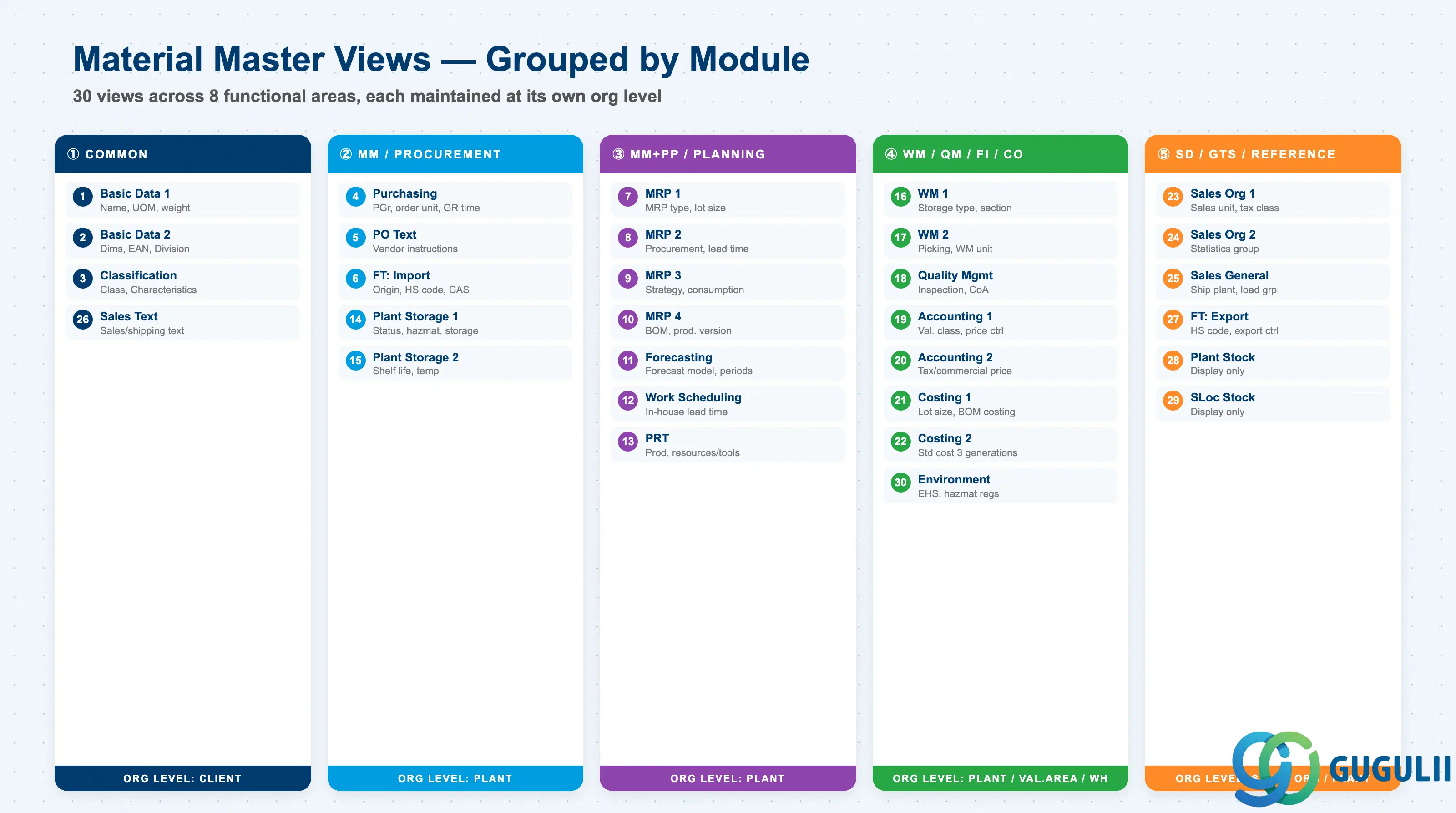
The Material Master is divided into department-specific Views. For DIEN service products, only a subset of views is relevant — stock and production views are not applicable.
| # | View | Owning Dept | Key Fields | Org Level |
|---|---|---|---|---|
| 1 | Basic Data 1 | Cross-module | Material description, Base UoM, Material group, Weight/Volume | Client |
| 2 | Basic Data 2 | Cross-module | Dimensions, EAN/UPC, Old material number, Division | Client |
| 3 | Classification | Cross-module | Class assignment, Characteristic values | Client |
| 4 | Purchasing | Purchasing (MM) | Purchasing group, Order unit, GR processing time, Source list required flag | Plant |
| 5 | Purchase Order Text | Purchasing (MM) | PO text, Text ID, Language | Plant |
| 6 | Foreign Trade: Import | Purchasing (MM) / GTS | Country of origin, HS code (import), CAS number, Import license | Plant |
| 7 | MRP 1 | Purchasing / PP (MM/PP) | MRP type, MRP controller, Lot size, Reorder point | Plant |
| 8 | MRP 2 | Purchasing / PP (MM/PP) | Procurement type, Special procurement, Planned delivery time, Safety stock | Plant |
| 9 | MRP 3 | Purchasing / PP (MM/PP) | Strategy group, Consumption mode, Availability check | Plant |
| 10 | MRP 4 | PP-oriented | BOM selection, Individual/collective requirements, Discontinuation flag | Plant |
| 11 | Forecasting | Purchasing / PP (MM/PP) | Forecast model, Historical/forecast periods, Smoothing factors | Plant |
| 12 | Work Scheduling | Production (PP) | Production unit, Receiving storage location, In-house production time | Plant |
| 13 | Production Resources/Tools | Production (PP) | Production resource/tool data | Plant |
| 14 | General Plant Data / Storage 1 | Inventory (MM) / EHS | Plant-specific material status, Storage conditions, Hazardous material number, EHS hazard data | Plant |
| 15 | General Plant Data / Storage 2 | Inventory (MM) | Shelf life management, Minimum remaining shelf life, Temperature conditions | Plant |
| 16 | Warehouse Management 1 | Warehouse (WM/EWM) | Warehouse number, Storage type, Storage section | Warehouse |
| 17 | Warehouse Management 2 | Warehouse (WM/EWM) | Picking type, WM unit of measure | Warehouse |
| 18 | Quality Management | Quality (QM) | QM procurement key, Inspection type, Certificate type | Plant |
| 19 | Accounting 1 | Finance (FI) | Valuation class, Price control (S/V), Standard price / Moving average price | Valuation Area |
| 20 | Accounting 2 | Finance (FI) | Tax-based valuation, Commercial valuation, Devaluation flag | Valuation Area |
| 21 | Costing 1 | Controlling (CO) | Costing lot size, With/without quantity structure, Variance key | Plant |
| 22 | Costing 2 | Controlling (CO) | Standard cost (Future/Current/Previous), Costing status | Plant |
| 23 | Sales: Sales Org 1 | Sales (SD) | Sales unit, Tax classification, Item category group | Sales Org / DCh |
| 24 | Sales: Sales Org 2 | Sales (SD) | Material statistics group, Material group 1–5 | Sales Org / DCh |
| 25 | Sales: General/Plant | Sales (SD) | Delivering plant, Transportation group, Loading group, Profit center | Plant |
| 26 | Sales Text | Sales (SD) | Sales/shipping texts | Client |
| 27 | Foreign Trade: Export | Trade (SD/GTS) | HS code (export), Export statistics group, Preference status, Export control | Plant |
| 28 | Plant Stock | Reference (display only) | Plant stock quantity / value (read-only) | Plant |
| 29 | Storage Location Stock | Reference (display only) | Storage location-level stock (read-only) | Storage Loc |
| 30 | Environment (EHS) | EHS | Hazardous substance regulations, Waste code | Plant |
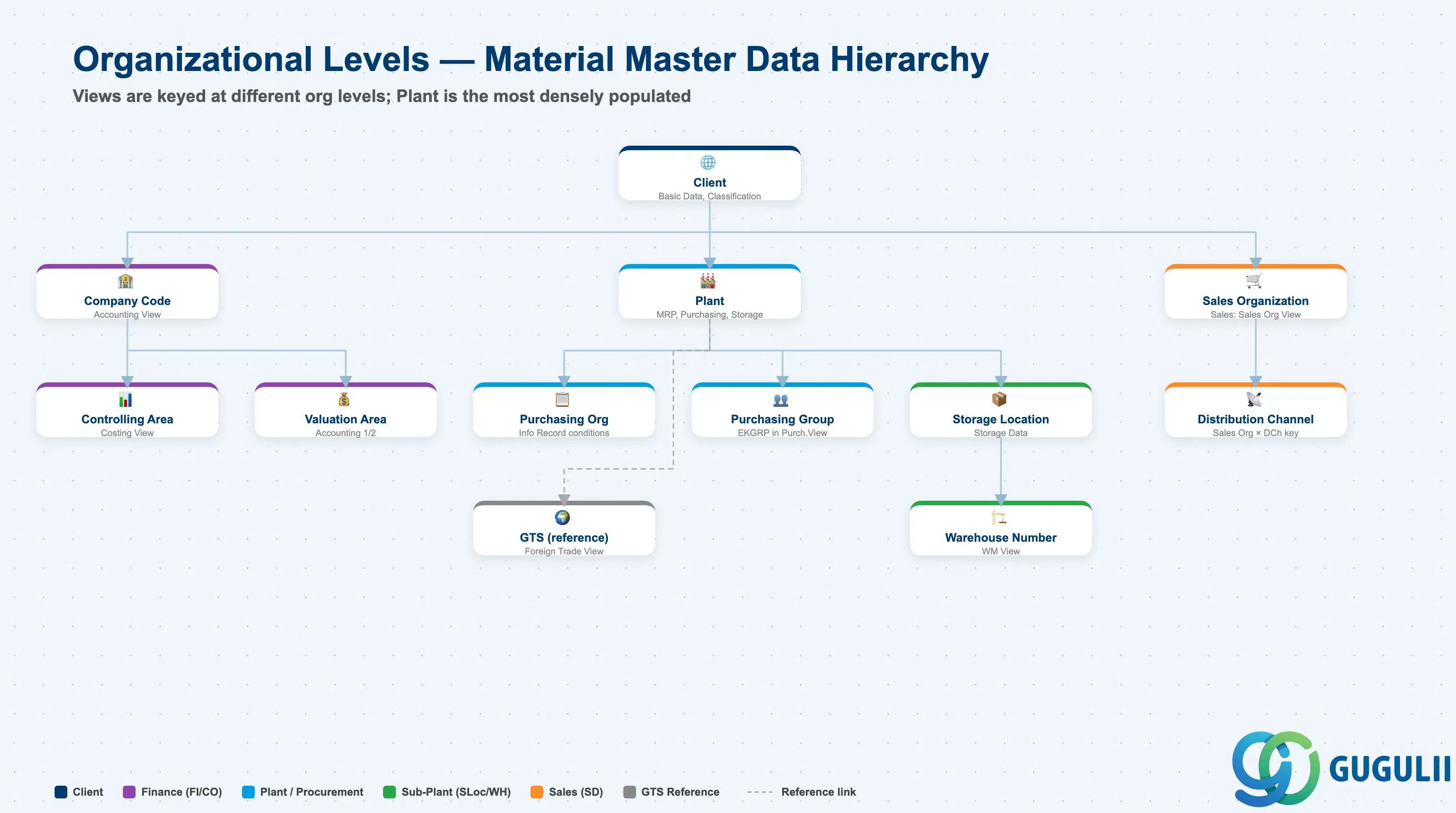
Each view stores its data at a different organizational level. This is the core design challenge of the Material Master.
Client (300)
   │
   ├── Basic Data, Classification ← Client-level (one record for entire enterprise)
   │
   ├── Plant (1000, 2000, ...)
   │      │
   │      ├── MRP, Purchasing, Work Scheduling ← Plant-level
   │      │
   │      ├── Storage Location (0001, 0002, ...)
   │      │      └── Storage Data ← Storage Location-level
   │      │
   │      └── Warehouse Number (WH1, ...)
   │             └── WM Data ← Warehouse-level
   │
   ├── Valuation Area = Plant ← Accounting is typically at Plant level
   │      └── Valuation class, Standard cost
   │
   └── Sales Org × Distribution Channel
└── Sales Data ← Sales Org-level| Org Level | Primary Use | Representative Fields | Notes |
|---|---|---|---|
| Client | Enterprise-wide common attributes | Material description, Base UoM, Classification | One record shared across entire enterprise |
| Company Code | Financial accounting unit | Accounting View (valuation class, price control) | When Valuation Area = Company Code |
| Controlling Area | Management accounting unit | Costing View (cost estimate, variance analysis) | May span multiple Company Codes |
| Plant | Factory / site unit | MRP, Purchasing, Work Scheduling, General Plant Data | The primary level with the most views |
| Valuation Area | Inventory valuation unit | Accounting 1 (valuation class, standard price) | Typically = Plant |
| Sales Organization | Sales org unit | Sales: Sales Org View (sales unit, tax classification) | Keyed together with Distribution Channel |
| Distribution Channel | Distribution channel unit | Sales: Sales Org View | Extended in combination with Sales Org |
For DIEN service products, stock and production views are not applicable. The critical views are Basic Data, Sales, Accounting, and Costing.
| # | View | Primary Module | Service Product Involvement |
|---|---|---|---|
| 1 | Basic Data 1 | Cross-module | ◎ (material type DIEN, base UoM, item category group) |
| 2 | Basic Data 2 | Cross-module | △ |
| 3 | Classification | Cross-module | △ |
| 4 | Purchasing | MM | × (not applicable for DIEN) |
| 5 | Purchase Order Text | MM | × |
| 6 | Foreign Trade: Import | MM | × |
| 7 | MRP 1 | MM / PP | × |
| 8 | MRP 2 | MM / PP | × |
| 9 | MRP 3 | MM / PP | × |
| 10 | MRP 4 | PP | × |
| 11 | Forecasting | MM / PP | × |
| 12 | Work Scheduling | PP | × |
| 13 | Production Resources/Tools | PP | × |
| 14 | General Plant Data / Storage 1 | MM | × |
| 15 | General Plant Data / Storage 2 | MM | × |
| 16 | Warehouse Management 1 | WM / EWM | × |
| 17 | Warehouse Management 2 | WM / EWM | × |
| 18 | Quality Management | QM | × |
| 19 | Accounting 1 | FI | ◎ (valuation class for service revenue) |
| 20 | Accounting 2 | FI | △ |
| 21 | Costing 1 | CO | ○ (service product cost) |
| 22 | Costing 2 | CO | △ |
| 23 | Sales: Sales Org 1 | SD / Service | ◎ (item category group, tax classification, account assignment group) |
| 24 | Sales: Sales Org 2 | SD / Service | ○ |
| 25 | Sales: General/Plant | SD / Service | ◎ (delivering plant, profit center) |
| 26 | Sales Text | SD / Service | ◎ (customer-facing service description) |
| 27 | Foreign Trade: Export | SD / GTS | △ |
| 28 | Plant Stock | Reference | — (always zero for DIEN) |
| 29 | Storage Location Stock | Reference | — |
| 30 | Environment (EHS) | EHS | × |
Legend: ◎ = Owner / Critical, ○ = Direct involvement, △ = Reference / Integration, × = Not applicable for DIEN, — = Display-only view
| Field | Description | Practical Usage |
|---|---|---|
| Material Type | DIEN (Service Product) | DIEN: no stock management, value-only posting. Mandatory for service line items in service contracts and service orders. Once set, Material Type cannot be changed — confirm with the business before creation. |
| Base Unit of Measure | Service billing unit | H (hours) for time-based services, EA for fixed-scope services, MO (months) for subscriptions — must align with the contract pricing unit. The billing document quantity = confirmed service quantity in this unit. |
| Material Group | Service category | Design a service-specific Material Group hierarchy: Field Service, Remote Support, Preventive Maintenance, Warranty Service. Used as a key axis in service revenue reporting and CO-PA profitability analysis. |
| General Item Category Group | SD item category driver | For DIEN service products: LEIS (service without delivery) — drives Item Category determination, controlling delivery creation, billing relevance, and revenue recognition method. This is the most critical field in Basic Data for service materials. |
| Field | Description | Practical Usage |
|---|---|---|
| Item Category Group | Service order line item type | LEIS = service without delivery reference (most common for S/4HANA Service). Controls the entire service order and contract line item processing — billing plan generation, revenue recognition, and delivery relevance. |
| Tax Classification | Output tax determination | For services, tax rules often differ from physical goods (e.g., place-of-supply rules for cross-border services). Set per service type and align with the tax determination procedure. |
| Account Assignment Group | Revenue G/L determination | Determines which revenue G/L account is posted when service billing occurs. Design separate groups for: Service Revenue (time-based), Contract Revenue, One-time Service. Align with FI for P&L visibility. |
| Sales Unit | Billing unit | Must match the unit in the service contract. H for time-and-material, EA for fixed-scope, MO for subscription. |
| Field | Description | Practical Usage |
|---|---|---|
| Profit Center | Service revenue profit center | Revenue from service contracts and service orders flows to this Profit Center. Design separate Profit Centers for: service contracts, ad-hoc service, warranty service — to enable clear service P&L reporting by business line. |
| Availability Check | ATP check rule | For DIEN materials, ATP is not relevant (no stock). Set to blank or a rule that returns “always available.” |
| Field | Description | Practical Usage |
|---|---|---|
| Sales Text | Customer-facing service description | Appears on service quotes, order confirmations, and invoices. Write from the customer’s perspective: “Annual Preventive Maintenance Service — includes 2 scheduled visits, system performance check, filter replacement, and software update.” A vague or missing text leads to billing disputes. |
| Field | Description | Practical Usage |
|---|---|---|
| Valuation Class | Revenue account for services | For DIEN materials (no stock), the Valuation Class maps to the service revenue G/L account via VKOA. Design a dedicated Valuation Class for each service revenue category (contract revenue, time-and-material revenue, warranty-covered service). |
| Price Control | Not applicable for DIEN | DIEN materials have no stock and no inventory valuation — Price Control field is not relevant. |
| ID | Category | Title |
|---|---|---|
| srv-001 | Overview | What is SAP Service? |
| ID | Category | Title |
|---|---|---|
| srv-a01 | Overview | SAP Service Master Data: Overview, Hierarchy & Relationships |
| srv-a03-01 | Master Data | SAP Service Product Master 📍 |
| srv-a04-01 | Master Data | SAP Spare Parts Master |
| srv-a03-02 | Master Data | SAP Service Pricing Condition |
| srv-a05-01 | Master Data | SAP Service Functional Location |
| srv-a05-02 | Master Data | SAP Service Equipment |
| srv-a05-03 | Master Data | SAP Service Bill of Material |
| srv-a06-01 | Master Data | SAP Service Service Contract Template |
| srv-a06-02 | Master Data | SAP Service Service Order Template |
| srv-a07-01 | Master Data | SAP Service Warranty Master |