Title here
Summary here

Spare Parts in SAP S/4HANA Service are defined using the Material Master with Material Type ERSA (Spare Parts) or HIBE (Operating Supplies). Unlike service products (DIEN), spare parts are stock-managed — they are physically consumed during service order execution. First-Time Fix Rate (FTFR), service SLA compliance, and field engineer productivity all depend on spare parts availability, which is driven by settings in this master. This article covers the key views Service consultants must configure for spare parts management.
The Material Master is the central repository that stores all information about every material (item/product) a company handles — raw materials, semi-finished goods, finished products, consumables, and everything else that flows through the enterprise.
| Aspect | Details |
|---|---|
| Role | Single Source of Truth for all material attributes across the enterprise |
| Modules using it | MM (Purchasing, Inventory), PP (Production Planning, MRP, BOM), SD (Sales, Shipping, ATP), WM/EWM (Warehouse Mgmt, Putaway/Pick), QM (Quality Inspection, CoA), FI (Inventory Valuation, Auto Posting), CO (Standard Cost, Variance Analysis), PM (Plant Maintenance, MRO Procurement), PS (Project Procurement, Material Allocation), CS (Customer Service, Spare Parts), EHS (Hazardous Material Mgmt, Environmental Compliance), GTS (Trade Compliance, HS Code, Export Control) |
| Transactions | MM01 (Create) / MM02 (Change) / MM03 (Display) |
| S/4HANA change | Material number length extended from 18 to 40 digits (MATNR field) |
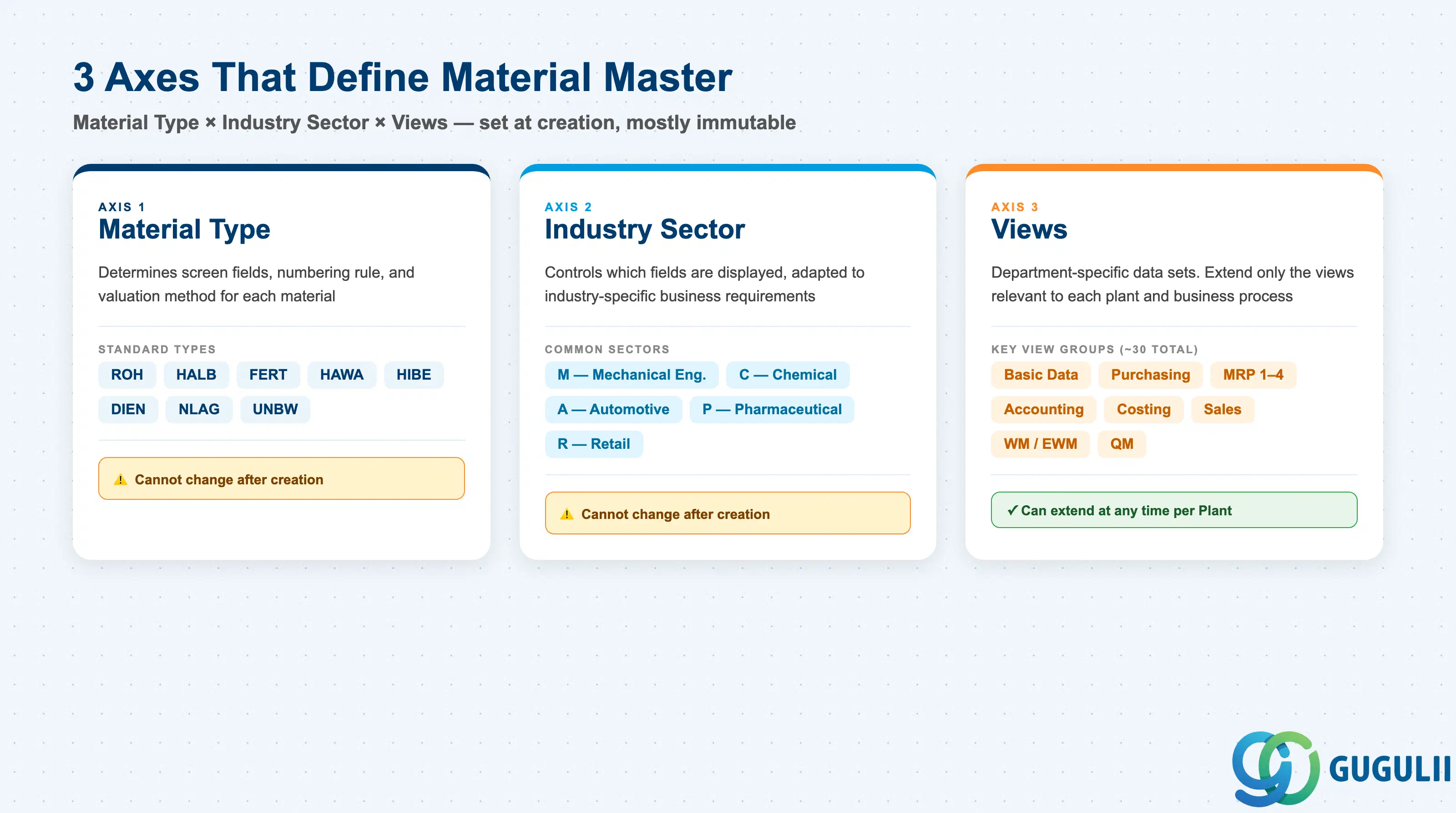
The structure of a Material Master record is determined by the combination of three axes:
| Axis | Description | Examples |
|---|---|---|
| Material Type | Classifies the material. Controls screen layout, number assignment, and valuation method | ERSA, HIBE, NLAG |
| Industry Sector | Industry branch. Controls which fields are displayed based on industry characteristics | M (Mechanical), C (Chemical), A (Automotive) |
| Views | Data sets organized by department. Only relevant views need to be extended | Basic Data, Purchasing, MRP, Accounting |
Important: Once created, Material Type and Industry Sector cannot be changed as a general rule. Lock these in during design.
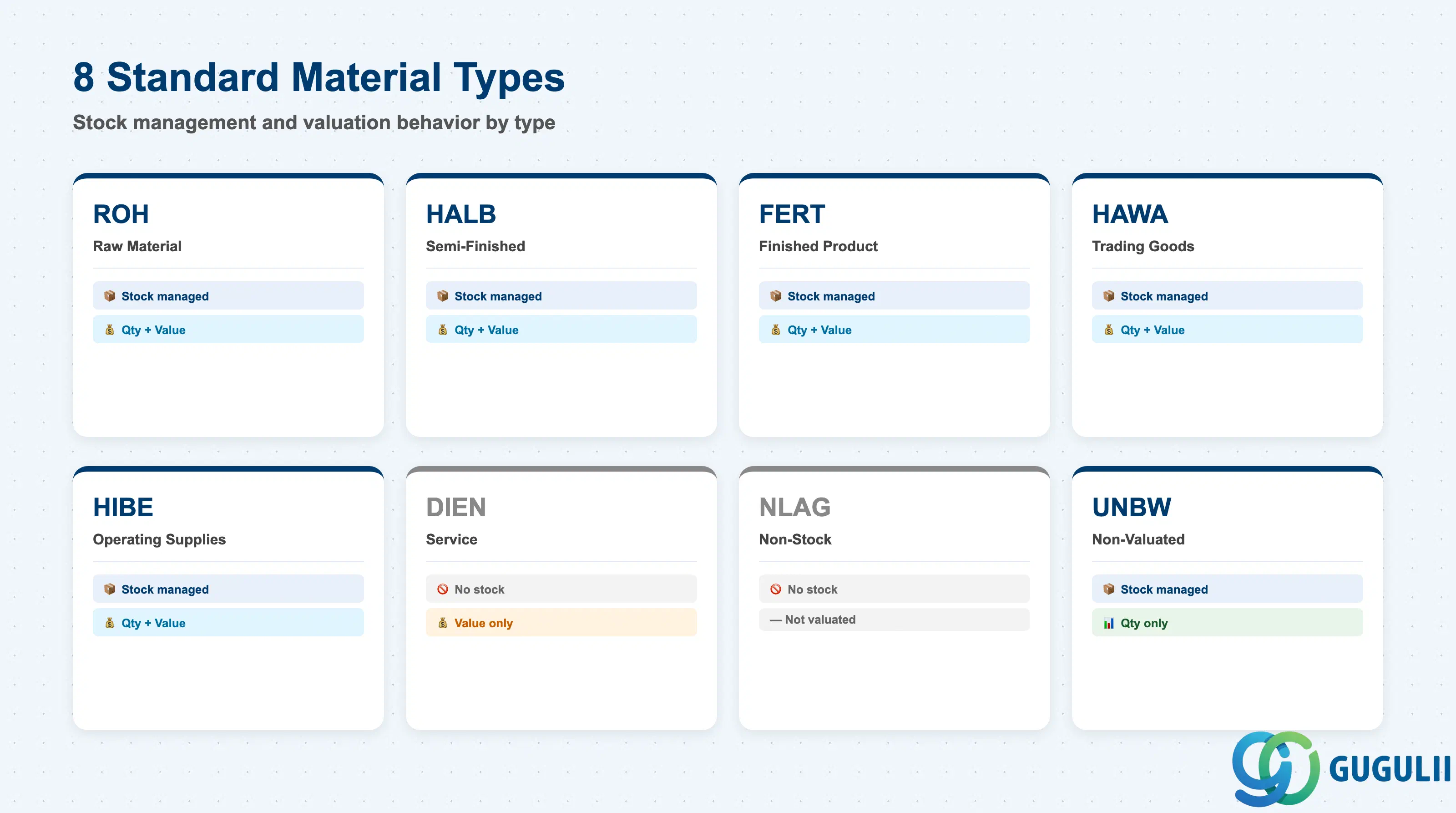
| Code | Name | Use Case | Stock-Managed | Qty / Value |
|---|---|---|---|---|
| ROH | Raw Material | Input materials | Yes | Both |
| HALB | Semi-Finished | Internally produced intermediates | Yes | Both |
| FERT | Finished Product | Internally produced / sold goods | Yes | Both |
| HAWA | Trading Goods | Buy-and-sell merchandise | Yes | Both |
| HIBE | Operating Supplies | Indirect materials, consumables | Yes | Both |
| DIEN | Service | Service items | No | Value only |
| NLAG | Non-Stock | No inventory management | No | — |
| UNBW | Non-Valuated | Quantity tracking only | Yes | Qty only |
Service spare parts use ERSA / HIBE: ERSA (Spare Parts) for repairable/critical components with stock management. HIBE (Operating Supplies) for consumables used during service execution (lubricants, filters). NLAG for low-value items procured directly to service orders without stock management.
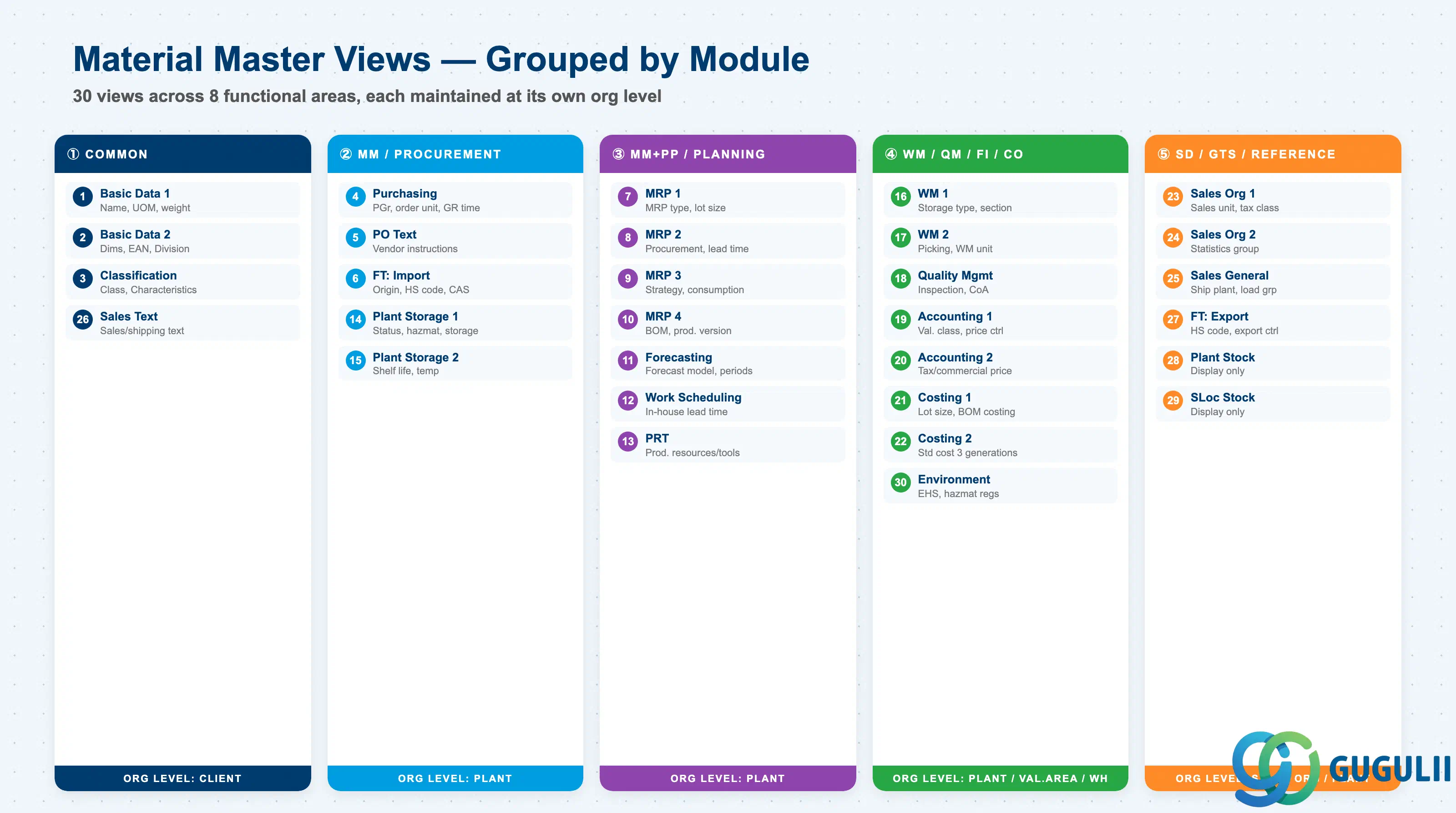
The Material Master is divided into department-specific Views. For spare parts (ERSA/HIBE), Purchasing, MRP, Storage, and Accounting views are all relevant.
| # | View | Owning Dept | Key Fields | Org Level |
|---|---|---|---|---|
| 1 | Basic Data 1 | Cross-module | Material description, Base UoM, Material group, Weight/Volume | Client |
| 2 | Basic Data 2 | Cross-module | Dimensions, EAN/UPC, Old material number, Division | Client |
| 3 | Classification | Cross-module | Class assignment, Characteristic values | Client |
| 4 | Purchasing | Purchasing (MM) | Purchasing group, Order unit, GR processing time, Source list required flag | Plant |
| 5 | Purchase Order Text | Purchasing (MM) | PO text, Text ID, Language | Plant |
| 6 | Foreign Trade: Import | Purchasing (MM) / GTS | Country of origin, HS code (import), CAS number, Import license | Plant |
| 7 | MRP 1 | Purchasing / PP (MM/PP) | MRP type, MRP controller, Lot size, Reorder point | Plant |
| 8 | MRP 2 | Purchasing / PP (MM/PP) | Procurement type, Special procurement, Planned delivery time, Safety stock | Plant |
| 9 | MRP 3 | Purchasing / PP (MM/PP) | Strategy group, Consumption mode, Availability check | Plant |
| 10 | MRP 4 | PP-oriented | BOM selection, Individual/collective requirements, Discontinuation flag | Plant |
| 11 | Forecasting | Purchasing / PP (MM/PP) | Forecast model, Historical/forecast periods, Smoothing factors | Plant |
| 12 | Work Scheduling | Production (PP) | Production unit, Receiving storage location, In-house production time | Plant |
| 13 | Production Resources/Tools | Production (PP) | Production resource/tool data | Plant |
| 14 | General Plant Data / Storage 1 | Inventory (MM) / EHS | Plant-specific material status, Storage conditions, Hazardous material number, EHS hazard data | Plant |
| 15 | General Plant Data / Storage 2 | Inventory (MM) | Shelf life management, Minimum remaining shelf life, Temperature conditions | Plant |
| 16 | Warehouse Management 1 | Warehouse (WM/EWM) | Warehouse number, Storage type, Storage section | Warehouse |
| 17 | Warehouse Management 2 | Warehouse (WM/EWM) | Picking type, WM unit of measure | Warehouse |
| 18 | Quality Management | Quality (QM) | QM procurement key, Inspection type, Certificate type | Plant |
| 19 | Accounting 1 | Finance (FI) | Valuation class, Price control (S/V), Standard price / Moving average price | Valuation Area |
| 20 | Accounting 2 | Finance (FI) | Tax-based valuation, Commercial valuation, Devaluation flag | Valuation Area |
| 21 | Costing 1 | Controlling (CO) | Costing lot size, With/without quantity structure, Variance key | Plant |
| 22 | Costing 2 | Controlling (CO) | Standard cost (Future/Current/Previous), Costing status | Plant |
| 23 | Sales: Sales Org 1 | Sales (SD) | Sales unit, Tax classification, Item category group | Sales Org / DCh |
| 24 | Sales: Sales Org 2 | Sales (SD) | Material statistics group, Material group 1–5 | Sales Org / DCh |
| 25 | Sales: General/Plant | Sales (SD) | Delivering plant, Transportation group, Loading group, Profit center | Plant |
| 26 | Sales Text | Sales (SD) | Sales/shipping texts | Client |
| 27 | Foreign Trade: Export | Trade (SD/GTS) | HS code (export), Export statistics group, Preference status, Export control | Plant |
| 28 | Plant Stock | Reference (display only) | Plant stock quantity / value (read-only) | Plant |
| 29 | Storage Location Stock | Reference (display only) | Storage location-level stock (read-only) | Storage Loc |
| 30 | Environment (EHS) | EHS | Hazardous substance regulations, Waste code | Plant |
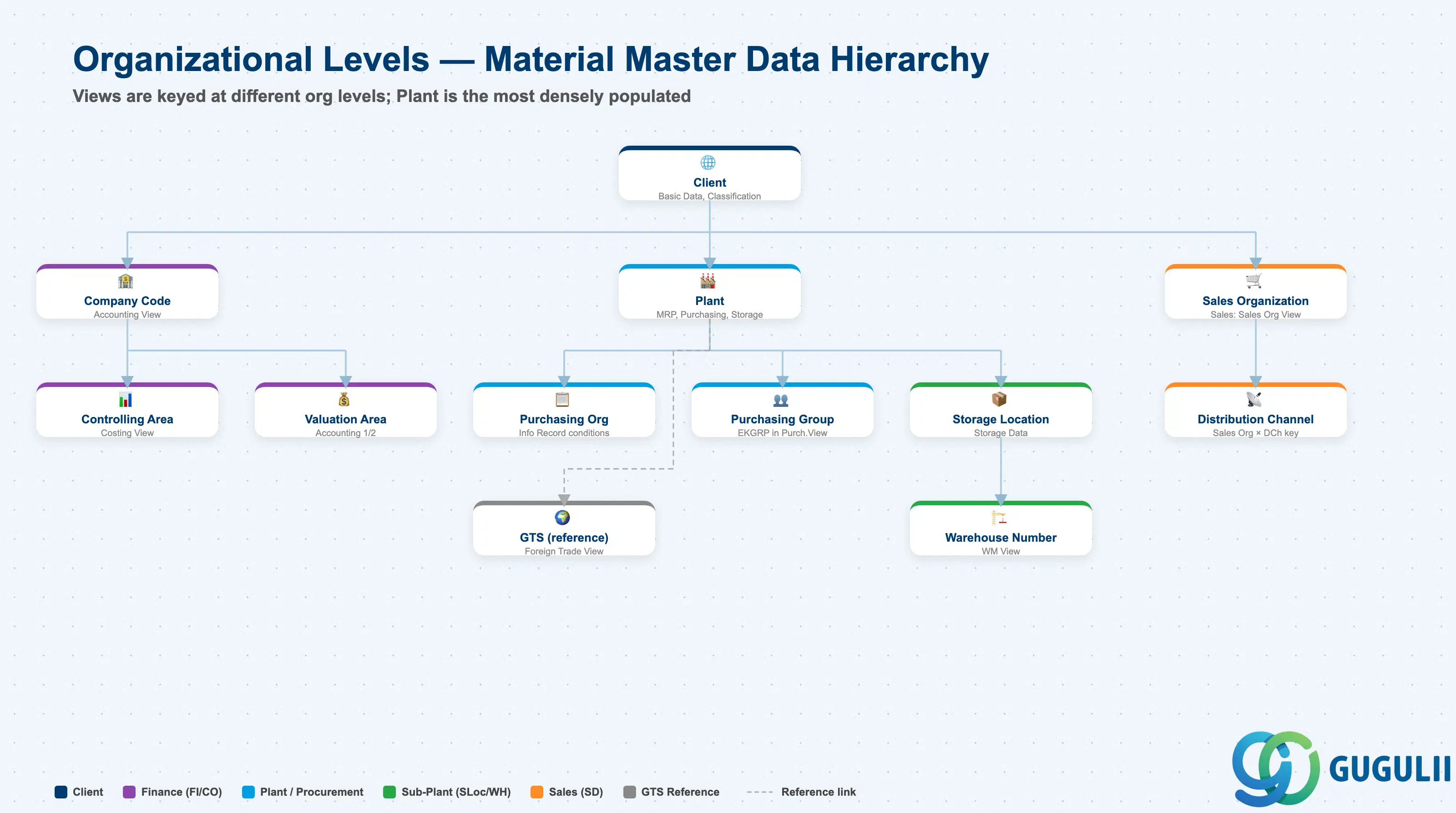
Each view stores its data at a different organizational level. This is the core design challenge of the Material Master.
Client (300)
   │
   ├── Basic Data, Classification ← Client-level (one record for entire enterprise)
   │
   ├── Plant (1000, 2000, ...)
   │      │
   │      ├── MRP, Purchasing, Work Scheduling ← Plant-level
   │      │
   │      ├── Storage Location (0001, 0002, ...)
   │      │      └── Storage Data ← Storage Location-level
   │      │
   │      └── Warehouse Number (WH1, ...)
   │             └── WM Data ← Warehouse-level
   │
   ├── Valuation Area = Plant ← Accounting is typically at Plant level
   │      └── Valuation class, Standard cost
   │
   └── Sales Org × Distribution Channel
└── Sales Data ← Sales Org-level| Org Level | Primary Use | Representative Fields | Notes |
|---|---|---|---|
| Client | Enterprise-wide common attributes | Material description, Base UoM, Classification | One record shared across entire enterprise |
| Company Code | Financial accounting unit | Accounting View (valuation class, price control) | When Valuation Area = Company Code |
| Plant | Factory / service depot unit | MRP, Purchasing, General Plant Data | The primary level with the most views |
| Purchasing Organization | Purchasing org unit | Purchasing Info Record (price, conditions) | Material Master itself is at Plant level |
| Purchasing Group | Buyer group | Purchasing View: Purchasing Group (EKGRP) | Service parts buyer group |
| Valuation Area | Inventory valuation unit | Accounting 1 (valuation class, standard price) | Typically = Plant |
| Storage Location | Storage area unit | General Plant Data / Storage (storage location stock) | Service parts warehouse / van stock |
| Warehouse Number | Warehouse management unit | WM View (storage type, picking strategy) | Used in depots with WM/EWM |
For spare parts (ERSA/HIBE), Purchasing, MRP, Storage, and Accounting views are all critical. Sales views apply only when spare parts are also sold directly to customers.
| # | View | Primary Module | Spare Parts Involvement |
|---|---|---|---|
| 1 | Basic Data 1 | Cross-module | ◎ (material type ERSA/HIBE, description, base UoM) |
| 2 | Basic Data 2 | Cross-module | ○ (old material number / manufacturer cross-reference) |
| 3 | Classification | Cross-module | ◎ (spare part search by specification) |
| 4 | Purchasing | MM / Service | ◎ (MRO procurement settings, purchasing group) |
| 5 | Purchase Order Text | MM | ○ (service-specific delivery instructions) |
| 6 | Foreign Trade: Import | MM | △ (imported OEM parts) |
| 7 | MRP 1 | MM / PP | ◎ (reorder point for critical spares) |
| 8 | MRP 2 | MM / PP | ○ (planned delivery time, safety stock) |
| 9 | MRP 3 | MM / PP | × |
| 10 | MRP 4 | PP | × |
| 11 | Forecasting | MM / PP | △ |
| 12 | Work Scheduling | PP | × |
| 13 | Production Resources/Tools | PP | × |
| 14 | General Plant Data / Storage 1 | MM | ◎ (storage conditions, shelf life) |
| 15 | General Plant Data / Storage 2 | MM | ○ |
| 16 | Warehouse Management 1 | WM / EWM | ○ (service depot bin location) |
| 17 | Warehouse Management 2 | WM / EWM | ○ |
| 18 | Quality Management | QM | △ (incoming inspection for critical parts) |
| 19 | Accounting 1 | FI | ◎ (valuation class for spare parts inventory) |
| 20 | Accounting 2 | FI | △ |
| 21 | Costing 1 | CO | △ |
| 22 | Costing 2 | CO | △ |
| 23 | Sales: Sales Org 1 | SD | ○ (when spare parts sold directly to customers) |
| 24 | Sales: Sales Org 2 | SD | △ |
| 25 | Sales: General/Plant | SD | ○ (profit center for spare parts sales) |
| 26 | Sales Text | SD | △ |
| 27 | Foreign Trade: Export | SD / GTS | △ |
| 28 | Plant Stock | Reference | — |
| 29 | Storage Location Stock | Reference | — |
| 30 | Environment (EHS) | EHS | ○ (hazardous consumables) |
Legend: ◎ = Owner / Critical, ○ = Direct involvement, △ = Reference / Integration, × = Not applicable, — = Display-only view
| Field | Description | Practical Usage |
|---|---|---|
| Material Type | ERSA (Spare Parts) or HIBE (Consumables) | ERSA: stock-managed, for repairable/critical components consumed in service orders. HIBE: for consumables (lubricants, filters) used during service execution. NLAG: for low-value items procured directly to service orders without stock management. |
| Base Unit of Measure | Stock management unit | EA (each) for discrete parts, M for cables/seals, L/KG for consumables. Standardize across the spare parts catalog — mixing units for the same part type creates errors in service order component reservations. |
| Material Group | Service spare parts category | Align with the service business: Critical Spares, Consumables, Customer-Replaceable Units (CRU), Accessories. Drives spare parts spend analysis and ABC classification for safety stock policy. |
| Old Material Number | Manufacturer / OEM cross-reference | Store the manufacturer’s part number here. Field engineers typically know parts by OEM code — this enables cross-reference search in SE16/MM60 when the SAP material number is unknown on-site. |
| Field | Description | Practical Usage |
|---|---|---|
| Purchasing Group | Service parts buyer | Assign to a dedicated service procurement group, separate from production materials. Enables service-specific procurement approval policies and service parts contract management (e.g., OEM spare parts contracts). |
| Planned Delivery Time | Lead time for replenishment | For field service operations, planned delivery time of critical spare parts directly determines First-Time Fix Rate (FTFR). For long-lead OEM parts, consider consignment stock or vendor-managed inventory to eliminate lead time impact. |
| GR Processing Time | Receipt handling time | For spare parts requiring incoming inspection (QM), add inspection time here so MRP schedules the PR creation correctly. |
| Source List Required | Approved vendor restriction | For OEM-only spare parts (warranty compliance), enable this flag to prevent unauthorized vendor selection. Combine with a Source List entry for the approved vendor. |
| Field | Description | Practical Usage |
|---|---|---|
| MRP Type | Replenishment method | VB (Reorder Point) is standard for service spare parts — consumption is event-driven (equipment failures, scheduled maintenance calls), not forecast-driven. ND = no planning for non-critical / one-time-order parts. |
| Reorder Point | Minimum stock trigger | For critical spare parts whose stockout causes customer SLA breaches: set higher reorder point. ABC-classify service spare parts — A-critical = VB with safety stock, C = ND or one-time order. |
| Safety Stock | Buffer for demand variability | In field service, spare parts demand variability is high (failures are unpredictable). Set safety stock based on service level targets (e.g., 98% fill rate for critical parts). Document the rationale in the material long text. |
| MRP Controller | Service parts planner | Assign to the service parts planner (not production planner) so replenishment decisions are made by the right person when MRP generates exception messages. |
| Field | Description | Practical Usage |
|---|---|---|
| Storage Conditions | Special storage requirements | Electronic components require ESD-safe storage. Hydraulic seals must not be stored near solvents. Lubricants require temperature-controlled areas. Define storage conditions to route incoming parts to the correct service depot storage area. |
| Hazardous Material Number | EHS hazmat reference | Service consumables (lubricants, cleaning agents) are often classified as hazardous. Links to SDS and ensures compliance with storage and handling regulations. |
| Shelf Life Expiration Required | Shelf life management | Enable for parts with limited shelf life (seals, gaskets, adhesives). Prevents the use of expired parts in service orders — which can void OEM warranties and cause premature equipment failure. |
| Field | Description | Practical Usage |
|---|---|---|
| Valuation Class | Spare parts inventory G/L account | Assign a dedicated Valuation Class for service spare parts (separate from production materials). Creates a separate spare parts inventory balance sheet account — enabling service parts inventory management and COGS reporting independent of production inventory. |
| Price Control (V = Moving Average) | Spare parts valuation method | Moving Average Price (V) is standard — spare parts prices vary by order. Monitor MAP for high-value critical spares: irregular large orders can cause significant MAP fluctuations. |
| ID | Category | Title |
|---|---|---|
| srv-001 | Overview | What is SAP Service? |
| ID | Category | Title |
|---|---|---|
| srv-a01 | Overview | SAP Service Master Data: Overview, Hierarchy & Relationships |
| srv-a03-01 | Master Data | SAP Service Product Master |
| srv-a04-01 | Master Data | SAP Spare Parts Master 📍 |
| srv-a03-02 | Master Data | SAP Service Pricing Condition |
| srv-a05-01 | Master Data | SAP Service Functional Location |
| srv-a05-02 | Master Data | SAP Service Equipment |
| srv-a05-03 | Master Data | SAP Service Bill of Material |
| srv-a06-01 | Master Data | SAP Service Service Contract Template |
| srv-a06-02 | Master Data | SAP Service Service Order Template |
| srv-a07-01 | Master Data | SAP Service Warranty Master |