Title here
Summary here

| Reader | What You Will Get |
|---|---|
| Executives & DX Leaders | A 3-line takeaway on what BTP delivers and why it matters now |
| Enterprise IT Leads | BTP’s functional categories and typical use cases |
| SAP Consultants & Engineers | Help Portal-aligned overview with links to each official service page |
Each section is tagged with 🎯 [Audience]. Skip to what is relevant for you.
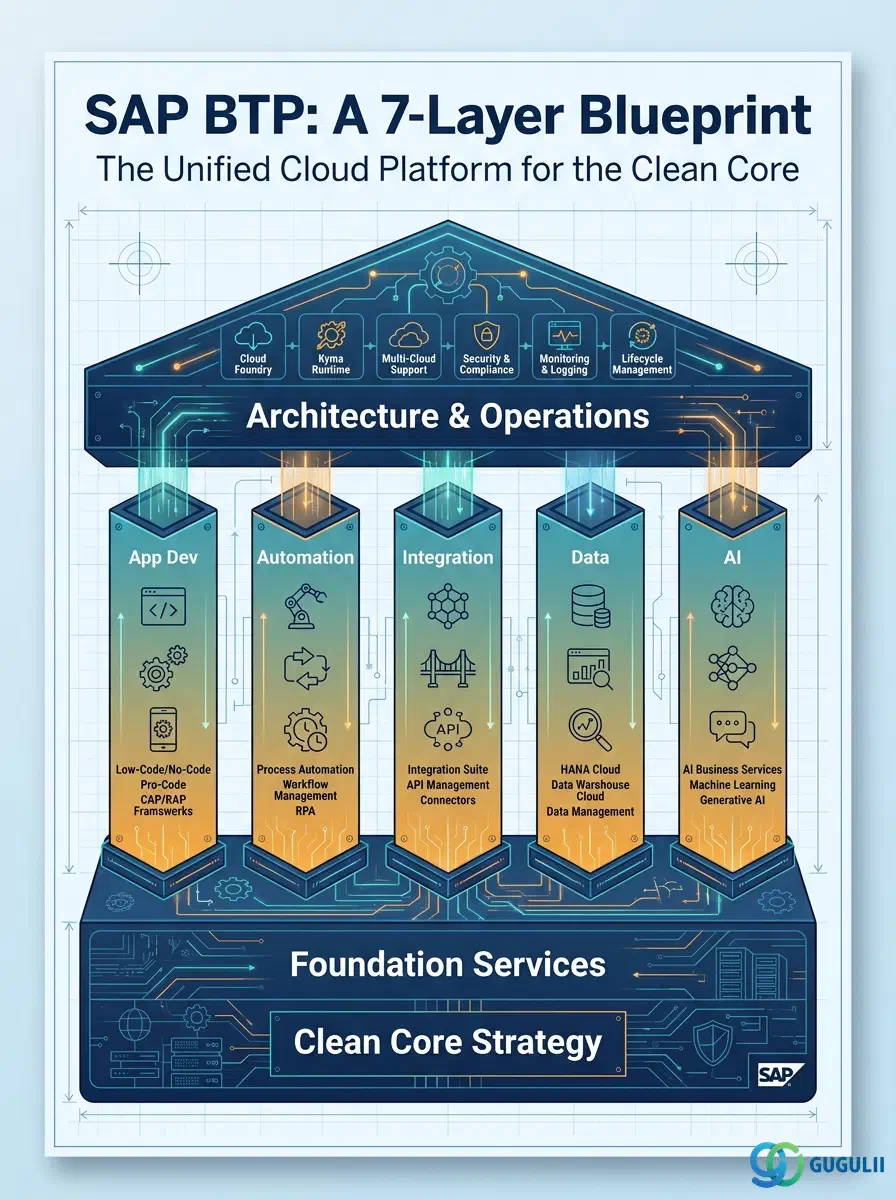
BTP can be organized in 7 layers. This article covers the Big Picture (📍).
The Domain column below is numbered to match the section structure of this article — when you see 5-1) Application Development, that section drills into Layer 1.
| Layer Type | Domain | Key Services | This Article |
|---|---|---|---|
| Functional | a) Application Development | Build Apps / BAS / Cloud Foundry / Kyma / ABAP | — |
| Functional | b) Automation | Build Process Automation / Task Center | — |
| Functional | c) Integration | Integration Suite / Event Mesh / API Mgmt | — |
| Functional | d) Data and Analytics | HANA Cloud / Datasphere / SAC / MDG | — |
| Functional | e) AI | AI Core / Joule / GenAI Hub | — |
| Foundation | f) Foundation Services | IAS / IPS / XSUAA / Cloud Connector | — |
| Cross-cutting | g) Big Picture / Architecture & Ops / Use Cases | Landscape / CI-CD / Security / Use Cases | 📍 |
Each service is detailed in dedicated articles (see “What to Read Next” at the end).
🎯 For: All readers
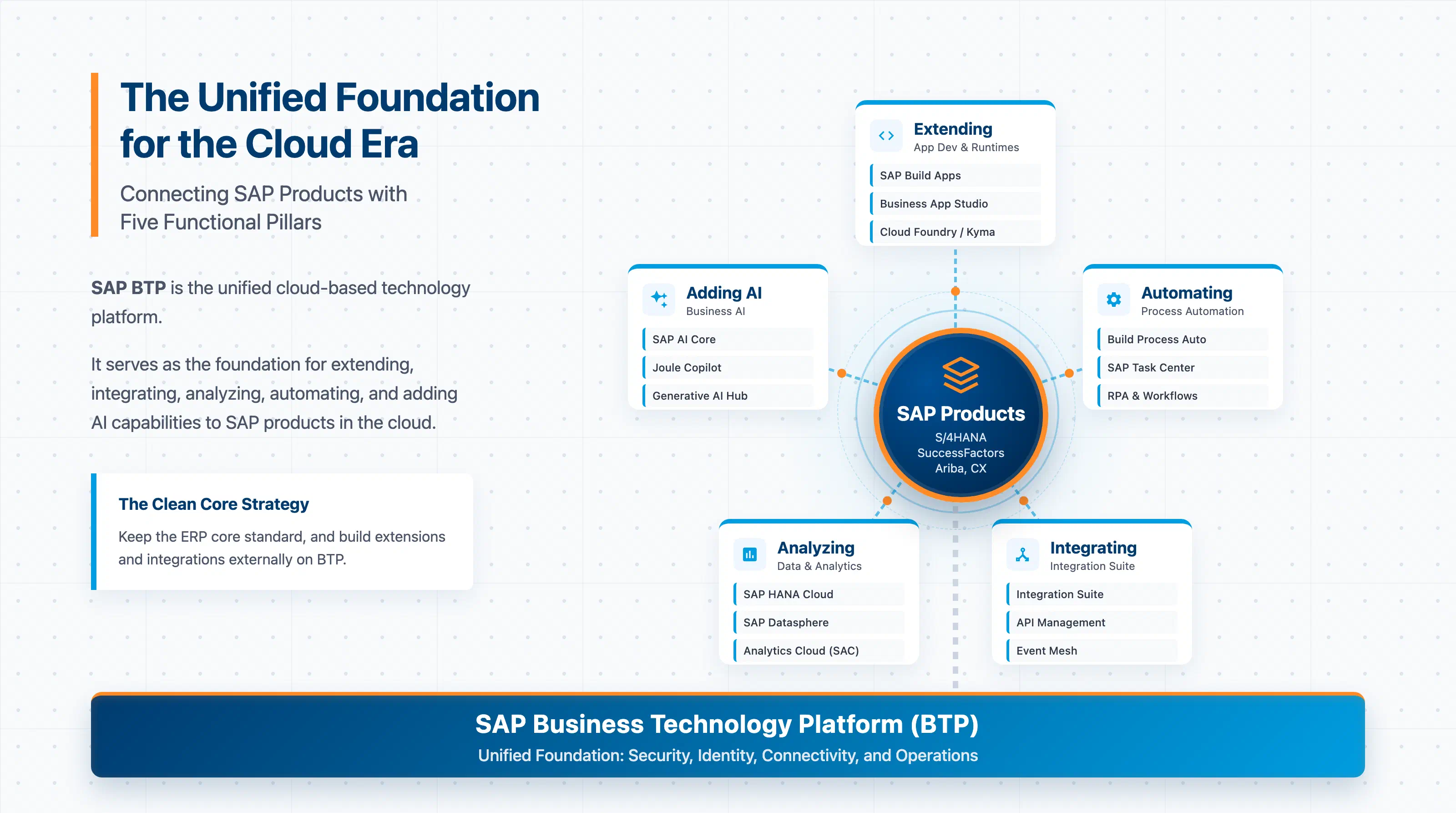
SAP Business Technology Platform (BTP) is SAP’s unified cloud-based technology platform.
In one sentence: it is the foundation for extending, integrating, analyzing, automating, and adding AI capabilities to SAP products in the cloud.
| Aspect | Description |
|---|---|
| Delivery model | Cloud service (mix of PaaS and SaaS) |
| Provider | SAP, running on hyperscaler infrastructure (AWS / Azure / GCP) |
| Primary use | Extending SAP products like S/4HANA, system integration, analytics, AI, automation |
| Official docs | SAP Help Portal: SAP Business Technology Platform |
⚠️ A common misconception “Should we adopt BTP?” is the wrong question. BTP is an umbrella for many services. The right question is: “Which BTP service, for which purpose?”
🎯 For: Executives & DX Leaders
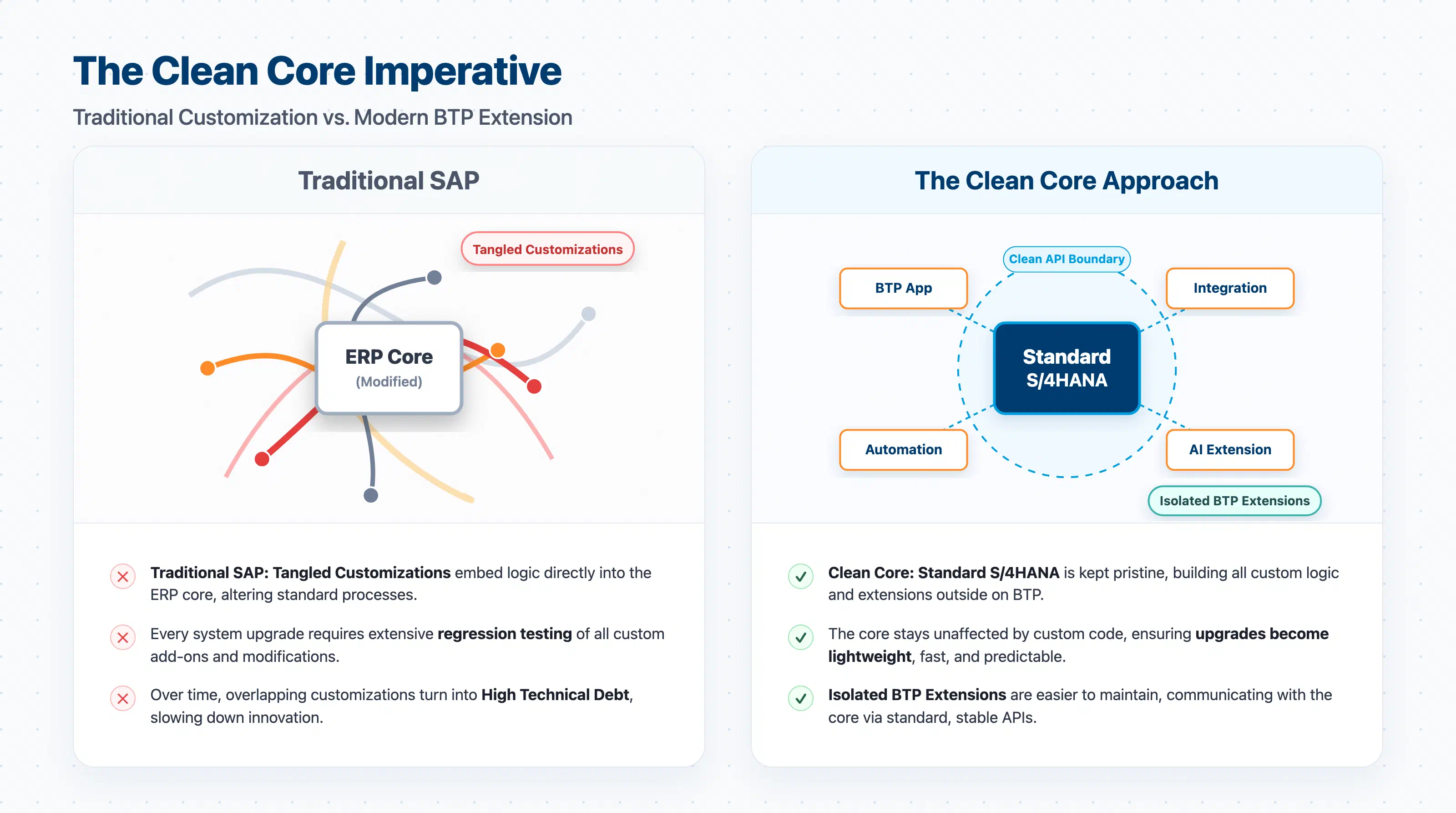
SAP has been pushing the Clean Core strategy hard in recent years. This is the core reason BTP exists.
| Traditional SAP | Clean Core Approach |
|---|---|
| Customize ERP core to match business needs | Keep ERP core standard, build extensions outside (on BTP) |
| Every upgrade requires regression testing of all add-ons | Core stays unaffected; upgrades become lightweight |
| Customizations turn into technical debt | Extensions are isolated and easier to maintain |
S/4HANA’s release cycle is shorter than the legacy ERP’s, making “how to meet business requirements without modifying the core” a board-level concern. BTP is the answer SAP provides.
📖 Learn more: Clean Core Extensibility — SAP Help Portal
🎯 For: IT Leads & Consultants
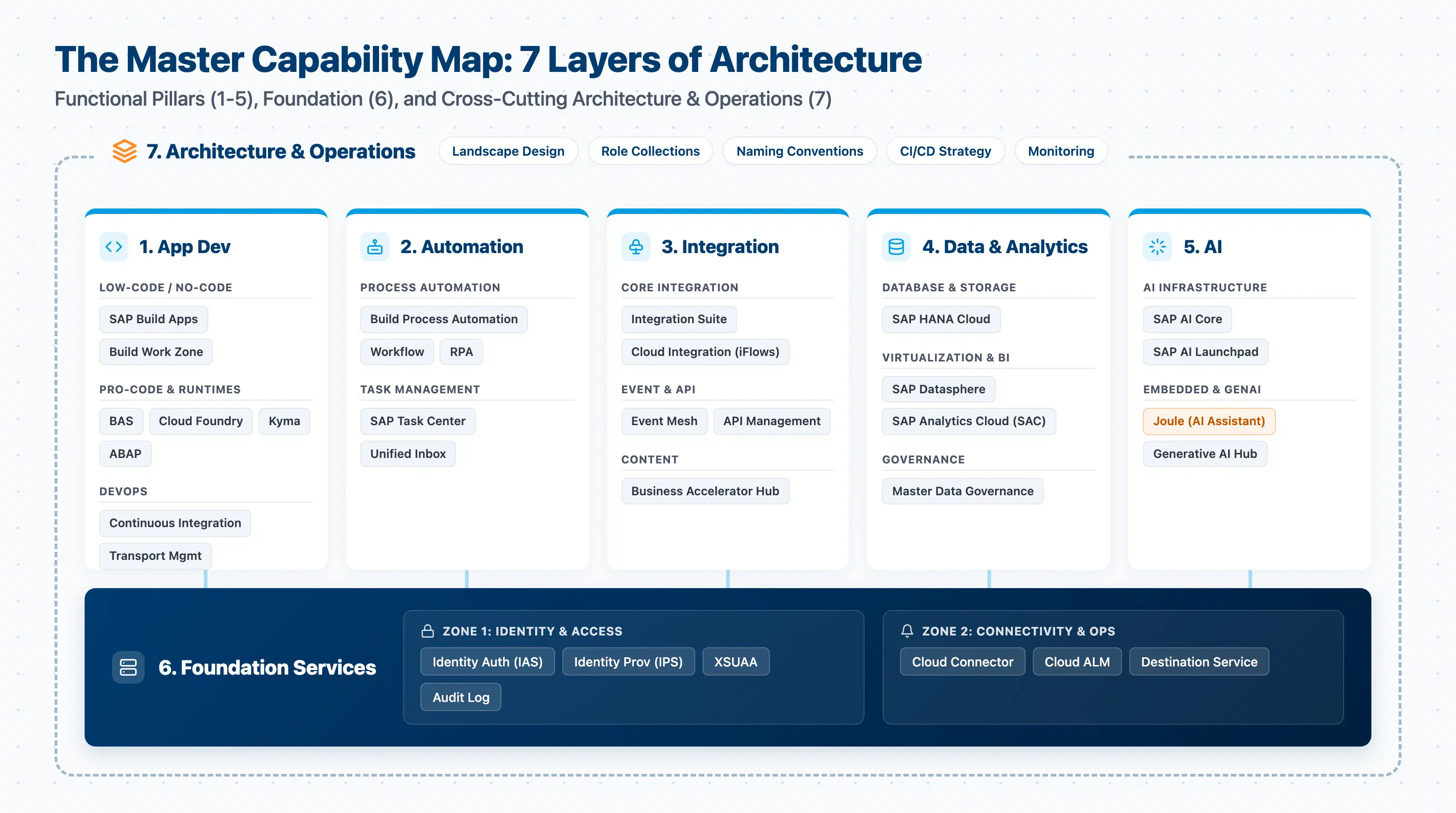
Aligned with SAP Help Portal, BTP can be understood through these 7 layers. Layers 1 to 5 are SAP’s official “five pillars”; layers 6 and 7 are essential surrounding domains in actual practice.
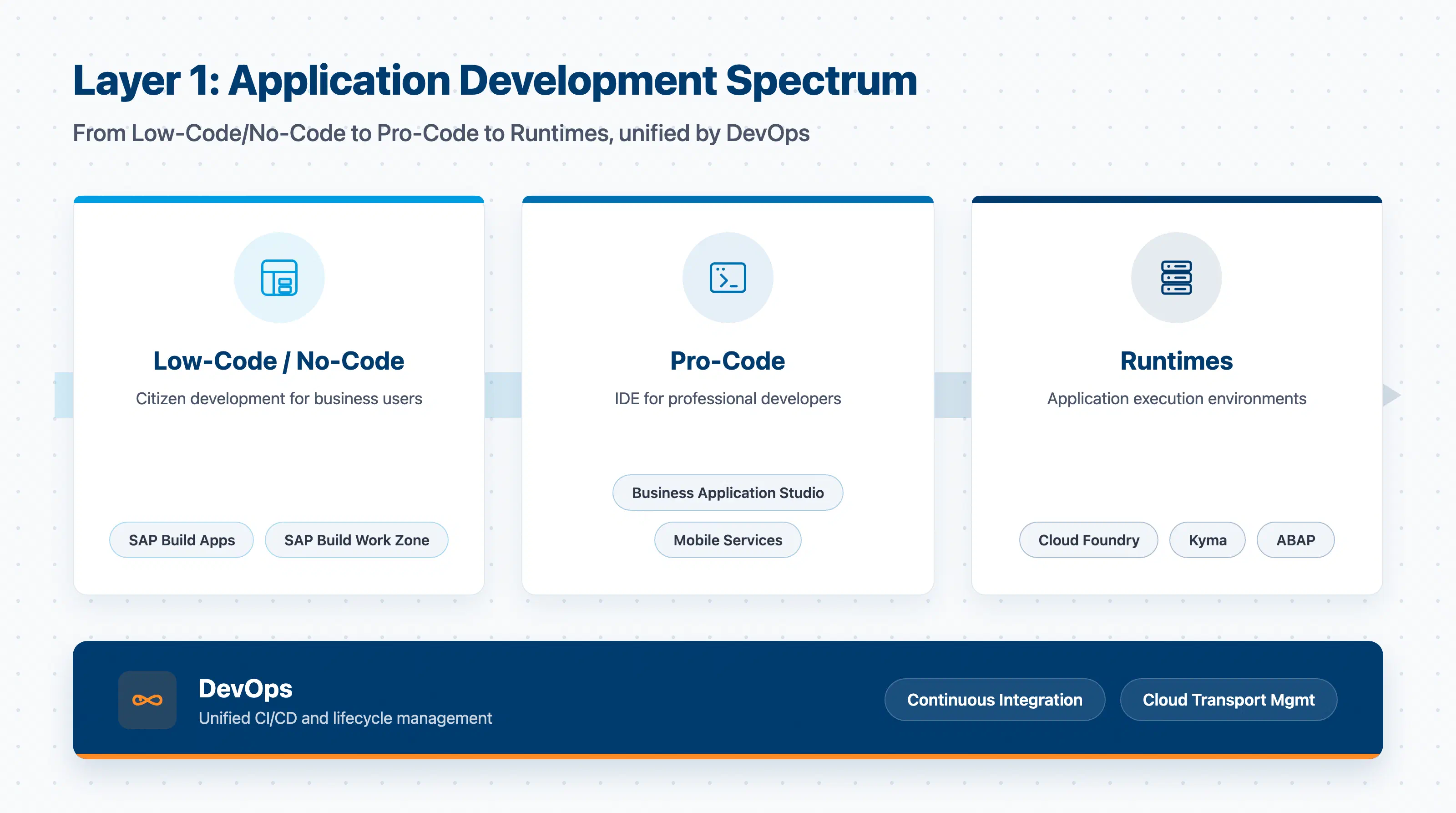
The domain for building SAP and custom applications.
| Sub-domain | Key Services | Role |
|---|---|---|
| Low-Code/No-Code | SAP Build Apps / Build Work Zone | Citizen development for business users |
| Pro-Code | Business Application Studio / Mobile Services | IDE for professional developers |
| Runtimes | Cloud Foundry / Kyma / ABAP | Application execution environments |
| DevOps | Continuous Integration / Cloud Transport Mgmt | CI/CD and transport management |
📖 Learn more: Application Development — SAP Help Portal
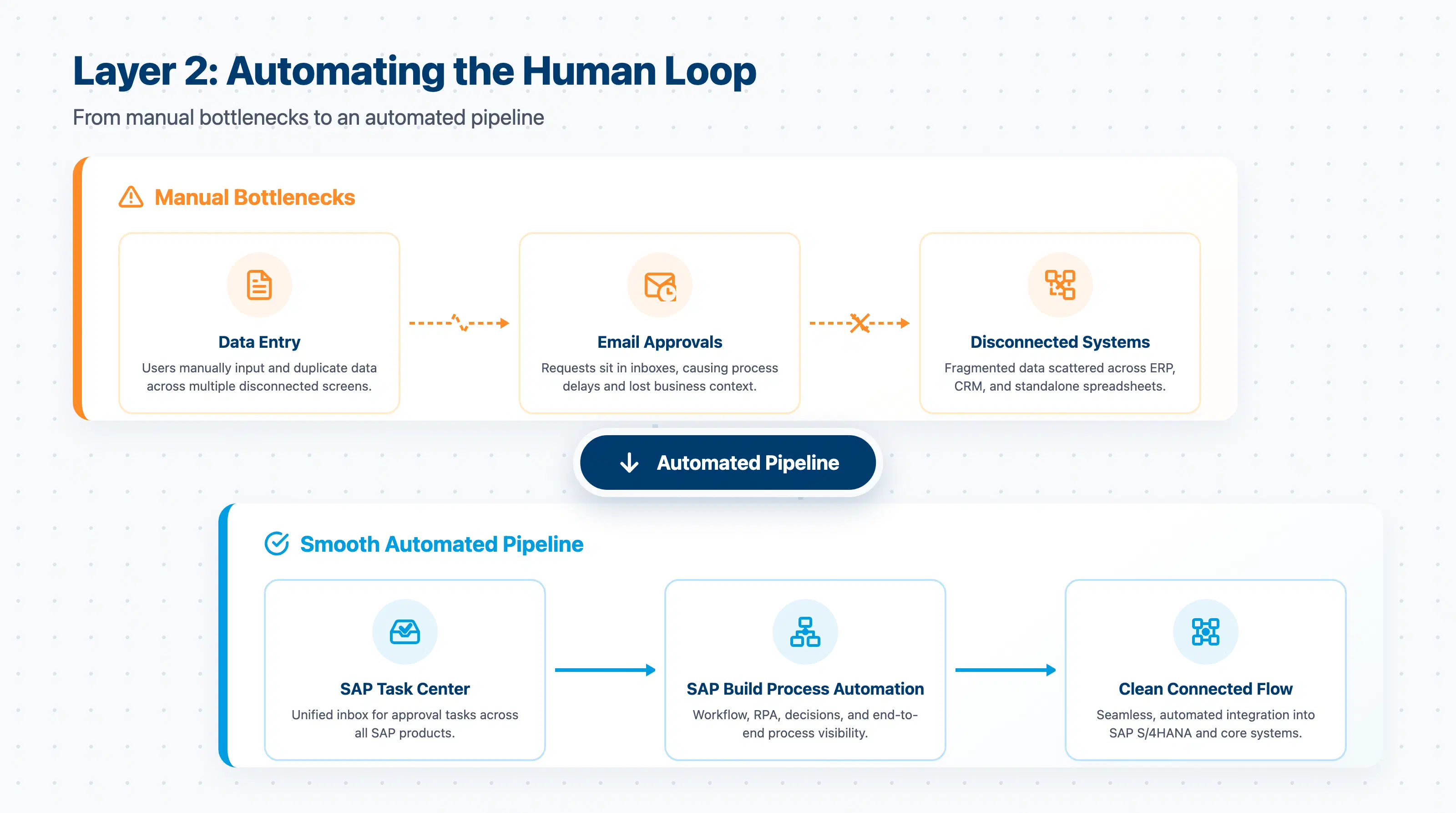
The domain for automating business processes.
| Key Services | Role |
|---|---|
| SAP Build Process Automation | Workflow, RPA, decisions, process visibility |
| SAP Task Center | Unified inbox for approval tasks across SAP products |
📖 Learn more: SAP Build Process Automation — SAP Help Portal
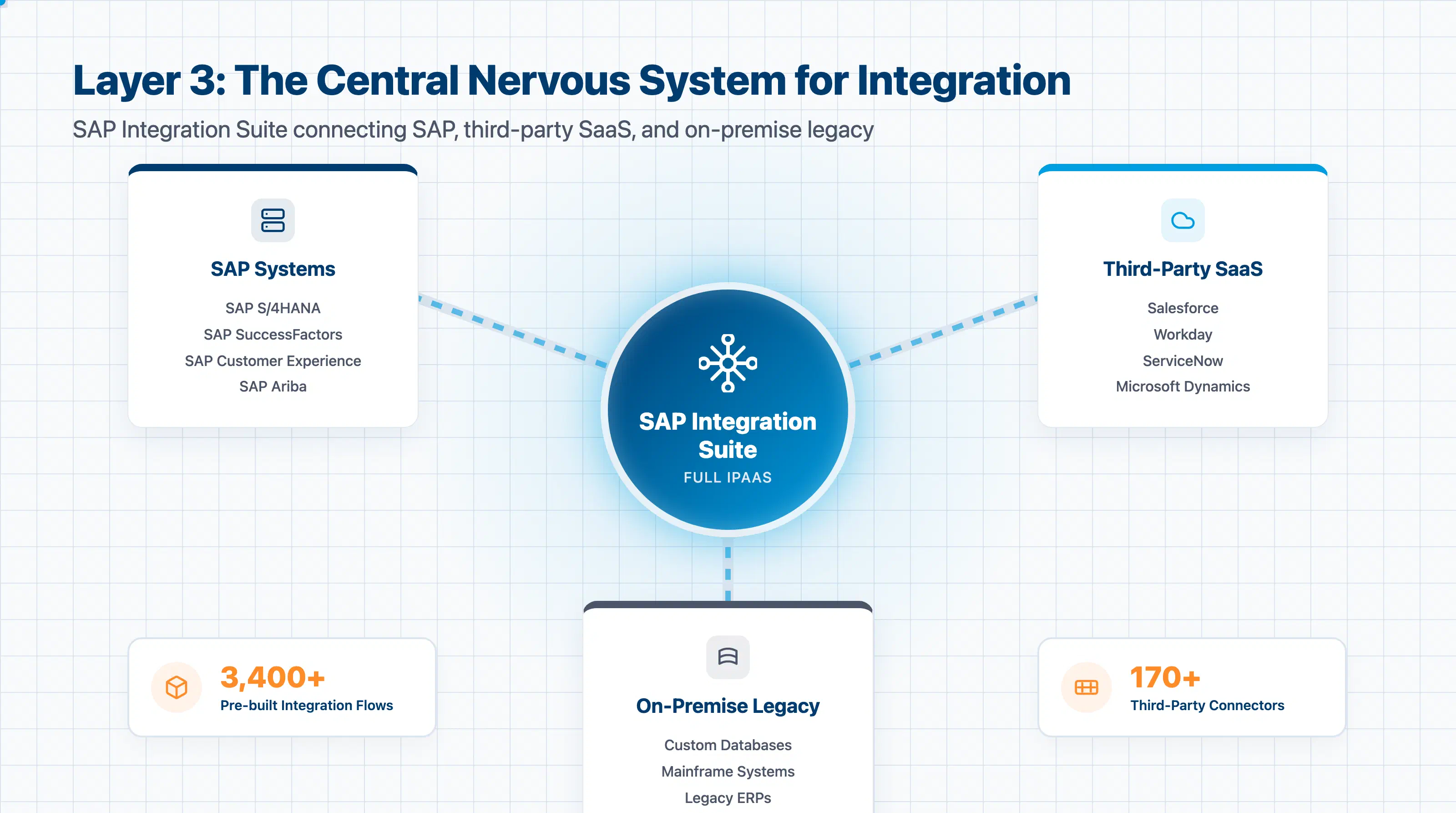
The domain for connecting SAP and external systems (SaaS, on-premise, custom apps).
| Key Services | Role |
|---|---|
| SAP Integration Suite | Full iPaaS: iFlow, API, Event, Open Connectors |
| SAP Business Accelerator Hub | Catalog of pre-built integration content and APIs |
The Integration Suite ships with over 3,400 pre-built iFlows and 170+ third-party connectors, removing the need to build integrations from scratch.
📖 Learn more: Integration Suite — SAP Help Portal
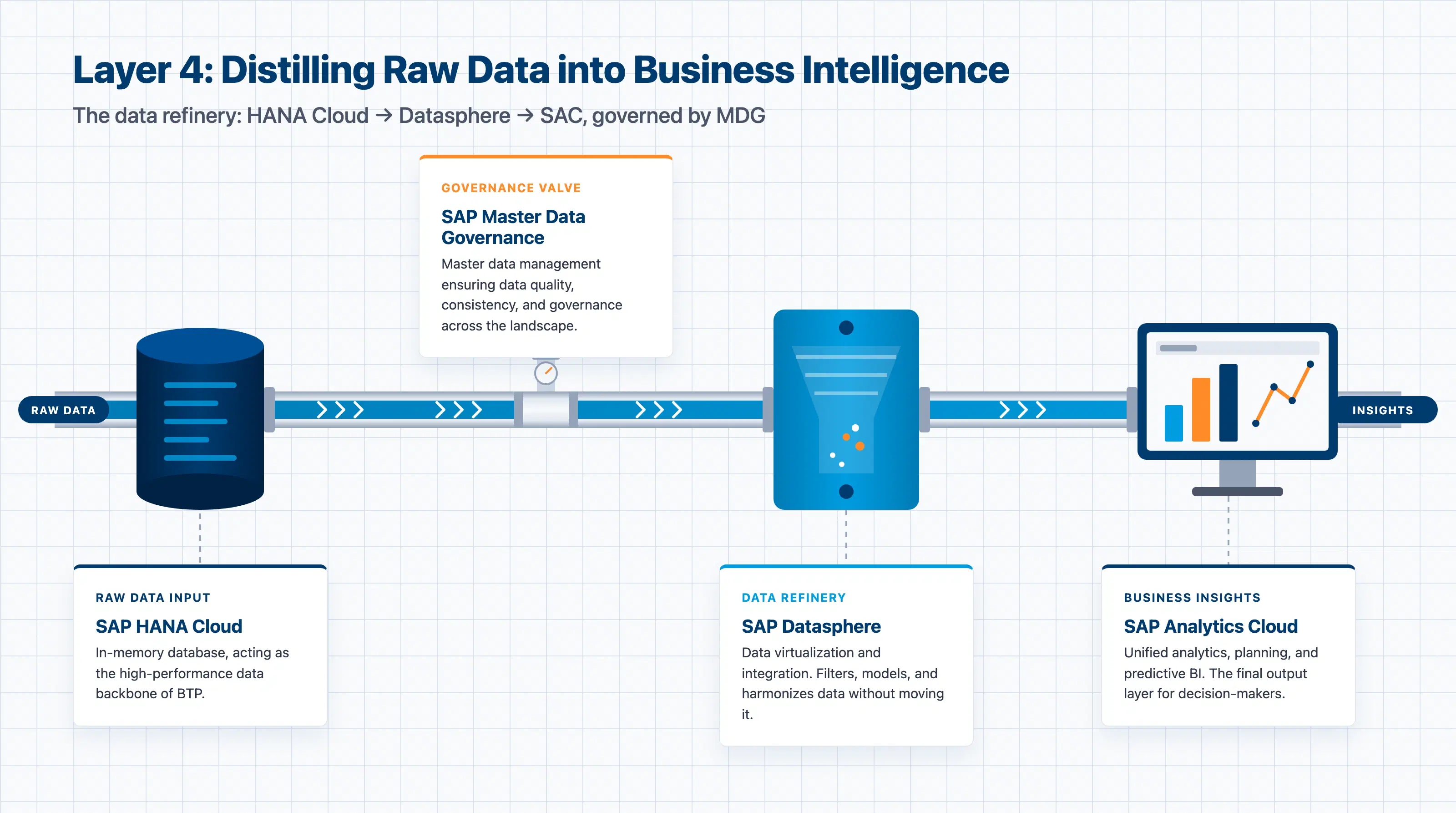
The domain for data management, analytics, and planning.
| Key Services | Role |
|---|---|
| SAP HANA Cloud | In-memory database, the data backbone of BTP |
| SAP Datasphere | Data virtualization and integration (formerly Data Warehouse Cloud) |
| SAP Analytics Cloud (SAC) | Analytics, planning, and predictive (BI) |
| SAP Master Data Governance | Master data management |
📖 Learn more: Data and Analytics — SAP Help Portal
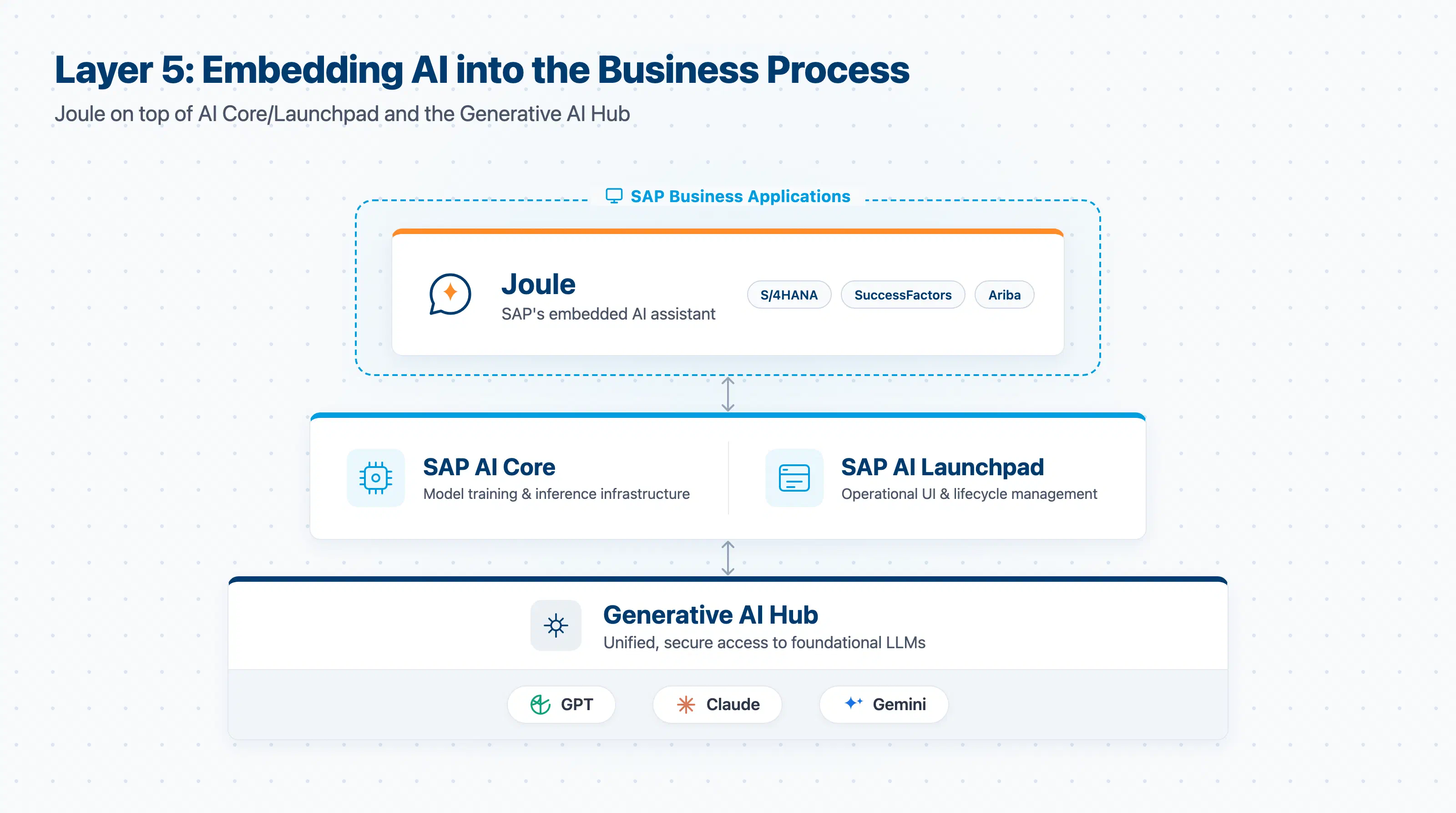
The domain for embedding AI into SAP business processes.
| Key Services | Role |
|---|---|
| SAP AI Core | AI infrastructure (model training and inference) |
| SAP AI Launchpad | Operational UI for AI |
| Joule | SAP’s AI assistant, embedded across SAP products |
| Generative AI Hub | Unified access to LLMs (GPT, Claude, Gemini, etc.) |
As of 2026, Joule is integrated into S/4HANA, SuccessFactors, Ariba, and other major SAP products, enabling conversational interactions with business processes.
📖 Learn more: Business AI — SAP Help Portal
🎯 For: Infrastructure & Security Teams
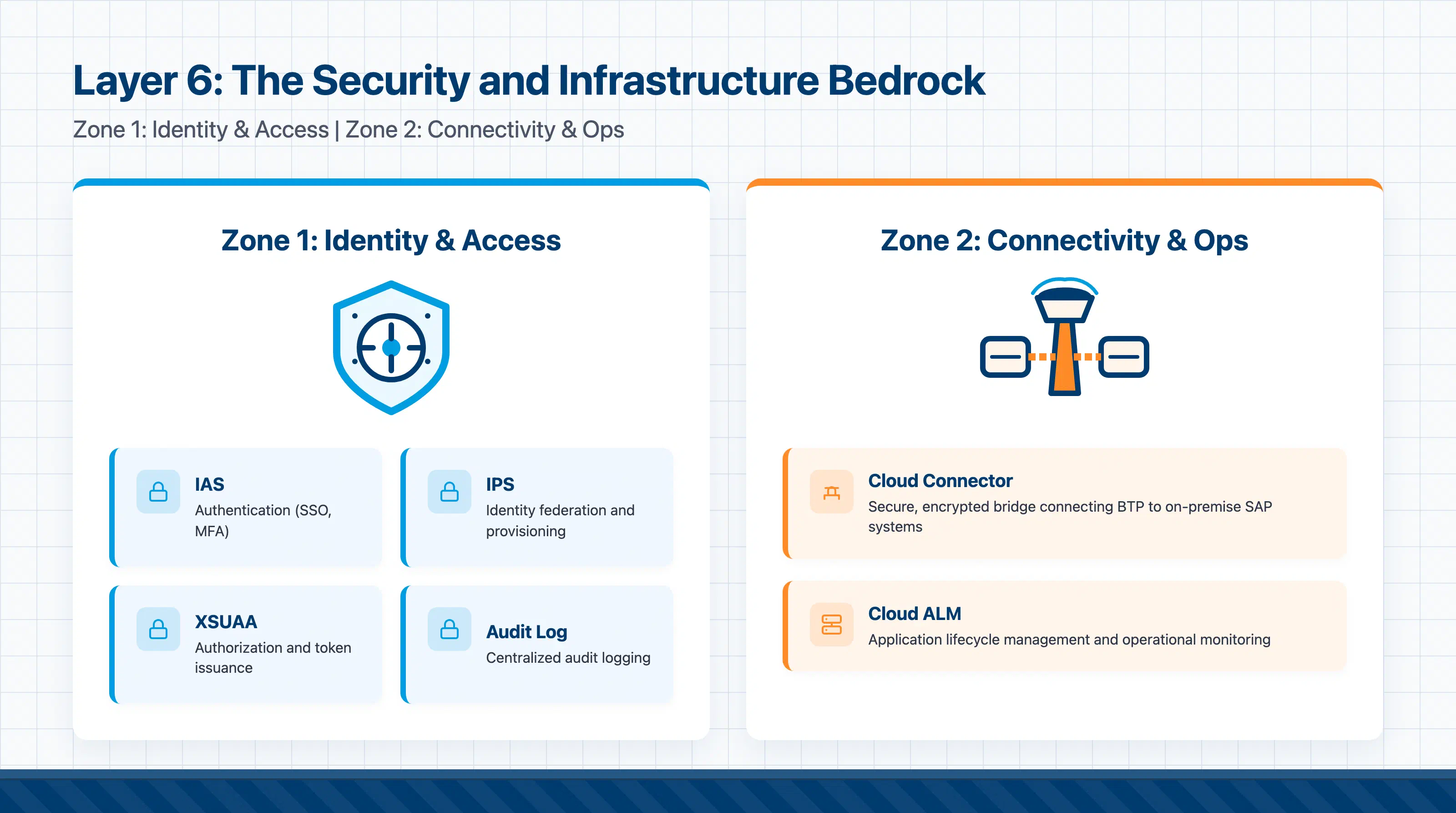
The shared foundation supporting layers 1 through 5.
| Key Services | Role |
|---|---|
| Identity Authentication Service (IAS) | Authentication (SSO, MFA) |
| Identity Provisioning Service (IPS) | Identity federation and provisioning |
| XSUAA | Authorization and token issuance |
| Cloud Connector | Secure connection to on-premise SAP systems |
| Cloud ALM | Application lifecycle management |
| Audit Log | Audit logging |
📖 Learn more: Security — SAP Help Portal
🎯 For: Architects & Operations Teams
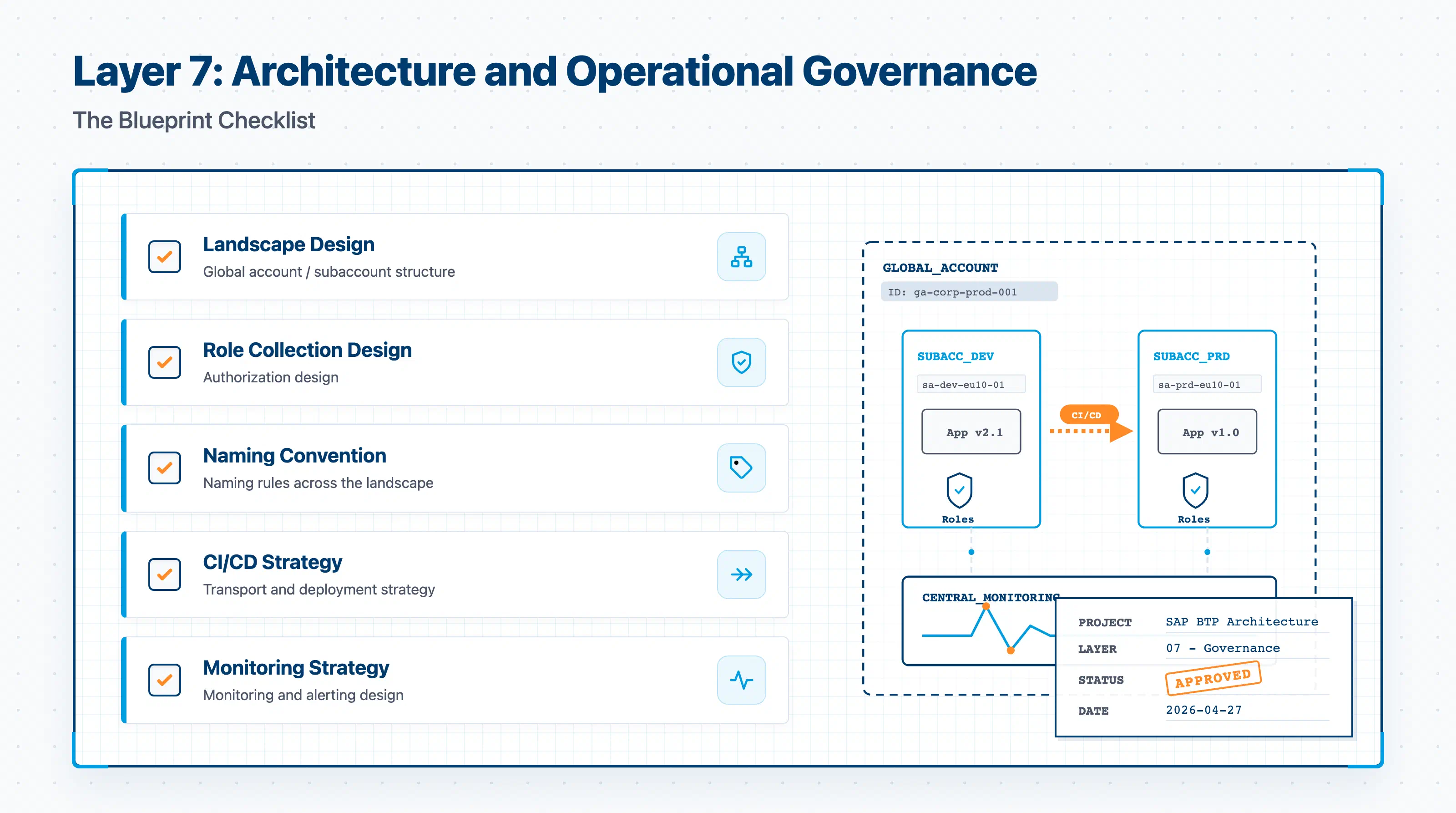
The know-how needed to combine the above services into a working solution.
| Topic | Key Considerations |
|---|---|
| Landscape Design | Global account / subaccount structure |
| Role Collection Design | Authorization design |
| Naming Convention | Naming rules across the landscape |
| CI/CD Strategy | Transport and deployment strategy |
| Monitoring Strategy | Monitoring and alerting design |
These are scattered across SAP’s official documentation, which is why this site organizes them as a dedicated series.
🎯 For: Executives & Procurement
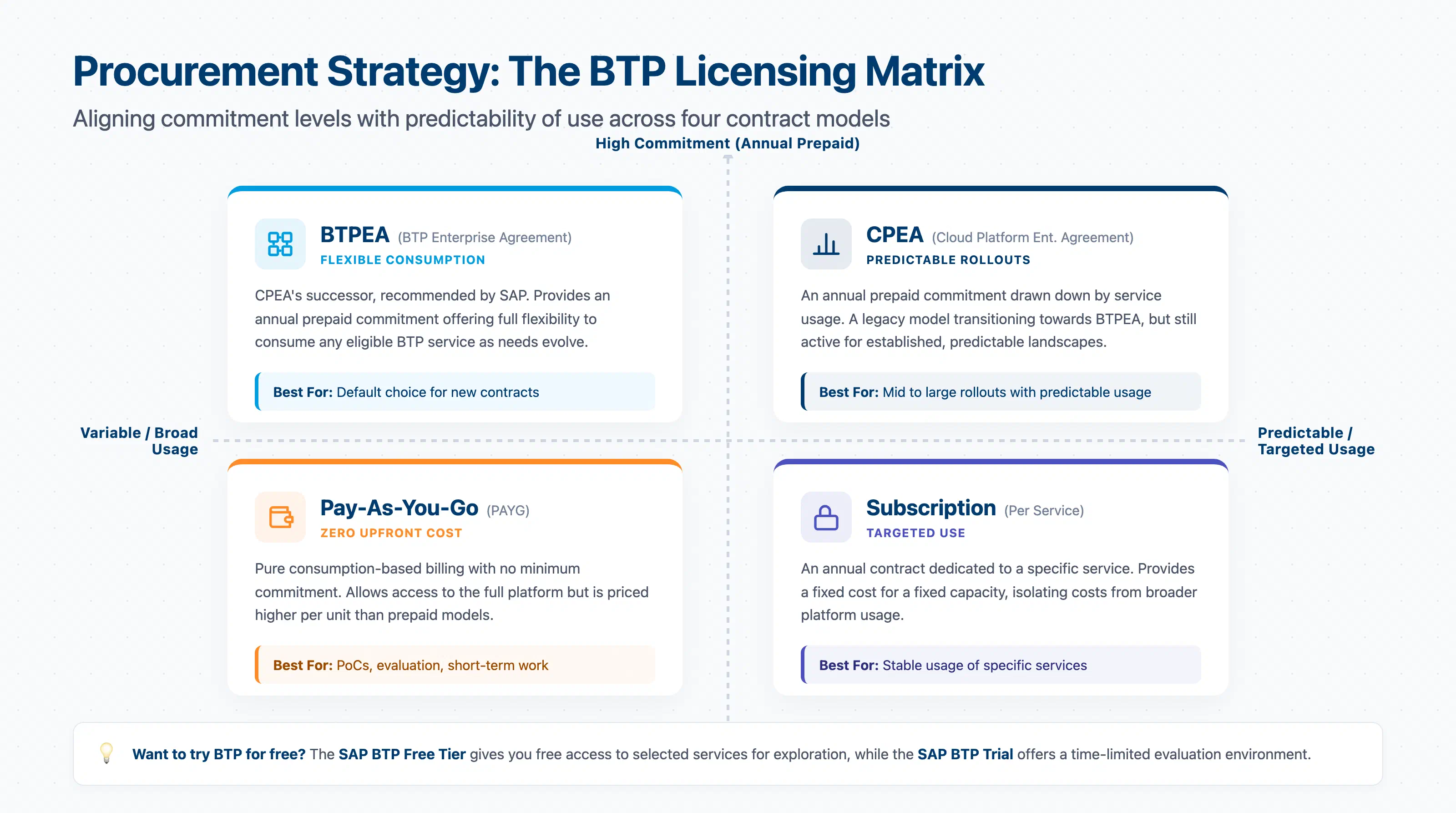
BTP offers several contract models. The right one depends on when, who, and how much you plan to use.
| Model | Overview | Best For |
|---|---|---|
| CPEA (Cloud Platform Enterprise Agreement) | Annual prepaid commitment, drawn down by service usage | Mid to large rollouts with predictable usage |
| BTPEA (BTP Enterprise Agreement) | CPEA’s successor, recommended by SAP | Default choice for new contracts |
| Subscription | Annual contract per service | Stable usage of specific services |
| Pay-As-You-Go (PAYG) | Pure consumption-based billing | PoCs, evaluation, short-term work (priced higher per unit) |
💡 Want to try BTP for free? SAP BTP Free Tier gives you free access to selected services. SAP BTP Trial offers a time-limited evaluation environment.
🎯 For: All readers
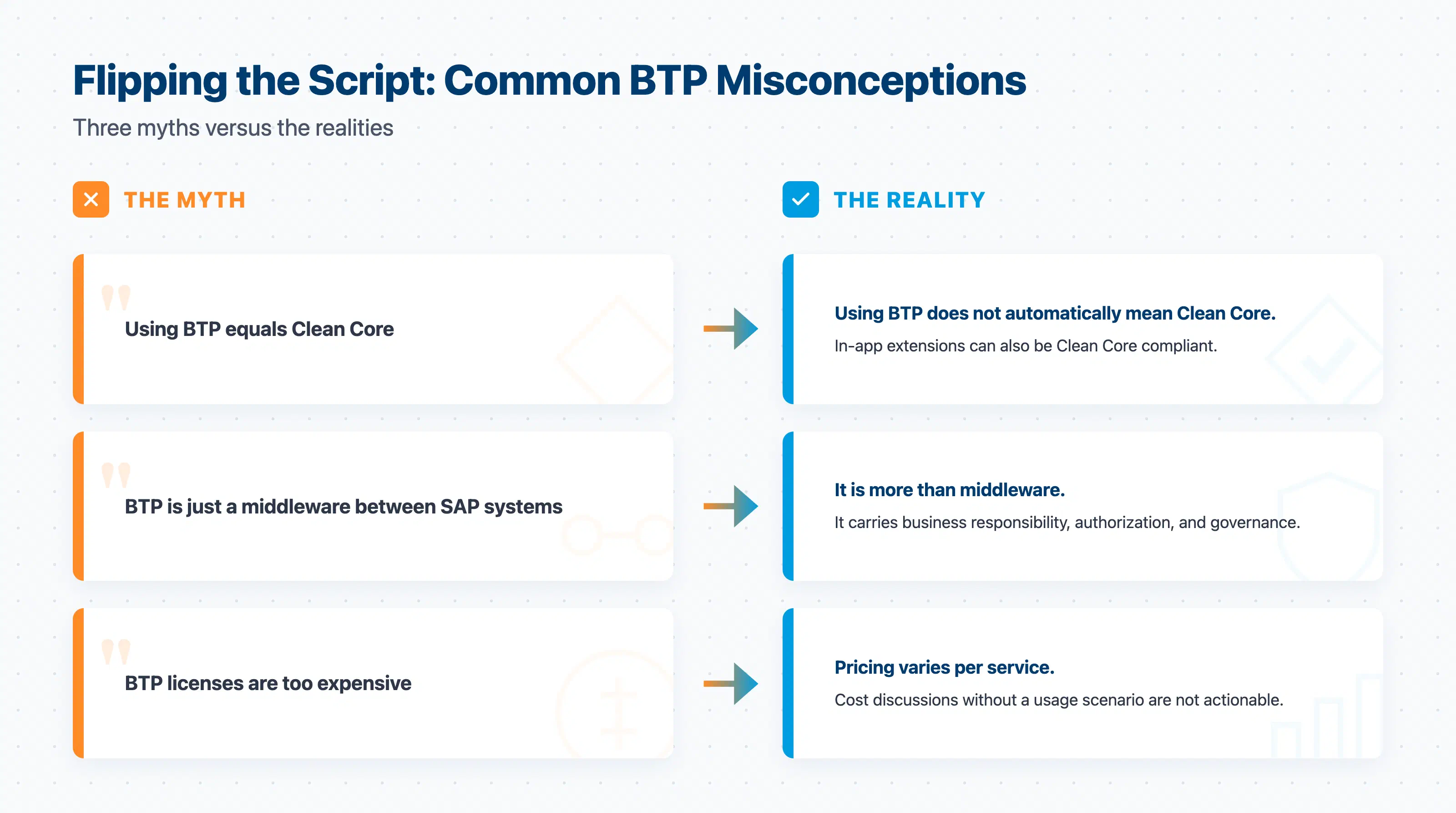
| Misconception | Reality |
|---|---|
| “Using BTP equals Clean Core” | Using BTP does not automatically mean Clean Core. In-app extensions can also be Clean Core compliant. |
| “BTP is just a middleware between SAP systems” | It is more than middleware. It carries business responsibility, authorization, and governance. |
| “Should we adopt BTP?” | The unit of debate is too large. Reframe as: “Which service, for which purpose?” |
| “BTP licenses are too expensive” | Pricing varies per service. Cost discussions without a usage scenario are not actionable. |
These misconceptions surface in real projects all the time. Each is addressed in dedicated articles in this series.
Each service is detailed in the L2-A through L2-G series.
Q: Can companies without S/4HANA still use BTP? A: Yes. BTP integrates with non-SAP systems and works as a standalone application platform. That said, its value peaks when extending SAP products.
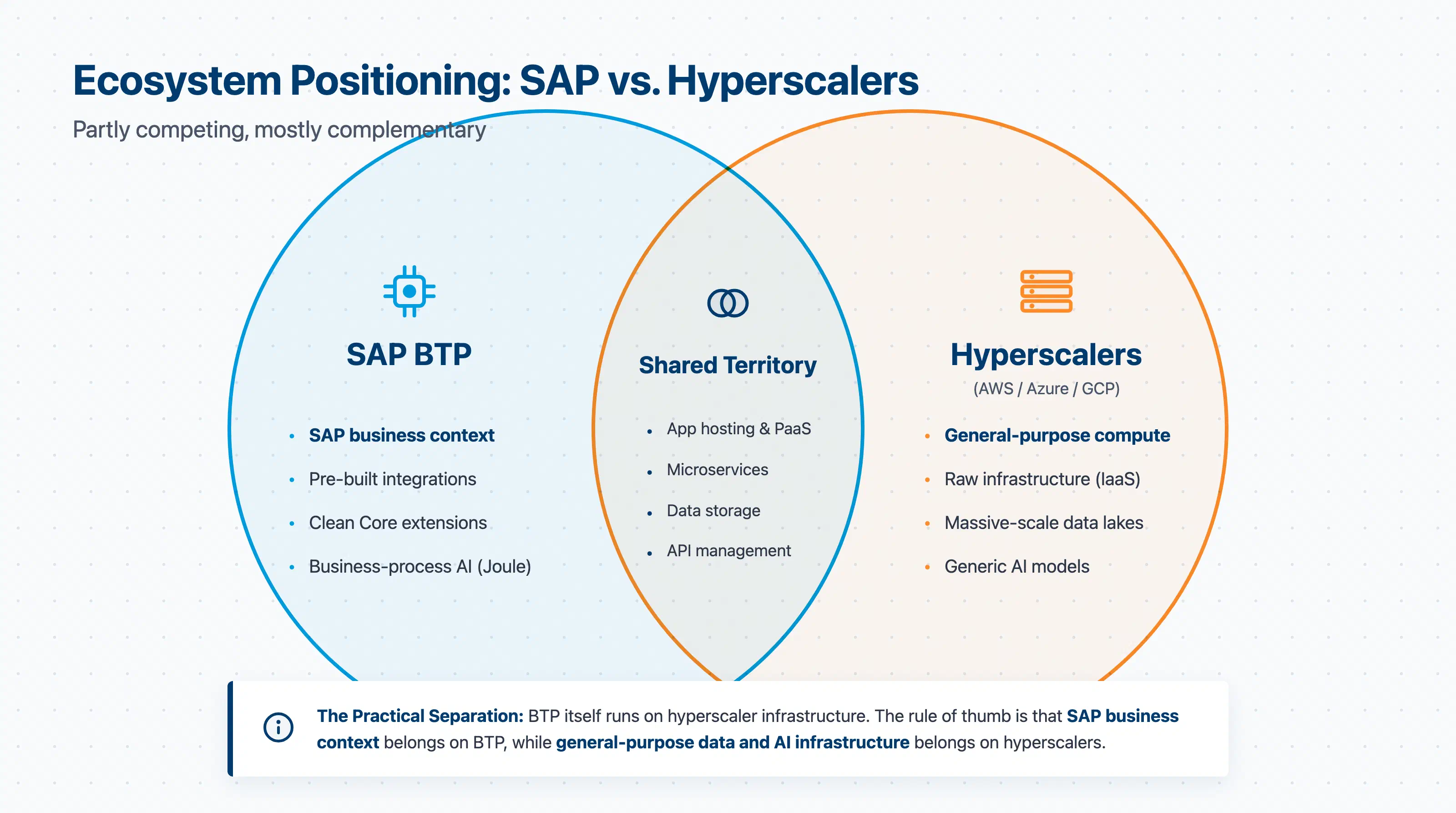
Q: Does BTP compete with AWS, Azure, or GCP? A: Partly competing, partly complementary. BTP itself runs on AWS, Azure, or GCP. The practical separation is “SAP business context belongs on BTP; general-purpose data and AI infrastructure belongs on hyperscalers.”
Q: Is there a free way to try BTP? A: Yes. The Free Tier provides free access to selected services, and the Trial gives a time-limited evaluation environment.
Q: Where should I start learning? A: The official SAP Learning journey is the most structured. For hands-on, start with Build Apps or Integration Suite on the Free Tier.
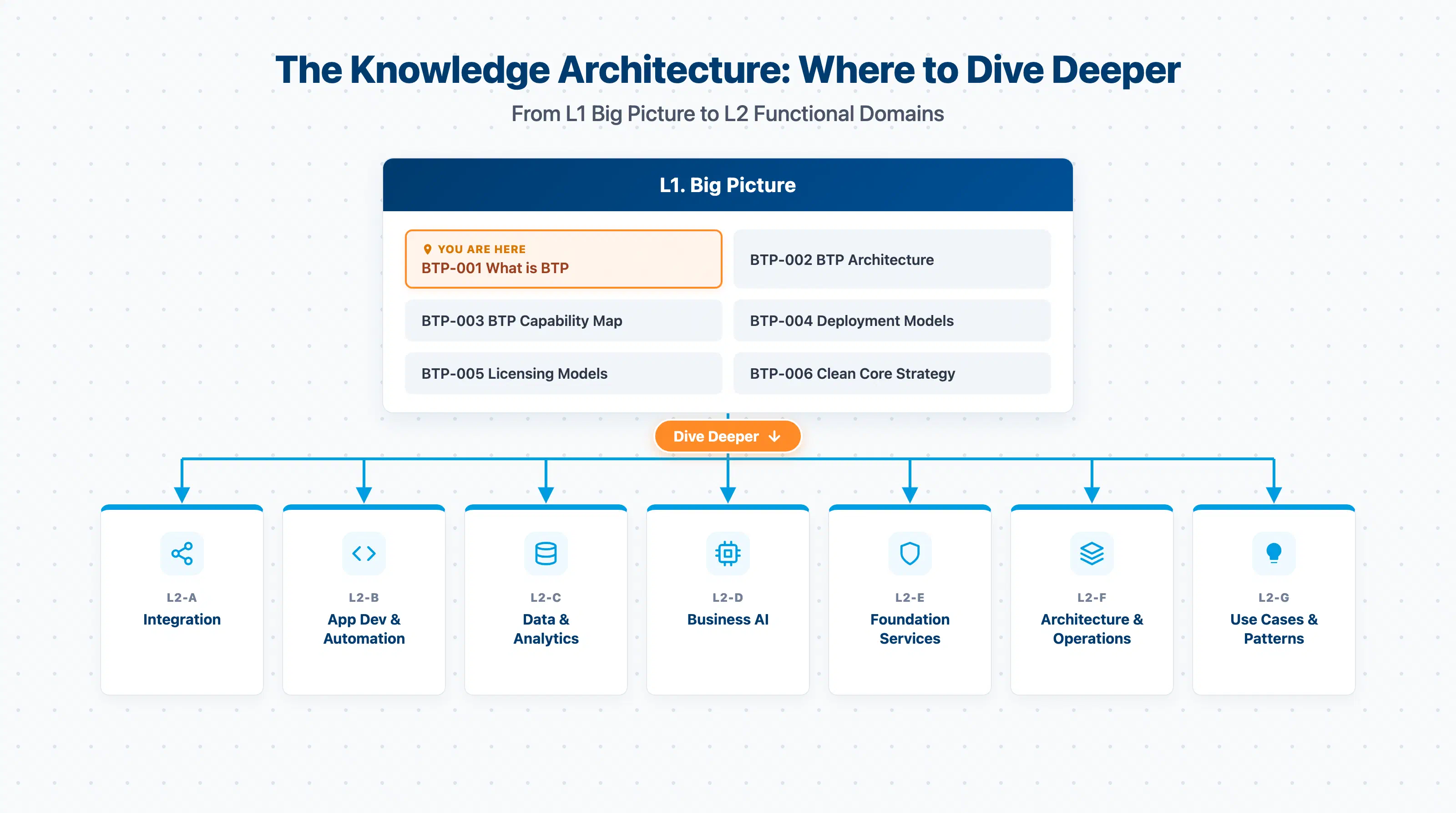
This site organizes BTP knowledge into the following structure:
| L1. Big Picture | L2. Functional Domains |
|---|---|
| BTP-001 What is BTP (this article) | L2-A. Integration |
| BTP-002 BTP Architecture | L2-B. Application Development & Automation |
| BTP-003 BTP Capability Map | L2-C. Data & Analytics |
| BTP-004 Deployment Models | L2-D. AI |
| BTP-005 Licensing Models | L2-E. Foundation Services |
| BTP-006 Clean Core Strategy | L2-F. Architecture & Operations |
| L2-G. Use Cases & Patterns |