Title here
Summary here

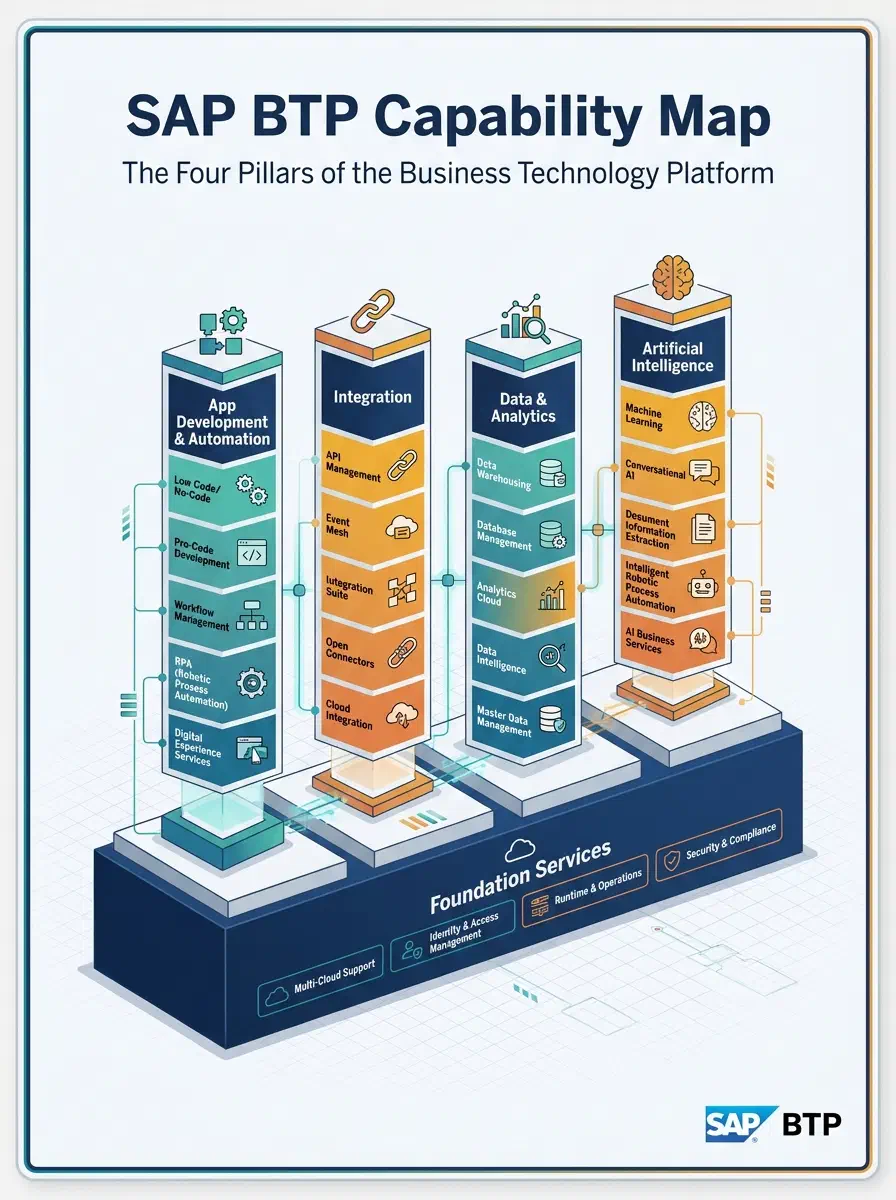
If you have read BTP-001 and BTP-002, you know what SAP BTP is and how its architecture hangs together. The next question every SAP professional asks in a real project is blunter: “Which BTP service do I actually use for this?”
That is the question the capability map answers. SAP organizes BTP capabilities into four named pillars, with dozens of specific products sitting inside each one. Knowing the pillars is table stakes. Knowing the individual products — and the trade-offs between them — is where project success or failure is decided.
This article walks through all four pillars, maps the key products, and flags what has changed in 2025 and 2026.
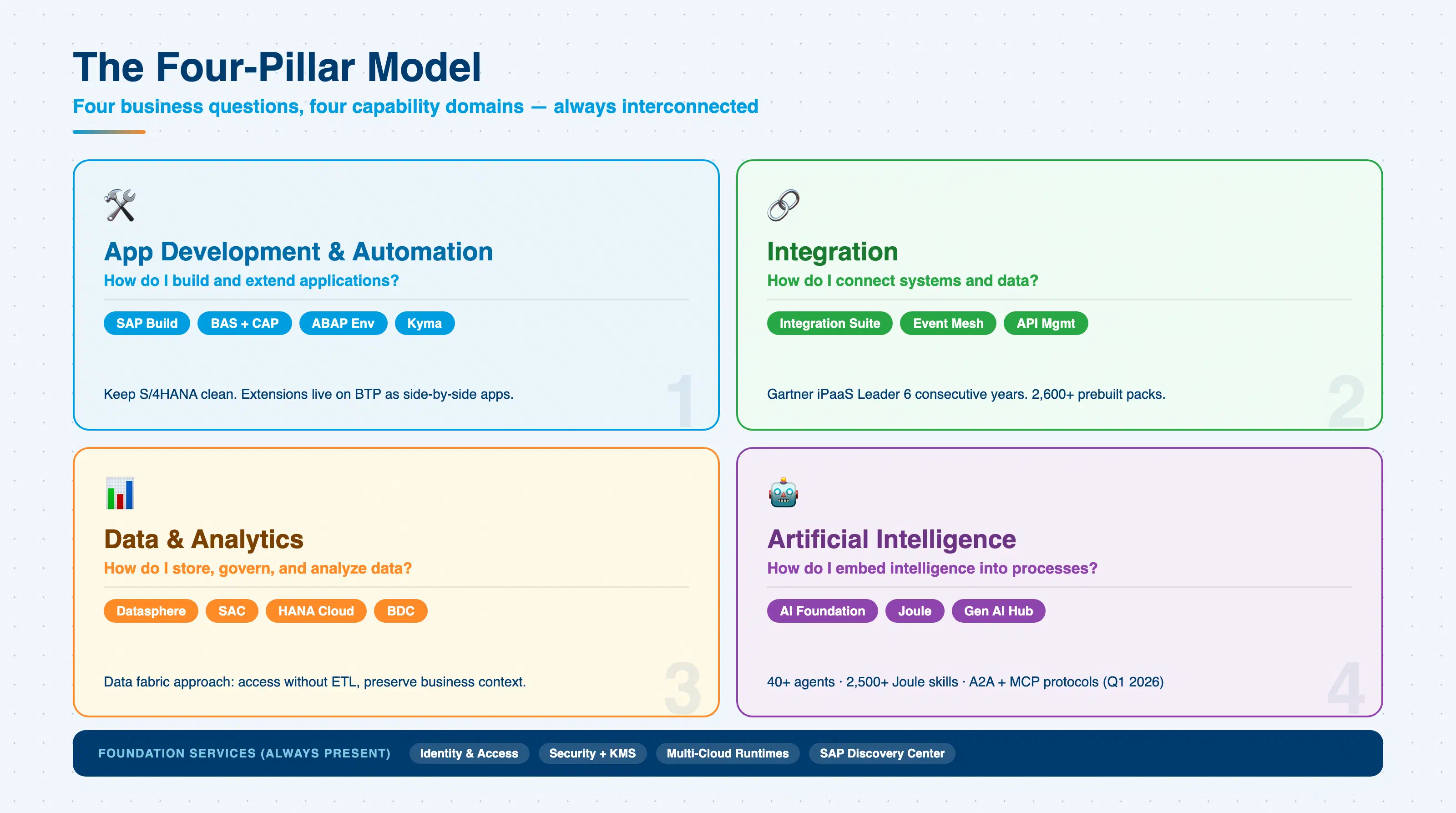
SAP BTP officially organizes its capabilities into four categories, as documented across the SAP Help Portal, SAP Discovery Center, and official product pages:
| Pillar | Primary Business Question |
|---|---|
| App Development & Automation | How do I build and extend applications? |
| Integration | How do I connect systems and data? |
| Data & Analytics | How do I store, govern, and analyze data? |
| Artificial Intelligence | How do I embed intelligence into processes? |
These four pillars are not silos. In most real-world BTP projects, two or more pillars are used together. A typical S/4HANA extension might use App Development to build a Fiori app, Integration to connect to an external API, Datasphere to serve unified data, and Joule to give the app an AI copilot experience.
The Foundation Services layer — identity, security, multi-cloud runtimes, and governance — runs beneath all four pillars and is always present, even when it is not explicitly mentioned in project design discussions.
The capability map is the third article in the BTP L1 series. It provides the vocabulary for every L2 article that follows, which go deeper into individual capability domains such as Integration, Application Development, and AI.
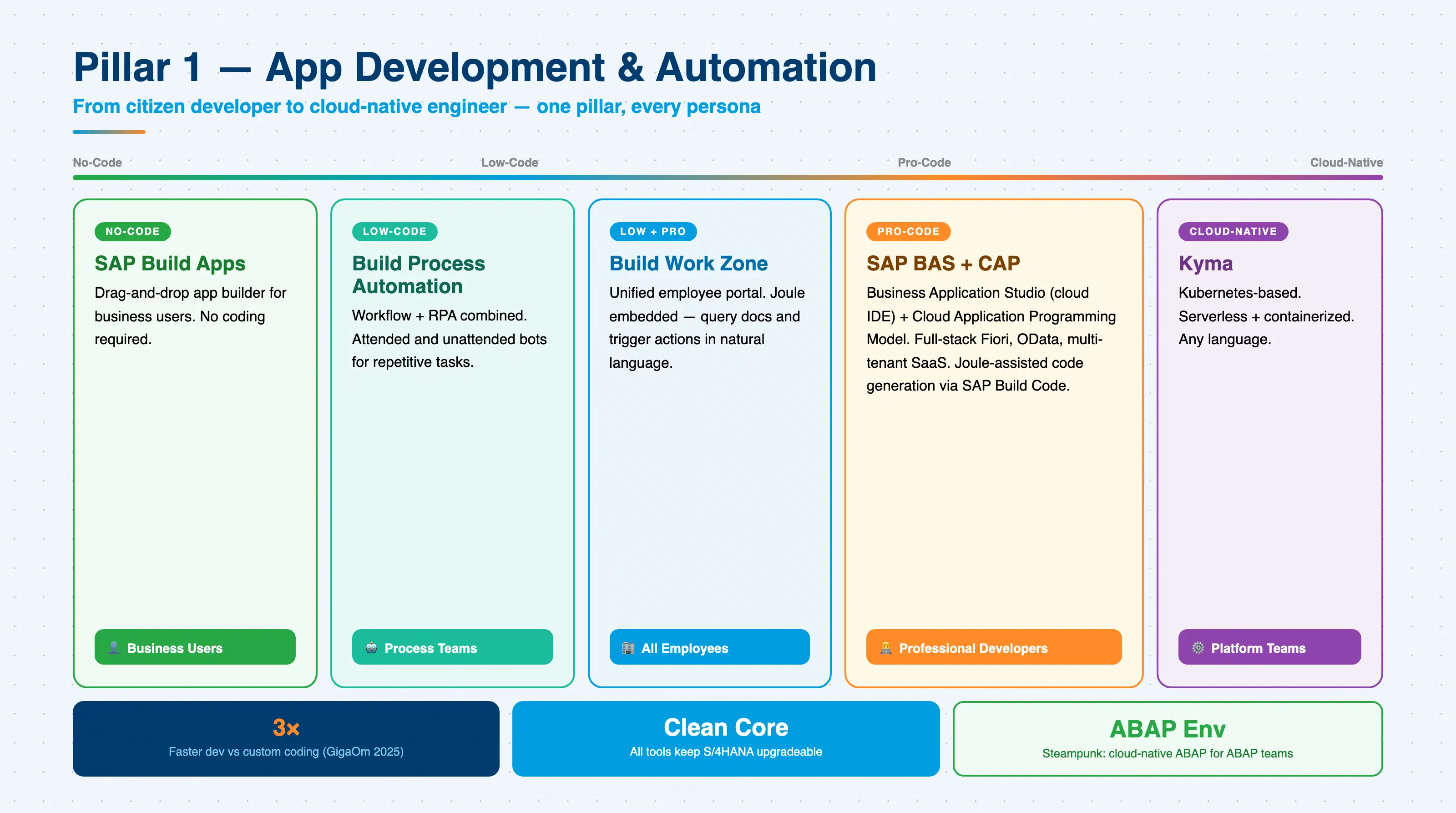
Extending SAP systems has historically required modifying the ERP core. This creates technical debt, slows upgrades, and raises the cost of S/4HANA migrations. The App Development & Automation pillar provides the tooling to build extensions and automations that live outside the core — a practice SAP formally calls Clean Core.
SAP Build is SAP’s flagship low-code/no-code environment. It contains three components:
SAP Build Code is the pro-code companion to SAP Build, combining SAP Business Application Studio (BAS) — SAP’s cloud IDE — with the Cloud Application Programming Model (CAP) and Joule-assisted code generation for full-stack development.
SAP Business Application Studio (BAS): the cloud-based IDE for developing Fiori applications, CAP services, and mobile applications on SAP BTP.
SAP CAP (Cloud Application Programming Model): a framework using Core Data Services (CDS) for defining data models, services, and security. Runs on Node.js or Java. Recommended for greenfield cloud applications, API-driven integrations, and multi-tenant SaaS scenarios.
ABAP Environment (Steampunk): a managed ABAP runtime on SAP BTP for customers who need ABAP development outside of S/4HANA. Also used for custom code migration scenarios with AI assistance via Joule for Developers.
SAP Kyma Environment: a Kubernetes-based runtime for containerized and serverless applications. Suited for cloud-native extensions that need container orchestration.
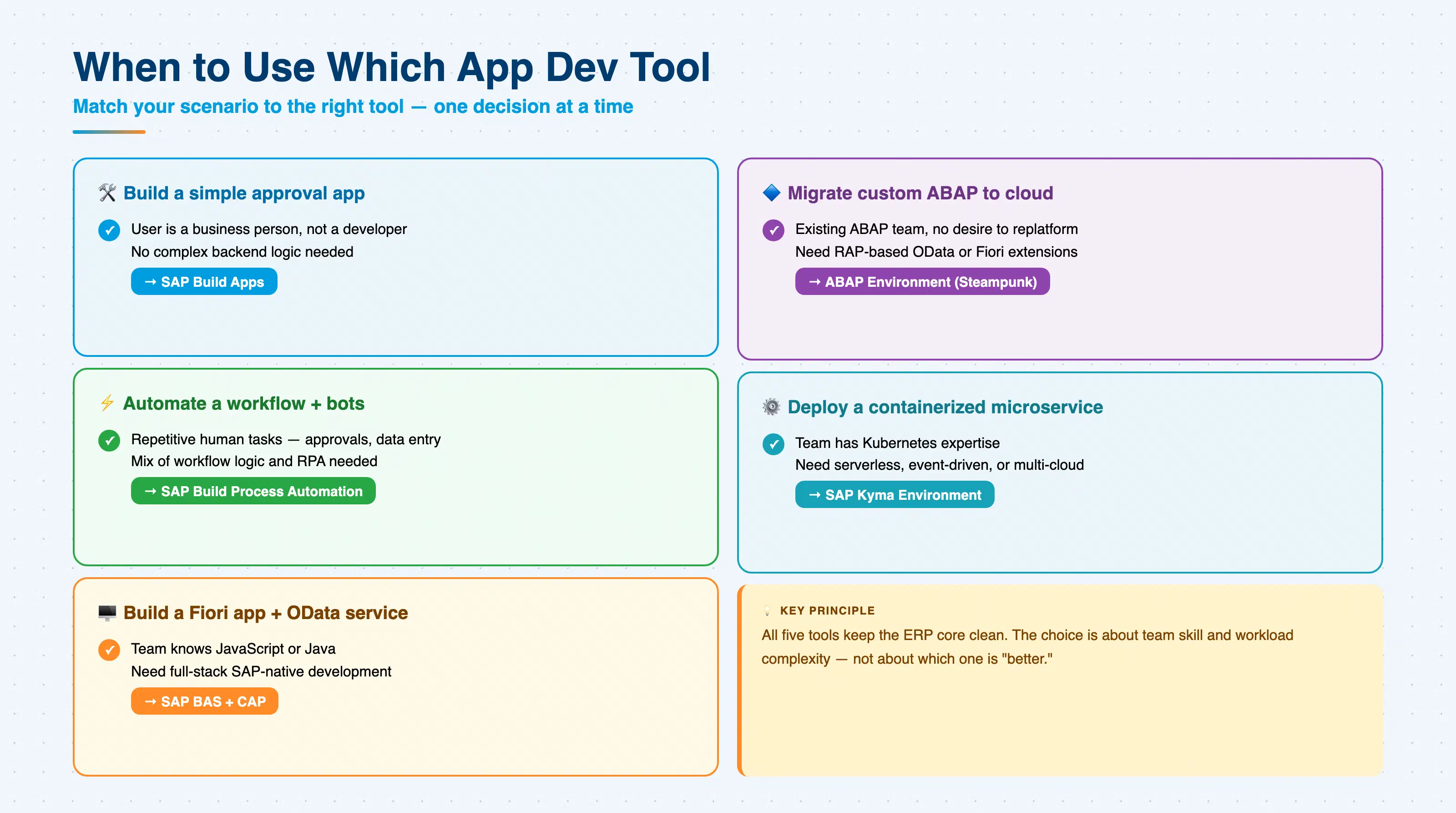
| Scenario | Recommended Tool |
|---|---|
| Business user builds a simple approval app | SAP Build Apps |
| Automate a procurement approval workflow | SAP Build Process Automation |
| Build a Fiori app backed by an OData service | SAP BAS + CAP |
| Migrate custom ABAP code to cloud standards | ABAP Environment + Joule for Developers |
| Deploy a containerized microservice | SAP Kyma |
Enterprise landscapes are never uniform. SAP S/4HANA runs alongside SuccessFactors, Salesforce, third-party logistics platforms, and legacy on-premise systems. Integration is the connective tissue that makes these systems behave as a coherent whole.
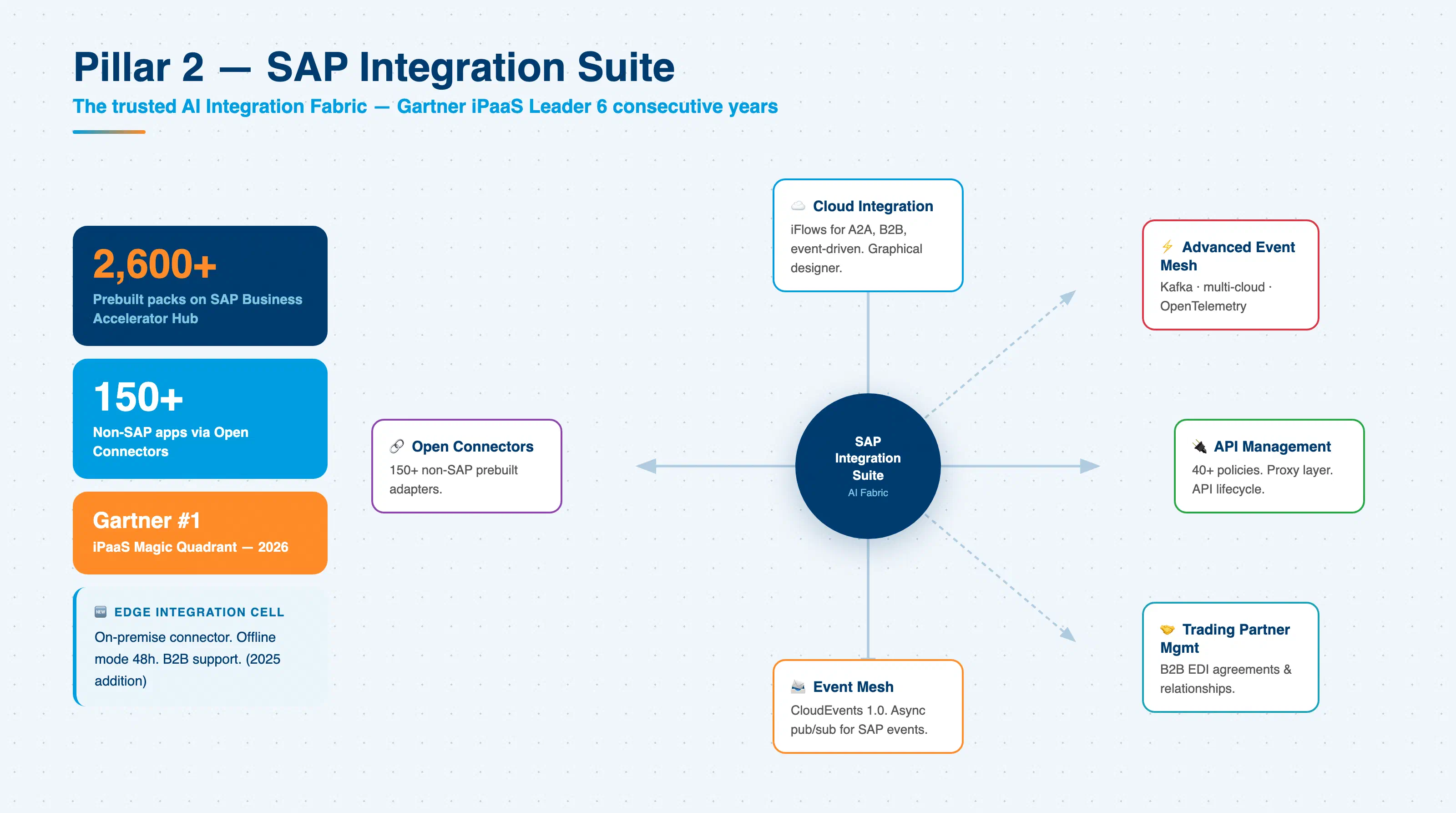
SAP Integration Suite is the flagship product in this pillar — an enterprise-grade integration platform as a service (EiPaaS) that SAP calls a “trusted AI Integration Fabric” as of 2026 ( SAP Community, Feb 2026). SAP has been recognized as a Leader in the 2026 Gartner Magic Quadrant for Integration Platform as a Service — the sixth consecutive year in that position.
The suite bundles multiple capabilities under a single subscription:
| Capability | Purpose |
|---|---|
| Cloud Integration | Build and run integration flows (iFlows) between systems using a graphical designer. Supports A2A, B2B, and event-driven patterns. |
| API Management | Create, secure, and monetize APIs. 40+ out-of-the-box policies. Acts as a proxy layer between consumers and backend systems. |
| Event Mesh | Managed event broker for asynchronous event-driven architectures. Publishes/subscribes to business events (e.g., BusinessPartner.Created from S/4HANA). Events conform to CloudEvents 1.0 specification. |
| Advanced Event Mesh | Enterprise-grade extension of Event Mesh: distributed broker mesh, OpenTelemetry tracing, Kafka bridging, active-standby failover. Event Portal 2.0 replaced Portal 1.0 as of April 2025. |
| Open Connectors | Prebuilt connectors for 150+ non-SAP cloud applications. |
| Integration Advisor | ML-based mapping recommendations for B2B/EDI integration scenarios. |
| Trading Partner Management | Manage B2B trading relationships and EDI agreements. |
The SAP Business Accelerator Hub (api.sap.com) serves as the catalog for all prebuilt integration content — over 2,600 integration packs, APIs, events, and connectors — making it the starting point for most integration projects.
Edge Integration Cell is a notable 2025 addition: a customer-managed connector deployed within a private landscape, supporting offline mode for up to 48 hours. This is relevant for manufacturing and logistics environments with intermittent connectivity.
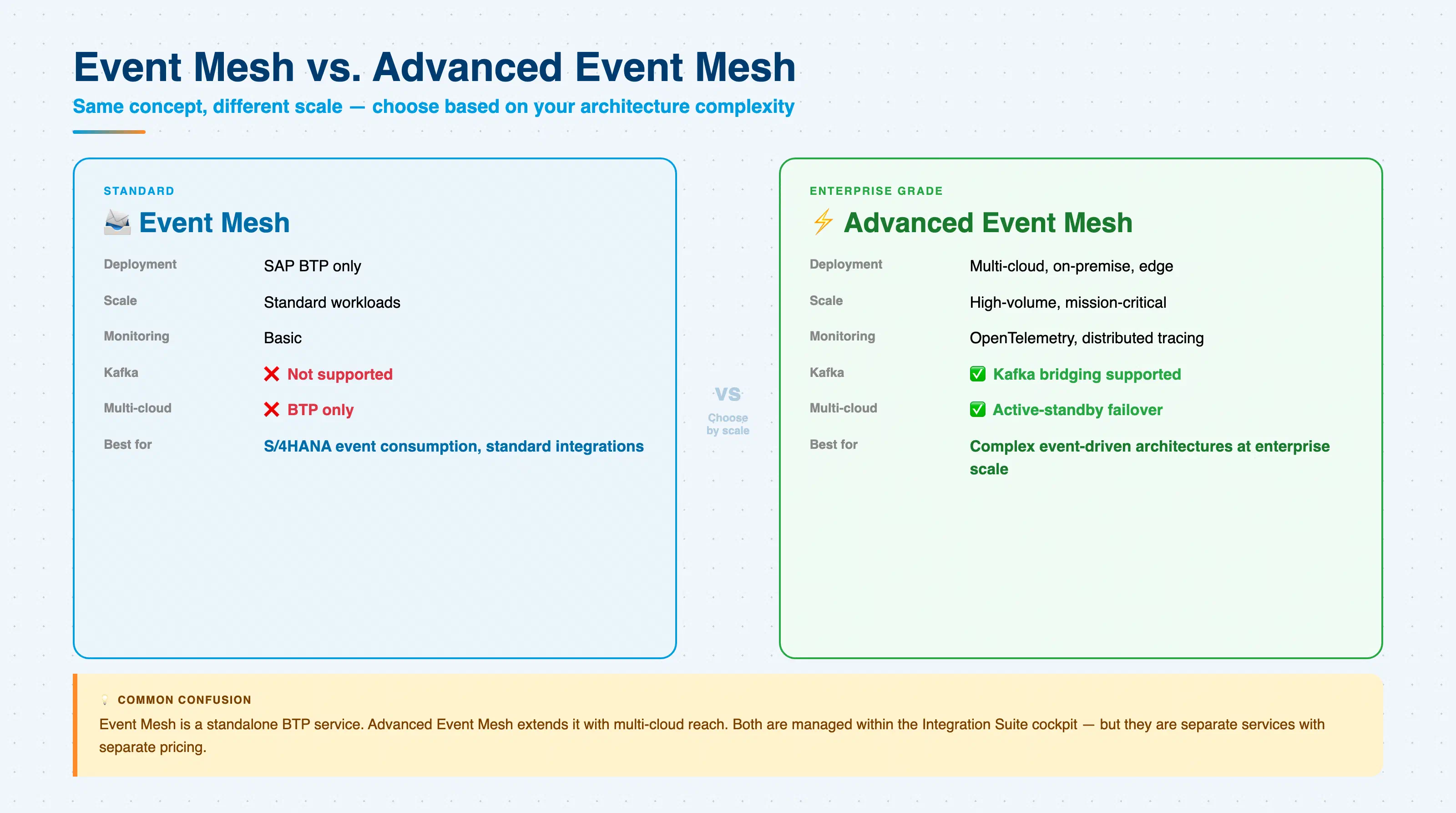
A frequent source of confusion in BTP projects:
| Feature | Event Mesh | Advanced Event Mesh |
|---|---|---|
| Deployment | SAP BTP only | Multi-cloud, on-premise, edge |
| Scalability | Standard | High-volume, mission-critical |
| Monitoring | Basic | OpenTelemetry, distributed tracing |
| Kafka integration | No | Yes |
| Best for | S/4HANA event consumption, standard integrations | Complex event-driven architectures at enterprise scale |
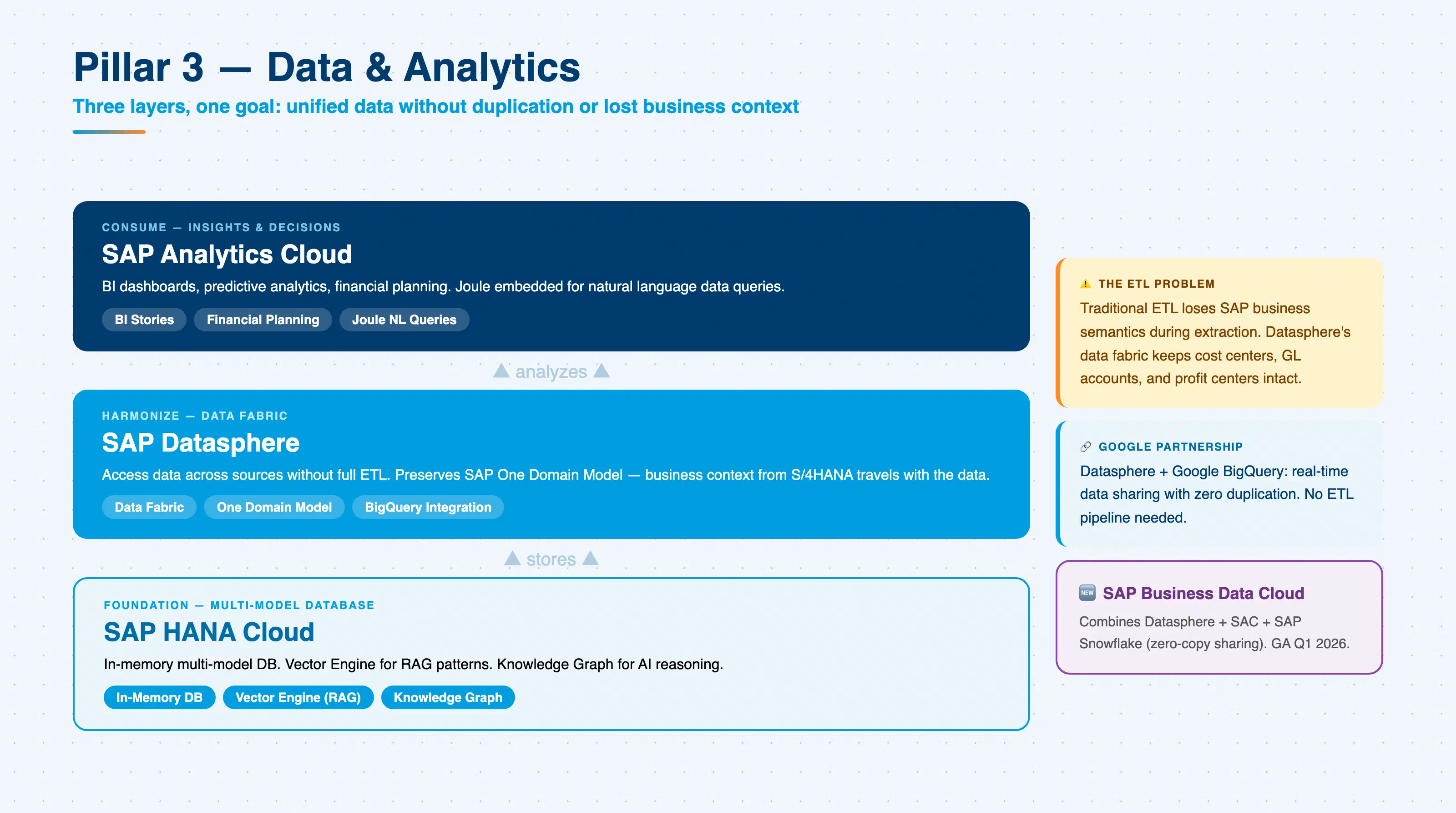
Business data is fragmented across SAP and non-SAP systems, cloud and on-premise environments. Reporting on this data typically requires extraction, transformation, and loading (ETL) into a central warehouse — a process that introduces latency and loses business context (such as SAP-specific data semantics). The Data & Analytics pillar aims to eliminate unnecessary data movement while preserving business meaning.
SAP Datasphere (formerly SAP Data Warehouse Cloud): the next-generation data platform on BTP. It provides a “data fabric” approach — allowing access to data from multiple sources without full physical consolidation. Critically, it preserves SAP’s One Domain Model metadata, so reports on finance or supply chain data retain the business context defined in S/4HANA. SAP and Google partnered to integrate Datasphere with Google Cloud BigQuery, enabling real-time data sharing without duplication.
SAP Analytics Cloud (SAC): the unified analytics and planning platform. Covers business intelligence (stories, dashboards), augmented analytics (natural language querying), and financial planning. Joule is now embedded in SAC for natural language interaction with data.
SAP HANA Cloud: the multi-model database engine underlying much of the BTP platform. Stores structured, semi-structured, and spatial data. The Vector Engine enables Retrieval Augmented Generation (RAG) for AI applications; the Knowledge Graph Engine provides semantically connected enterprise data for AI reasoning. In 2025, self-service migration tooling was added for customers moving from on-premise SAP HANA.
SAP Business Data Cloud (SAP BDC): announced in 2025, SAP BDC combines Datasphere and SAP Analytics Cloud with broader ecosystem connectivity. SAP Snowflake — a partnership enabling zero-copy data sharing between Snowflake and SAP BDC — reached general availability in Q1 2026.
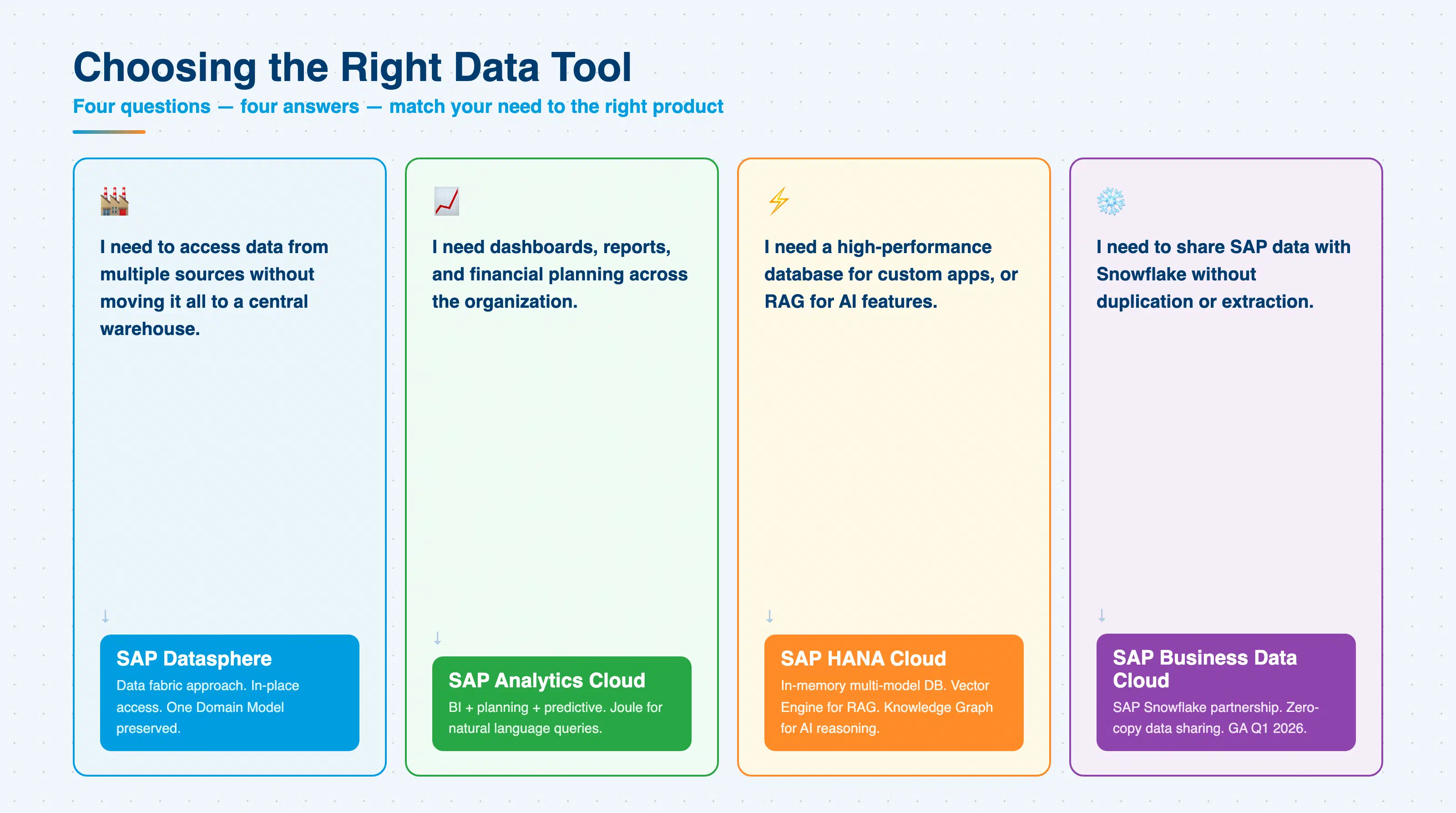
| Question | Direction |
|---|---|
| Do you need to keep data in place without full ETL? | SAP Datasphere (data fabric) |
| Do you need dashboards and financial planning? | SAP Analytics Cloud |
| Do you need a high-performance database for custom apps? | SAP HANA Cloud |
| Do you need to share data with Snowflake without duplication? | SAP Business Data Cloud + SAP Snowflake |
AI in enterprise software has historically meant narrow, feature-specific models embedded in individual applications — not a programmable layer that developers and business users can extend. The AI pillar changes this by providing both pre-built AI capabilities embedded in SAP applications and an open AI platform for customers to build their own.
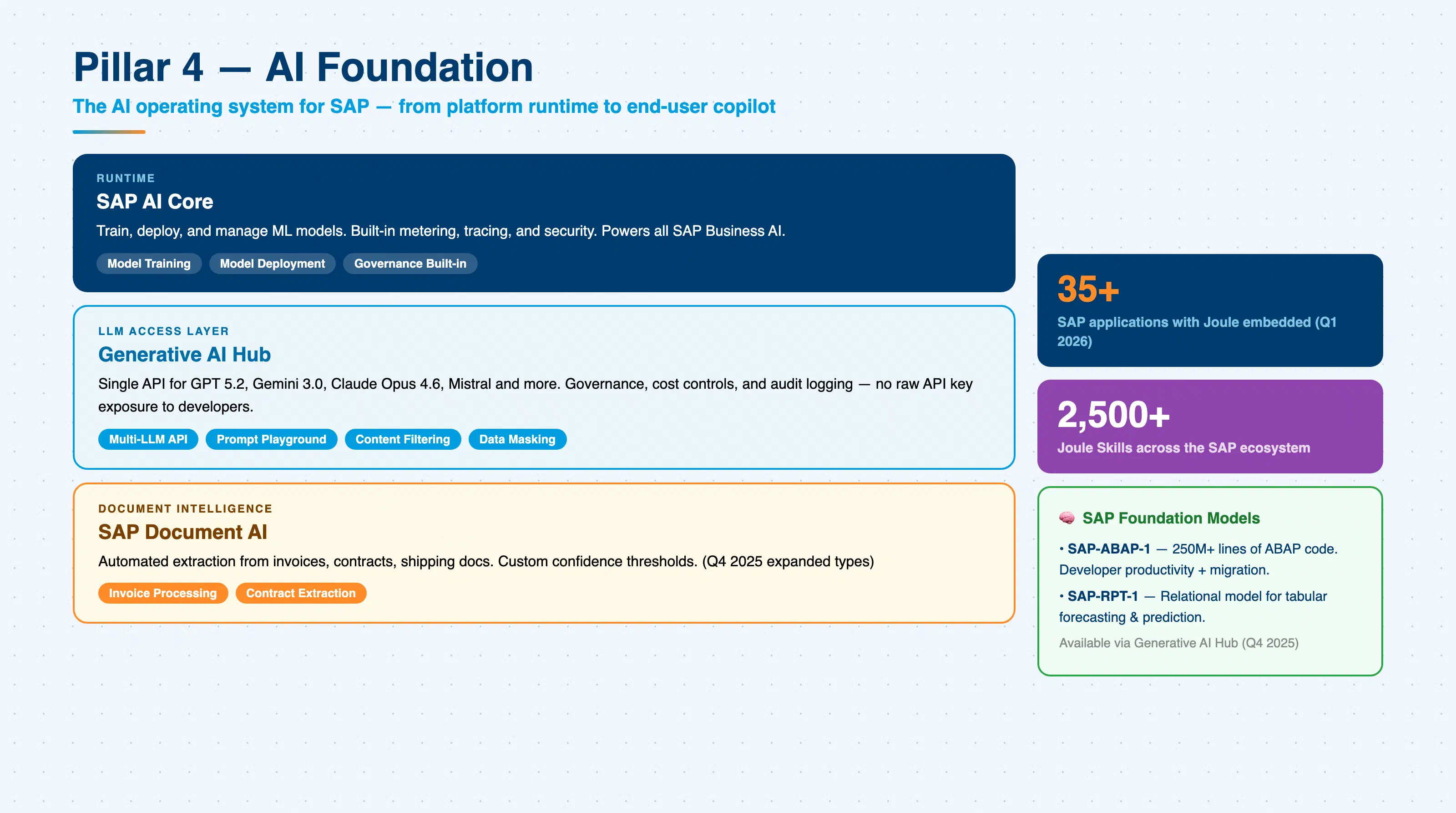
AI Foundation is described by SAP as “the comprehensive AI operating system for all SAP Business AI solutions” ( SAP AI Foundation product page). It runs on SAP AI Core, SAP BTP’s managed AI runtime.
Components of AI Foundation:
Generative AI Hub: a unified API giving developers access to frontier models — including OpenAI GPT 5.2, Gemini 3.0 Pro, Anthropic Claude Opus 4.6 and Sonnet 4.6, Mistral, and others ( SAP News Q1 2026). The hub includes a prompt engineering playground, prompt optimization (in partnership with Not Diamond), metadata filtering, and an orchestration service that combines content generation, grounding, data masking, and content filtering in a single pipeline call.
Joule Studio: the low-code/no-code environment for building custom AI agents and Joule skills. Joule Studio Agent Builder reached general availability in Q1 2026. Enterprises can design agents that automate multi-step business workflows, connect to SAP and non-SAP data via SAP Integration Suite, and orchestrate multi-agent workflows with built-in governance and audit trails.
SAP Document AI: automates data extraction from unstructured documents (invoices, contracts, shipping documents). Includes custom confidence thresholds and expanded document type support as of Q4 2025.
SAP-ABAP-1: SAP’s own foundation model trained on 250M+ lines of ABAP code and 30M+ lines of CDS code. Available via the Generative AI Hub for developer productivity and ABAP code migration use cases ( SAP News Q4 2025).
SAP-RPT-1: SAP’s first enterprise relational foundation model — unlike LLMs, optimized for tabular data prediction, forecasting, and relational business logic.
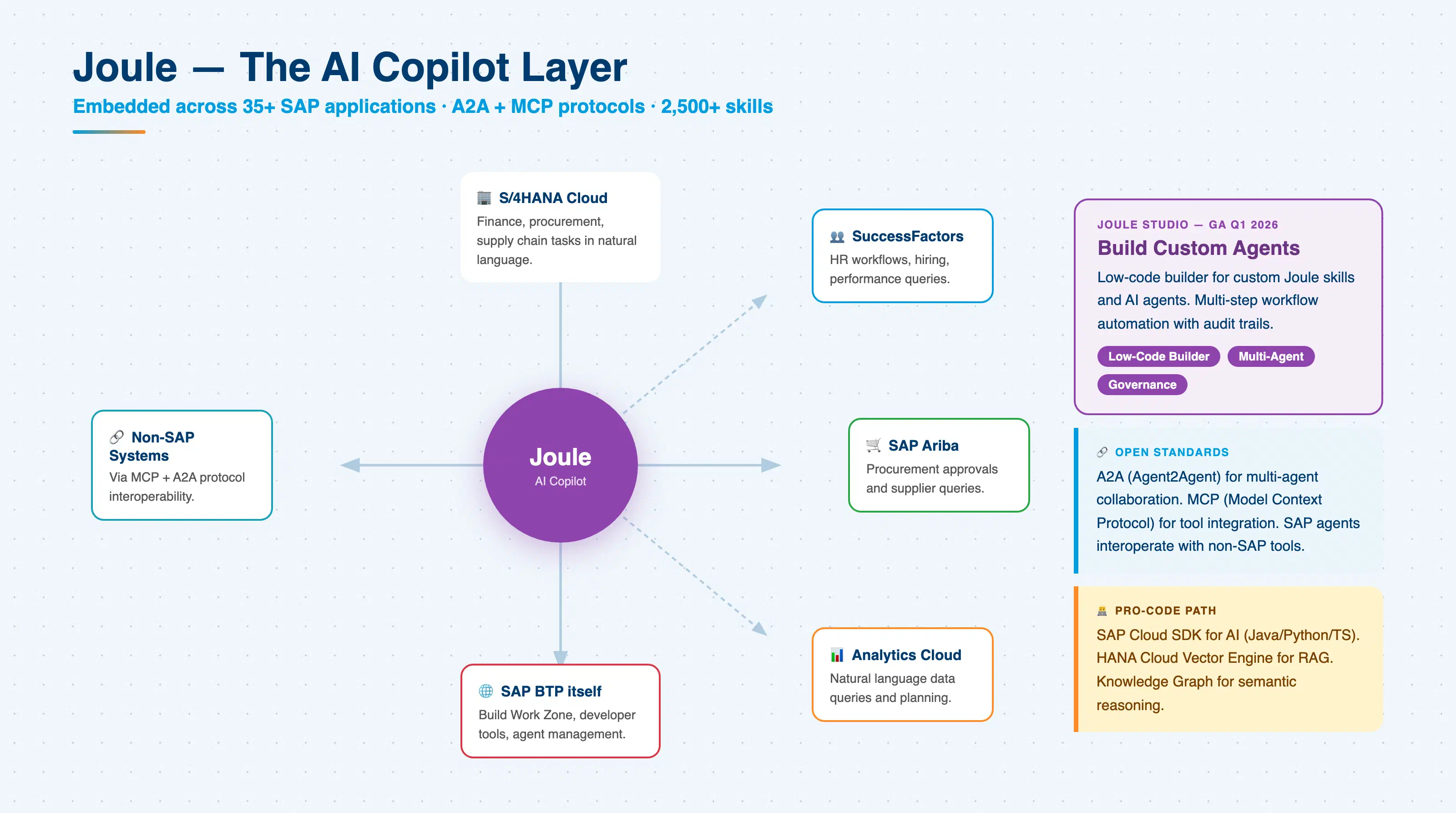
Joule is SAP’s generative AI copilot, embedded across S/4HANA Cloud, SAP SuccessFactors, SAP Ariba, SAP Analytics Cloud, and SAP BTP itself. As of Q1 2026, Joule is live across 35 SAP solutions. The platform now offers 40+ specialized agents and 2,500+ Joule skills.
Joule uses the A2A (Agent2Agent) protocol for multi-agent collaboration and the MCP (Model Context Protocol) for tool integration — both open standards that allow SAP agents to interoperate with non-SAP agents and tools ( SAP Architecture Center).
For complex scenarios requiring deep customization, SAP BTP supports pro-code agent development via:
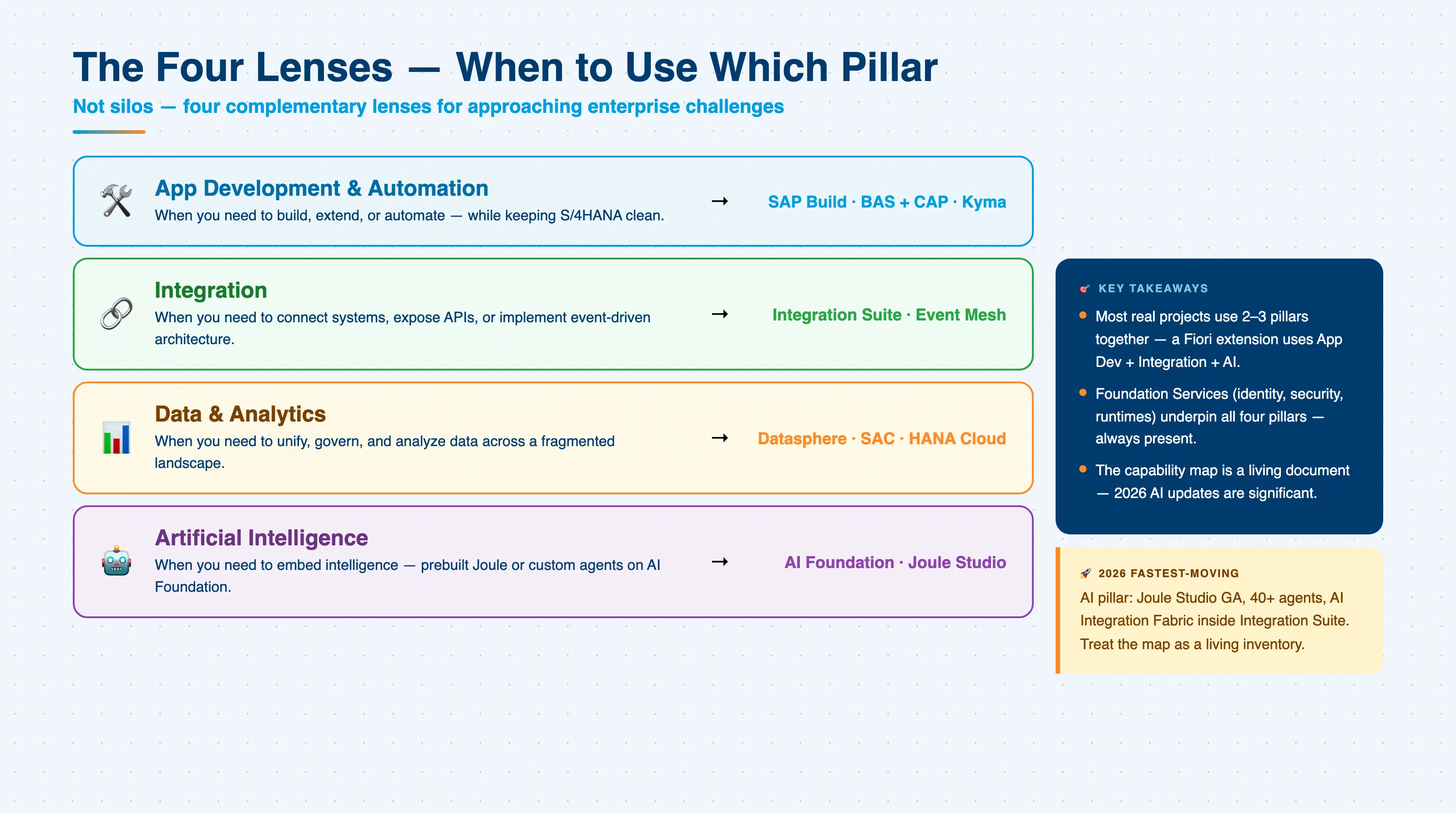
The SAP BTP capability map is best understood as four interconnected pillars — not separate products, but four lenses for approaching different enterprise challenges:
In 2026, the capability map is expanding fastest in the AI pillar: Joule Studio, agentic workflows, and the AI Integration Fabric inside Integration Suite are redefining what “standard” BTP looks like. Organizations that treat the capability map as a static reference will fall behind those who track it as a living inventory of what is now possible.
Q: Is SAP BTP the same as SAP Cloud Platform? A: SAP BTP is the evolution and rebranding of SAP Cloud Platform, announced in 2020. It consolidates services that were previously separate products — including SAP HANA, SAP Data Intelligence, and SAP Integration Suite — into a unified platform.
Q: Do I need all four pillars for every BTP project? A: No. Most projects use one or two pillars. A clean core extension project might only use App Development and Integration. An analytics modernization project might only use Data & Analytics and AI. The pillars are independent starting points, not a mandatory bundle.
Q: What is the difference between SAP Integration Suite and SAP Event Mesh? A: SAP Integration Suite is a multi-capability integration platform (Cloud Integration, API Management, Open Connectors, etc.). SAP Event Mesh is technically a separate, independent BTP service for event-driven architectures — though it is managed within the Integration Suite cockpit and used together in most event-driven integration designs.
Q: How does AI Foundation relate to Joule? A: AI Foundation is the underlying platform (SAP AI Core, Generative AI Hub, Joule Studio, SAP Document AI). Joule is the end-user-facing copilot experience built on top of AI Foundation. Developers build on AI Foundation; business users experience Joule.
Q: Is SAP BTP available on AWS and Azure? A: Yes. SAP BTP runs on AWS, Microsoft Azure, Google Cloud Platform, and SAP’s own infrastructure. As of H2 2025, select BTP services also became available directly through hyperscaler marketplaces on AWS, Azure, and GCP.
This site organizes BTP knowledge into the following structure:
| L1. Big Picture | L2. Functional Domains |
|---|---|
| BTP-001 What is BTP | L2-A. Integration |
| BTP-002 BTP Architecture | L2-B. Application Development & Automation |
| BTP-003 BTP Capability Map (this article) | L2-C. Data & Analytics |
| BTP-004 Deployment Models | L2-D. AI |
| BTP-005 Licensing Models | L2-E. Foundation Services |
| BTP-006 Clean Core Strategy | L2-F. Architecture & Operations |
| L2-G. Use Cases & Patterns |