Title here
Summary here

| Reader | What You Will Get |
|---|---|
| SAP project managers and solution architects | A clear map of which licensing model fits which project stage and usage pattern |
| IT procurement and finance leaders | An explanation of credit mechanics, overage risks, and negotiation levers |
| Developers and BTP newcomers | Clarity on the difference between Trial, Free Tier, Pay-As-You-Go, and enterprise agreements |
| RISE/GROW customers | An understanding of what BTP is — and is not — included in their bundle |
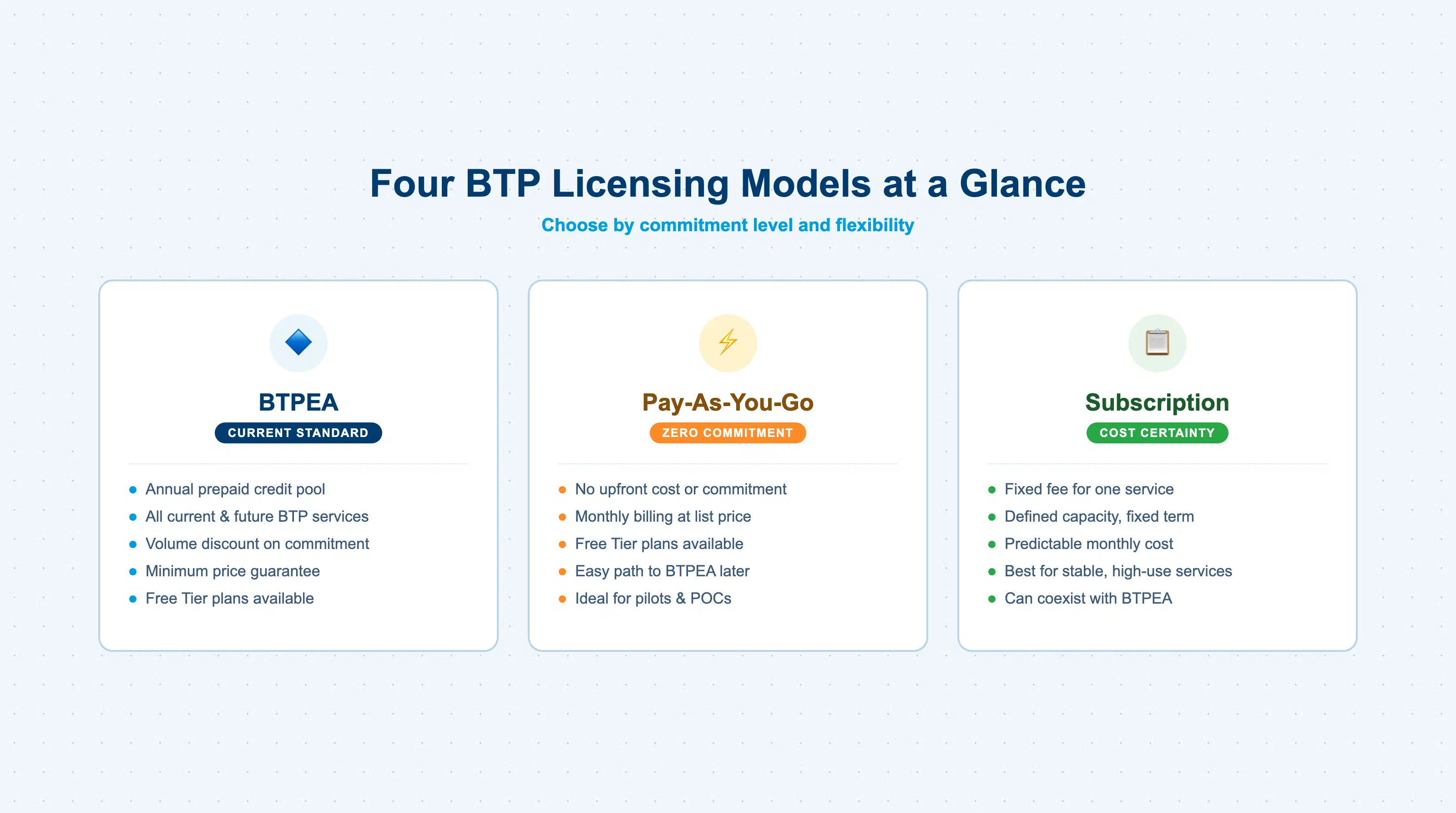
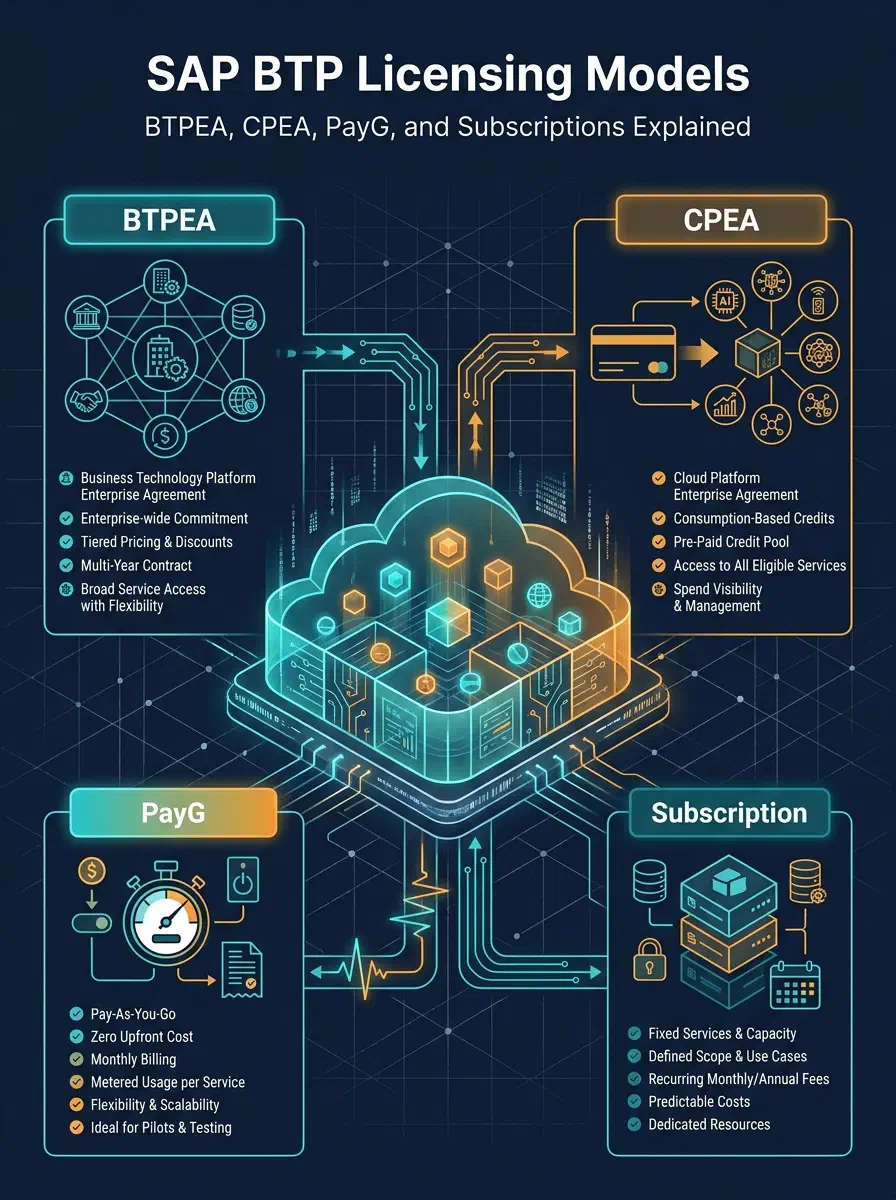
SAP BTP organizes commercial access into two broad categories: consumption-based models and subscription-based models. Within consumption-based, there are three distinct flavors. Understanding the difference between them is the foundation of any BTP cost planning exercise.
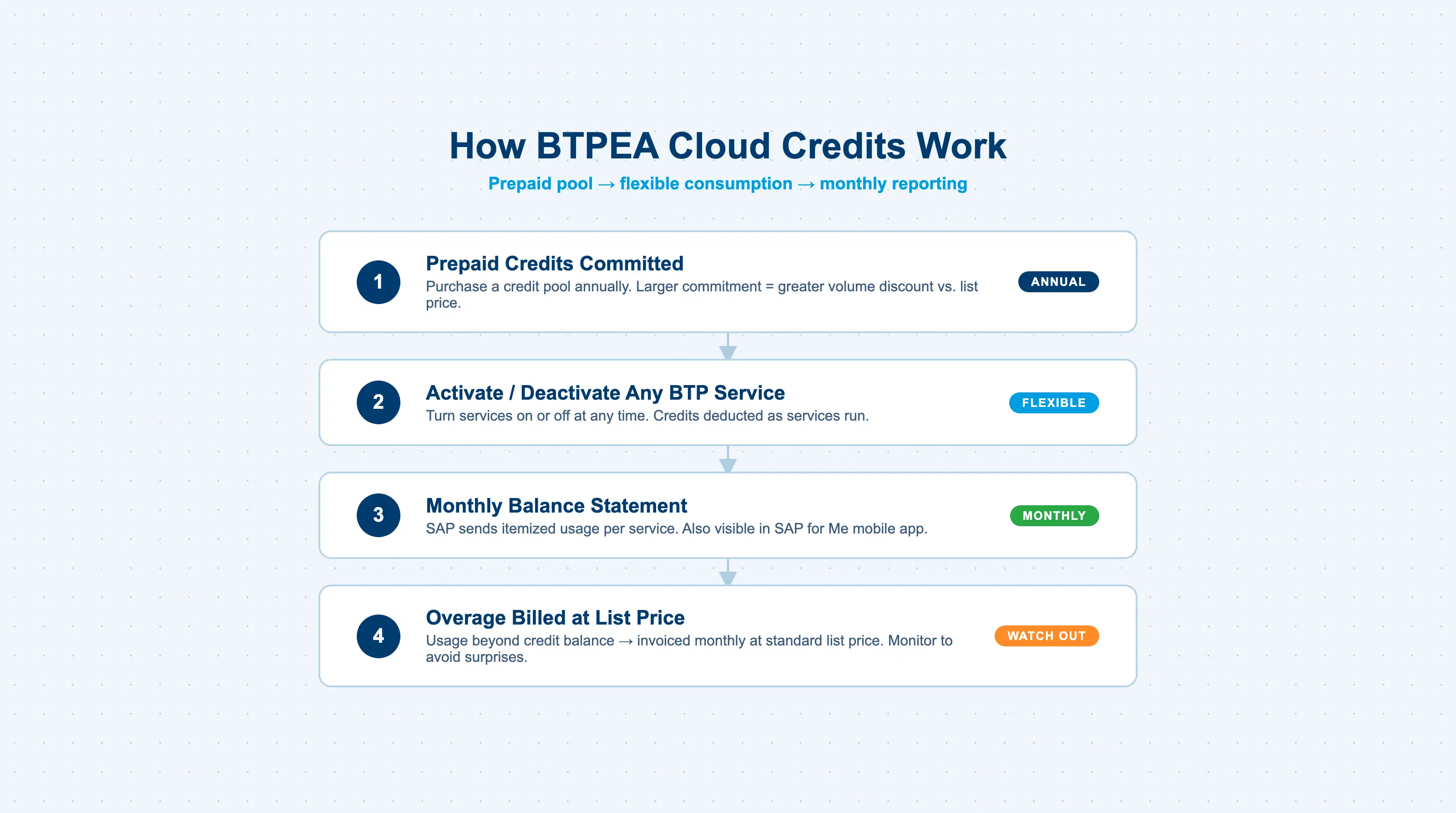
BTPEA is the current consumption-based model for SAP BTP, introduced in April 2024 as the successor to CPEA. Under BTPEA, an organization purchases a pool of cloud credits upfront — typically on an annual basis — and draws from that pool as BTP services are activated and used ( SAP BTP Pricing).
The core mechanics:
A key advantage of BTPEA is access to the latest SAP innovations. Services such as SAP Analytics Cloud (public system option, BI and Planning) and certain AI capabilities are available exclusively under BTPEA and are not part of the CPEA catalog ( ASUG).
BTPEA also introduces a minimum price guarantee: if the price of any BTP service decreases after a contract is signed, SAP will bill at the new lower price for the remainder of the term ( ASUG).
One technical constraint: BTPEA does not support the SAP BTP NEO environment or deprecated services ( SAP Developers).
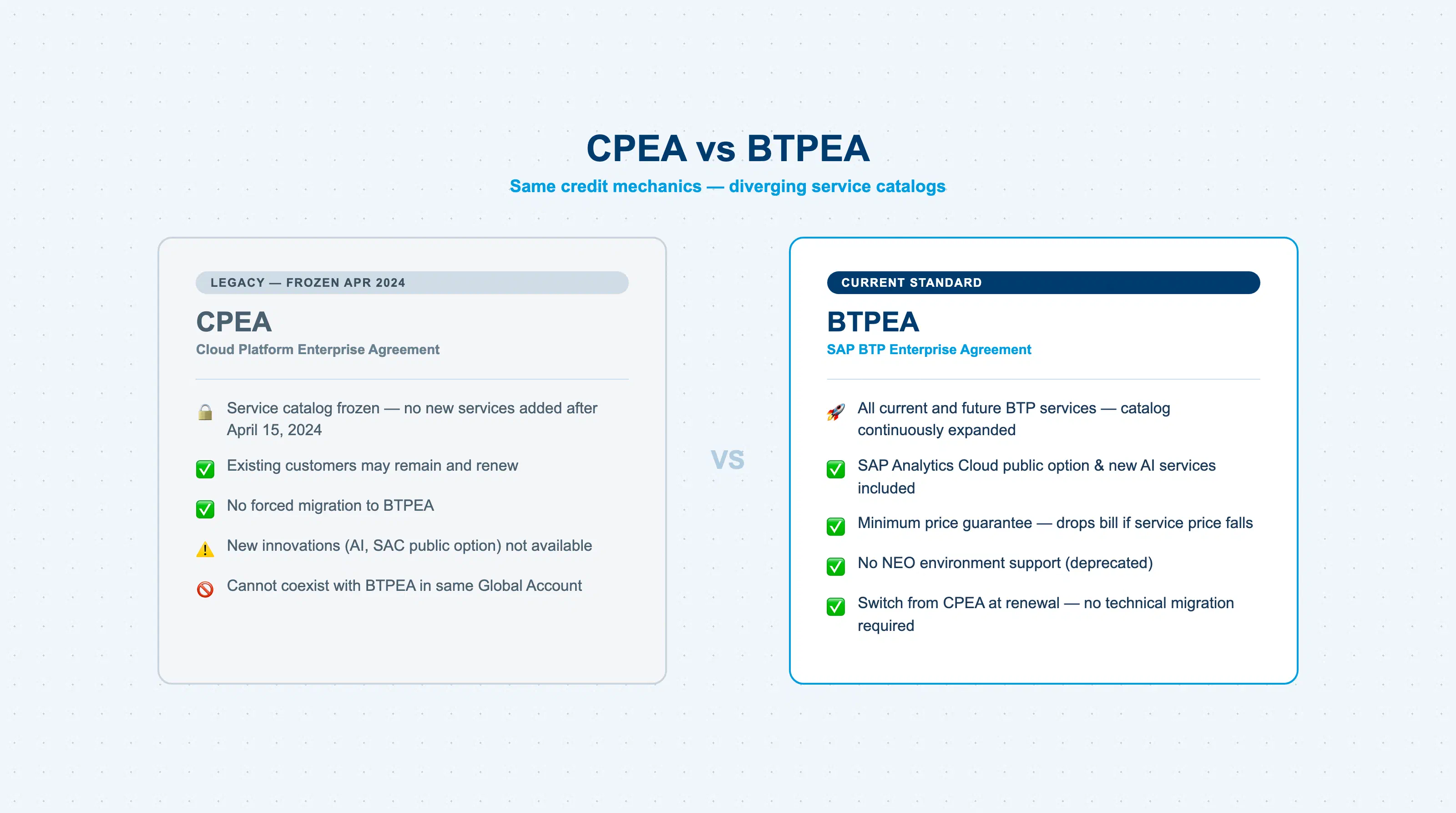
CPEA was SAP’s first consumption-based model for BTP and operated on the same credit-pool mechanics as BTPEA. However, as of April 15, 2024, CPEA is no longer available to new customers, and its service catalog is frozen — no new BTP services will be added to CPEA going forward ( SAP Developers).
Existing CPEA customers can remain on CPEA and continue to purchase additional credits at renewal. SAP has confirmed there is no forced migration to BTPEA, and the transition can happen at a standard renewal without any technical changes to the existing landscape ( ASUG).
The practical implication for CPEA customers: if an organization needs access to newer BTP services or AI capabilities that SAP has introduced after April 2024, those services will not be available under CPEA. Moving to BTPEA at the next renewal is the path to accessing them.
BTPEA and CPEA cannot coexist within a single Global Account. An organization requiring both models simultaneously would need two separate Global Accounts ( SAP Developers).
Pay-As-You-Go for SAP BTP requires no upfront commitment and no minimum spend. Usage is billed monthly based on actual consumption at standard list prices — which are higher than the discounted rates available under BTPEA or CPEA ( SAP Licensing Experts).
PayG accounts also support Free Tier service plans, allowing teams to test specific services at no cost within defined limits ( SAP Developers).
PayG is the natural entry point for organizations that are:
Transitioning from PayG to BTPEA is operationally straightforward: existing services and subaccounts are preserved, and billing simply shifts from per-use to credit-based ( Redress Compliance).
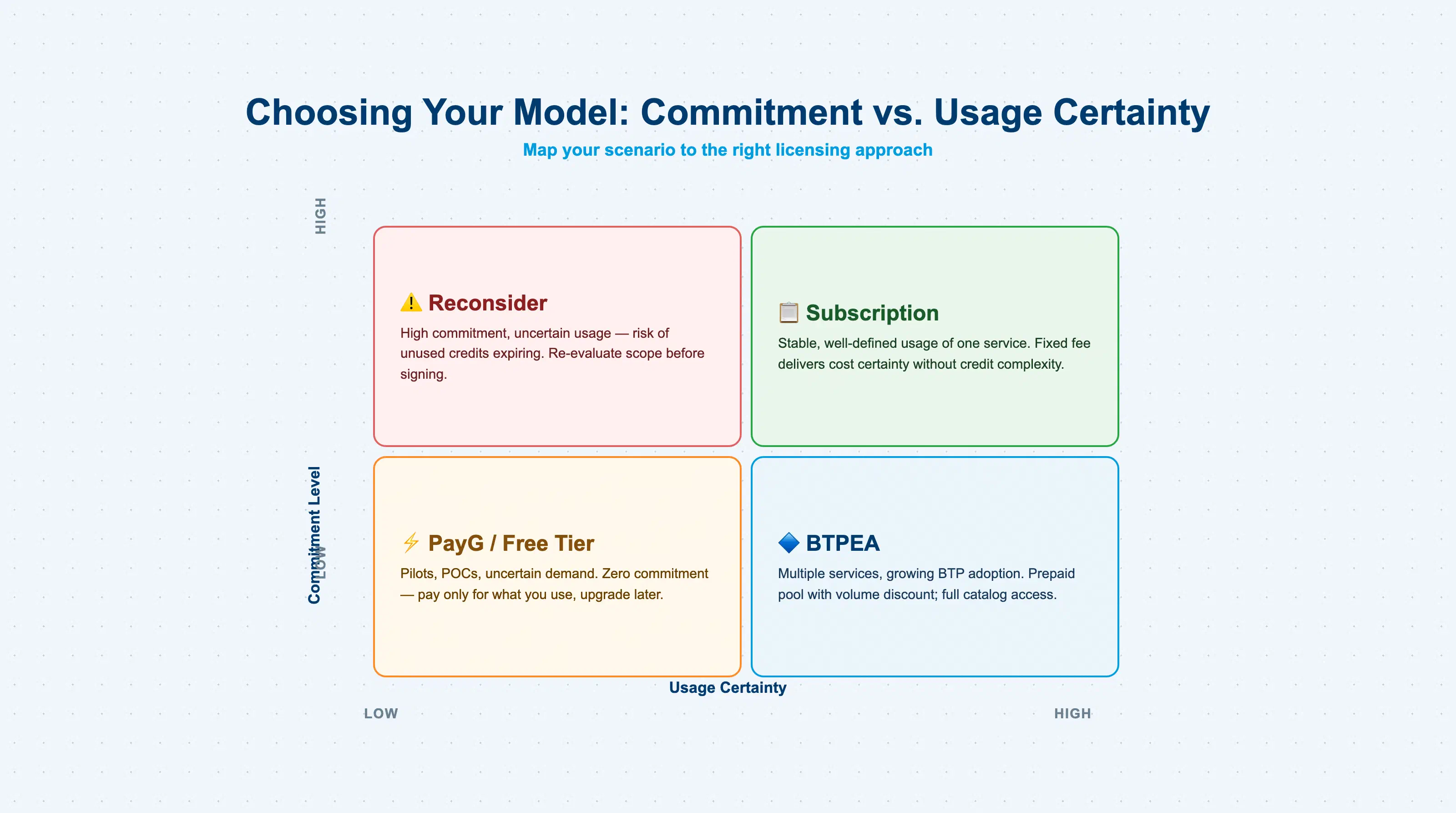
The subscription model is the traditional approach: a fixed fee for a specific BTP service or bundle, covering a defined capacity over a fixed term (typically one to three years). Unlike consumption models, subscriptions do not use cloud credits; they are separate line items covering only the services named in the contract.
Subscriptions suit scenarios where:
The consumption and subscription models are not mutually exclusive. An organization can maintain a BTPEA global account for flexible services while holding specific subscriptions for services with predictable, high utilization ( SAP Licensing Experts).
Two no-cost options exist for teams that want to evaluate BTP before making any commercial commitment.
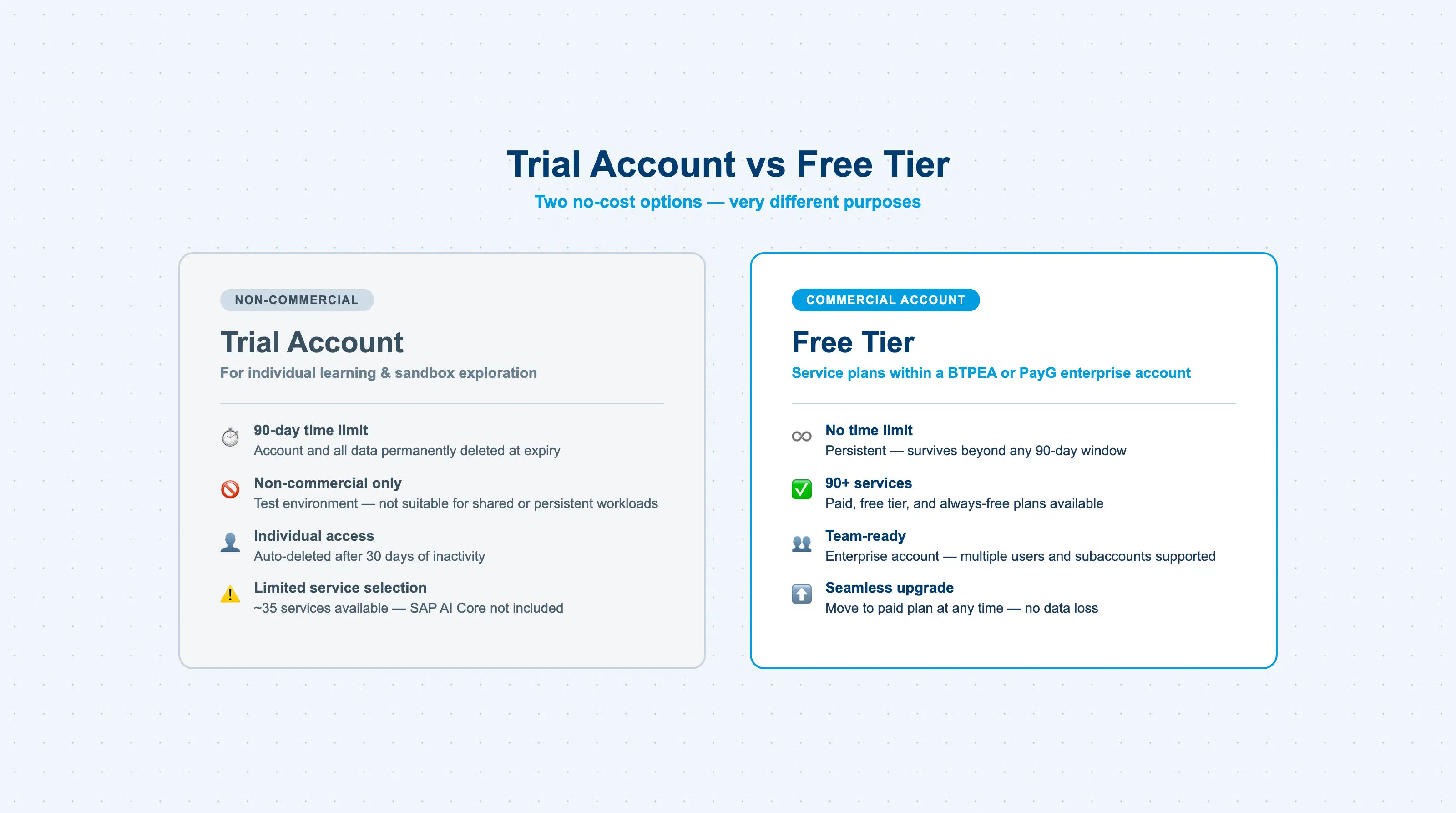
The Trial account is a non-commercial, time-limited offering giving 90 days to explore a subset of BTP services in a test environment. At the end of the 90-day period — or after 30 consecutive days of inactivity — the account, all deployed applications, and all data are permanently deleted ( SAP BTP Trial).
Trial is intended for individual learning and sandbox exploration. It is not suitable for proof-of-concept work that needs to persist or be shared across a team.
Free Tier is not an account type — it is a set of service plans available within a commercial enterprise account (BTPEA or PayG). Free Tier plans have no time limit and give access to more than 90 BTP services up to defined usage thresholds, at no cost ( SAP BTP Trial).
The distinction matters in practice: a developer who needs persistent access to SAP AI Core for a real project needs a BTPEA or PayG account with the Free Tier plan for that service — not a trial account, which does not include AI Core ( SAP Community).
Free Tier plans can be upgraded to paid plans at any time without losing existing work, providing a smooth path from exploration to production.
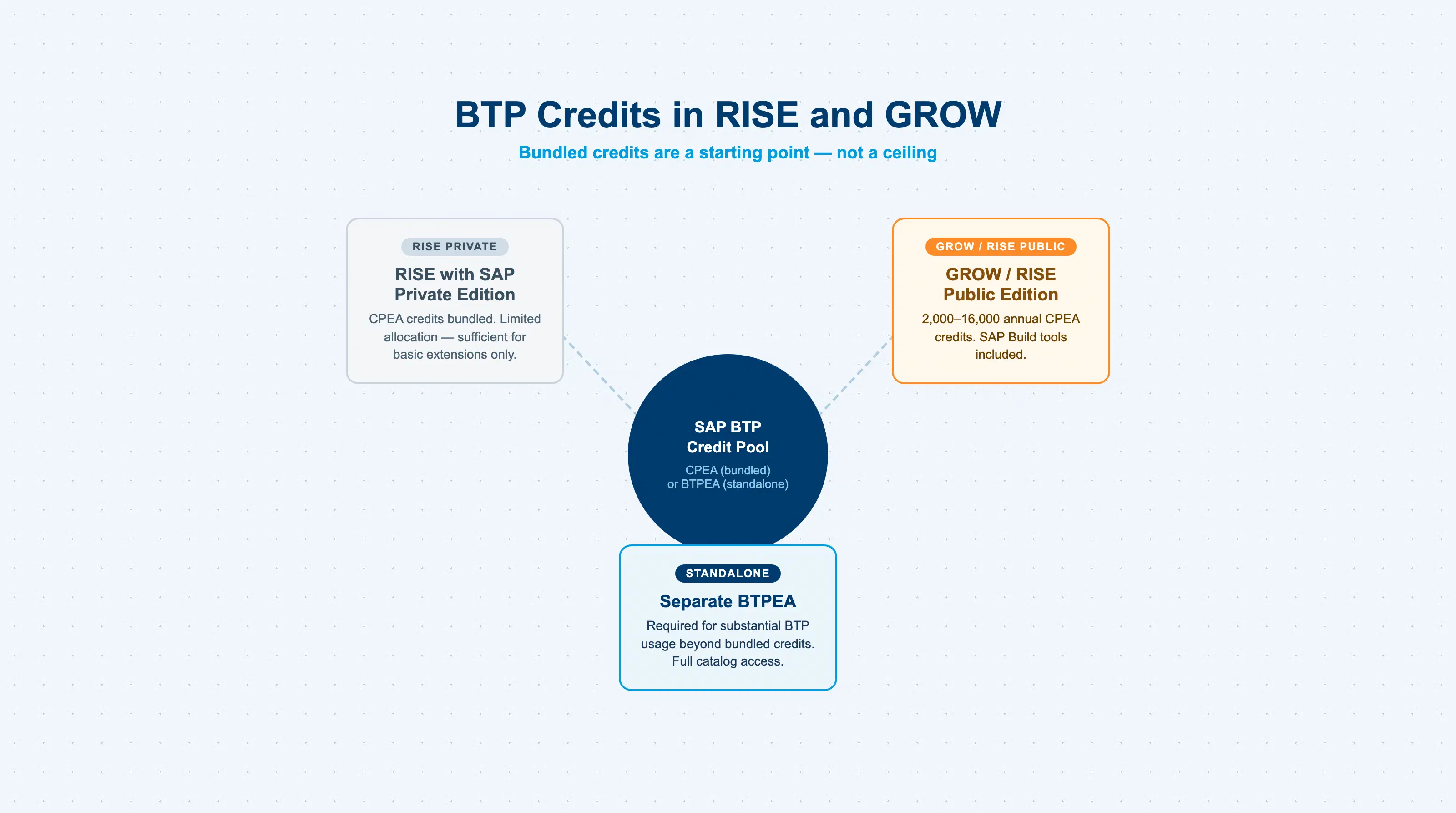
Many SAP customers first encounter BTP licensing not through a standalone BTP contract, but through a RISE with SAP or GROW with SAP bundle.
RISE with SAP includes BTP credits in the form of CPEA as standard. For S/4HANA public cloud customers under GROW, the included annual CPEA credit value typically falls between 2,000 and 16,000 credits, depending on the contract ( ITAA). GROW with SAP editions also include access to SAP Build tools for low-code application development ( LeverX).
These bundled credits are intended as a foundation — sufficient for basic extensions, integrations, and process automation at moderate scale.
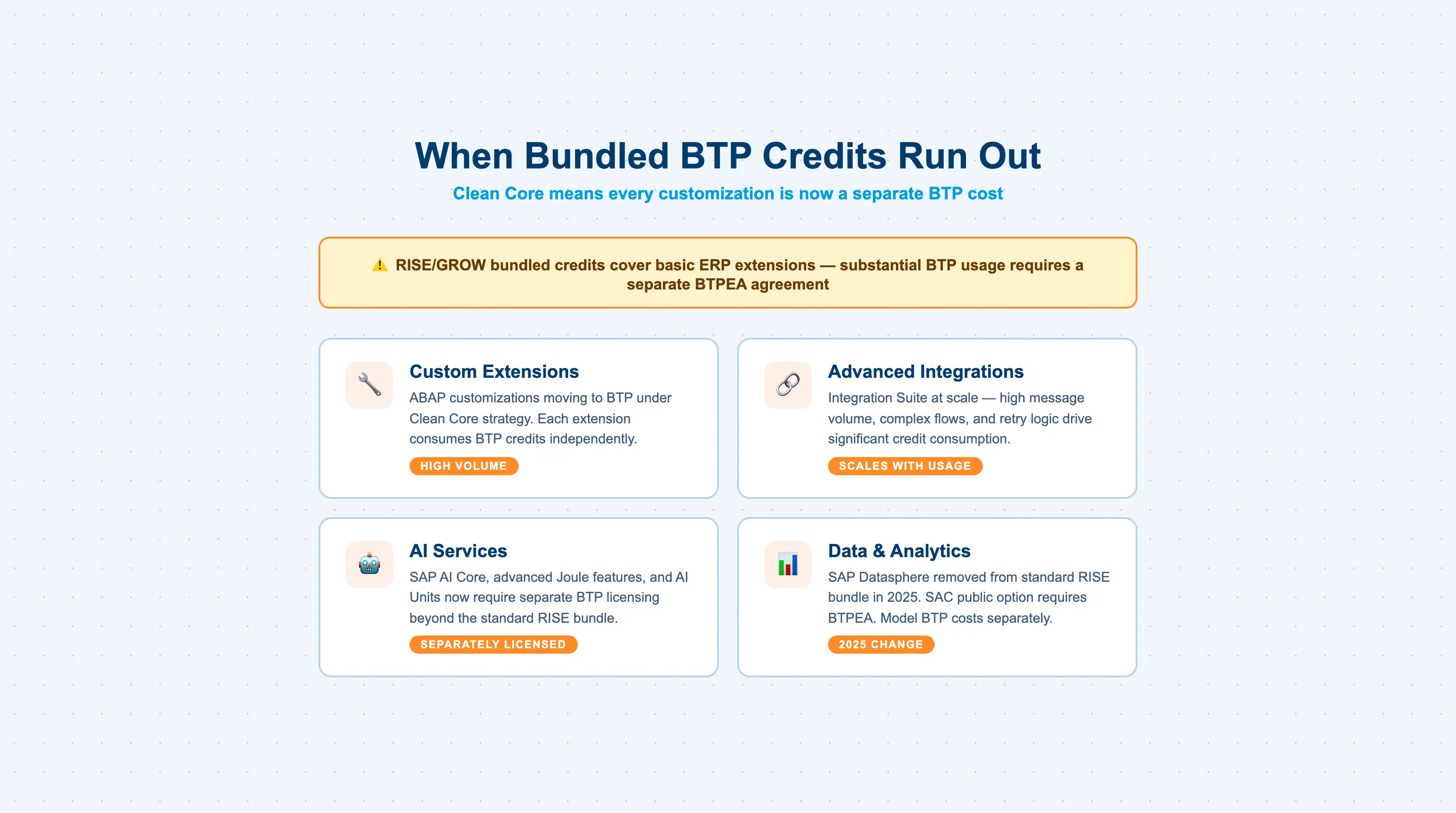
An important constraint: the included BTP credits in RISE/GROW are a fixed allocation tied to the ERP contract. For organizations planning substantial BTP usage — custom extensions, advanced integrations, data analytics workloads, or AI services — the bundled credits will not be sufficient, and a separate BTPEA agreement is required.
SAP’s Clean Core strategy reinforces this dynamic. As customizations that previously lived inside S/4HANA are moved to BTP (the expected pattern for cloud-ready implementations), each extension, integration, and automation becomes a BTP cost that scales independently of the ERP subscription. Organizations with significant customization portfolios should model BTP costs separately and not assume the bundled credits cover them ( Redress Compliance — 2026).
SAP restructured RISE and GROW packaging in 2025. Several capabilities previously bundled in the standard RISE package — including SAP Datasphere, certain AI Unit capabilities, advanced Joule features, and sustainability tools — were moved to separate licensed add-ons, many of which consume BTP credits or require additional BTP agreements ( Redress Compliance — 2026). Organizations reviewing or renewing RISE contracts should verify which BTP-adjacent capabilities remain in their bundle versus what now requires separate procurement.
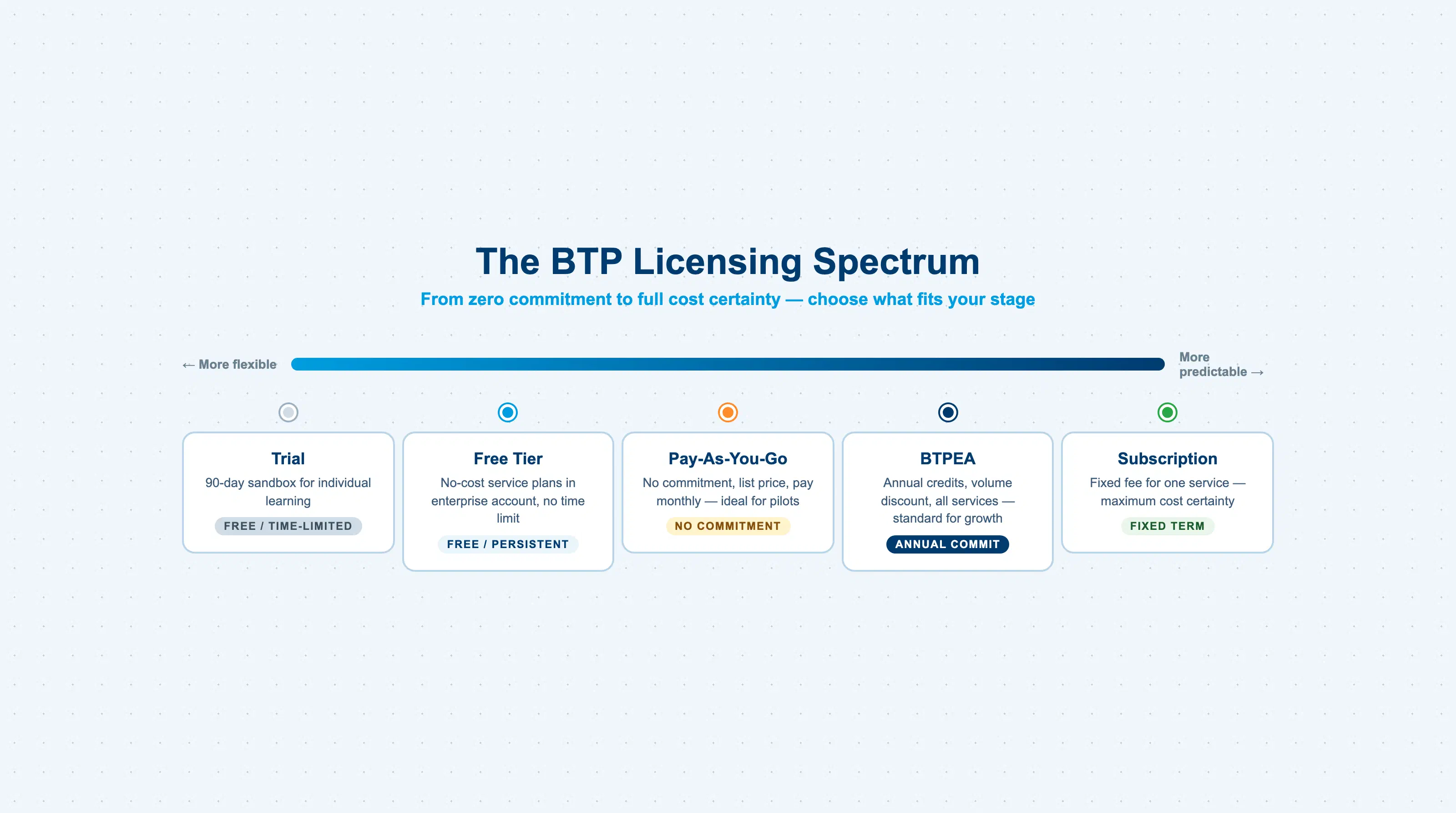
The table below summarizes the primary trade-offs:
| Model | Upfront Commitment | Flexibility | Cost per Unit | Best Starting Point For |
|---|---|---|---|---|
| Trial | None | Low (test only, 90 days) | Free | Individual learning |
| Free Tier (via BTPEA/PayG) | None | Medium | Free up to limits | Team POC, initial dev |
| Pay-As-You-Go | None | High | List price (highest) | Pilots, uncertain demand |
| CPEA | Annual (existing only) | High (frozen catalog) | Discounted | Existing CPEA customers |
| BTPEA | Annual | Highest (all current + future services) | Discounted | New customers, innovation focus |
| Subscription | Fixed term | Low (fixed service + capacity) | Fixed | Single-service, stable demand |
| RISE/GROW bundle | Multi-year (ERP deal) | Medium (limited BTP credits) | Part of ERP deal | ERP transformation entry point |
A common adoption path: start with PayG for pilots and proof-of-concept work, transition to BTPEA as usage stabilizes and the service mix becomes clear, and layer in individual subscriptions for any high-use services where fixed pricing provides meaningful budget certainty.
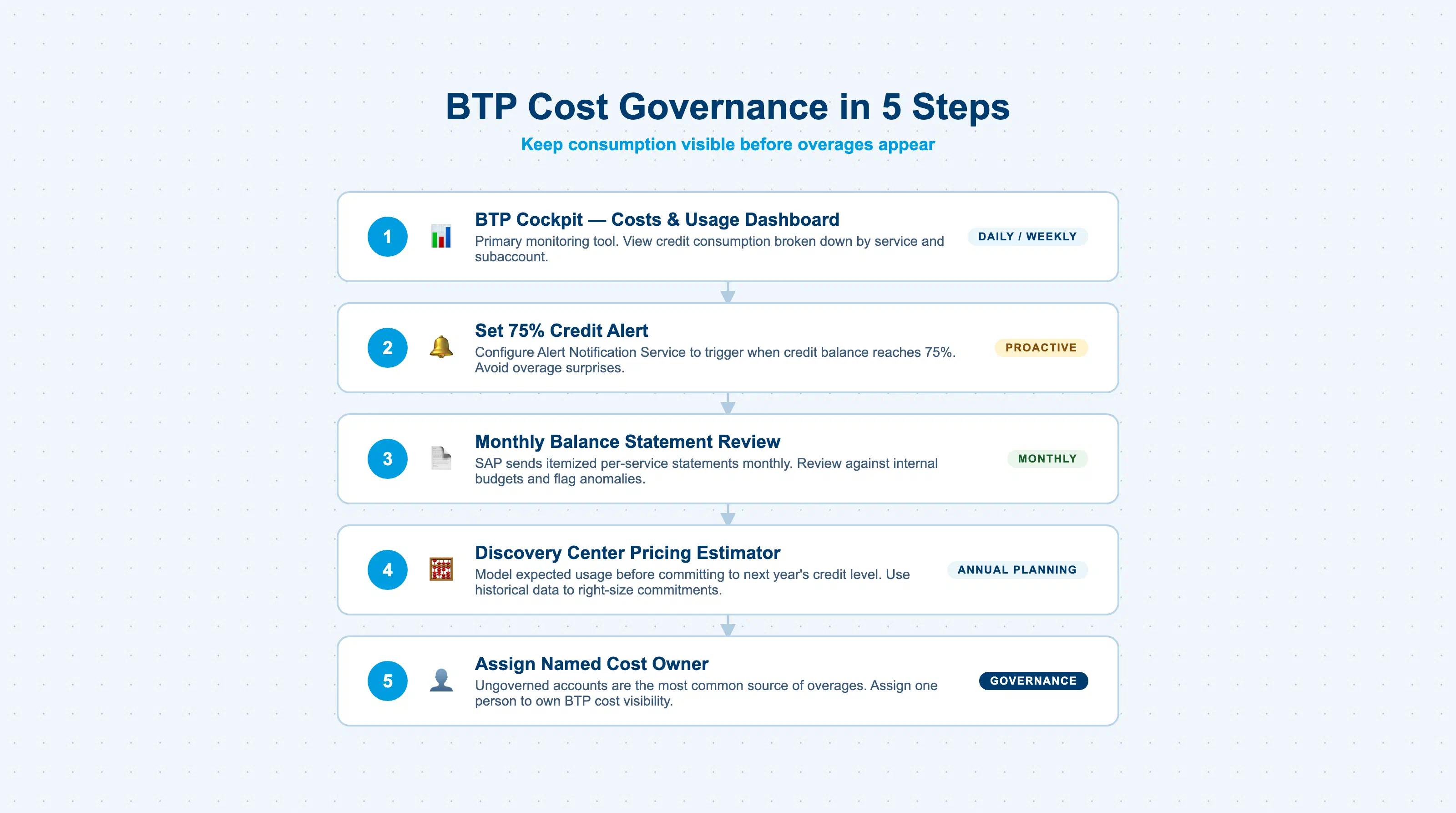
Under BTPEA or CPEA, cost governance is the customer’s responsibility. SAP provides tooling in the BTP Cockpit (Costs & Usage dashboard) to track credit consumption by service and set alerts. Recommended practices include:
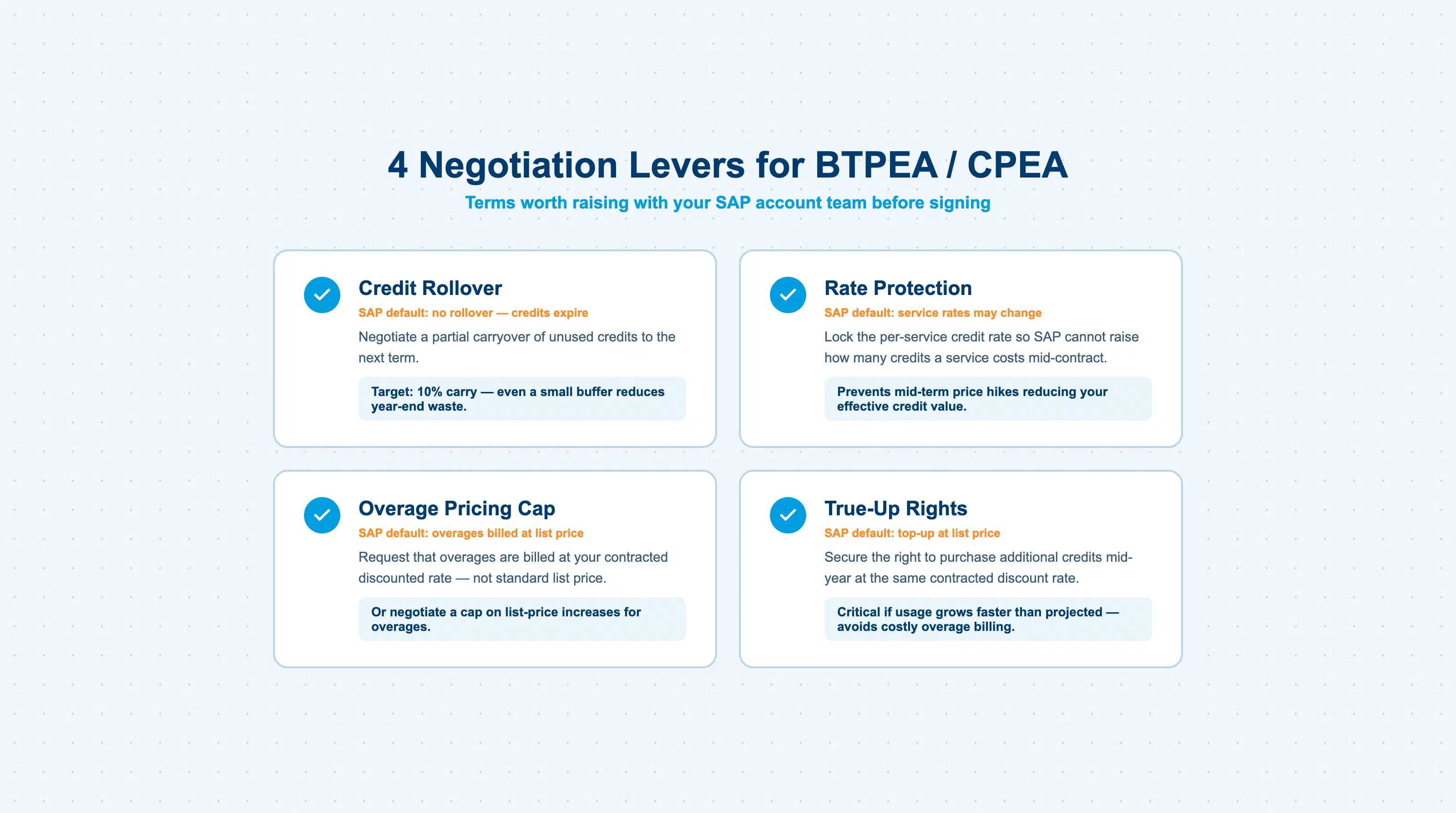
When entering a BTPEA or CPEA agreement, several contractual terms are worth raising with the SAP account team:
( SAP Licensing Experts — CPEA Tips, Redress Compliance)
Note: Exact BTPEA credit pricing and discount tier details are not publicly disclosed. Contact your SAP account executive for a formal quote.
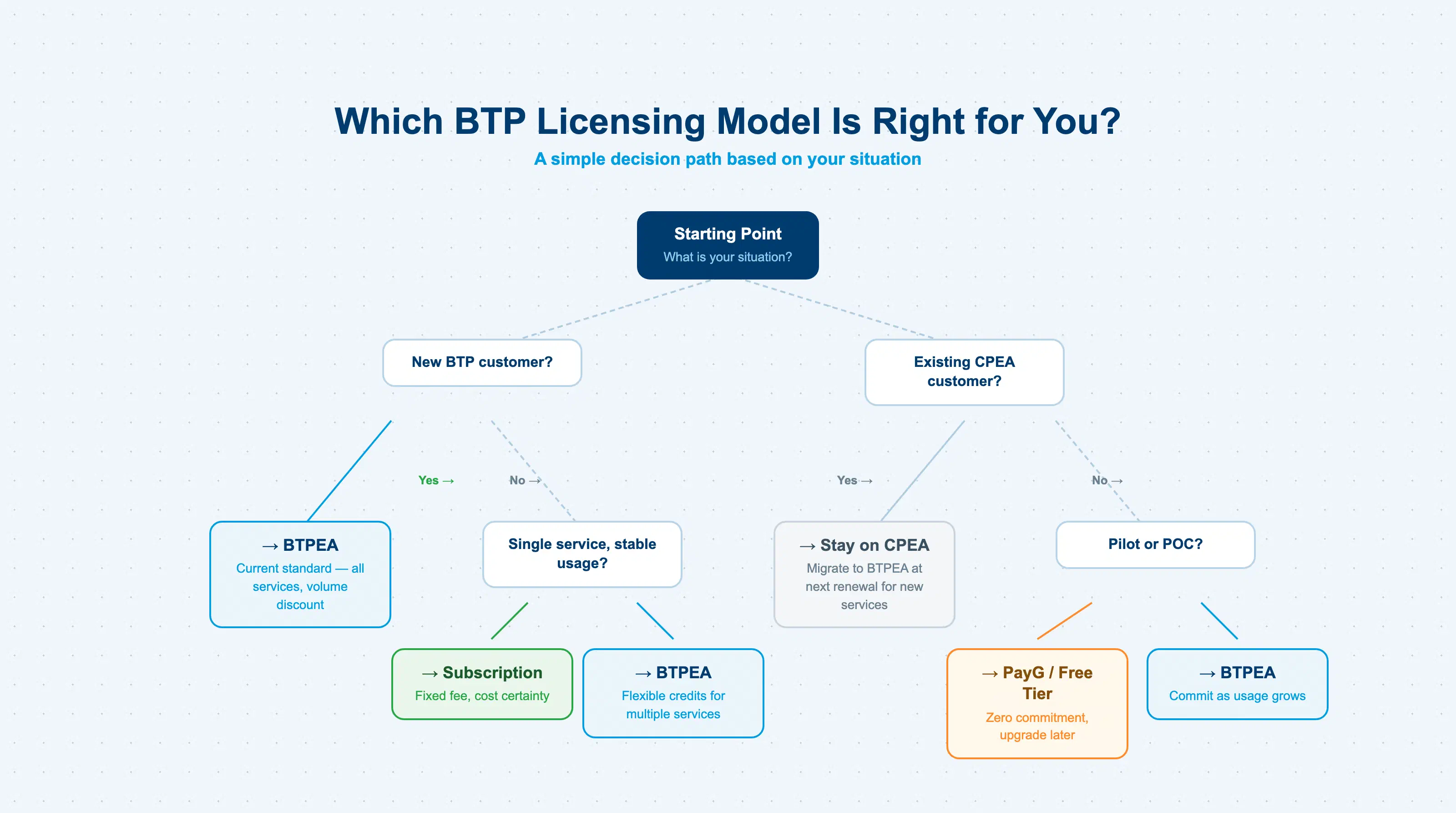
SAP BTP licensing is not a single decision — it is a layered set of choices that should reflect an organization’s current usage certainty, service breadth, and growth trajectory. BTPEA is the current standard for consumption-based access and the only path to SAP’s latest innovations. CPEA remains valid for existing customers but no longer receives new services. PayG offers the lowest barrier to entry with no commitment. Subscriptions serve specific, stable workloads. And for RISE/GROW customers, bundled BTP credits are a starting point — not a ceiling.
Understanding the mechanics of each model before signing a contract, and establishing governance practices for credit consumption, are the two most practical steps any organization can take to control BTP costs as adoption grows.
Q: Can I use BTPEA and CPEA in the same Global Account? A: No. BTPEA and CPEA cannot coexist within a single Global Account. Two separate Global Accounts are required if both models are needed simultaneously.
Q: What happens if I run out of credits before my contract ends? A: Usage beyond your available credit balance results in overages, which are invoiced monthly at SAP list prices. To avoid this, set BTP Cockpit alerts and consider negotiating overage pricing protections at contract signing.
Q: If I stay on CPEA, what am I missing? A: CPEA’s service catalog was frozen as of April 2024. Any new SAP BTP service introduced after that date — including certain AI capabilities and SAP Analytics Cloud (public system option) — will only be available under BTPEA.
Q: Does RISE with SAP cover all my BTP needs? A: For basic extensions and integrations, the bundled CPEA credits in RISE are often sufficient. For substantial BTP usage — advanced integrations, data analytics, AI services, or large-scale custom development — a separate BTPEA agreement is typically required.
Q: Is switching from Pay-As-You-Go to BTPEA technically disruptive? A: No. Existing services and subaccounts are preserved during the transition. The switch is a commercial change; no technical migration or reconfiguration is needed.
Q: What is the difference between Trial and Free Tier? A: Trial is an account type — non-commercial, 90-day, deleted at expiry. Free Tier is a set of service plans within a commercial enterprise account (BTPEA or PayG) with no time limit, supporting genuine development and testing work.
This site organizes BTP knowledge into the following structure:
| L1. Big Picture | L2. Functional Domains |
|---|---|
| BTP-001 What is BTP | L2-A. Integration |
| BTP-002 BTP Architecture | L2-B. Application Development & Automation |
| BTP-003 BTP Capability Map | L2-C. Data & Analytics |
| BTP-004 Deployment Models | L2-D. AI |
| BTP-005 Licensing Models (this article) | L2-E. Foundation Services |
| BTP-006 Clean Core Strategy | L2-F. Architecture & Operations |
| L2-G. Use Cases & Patterns |