Title here
Summary here

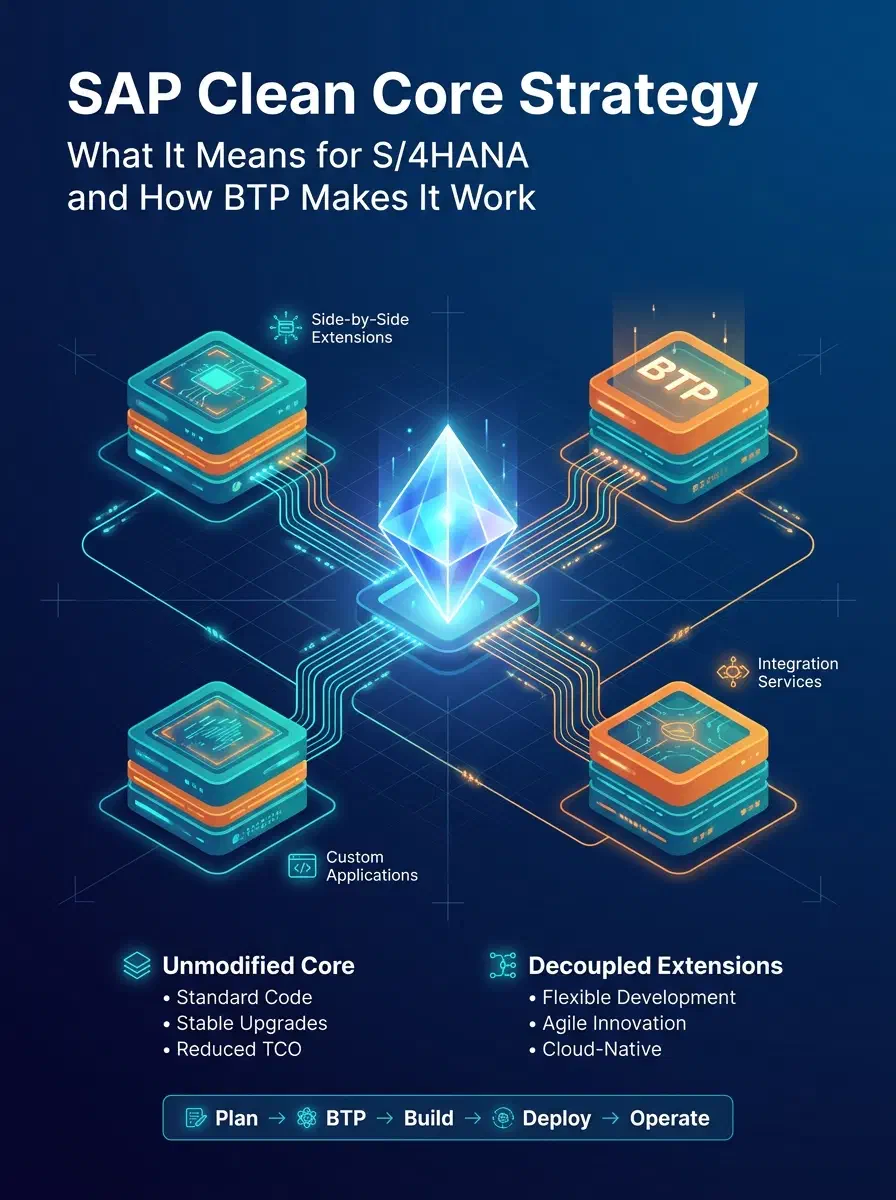
Ask ten SAP consultants what “Clean Core” means and you will likely get ten different answers. Some describe it as a restriction — a mandate to stop writing custom ABAP. Others see it as SAP’s marketing wrapper for selling BTP services. Neither view is accurate.
Clean Core is an architectural principle with a precise definition, a structured framework of five dimensions, and concrete tooling to make it real ( SAP Help Portal — BTP Guidance Framework). For SAP consultants and enterprise architects, understanding it is no longer optional: it is the strategic foundation for every S/4HANA adoption decision, every integration design, and every extensibility conversation with a customer.
This article explains what Clean Core means in practice, why it exists, how its five dimensions translate into day-to-day decisions, and what role SAP BTP plays in making compliance achievable — not just aspirational.
| Reader | What You Will Get |
|---|---|
| SAP consultant advising on S/4HANA adoption | A clear framework for Clean Core conversations with customers — including where it is flexible and where it is not |
| Enterprise architect designing an S/4HANA landscape | Concrete mapping of each Clean Core dimension to BTP services and extension patterns |
| Technical lead inheriting an ECC customization estate | Context for why Clean Core exists and a starting-point roadmap for reducing technical debt |
| IT manager evaluating RISE with SAP | An explanation of what Clean Core commitments RISE with SAP implies in practice |
To understand why Clean Core matters, it helps to understand the problem it solves.
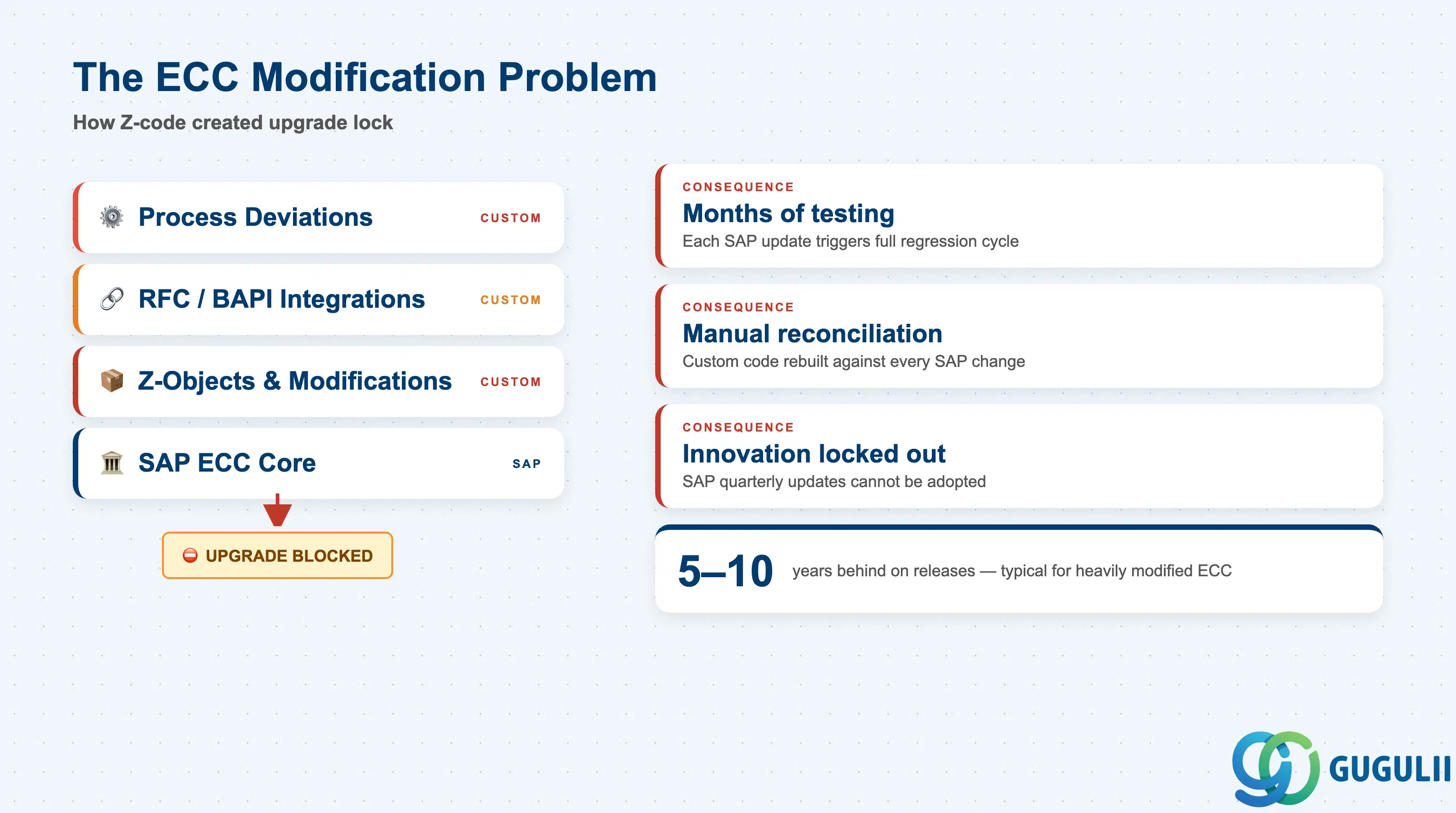
SAP ECC (ERP Central Component) was designed in an era when on-premise software was expected to be heavily customized. Over years of operation, most large ECC installations accumulated:
Z or Y, living directly in SAP’s repositoryThe result was what the industry came to call “upgrade lock.” When SAP delivered a new ECC support package or a new EHP (Enhancement Package), customers with heavy customization found the upgrade cost prohibitive. Testing alone could take months. Custom code had to be manually reconciled with SAP’s new code base. The risk of regression was high.
According to SAPinsider, this pattern caused many organizations to remain on ECC versions five to ten years past SAP’s own stated support dates ( SAPinsider, “What Is Clean Core”). With SAP’s mainstream maintenance window for ECC now narrowing, organizations that delayed S/4HANA migration because of modification debt face a strategic urgency they cannot defer indefinitely.
Clean Core is SAP’s architectural answer to ensure S/4HANA customers do not repeat ECC’s mistake. The principle is embedded in how S/4HANA Cloud (Public Edition) is built — direct modification of SAP code is technically impossible in the public cloud. For private cloud and on-premise deployments, Clean Core is a strategic discipline rather than a technical enforcement.
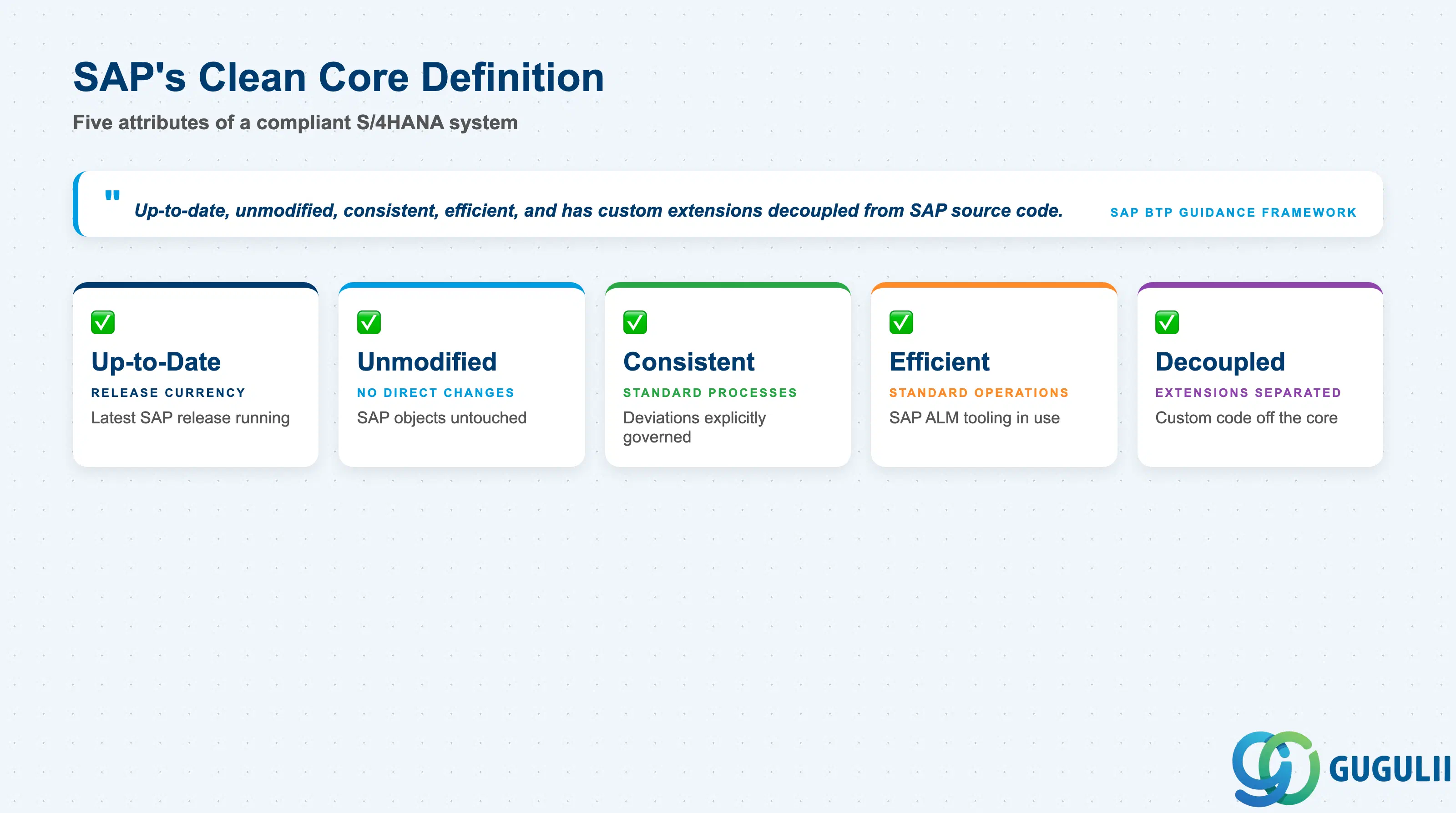
SAP’s official definition, as documented in the SAP BTP Guidance Framework, states that a Clean Core S/4HANA environment is:
“Up-to-date, unmodified, consistent, efficient, and has custom extensions decoupled from SAP source code.”
Each word in that definition matters. “Up-to-date” means the system runs the latest SAP release. “Unmodified” means SAP-delivered code has not been changed directly. “Decoupled” means custom extensions do not depend on internal SAP implementation details.
SAP organizes Clean Core compliance across five dimensions ( SAP BTP Guidance Framework):
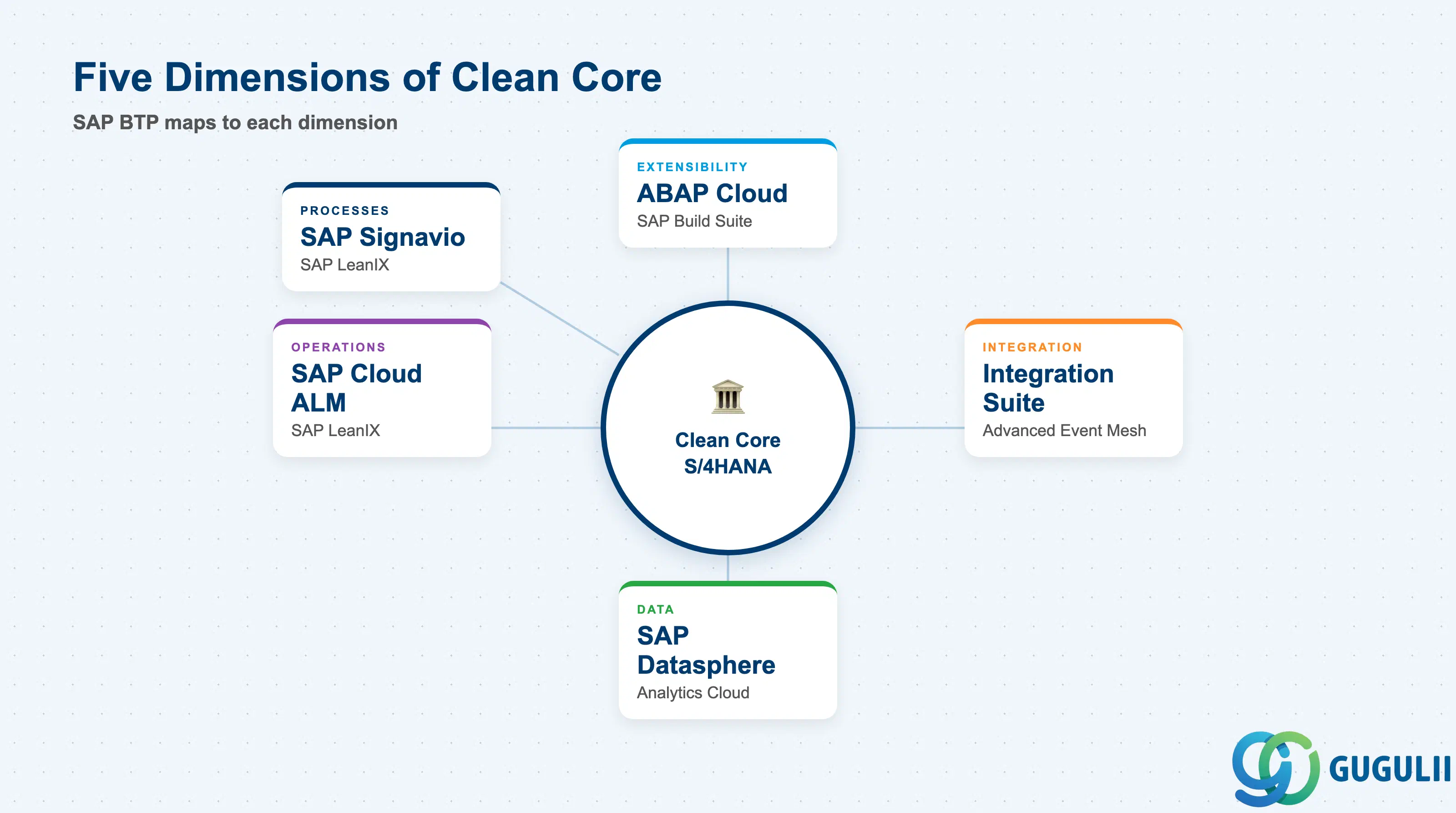
Custom code must use only SAP-approved, stable extension points — no modification of SAP objects, no calls to internal APIs. On-stack extensions use the ABAP Cloud development model (released C1/C2 APIs only, enforced by ABAP Test Cockpit). Side-by-side extensions run on BTP and communicate with S/4HANA through released OData or REST APIs.
Business processes should align to SAP standard processes wherever possible. Organizations should identify and govern deviations explicitly — rather than silently encoding process variants in custom code that becomes invisible to future project teams.
Data quality, data governance, and migration accuracy are core responsibilities. Clean Core on the data dimension means maintaining a governed data architecture where master and transactional data is accurate, accessible, and not buried in custom tables that only legacy custom code understands.
Integrations should use SAP’s released APIs — OData services, Business Events, or SAP Integration Suite pre-built packages. Direct RFC/BAPI connections should be replaced progressively, because they rely on internal SAP function module implementations that SAP does not guarantee to preserve across upgrades.
Systems management, transport management, application lifecycle management (ALM), and monitoring should follow SAP standard tools and practices. Operating an S/4HANA system in a non-standard way creates invisible technical debt in operations just as surely as custom ABAP creates it in development.
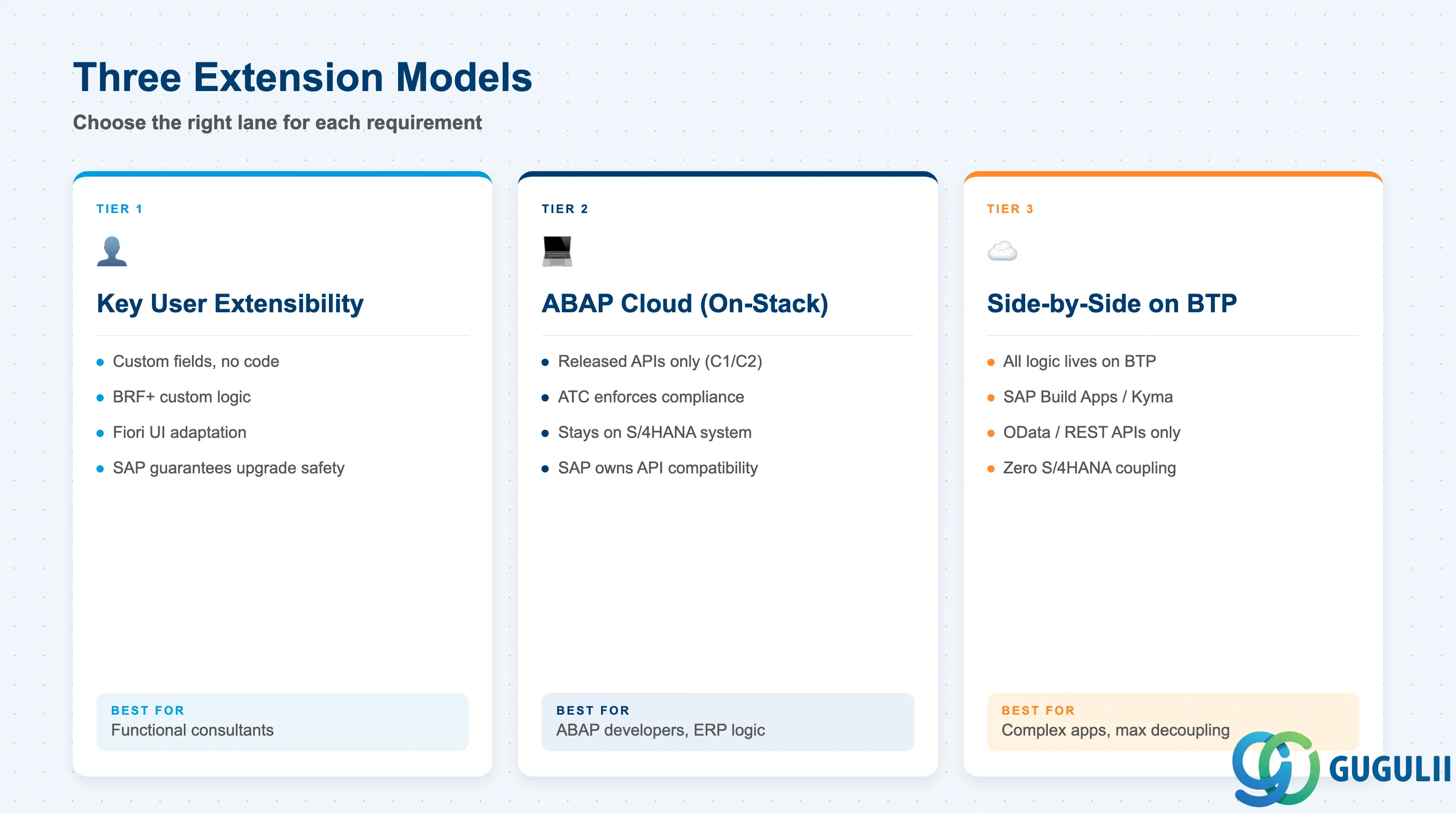
Clean Core does not mean no customization. It means customization through approved patterns. SAP defines three tiers ( SAP S/4HANA Cloud Extensibility documentation):
Business users and functional consultants can extend S/4HANA through configuration tools without writing code. This includes custom fields, custom business objects, custom logic via Business Rules Framework plus (BRF+), and UI adaptations via SAP Fiori UI adaptation tooling. These extensions are upgrade-safe by design — SAP guarantees they survive releases.
This tier is often underused. Many projects reach for ABAP solutions for requirements that Key User tools could address cleanly.
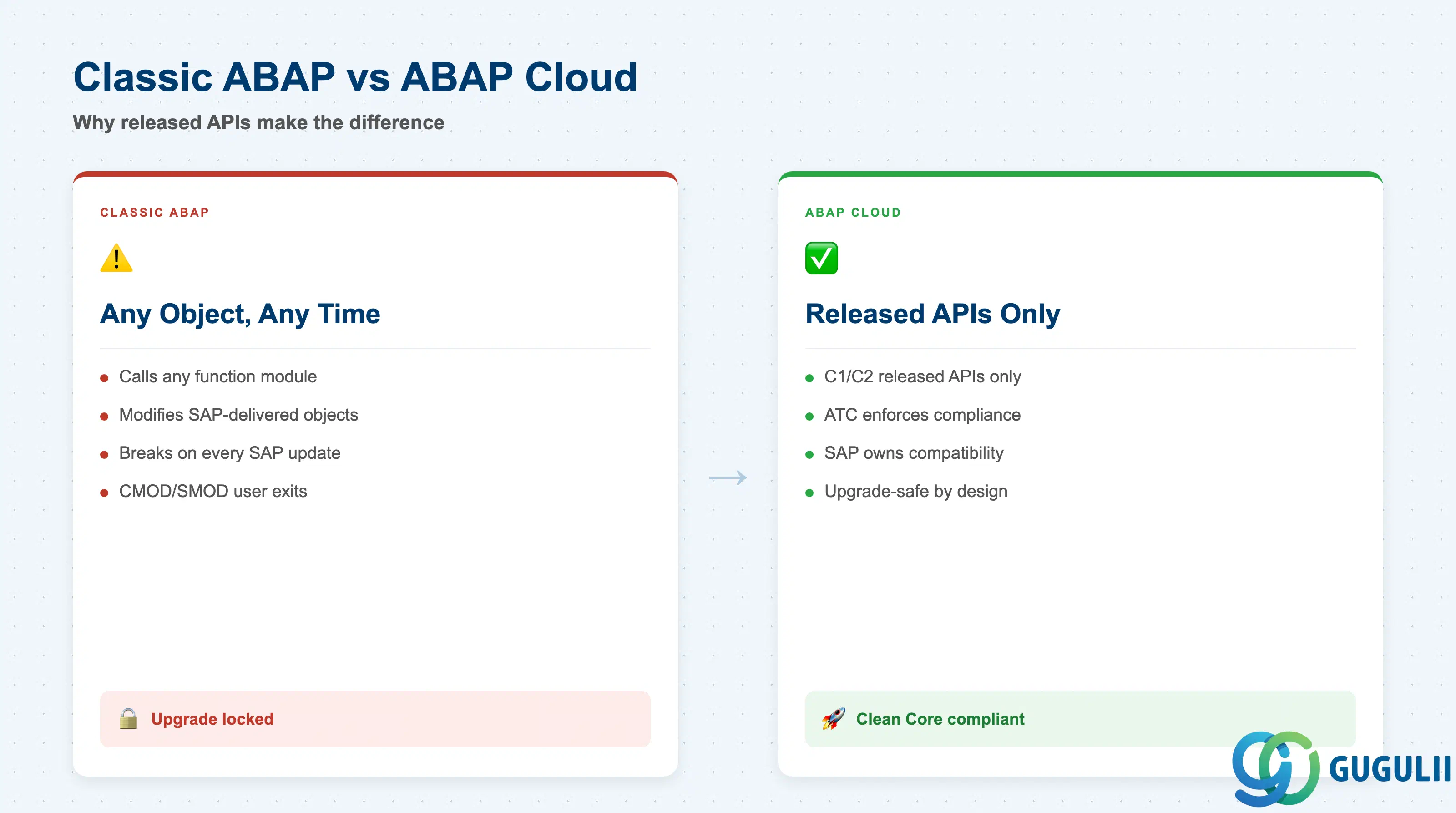
When business requirements cannot be met by configuration alone, the ABAP Cloud development model allows developers to write custom ABAP that stays in the core system while remaining upgrade-safe.
The key constraint: only SAP-released APIs, marked with Release State C1 (for customer use) or C2 (for partner use), may be called. SAP’s ABAP Test Cockpit (ATC) enforces this during development, flagging any call to a non-released API as a compliance violation. Code that passes ATC checks is guaranteed to compile and behave correctly after SAP upgrades — SAP owns the compatibility commitment for released APIs.
As SAPinsider documents, this on-stack model “involves custom ABAP code development using the ABAP Cloud development model directly on SAP systems” ( SAPinsider, Clean Core definition).
The most flexible extension model places all custom logic outside the S/4HANA system entirely. Applications are built on SAP BTP — using SAP Build Apps, SAP Build Process Automation, or custom apps on Cloud Foundry or Kyma — and connect to S/4HANA through released APIs.
As SAPinsider notes, BTP is “positioned by SAP as the foundation for building, integrating, and extending applications outside core systems” ( SAPinsider, Layer Seven Security article). Side-by-side extensions have zero coupling to SAP’s internal code and can evolve independently of the S/4HANA release cycle. The tradeoff is higher integration overhead compared to on-stack development.
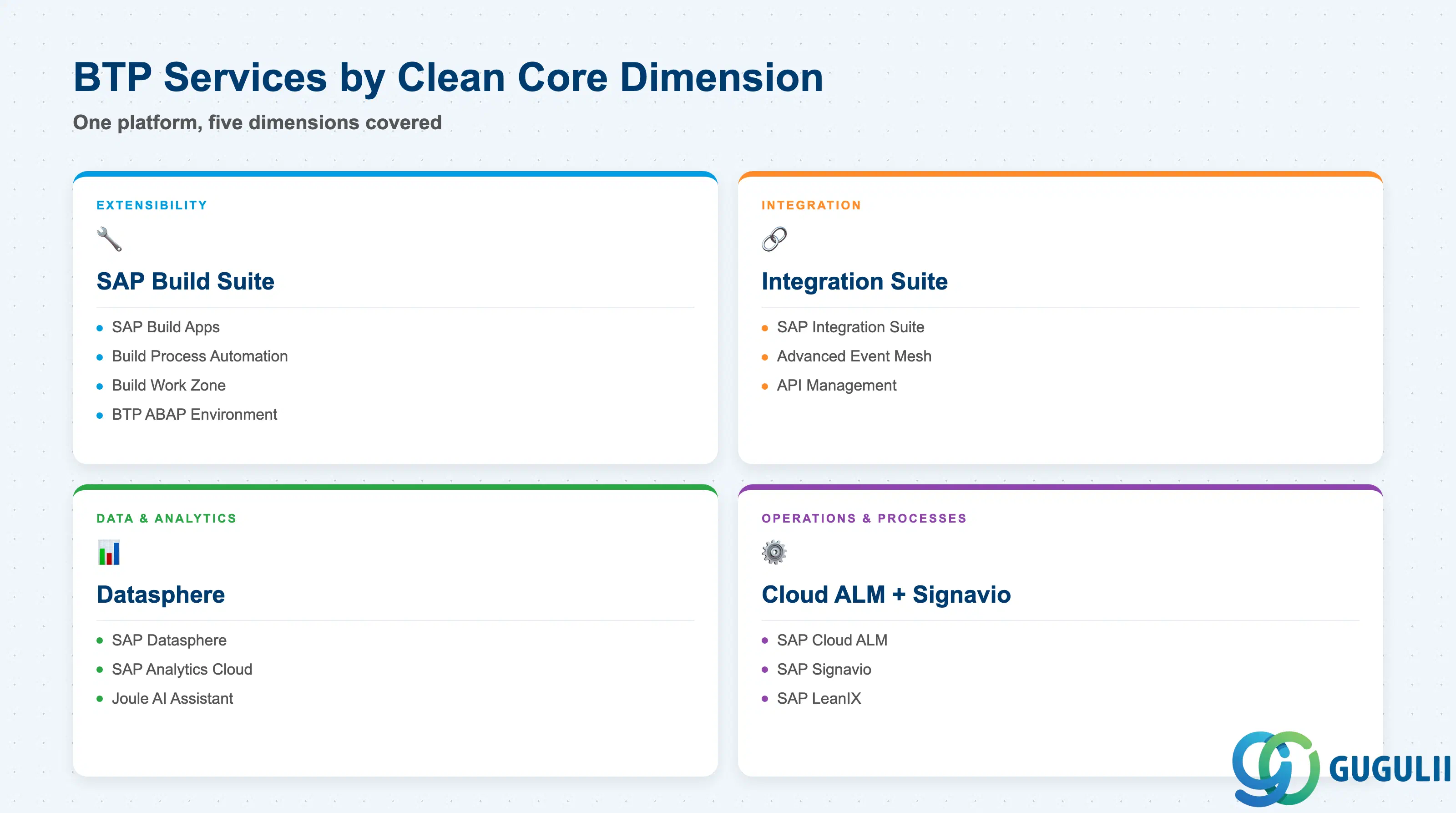
Each of the five Clean Core dimensions has corresponding SAP BTP services. Understanding this mapping is essential for architects designing Clean Core-compliant landscapes.
SAP Build Apps delivers a low-code/no-code environment for building UI applications and mobile apps without touching S/4HANA Fiori configurations. SAP Build Process Automation covers workflow extensions and robotic process automation. SAP Build Work Zone aggregates standard SAP Fiori apps and custom BTP apps in a single, governed launchpad ( SAPinsider, Layer Seven Security article).
For ABAP developers, the SAP BTP ABAP Environment (also called Steampunk) provides a managed ABAP runtime on BTP where ABAP-based side-by-side extensions can be developed using the full ABAP Cloud development model — including ATC checks — without running on S/4HANA itself.
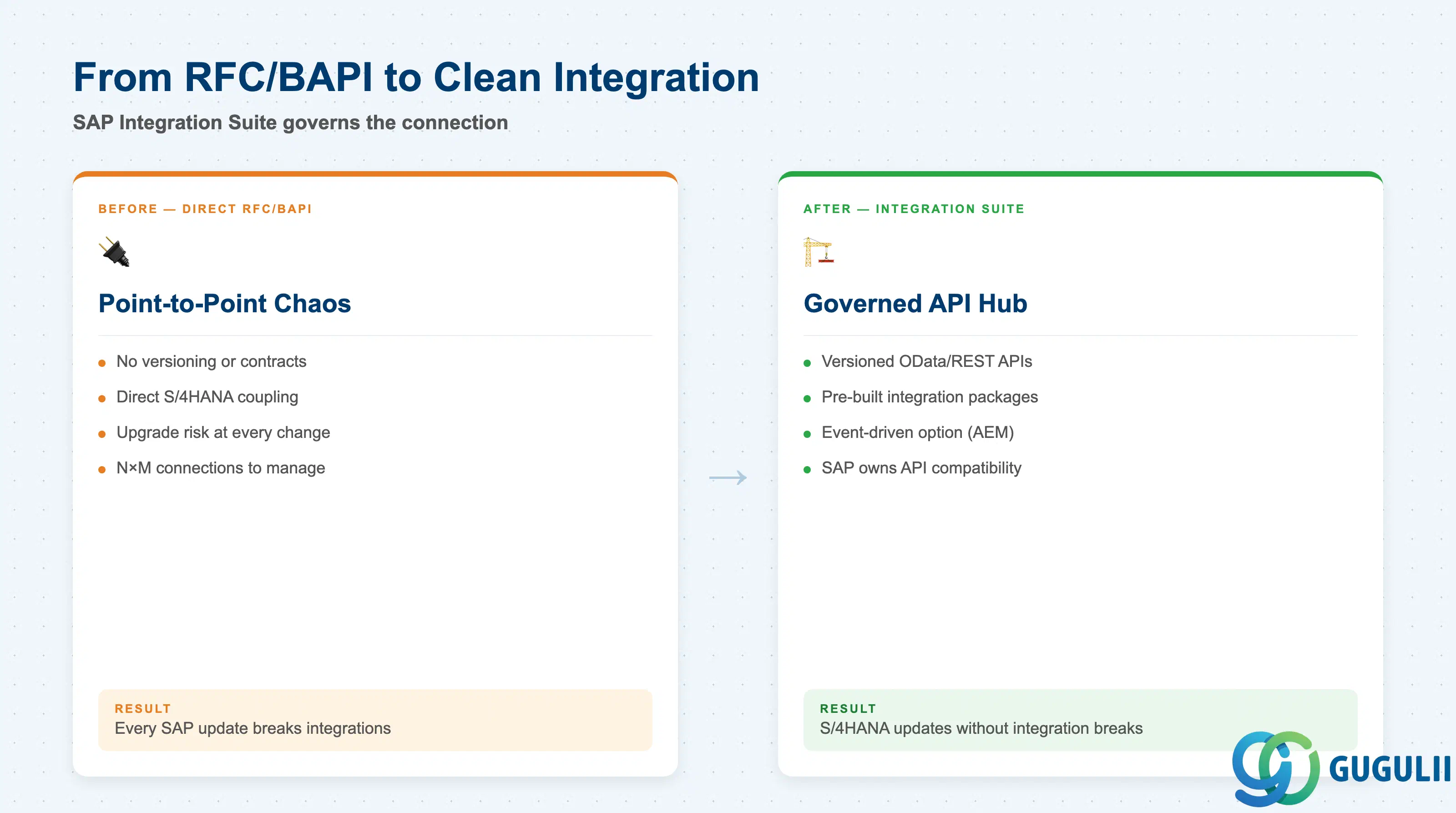
SAP Integration Suite is the central hub for replacing direct RFC/BAPI connections with governed, versioned integrations. The suite provides pre-built Integration Packages for common SAP-to-SAP and SAP-to-third-party scenarios, reducing the time required to build Clean Core-compliant integrations. API Management within Integration Suite adds lifecycle management, rate limiting, and developer portals for exposing S/4HANA OData services externally.
For event-driven scenarios, SAP Advanced Event Mesh provides a managed messaging layer. Instead of custom ABAP programs that poll for data changes, Clean Core-compliant designs publish S/4HANA business events to Event Mesh and let consuming applications react asynchronously — with zero coupling between producer and consumer.
A practical example: the SAPinsider whitepaper on invoice workflows ( SAPinsider, February 2026) shows how finance teams can automate invoice processing using SAP BTP and “standardized workflows and intelligent automation to ensure compliance and scalability,” replacing custom ABAP that previously required manual maintenance through every upgrade cycle.
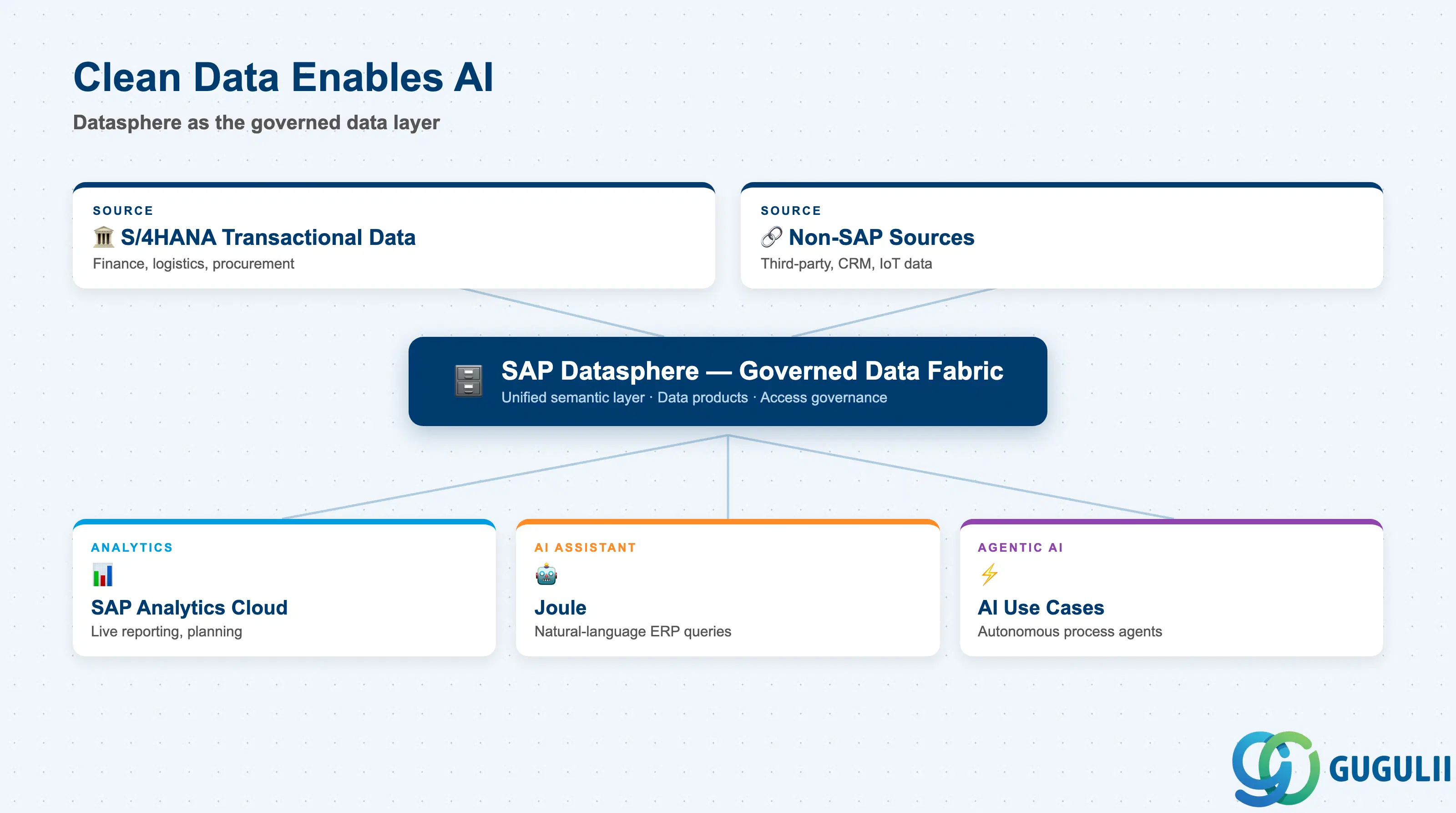
SAP Datasphere provides a governed data fabric layer where SAP and non-SAP data can be federated, modeled, and accessed without extracting it to a fragile custom reporting infrastructure. SAP Analytics Cloud consumes this governed data for analytics and planning.
The data dimension has become particularly strategically important. As of May 2026, SAP announced the acquisition of Dremio to further unify SAP and non-SAP data for agentic AI use cases ( SAP News, May 2026). Joule, SAP’s AI assistant, and future agentic AI capabilities depend on clean, governed data — organizations with fragmented, custom-coded data architectures will face barriers to AI adoption.
SAP Cloud ALM provides centralized application lifecycle management for SAP cloud solutions, including S/4HANA Cloud deployments. It covers project management, implementation activities, transport management, and monitoring in a single governed tool.
SAP Signavio Process Intelligence analyzes actual process execution data from S/4HANA to identify deviations from SAP standard processes. It allows organizations to quantify the gap between current processes and SAP best practice — an essential input before deciding which process deviations justify custom extensions and which should simply be removed.
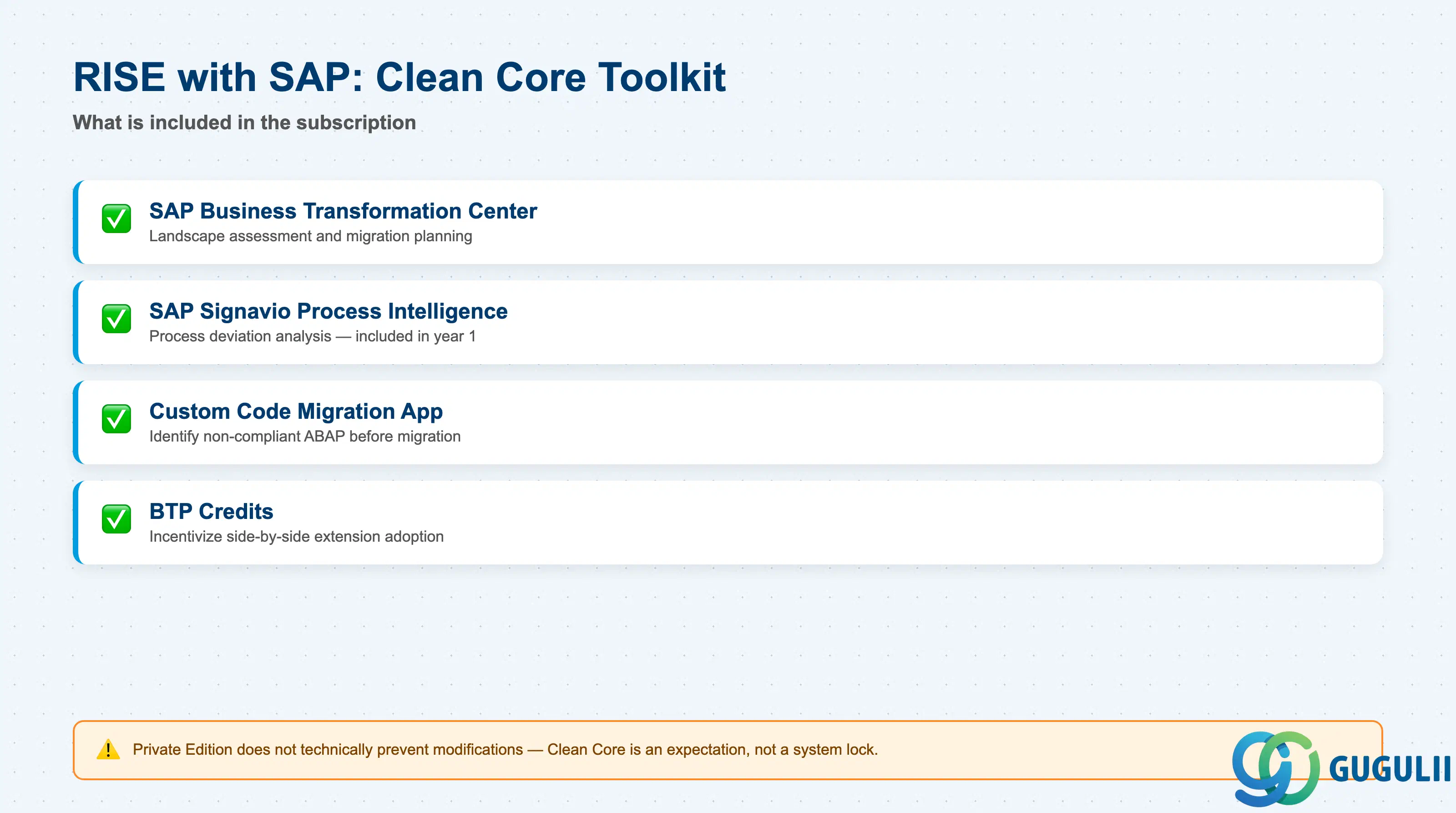
RISE with SAP is SAP’s managed cloud subscription model for S/4HANA Cloud Private Edition. It is the most structured path to Clean Core compliance and includes several tools that directly address the challenge ( SAP Help Portal — BTP Guidance Framework):
RISE with SAP does not technically prevent modifications (unlike Public Cloud, which does), but the engagement model creates a strong incentive toward Clean Core: SAP manages upgrades, and a heavily modified system creates friction for SAP’s operations team. In practice, RISE contracts carry an implicit expectation of Clean Core alignment.
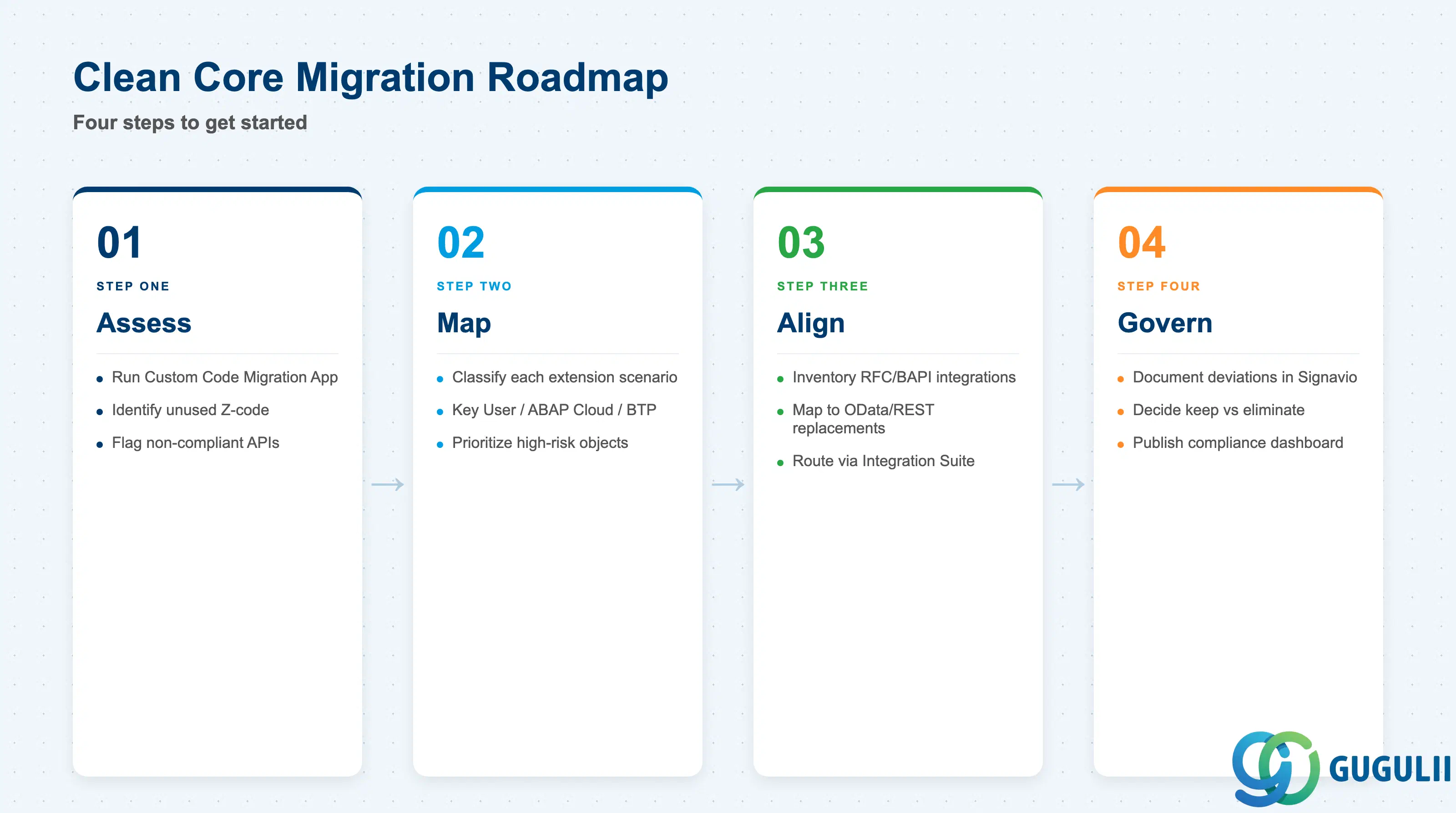
For organizations with existing ECC customization estates, Clean Core is not a switch to flip — it is a migration journey. A practical starting approach involves four steps ( SAP S/4HANA Cloud Extensibility documentation):
Run the SAP Custom Code Migration app against the existing ECC landscape. The output identifies the volume of custom objects, which ones are actively used, and which API calls are non-compliant with ABAP Cloud. This assessment typically reveals a significant portion of custom code that is never executed in production — a meaningful early cleanup opportunity before migration.
For each significant custom scenario, determine which extension tier is appropriate: Key User configuration, ABAP Cloud on-stack, or side-by-side on BTP. The decision should be driven by functional requirements, not developer familiarity with on-stack ABAP.
Inventory existing RFC/BAPI integrations and map each to an available OData or REST API replacement. SAP’s API Business Hub documents all released S/4HANA APIs. Where gaps exist, Integration Suite’s pre-built packages often cover common scenarios that previously required custom RFC wrappers.
Use SAP Signavio to document current process deviations from SAP standard. For each deviation, make an explicit decision: accept the deviation and build a supported extension, or eliminate it by adopting the SAP standard process. The documentation itself — independently of the decision — is a Clean Core compliance outcome.
Clean Core is the architectural principle that defines what it means to run SAP S/4HANA in a way that preserves upgrade agility and enables continuous innovation. Its five dimensions — Extensibility, Processes, Data, Integration, and Operations — each have concrete BTP-based tooling that translates the principle into practice.
The principle exists because ECC’s modification model allowed organizations to accumulate technical debt that eventually made upgrades prohibitively expensive. S/4HANA Cloud Public Edition enforces Clean Core by design — direct code modification is technically impossible ( SAP S/4HANA Cloud Extensibility documentation). For private cloud and on-premise deployments, the discipline must be chosen and maintained deliberately.
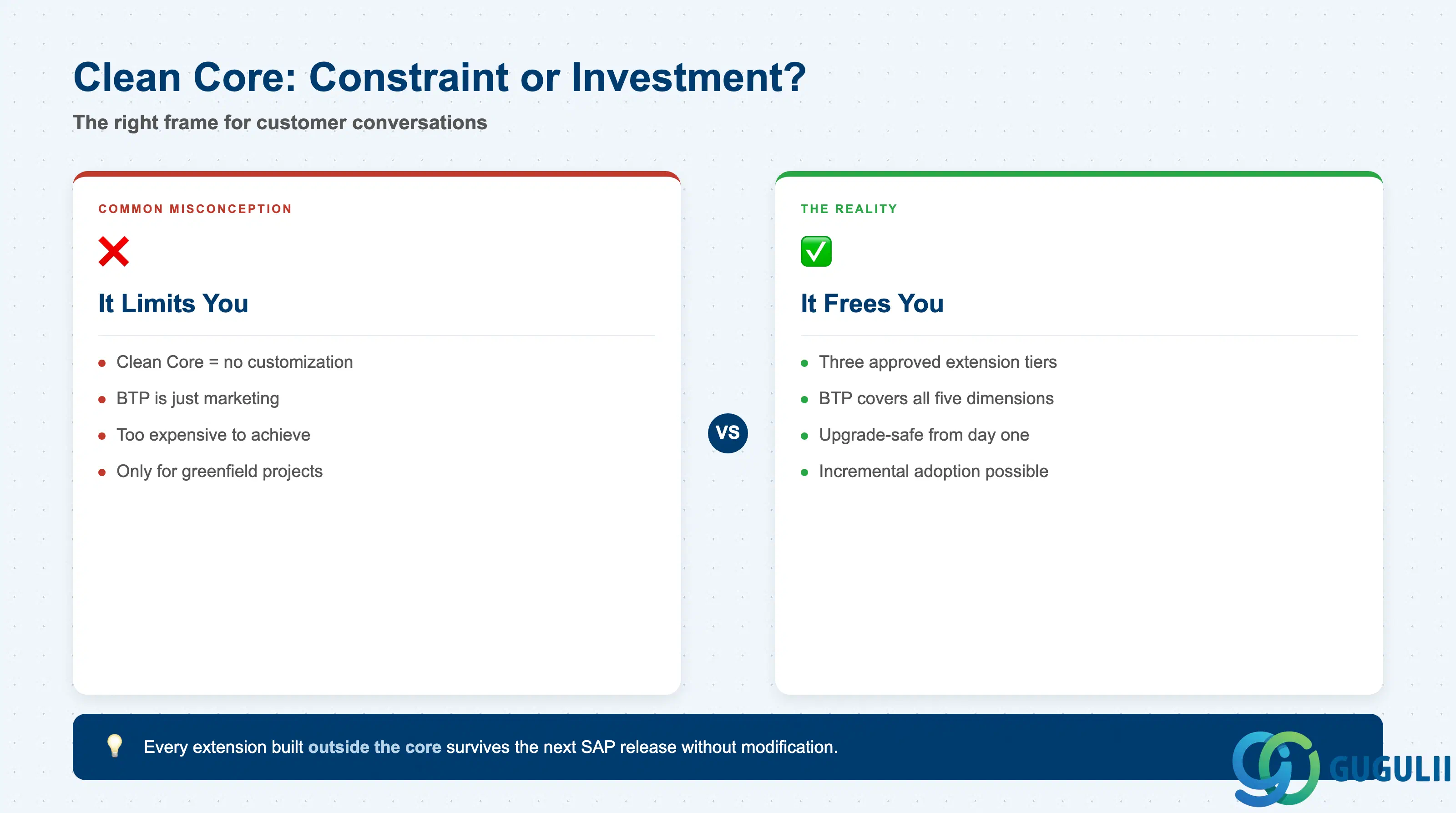
For consultants advising customers, Clean Core is best understood not as a constraint but as an investment in maintainability: every custom extension built outside the core is an extension that survives the next SAP release without modification. In a landscape where SAP delivers functional and AI innovation on a quarterly basis, that survivability has compounding value.
Q: Does Clean Core mean we cannot customize S/4HANA at all? A: No. Clean Core defines how to customize, not whether to customize. All three extension tiers — Key User configuration, ABAP Cloud on-stack, and BTP side-by-side — are approved customization paths. The constraint is on the method (no modification of SAP-delivered objects, no calls to non-released APIs), not on the existence of custom logic.
Q: Is Clean Core mandatory for SAP S/4HANA customers? A: In S/4HANA Cloud Public Edition (SaaS), Clean Core is technically enforced — modifications are not possible. In S/4HANA Cloud Private Edition (RISE with SAP), it is strongly expected. In on-premise S/4HANA, it is a strategic choice. However, customers who ignore it risk recreating ECC’s upgrade-lock problem.
Q: What is ABAP Cloud, and how is it different from classic ABAP? A: Classic ABAP allows developers to call any function module or class method, including internal SAP implementation code. ABAP Cloud restricts developers to SAP-released APIs only. The ABAP Test Cockpit (ATC) enforces this restriction during development. Code written in ABAP Cloud is upgrade-safe; code that calls non-released APIs may break when SAP refactors its internal implementation.
Q: How does BTP’s role in Clean Core affect BTP licensing costs? A: BTP is licensed primarily through RISE with SAP credits or standalone BTP agreements. Shifting extensions to BTP does change the cost model — from ABAP development on S/4HANA to BTP service consumption. The business case typically rests on upgrade cost savings and innovation speed, not immediate cost reduction. BTP pricing details are not covered in public SAP documentation and should be discussed with an SAP account executive.
Q: What happens to existing ECC custom code during an S/4HANA migration? A: SAP provides the Custom Code Migration app to assess existing custom code before migration. Organizations typically classify custom objects as: keep and adapt to ABAP Cloud, move to BTP side-by-side, or retire (delete, as they are no longer used). The migration is also an opportunity to eliminate custom code built for requirements that are now covered by SAP standard functionality in S/4HANA.
This site organizes BTP knowledge into the following structure:
| L1. Big Picture | L2. Functional Domains |
|---|---|
| BTP-001 What is BTP | L2-A. Integration |
| BTP-002 BTP Architecture | L2-B. Application Development & Automation |
| BTP-003 BTP Capability Map | L2-C. Data & Analytics |
| BTP-004 Deployment Models | L2-D. AI |
| BTP-005 Licensing Models | L2-E. Foundation Services |
| BTP-006 Clean Core Strategy (this article) | L2-F. Architecture & Operations |
| L2-G. Use Cases & Patterns |