Title here
Summary here

| ID | Title |
|---|---|
| BTP-A01 | SAP Integration Suite Overview: Capabilities, Components, and When to Use Each (this article) |
| BTP-A02 | Cloud Integration (CPI): Architecture and Use |
| BTP-A03 | API Management: Architecture and Use |
| BTP-A04 | Event Mesh: Architecture and Use |
| BTP-A05 | Open Connectors: Architecture and Use |
| BTP-A06 | B2B Integration (1): Trading Partner Management |
| BTP-A07 | B2B Integration (2): Integration Advisor |
| BTP-A08 | Integration Suite: Use Cases and Decision Patterns |
| Resource | URL |
|---|---|
| Feature Scope Description for SAP Integration Suite (PDF, 2025-09-04) | help.sap.com → |
| Capabilities of SAP Integration Suite | help.sap.com → |
| What is PubSub Cloud (Advanced Event Mesh) | help.sap.com → |
| SAP Integration Suite — Pricing | sap.com → |
| PI/PO to Integration Suite migration reference | sap.com → |
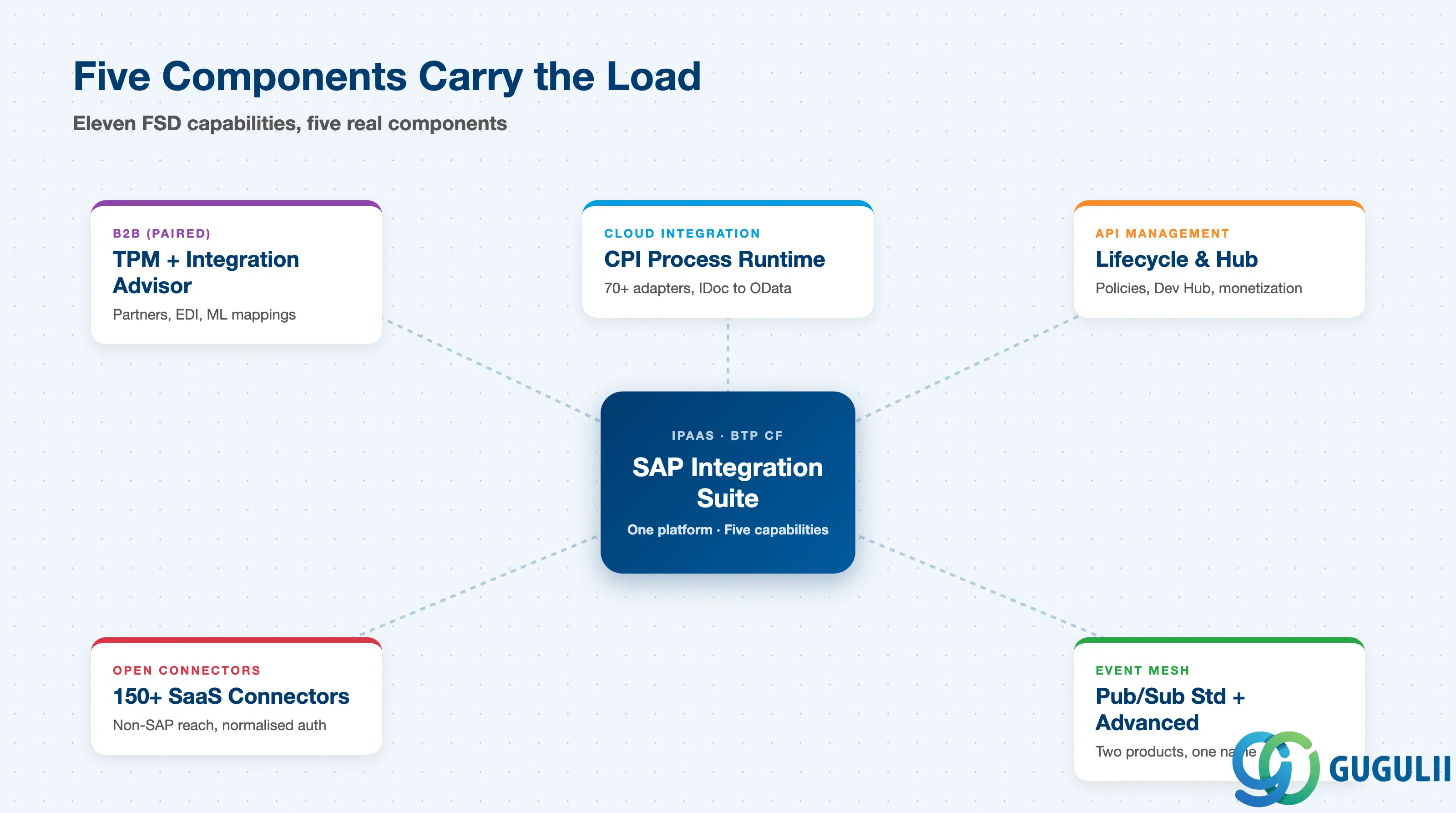
SAP Integration Suite is SAP’s iPaaS on SAP BTP Cloud Foundry. The official Feature Scope Description (2025-09-04) lists eleven capabilities, but for delivery purposes most projects work with the five below. The remaining six — OData Provisioning, Integration Assessment, Migration Assessment, the Edge Integration Cell hybrid deployment option, Graph (a sub-capability of API Management), and Data Space Integration — are either advisory tools, legacy-leaning, or scope-bounded; they are valuable but rarely the load-bearing component of a project.
| Component | What it does | Primary user |
|---|---|---|
| Cloud Integration (CPI) | Process integration, mapping, transformation, 70+ adapters | Integration developer |
| API Management | API lifecycle, security, monetization, Developer Hub | API owner / platform team |
| Event Mesh (Standard + Advanced) | Pub/sub event distribution between SAP and beyond | Event-driven architect |
| Open Connectors | Pre-built connectors to non-SAP SaaS (>150) | LoB integration analyst |
| B2B Integration (TPM + Integration Advisor) | Trading partner onboarding, EDI, machine-learning mapping | B2B/EDI specialist |
They are not substitutes.
                        SAP Integration Suite (BTP Cloud Foundry)
   ┌────────────────────────────────────────────────────────────────────┐
   │  Cloud Integration  ──  API Management  ──  Event Mesh             │
   │        │                     │                  │                  │
   │  Open Connectors  ──  TPM + Integration Advisor  (B2B pair)        │
   └──────┬───────────────────────────┬─────────────────────────┬───────┘
          │ IDoc / OData / SOAP       │ REST                    │ Events
          ▼                           ▼                         ▼
   ┌──────────────┐            ┌────────────────┐        ┌──────────────┐
   │ S/4HANA      │            │ S/4HANA Cloud  │        │ S/4HANA      │
   │ on-premise   │            │ public/private │        │ (event-      │
   │ (via SAP     │            │                │        │ enabled)     │
   │ Cloud        │            └────────────────┘        └──────────────┘
   │ Connector)   │
   └──────────────┘
          ▲                                                     ▲
          │                                                     │
   ┌──────┴────────────┐                                ┌───────┴─────┐
   │ Trading partners  │                                │ Non-SAP     │
   │ (EDIFACT/X12/AS2) │                                │ SaaS / IoT  │
   └───────────────────┘                                └─────────────┘
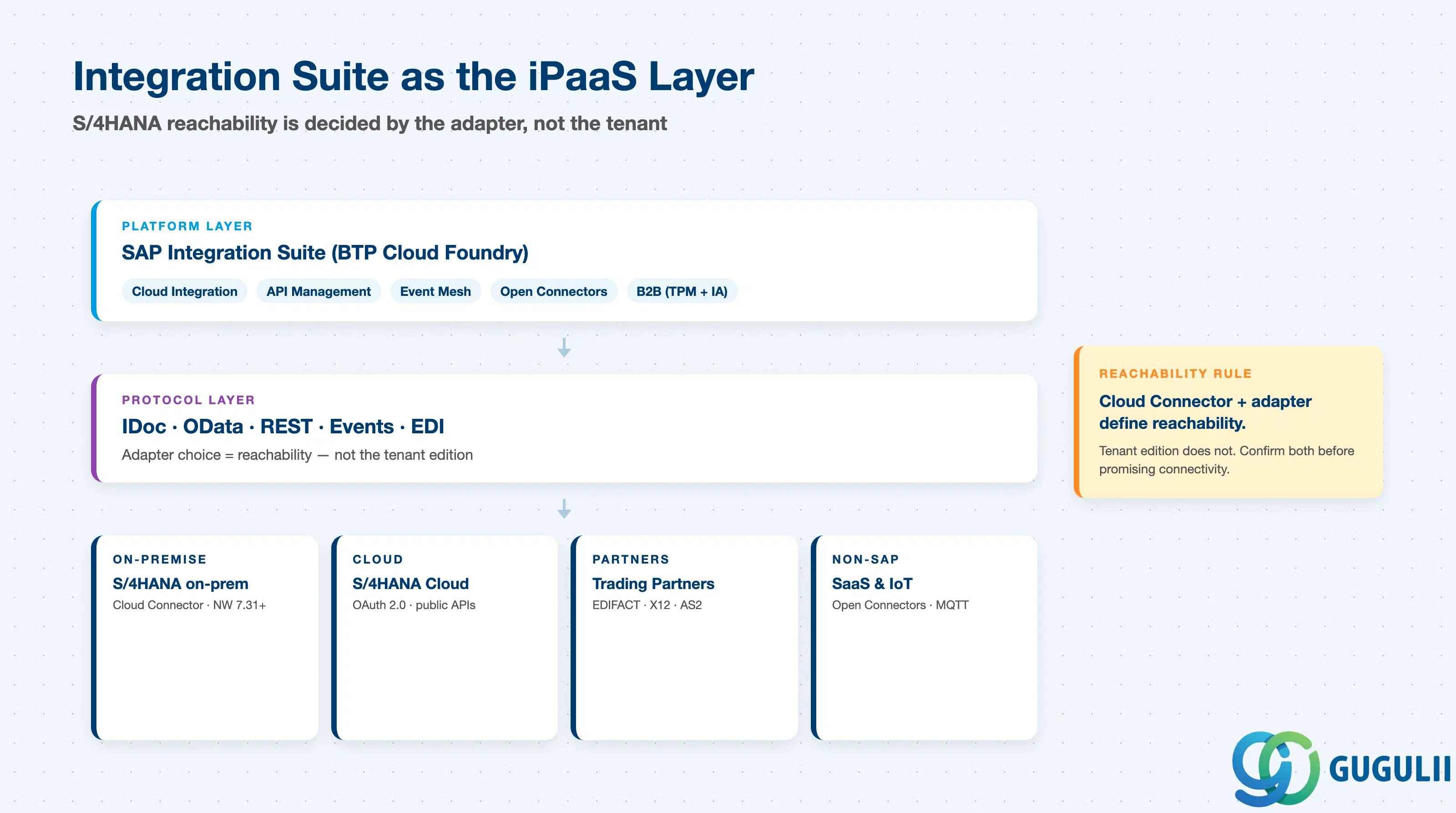
For on-premise S/4HANA, the RFC and IDoc adapters in Cloud Integration require SAP Cloud Connector as the secure tunnel, and the supported floor is SAP NetWeaver 7.31. For S/4HANA Cloud, OAuth 2.0 is the standard auth pattern. For event-driven flows, S/4HANA emits cloud events that Standard Event Mesh consumes for mid-volume scenarios; high-volume IoT or external multi-cloud cases push to Advanced Event Mesh, which is OEM’d from Solace PubSub+ and runs as dedicated brokers.
Key point: Integration Suite is the iPaaS layer — Cloud Connector and the chosen adapter define whether your S/4HANA endpoint is reachable, not the Integration Suite tenant itself.
| Component | Maturity | Notes |
|---|---|---|
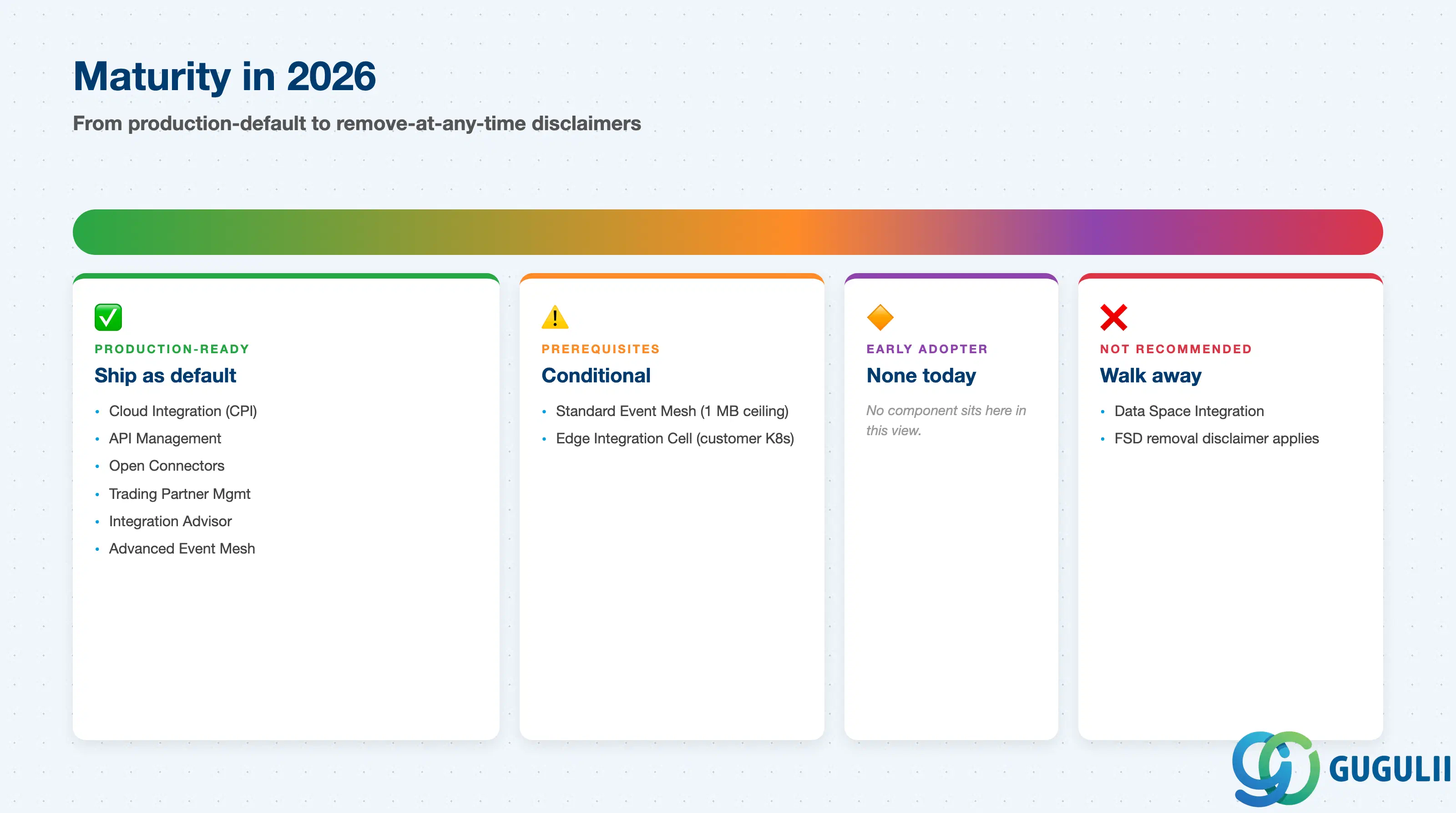
| Cloud Integration (CPI) | ✅ Production-ready | 70+ adapters, Cloud Foundry, AES-256 per-tenant keys, ZDM up to 4 upgrades/year. |
| API Management | ✅ Production-ready | Designer, Portal, Developer Hub, Analytics, Monetization, AI-based Anomaly Detection and traffic Predictions. |
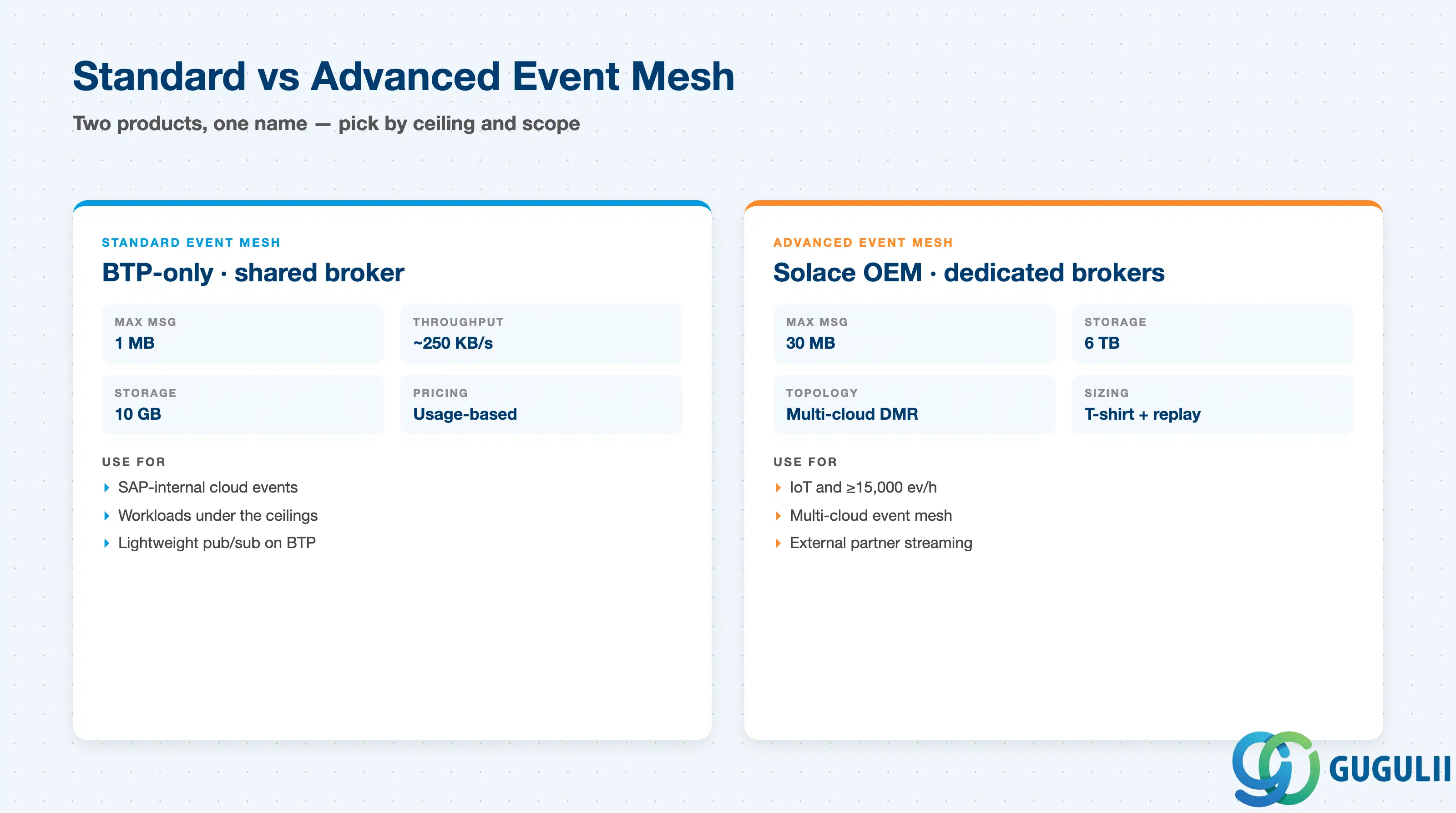
| Standard Event Mesh | ⚠️ Ready with prerequisites | 1 MB hard message size, ~250 KB/s practical per subaccount, BTP-only. Fits standard S/4HANA event flows; not for IoT or external B2B. |
| Advanced Event Mesh (AEM) | ✅ Production-ready (separate product) | OEM’d Solace PubSub+, dedicated brokers, 30 MB messages, 6 TB storage, multi-cloud DMR. Sold as broker T-shirt sizes — separate cost track. |
| Open Connectors | ✅ Production-ready | >150 connectors per FSD (older marketing says 170+); GDPR/HIPAA-aligned controls. |
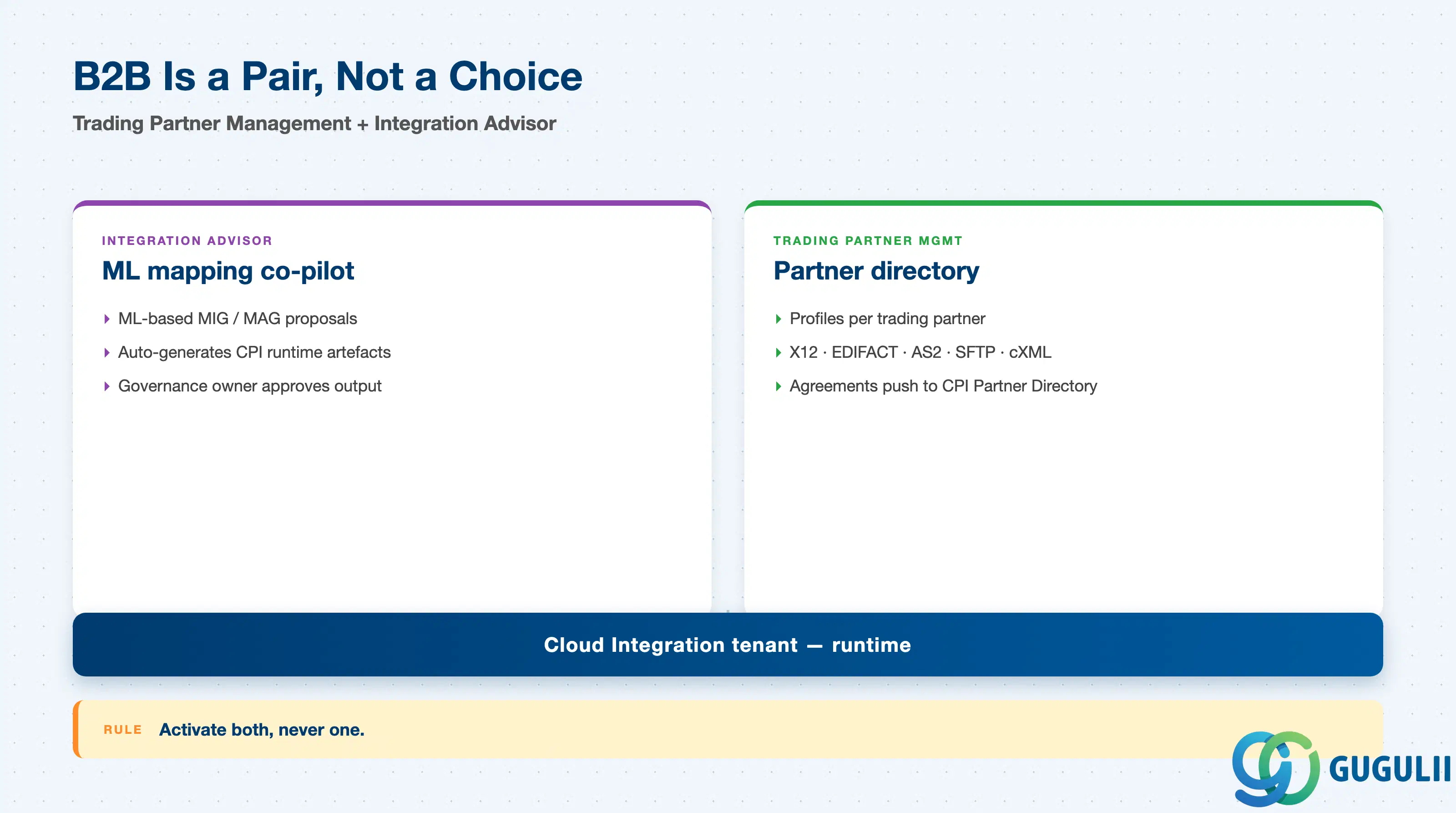
| Trading Partner Management | ✅ Production-ready | Tightly paired with Cloud Integration Partner Directory; X12/EDIFACT/AS2 standards. |
| Integration Advisor | ✅ Production-ready | ML-based MIG/MAG proposals; auto-generates Cloud Integration runtime artifacts. |
| Edge Integration Cell (hybrid) | ⚠️ Ready with prerequisites | Customer-managed Kubernetes; node sizing not in public docs — confirm with SAP. |
| Data Space Integration | ❌ Not recommended for new projects | SAP “expressly disclaims any warranty or obligation” that this capability will remain in Integration Suite. Scope only with that disclaimer in writing. |
One sub-table per component. Each row is decidable at requirements stage — no implementation detail.
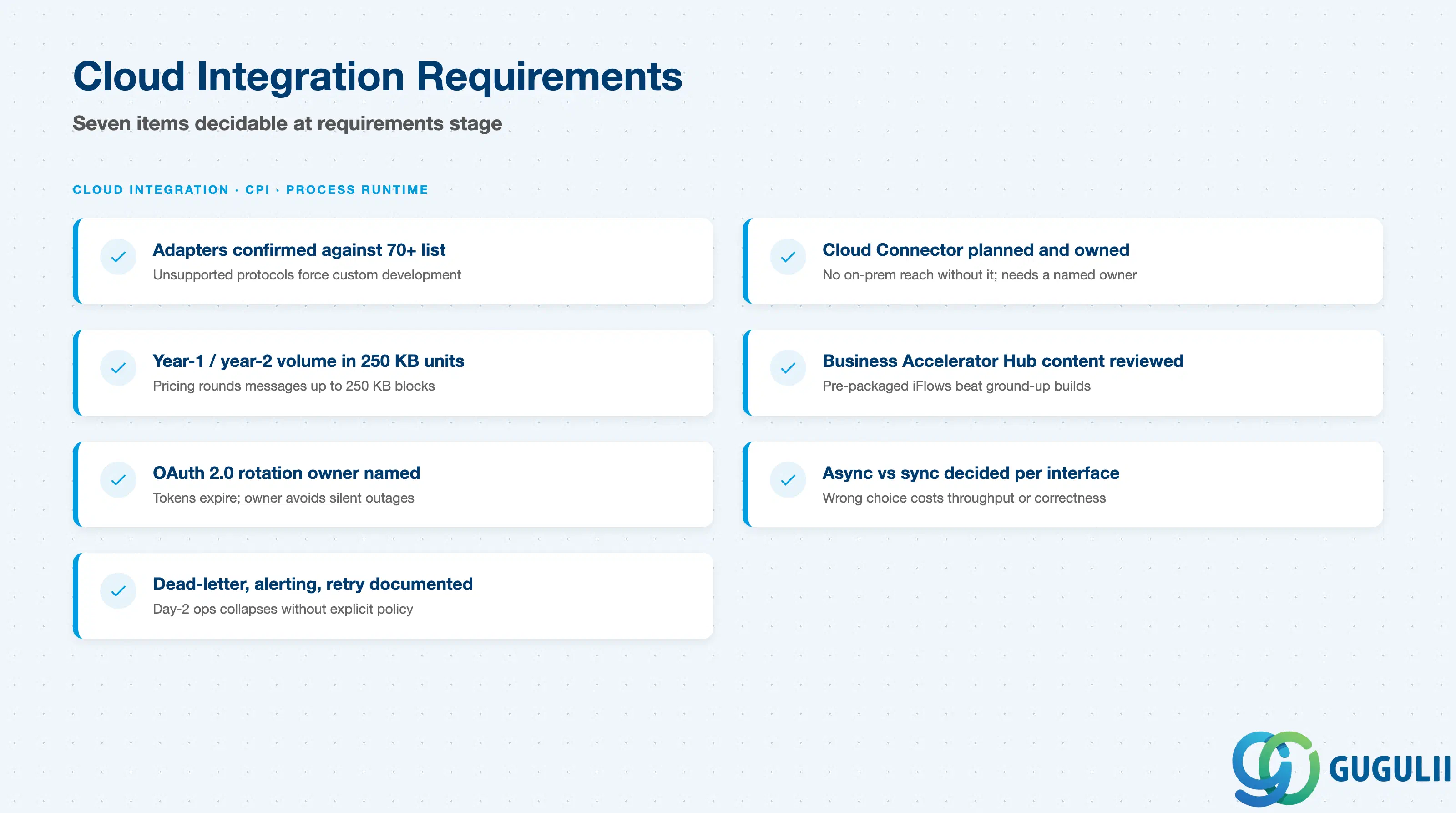
| Checklist item | Why it matters |
|---|---|
| Source/target systems and adapters confirmed against the 70+ supported list | An unsupported adapter forces custom Groovy or a third-party connector — different cost class. |
| On-prem reach via SAP Cloud Connector planned and owned | Without Cloud Connector, on-prem RFC/IDoc cannot be reached securely. |
| Message volume forecast in 250 KB units, year-1 and year-2 | Billing counts every 250 KB chunk as one message; year-2 volume is where overruns hit. |
| Prebuilt Business Accelerator Hub content reviewed before custom design | Customising prebuilt content is faster and SAP-supported; ground-up redesign rarely pays off. |
| Identity / OAuth 2.0 token rotation owner named | Rotation gaps cause post-go-live outages; nominate before design freeze. |
| Async vs. sync pattern decided per interface | High-volume sync interfaces fail under load; async + retry is the default. |
| Exception handling: dead-letter, alerting, retry pattern documented | Mapping errors are routine; an undocumented exception path becomes a 2 a.m. ticket. |
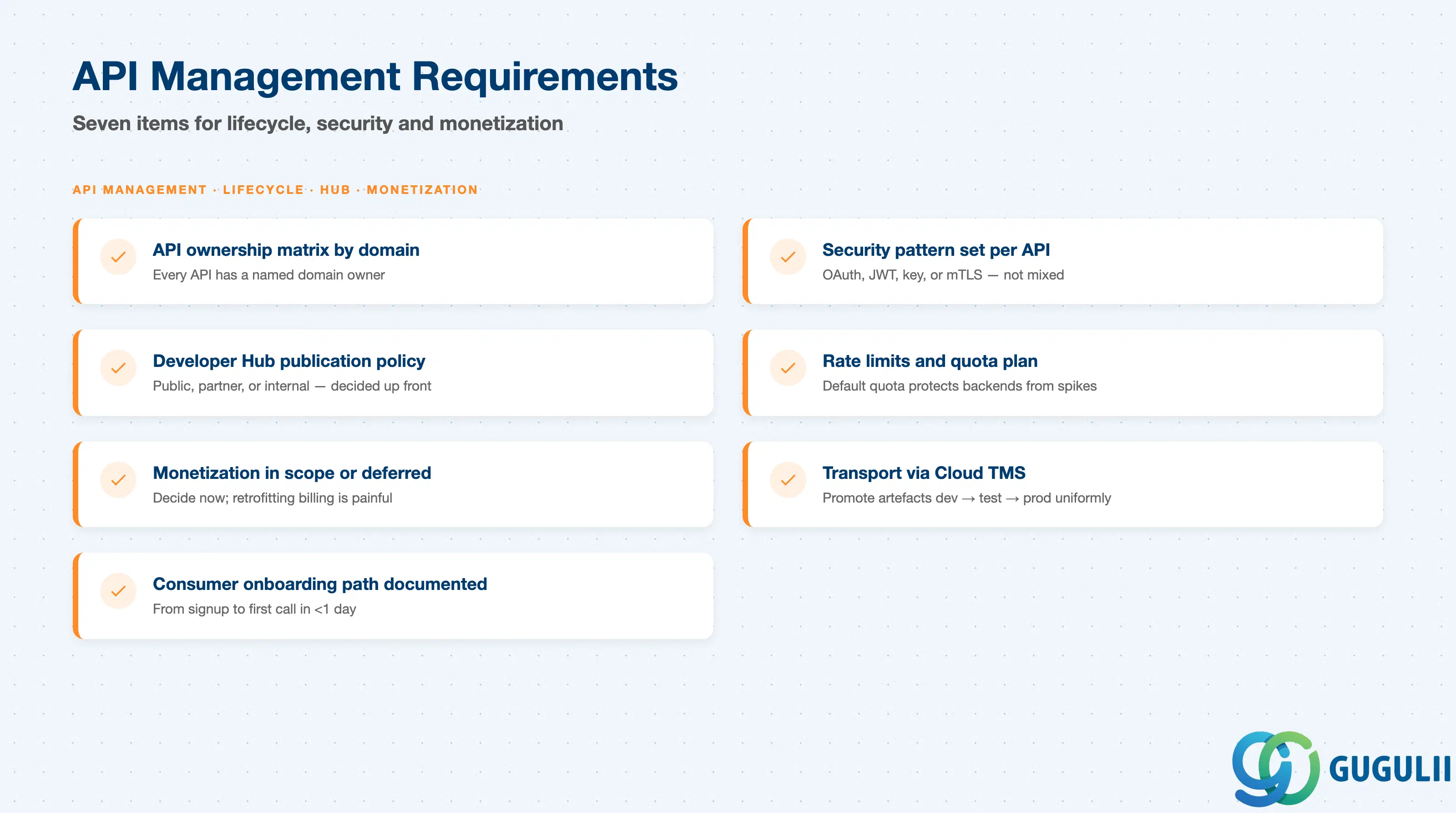
| Checklist item | Why it matters |
|---|---|
| API ownership matrix by domain (who owns lifecycle, breaking changes) | Without a named owner, deprecations land on consumers without warning. |
| Security pattern selected per API (OAuth 2.0, JWT, API key, mTLS) | Mixing patterns is normal; choosing none is the failure. |
| Developer Hub publication policy (internal-only / partner / public) | The Hub is the consumer-facing surface; uncurated docs damage adoption. |
| Rate limiting and quota plan defined | Anomaly Detection and Predictions help, but the threshold values are a business decision. |
| Monetization in scope or explicitly deferred | API Monetization is a feature, not a default — scope it in or out, do not ignore. |
| Transport flow via SAP Cloud TMS planned | Promotion across dev/test/prod without TMS produces drift; bake it into the plan. |
| Consumer onboarding path (sandbox keys, throttle defaults) documented | Self-service onboarding is the productivity payoff; without it, the platform team becomes the bottleneck. |
| Checklist item | Why it matters |
|---|---|
| Message size and rate forecast vs. Standard EM ceilings (1 MB, ~250 KB/s) | If forecast exceeds the ceiling, AEM is the answer — and the cost class shifts. |
| Decision recorded: Standard EM, AEM, or hybrid | “Event Mesh” is two products; ambiguity in scope causes contract surprises. |
| Event catalogue maintained (topics, payload schemas, owners) | Undocumented topics become unconsumed; governance is a Day-1 artefact. |
| Multi-cloud or external-partner scope flagged | Standard EM is BTP-only and cannot authenticate non-BTP partners; AEM can. |
| Replay and durability requirements stated | AEM supports event replay; Standard EM does not. Replay-required flows must be on AEM. |
| Operational runbook for queue/topic backlog | Backlogs accumulate silently; the runbook covers when to drain, when to alert. |
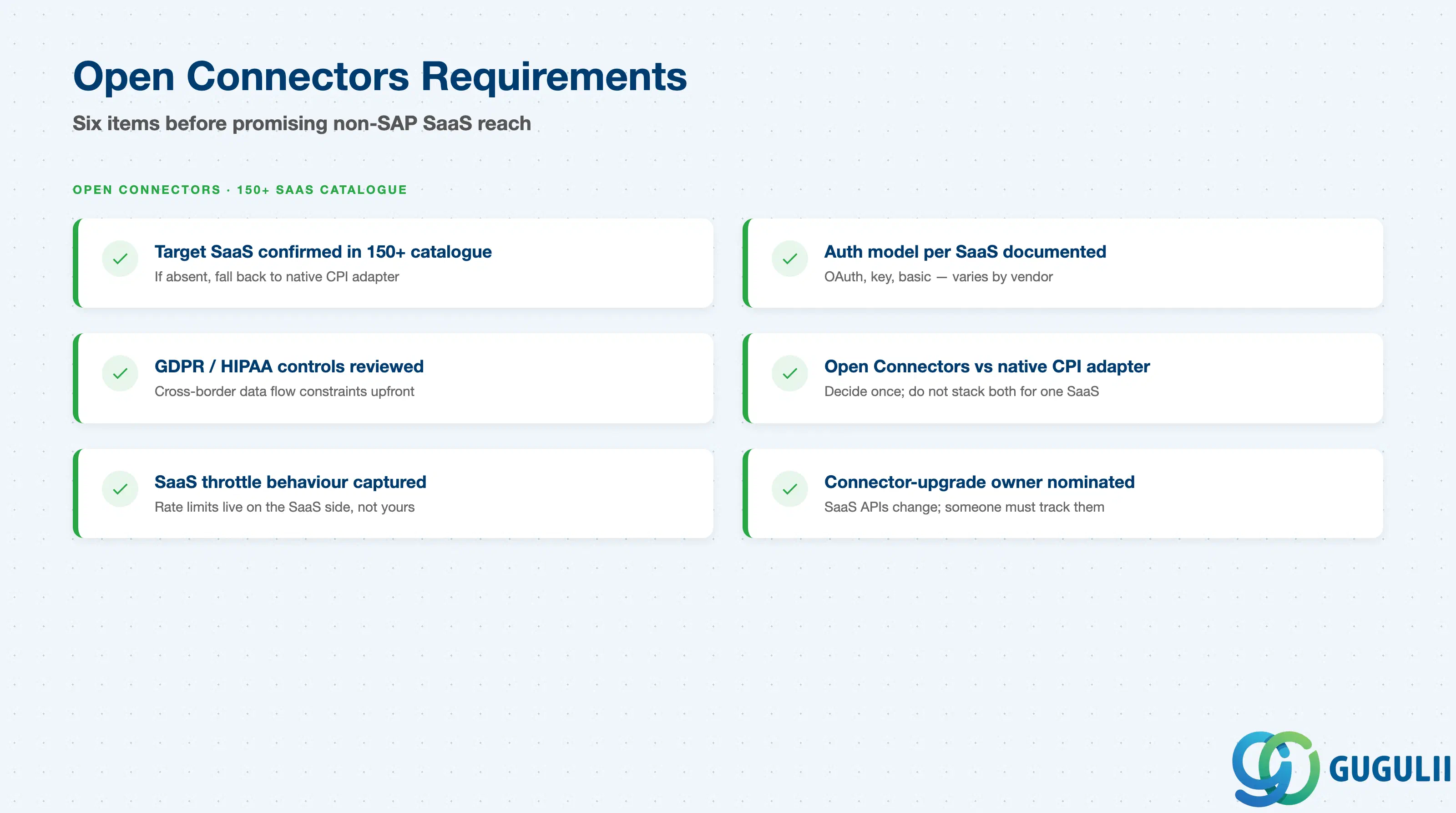
| Checklist item | Why it matters |
|---|---|
| Target SaaS confirmed in the >150 connector catalogue | Catalogue churn is real; “we have a connector” needs a screenshot, not memory. |
| Auth model per SaaS (OAuth flavours, API key) documented | OAuth flavours vary across Salesforce, ServiceNow, Workday; pre-flight saves a sprint. |
| Data masking / GDPR / HIPAA controls reviewed for the SaaS in scope | Open Connectors offers controls; only the customer can decide which apply. |
| Open Connectors vs. native CPI adapter decision per source | Some SaaS (Salesforce, ServiceNow) have both; pick one and document why. |
| Throttle and rate-limit behaviour of target SaaS captured | The bottleneck is usually the SaaS, not Open Connectors. |
| Owner of connector upgrades nominated | SaaS APIs deprecate; without an owner, integrations rot quietly. |
| Checklist item | Why it matters |
|---|---|
| Trading partner inventory drafted (count, types, standards used) | TPM is priced and operated per partner profile — count drives effort. |
| Standards confirmed (X12, EDIFACT, AS2, SFTP, cXML) | Mixing standards is normal; missing one in scope is not. |
| Integration Advisor activated alongside TPM | TPM and IA are designed as a pair — TPA delivery breaks if only one is provisioned. |
| MIG/MAG governance owner named (who accepts ML-proposed mappings) | The “machine-learning-based proposal” still needs a human approver. |
| Cloud Integration tenant for runtime confirmed | TPM agreements push to the CPI Partner Directory on activation; no CPI = no runtime. |
| Code list / qualifier source-of-truth identified | Most B2B production incidents are code-list mismatches, not transport. |
| Onboarding playbook per partner type (retailer vs. supplier vs. logistics) drafted | Generic onboarding stretches to weeks per partner; templated onboarding is the productivity gain. |
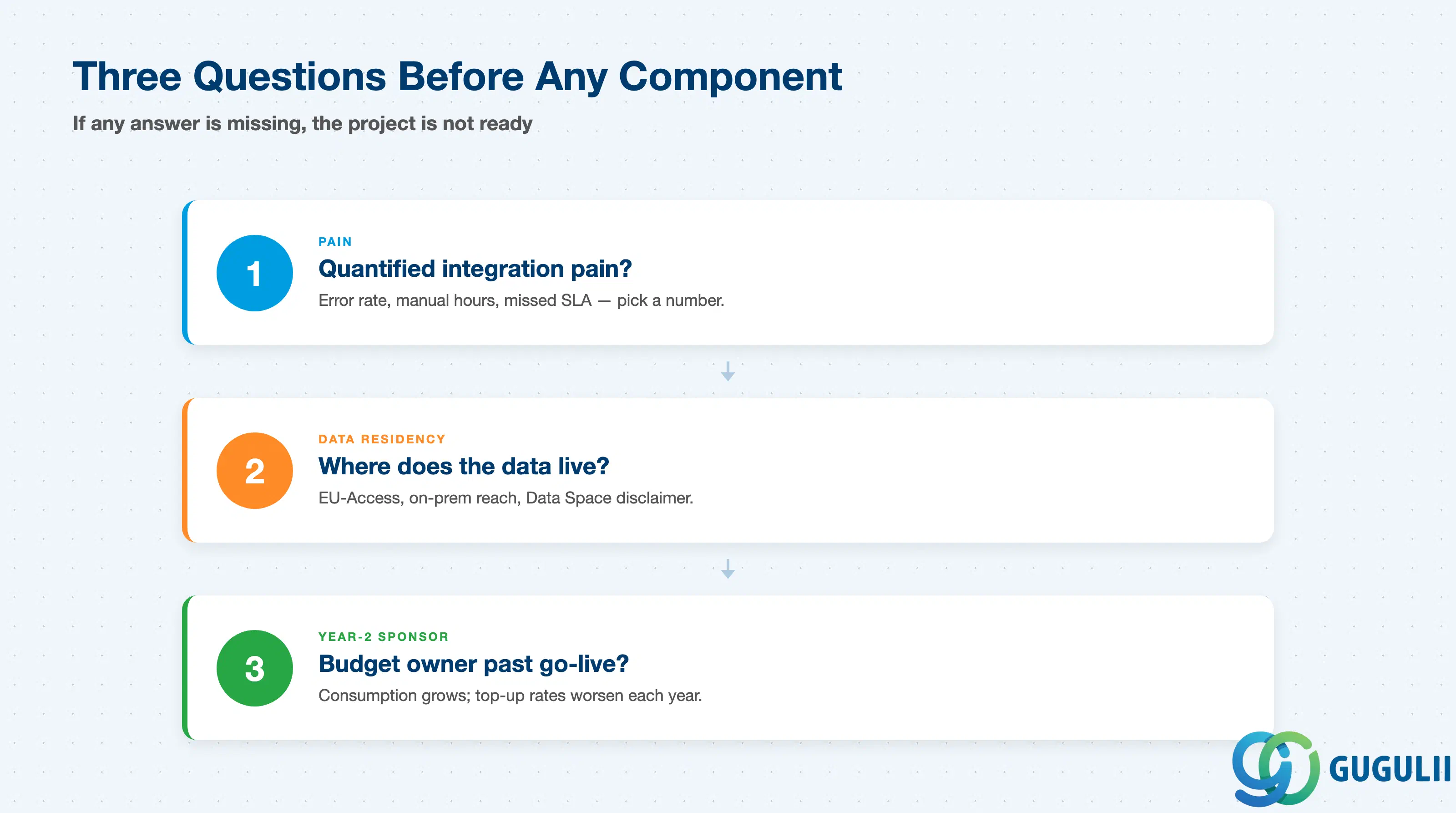
Q1. Is there a measurable integration pain that the customer can quantify today?
Without a quantified pain — error rate, manual effort hours, missed SLAs, partner churn, API consumer support tickets — Integration Suite scope is aspirational. Ask for the metric and the target. If the customer cannot produce one, the project does not yet have a business case for any of the five components.
Q2. Where does the data live, who owns it, and which residency rule applies?
Cloud Integration runs on SAP BTP Cloud Foundry across AWS, Azure, and Alibaba Cloud regions, but EU-Access contracts forbid the Cloud Foundry environment outside EU operators. On-prem S/4HANA reachability requires Cloud Connector. Data Space Integration carries an explicit SAP disclaimer of removal. Walking into a steering committee without these answers is how deployments get paused at week eight.
Q3. Is there an internal sponsor with budget authority for year-two consumption, not only go-live?
Integration Suite buyers commonly hit consumption overruns 12-18 months after go-live because message volume grows faster than estimated and top-up rates are less favourable than the original CPEA rate. The sponsor must own year-two budget, not just project rollout.
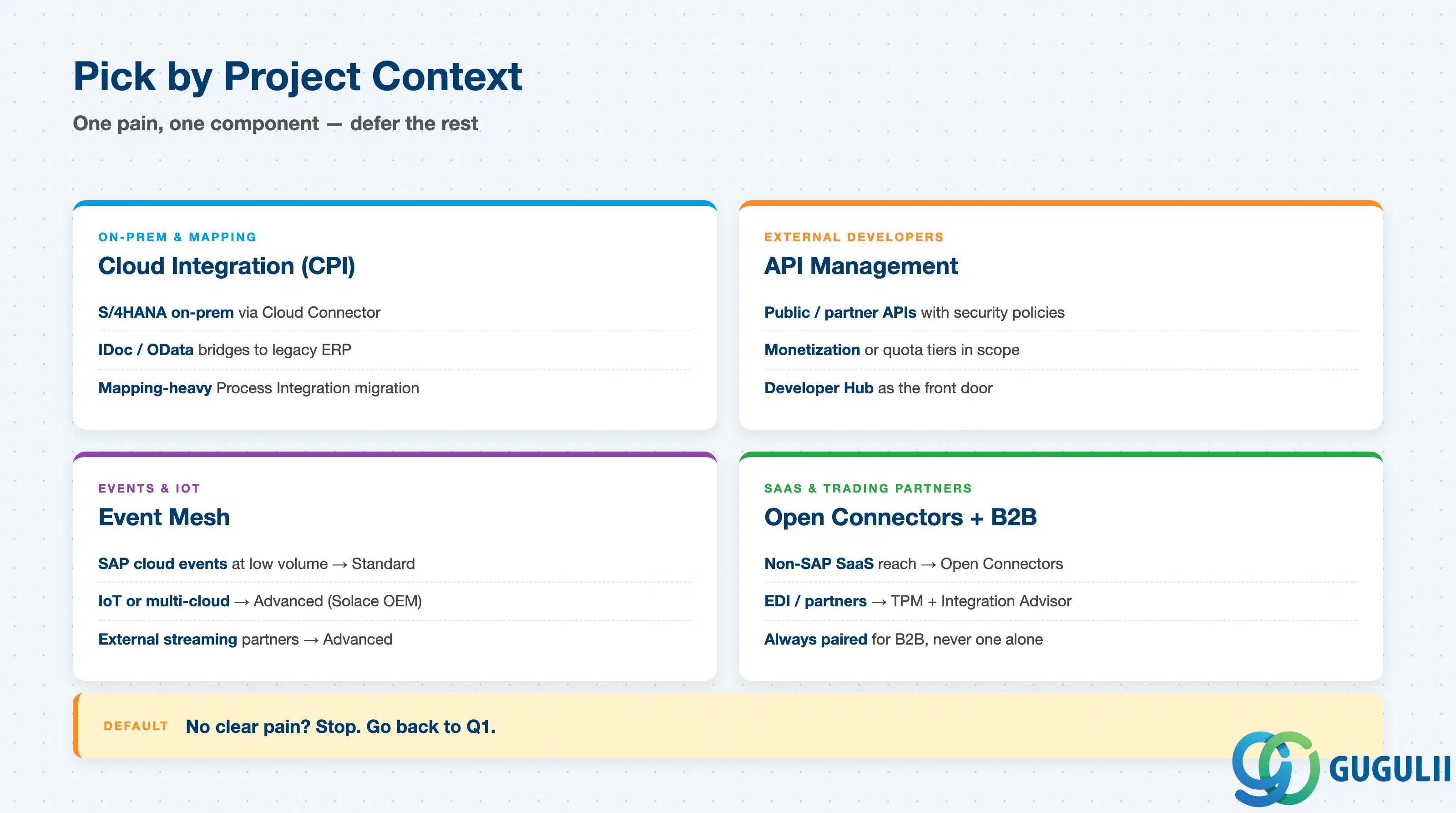
| Project context | Recommended starting component |
|---|---|
| Process integration with on-prem S/4HANA, IDocs, mapping pain | Cloud Integration (CPI) |
| External developers consuming SAP APIs, monetization or rate-control needed | API Management |
| Standard cloud-event flows between SAP modules (Business Partner sync, PO events) | Standard Event Mesh |
| IoT, ≥15,000 events/hour, multi-cloud, or external non-BTP partners as event consumers | Advanced Event Mesh |
| Non-SAP SaaS reach (Salesforce, ServiceNow, Workday, Slack, ad-tech) without bespoke build | Open Connectors |
| EDI / B2B with trading partners, X12/EDIFACT/AS2 standards | TPM + Integration Advisor (paired) |
| PI/PO migration mandated by clean-core | Cloud Integration + Migration Assessment |
| Hybrid landscape with strict data-locality requirement | Edge Integration Cell on top of Cloud Integration |
| No clear pain point identified yet | Stop. Go back to Q1. |
| Component | Licensing model | Key question to ask |
|---|---|---|
| Cloud Integration | Subscription (Starter / Standard / Premium tenant) or consumption via CPEA / BTPEA / PAYG; message-based billing in 250 KB units | What is the year-2 message volume forecast, and which edition delta is the project relying on? |
| API Management | Same Integration Suite envelope; consumption metered through call volume and add-ons (Monetization, Anomaly Detection) | Is API Monetization in scope, and is the rate-plan model agreed with finance? |
| Standard Event Mesh | Usage-based via the Integration Suite tenant | Does the volume forecast stay under the 1 MB / ~250 KB/s ceiling? |
| Advanced Event Mesh (AEM) | Broker-based (T-shirt size); separate commercial track from Integration Suite | Has the broker size been sized against year-2 throughput, not go-live? |
| Open Connectors | Included in Integration Suite editions; no per-connector seat licensing | Which connectors are needed today vs. anticipated, and who owns connector upgrades? |
| TPM + Integration Advisor | Activated as separate capabilities on the same tenant; both must be provisioned | Has the partner count been validated against Integration Suite edition? |
| Edge Integration Cell | Customer-managed Kubernetes; runtime cost is customer infra | Who owns the Kubernetes cluster lifecycle and patching? |
The Free Tier offers one Integration Suite tenant per CPEA / PAYG / PAYG-TDD Global Account with Standard Edition functionality; the trial tenant is valid for 90 days, after which it auto-decommissions. The KBA documenting the Standard vs. Premium edition feature delta is referenced as KBA 3189288 — its existence is public; full content requires SAP for Me login.
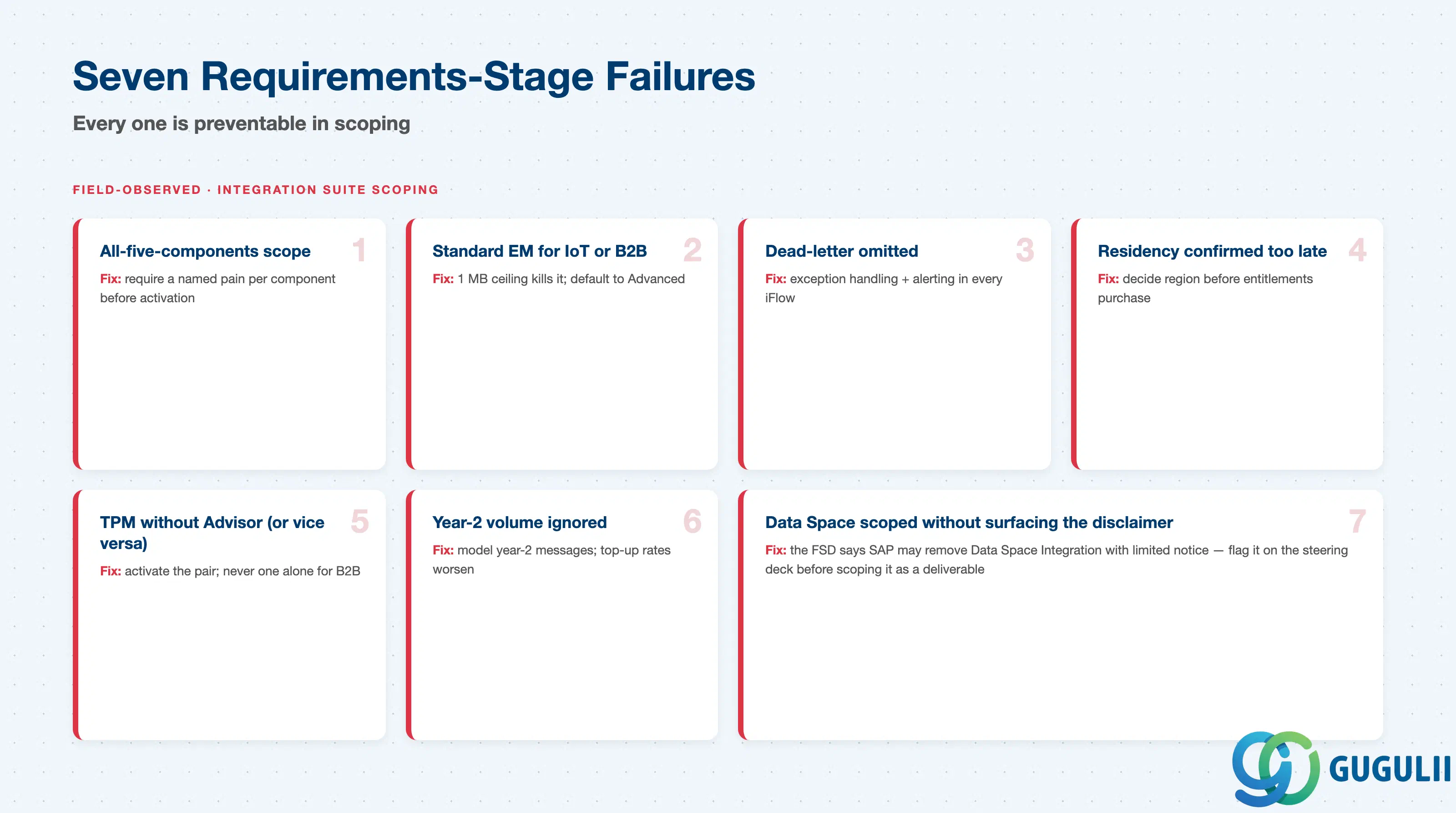
These are requirements-stage failures, not implementation bugs — every one is preventable in scoping.
Failure 1: Scope assumed at “all five components” without a per-component pain point
Steering decks frame Integration Suite as a single purchase, so the project team scopes all five capabilities by default. Each one carries activation, governance, and budget overhead. Scope only the components that map to a Q1-quantified pain; defer the rest with a written re-evaluation date.
Failure 2: Standard Event Mesh promised for IoT or external B2B
The 1 MB hard limit and ~250 KB/s practical per subaccount are non-negotiable. Promising Standard Event Mesh for IoT volumes or for partners outside BTP forces an emergency move to Advanced Event Mesh mid-project, with a separate commercial track and broker sizing decisions. Do the volume math in week one.
Failure 3: Exception handling and dead-letter pattern omitted from the design
Mapping errors, partner outages, and adapter timeouts are routine; the project that has not chosen a dead-letter and alerting pattern at requirements stage finds out at hypercare. Document retry, dead-letter, and alerting per interface before design freeze.
Failure 4: Data governance and residency confirmed only after entitlements are raised
EU-Access constraints, on-prem reachability through Cloud Connector, AES-256 per-tenant keys, and the Data Space Integration disclaimer are all governance items. Discovering one of them in week six rewinds the project to procurement. Read the FSD with the customer’s CISO in week one.
Failure 5: TPM activated without Integration Advisor (or vice versa)
The two are designed as a pair: Integration Advisor designs MIGs and MAGs and auto-generates Cloud Integration runtime artefacts; TPM operates trading partner profiles and pushes agreements into the CPI Partner Directory. Activating only one and discovering the gap during partner onboarding is the most common B2B failure.
Failure 6: Year-one message volume taken as the budget, year-two ignored
Adoption pulls volume up; top-up rates after a CPEA term are routinely worse than the negotiated rate. A sponsor who signs off on year-one consumption only is the wrong sponsor. Build a year-two forecast and put it in the business case.
Failure 7: Data Space Integration scoped without surfacing the SAP disclaimer
The FSD states SAP “expressly disclaims any warranty or obligation that this Data Space Integration capability will be provided within SAP Integration Suite indefinitely.” A customer entering Catena-X scope with this capability needs the disclaimer on paper before architecture commits. Without it, the project owns a removal risk it has not been told about.
Q: Does Integration Suite work with on-premise S/4HANA, or is it cloud-only?
It works with both, with a caveat. Cloud Integration’s RFC and IDoc adapters reach on-premise SAP via SAP Cloud Connector, supported down to SAP NetWeaver 7.31. The Integration Suite tenant itself runs on SAP BTP Cloud Foundry only. So on-prem connectivity is fully supported in design, but the Integration Suite control plane is cloud — that is the trade the customer is making, and it should be stated explicitly.
Q: How is Integration Suite licensed, and where do customers usually overspend?
Three commercial models exist: Subscription (Starter / Standard / Premium tenant-based), consumption-based via CPEA or BTPEA (a credit pool across BTP services), and PAYG / PAYG-TDD. Mid-tier subscription pricing reported in third-party reviews is in the low thousands per month, but list pricing is not published — assume an account-team conversation. The two overspend traps: year-two message volume scaling beyond forecast (a “message” is up to 250 KB; every additional 250 KB or portion thereof counts as one more), and Advanced Event Mesh broker sizing creeping up under load. Standard Event Mesh pricing is usage-based but capped by its hard ceilings; AEM is broker-based and a separate cost track.
Q: When should we descope an Integration Suite component from a project?
When any of the following is true: there is no quantified pain point that maps to the component; volume forecasts exceed the component’s published ceilings (Standard EM is the typical case); the data residency or EU-Access rule conflicts with the component’s deployment; the customer cannot name a year-two sponsor; the capability ships with a removal disclaimer (Data Space Integration); or the project has more components in scope than it has named owners. Saying “not in this phase” with a written re-evaluation date is a deliverable, not a regression.
Q: How do we document an Integration Suite requirement so it survives delivery?
Write each interface as a sextet: (1) the source/target systems and the chosen adapter, (2) the volume forecast in 250 KB units for year-1 and year-2, (3) the on-prem reachability assumption (Cloud Connector? OAuth?), (4) the exception handling pattern (dead-letter, alerting, retry), (5) the security pattern (auth, certificate rotation owner), and (6) the named LoB owner and year-2 sponsor. Without all six, the requirement gets shaped during build — usually by quietly removing scope.
Q: Standard Event Mesh vs. Advanced Event Mesh — how do we decide, and is the difference real?
The difference is real and architectural. Standard Event Mesh is a shared broker on BTP, capped at 1 MB messages, with practical throughput around 250 KB/s per subaccount and 10 GB storage. Advanced Event Mesh is OEM’d from Solace PubSub+, runs as dedicated brokers in T-shirt sizes, supports 30 MB messages, 6 TB storage, event replay, transactions, and Dynamic Message Routing across cloud providers. The decision rule: Standard EM for SAP-internal cloud event flows under the ceilings; AEM for IoT, ≥15,000 events/hour, multi-cloud, or external partners. Mixing both is acceptable.
Q: Is Integration Suite the strategic successor to PI/PO, and what should we do with our PI/PO estate?
Yes. SAP Architecture Center positions Integration Suite as the strategic successor to SAP Process Integration / Process Orchestration, aligned with the clean-core narrative — PI/PO is ABAP-rooted; Integration Suite is cloud-native iPaaS. The Migration Assessment capability is purpose-built for evaluating the move from PI/PO 7.5 to Integration Suite and now also analyses BAPIs and recommends Business Accelerator Hub content. Treat PI/PO sunsetting as a parallel programme, not a rip-and-replace; Migration Assessment is the entry point.
Q: What about Edge Integration Cell — should we plan for it now?
Plan for it only if data residency or latency requires integration runtime inside a customer-managed network. The Edge Integration Cell allows running Cloud Integration flows and API proxies in a customer-managed Kubernetes cluster, with multiple cells per Integration Suite tenant. Sizing tables are not publicly published — confirm node count, CPU, and memory with SAP. For most projects, the Integration Suite cloud runtime is sufficient and Edge is over-engineering.
SAP Integration Suite in 2026 is best read as a portfolio of eleven officially listed capabilities, of which five carry the load on real projects: Cloud Integration as the process-integration core; API Management as the lifecycle and consumer-experience layer; Event Mesh in two distinct flavours (Standard for SAP-internal flows under the ceilings, Advanced for everything beyond); Open Connectors for non-SAP SaaS reach without bespoke build; and the TPM plus Integration Advisor pair for B2B. The consultant value is reading the customer’s quantified pain, data residency, and year-two sponsor, then committing to the components that map — and refusing the rest in writing. Promise inside the FSD envelope, scope around the disclaimers, and budget for the second year of message volume every time.
| L1. Big Picture | L2. Functional Domains |
|---|---|
| BTP-001 What is BTP | L2-A. Integration — BTP-A01 Suite Overview (this article) |
| BTP-002 BTP Architecture | L2-B. Application Development & Automation |
| BTP-003 BTP Capability Map | L2-C. Data & Analytics |
| BTP-004 Deployment Models | L2-D. AI |
| BTP-005 Licensing Models | L2-E. Foundation Services |
| BTP-006 Clean Core Strategy | L2-F. Architecture & Operations |
| L2-G. Use Cases & Patterns |