Title here
Summary here

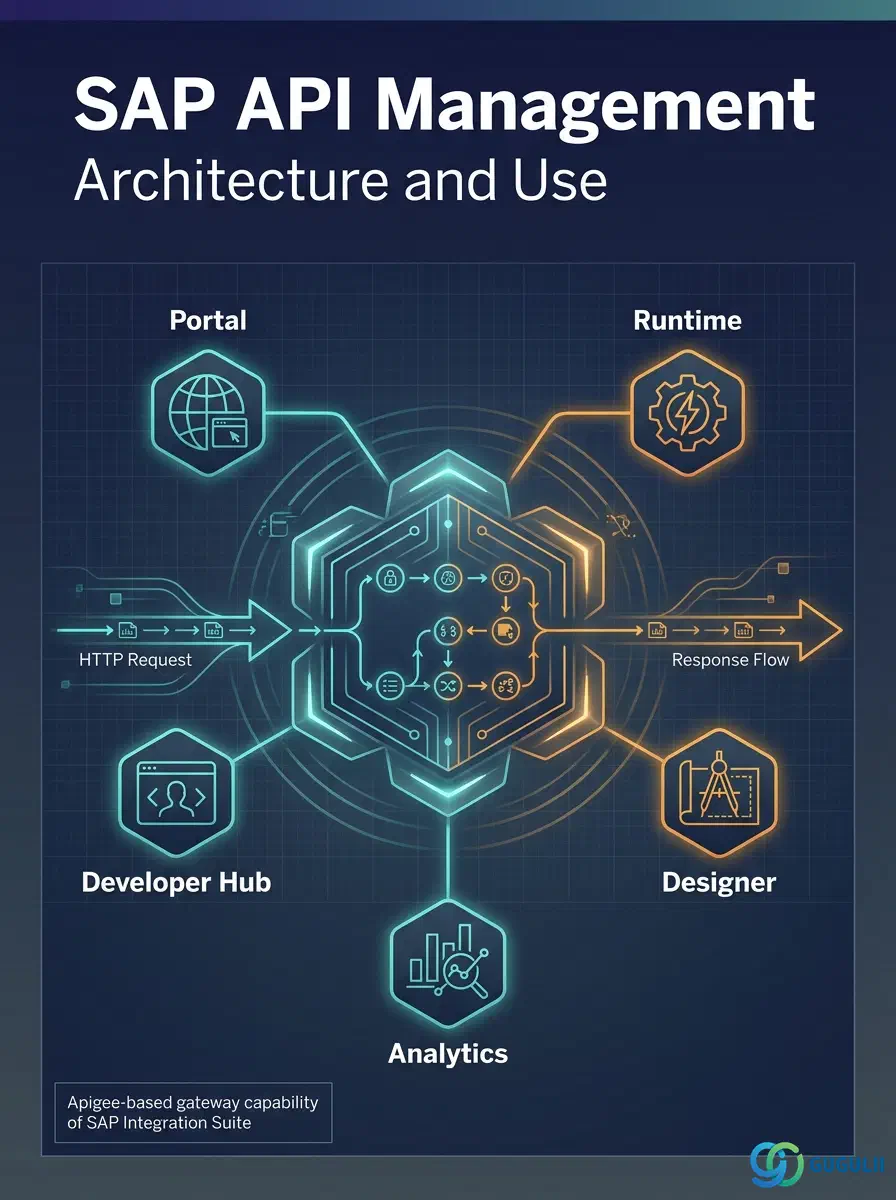
| ID | Title |
|---|---|
| BTP-A01 | SAP Integration Suite Overview |
| BTP-A02 | Cloud Integration (CPI): Architecture and Use |
| BTP-A03 | API Management: Architecture and Use (this article) |
| BTP-A04 | Event Mesh: Architecture and Use |
| BTP-A05 | Open Connectors: Architecture and Use |
| BTP-A06 | B2B Integration (1): Trading Partner Management |
| BTP-A07 | B2B Integration (2): Integration Advisor |
| BTP-A08 | Integration Suite: Use Cases and Decision Patterns |
| Resource | URL |
|---|---|
| API Management — SAP Integration Suite | help.sap.com → |
| SAP API Management (product docs root) | help.sap.com → |
| Policies (Policy Types) | help.sap.com → |
| API Proxy Structure | help.sap.com → |
| SAP Integration Suite — API Management capability page | sap.com → |
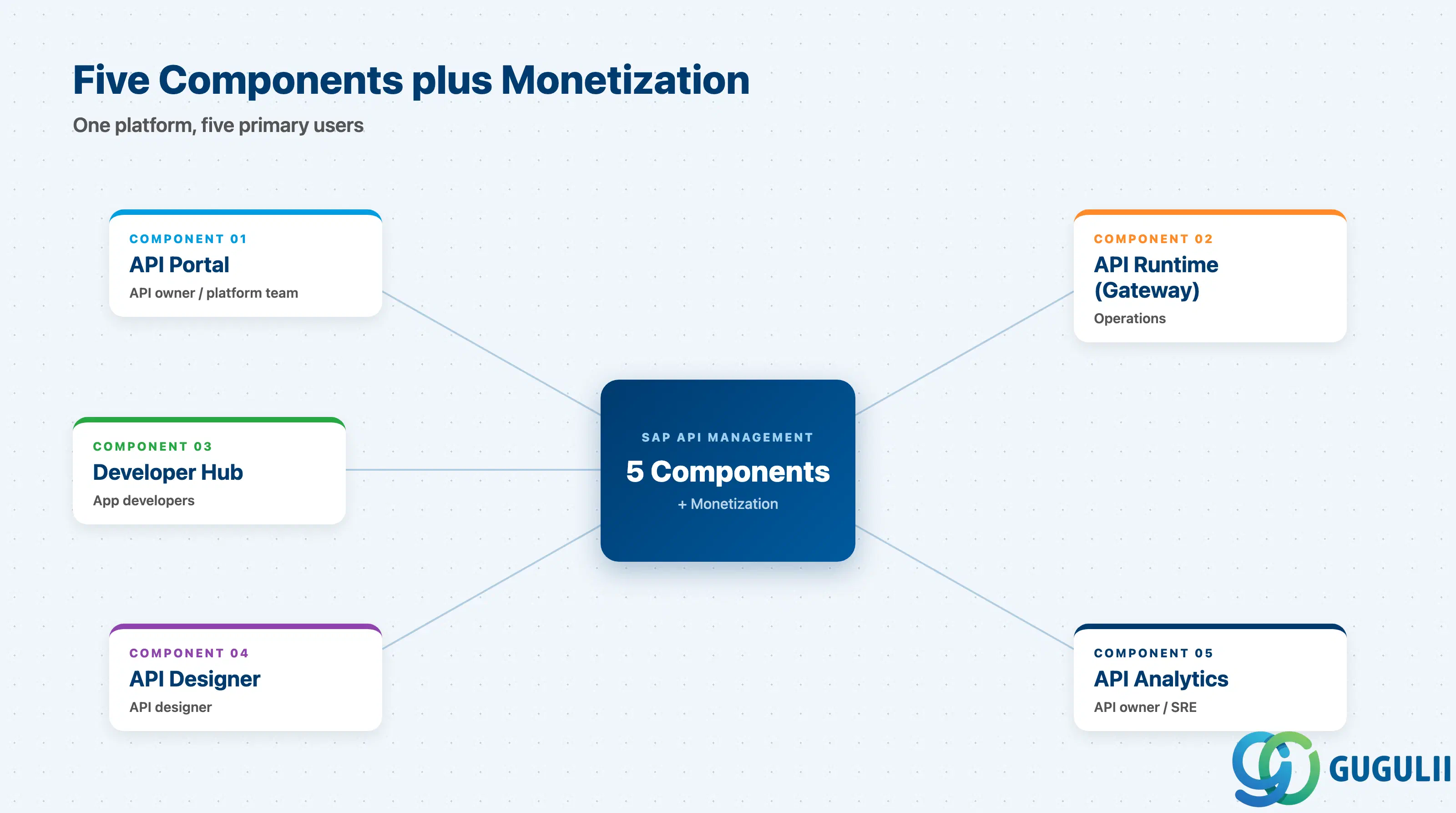
SAP API Management is one capability inside SAP Integration Suite. Its infrastructure is officially described as five components plus monetization. Knowing which is which prevents most scope arguments later.
| Sub-component | What it does | Primary user |
|---|---|---|
| API Portal | Create, secure, publish API Proxies; bundle into API Products; attach Rate Plans | API owner / platform team |
| API Runtime (Gateway) | Executes proxies, runs policies, enforces quotas and security at request time | Operations |
| Developer Hub (API Business Hub Enterprise) | Self-service catalogue where app developers discover APIs, register apps, get keys, subscribe to plans | External / internal app developers |
| API Designer | Design-first OpenAPI / GraphQL editor for new APIs before backend exists | API designer |
| API Analytics | Per-proxy, per-app, per-product metrics — latency, error rate, traffic, anomaly detection | API owner, platform SRE |
They are not substitutes.
                                             SAP Integration Suite (BTP)
                       ┌───────────────────────────────────────────────────────────────┐
   App developer ──────▶│  Developer Hub (API Business Hub Enterprise)                 │
   (registers app,      │            │                                                 │
    gets API key)       │            ▼  app credentials                                │
                        │  ┌───────────────────────────────────────────────────────┐  │
   Client app  ─ HTTPS ─┼─▶│  API Runtime (Gateway)                                │  │
                        │  │  Proxy Endpoint  ──  Policies  ──  Target Endpoint     │  │
                        │  │   (Pre/Post/Cond.   (Sec/Traffic/  (route to backend) │  │
                        │  │    + Fault Rules)    Med/Ext)                          │  │
                        │  └────────┬─────────────────────────────────┬────────────┘  │
                        │           │                                 │               │
                        │           ▼                                 ▼               │
                        │   Cloud Integration iflow            S/4HANA OData / SOAP   │
                        │   (CPI as backend)                   (direct backend)       │
                        └───────────┬─────────────────────────────────┬───────────────┘
                                    │ via Cloud Connector             │
                                    ▼                                 ▼
                            S/4HANA on-premise                 S/4HANA Cloud
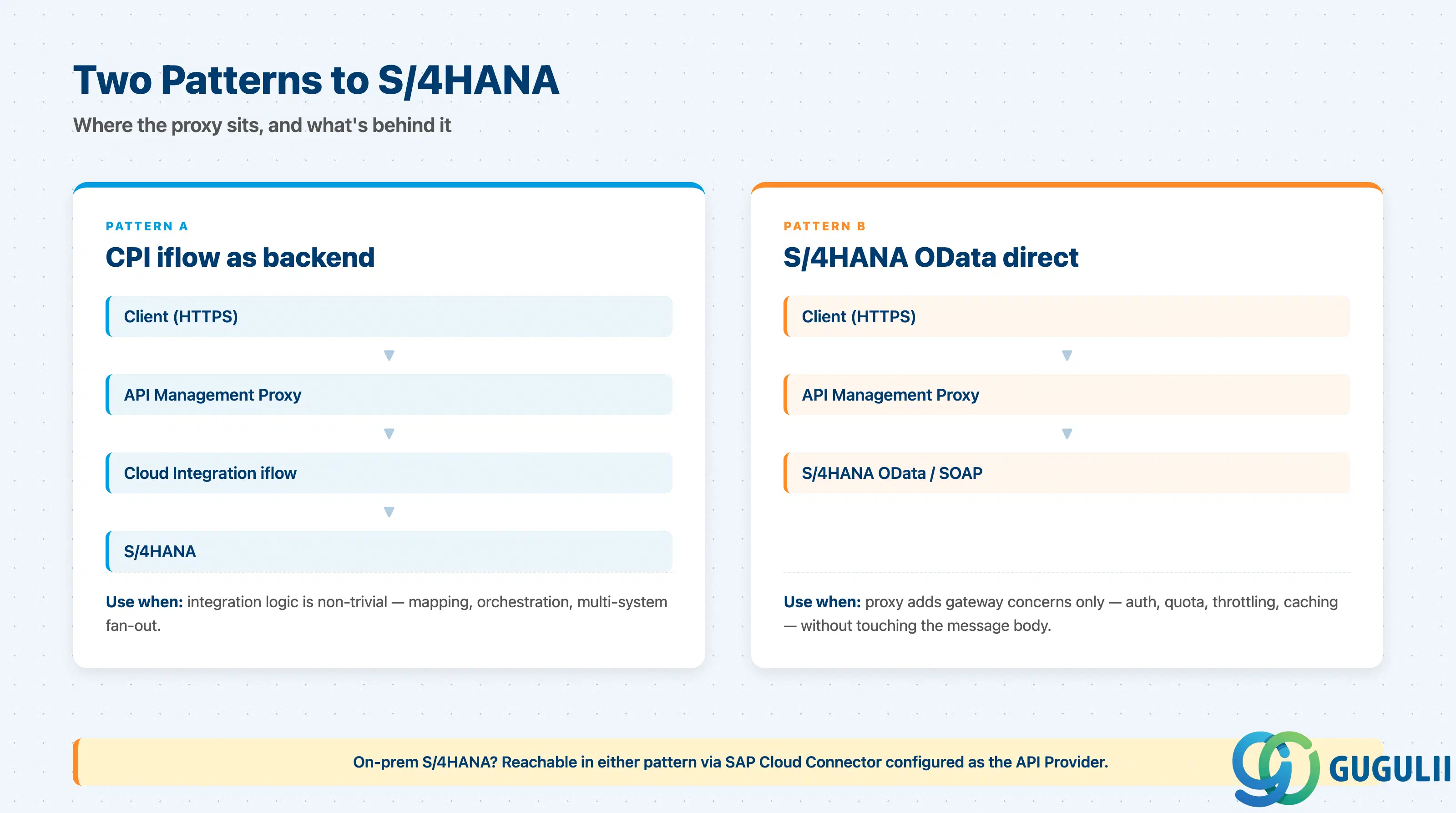
API Management does not own the connection to S/4HANA — that is CPI’s or the OData adapter’s job. API Management owns the proxy that fronts whatever exposes the data. Two patterns dominate. Pattern A: CPI iflow as backend, proxy on top — when the integration logic is non-trivial. Pattern B: S/4HANA OData service as direct backend, proxy on top — when the proxy only adds gateway concerns (auth, quota, throttling, caching). On-premise S/4HANA is reachable in either pattern via SAP Cloud Connector configured as the API Provider.
Key point: API Management is the perimeter and the consumer experience layer. It is not the integration runtime.
| Sub-component | Maturity | Notes |
|---|---|---|
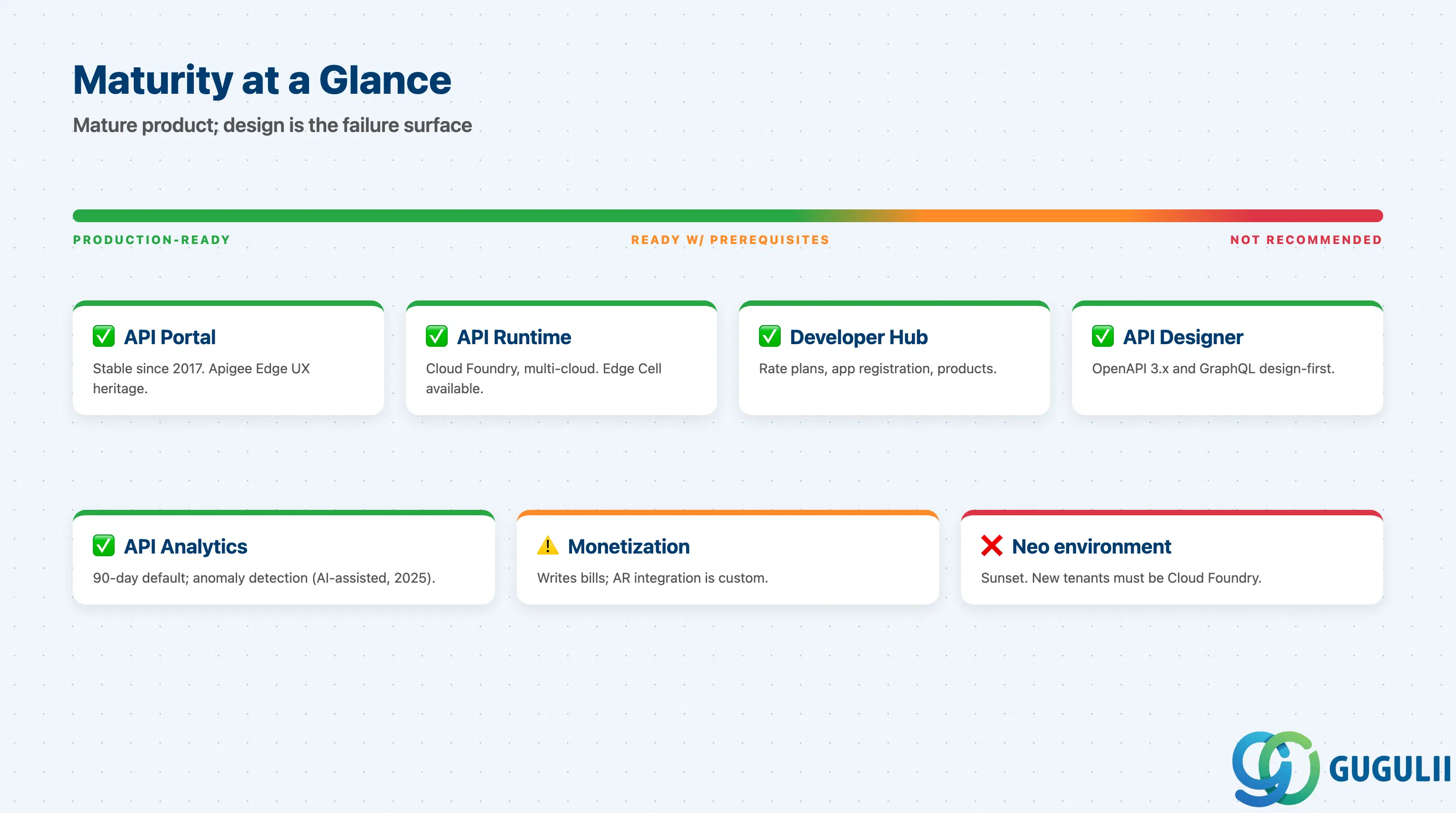
| API Portal | ✅ Production-ready | Stable since 2017. Apigee Edge UX heritage. |
| API Runtime (Gateway) | ✅ Production-ready | Cloud Foundry (multi-cloud). Edge Integration Cell extends runtime into customer Kubernetes. |
| Developer Hub | ✅ Production-ready | Supports rate plan subscription, app registration, API products. |
| API Designer | ✅ Production-ready | OpenAPI 3.x and GraphQL design-first editor. Less mature for AsyncAPI / Event-first design. |
| API Analytics | ✅ Production-ready | Custom dashboards, anomaly detection, traffic prediction (AI-assisted as of 2025). 90-day default retention. |
| Monetization | ⚠️ Ready with prerequisites | Rate plans, billing, downloadable bills work; integration with the customer’s billing/AR system is custom. |
| On-premise edition | ⚠️ Ready with prerequisites | Still supported but not the strategic line; pick only when residency forces it. |
| Neo environment | ❌ Not recommended | Sunset; new tenants must be Cloud Foundry / multi-cloud. |
One sub-table per design concern. Each row is decidable at requirements stage.
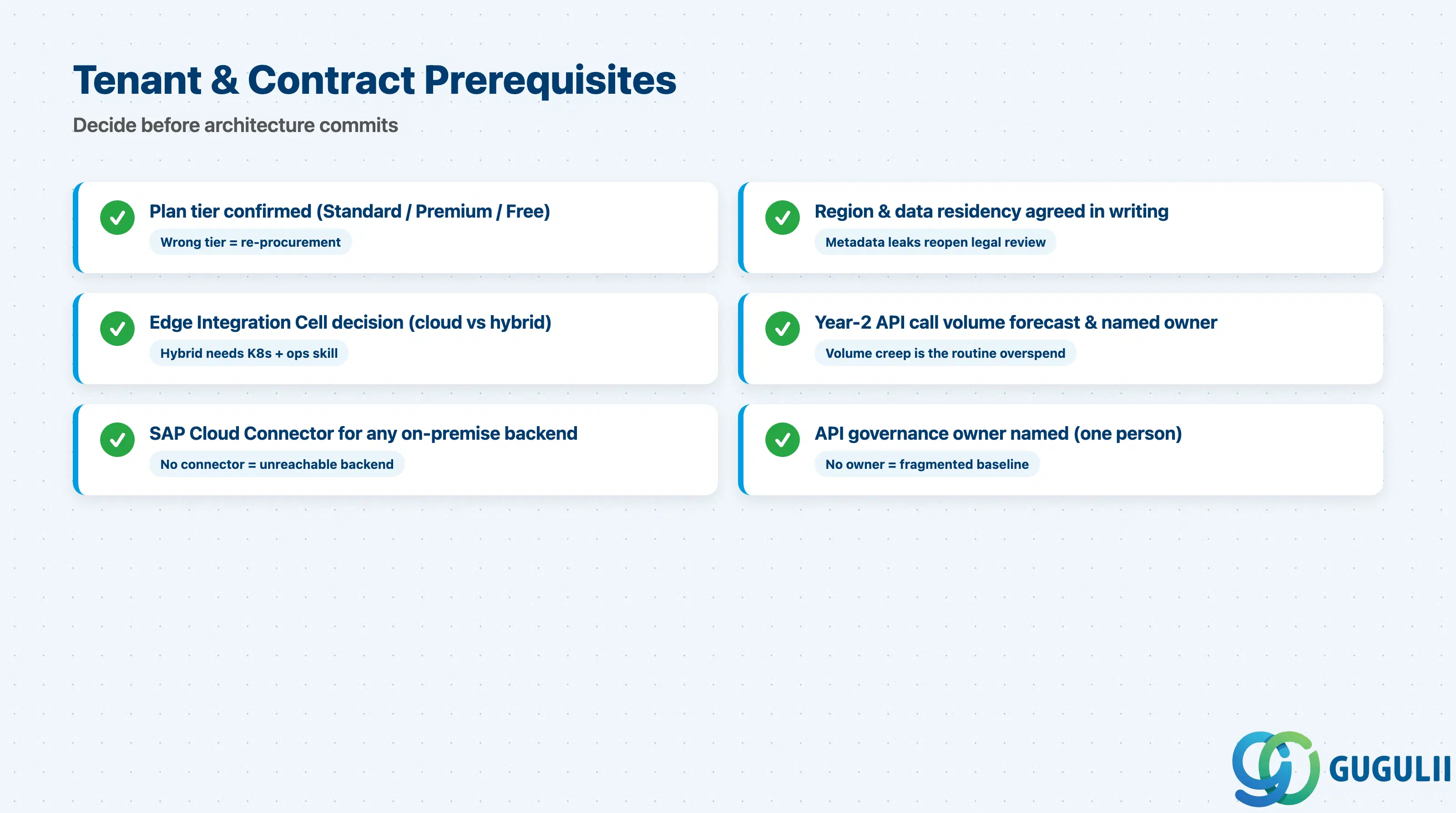
| Checklist item | Why it matters |
|---|---|
| Integration Suite plan tier confirmed (Standard / Premium / Free) and API Management included | Wrong tier means re-procurement mid-build. |
| Region and data residency for the API Management tenant agreed in writing | Proxy logs traffic metadata; residency wrong = legal review reopens at UAT. |
| Edge Integration Cell decision made (cloud-only vs hybrid runtime) | Hybrid runtime needs customer-managed Kubernetes, separate sizing, separate ops skill. |
| Year-2 API call volume forecast and named owner | Volume creep is the routine overspend; year-1-only sponsors leave gaps. |
| SAP Cloud Connector availability for any on-premise backend | No connector = unreachable backend; build-time discovery is too late. |
| API governance owner named (not “the integration team”) | One owner or the consumer experience fragments across teams. |
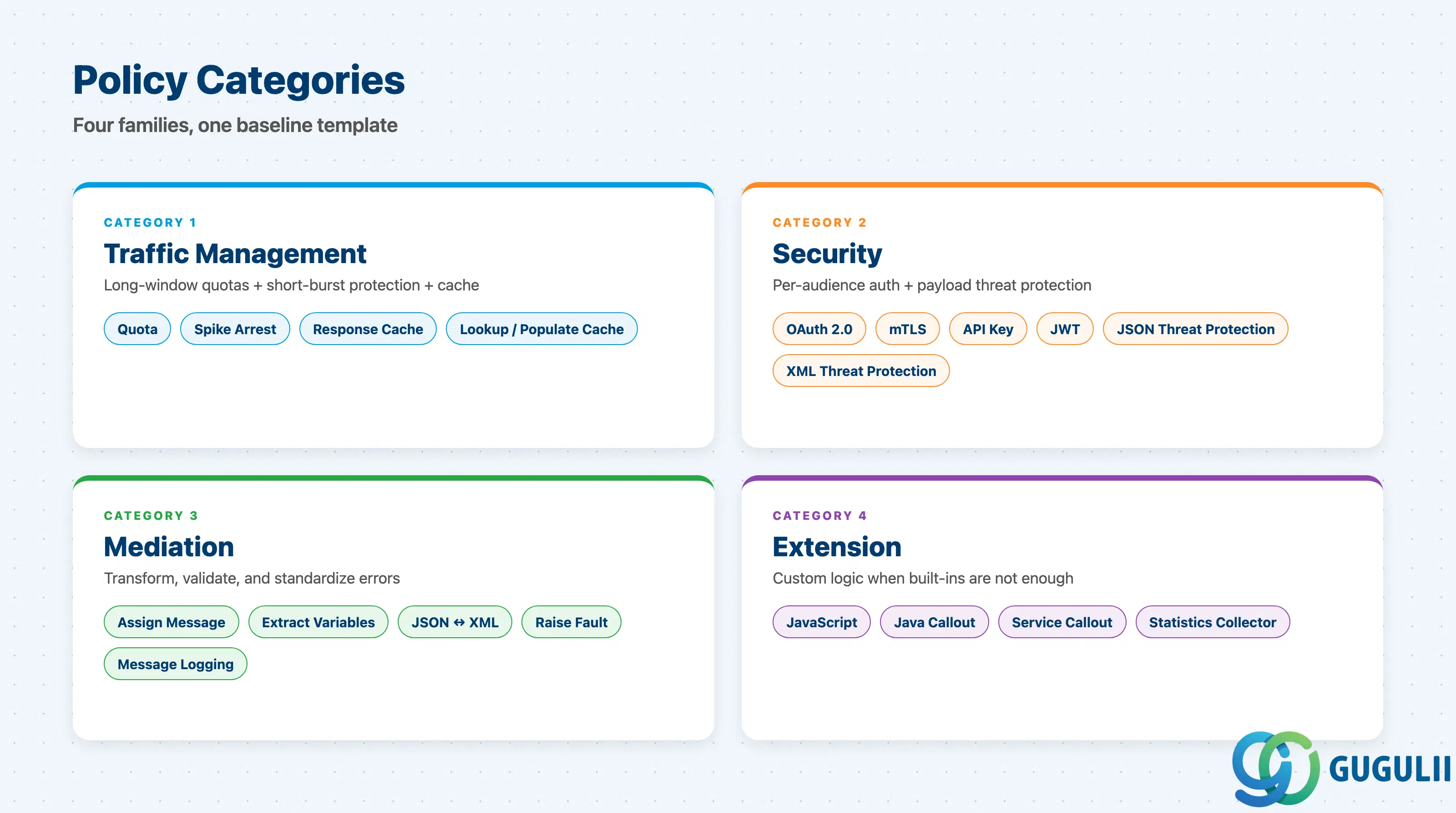
| Checklist item | Why it matters |
|---|---|
| Authentication pattern per audience: OAuth 2.0 (default), mTLS (B2B), API Key (prototype only) | API Key as production auth is the most common security finding. |
| Quota policy and Spike Arrest policy defaults agreed | Quota is long-window; Spike Arrest is short-burst. They are not redundant. |
| Threat protection in baseline: JSON Threat Protection, XML Threat Protection, Regular Expression Protection | Default proxies omit them; payload-complexity DoS goes unmitigated. |
| Caching strategy (Response Cache, Lookup/Populate Cache) decided per backend | “No cache” in writing is also a valid answer; defaults are not. |
| Fault rule and Default Fault Rule template defined | Default error envelope does not match SAP API Guidelines; standardize once. |
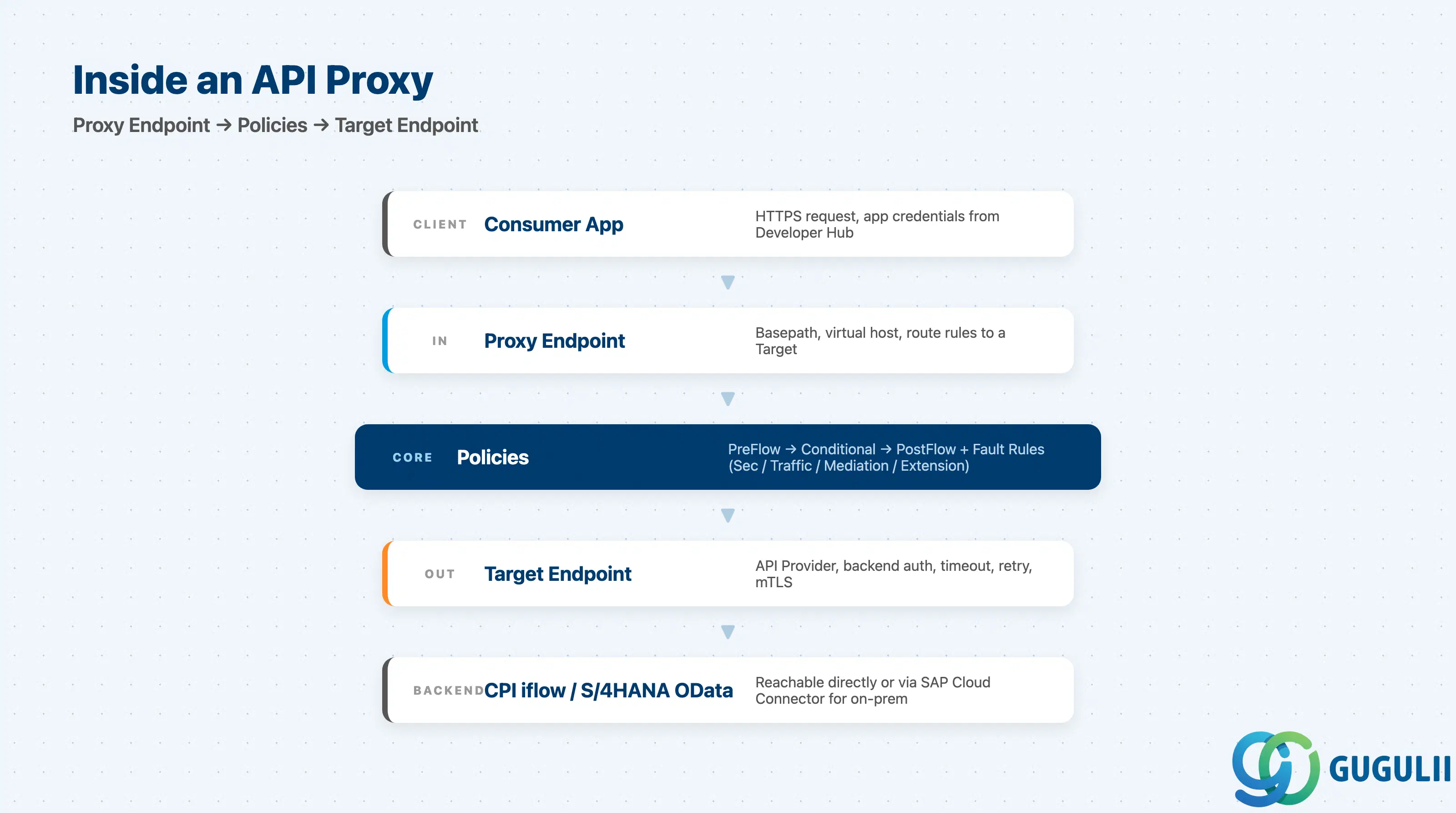
| Checklist item | Why it matters |
|---|---|
| API Provider configured per distinct backend (host, port, auth) | Hard-coded URLs in proxies block clean DEV/QA/PROD promotion. |
| Backend authentication chosen and credentials lifecycle owner named | Rotation without an owner is the slow-burn outage. |
| Route rules / dynamic routing for promotion or blue-green | Otherwise you duplicate proxies per environment — easy to drift. |
| Connection timeout and retry behavior set per target | Defaults can saturate the runtime; retries on non-idempotent calls double-post. |
| Cloud Connector mapping for any on-premise target | Virtual-to-internal mapping is the only path to the backend. |
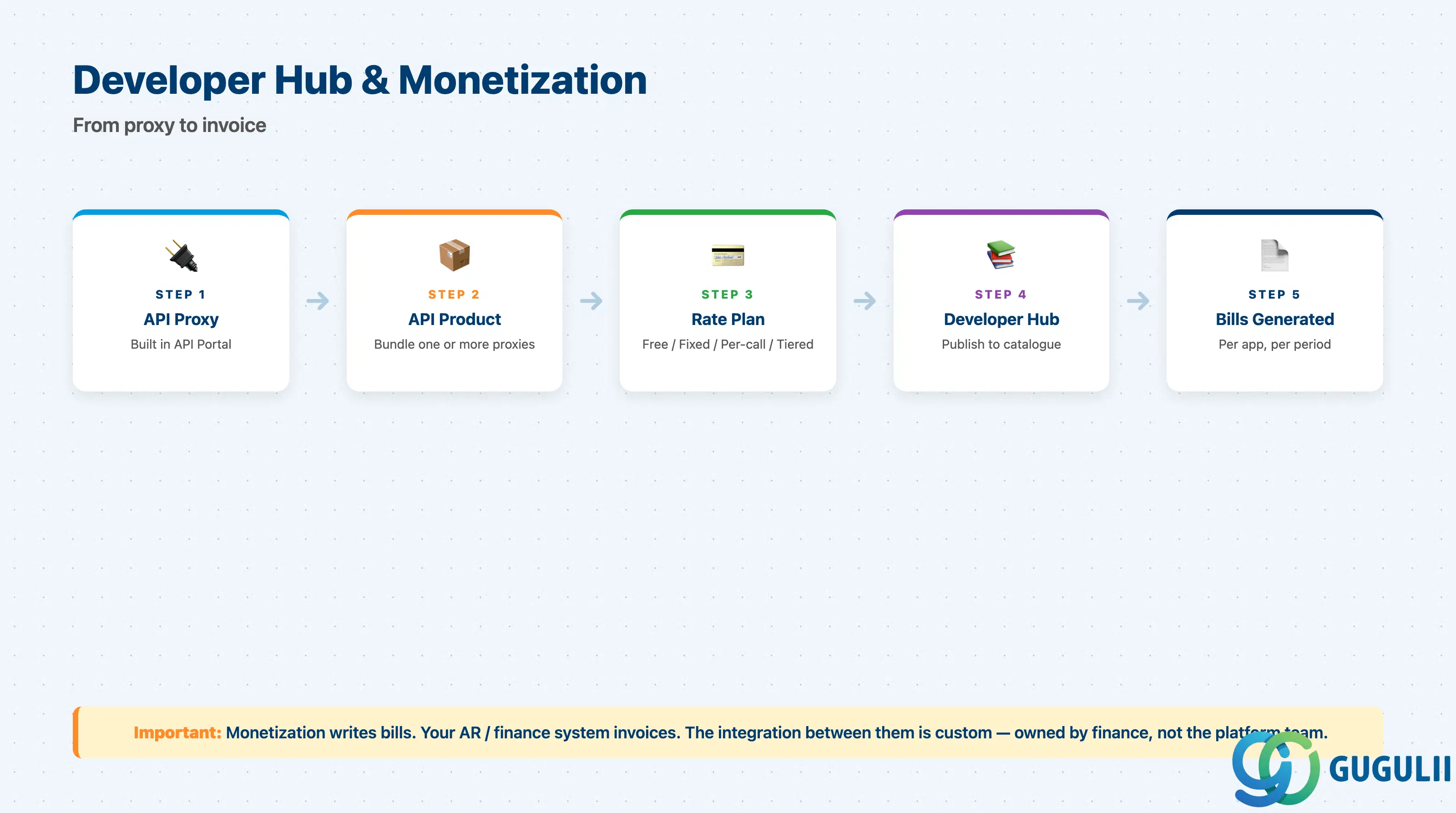
| Checklist item | Why it matters |
|---|---|
| API Products and Rate Plans (free / fixed / per-call / tiered) decided per audience | Rate plans cannot be retrofitted onto live products without disruption. |
| Developer Hub IdP integrated (corporate IdP for internal, SAP ID / external IdP for partners) | Without IdP, every external developer is a manual onboarding ticket. |
| App registration approval workflow decided (auto vs manual) | Auto is fast but open; manual is safe but needs a named approver SLA. |
| Billing system integration scope agreed (Monetization writes bills; AR invoices) | Monetization is not an invoicing system; AR integration is custom. |
| API documentation and SLA published per product | A Developer Hub without SLAs is a catalogue without a contract. |
| Checklist item | Why it matters |
|---|---|
| Message Logging policy in every external-facing proxy with PII-aware payload masking | Default analytics omit per-call diagnostics; root cause becomes guesswork. |
| Analytics retention agreed (default 90 days) and longer-term destination if needed | Audit and capacity planning often need >90 days; export pipeline is custom. |
| Anomaly detection thresholds agreed per product | Out-of-the-box defaults produce noise; per-product tuning prevents alert fatigue. |
| Deprecation and versioning policy written | Without sunset header + parallel-run window + EOL date, consumers do not migrate. |
| On-call ownership of API Runtime alerts named | “Integration team” is not a name; one person, one rotation. |
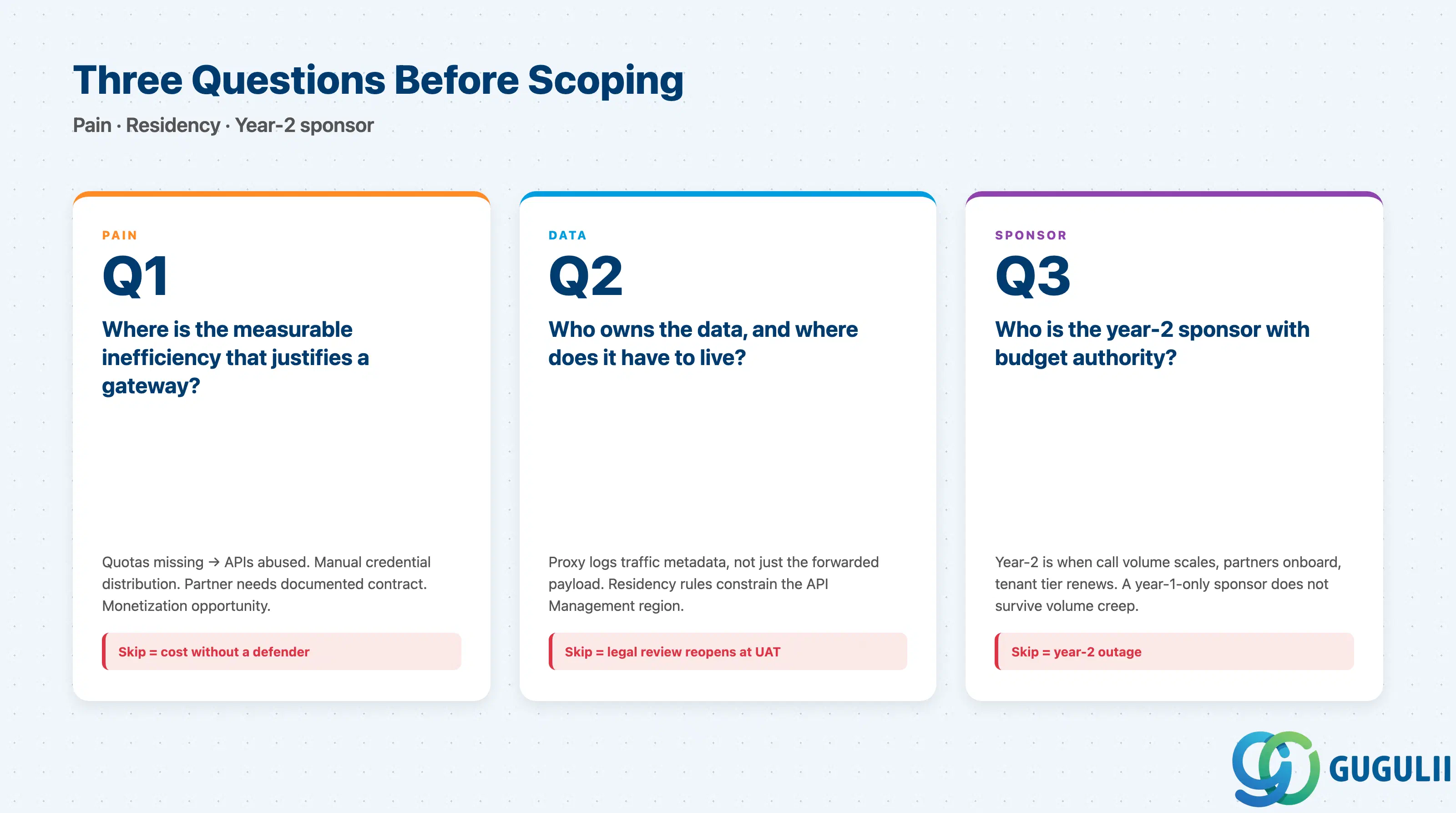
Q1. Where is the measurable inefficiency that justifies a gateway?
Examples that justify it: APIs exposed without quotas being abused; manual credential distribution; an external partner needs a documented contract; finance wants to monetize a data product. Examples that do not: “everyone has one.” Without quantified pain, the gateway is a cost without a defender.
Q2. Who owns the data behind the API, and where does it have to live?
The proxy logs traffic metadata, not just the forwarded payload. If residency rules exclude shipping metadata cross-region, the API Management region has to match. Not negotiable at UAT.
Q3. Who is the year-two sponsor with budget authority?
Year-1 is easy money. Year-2 is when call volume scales, partners onboard the Developer Hub, and someone has to renew the tenant tier. A year-1-only sponsor does not survive volume creep.
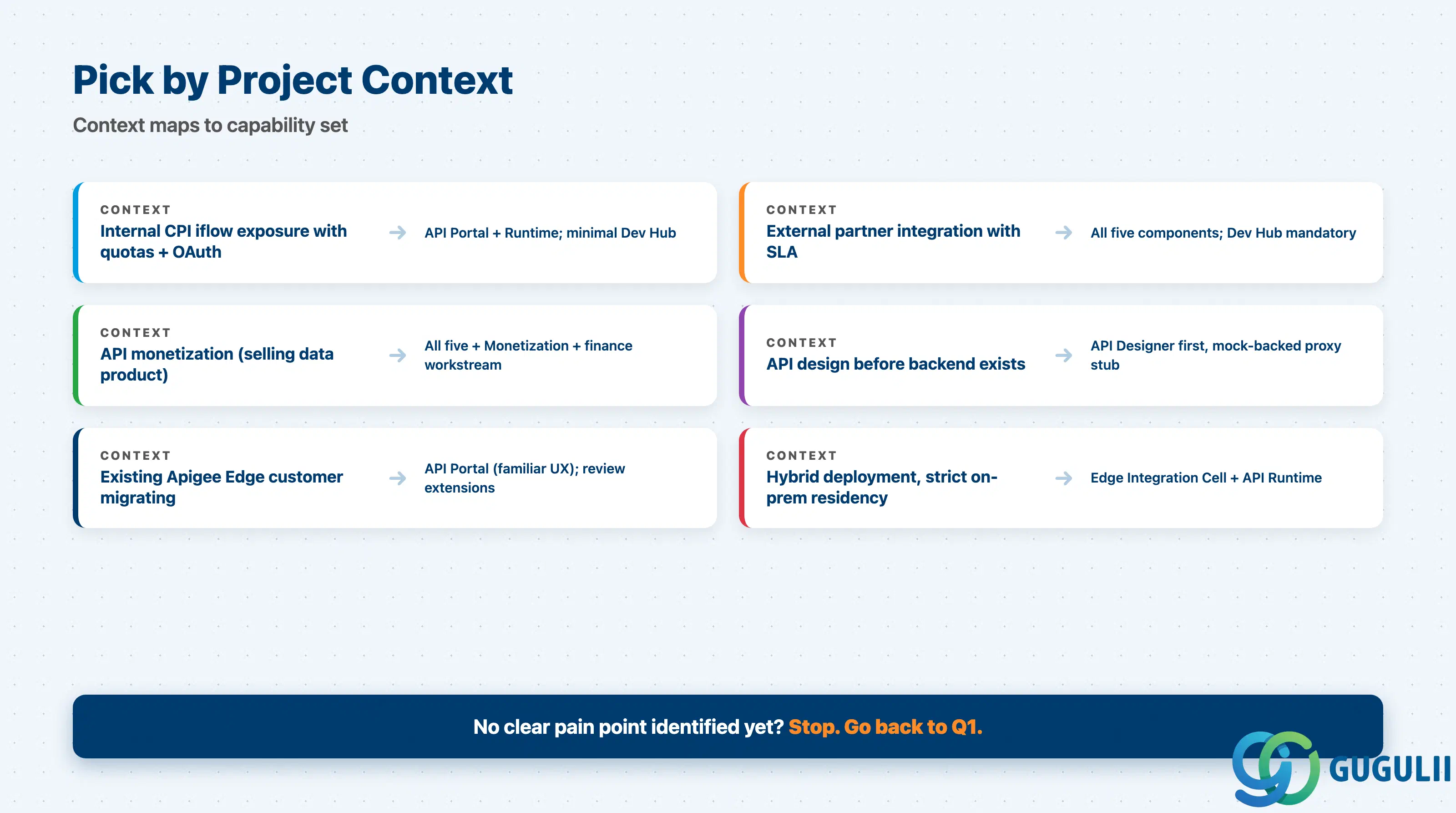
| Project context | Recommended starting capability |
|---|---|
| Internal team needs to expose CPI iflow with quotas and OAuth | API Portal + API Runtime; minimal Developer Hub config |
| External partner integration with documented SLA | All five sub-components; Developer Hub mandatory |
| API monetization (selling data product access) | All five + Monetization; finance integration as separate workstream |
| API design before backend exists | API Designer first, then proxy stub against mock backend |
| Existing Apigee Edge customer migrating to SAP-native gateway | API Portal (familiar UX); review Apigee-specific extensions for parity gaps |
| Hybrid deployment with strict on-prem residency | Edge Integration Cell + API Runtime; cloud-only is not a fit |
| No clear pain point identified yet | Stop. Go back to Q1. |
| Sub-component | Licensing model | Key question to ask |
|---|---|---|
| API Portal / Runtime / Developer Hub | Bundled in Integration Suite Standard or Premium; consumption-based by API call count | What is the year-2 call volume, and which tier covers it without overage? |
| API Designer / Analytics | Bundled in the same tier | Cost rolls up with the tenant. |
| Monetization | Bundled in API Management capability | Is finance integration scoped as a separate workstream with its own owner? |
| Edge Integration Cell | Optional extension; customer-managed Kubernetes cost is separate | Sized the cluster (nodes, CPU, memory) and budgeted ops skill? |
| On-premise edition | Separate license track | New project? Default to cloud unless residency forces otherwise. |
List prices are not published. Pricing is by quote and depends on tier, region, and call volume — plan procurement before architecture commits.
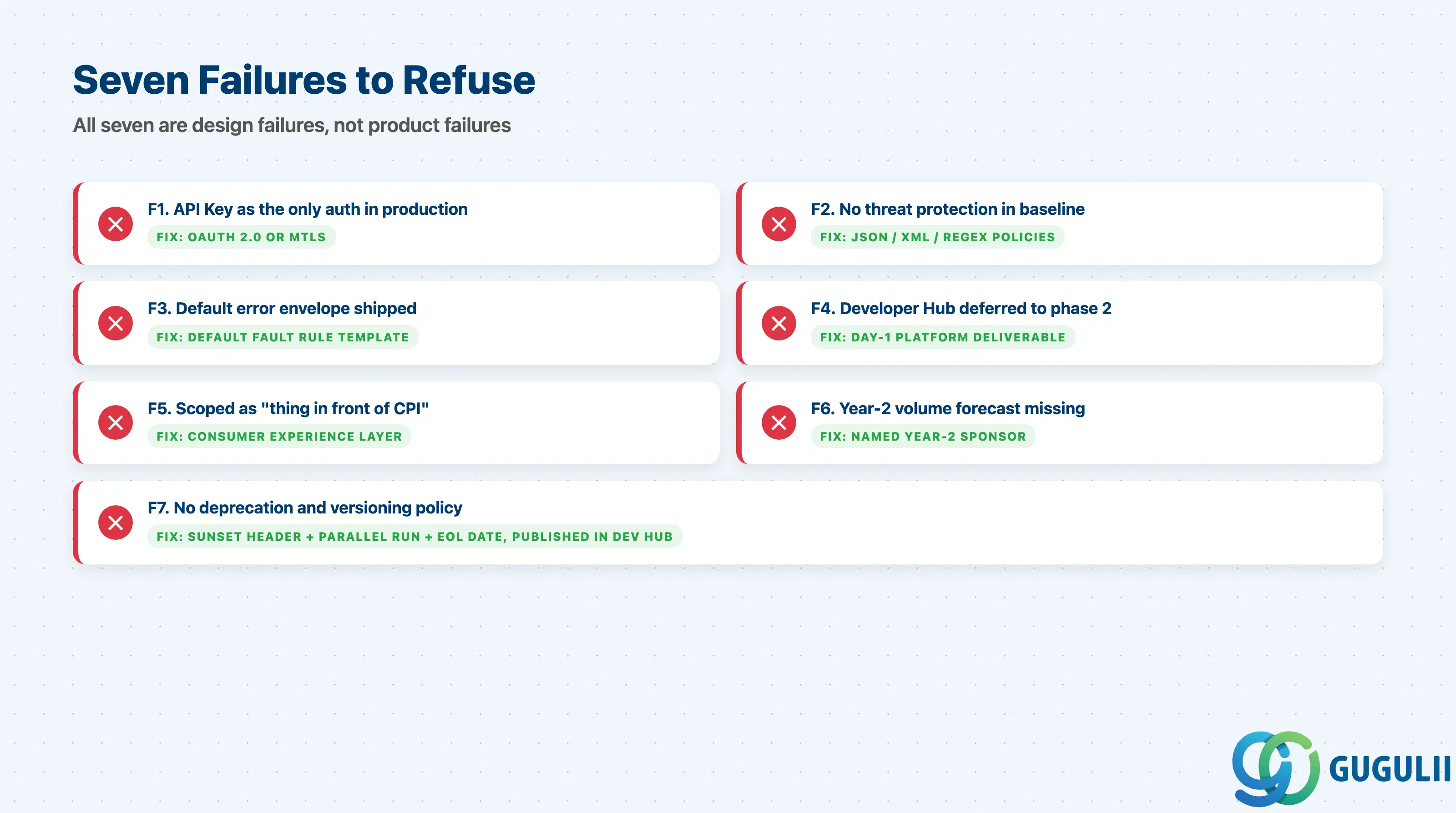
Failure 1: API Key as the only authentication in production
API Key is documented as a prototype mechanism. Production proxies should use OAuth 2.0 (internal/B2C) or mutual TLS (B2B/partner). This is the most common security finding — detected at the first penetration test.
Failure 2: No threat protection policies in the baseline template
JSON Threat Protection, XML Threat Protection, and Regular Expression Protection are not on by default. Without them, payload-complexity attacks reach the backend and exhaust memory or CPU. The fix is template-level: every external-facing proxy starts from a baseline that includes them.
Failure 3: Default error envelope shipped to consumers
The default fault response does not match SAP API Guidelines and varies by which policy raised the fault. The fix is a Default Fault Rule plus a Raise Fault + Assign Message template that emits a standardized envelope. Without it, every API team improvises and the Developer Hub catalogue looks built by strangers.
Failure 4: Developer Hub treated as optional because the first APIs are internal
“We will set up the Developer Hub later” is a common scope cut. The cost is that the first external partner request becomes a re-architecture: IdP integration rushed, approval workflows invented under deadline. The Developer Hub belongs in the day-1 platform.
Failure 5: API Management scoped as “the thing in front of CPI”
This framing lets logic creep into the proxy via JavaScript or Service Callout, or causes API Management to be descoped because “CPI already does authentication” — missing that quotas, monetization, and public Developer Hub cannot be retrofitted onto an iflow URL. Reframe: API Management is the consumer experience layer for any API, whether CPI is behind it or not.
Failure 6: Year-two API call volume forecast missing
Adoption pulls volume up and tier overage rates are worse than negotiated. Year-1 volume as the budget is a year-2 outage waiting to happen.
Failure 7: No deprecation and versioning policy
Without a written deprecation contract — sunset HTTP header, parallel-run window, EOL date — consumers do not migrate, and the platform team carries old versions indefinitely. The contract must be platform-level and published in the Developer Hub.
Q: Does SAP API Management work with on-premise S/4HANA, or is it cloud-only?
Both. The tenant runs on SAP BTP Cloud Foundry, but the API Provider can point at an on-premise backend reachable through SAP Cloud Connector. The gateway is cloud, the backend can be on-prem — a “control plane in the cloud, data plane partly on-prem” trade that should be stated explicitly in the architecture decision.
Q: How is SAP API Management licensed in 2026, and where do customers overspend?
Bundled in Integration Suite (Standard or Premium) and metered primarily by API call count; list pricing is not published, so plan an account-team conversation. Two routine traps: year-2 call volume exceeding the tier ceiling (overage rates are worse than negotiated), and Edge Integration Cell clusters under-sized at procurement and expanded under load. Defence: year-2 forecast with a named sponsor, plus a six-month sizing review.
Q: When should we descope SAP API Management from a project?
When any of: no quantified pain maps to gateway concerns; APIs are entirely internal and an existing IdP gateway already handles authentication; volume is low enough that hand-managed credentials cost less than two years of tenant fees; or no governance owner has been named. “Not in this phase, re-evaluate at
Q: How do we document an API requirement so it survives delivery?
Write each API as a sextet: (1) audience, (2) auth pattern and credential lifecycle owner, (3) quota and Spike Arrest defaults, (4) SLA including deprecation contract, (5) analytics retention and overflow destination, (6) named API owner for the product lifetime. Without all six, the deprecation contract gets quietly dropped during build.
Q: SAP API Management vs Cloud Integration (CPI) — when does which apply?
CPI is the integration runtime (orchestration, mapping, message routing). API Management is the gateway (lifecycle, security, quotas, Developer Hub, monetization). “Expose an existing OData service with quotas and OAuth” → API Management alone. “Transform an XML order into IDoc and post to SAP” → CPI alone. “Expose that transformation as an authenticated, rate-limited API to a partner” → both, CPI first then API Management proxy on top.
Q: What about SAP API Policy v4/2026 — does it change how we use API Management?
Indirectly. The policy reinforces that only published APIs (listed in SAP Business Accelerator Hub or product docs) are sanctioned for consumption; internal/private APIs are out of scope. This elevates the Developer Hub role: every customer-exposed API has to be a deliberate, documented product. Run a one-time inventory of every active proxy against supported backends.
Q: Is the on-premise edition still a viable choice for new projects?
Generally no. SAP’s strategic line is cloud; on-premise is supported but not enhanced at the same pace, and Neo is sunset. Pick on-premise only when residency or latency forces the data plane into the customer network — and even then, prefer Edge Integration Cell as the hybrid path first.
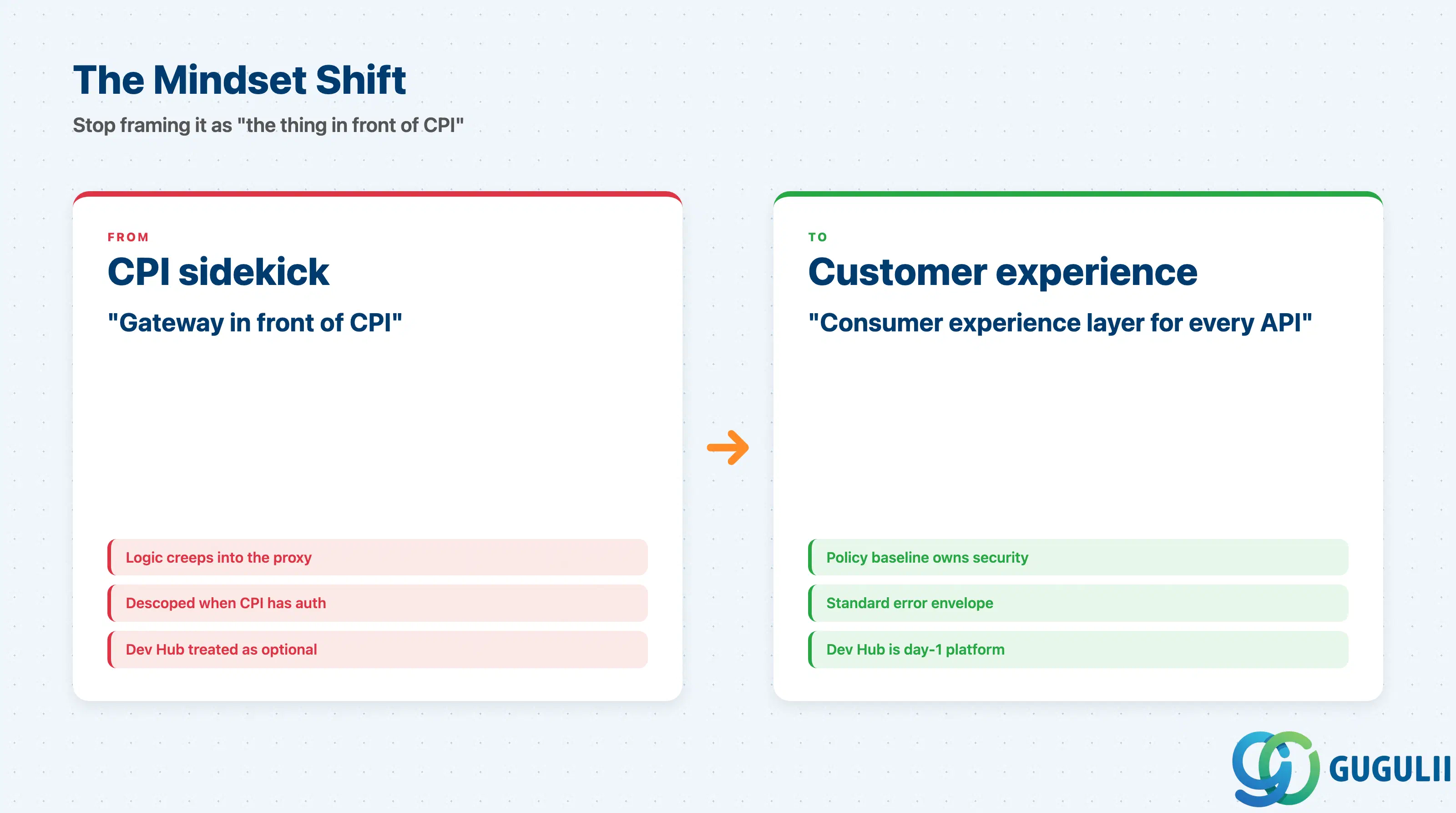
SAP API Management in 2026 is five sub-components plus monetization, all built on Apigee Edge, all production-ready. The product is mature; project failures are design failures: API Key in production, no threat protection in the baseline, default error envelopes, Developer Hub deferred, year-2 volume forecast missing. The consultant value is to scope around a policy baseline, a fault-rule template, a Developer Hub plan with IdP integration, and a year-2 sponsor — not around “do we need a gateway.” Refuse the framing of API Management as “the thing in front of CPI.” It is the consumer experience layer for every API the customer exposes.
| L1. Big Picture | L2. Functional Domains |
|---|---|
| BTP-001 What is BTP | L2-A. Integration — BTP-A01 Suite Overview |
| BTP-002 BTP Architecture | BTP-A02 Cloud Integration (CPI) |
| BTP-003 BTP Capability Map | BTP-A03 API Management (this article) |
| BTP-004 Deployment Models | BTP-A04 Event Mesh |
| BTP-005 Licensing Models | BTP-A05 Open Connectors |
| BTP-006 Clean Core Strategy | BTP-A06 B2B Integration (1): TPM |
| BTP-A07 B2B Integration (2): Integration Advisor | |
| BTP-A08 Integration Suite: Use Cases and Patterns | |
| L2-B. Application Development & Automation | |
| L2-C. Data & Analytics | |
| L2-D. AI | |
| L2-E. Foundation Services | |
| L2-F. Architecture & Operations | |
| L2-G. Use Cases & Patterns |