Title here
Summary here

| ID | Title |
|---|---|
| BTP-A01 | SAP Integration Suite Overview |
| BTP-A02 | Cloud Integration (CPI): Architecture and Use |
| BTP-A03 | API Management: Architecture and Use |
| BTP-A04 | Event Mesh: Architecture and Use (this article) |
| BTP-A05 | Open Connectors: Architecture and Use |
| BTP-A06 | B2B Integration (1): Trading Partner Management |
| BTP-A07 | B2B Integration (2): Integration Advisor |
| BTP-A08 | Integration Suite: Use Cases and Decision Patterns |
| Resource | URL |
|---|---|
| What Is SAP Event Mesh | help.sap.com → |
| SAP Event Mesh Default Plan Technical Constraints | help.sap.com → |
| Scope of Event Mesh (Integration Suite) | help.sap.com → |
| What Is PubSub Cloud (Advanced Event Mesh) | help.sap.com → |
| Designing Event-Driven Applications (SAP Architecture Center) | sap.com → |
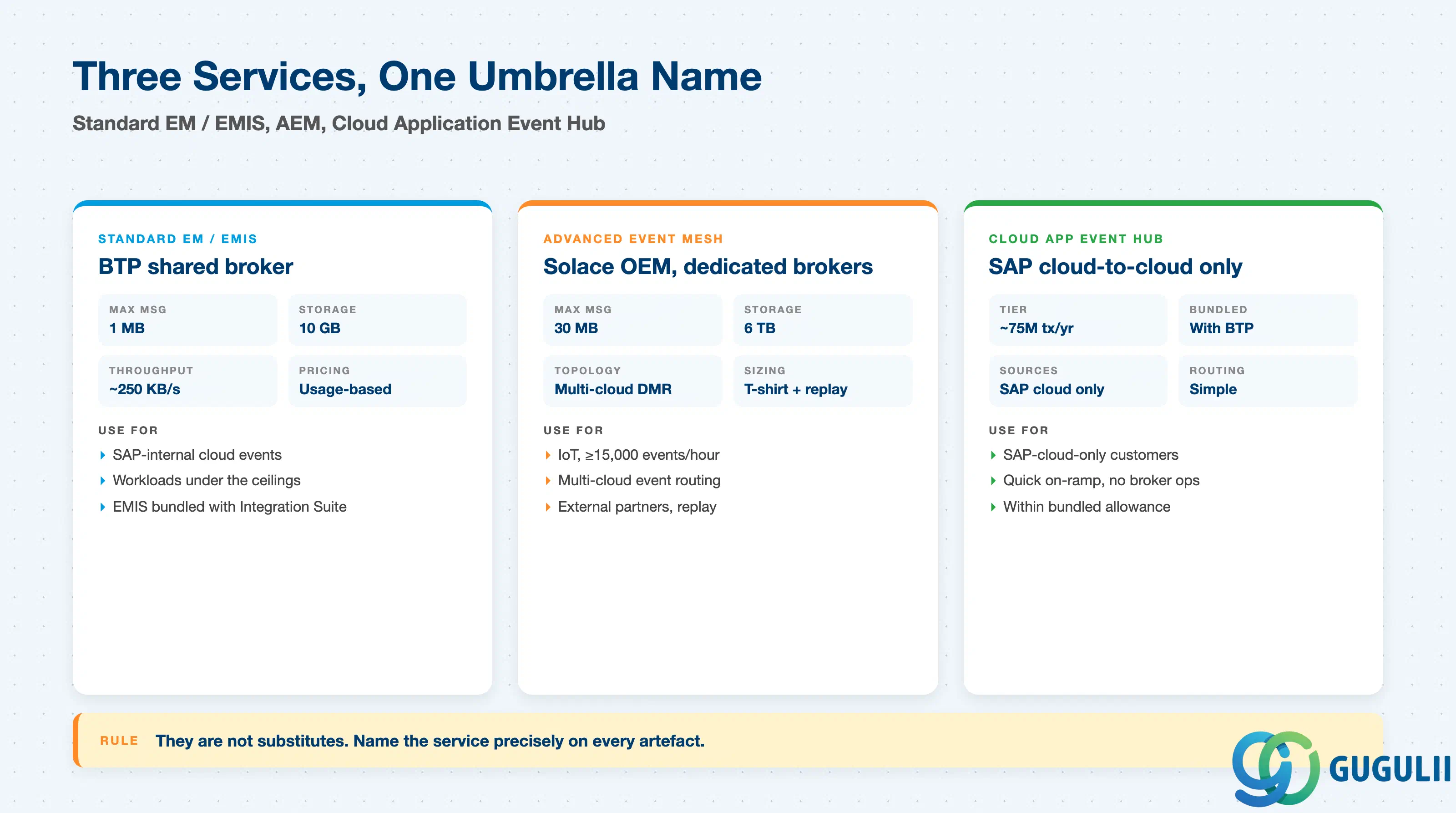
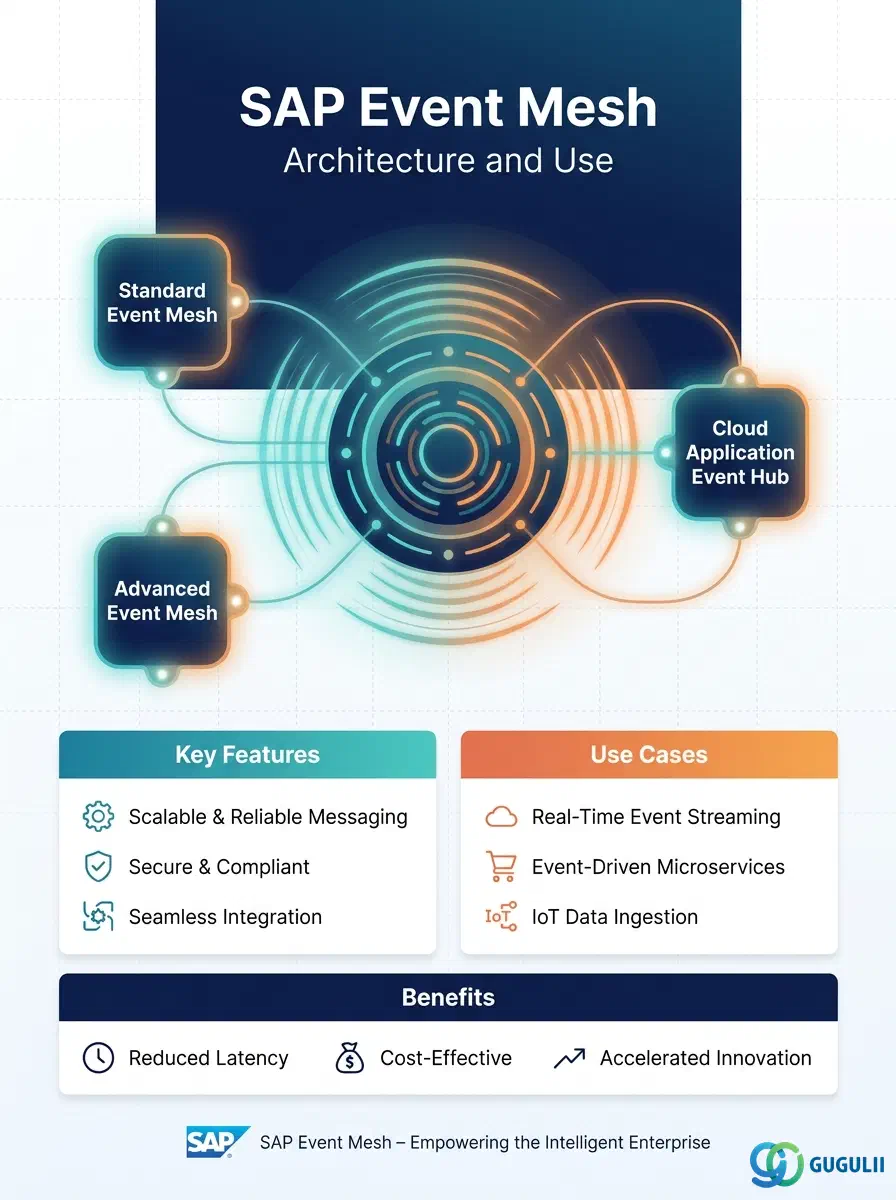
SAP groups three distinct eventing services under the loose umbrella term “Event Mesh.” On a real project they have to be named precisely or the contract conversation goes sideways. Standard Event Mesh — the original “Enterprise Messaging” — is a shared, BTP-only broker. Advanced Event Mesh is OEM’d from Solace PubSub+ and runs as dedicated brokers inside or outside BTP. Cloud Application Event Hub is the newest service and is bundled with BTP licenses for cloud-to-cloud SAP-to-SAP scenarios. The Integration Suite “Event Mesh capability” (EMIS) is a packaging variant of Standard Event Mesh that is included with Standard and Premium editions; it shares the same technical ceilings, not a separate runtime.
| Service | What it does | Primary user |
|---|---|---|
| Standard Event Mesh / EMIS | Shared broker on BTP for SAP-internal pub/sub at moderate volume | Integration developer |
| Advanced Event Mesh (AEM) | Distributed multi-broker across cloud, on-prem, edge with replay and governance | Event-driven architect |
| Cloud Application Event Hub | SAP cloud-to-cloud event distribution included with BTP up to ~75M transactions/year | SAP cloud admin |
They are not substitutes.
                     SAP eventing portfolio (BTP and beyond)
   ┌──────────────────────────────────────────────────────────────────────┐
   │                                                                      │
   │   Cloud Application Event Hub        Standard Event Mesh / EMIS      │
   │   (SAP cloud-to-cloud only)          (BTP shared broker, 1 MB cap)   │
   │            ▲                                  ▲                      │
   │            │                                  │                      │
   │            │ AMQP / MQTT / REST / Webhook ────┘                      │
   │            │                                                         │
   │   ┌────────┴────────────────┐         ┌─────────────────────────┐    │
   │   │ S/4HANA Cloud (events)  │         │ S/4HANA on-prem         │    │
   │   │ pre-built BAH catalogue │         │ via SAP Cloud Connector │    │
   │   └─────────────────────────┘         └─────────────────────────┘    │
   │                                                  │                   │
   └──────────────────────────────────────────────────┼───────────────────┘
                                                      │
                                                      ▼
                            Advanced Event Mesh (dedicated brokers,
                            on-prem / public cloud / private cloud / edge,
                            multi-cloud DMR, 30 MB / 6 TB, replay)
                                          ▲
                                          │
                                  ┌───────┴────────┐
                                  │ Non-SAP / IoT  │
                                  │ External B2B   │
                                  └────────────────┘
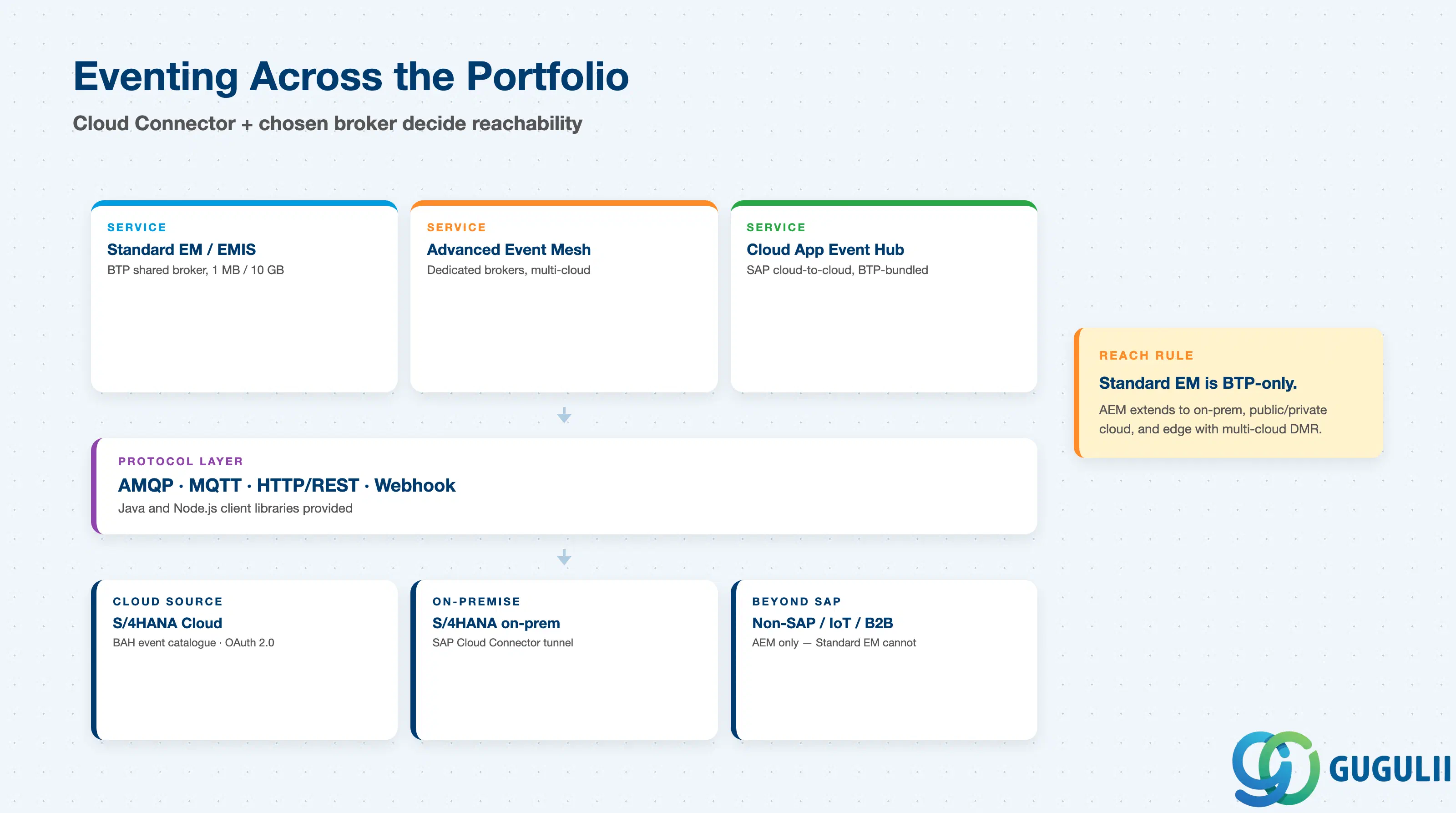
S/4HANA Cloud publishes a curated catalogue of business events on the SAP Business Accelerator Hub; on-premise S/4HANA can also publish events through the same eventing protocols, with SAP Cloud Connector providing the secure tunnel into BTP. Standard Event Mesh accepts those events using AMQP, MQTT, HTTP/REST, or webhook delivery. AEM extends the same surface but adds dedicated brokers that can sit outside BTP, with Dynamic Message Routing across cloud providers and event replay. Cloud Application Event Hub is reserved for SAP-to-SAP cloud applications and is therefore narrower than Standard EM, even though SAP positions it as the easier on-ramp.
Key point: Eventing is the protocol layer; Cloud Connector and the chosen broker decide whether your S/4HANA endpoint is reachable, not “Event Mesh” as a generic name.
| Service | Maturity | Notes |
|---|---|---|
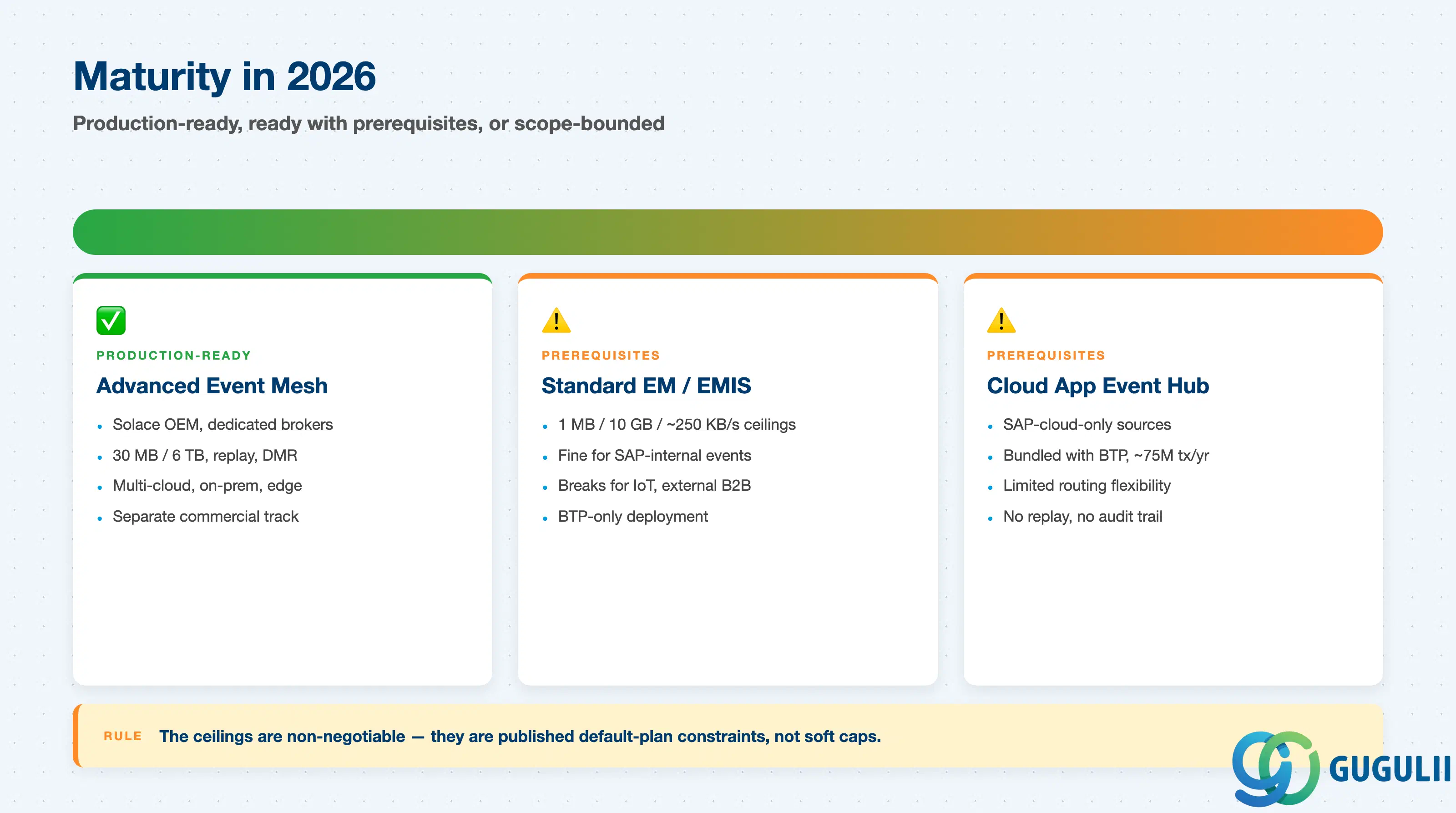
| Standard Event Mesh / EMIS | ⚠️ Ready with prerequisites | 1 MB message ceiling, 10 GB storage per subaccount, ~250 KB/s throughput. Production-ready for SAP-internal cloud event flows; not for IoT, external B2B, or multi-cloud. |
| Advanced Event Mesh (AEM) | ✅ Production-ready | OEM’d Solace PubSub+, dedicated brokers in T-shirt sizes, 30 MB / 6 TB, event replay, transactions, multi-cloud DMR. Separate commercial track from Integration Suite. |
| Cloud Application Event Hub | ⚠️ Ready with prerequisites | Included with BTP licenses up to ~75M transactions/year per most-cited summaries. Cloud-to-cloud SAP only; limited flexibility for complex routing. SAP-roadmap-positioned for SAP-centric cloud customers. |
The Standard EM ceilings are non-negotiable — they are the published default-plan constraints, not soft caps. AEM’s broker T-shirt sizing and Cloud Application Event Hub’s transaction allowance are the only headroom dials, and each lives on a different commercial track.
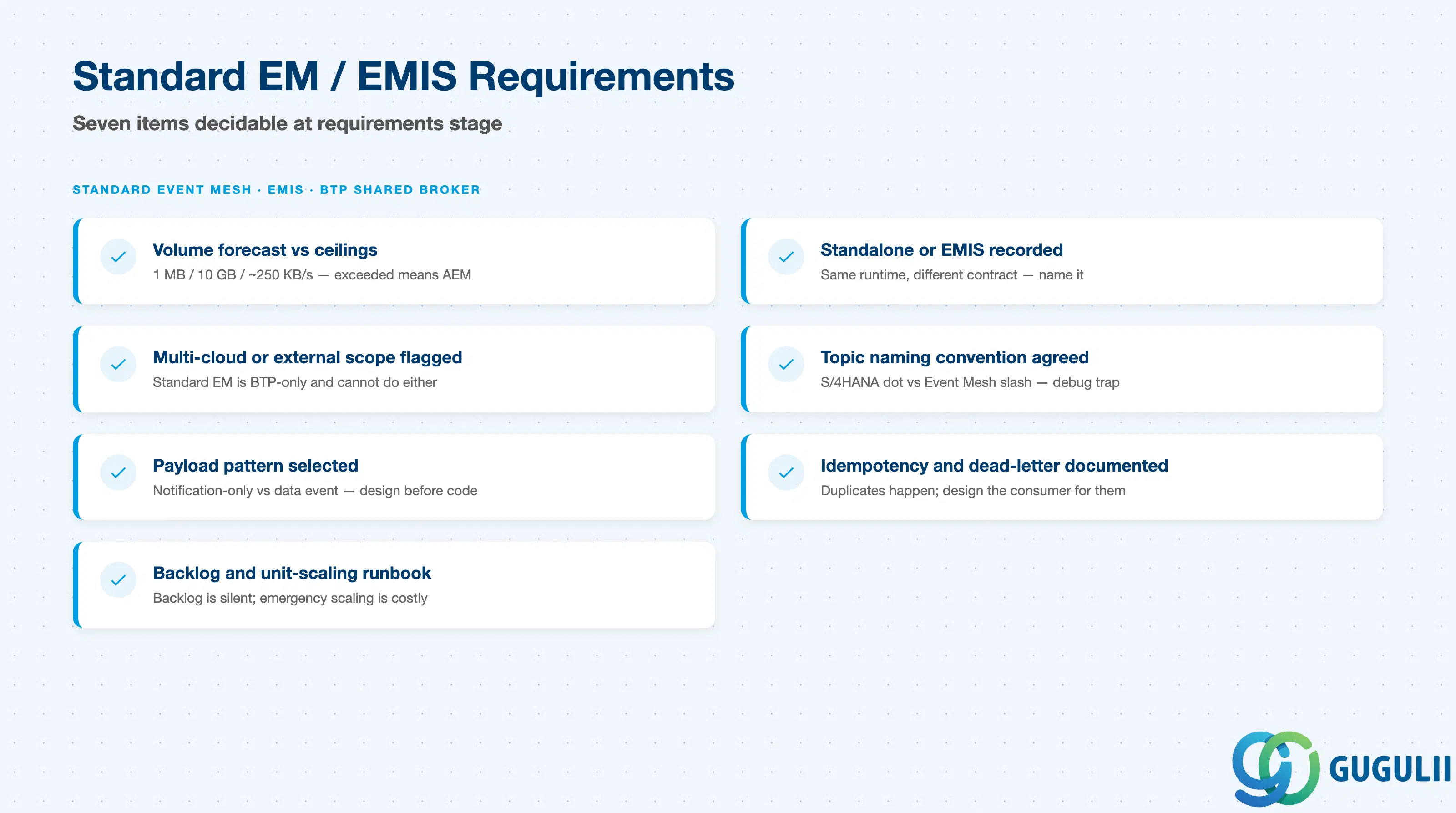
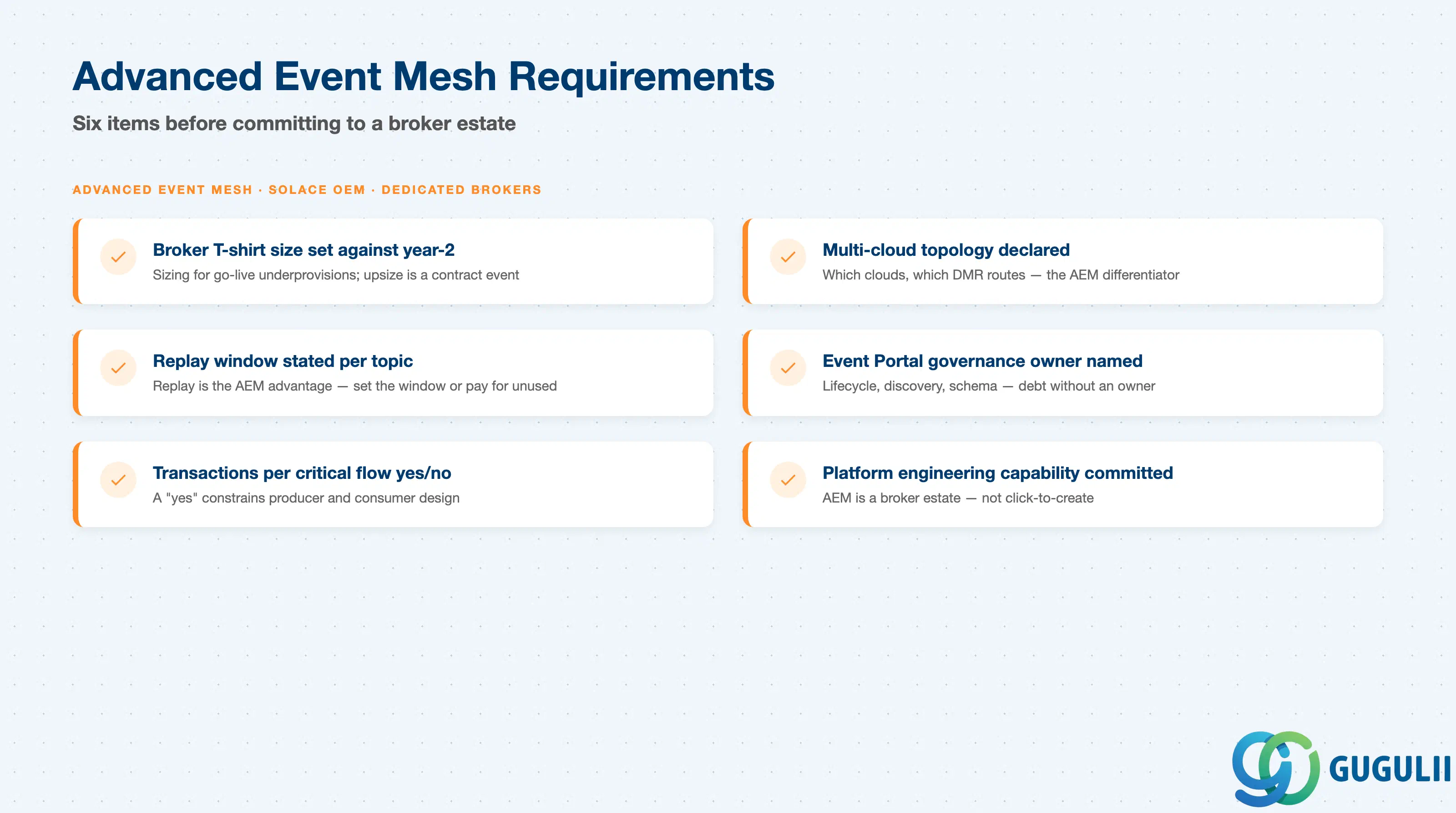
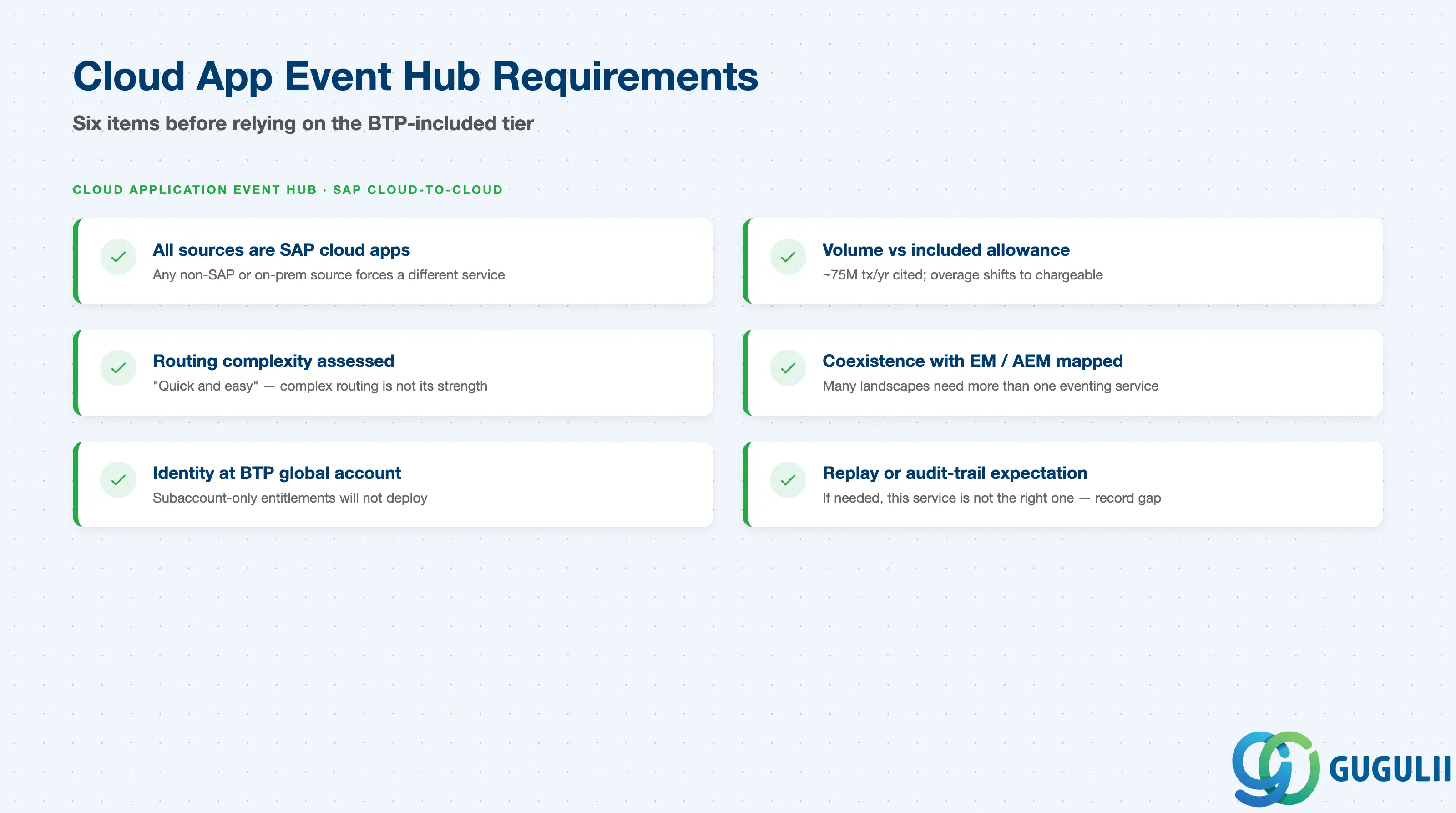
One sub-table per service in the eventing portfolio. Each row is decidable at requirements stage.
| Checklist item | Why it matters |
|---|---|
| Message size and rate forecast vs. 1 MB / 10 GB / ~250 KB/s ceilings | If forecast exceeds any ceiling, AEM is the answer — and the cost class shifts. |
| Decision recorded: standalone Event Mesh or EMIS within Integration Suite | Same runtime ceilings, different contract; ambiguity causes billing surprises. |
| Multi-cloud or external-partner scope flagged | Standard EM is BTP-only and cannot authenticate non-BTP partners; if either is in scope, this is the wrong service. |
| Topic and queue naming convention agreed across producers and consumers | S/4HANA displays topics in dot notation, Event Mesh uses slash notation; mismatched naming is a routine 2-hour debug trap. |
| Event payload pattern selected (notification-only vs. data event) | SAP standard events default to notification-only; consumers must call S/4HANA APIs for full data. Decide before consumer development starts. |
| Dead-letter and idempotency pattern documented per consumer | Duplicate events occur in practice; non-idempotent consumers corrupt downstream state silently. |
| Operational runbook for queue backlog and unit scaling | Backlog accumulates silently; without a runbook, emergency unit scaling becomes a Sev-1 ticket. |
| Checklist item | Why it matters |
|---|---|
| Broker T-shirt size sized against year-2 throughput | Sizing for go-live underprovisions year-2; broker upsize is a contract event. |
| Multi-cloud topology declared (which clouds, which DMR routes) | DMR is the AEM differentiator; an undeclared topology means the broker cost has no business case. |
| Event replay window and retention policy stated per topic | Replay is AEM’s differentiator over Standard EM; without a stated window, the feature is paid-for and unused. |
| Event Portal governance owner named (lifecycle, discovery, schema) | Event Portal is part of the AEM commercial bundle; without an owner, governance debt accumulates. |
| Transaction semantics required (yes/no) per critical flow | AEM supports event transactions; a “yes” for a flow imposes design constraints on producers and consumers. |
| Dedicated platform engineering capability committed | AEM is a distributed broker estate, not a click-to-create service; without engineering ownership, operations break. |
| Checklist item | Why it matters |
|---|---|
| All event sources confirmed as SAP cloud applications | Cloud Application Event Hub is SAP-cloud-only; any non-SAP or on-prem source forces a different service. |
| Transaction volume forecast against the included allowance | The included tier covers a finite number of transactions per year; overage shifts to chargeable consumption. |
| Routing complexity assessed against the service’s known limits | Cloud Application Event Hub is “quick and easy” by design; complex routing is not its strength. |
| Coexistence with Standard EM or AEM mapped | Many landscapes need more than one eventing service; document which events flow through which service. |
| Identity and entitlement model aligned with BTP global account | Activation lives in the BTP global-account scope; subaccount-only entitlements will not deploy. |
| Replay or audit-trail expectation captured | If replay or long retention is needed, this service is not the right one — record the gap explicitly. |
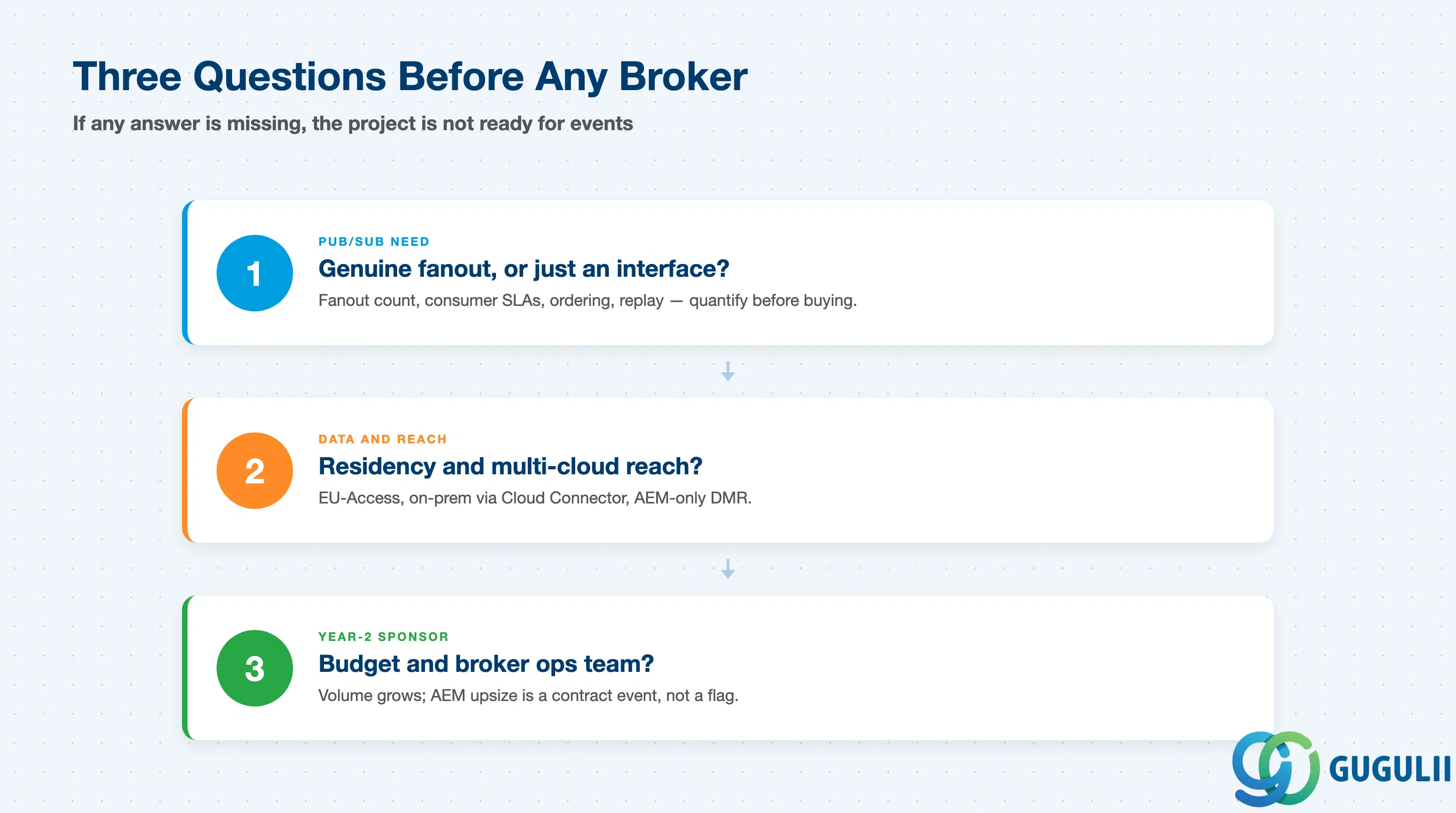
Q1. Is there a measurable integration pain that genuinely needs pub/sub fanout, not just an iPaaS interface?
Brokers earn their cost when the same event must reach multiple consumers, when consumers vary in availability, when ordering or replay is required, or when the volume profile is too spiky for synchronous integration. If the only requirement is point-to-point with transformation, Cloud Integration alone is the right answer and Event Mesh is over-engineering. Quantify the fanout fan-out, the volume profile, and the consumer SLAs before committing to a broker.
Q2. Where does the data live, who owns it, and which residency rule applies?
Standard Event Mesh runs on SAP BTP Cloud Foundry only; multi-cloud DMR is an AEM-only capability. EU-Access contracts forbid the Cloud Foundry environment outside EU operators. On-prem S/4HANA reachability requires Cloud Connector. Cloud Application Event Hub is SAP-cloud-only and silently excludes non-SAP sources. Walking into a steering committee without these answers is how event-driven scope gets paused at week eight.
Q3. Is there an internal sponsor with budget authority for year-two consumption and an ops team for the broker estate?
Event volume grows faster than estimated post go-live, and AEM in particular requires platform-engineering capability beyond click-to-create. The sponsor must own year-two consumption, and a named operations team must own broker health, queue depth, and replay-window lifecycle.
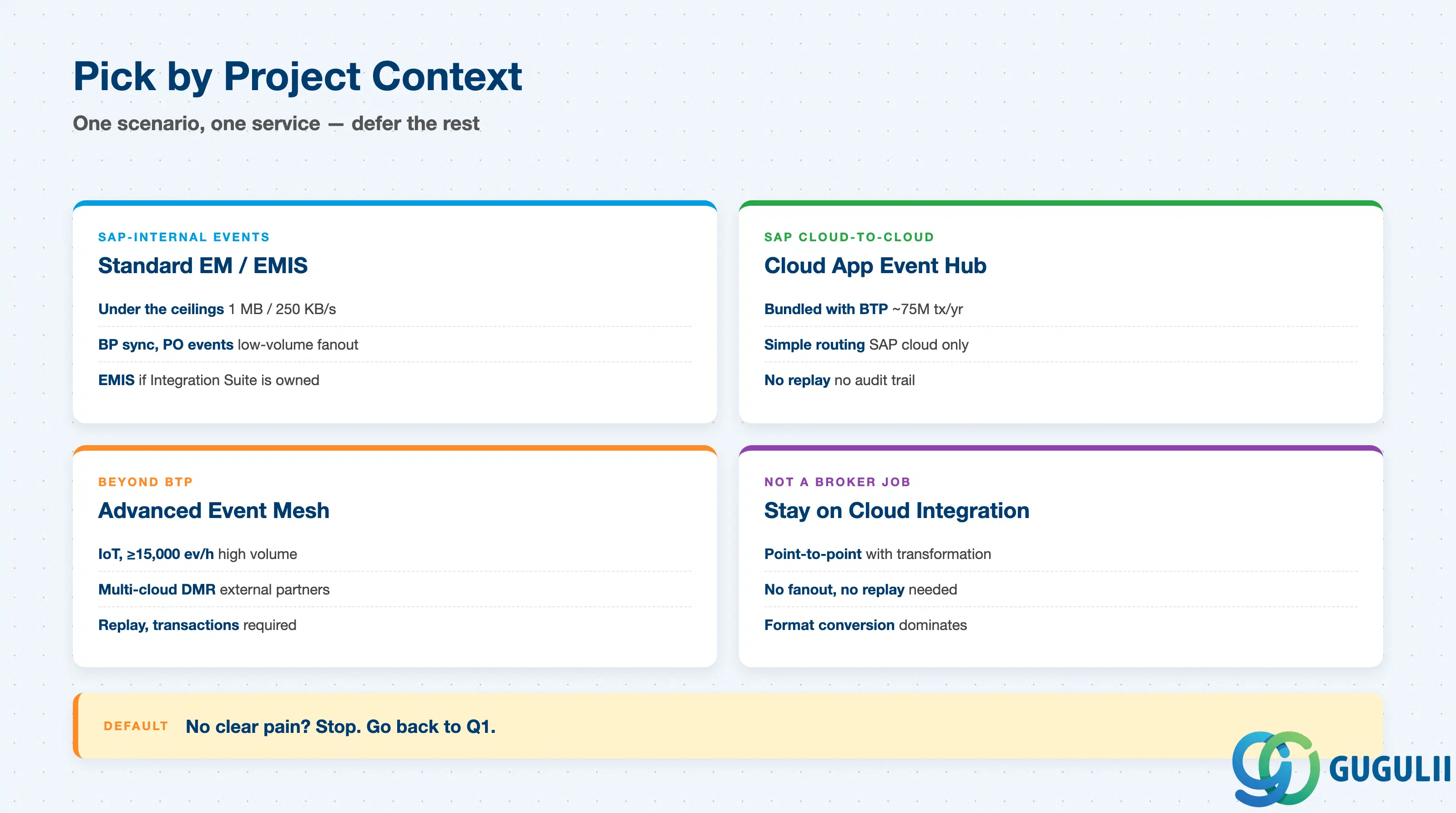
| Project context | Recommended starting service |
|---|---|
| SAP-internal cloud event flows under 1 MB / ~250 KB/s (BP sync, PO events) | Standard Event Mesh / EMIS |
| Same as above but the customer already owns Integration Suite Standard or Premium | EMIS (no separate license) |
| SAP-cloud-to-SAP-cloud event distribution, simple routing, BTP-included pricing acceptable | Cloud Application Event Hub |
| IoT, telemetry, sensor data, ≥15,000 events/hour | Advanced Event Mesh |
| External non-BTP partners as event consumers or publishers | Advanced Event Mesh |
| Multi-cloud routing (SAP + AWS + Azure events stitched together) | Advanced Event Mesh (DMR) |
| Event replay, transactions, or ordered streams required | Advanced Event Mesh |
| Point-to-point with transformation only, no fanout, no replay | Stay on Cloud Integration; do not buy a broker |
| No clear pain point identified yet | Stop. Go back to Q1. |
| Service | Licensing model | Key question to ask |
|---|---|---|
| Standard Event Mesh (standalone) | Subscription or consumption via CPEA / BTPEA / PAYG; usage-based metering within the 1 MB / 10 GB / ~250 KB/s ceilings | Is the year-2 volume forecast still under all three ceilings? |
| EMIS (Integration Suite-embedded) | Included in Integration Suite Standard and Premium; metered through the same Integration Suite contract | Does the customer’s Integration Suite edition already cover the eventing scope? |
| Advanced Event Mesh | Broker-based (T-shirt size); separate commercial track from Integration Suite | Has the broker size been validated against year-2 throughput, not go-live? |
| Cloud Application Event Hub | Bundled with BTP licenses up to a transaction allowance (most-cited at ~75M/year); overage is chargeable | What is the realistic year-2 transaction count, and where does it land vs. the included allowance? |
The Free Tier offers one Integration Suite tenant per CPEA / PAYG / PAYG-TDD Global Account with Standard Edition functionality, valid for 90 days as a trial. Standard EM list pricing is not published — assume an account-team conversation. Real-world consulting cases describe emergency Standard EM unit scaling reaching low-thousands-per-month within days when the volume profile was misjudged; size against year-two volume from the outset.
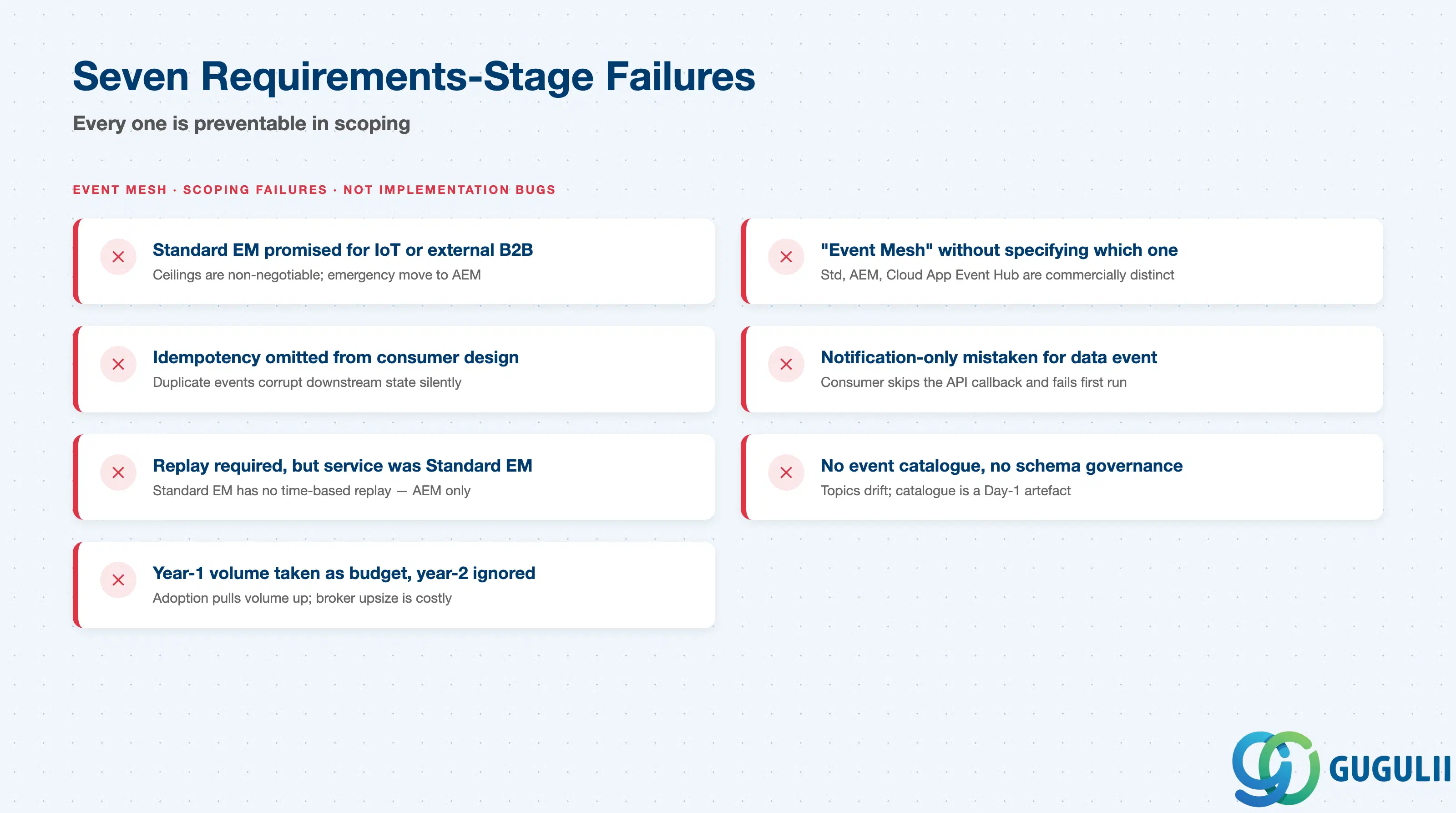
These are requirements-stage failures, not implementation bugs — every one is preventable in scoping.
Failure 1: Standard Event Mesh promised for IoT or external B2B
The 1 MB hard message limit and ~250 KB/s practical throughput per subaccount are non-negotiable. Promising Standard EM for IoT volumes (10–100× business-event volumes) or for non-BTP partners (which Standard EM cannot authenticate natively) forces an emergency move to AEM mid-project, with a separate commercial track and broker sizing. Do the volume math in week one.
Failure 2: “Event Mesh” written in the contract without specifying which one
Steering decks and SOWs frequently say “Event Mesh” as if it were a single product. Standard EM and AEM are commercially distinct, and Cloud Application Event Hub is a third service entirely. Ambiguity at contract stage produces a contract surprise at deployment. Name the service precisely on every artefact.
Failure 3: Idempotency omitted from consumer design
Duplicate events occur in practice — through retries, restarts, and at-least-once delivery semantics. Non-idempotent consumers corrupt downstream state silently. Webhook handlers and AMQP consumers must be designed to process the same event twice without side effects, and the design pattern must be documented before development starts.
Failure 4: Notification-only payload mistaken for a data event
SAP standard events default to notification-only — they carry a key (e.g., Business Partner number), not the full record. Consumers that assume a data event and skip the S/4HANA API callback fail at first run. The payload pattern must be stated per topic and validated against the SAP Business Accelerator Hub catalogue before consumer development.
Failure 5: Replay required, but the service was Standard EM
Standard Event Mesh has no time-based replay — once a topic message has no buffering subscriber, it is gone. Queue persistence is not the same feature. Projects that scope replay onto Standard EM discover the gap during incident recovery rehearsal. If replay is required, the service is AEM, full stop.
Failure 6: No event catalogue, no schema governance
Topics proliferate, schemas drift, and the consumer team has no reliable inventory. Event Mesh does not enforce a catalogue; AEM’s Event Portal does, but only when an owner is named. Without a Day-1 catalogue artefact, the project ships an undocumented integration surface and pays for it during change requests.
Failure 7: Year-one event volume taken as the budget; year-two ignored
Adoption pulls volume up; broker upsize and Standard EM unit scaling are commercial events with their own approval cycles. A sponsor who signs off on year-one consumption only is the wrong sponsor — particularly for AEM, where T-shirt size changes are not free.
Q: Does Event Mesh work with on-premise S/4HANA, or is it cloud-only?
It works with both, with a caveat. Standard Event Mesh runs on SAP BTP Cloud Foundry only, but on-premise S/4HANA can publish events to it through the eventing protocols once SAP Cloud Connector provides the secure tunnel. Advanced Event Mesh is the option that physically deploys outside BTP — on-prem, public cloud, private cloud, and edge. Cloud Application Event Hub is SAP-cloud-only by design. So the question for a hybrid landscape is which service, not whether Event Mesh applies.
Q: How is Event Mesh licensed, and where do customers usually overspend?
Three commercial models exist. Standard Event Mesh is licensed via subscription or consumption (CPEA / BTPEA / PAYG) — usage-based metering within the 1 MB / 10 GB / ~250 KB/s ceilings. EMIS is included with Integration Suite Standard and Premium editions, so customers who already own Integration Suite avoid a separate Standard EM line item. AEM is broker-based (T-shirt size) and runs on a separate commercial track. Cloud Application Event Hub is bundled with BTP up to a transaction allowance most often cited at around 75 million per year, with overage chargeable. The recurring overspend traps are misjudging year-two volume on Standard EM, undersizing AEM brokers for go-live, and exceeding the included allowance on Cloud Application Event Hub without anyone watching the meter.
Q: When should we descope Event Mesh from a project?
When any of the following is true: there is no genuine pub/sub fanout requirement (one consumer + transformation = use Cloud Integration); volume forecasts exceed Standard EM ceilings and AEM is out of budget (do not promise Standard EM and hope); the data residency rule conflicts with Cloud Foundry deployment and AEM’s edge option is not in scope; replay is required and Standard EM was the proposed service; or the customer cannot name a broker operations team. Saying “events not in this phase, plan re-evaluation in six months” is a deliverable, not a regression.
Q: How do we document an Event Mesh requirement so it survives delivery?
Write each event flow as a sextet: (1) the producer system and event topic name (with the dot-vs-slash naming canonicalised), (2) the payload pattern (notification-only or data event) and why, (3) the consumer list with idempotency design, (4) the volume forecast in events per second for year-1 and year-2, (5) the dead-letter, retry, and alerting pattern with owner, and (6) the replay window and retention policy. Without all six, the requirement gets shaped during build — usually by the consumer team discovering the gap mid-sprint.
Q: Standard Event Mesh vs Advanced Event Mesh — how do we decide, and is the difference real?
The difference is real and architectural. Standard EM is a shared broker on BTP, capped at 1 MB messages, ~250 KB/s throughput per subaccount, and 10 GB storage. It has no time-based replay and cannot route across cloud providers. AEM is OEM’d from Solace PubSub+, runs as dedicated brokers in T-shirt sizes, supports 30 MB messages, 6 TB storage, event replay, transactions, and Dynamic Message Routing across cloud providers. The decision rule: Standard EM for SAP-internal cloud event flows under the ceilings; AEM for IoT, ≥15,000 events/hour, multi-cloud, or external partners. Mixing both is acceptable.
Q: What is Cloud Application Event Hub, and is it included for free?
Cloud Application Event Hub is the newest SAP eventing service, formerly named “SAP Event Broker for SAP Cloud Applications.” It is positioned for SAP cloud-to-cloud event distribution and is bundled with BTP licenses up to a transaction allowance most often cited at around 75 million per year. “Free” is the right intuition for SAP-centric cloud customers within the allowance, but the service is narrower than Standard EM — limited routing flexibility, SAP-cloud-only sources, no replay — so it does not replace Standard EM or AEM for hybrid or non-SAP scenarios.
Q: Do we need a broker at all, or is Cloud Integration enough?
Use a broker when the requirement is genuine pub/sub fanout, when consumers vary in availability, when ordering or replay is needed, or when volume is too spiky for synchronous integration. Use Cloud Integration alone when the requirement is point-to-point with transformation, or when format/structure conversion dominates. The two are complementary, not competing — a common production pattern is Standard EM (for fanout and decoupling) plus Cloud Integration (for enrichment, mapping, and adapter reach). If neither requirement is documented, do not buy a broker.
Eventing on SAP BTP is best read as a portfolio of three services with one packaging variant. Standard Event Mesh — and its EMIS variant inside Integration Suite — is the shared BTP broker for SAP-internal cloud event flows under hard ceilings of 1 MB, 10 GB, and ~250 KB/s. Advanced Event Mesh is the OEM’d Solace dedicated-broker estate for IoT, multi-cloud, replay, transactions, and external partners; it is a separate commercial track and demands platform-engineering ownership. Cloud Application Event Hub is the BTP-bundled SAP-cloud-to-SAP-cloud option for customers who want eventing without a broker discussion. The consultant’s job is to refuse “Event Mesh” as a single product, name the service precisely, size against year-two volume, and decline pub/sub when an iPaaS interface alone would do.