Title here
Summary here

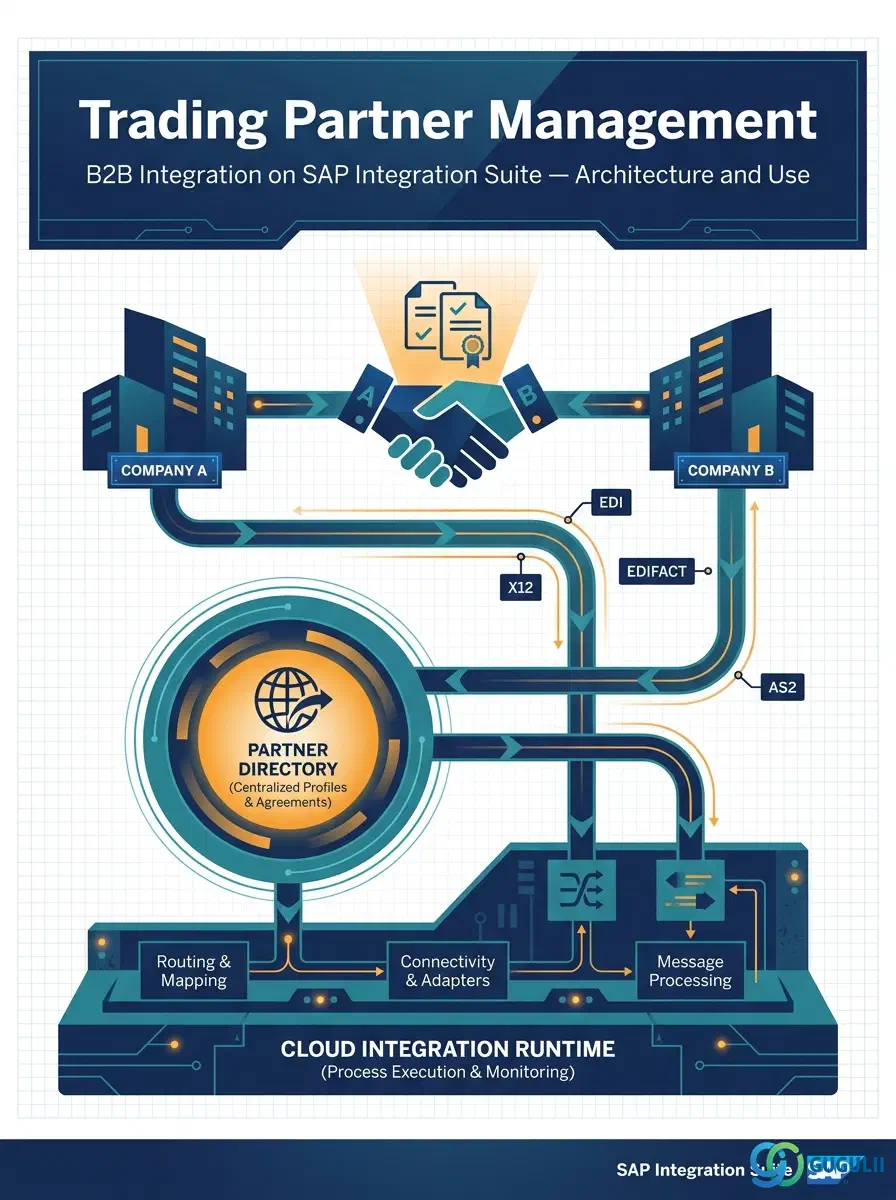
This is the first of two B2B installments inside the L2-A Integration series. A06 covers TPM (partners, agreements, runtime). A07 covers Integration Advisor (MIG/MAG, type systems, mapping guidelines). Both sit on top of Cloud Integration (A02) and report into the same monitoring stack. A08 ties the whole Integration Suite together as decision patterns.
| ID | Title |
|---|---|
| BTP-A01 | SAP Integration Suite Overview |
| BTP-A02 | Cloud Integration (CPI): Architecture and Use |
| BTP-A03 | API Management: Architecture and Use |
| BTP-A04 | Event Mesh: Architecture and Use |
| BTP-A05 | Open Connectors: Architecture and Use |
| BTP-A06 | B2B Integration (1): Trading Partner Management — Architecture and Use (this article) |
| BTP-A07 | B2B Integration (2): Integration Advisor |
| BTP-A08 | Integration Suite: Use Cases and Decision Patterns |
| Resource | URL |
|---|---|
| Trading Partner Management (SAP Help Portal) | help.sap.com → |
| Glossary for SAP Trading Partner Management (SAP Help Portal) | help.sap.com → |
| Trading Partner Agreement (SAP Help Portal) | help.sap.com → |
| Business to Business Integration — Reference Architecture (SAP Architecture Center) | sap.com → |
| SAP Integration Suite Pricing | sap.com → |
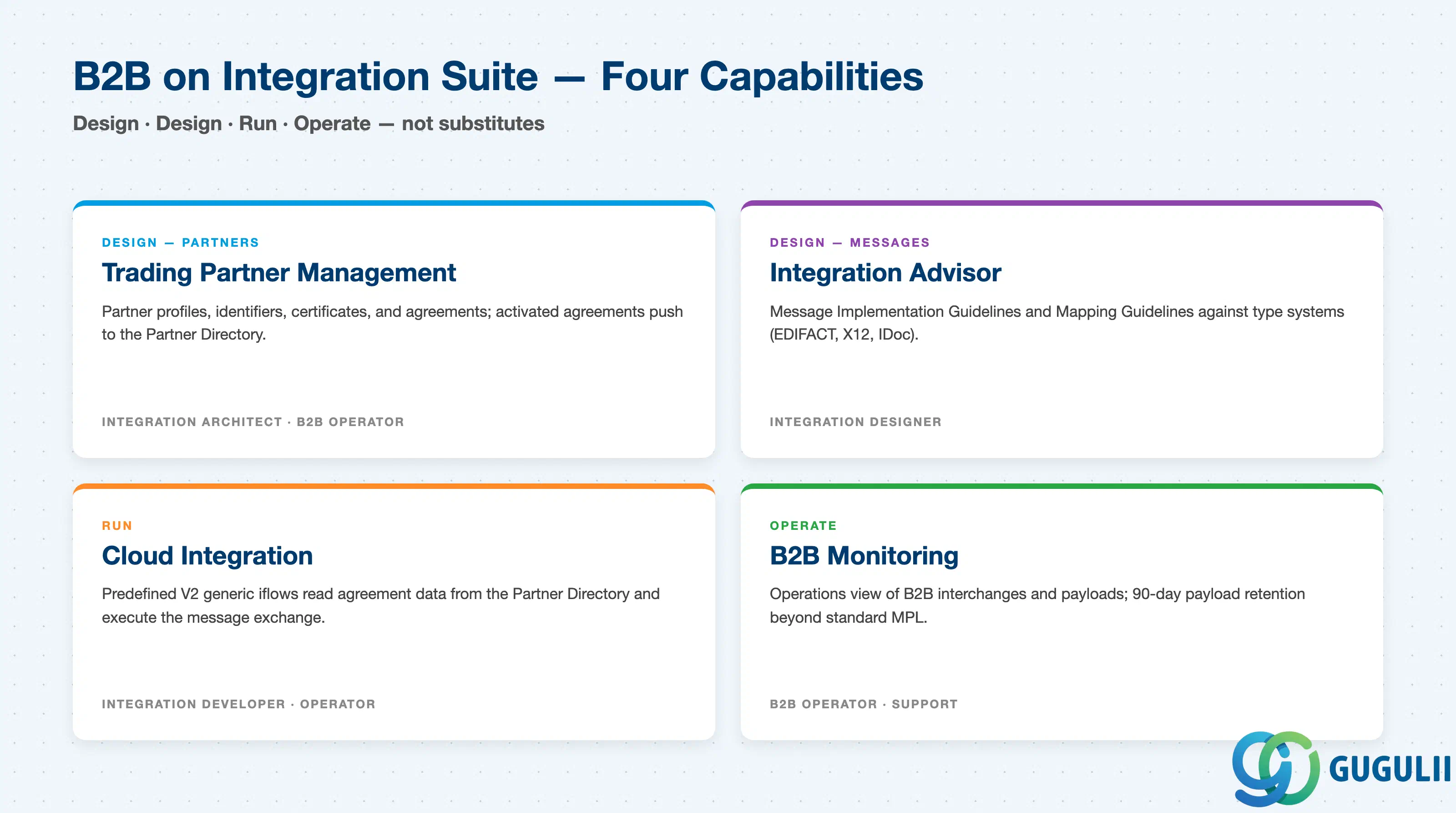
B2B integration on SAP Integration Suite is not a single feature. It is a stack: a design-time cockpit for partners and agreements, a design-time cockpit for message structure and mappings, a runtime that executes the actual exchange, and an operations view that watches it. Each piece is a separate capability with its own licensing, its own roles, and its own gaps.
| Capability | What it does | Primary user |
|---|---|---|
| Trading Partner Management (TPM) | Design-time cockpit for partner profiles, identifiers, communication channels, certificates, and agreements; activated agreements push to the Partner Directory | Integration architect, B2B operator |
| Integration Advisor (IA) | Designs Message Implementation Guidelines (MIGs) and Mapping Guidelines (MAGs) against industry type systems (EDIFACT, X12, etc.) | Integration designer |
| Cloud Integration (CI) | Runtime; predefined generic iflows read agreement data from the Partner Directory and execute the message exchange | Integration developer, operator |
| B2B Monitoring | Operations view of B2B interchanges and payloads; complements standard MPL with longer payload retention | B2B operator, support |
They are not substitutes.
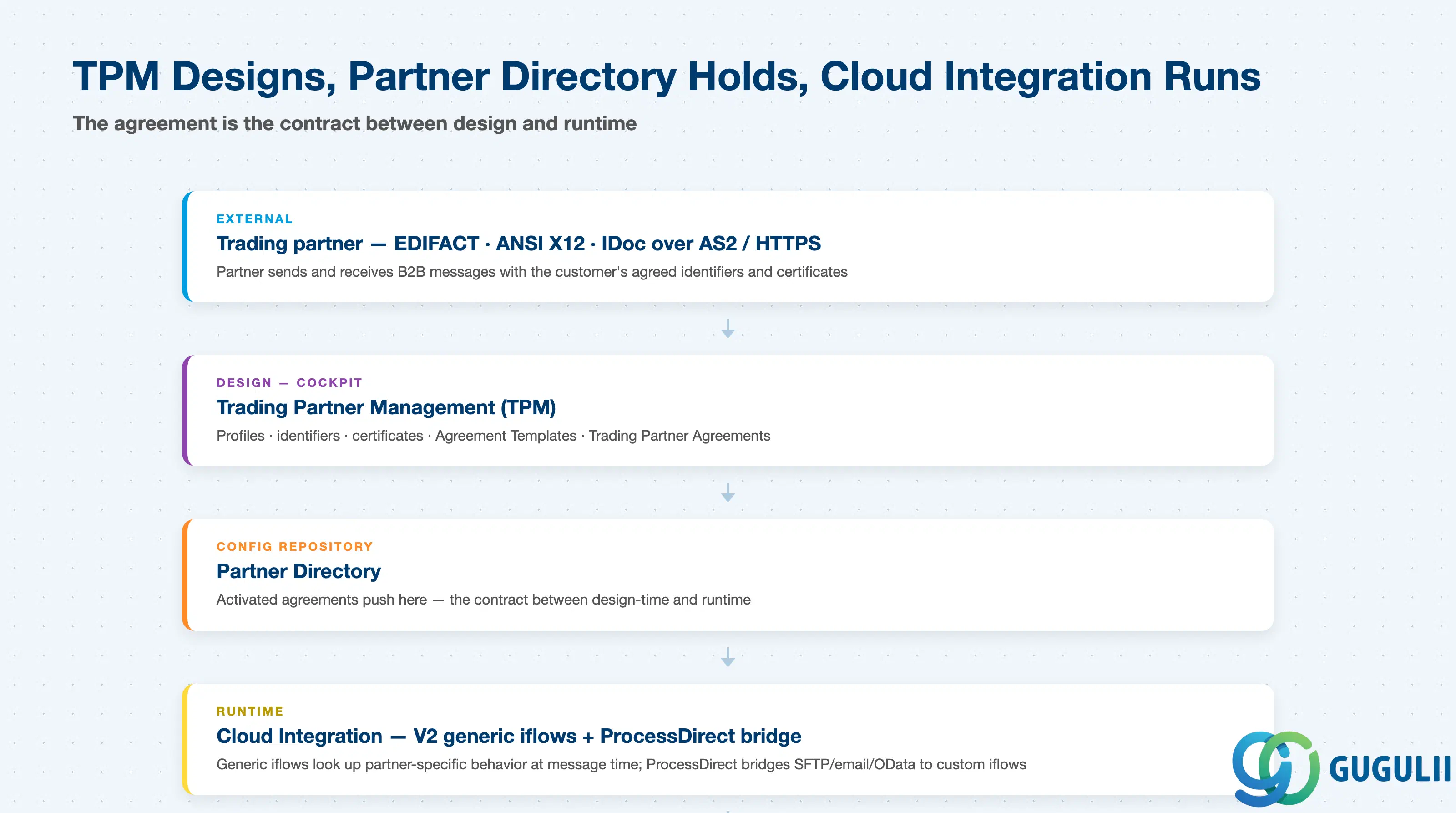
Every TPM-managed exchange is a triangle between an external trading partner, a runtime on Cloud Integration, and a system of record — usually S/4HANA but also Ariba, SuccessFactors, or a non-SAP backend. TPM itself does not move messages; it tells the runtime how to.
                       ┌─────────────────────────────┐
   External            │ External trading partner    │
   partner ──AS2/HTTPS►│   (EDIFACT / X12 / IDoc)    │
                       └──────────────┬──────────────┘
                                      ▼
                       ┌─────────────────────────────┐
                       │ SAP Integration Suite       │
                       │  ┌────────────────────────┐ │
                       │  │ TPM cockpit (design)   │ │
                       │  │  Partner / Agreement   │ │
                       │  └──────────┬─────────────┘ │
                       │             ▼ activate      │
                       │  ┌────────────────────────┐ │
                       │  │ Partner Directory      │ │
                       │  │  (config repository)   │ │
                       │  └──────────┬─────────────┘ │
                       │             ▼ runtime read  │
                       │  ┌────────────────────────┐ │
                       │  │ Cloud Integration      │ │
                       │  │  Generic TPM V2 iflows │ │
                       │  │  + ProcessDirect bridge│ │
                       │  └──────────┬─────────────┘ │
                       └─────────────┼───────────────┘
                                     ▼ IDoc / OData
                       ┌─────────────────────────────┐
                       │ System of record            │
                       │  • SAP S/4HANA (any edition)│
                       │  • SAP Ariba / S/4 backend  │
                       │  • Non-SAP ERP via adapter  │
                       └─────────────────────────────┘
The transactional posting always lives in the system of record. TPM never owns business state — it owns the agreement and the runtime mapping that gets each partner’s payload to the right backend in the right format. For SFTP, email, OData, or any transport not in TPM’s native receiver list, a ProcessDirect bridge to a custom iflow stitches in the missing channel without breaking the TPM-managed flow.
Key point: TPM is the agreement and identifier authority; Cloud Integration is the executor; the Partner Directory is the contract between them. Treating any one of those as a substitute for the others is the most common architectural mistake at design time.
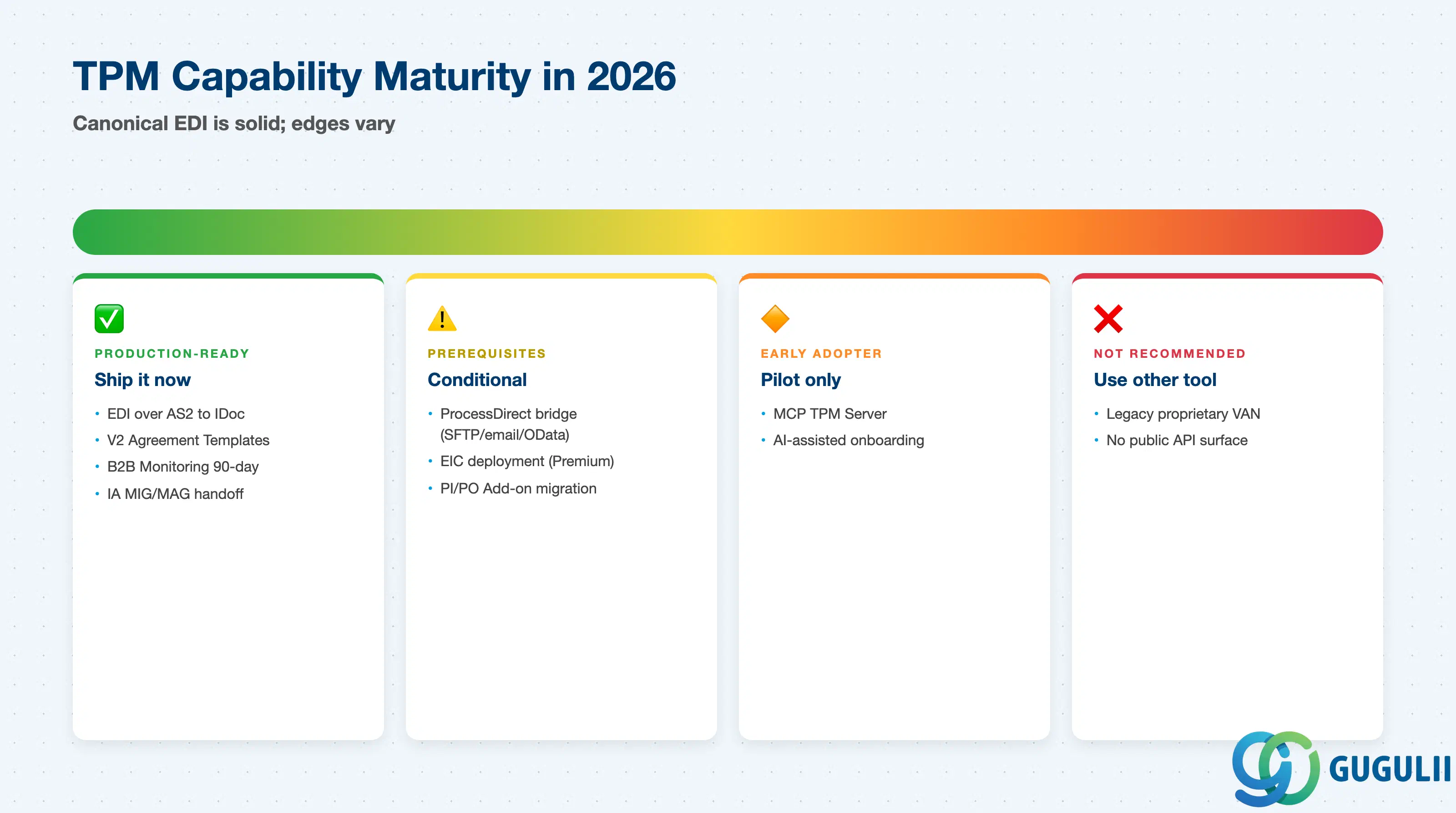
TPM’s maturity in 2026 is uneven. Canonical EDI-over-AS2 to S/4HANA via IDoc is the most production-ready path SAP ships. Edges — non-AS2 transports, AI-driven onboarding, PI/PO migration — vary from “ready with prerequisites” to “early adopter.”
| Capability | Maturity | Notes |
|---|---|---|
| EDIFACT / ANSI X12 over AS2 with IDoc backend | ✅ Production-ready | The canonical TPM pattern. Native receivers cover the whole flow. |
| TPM Agreement Templates (V2 content package) | ✅ Production-ready | Current major version on SAP Business Accelerator Hub; reusable templates instantiate per-partner. |
| B2B Monitoring view with 90-day payload retention | ✅ Production-ready | Operations counterpart to the design cockpit; longer retention than standard 30-day MPL. |
| Integration Advisor MIG/MAG handoff into TPM | ✅ Production-ready | The supported design path: model in IA, import into TPM as the contract for validation and mapping. |
| ProcessDirect bridge for SFTP / email / OData / custom HTTP | ⚠️ Ready with prerequisites | Supported since Nov 2023 as both Receiver and Sender; needs a custom iflow per non-native channel. |
| MCP Trading Partner Management Server (AI client access) | 🔶 Early adopter | New in 2025-2026; surfaces TPM operations to Joule and other MCP clients; scope and GA boundary not fully published. |
| Deployment to Edge Integration Cell (hybrid runtime) | ⚠️ Verify | EIC is included from Premium edition; whether all TPM-managed flows execute on EIC needs SAP confirmation per scenario. |
| Migration from SAP PI / PO B2B Add-on to TPM | ⚠️ Ready with prerequisites | Supported and SAP-published as a learning topic; not all PI/PO scenarios map 1:1 — needs a per-partner inventory. |
| Partners requiring transport not bridgeable via ProcessDirect | ❌ Not recommended via TPM | Some legacy partners need transports outside Integration Suite’s reach (e.g., proprietary VANs without API surface). Use a separate B2B gateway. |
§3 answers “is the capability ready?” §4 answers “are we ready?” Build one checklist per topic into every B2B scoping document.
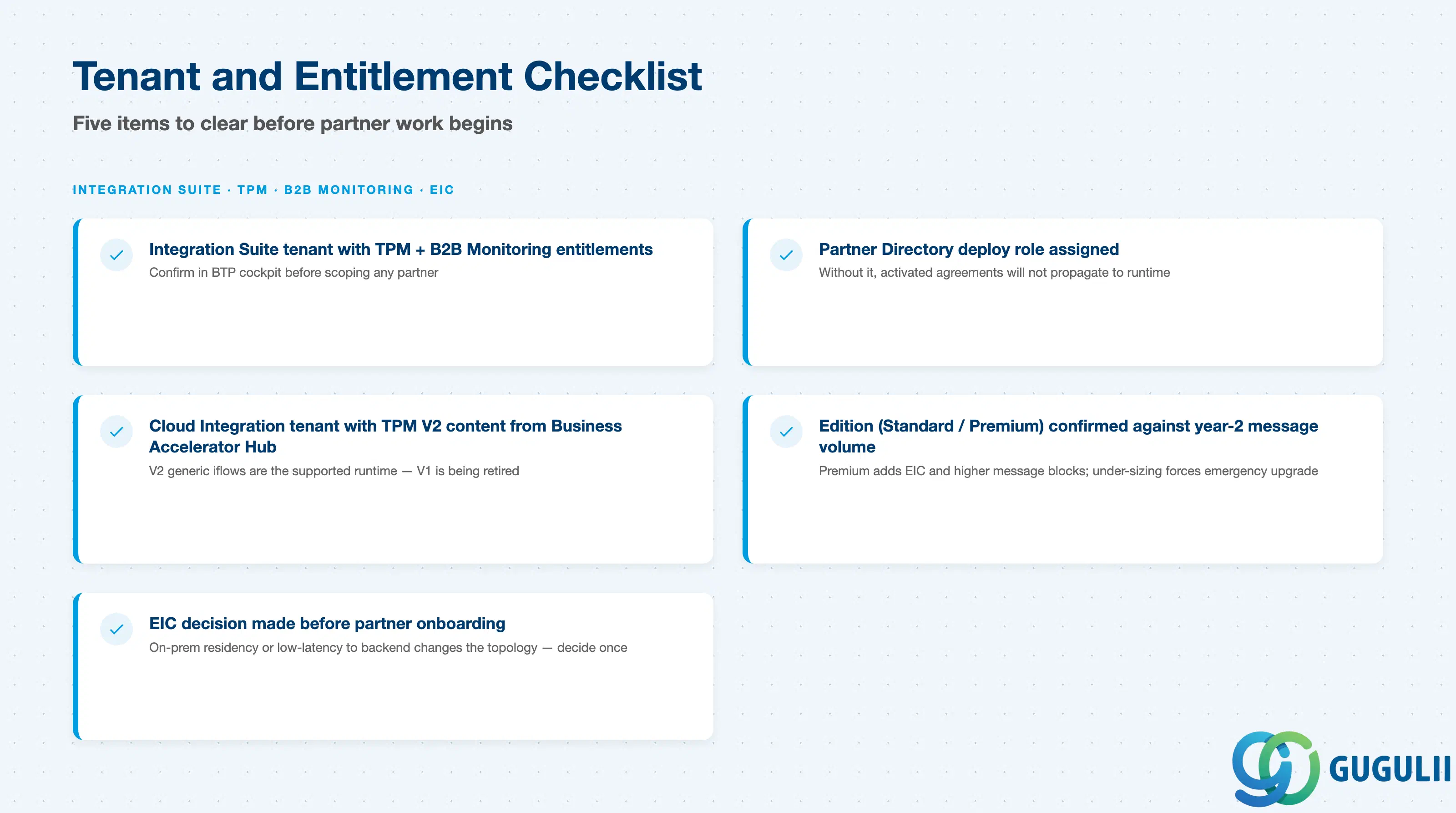
| Checklist item | Why it matters |
|---|---|
| Integration Suite tenant provisioned with TPM and B2B Monitoring entitlements confirmed | TPM is not always in the lowest edition; missing entitlement blocks activation. Confirm with the SAP account team — public KBA is gated. |
| Partner Directory access role assigned to the integration team | TPM can write agreements, but only assigned roles can deploy them to the Partner Directory used by Cloud Integration. |
| Cloud Integration tenant with TPM V2 content package imported from SAP Business Accelerator Hub | Without the V2 generic iflows, activated agreements have nothing to execute against. |
| Edition (Standard / Premium) confirmed against year-2 message volume | Premium is custom-quoted by entitlements package; under-tier is the most common procurement mistake. |
| EIC (Edge Integration Cell) decision made before partner onboarding | EIC is Premium-only; deciding hybrid runtime late forces re-architecture per partner. |
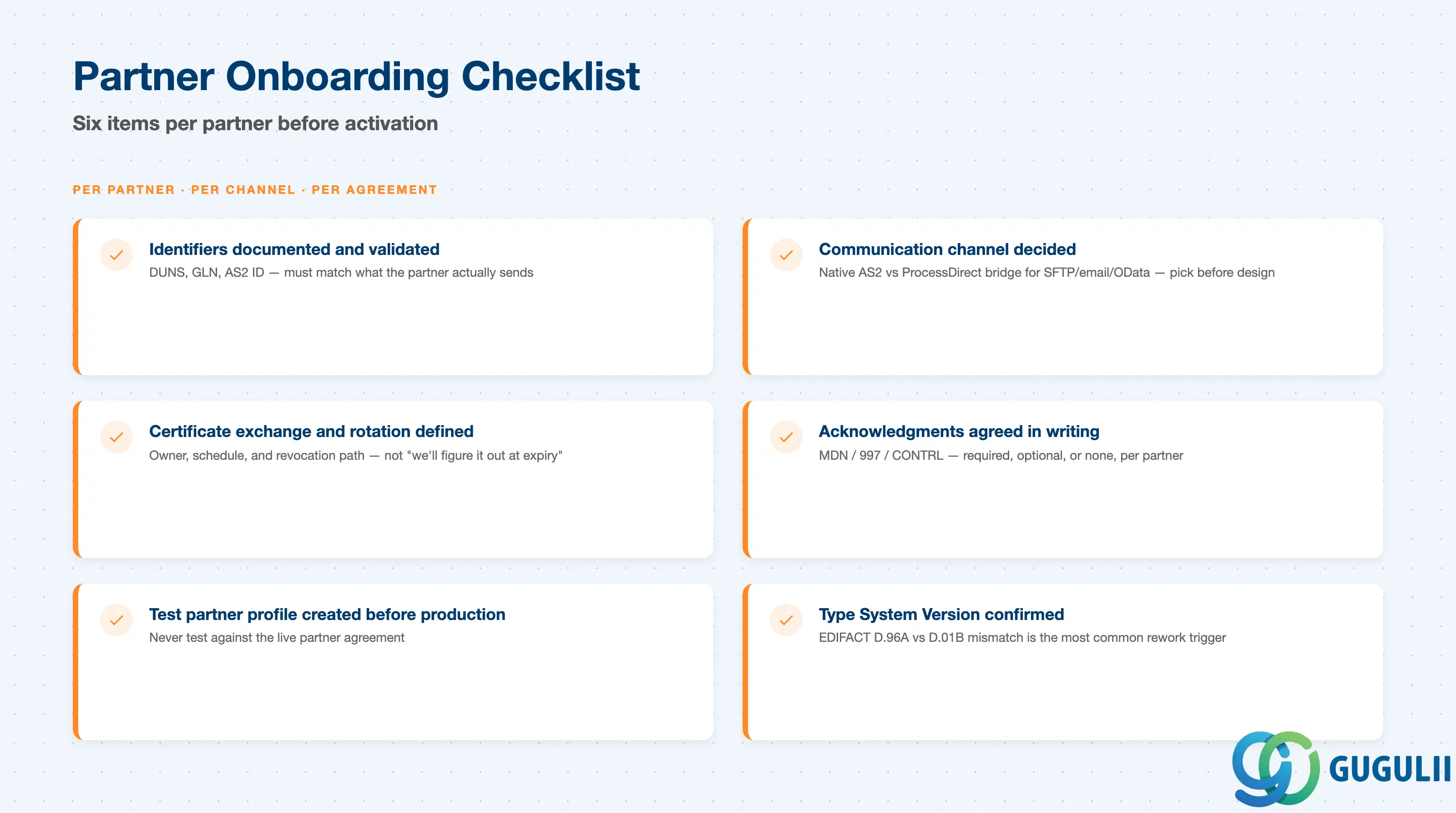
| Checklist item | Why it matters |
|---|---|
| Each partner’s identifiers (e.g., EDIFACT sender/receiver IDs, X12 ISA qualifiers) documented and validated against the partner’s own systems | Identifier mismatch is the #1 cause of message rejection; TPM enforces them strictly. |
| Communication channel decided per partner (AS2 / IDoc / SAP RM / SOAP 1.x natively, or ProcessDirect bridge) | Drives whether a custom iflow is needed; affects effort and operational ownership. |
| Certificate exchange and storage process defined (TPM stores partner certificates with rotation cadence) | Expired certificates fail messages silently from TPM’s view; rotation must be operationalized. |
| Acknowledgment expectations (MDN for AS2, functional acks like 997/CONTRL) agreed in writing | Acknowledgment misalignment shows up only in production and is hard to debug after partners go live. |
| Test partner profile created before production agreement | TPM allows it; teams that skip test profiles ship configuration mistakes to live partners. |
| Type System Version (e.g., EDIFACT D.01B, X12 4010) confirmed against the partner’s actual messages | Wrong version creates filters on MIGs that silently drop fields; the partner sees no error, but data is missing. |
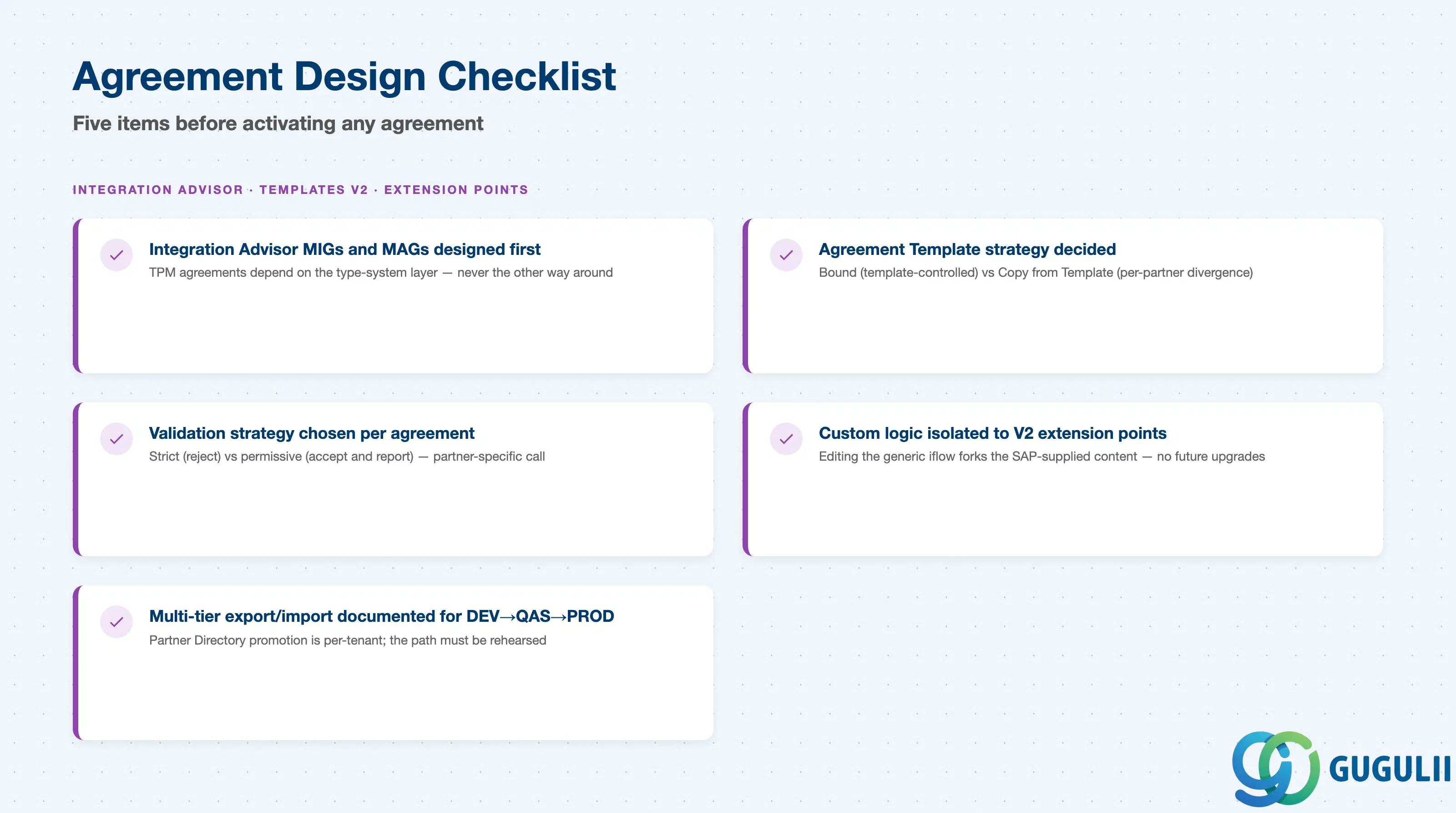
| Checklist item | Why it matters |
|---|---|
| Integration Advisor MIGs and MAGs designed before TPM Agreement Template work begins | TPM agreements bind to MIGs and MAGs; building agreements without them produces empty contracts. |
| Agreement Template strategy decided: bound vs. independent (Copy from Template) | Bound templates enforce uniformity but cascade changes; independent copies isolate partners but drift over time. |
| Validation strategy chosen per agreement (strict vs. permissive on optional fields) | Strict validation rejects partner messages with non-fatal omissions; permissive validation accepts garbage. |
| Custom logic isolated to sanctioned extension points in the V2 pipeline | Modifying the generic TPM iflow forks the SAP-managed content; extension points keep upgrades safe. |
| Multi-tier export/import documented for transports (DEV → QAS → PROD) | TPM objects do not transport like classic PI ESR content; lifecycle management has its own pattern (covered in SAP Learning’s operations module). |
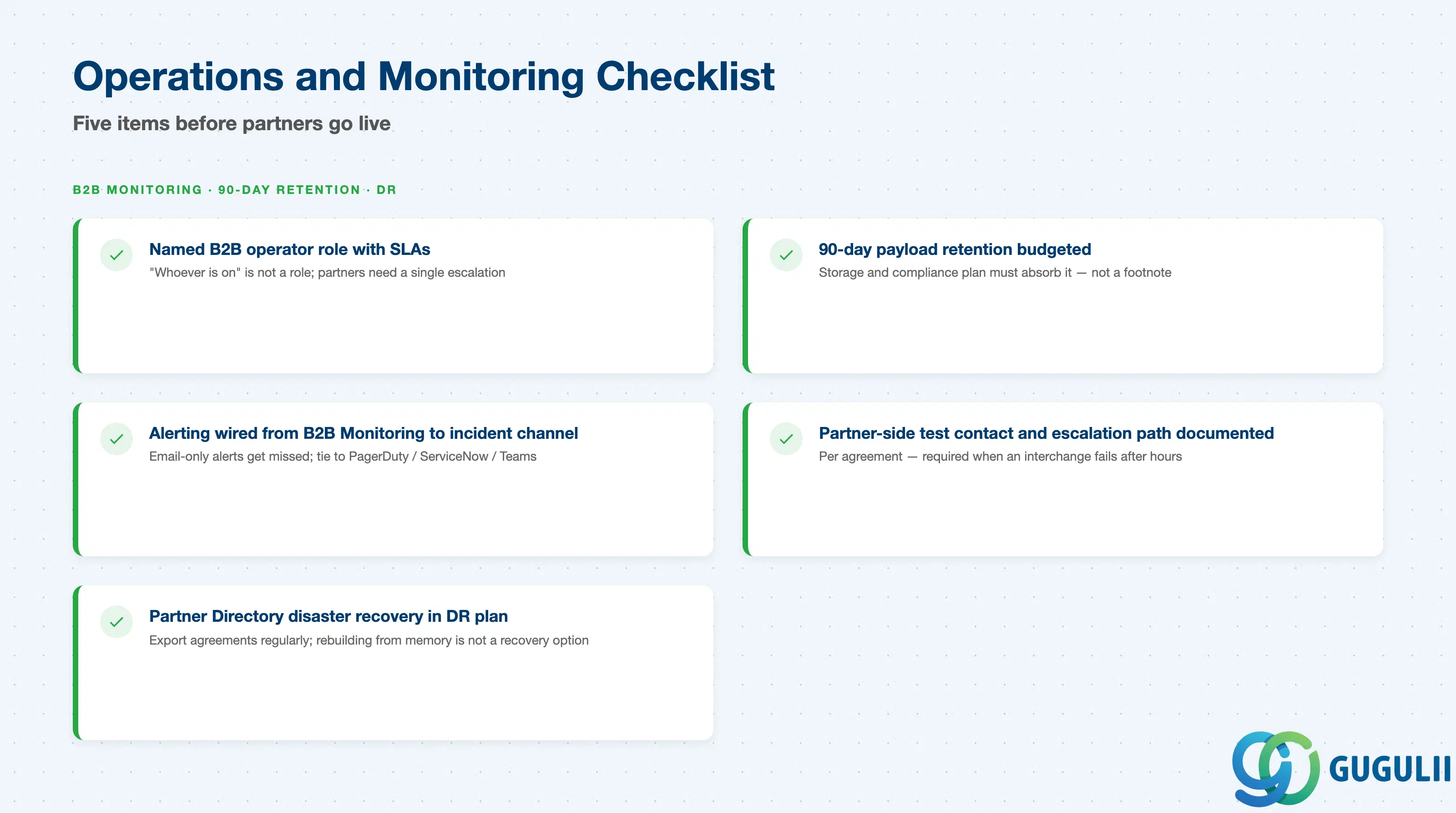
| Checklist item | Why it matters |
|---|---|
| Named B2B operator role on the customer side, with SLAs for partner messages | TPM cannot self-operate; without a named operator, partner SLAs slip and certificate rotations are missed. |
| 90-day B2B Monitoring payload retention budgeted into storage / compliance plan | The longer retention is a benefit but also a compliance surface for PII-bearing payloads. |
| Alerting wired from B2B Monitoring to the customer’s incident channel | The cockpit is for operators; production failures need to wake somebody, not wait for someone to refresh a screen. |
| Partner-side test contact and escalation path documented per agreement | When a partner’s certificate expires or identifier changes, the customer needs a working contact, not a generic mailbox. |
| Disaster recovery for Partner Directory (export of agreements) included in DR plan | Partner Directory is the contract repository; losing it is a multi-week recovery without backups. |
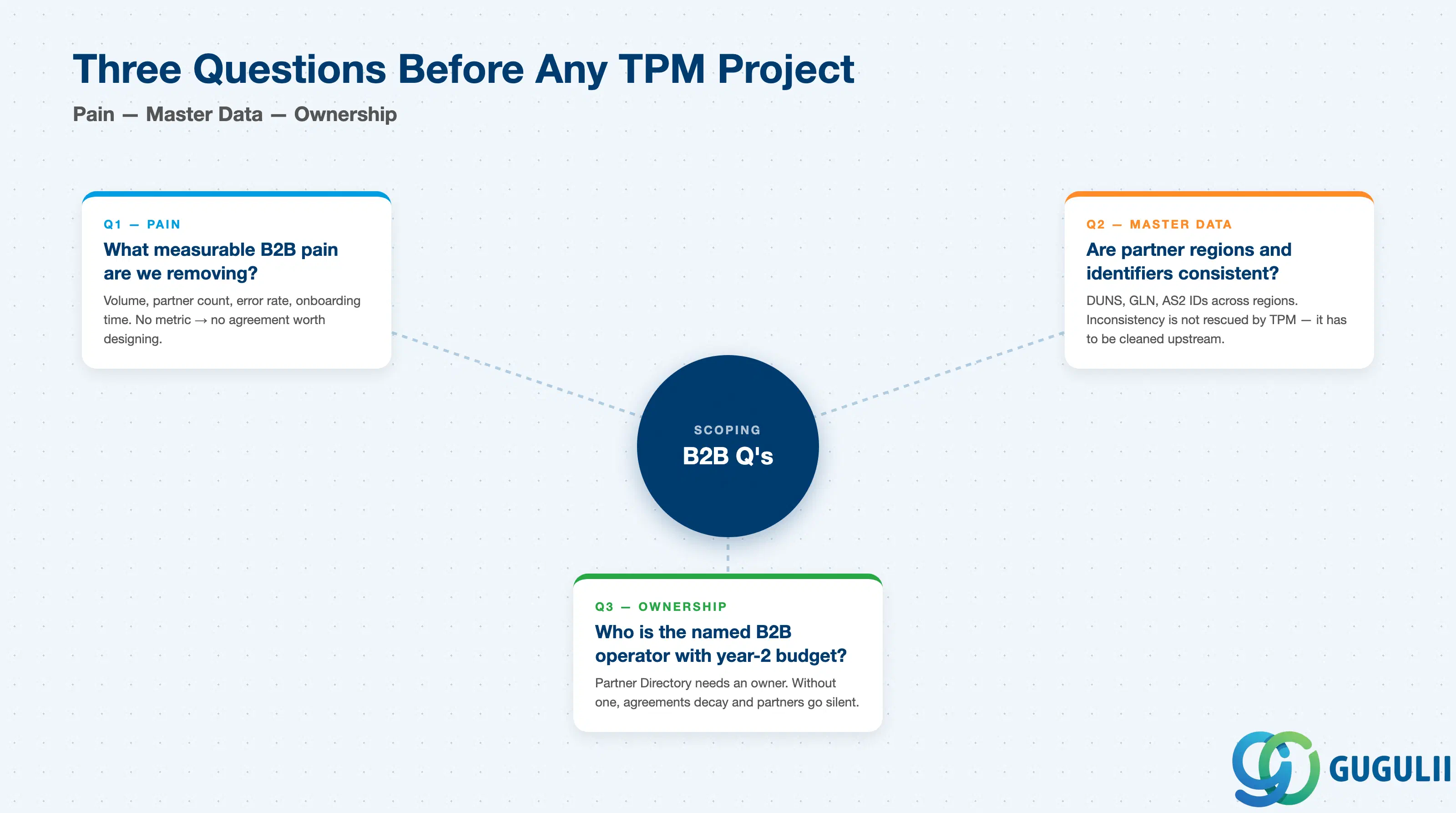
Q1. What measurable B2B pain — message volume, partner count, error rate, time to onboard a new partner — are we removing, and what is its current cost?
Without a metric, TPM scoping turns into a feature compare with the customer’s incumbent B2B platform. With a metric — “we onboard a partner in eight weeks today and want it in two” — the scoping conversation can choose the right TPM patterns and cut the rest.
Q2. Where do the partner messages flow, what regions are they in, and is the customer’s master data clean enough that identifier mismatches will not dominate the error rate?
If half the partners use the same identifier convention as the customer’s own systems, TPM lights up fast. If identifiers are inconsistent or the customer’s partner master is dirty, the first eight weeks of any TPM project are master-data work, regardless of what the proposal says.
Q3. Who owns the B2B operations after go-live — partner contacts, certificate rotation, error queue, AI Unit / message-block budget — and do they have year-two budget?
TPM is not a one-time install. Partners change identifiers, certificates expire, message volume grows with adoption, and the message-block tier has to keep up. Without a named B2B operator with year-two budget, partners go silent and nobody notices for a quarter.
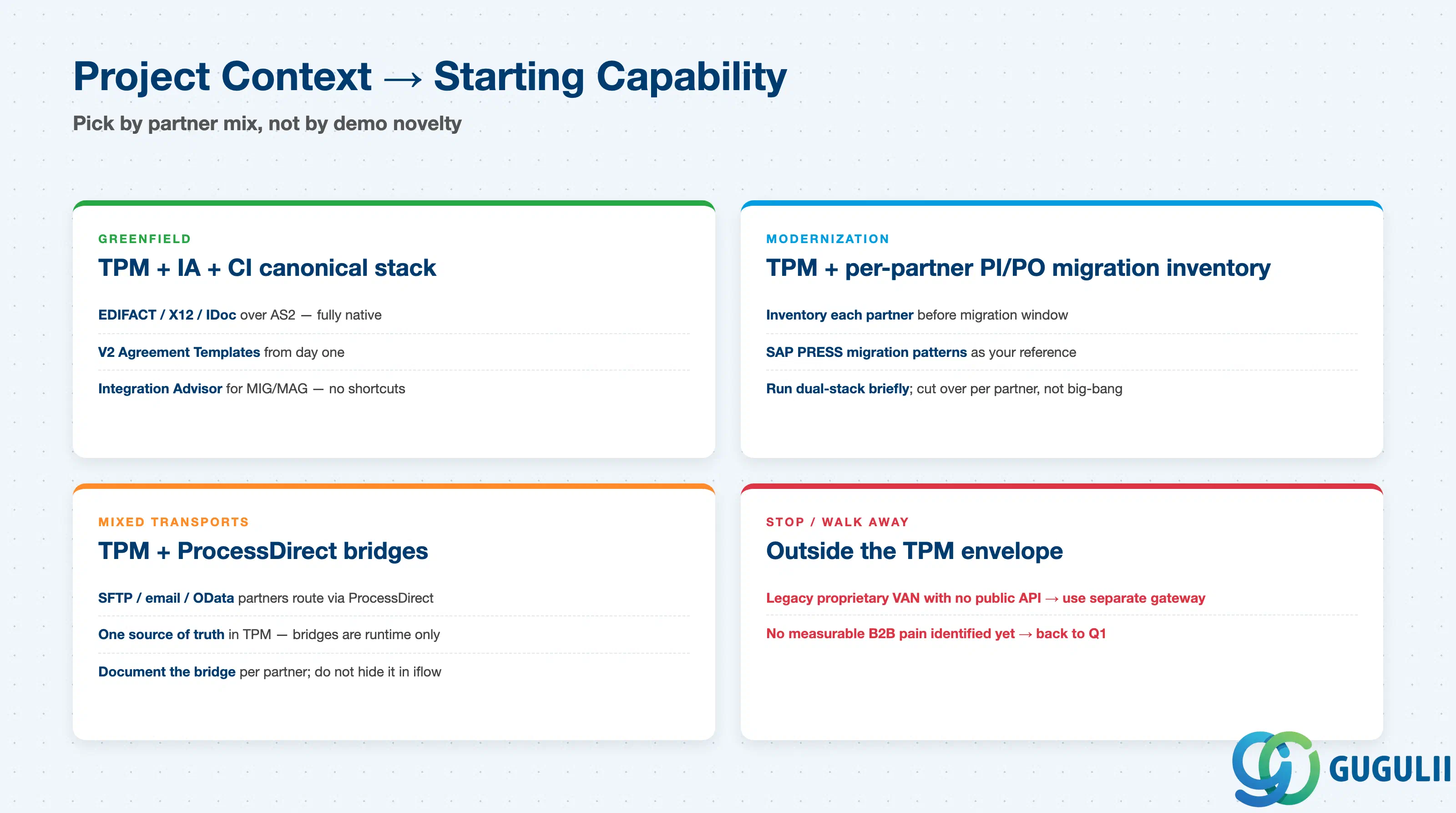
| Project context | Recommended starting capability |
|---|---|
| Greenfield B2B program with EDI-over-AS2 to S/4HANA | TPM + Integration Advisor + Cloud Integration as the canonical stack |
| Existing PI / PO B2B Add-on to be modernized | TPM with a per-partner migration inventory, not a big-bang |
| Partner program dominated by SFTP-only partners | TPM + ProcessDirect bridges per partner; budget custom iflow effort up-front |
| Mixed AS2 + SFTP + email partners | TPM as the agreement authority, ProcessDirect for non-native channels — keep one source of truth |
| AI-assisted partner onboarding (Joule + MCP TPM Server) | Start with one partner pilot inside MCP; do not commit roadmap value before SAP publishes GA scope |
| Hybrid / on-premise runtime requirement | Confirm Premium edition + EIC, then verify which TPM flows are EIC-runnable per scenario |
| Legacy proprietary VAN with no public API or AS2 endpoint | Stop. Use a separate B2B gateway. TPM is not the right tool. |
| No clear pain point identified yet | Stop. Go back to Q1. |
| Capability | Licensing model | Key question to ask |
|---|---|---|
| Integration Suite tenant (any edition) | Subscription per tenant per year + included message volume | Which edition fits year-2 message volume, not just go-live? |
| Message metering | Blocks of 10,000 messages; messages > 250 KB count as one extra message per additional 250 KB | What is the average and 95th-percentile EDI envelope size per partner? |
| Premium edition + EIC for hybrid runtime | Custom-quoted entitlements package | Does the hybrid case require EIC, or can the cloud runtime cover it? |
| TPM and B2B Monitoring entitlement | Edition-dependent; Standard vs. Premium matrix is gated behind SAP for Me login | Has the SAP account team confirmed TPM is in the customer’s edition? |
| ProcessDirect bridge custom iflows | Counted in standard message metering | How many non-native partners, and what is the iflow build cost in the SI proposal? |
| MCP TPM Server (AI client access) | Tied to AI Units when invoked through Joule / GenAI Hub | What is the projected AI-assisted onboarding volume in year 2? |
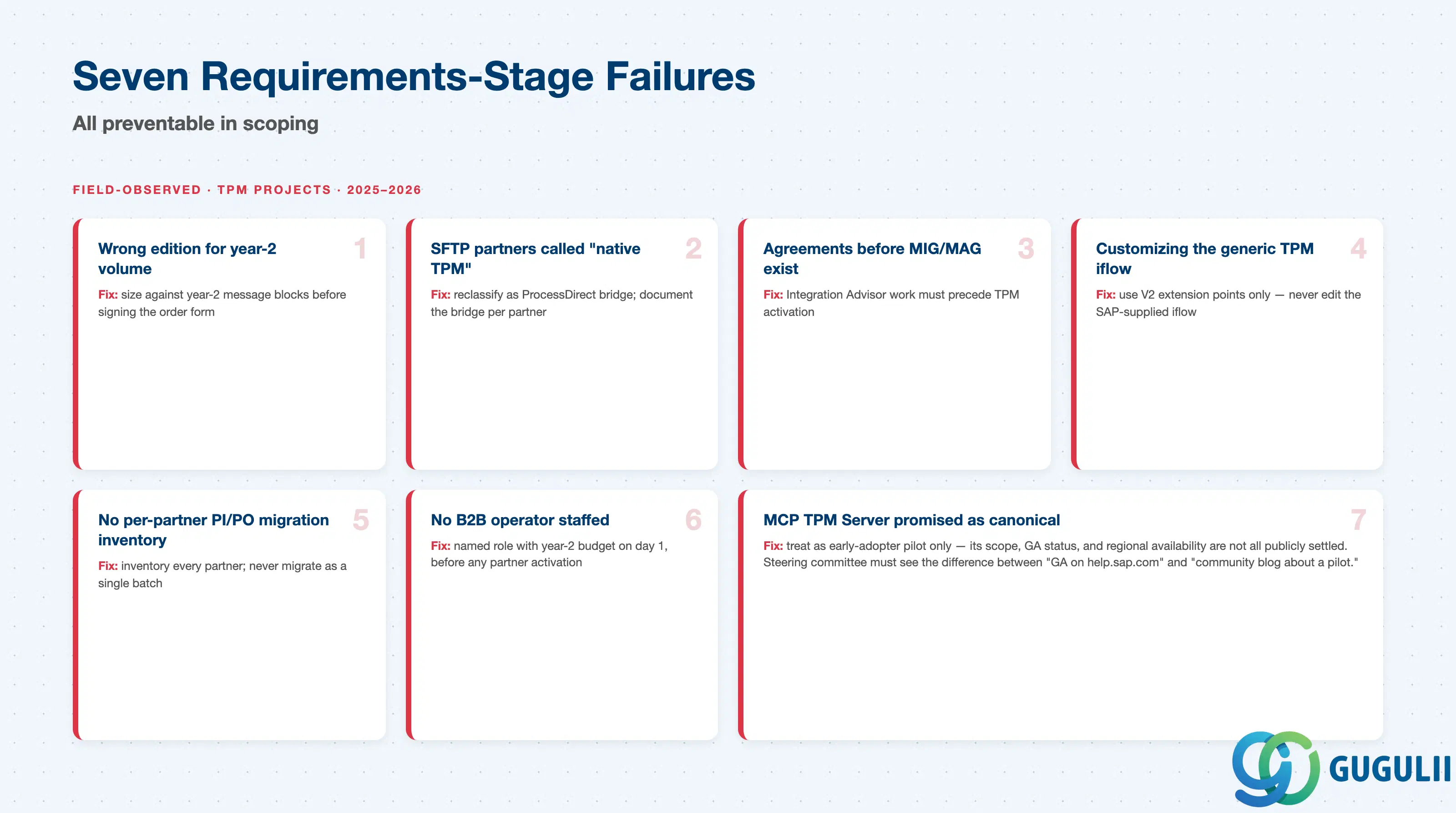
These are requirements-stage failures, not implementation bugs. Every one is preventable in scoping.
Failure 1: Picking the wrong edition for year-2 message volume
The team buys the edition that fits go-live, message volume scales with partner adoption, and procurement runs an emergency upgrade in year two. Model year-2 volume per partner and pick the edition (and entitlement package, if Premium) against year-2 numbers with at least 30% headroom.
Failure 2: Treating SFTP partners as “TPM-supported” without flagging the ProcessDirect bridge
TPM’s native receivers cover AS2, IDoc, SAP RM, and SOAP 1.x. SFTP, email, OData, and custom HTTP need a ProcessDirect bridge to a custom iflow. The bridge works and is SAP-supported since Nov 2023, but it pushes design and operations effort outside the TPM cockpit. Calling it “native TPM” in a proposal hides effort and surprises delivery.
Failure 3: Building agreements before MIGs and MAGs exist in Integration Advisor
TPM agreements reference MIGs and MAGs as their contract. Starting in TPM without the IA work produces empty agreements that pass activation but fail at the first real message. Integration Advisor (A07) is not optional context — it is the design predecessor.
Failure 4: Customizing the generic TPM iflow instead of using sanctioned extension points
TPM V2 ships generic iflows that read partner-specific behavior from the Partner Directory. A team that needs custom logic edits the iflow directly, forks the SAP content, and breaks the upgrade path. The supported pattern is to plug into V2 extension points; the generic iflow stays SAP-managed.
Failure 5: Skipping a per-partner inventory in PI / PO B2B Add-on migrations
SAP Learning’s TPM operations module covers legacy migration as a topic, and SAP PRESS publishes a 105-page reference on it, both signaling that migration is real and non-trivial. Not all PI/PO B2B scenarios map 1:1 to TPM (proprietary mappings, legacy adapters, Java mapping that has no TPM equivalent). A per-partner inventory at scoping prevents the team from discovering blockers in week ten.
Failure 6: Operations not staffed before partners go live
The cockpit is a tool, not an operator. Without a named B2B operations role on the customer side — owning partner contacts, certificate rotation, the error queue, and the message-block budget — partners fail silently and nobody notices for a quarter. Staff this role in scoping, not after go-live.
Failure 7: Promising MCP TPM Server capabilities as if they were canonical TPM
The MCP Trading Partner Management Server is new and exciting; demos look great. The scope of operations exposed via MCP, the GA status, and regional availability are not all publicly settled. Treating MCP-driven onboarding as a roadmap commitment in 2026 is the same mistake D-series articles call out for limited-release Joule agents.
Q: Is Trading Partner Management included in every SAP Integration Suite edition?
The public Standard-vs-Premium feature comparison (KBA 3189288) is gated behind SAP for Me login, so the public answer is “verify with the SAP account team.” What is publicly clear: Integration Suite is sold in Starter, Standard, and Premium tiers; Premium adds Edge Integration Cell and is custom-quoted by entitlements package; B2B Monitoring is the operations counterpart to TPM and tracks the same edition story. At scoping time, treat TPM availability as an open question to confirm in writing.
Q: Does TPM work for on-premise S/4HANA, or only S/4HANA Cloud?
TPM is part of Integration Suite, which runs on SAP BTP. The runtime executes on Cloud Integration in the cloud, with Edge Integration Cell available for hybrid execution from Premium. The system of record on the back end can be S/4HANA Cloud, S/4HANA private edition, on-premise S/4HANA, or non-SAP — TPM does not care, as long as the chosen receiver adapter (IDoc, SAP RM, SOAP 1.x, or a ProcessDirect bridge into the backend) can reach it. Confirm whether EIC is required for the customer’s network topology.
Q: When should we descope a B2B partner from a TPM project?
When any of the following is true: the partner uses a transport that cannot be bridged via ProcessDirect (proprietary VAN with no public API surface); the partner’s identifier convention conflicts irreconcilably with the customer’s master data; the partner is a one-off for a sunsetting business unit and the integration cost exceeds the residual revenue; or the partner refuses to issue a working test contact and certificate rotation process. Descoping early is cheaper than running a partner that nobody operates.
Q: How do we license TPM cleanly when message volumes are spiky?
Message metering on Integration Suite is sold in blocks of 10,000, with messages > 250 KB counted as one extra message per additional 250 KB chunk. Spiky B2B traffic — for example, daily INVOIC bursts from large retailers — inflates message counts non-linearly. Build the budget on (a) average envelope size per partner, (b) 95th-percentile envelope size, (c) projected message volume in year 2 with 30% headroom, and (d) the number of ProcessDirect bridge invocations, which also count against the same metering pool.
Q: How do we document a TPM partner requirement so it survives handover to delivery?
Write it as a sextet: (1) the named partner and identifier set, (2) the transport and adapter (native vs. ProcessDirect bridge), (3) the agreement template and bound MIG/MAG references in Integration Advisor, (4) the acknowledgment pattern (MDN, 997 / CONTRL), (5) the certificate exchange and rotation cadence, (6) the named B2B operator on the customer side. Without all six, requirements get reshaped during delivery — usually by removing scope or hiding effort in a custom iflow.
Q: Should we wait for the MCP TPM Server before starting AI-assisted onboarding?
No, but do not commit roadmap value to it. Run TPM with the canonical design pattern today and pilot the MCP TPM Server alongside one partner — read-only first, then write where SAP confirms scope. Treat MCP-driven onboarding as a productivity accelerator for the integration team, not a customer-facing commitment, until SAP publishes a clearer GA boundary.
Q: How does TPM differ from running EDI on the SAP PI / PO B2B Add-on?
TPM is the cloud-native successor and is the SAP-recommended path for new B2B work on Integration Suite. Differences that matter at scoping: TPM is design-time-driven (agreement-first) instead of channel-first; the runtime is Cloud Integration with predefined V2 generic iflows instead of PI/PO ESR content; lifecycle management uses a different transport pattern (multi-tier export/import); and not every PI/PO B2B scenario has a 1:1 TPM equivalent — proprietary mappings and Java adapters in particular need rework. SAP publishes legacy migration as a topic in its official B2B course, and SAP PRESS publishes a dedicated reference, both signaling that the migration is well-trodden but never trivial.
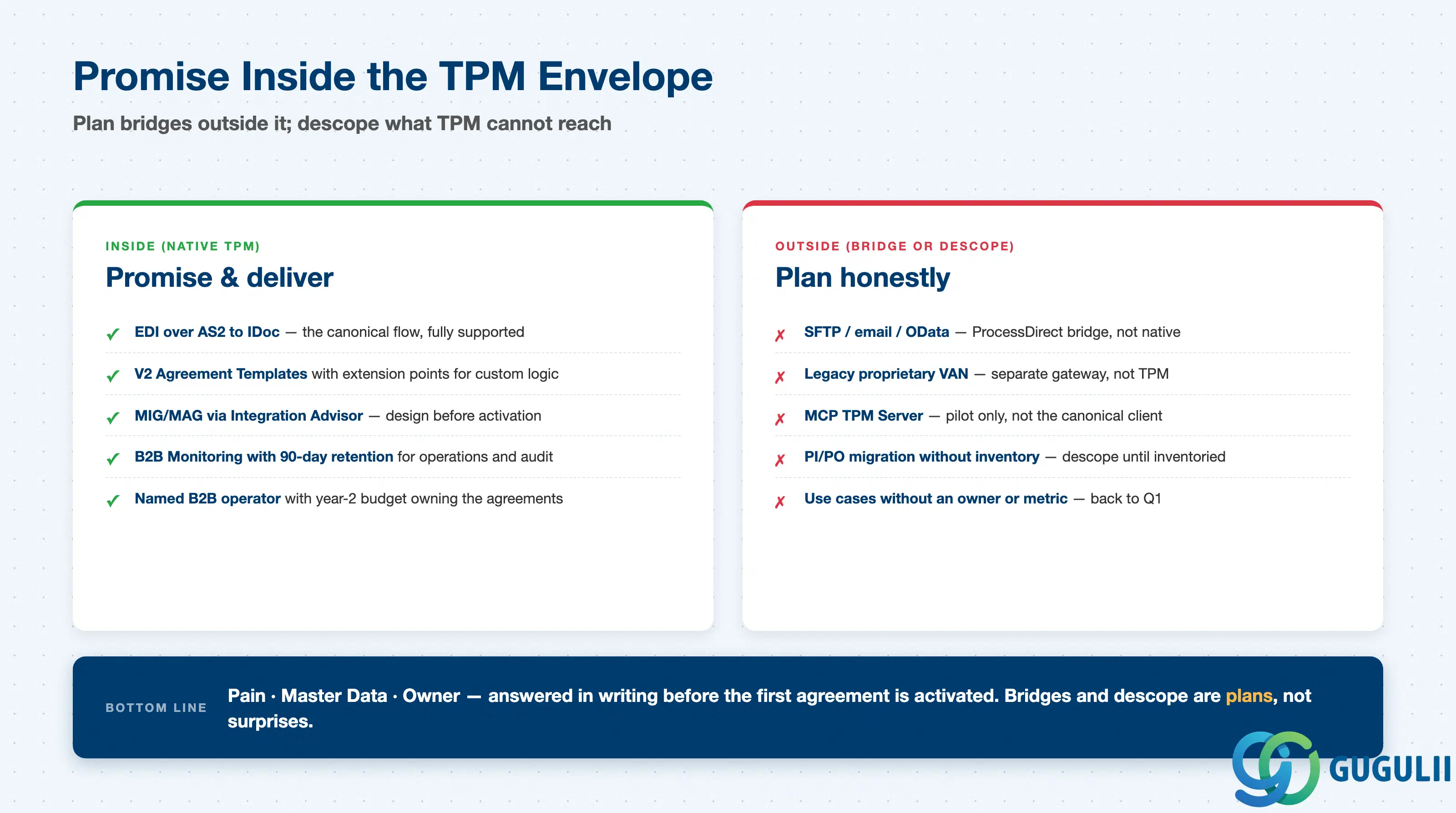
Trading Partner Management is the design-time cockpit at the center of SAP Integration Suite’s B2B story. It owns partners, identifiers, certificates, and agreements; the Partner Directory is the contract that activated agreements get pushed into; Cloud Integration runs the predefined V2 generic iflows that look up partner-specific behavior at message time; and B2B Monitoring is the operations view. The canonical EDI-over-AS2-to-IDoc path is production-ready and the most defensible recommendation in 2026; non-AS2 transports work via ProcessDirect bridges with budgeted custom-iflow effort; and emerging surfaces (MCP TPM Server, EIC deployment) are worth piloting but not committing on a roadmap. The consultant value is reading the customer’s partner mix, master data quality, year-2 message volume, and operations staffing — and saying, accurately, which partners fit native TPM, which need bridges, and which belong outside Integration Suite altogether. Promise inside the envelope, plan the bridges outside it, and ship the named B2B operator and message-block budget every time.
| L1. Big Picture | L2. Functional Domains |
|---|---|
| BTP-001 What is BTP | L2-A. Integration — BTP-A06 Trading Partner Management (this article) |
| BTP-002 BTP Architecture | L2-B. Application Development & Automation |
| BTP-003 BTP Capability Map | L2-C. Data & Analytics |
| BTP-004 Deployment Models | L2-D. AI |
| BTP-005 Licensing Models | L2-E. Foundation Services |
| BTP-006 Clean Core Strategy | L2-F. Architecture & Operations |
| L2-G. Use Cases & Patterns |