Title here
Summary here

| ID | Title |
|---|---|
| BTP-A01 | SAP Integration Suite Overview: Capabilities, Components, and When to Use Each |
| BTP-A02 | Cloud Integration (CPI): Architecture and Use |
| BTP-A03 | API Management: Architecture and Use |
| BTP-A04 | Event Mesh: Architecture and Use |
| BTP-A05 | Open Connectors: Architecture and Use |
| BTP-A06 | B2B Integration (1): Trading Partner Management |
| BTP-A07 | B2B Integration (2): Integration Advisor |
| BTP-A08 | Integration Suite: Use Cases and Decision Patterns (this article) |
| Resource | URL |
|---|---|
| SAP Integration Solution Advisory Methodology (ISA-M) | help.sap.com → |
| ISA-M: Define Integration Guidelines for Your Organization | community.sap.com → |
| What is Edge Integration Cell | help.sap.com → |
| Application-to-Application Integration reference architecture | sap.com → |
| Best practices and guidelines in SAP Integration Suite | community.sap.com → |
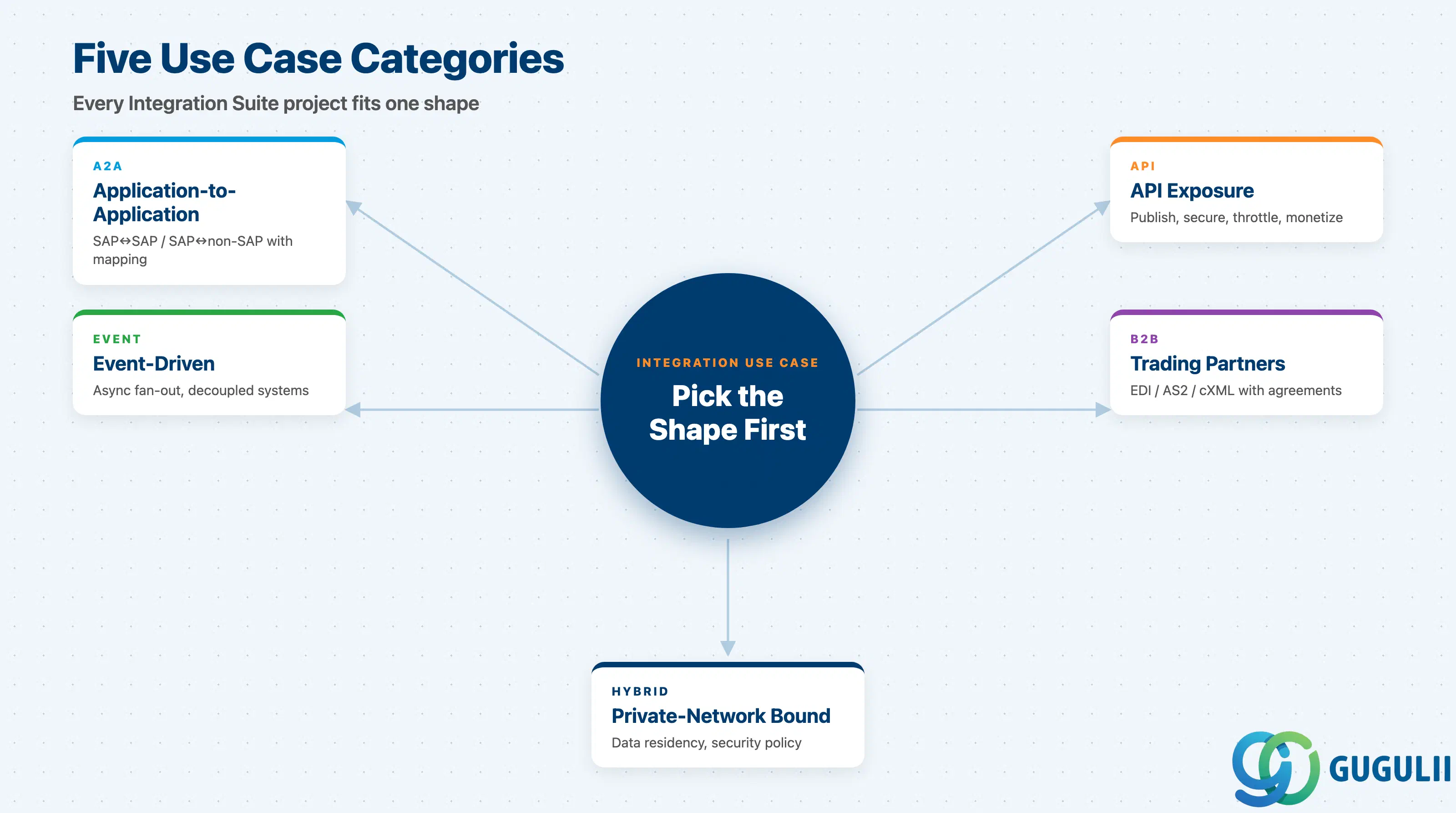
SAP Integration Suite covers a small number of recurring use case shapes. Whatever the customer’s words — “connect Salesforce”, “expose APIs to partners”, “real-time inventory”, “EDI for the new 3PL” — the underlying scenario almost always falls into one of the five rows below. Picking the right capability starts here, not at the price list.
| Use case category | What it actually means | Primary user |
|---|---|---|
| Application-to-Application (A2A) | System-to-system data exchange between SAP and other apps, usually with transformation | Integration developer |
| API exposure and management | Publishing, securing, throttling, and (sometimes) monetizing APIs to internal teams or external consumers | API owner / platform team |
| Event-driven integration | Asynchronous, decoupled fan-out of business events (S/4HANA changes, IoT, multi-step processes) | Event-driven architect |
| Business-to-Business (B2B) | Trading partner onboarding using EDI / AS2 / cXML standards with mapping and agreements | B2B / EDI specialist |
| Hybrid / on-premise-bound | Integration that must run inside a private network for data residency or security policy reasons | Enterprise architect |
They are not substitutes. Every real project has a primary category and usually one secondary category — naming both early is half the decision.
                     SAP Integration Suite (BTP)
   ┌──────────────────────────────────────────────────────────────┐
   │                                                              │
   │   A2A / Hybrid           API exposure          Event-driven  │
   │   ┌─────────────┐       ┌──────────────┐      ┌───────────┐  │
   │   │   Cloud     │──────▶│     API      │      │  Event    │  │
   │   │ Integration │       │  Management  │      │   Mesh    │  │
   │   └──────┬──────┘       └──────┬───────┘      └─────┬─────┘  │
   │          │                     │                    │        │
   │          │  Open Connectors    │                    │ AEM    │
   │          │  (non-SAP SaaS)     │                    │ (high  │
   │          │                     │                    │ volume)│
   │          │  TPM + Integration Advisor (B2B)         │        │
   │          │                                          │        │
   └──────────┼──────────────────────────────────────────┼────────┘
              │                                          │
              ▼  via Cloud Connector (on-prem)           ▼
        ┌──────────────┐                          ┌──────────────┐
        │  S/4HANA     │  ◀────  events  ────────▶│  S/4HANA     │
        │  on-premise  │                          │  Cloud       │
        └──────────────┘                          └──────────────┘
              ▲                                          ▲
              │                                          │
        ┌──────┴────────┐                          ┌─────┴────────┐
        │ Edge          │                          │ Non-SAP SaaS │
        │ Integration   │                          │ / IoT / B2B  │
        │ Cell (private)│                          │ partners     │
        └───────────────┘                          └──────────────┘
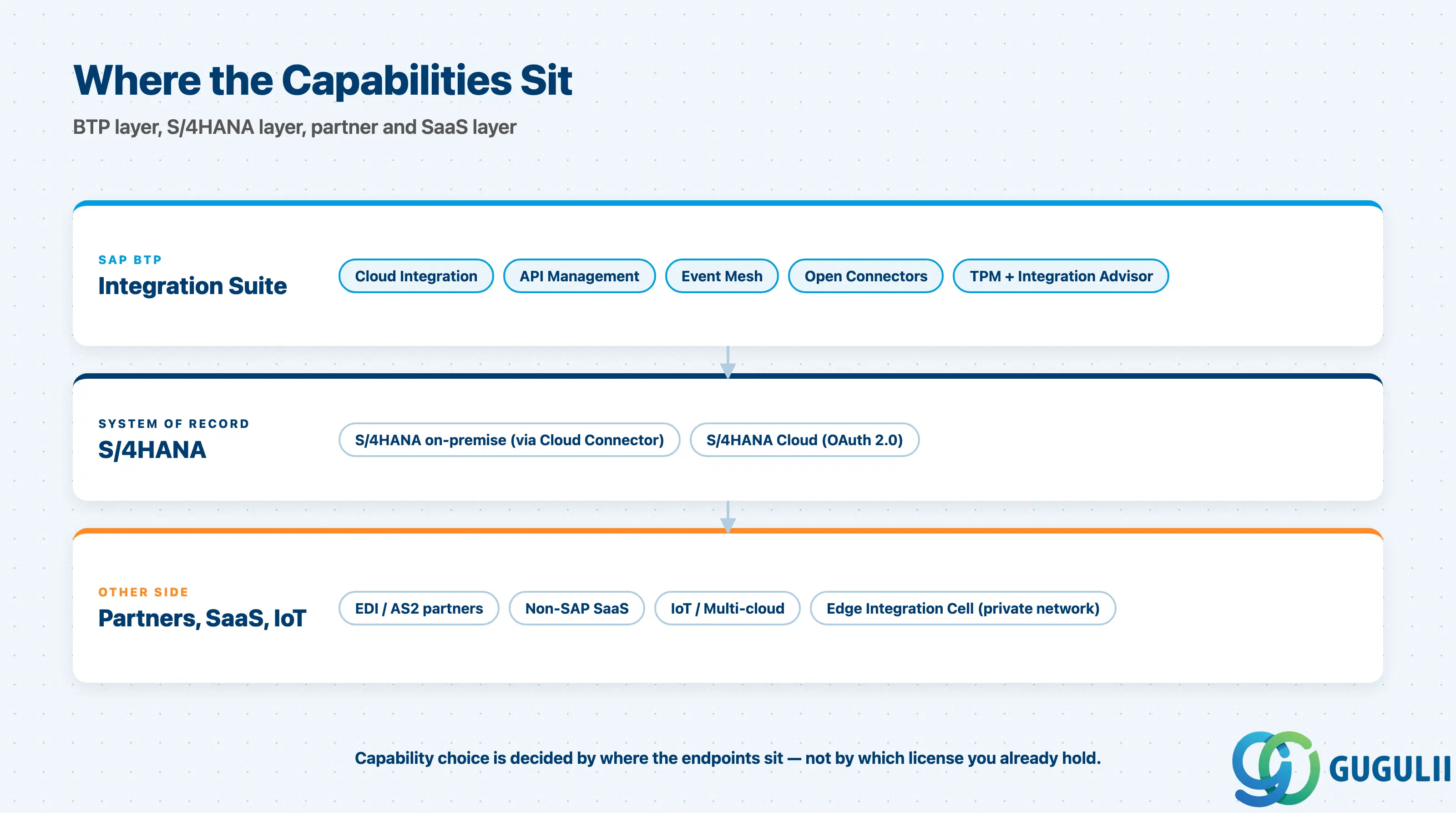
Read the diagram top-down: Integration Suite is the orchestration layer, S/4HANA (on-prem or Cloud) is the system of record, and the lower row is where the integration’s “other side” lives — partners, SaaS, IoT, or a private-network constrained sister system. The Edge Integration Cell sits below the BTP boundary because it runs in the customer’s network even though it is modeled and governed in BTP.
Key point: the choice of capability is decided by where the endpoints sit and how they want to talk — not by which capability the customer already provisioned.
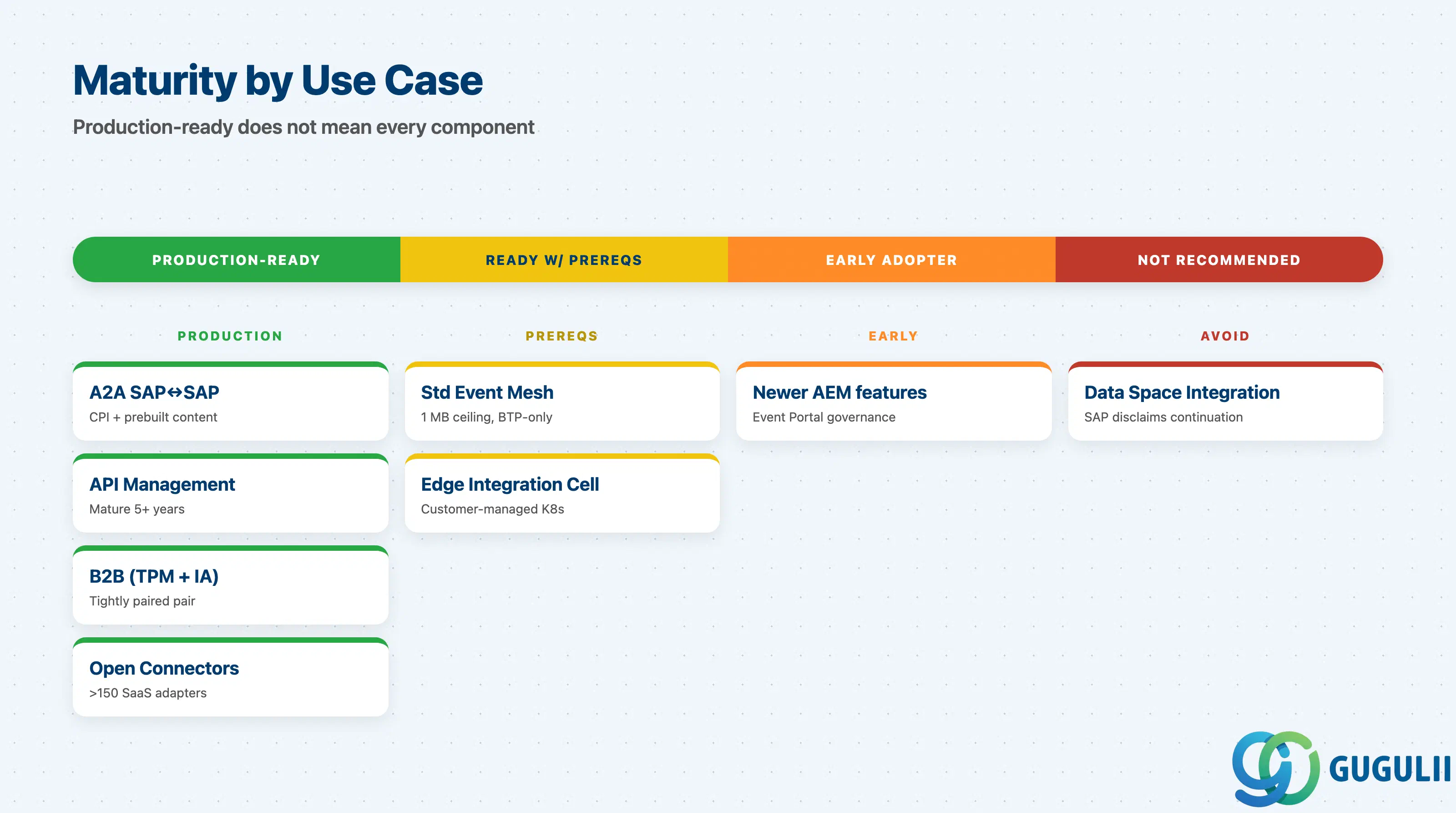
| Use case category | Maturity | Notes |
|---|---|---|
| A2A with SAP↔SAP standard scenarios | ✅ Production-ready | Cloud Integration with prebuilt content from SAP Business Accelerator Hub covers ~80% of canonical SuccessFactors-to-S/4HANA, Ariba-to-S/4HANA, Sales Cloud-to-S/4HANA flows. |
| API exposure (internal + external partners) | ✅ Production-ready | API Management is a 5-year-mature offering; Anomaly Detection and traffic Predictions are recent AI additions. |
| Event-driven (mid volume, BTP-internal) | ⚠️ Ready with prerequisites | Standard Event Mesh has 1 MB message ceiling and practical throughput limits — works for canonical S/4HANA business events, not IoT. |
| Event-driven (high volume / multi-cloud / IoT) | ✅ Production-ready (separate product) | Advanced Event Mesh is sold and operated as a distinct product line; commercial track is dedicated brokers, not message-based. |
| B2B with external trading partners | ✅ Production-ready | Trading Partner Management + Integration Advisor are tightly paired; Integration Advisor’s ML mapping suggestions reduce manual MIG/MAG work substantially. |
| Hybrid / data-residency-bound | ⚠️ Ready with prerequisites | Edge Integration Cell requires customer-managed Kubernetes and operational maturity; not a “click to deploy” capability. |
| Data Space Integration (Catena-X) | ❌ Not recommended for new projects | SAP’s Feature Scope Description disclaims continued availability — scope only with that disclaimer acknowledged. |
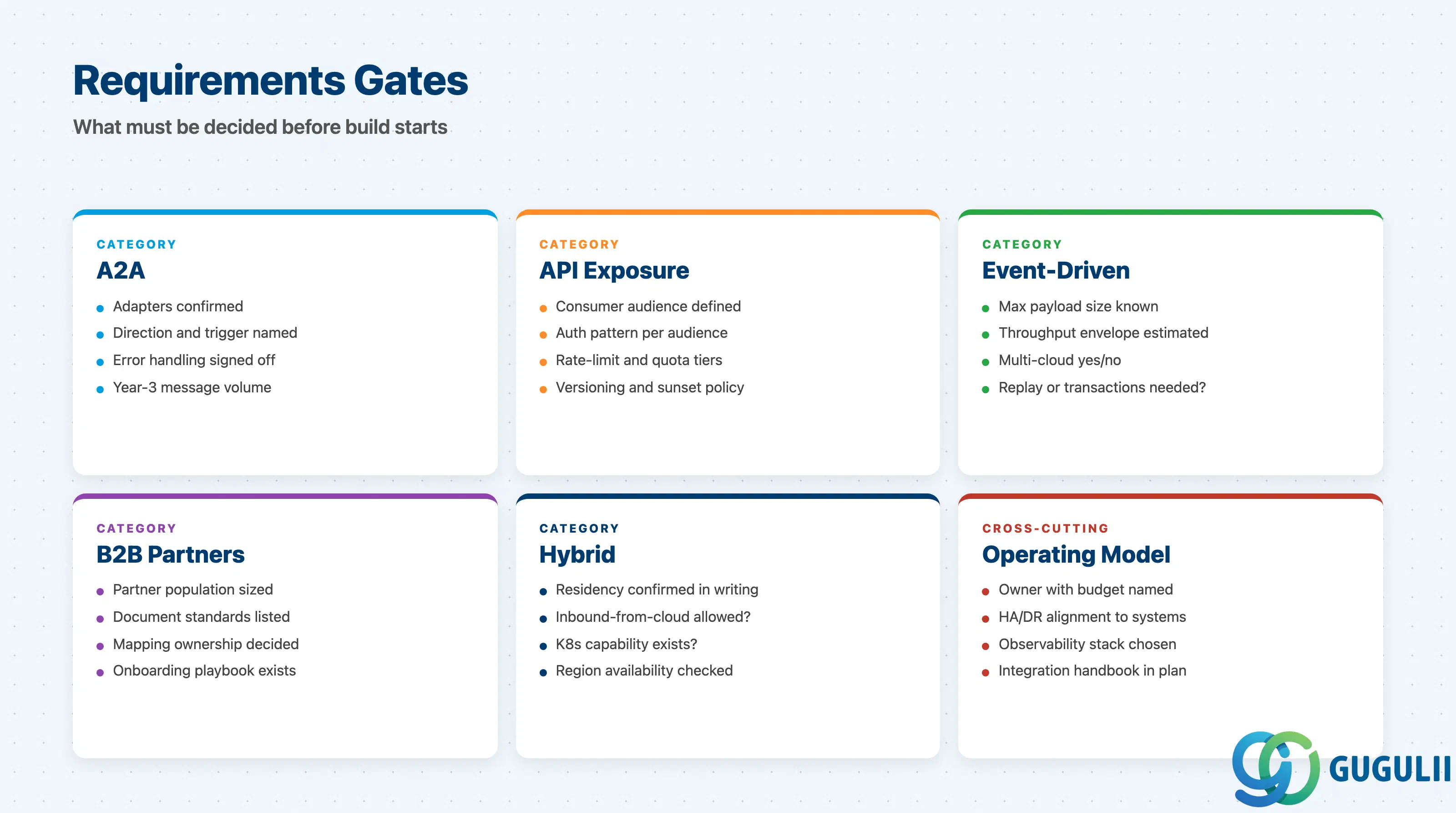
Each table below covers one use case category. Items here are decidable at requirements stage — if any line cannot be answered, that gap is the project risk, not the implementation work that follows it.
| Checklist item | Why it matters |
|---|---|
| Source and target systems are named, with adapter coverage confirmed against the published 70+ adapter list | An unsupported adapter forces custom Groovy or a third-party connector — different operational class. |
| Each interface has a primary direction and trigger (push vs pull, synchronous vs asynchronous) | Determines whether you need request-reply, event consumption, or scheduled polling — three different iFlow shapes. |
| Existing prebuilt content from SAP Business Accelerator Hub is checked first | Reuse beats rebuild; missed reuse is the most common scope inflation in CPI projects. |
| Error handling expectations are signed off (retry policy, dead-letter destination, business-user alerting) | Error volume in some B2B-adjacent A2A flows exceeds success volume; a logging plan defined late never recovers. |
| Identity and credential model is documented (technical user, OAuth client, certificate rotation cadence) | Cert/token expiry is the #1 silent production incident in CPI-managed integrations. |
| Volume profile distinguishes year-1 and year-3 message counts | The CPEA “message” billing unit is 250 KB; throughput growth is the budget surprise that hits 12–18 months in. |
| Checklist item | Why it matters |
|---|---|
| Consumer audience is named (internal teams, named external partners, open developer ecosystem) | Drives whether you need just a Portal, or also a Developer Hub, or also Monetization. |
| Auth pattern per audience is decided (OAuth 2.0 client credentials, API key, JWT, mTLS) | Mixing patterns inside one Product is common and pushes complexity into policy code. |
| Rate-limit and quota tiers are defined per consumer class | Without tiers, the first noisy consumer becomes a production incident. |
| Underlying systems of record are catalogued (S/4HANA OData, CPI iFlow URL, third-party REST) | API Management is a façade — you need to know what is behind every façade endpoint. |
| Lifecycle policy: API versioning, deprecation, sunset windows | Without this, every backend change becomes a breaking change for some consumer. |
| Observability / monetization data target is named (BW, BTP analytics, third-party) | API Analytics retains data with bounds; if monetization is in-scope, the billing data path must be confirmed. |
| Checklist item | Why it matters |
|---|---|
| Event sources and consumers are named, with cardinality (1:1 vs 1:many) | Fan-out cardinality is the difference between “Event Mesh works” and “you need Advanced Event Mesh”. |
| Maximum message size is estimated, with growth assumption | Standard Event Mesh hard ceiling is 1 MB; an IoT payload that occasionally exceeds it forces a redesign. |
| Throughput envelope is estimated in events/hour and bytes/hour | At ~250 KB/s practical Standard Event Mesh ceiling, IoT-class workloads are out of bounds. |
| Multi-cloud or external partner participation is confirmed (yes / no) | Standard Event Mesh is BTP-only; cross-cloud or external participants demand Advanced Event Mesh. |
| Event replay, transactional semantics, ordering guarantees are required (yes / no) | These are AEM features, not Standard Event Mesh — naming them late forces a product swap. |
| Governance: who owns the event catalog, naming conventions, schema evolution | Without an event handbook, the topic namespace becomes unmanageable in 18 months. |
| Checklist item | Why it matters |
|---|---|
| Trading partner population is sized (number of partners, growth trajectory, geographies) | Determines whether TPM is overkill or undersized; TPM scales but its onboarding workflow assumes >5 named partners. |
| Document standards are listed (X12, EDIFACT, cXML, AS2, SFTP) | Determines which Integration Advisor type systems are needed and whether existing prebuilt content applies. |
| Mapping ownership model is decided (central B2B team vs partner self-service via Integration Advisor) | Drives the operating model — central team is one cost class, partner self-service is another. |
| Communication channels and security per partner are documented (AS2 with certificates, SFTP keys, mTLS) | Cert/key rotation across many partners is its own operational discipline. |
| Acknowledgment, error workflow, and partner support escalation are defined | “Why didn’t my invoice go through” is the #1 partner ticket; without a workflow it eats consultant time. |
| Test partner onboarding playbook exists | Going live with a real partner without a documented dry-run is the most common cause of post-go-live churn. |
| Checklist item | Why it matters |
|---|---|
| Data residency / sovereignty constraints are confirmed in writing (legal, security) | EIC is a heavy commitment; deploying it on a verbal compliance hint is wasted budget. |
| Inbound-from-cloud is acceptable or prohibited | If inbound is prohibited, EIC’s outbound-only runtime is the deciding constraint. |
| Customer-managed Kubernetes operating capability exists or is explicitly being built | EIC requires platform engineering; customers without it should be told to build that capability first. |
| Subset of capabilities to run on EIC is defined (which iFlows, which API proxies) | EIC supports a subset of Cloud Integration adapters — confirm coverage before commitment. |
| BTP-region availability is confirmed for the customer’s geography | A reason to use EIC is when BTP is not available in the required region; this fact must be checked, not assumed. |
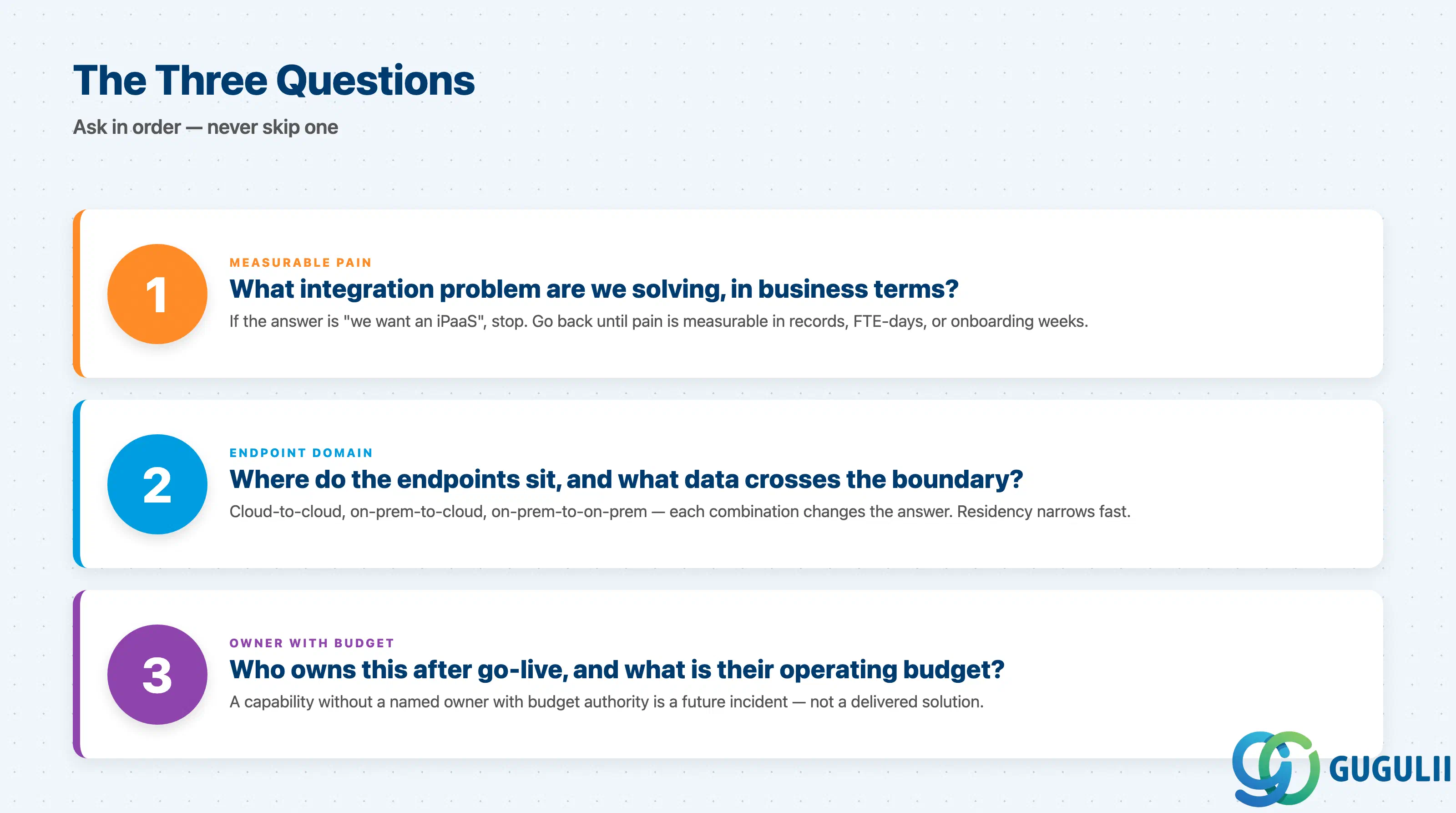
Q1. What is the measurable integration pain we are solving, in business terms?
If the answer is “we want an iPaaS” or “we already bought Integration Suite”, stop. Go back until the answer is shaped like “our SuccessFactors-to-S/4HANA payroll replication is failing 3% of records and it costs us four FTE-days per month to reconcile”, or “we cannot onboard our 12th 3PL because EDI mapping takes six weeks per partner”. Without a measurable pain, capability selection is arbitrary and the project will drift.
Q2. Where do the endpoints sit, and what data is crossing the boundary?
This is the ISA-M domain question. Cloud-to-cloud, on-prem-to-cloud, on-prem-to-on-prem, plus B2B / B2G overlays — each combination changes the answer. If the data is regulated (PII, health, financial), if it is bound by residency law, or if security policy prohibits inbound-from-cloud, the candidate set narrows fast — usually toward Edge Integration Cell.
Q3. Who owns the integration after go-live, and what is their operating budget?
A decision that delivers on day 30 and bankrupts the team on day 400 is a bad decision. Cloud Integration message-based billing grows as fast as adoption; API Management runs on a different commercial track; Advanced Event Mesh broker tiers are a separate negotiation. A capability without a named owner with budget authority is a future incident.
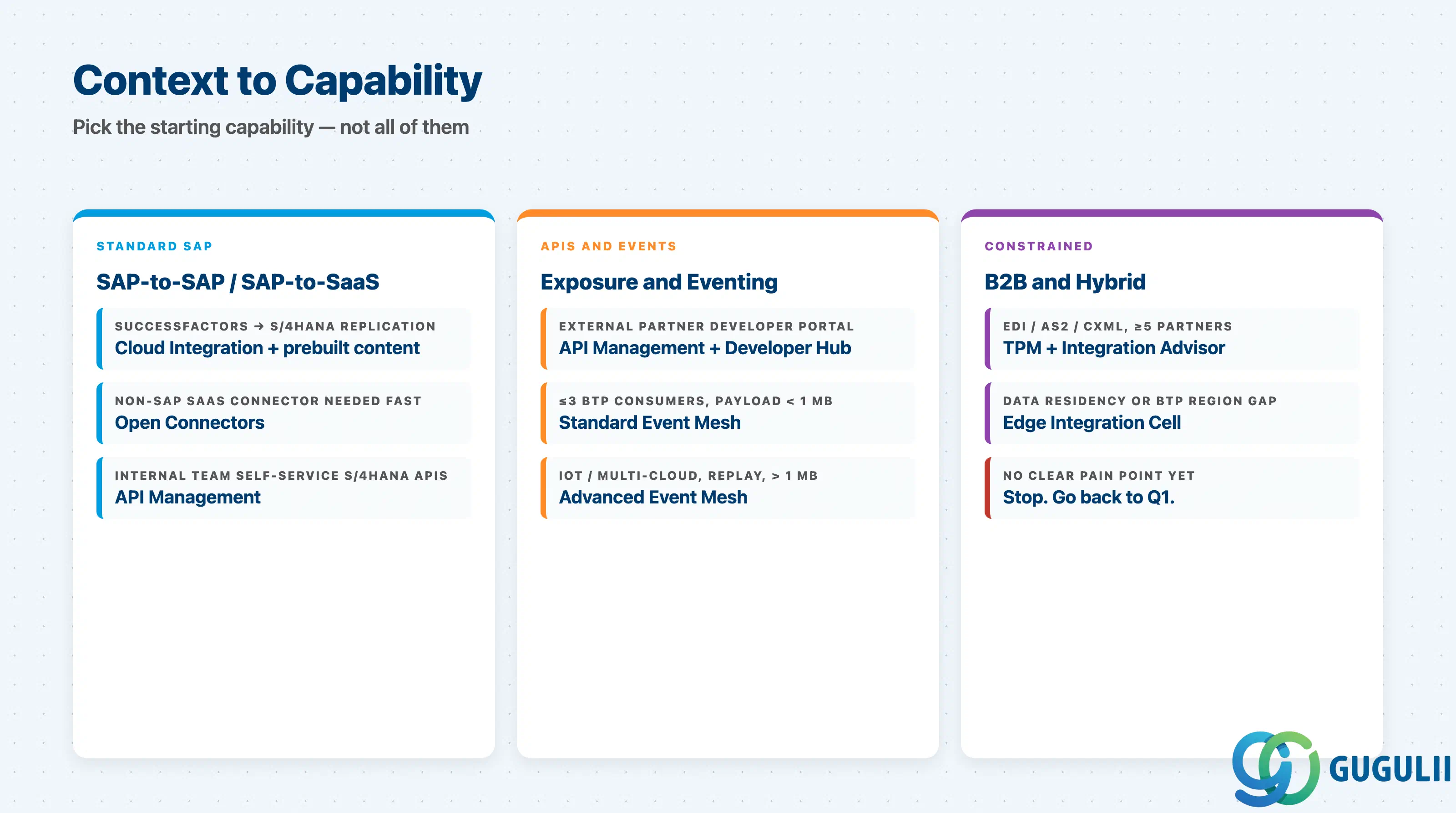
| Project context | Recommended starting capability |
|---|---|
| Standard SuccessFactors / Ariba / Sales Cloud → S/4HANA replication | Cloud Integration (start with prebuilt content) |
| Internal teams want to call S/4HANA APIs in a self-service way | API Management (CPI iFlow or direct OData behind it) |
| External partners need a developer portal, with rate limits and contracts | API Management (Developer Hub + Products) |
| S/4HANA business events fan out to ≤3 BTP consumers, payload < 1 MB, < 250 KB/s | Standard Event Mesh |
| IoT, multi-cloud event flow, payload > 1 MB, replay or ordering required | Advanced Event Mesh |
| Non-SAP SaaS (Salesforce, ServiceNow, Workday) connector needed fast | Open Connectors (then Cloud Integration if mapping is non-trivial) |
| EDI / AS2 / cXML trading partners, ≥5 named, ongoing onboarding | Trading Partner Management + Integration Advisor |
| Data must not leave a private network, or BTP not available in region | Edge Integration Cell |
| No clear pain point identified yet | Stop. Go back to Q1. |
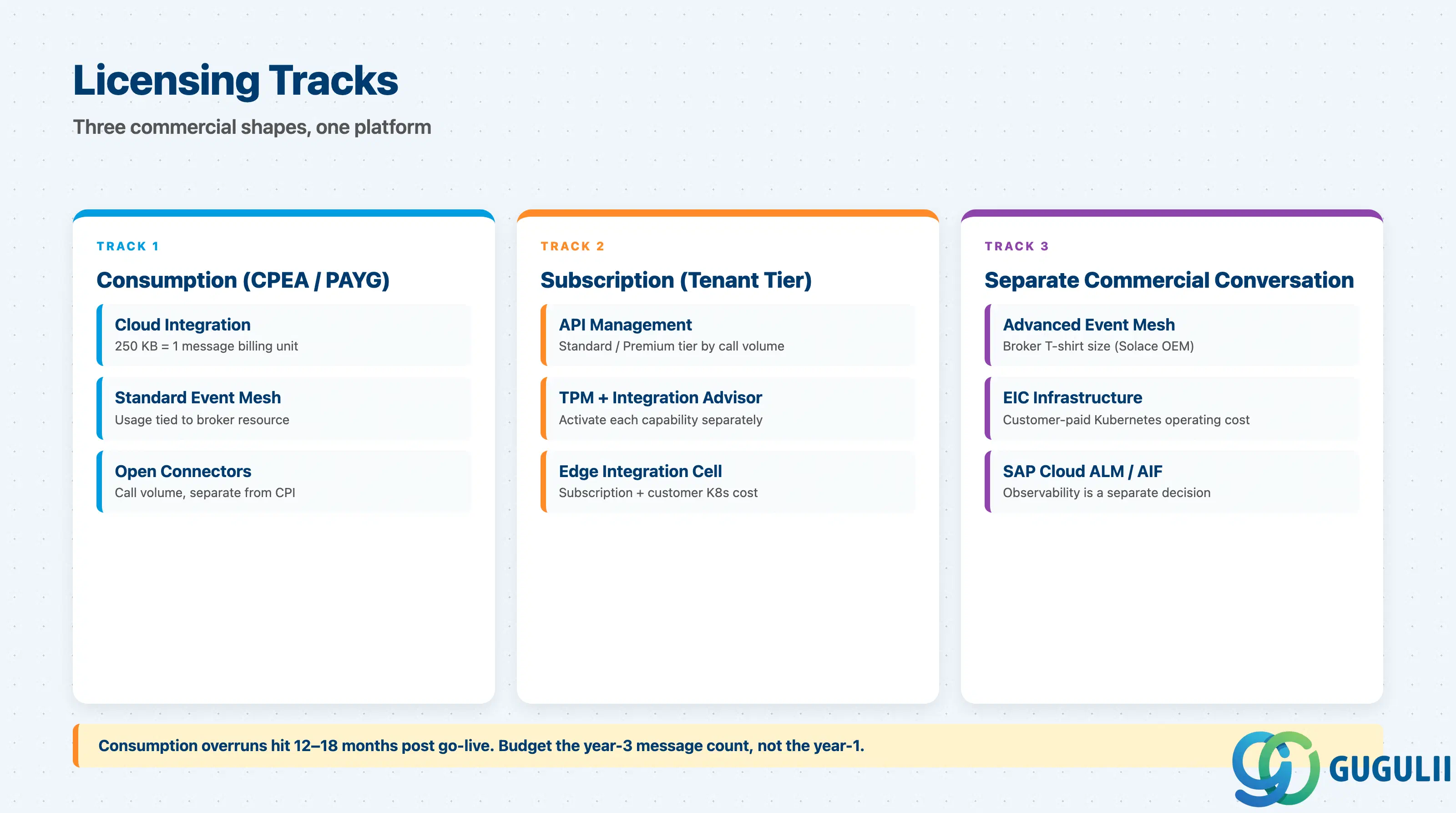
| Capability | Licensing model | Key question to ask |
|---|---|---|
| Cloud Integration | Consumption-based (CPEA / PAYG) — message billing in 250 KB units | “What is the year-2 message count, not just the year-1?” |
| API Management | Subscription (Standard / Premium tenant) — call volume tier | “Which tier covers peak day, not average day?” |
| Event Mesh (Standard) | Consumption-based — usage tied to broker resource | “Are we within 1 MB per message and within practical throughput?” |
| Advanced Event Mesh | Broker-based (“T-shirt size” — Solace OEM) | “What broker tier and how many regions — this is a separate commercial conversation.” |
| Open Connectors | Consumption-based — call volume | “Which connectors and what call volume — counted separately from Cloud Integration.” |
| TPM + Integration Advisor | Subscription, capability-by-capability activation | “Are we activating both? They are paired but priced separately.” |
| Edge Integration Cell | Subscription + customer-paid Kubernetes infrastructure | “Do we have the platform engineering capability, or is that a separate workstream?” |
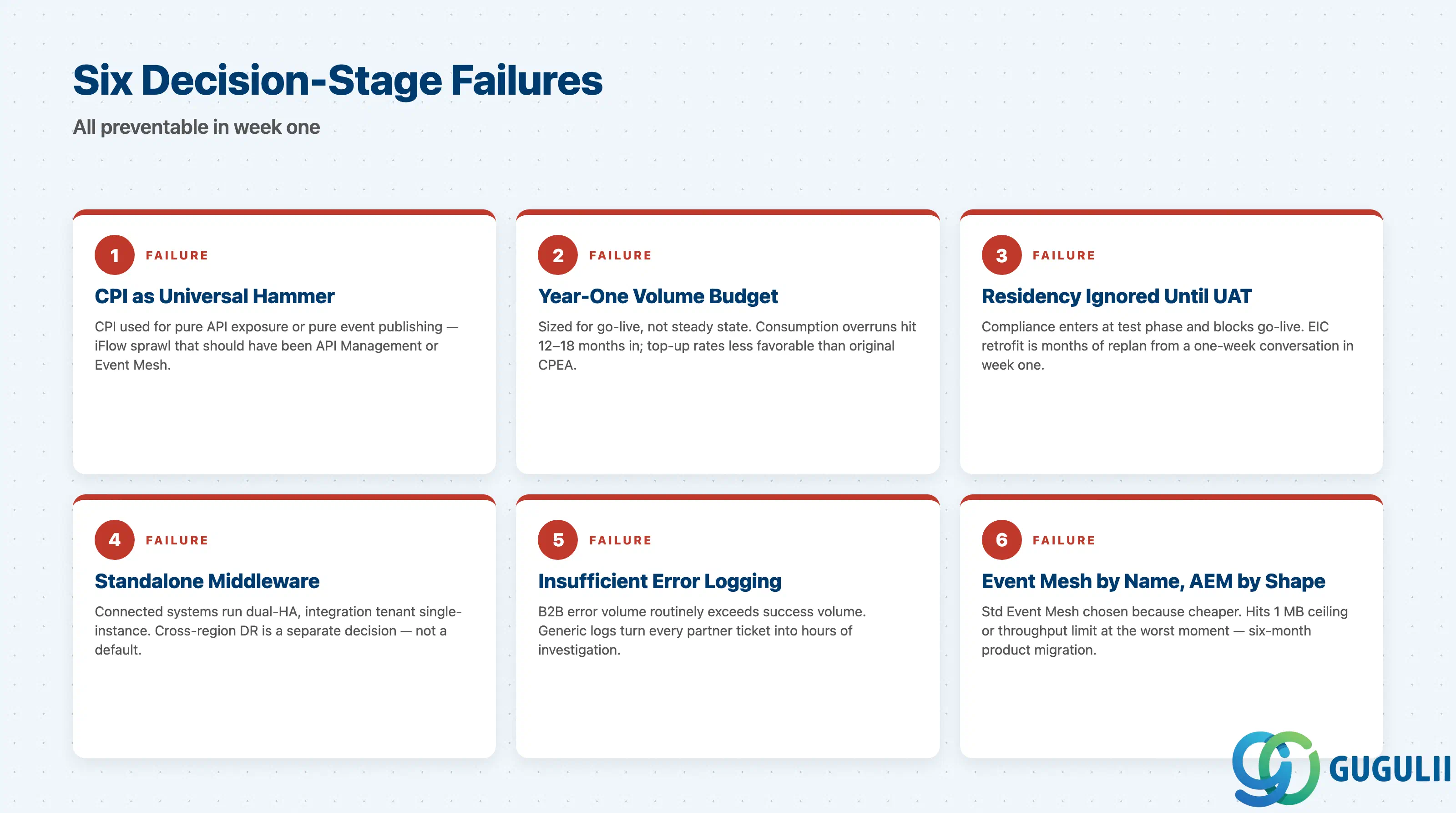
Failure 1: Cloud Integration as the universal hammer
Projects buy Cloud Integration first because it is the most-named capability, then use it for pure API exposure (where API Management is the right answer) and pure event publishing (where Event Mesh is the right answer). The result is iFlow sprawl that masquerades as integration code, with monitoring and lifecycle problems that surface at year two.
Failure 2: Year-one volume budgeting
Sizing the consumption budget against go-live message volume rather than steady-state adoption volume is the most common cost surprise in this space. Customers commonly hit consumption overruns 12–18 months post go-live, and top-up rates are typically less favorable than the original CPEA rate. Build the year-3 number into the year-1 contract.
Failure 3: Data residency ignored until UAT
Compliance and legal teams enter most projects in the test phase and routinely block go-live when data residency was not confirmed at requirements stage. This is the failure that triggers Edge Integration Cell retrofits — a multi-month replan that could have been a one-week conversation in week one.
Failure 4: Standalone middleware, dual-HA business systems
Two business-critical systems are run 24/7 with HA/DR while the integration tenant between them is a single instance. At failover, alignment fails and integrations stop. Integration Suite supports cross-region DR, but it is a separate decision — not a default.
Failure 5: Insufficient error logging in B2B-class flows
In B2B and B2G scenarios, error volume routinely exceeds success volume during partner onboarding and in seasonal load spikes. Generic logs (“processing failed”) make root cause analysis impossible and turn every partner ticket into a multi-hour engineering investigation. The error-handling contract belongs in the requirements document, not the implementation backlog.
Failure 6: Event Mesh chosen by name, AEM needed by shape
The two products share the words “Event Mesh” but are different commercial tracks and different infrastructure. Teams pick Standard Event Mesh because it is cheaper and bundled, then hit the 1 MB ceiling or the throughput practical limit at the worst possible moment. A 30-minute conversation about message size and event rate at requirements stage prevents a six-month product migration.
Q: We already use SAP PI/PO on-premise. Is Integration Suite the only path forward?
It is the SAP-published strategic path forward, supported by the Migration Assessment capability and the Edge Integration Cell deployment option for customers who cannot fully move to cloud-only. SAP Process Orchestration remains supported, but new investment is on the iPaaS side; clean core integration is one of SAP’s five clean core principles, and it points at Integration Suite. If your timeline is multi-year, plan the migration; if there is an immediate compliance constraint, EIC bridges the gap.
Q: When is Open Connectors the right choice over a Cloud Integration custom adapter?
When the target SaaS is on the supported connector list and the integration is mostly straight-through with light mapping. Open Connectors gives you the connection in days; Cloud Integration with a custom adapter is weeks of build and lifelong maintenance. The decision flips when the mapping is non-trivial — chain Cloud Integration after Open Connectors rather than building either alone.
Q: How do we know whether Standard Event Mesh is enough?
Three numbers decide it: maximum message size (must be < 1 MB), event rate (must comfortably fit ~250 KB/s practical per subaccount), and topology (must stay inside SAP BTP). If any of the three is uncertain, scope the next-volume tier or design for Advanced Event Mesh from the start. Mid-project product swaps in the event layer are expensive.
Q: When should we descope Trading Partner Management and stick with raw Cloud Integration B2B adapters?
When the trading partner population is small (typically ≤5 partners), document standards are minimal, and onboarding cadence is annual rather than quarterly. TPM’s value is its reusable artifacts (Company Profile, Trading Partner Profiles, agreements) and partner directory — at low volumes that overhead is not amortized. Above the threshold, TPM + Integration Advisor pays for itself in onboarding time saved.
Q: How do we document the integration requirement properly so the build team does not redesign it?
Three artifacts: (1) the use case category (one of the five from §1) with measurable pain, (2) the ISA-M classification (style + domain) with the chosen capability, and (3) the operating-model decision (owner, budget, monitoring stack, error workflow). All three live in the requirements document and survive into production. A diagram alone is not enough.
Q: Where does Cloud ALM fit in this picture?
SAP Cloud ALM and SAP Application Interface Framework are the recommended observability stack across Integration Suite. They are a separate decision from capability selection — every capability above can be operated without Cloud ALM, but at scale the central observability becomes load-bearing. Decide the monitoring stack alongside the capabilities, not after.
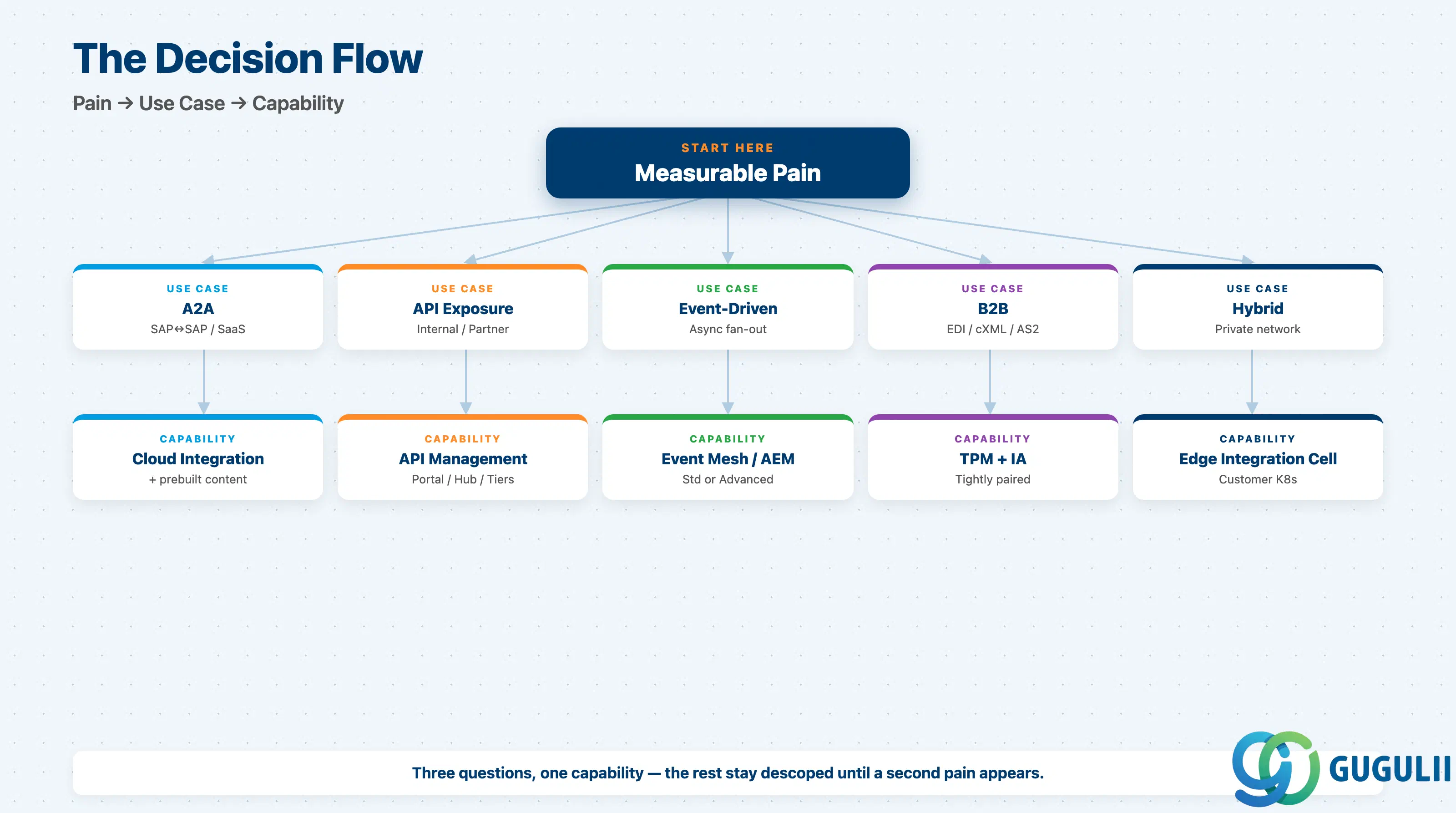
Integration Suite is not five products you deploy in sequence — it is one platform with a small number of use case shapes and a methodology, ISA-M, that turns those shapes into defensible technology choices. The five shapes (A2A, API exposure, event-driven, B2B, hybrid) cover almost everything a real project does. The three questions (measurable pain, endpoint domain, owner with budget) decide which shape applies. The seven failures are all decision-stage failures, not implementation bugs. A consultant who can walk a customer through this frame in one workshop is worth the engagement; a project that skips the frame and starts in the implementation tool is the one that comes back for a redesign.
| ID | Category | Component | Scope |
|---|---|---|---|
| BTP-A01: SAP Integration Suite Overview | Series anchor | Integration Suite | Overview and Capability Map |
| BTP-A02: Cloud Integration (CPI) | Capability | Cloud Integration | Architecture and Use |
| BTP-A03: API Management | Capability | API Management | Architecture and Use |
| BTP-A04: Event Mesh | Capability | Event Mesh | Architecture and Use |
| BTP-A05: Open Connectors | Capability | Open Connectors | Architecture and Use |
| BTP-A06: B2B Integration (1) | Capability | Trading Partner Management | Architecture and Use |
| BTP-A07: B2B Integration (2) | Capability | Integration Advisor | Architecture and Use |
| BTP-A08: Integration Suite: Use Cases and Decision Patterns | Series finale | Integration Suite | Use Cases and Decision Patterns (this article) |