Title here
Summary here

| ID | Title |
|---|---|
| BTP-B01 | Application Development on SAP BTP: Overview and Capability Map (this article) |
| BTP-B02 | Business Application Studio: Architecture and Use |
| BTP-B03 | CAP and Build Code: Pro-Code Development |
| BTP-B04 | ABAP Environment: Side-by-Side and Embedded |
| BTP-B05 | Build Apps: Low-Code Development |
| BTP-B06 | Build Process Automation: Workflow and RPA |
| BTP-B07 | Build Work Zone: Sites and Digital Workspaces |
| BTP-B08 | Application Development: Use Cases and Decision Patterns |
| Resource | URL |
|---|---|
| Cloud Foundry, Kyma, or Both? (BTP Admin Guide) | help.sap.com → |
| Development in the Cloud Foundry Environment | help.sap.com → |
| SAP BTP ABAP Environment | help.sap.com → |
| SAP Build product page | sap.com → |
| SAP Cloud Application Programming Model (capire) | cap.cloud.sap → |
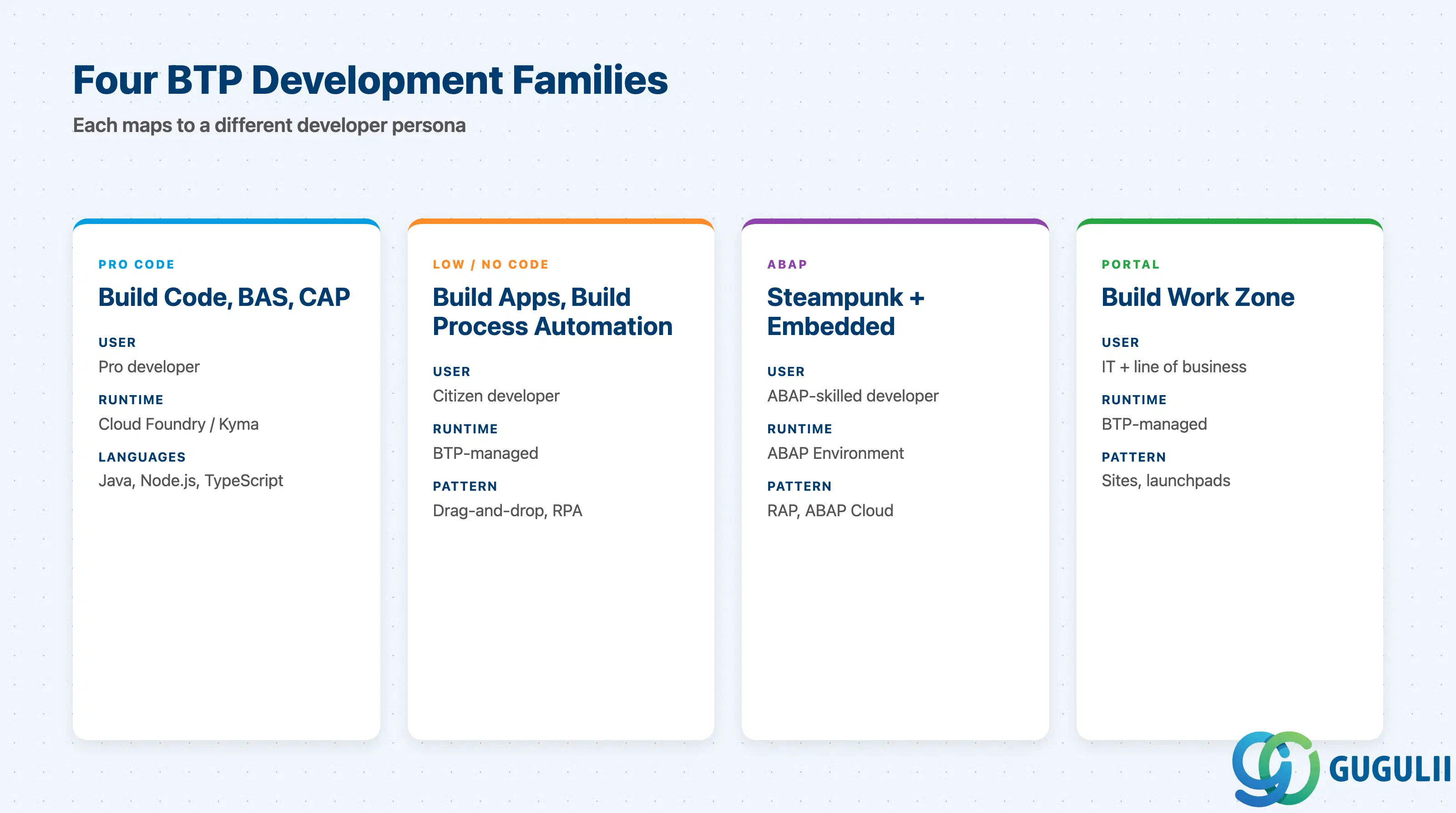
SAP BTP does not have one “development tool.” It has four families, each built around a different developer persona and a different runtime. Treating them as interchangeable is the most common requirements-stage mistake in this space.
| Family | Tools | Primary user | Primary runtime |
|---|---|---|---|
| Pro Code | SAP Build Code, Business Application Studio, CAP, Joule for Developers | Pro developer (Java / Node.js / TypeScript) | Cloud Foundry, Kyma |
| Low-Code / No-Code | SAP Build Apps, SAP Build Process Automation | Citizen developer, business user | BTP-managed |
| ABAP | SAP BTP ABAP Environment (“Steampunk”), Embedded Steampunk in S/4HANA Cloud | ABAP-skilled developer | ABAP Environment |
| Portal / Site | SAP Build Work Zone (standard / advanced) | IT plus line of business | BTP-managed |
They are not substitutes. A Build Apps no-code project does not become a CAP service; an ABAP Cloud extension cannot be repackaged as a Build Code microservice without a rewrite. Family choice is a one-way door for the lifetime of the asset and belongs in the requirements stage.
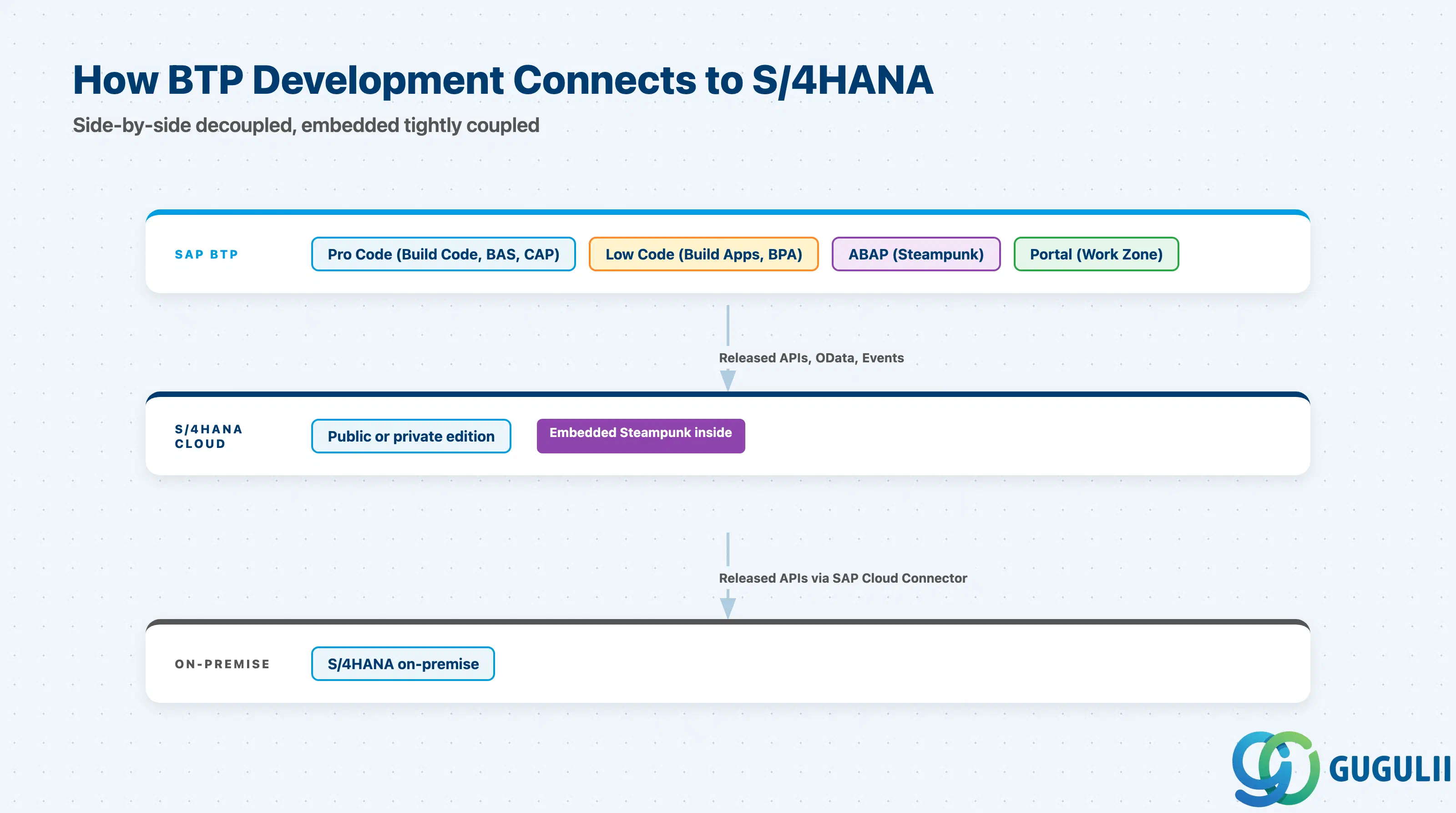
Every BTP development family talks to S/4HANA, but the direction, coupling, and contract differ:
                         SAP BTP — Application Development
   ┌────────────────────────────────────────────────────────────────────┐
   │  Pro Code:    Build Code / BAS / CAP   ─── Cloud Foundry / Kyma    │
   │  Low Code:    Build Apps / Build Process Automation                │
   │  ABAP:        BTP ABAP Environment (Steampunk, side-by-side)       │
   │  Portal:      Build Work Zone (standard + advanced)                │
   └────────────────────────────┬───────────────────────────────────────┘
                                │ Released APIs, OData, events
                                ▼
   ┌────────────────────────────────────────────────────────────────────┐
   │  S/4HANA Cloud (public or private edition)                         │
   │  ┌──────────────────────────────────────────────────────────────┐  │
   │  │  Embedded Steampunk (in-stack ABAP extensions, tight-coupled)│  │
   │  └──────────────────────────────────────────────────────────────┘  │
   └────────────────────────────────────────────────────────────────────┘
                                ▲
                                │ Released APIs (RFC where still allowed)
                                │ via SAP Cloud Connector
   ┌────────────────────────────┴───────────────────────────────────────┐
   │  S/4HANA on-premise                                                │
   └────────────────────────────────────────────────────────────────────┘
Key point: Side-by-side BTP development is decoupled from the S/4HANA upgrade cycle and can use any language; embedded (in-stack) ABAP is tightly coupled and can only be ABAP. Choosing the wrong side of that line is what produces extensions that block upgrades or extensions that drift away from the core.
| Capability | Maturity | Notes |
|---|---|---|
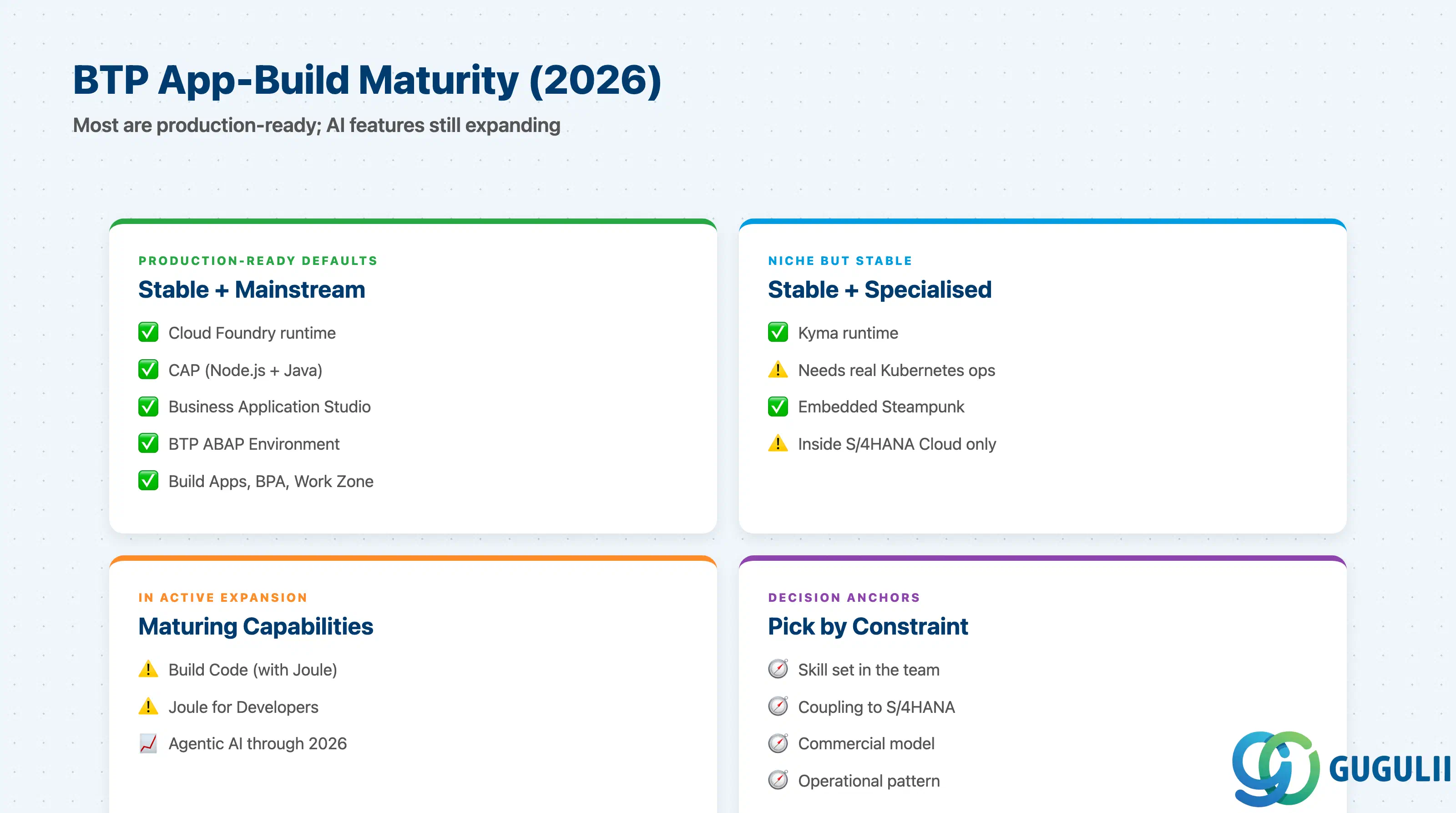
| Cloud Foundry runtime | ✅ Production-ready | Longest-running BTP runtime, broadest service catalogue, default for CAP. |
| Kyma runtime | ✅ Production-ready | Requires real Kubernetes operations capability; smaller community than Cloud Foundry. |
| BTP ABAP Environment (Steampunk) | ✅ Production-ready | Multi-hyperscaler since 2025 (AWS, Azure, GCP, SAP Cloud Infrastructure). |
| Embedded Steampunk | ✅ Production-ready | Lives inside S/4HANA Cloud; tight-coupling logic only; release tied to S/4HANA. |
| Business Application Studio | ✅ Production-ready | Browser-based; subscription. Joule integration expanding through 2026. |
| CAP (Node.js + Java) | ✅ Production-ready | Both runtimes are GA; Java path more common in regulated industries. |
| Build Apps | ✅ Production-ready | Mature low-code (formerly AppGyver); strongest fit for departmental web/mobile apps. |
| Build Code | ⚠️ Production-ready, AI features in active expansion | Joule generates CAP models and OData services; agentic AI capabilities maturing through 2026. |
| Build Process Automation | ✅ Production-ready | Unifies the former Workflow Management + Intelligent RPA; strong for cross-system orchestration. |
| Build Work Zone (standard) | ✅ Production-ready | Successor to Launchpad service. |
| Build Work Zone (advanced) | ✅ Production-ready | Adds collaboration, enterprise search, drag-and-drop site building. |
| Joule for Developers | ⚠️ GA in core scenarios | Available in Build Code, ABAP development tools, VS Code (Joule Studio code editor). Roadmap target: 20% writing time and 25% testing time reduction. |
Each family has a different set of questions to clear before you commit to it. Treat these as gating items — if any line is unanswered at requirements stage, the project is not ready to enter design.
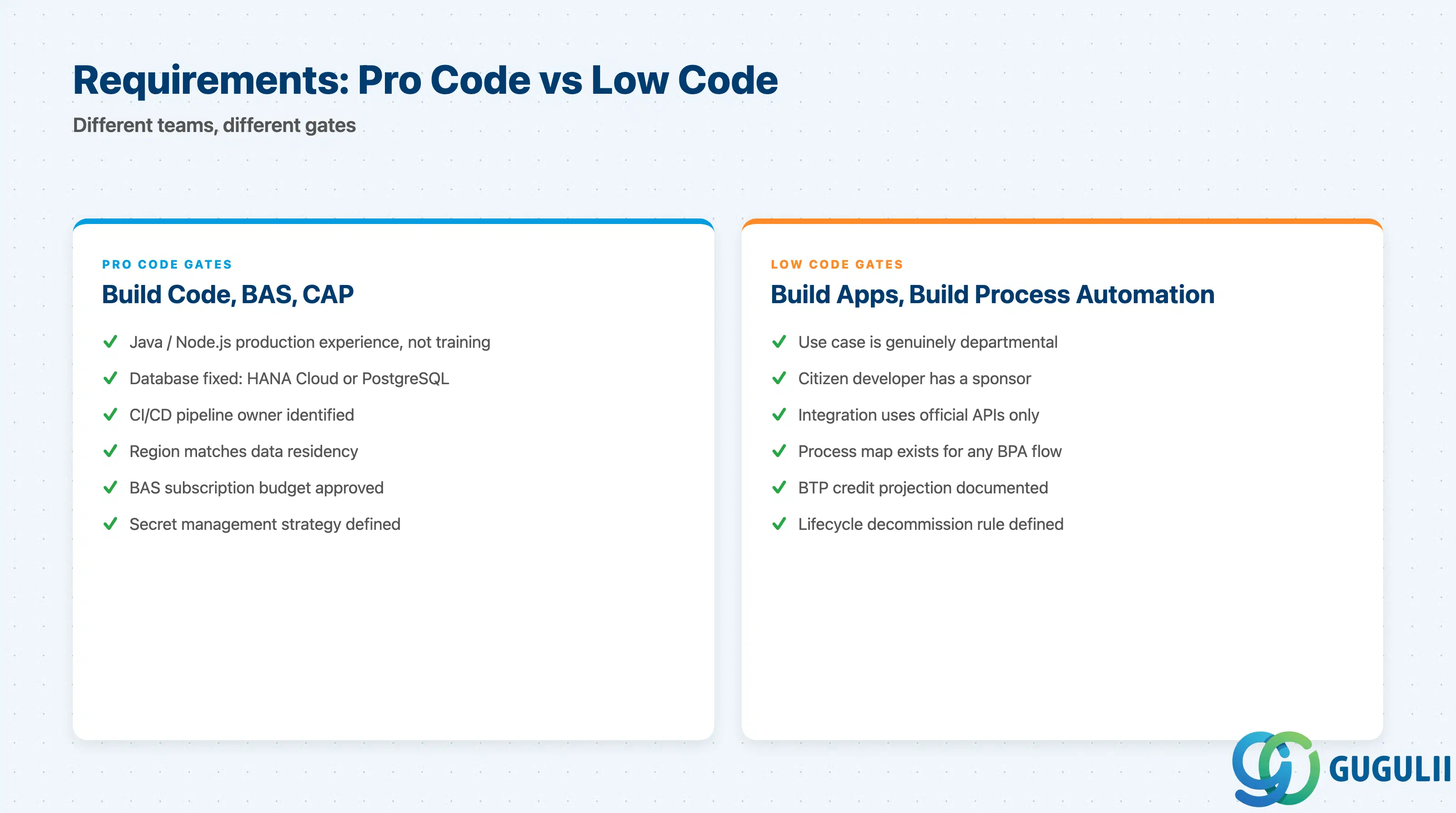
| Checklist item | Why it matters |
|---|---|
| Team has Java or Node.js production experience, not just training | CAP and Build Code assume professional polyglot skills; learning on the project is a budget risk. |
| Database choice fixed: SAP HANA Cloud or PostgreSQL on hyperscaler | Cost and operational ownership differ; HANA Cloud is licensed separately from CPEA credits in many contracts. |
| CI/CD pipeline owner identified (project team or platform group) | BTP does not deliver an opinionated pipeline; you bring your own (GitHub Actions, Jenkins, Azure DevOps). |
| Region selected matches data residency requirements | Cloud Foundry and Kyma availability varies by hyperscaler region; pick before architecture. |
| BAS subscription budget approved and secret management strategy defined | BAS is paid per developer; hard-coded secrets are the most common production-readiness blocker. |
| Checklist item | Why it matters |
|---|---|
| Use case is genuinely departmental, not a system of record | Citizen-built apps with system-of-record scope hit governance walls in audit. |
| Citizen developer has a sponsor with authority to maintain the app | Apps without a maintainer become shadow IT in 12 months. |
| Integration to SAP source uses official destinations or APIs | Direct DB pulls bypass Clean Core and rarely survive an upgrade. |
| Process map exists for any Build Process Automation workflow | Automating an undocumented process amplifies chaos. |
| BTP credit projection and lifecycle decommission rule documented | Budget surprises are common at scale; a clear sunset rule controls the estate cheaply. |
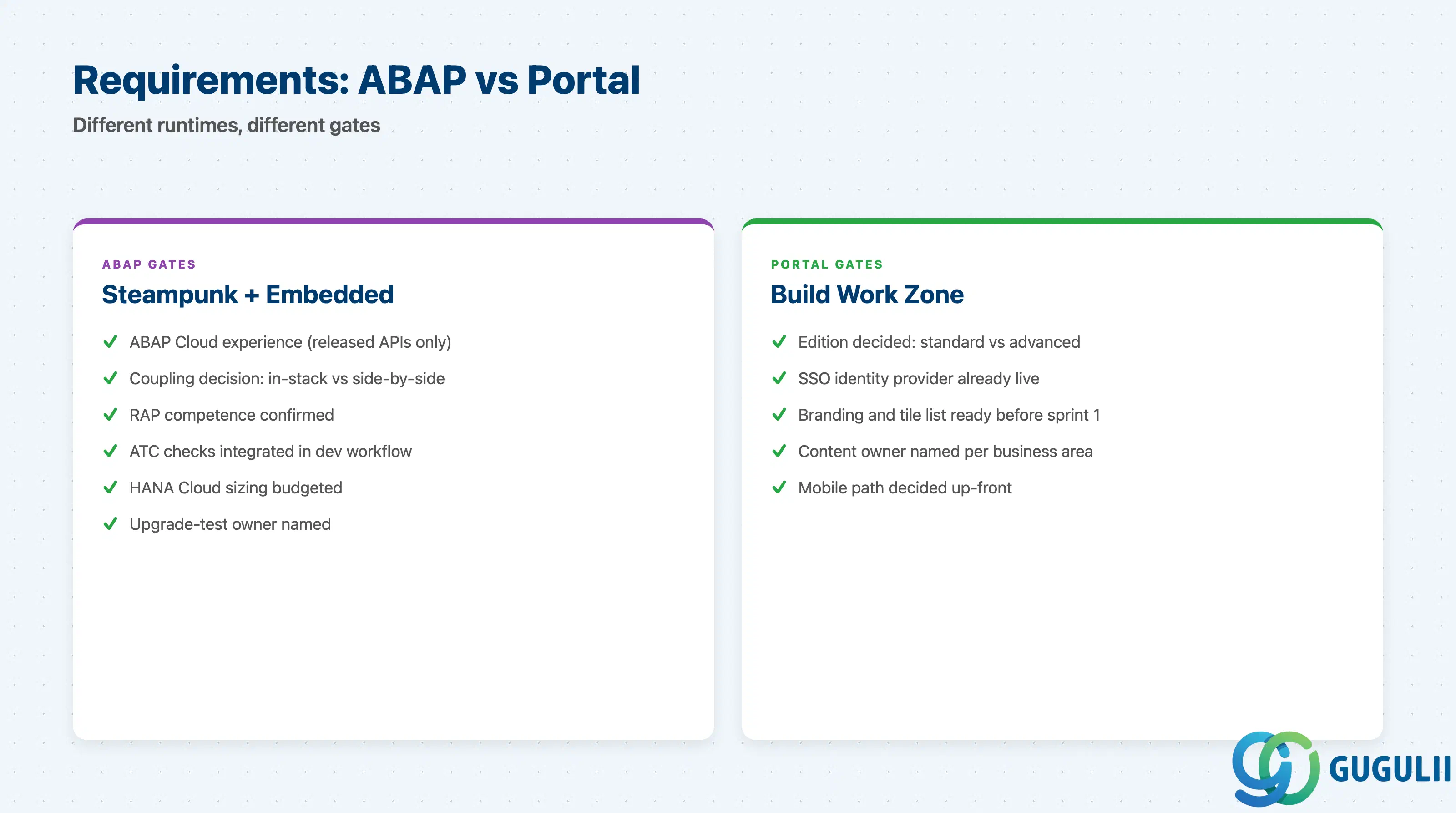
| Checklist item | Why it matters |
|---|---|
| Team has ABAP Cloud experience (released APIs only), not just classic ABAP | Classic patterns (direct table access, modifying SAP code) are blocked; Cloud discipline is required. |
| Coupling decision documented: in-stack (embedded) vs side-by-side | The wrong side produces upgrade-blocking or release-drifting code. |
| RAP (RESTful ABAP Programming) competence confirmed | RAP is the only path for OData services in ABAP Cloud; legacy Gateway patterns no longer apply. |
| ATC (ABAP Test Cockpit) checks integrated into the dev workflow | Cloud-readiness checks run automatically; ignoring them defers technical debt to release. |
| SAP HANA Cloud sizing budgeted and upgrade-test owner named | Steampunk uses HANA Cloud; embedded code is tied to S/4HANA’s quarterly cadence. |
| Checklist item | Why it matters |
|---|---|
| Edition decision made: standard vs advanced | Advanced edition costs significantly more and is only justified by collaboration / enterprise search needs. |
| Single sign-on identity provider already in production | Work Zone fronts SAP and non-SAP apps; SSO is a hard prerequisite, not a phase 2. |
| Branding assets and application tile list ready before sprint 1 | Empty deployments and post-launch rework both consume credibility and budget. |
| Content owner named per business area | Content rot is the most common reason for portal abandonment. |
| Mobile experience decided (Build Apps, Mobile Services, browser-only) | Deciding later forces re-architecture. |
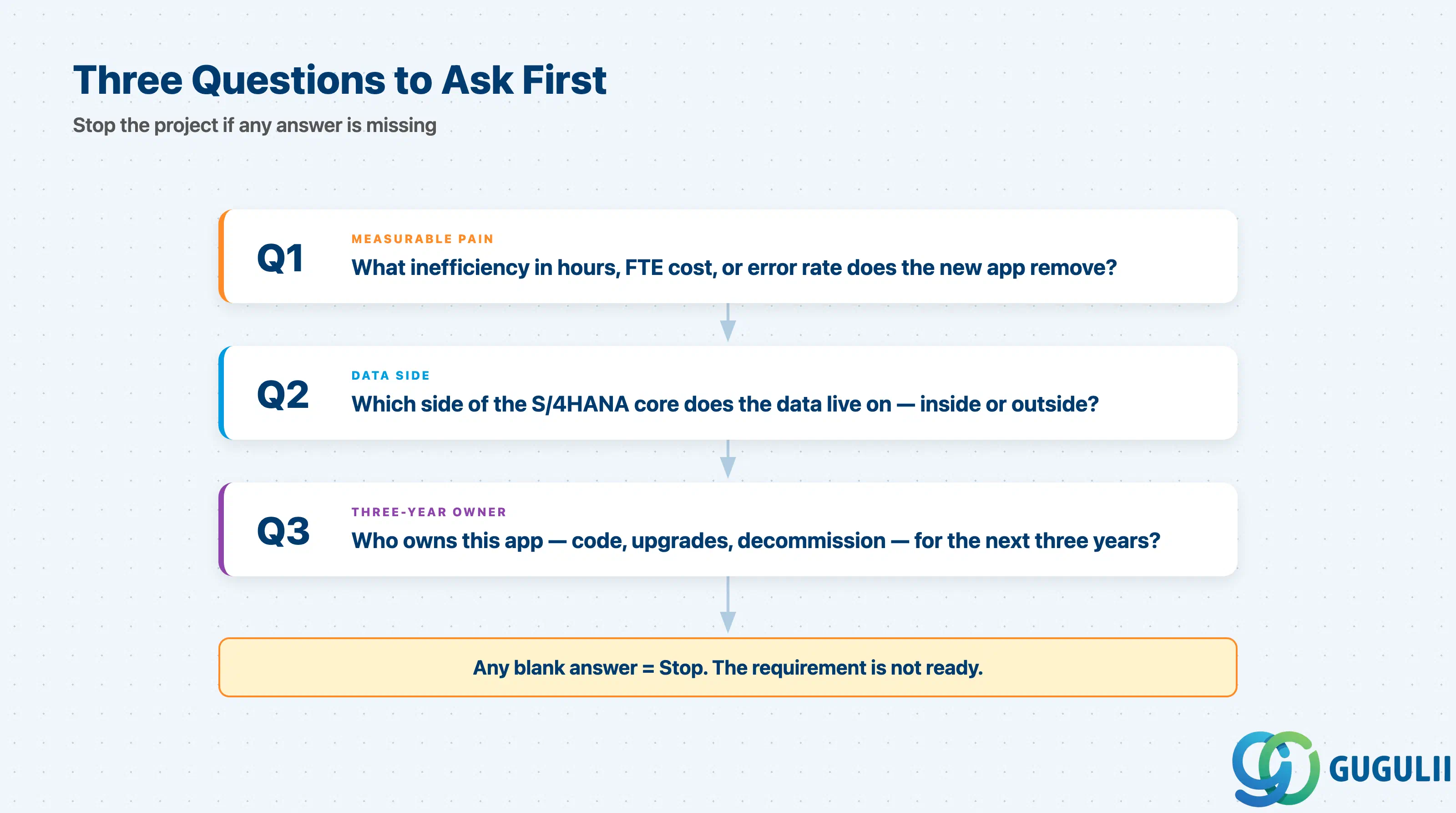
Q1. What is the measurable inefficiency the new app must remove?
Without a measurable starting point — hours per week, FTE cost, error rate, customer wait time — every “let’s modernise” pitch eventually loses funding. The question forces a real number before any tool is named.
Q2. Which side of the S/4HANA core does the data live on?
If the logic operates directly on a standard S/4HANA table or a custom field on a standard business object, the right answer is in-stack (Embedded Steampunk or Key User extensibility). If it operates on data mostly outside the core — partner data, IoT data, customer-facing portals — side-by-side on BTP is correct.
Q3. Who owns this app for the next three years?
A pro-code CAP project with no permanent owner becomes legacy faster than a low-code app does. Citizen-built apps without a sponsor become shadow IT. ABAP extensions without an upgrade-test owner become upgrade blockers. Naming the owner is gating.
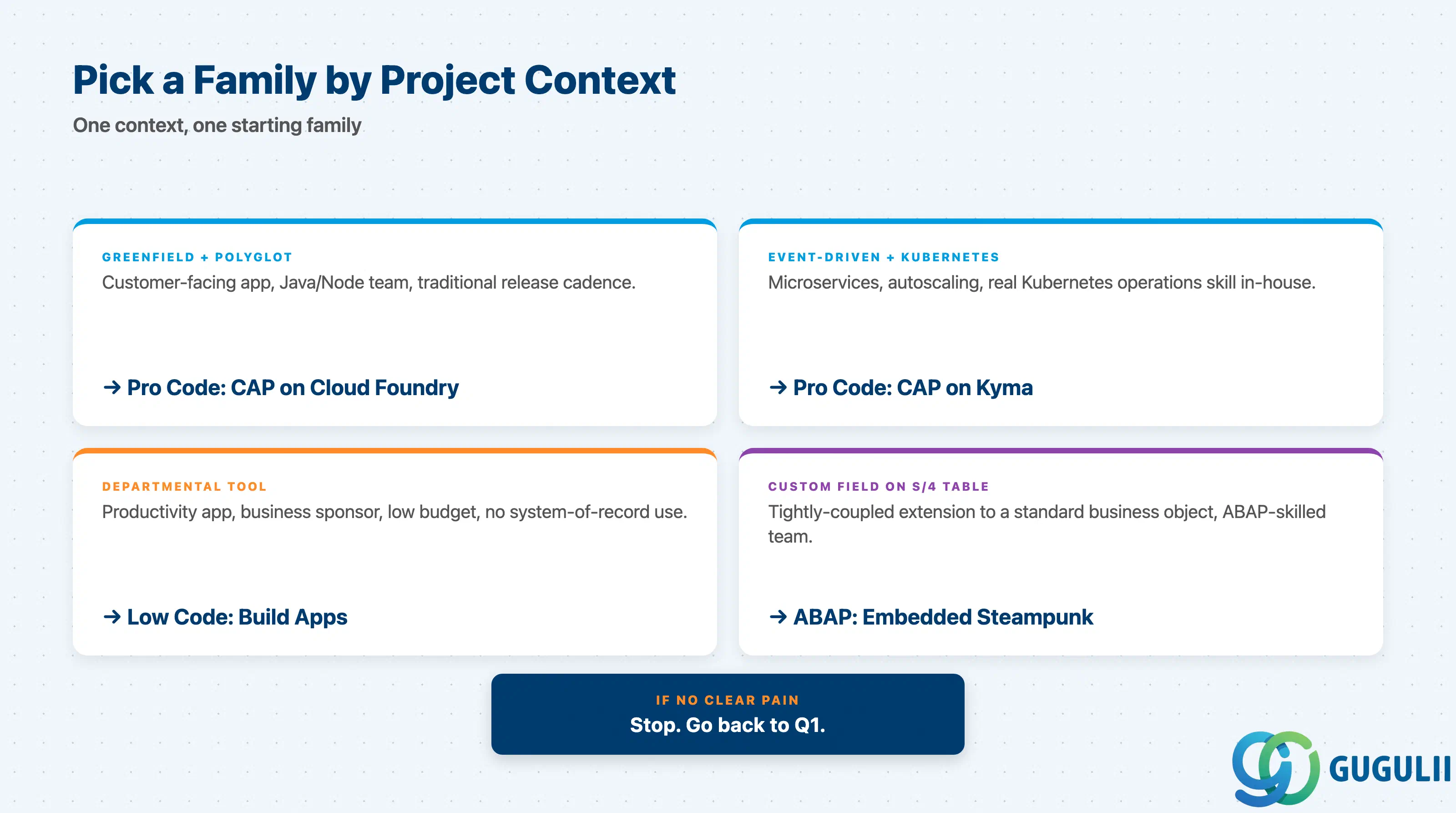
| Project context | Recommended starting family / tool |
|---|---|
| Greenfield customer-facing app, polyglot team | Pro Code — CAP on Cloud Foundry |
| Greenfield event-driven microservices, Kubernetes-skilled team | Pro Code — CAP / TypeScript on Kyma |
| Departmental productivity tool, business sponsor, low budget | Low Code — Build Apps |
| Cross-system workflow with a documented process map | Low Code — Build Process Automation |
| Custom field on a standard S/4HANA table or BAdI logic | ABAP — Embedded Steampunk (in S/4HANA Cloud) |
| Side-by-side ABAP extension reusing existing ABAP skill | ABAP — BTP ABAP Environment (Steampunk) |
| Employee or partner portal aggregating SAP and non-SAP apps | Portal — Build Work Zone |
| Any combination above with a Joule-augmented dev workflow | Add Build Code with Joule for Developers to whichever family applies |
| No clear pain point identified yet | Stop. Go back to Q1. |
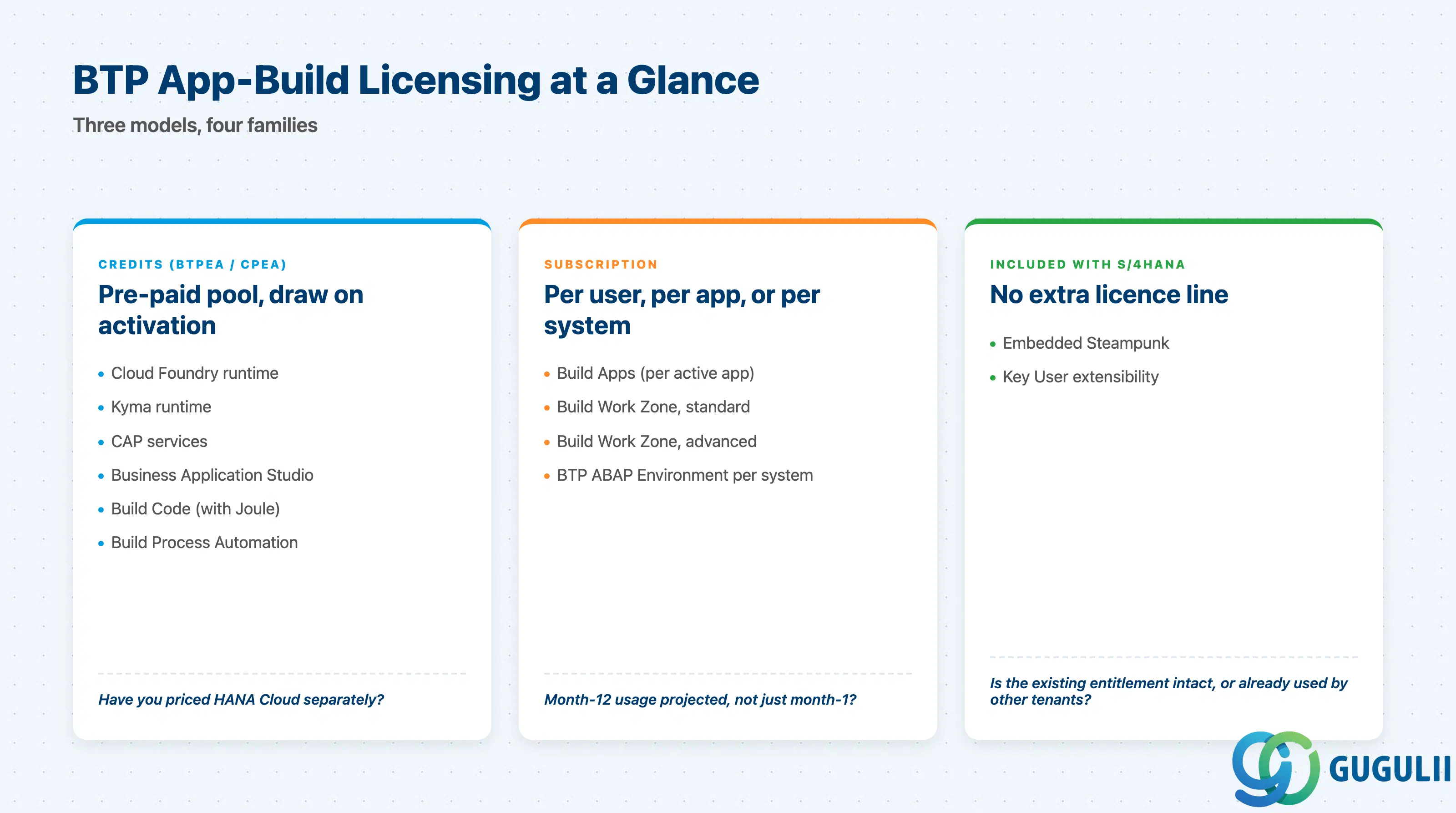
| Family | Licensing model | Key question to ask |
|---|---|---|
| Pro Code (Cloud Foundry, Kyma, CAP, BAS) | BTPEA / CPEA credits + per-developer BAS subscription | Have you priced HANA Cloud separately from your BTP credit pool? |
| Pro Code (Build Code with Joule) | BTPEA credits or subscription; Joule capacity may be metered | Is Joule consumption charged per call, per developer, or absorbed into the Build Code subscription? |
| Low-Code (Build Apps) | Subscription (per active app or session-based tier) | Have you projected month-12 active sessions, not month-1? |
| Low-Code (Build Process Automation) | BTPEA credits, metered by automation execution | What is the planned number of automation runs per month? |
| ABAP (BTP ABAP Environment) | Subscription per system; HANA Cloud sized separately | Is the Steampunk system sized for production peak, or developer peak? |
| ABAP (Embedded Steampunk) | Included with the S/4HANA Cloud licence | Is the existing S/4HANA Cloud entitlement intact, or has it been depleted by other tenants? |
| Portal (Build Work Zone, standard / advanced) | Subscription per registered user; advanced is a higher tier | How many users will log in monthly, and are advanced-only features actually used? |
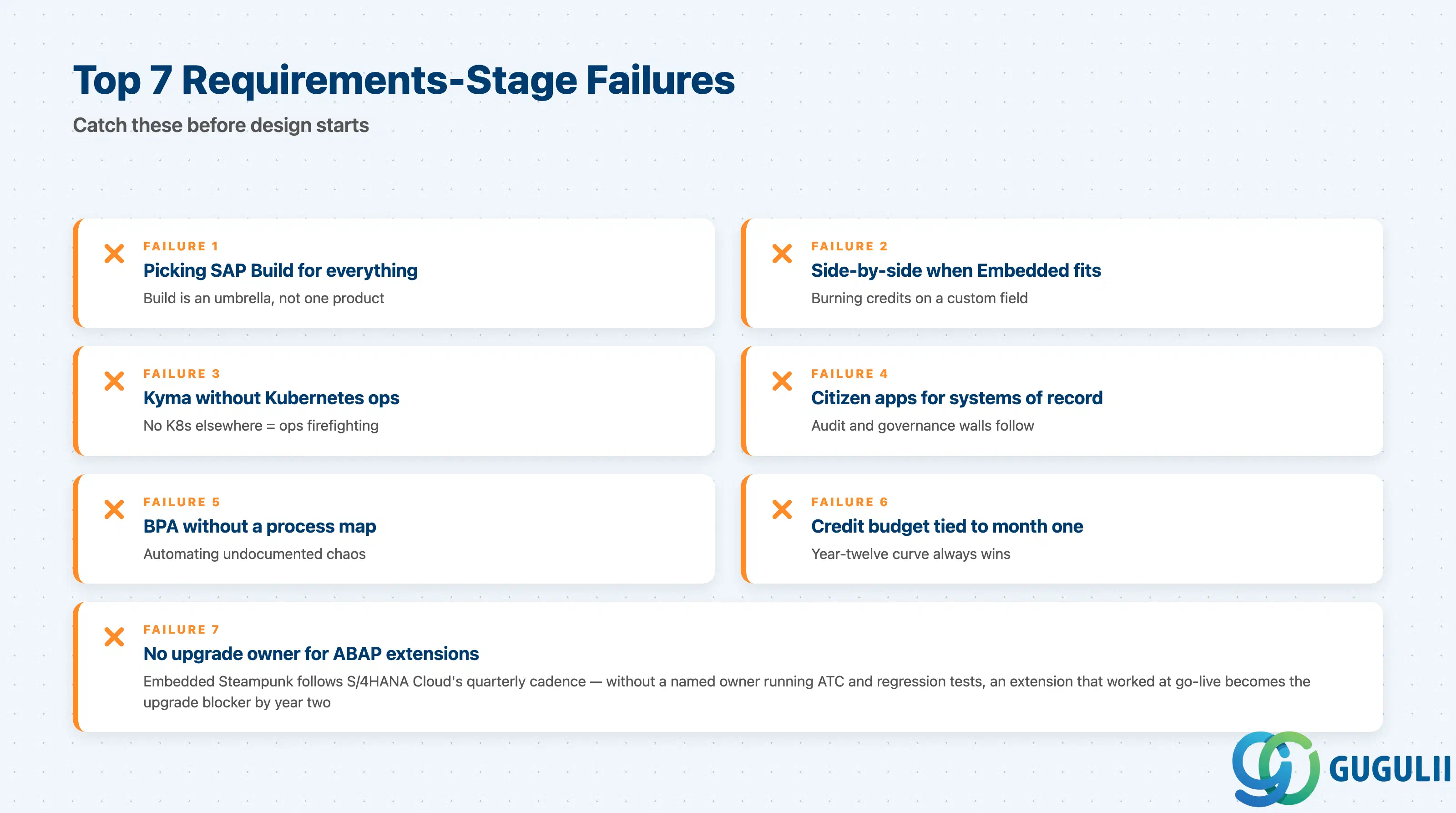
Failure 1: Picking SAP Build for everything
“SAP Build” is a marketing umbrella, not a single product. Teams that say “Build” without specifying Apps, Code, Process Automation, or Work Zone end up procuring the wrong subscription. Force a family-and-tool choice at requirements stage and write it into the charter.
Failure 2: Side-by-side when Embedded Steampunk fits
A custom field on a standard S/4HANA table can almost always be done in Embedded Steampunk and is included with the S/4HANA Cloud entitlement. Building it on BTP burns credits and requires data round-trips for no functional gain. Trigger phrase: “we’re paying BTP credits for an extension that is just a custom field.”
Failure 3: Kyma without Kubernetes operations
Kyma is genuinely cloud-native, but it is Kubernetes — node pools, RBAC, network policies, observability. Teams that pick it because it sounds modern, without already running Kubernetes elsewhere, lose the saved development time to operations firefighting. Cloud Foundry remains the safer default.
Failure 4: Citizen-built apps for systems of record
Build Apps is excellent for departmental tools and prototypes. Once a citizen-built app hosts master data, generates audit-relevant transactions, or feeds financial reporting, it is no longer citizen-built. Use a documented sunset-or-promote rule: at a defined threshold, IT rebuilds it in a pro-code family.
Failure 5: Process automation without a process map
Build Process Automation is a multiplier on whatever process you give it. If the process is undocumented, the automation amplifies the chaos and produces an opaque dependency. Requiring a documented process map as input to any SBPA scope is the cheapest defence.
Failure 6: BTP credit budget tied to month one, not month twelve
Credits look generous on day one because nothing is running yet. By month twelve, an event-driven CAP app with HANA Cloud, Joule calls, and Build Apps front-ends consumes credits faster than the pilot assumed. Build the year-twelve curve into the commercial case from the start.
Failure 7: No ownership for ABAP extensions across upgrades
Embedded Steampunk extensions follow S/4HANA Cloud’s quarterly release cadence. Without a named owner running ATC checks and regression tests on each release candidate, an extension that worked at go-live becomes an upgrade blocker by year two.
Q: Can on-premise SAP customers use these BTP development families?
Yes. BTP development is independent of whether the source system is S/4HANA Cloud or S/4HANA on-premise. Side-by-side patterns (CAP, ABAP Environment, Build Apps) all work against on-premise systems through SAP Cloud Connector and released APIs. Only Embedded Steampunk requires S/4HANA Cloud, because it lives inside that runtime.
Q: How does licensing work — is it one bill or many?
It depends on the commercial model. With BTPEA (BTP Enterprise Agreement), most BTP development services share a single credit pool and you draw against it as services are activated. Standalone subscriptions (BAS, some Build editions) are billed separately. HANA Cloud is almost always billed as a separate line, even within BTPEA. Model the total of credit + subscription + database before committing.
Q: When should we descope a development family from a project?
When Q1 (measurable pain) returns “we want to modernise” with no number, descope. When Q3 (three-year owner) returns “we’ll figure that out later,” descope. When the family is being chosen by what the team knows rather than what the problem requires, escalate to the architecture lead and document the constraint explicitly.
Q: How do we document the development-family requirement properly?
In the project charter, write one line per asset: Asset X uses Family Y, tool Z, runtime R, owned by O, sized for usage profile P. Five fields, one line. Any empty field means the requirement is not ready. Longer documents tend to hide gaps.
Q: Do we need Joule for Developers from day one?
No. Joule is GA in core scenarios and SAP’s stated efficiency gains (around 20% writing time, 25% testing time) are real, but it is not a prerequisite for any of the four families. Treat Joule as an accelerator that a team adopts when the development practice itself is already healthy. Adding it to a team without CI/CD or test discipline does not fix the underlying problem.
Q: How does Clean Core extensibility map to these families?
Clean Core “Level A” means custom code lives outside the digital core, accessed via released APIs and events. All four families can produce Level A extensions when used correctly: ABAP Cloud (in-stack or side-by-side), CAP, and SAP Build all qualify. The family choice is about the team and the use case, not the cleanliness rating itself.
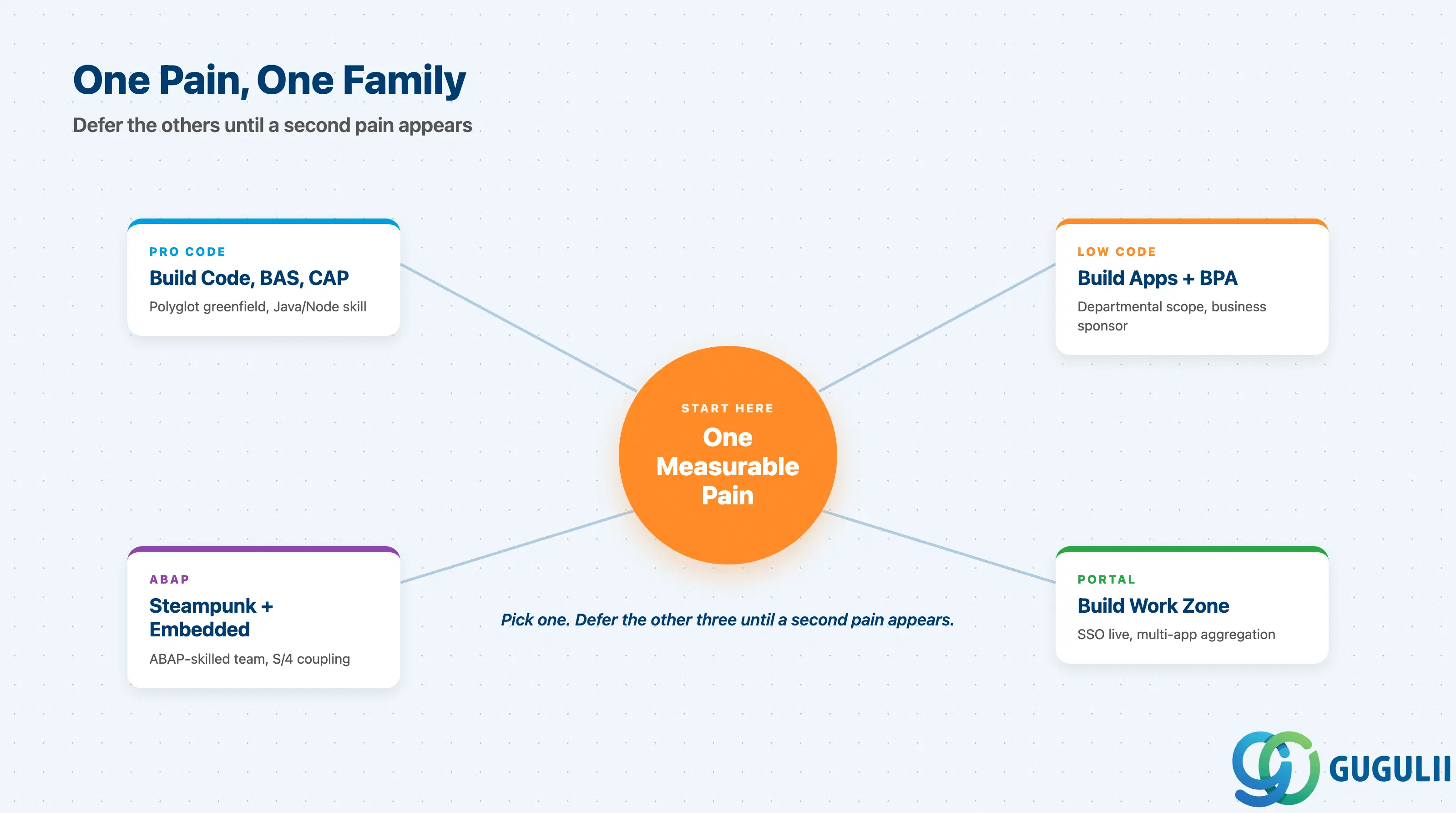
SAP BTP’s application development surface is four families: Pro Code, Low-Code, ABAP, and Portal. Each maps to a specific developer persona, runtime, and commercial line. They are not substitutes, and the family decision is a one-way door for the lifetime of each asset.
In 2026 every family is production-ready. The safest defaults remain Cloud Foundry for pro-code and BTP ABAP Environment for ABAP teams. Kyma rewards customers already running Kubernetes; Joule for Developers accelerates teams whose development practice is already healthy.
The consultant’s job is to refuse “let’s use SAP Build for everything,” translate one measurable pain into one family, and defer the others until a second pain appears. B02 through B08 drill into each family individually and converge on the decision patterns in B08.