Title here
Summary here

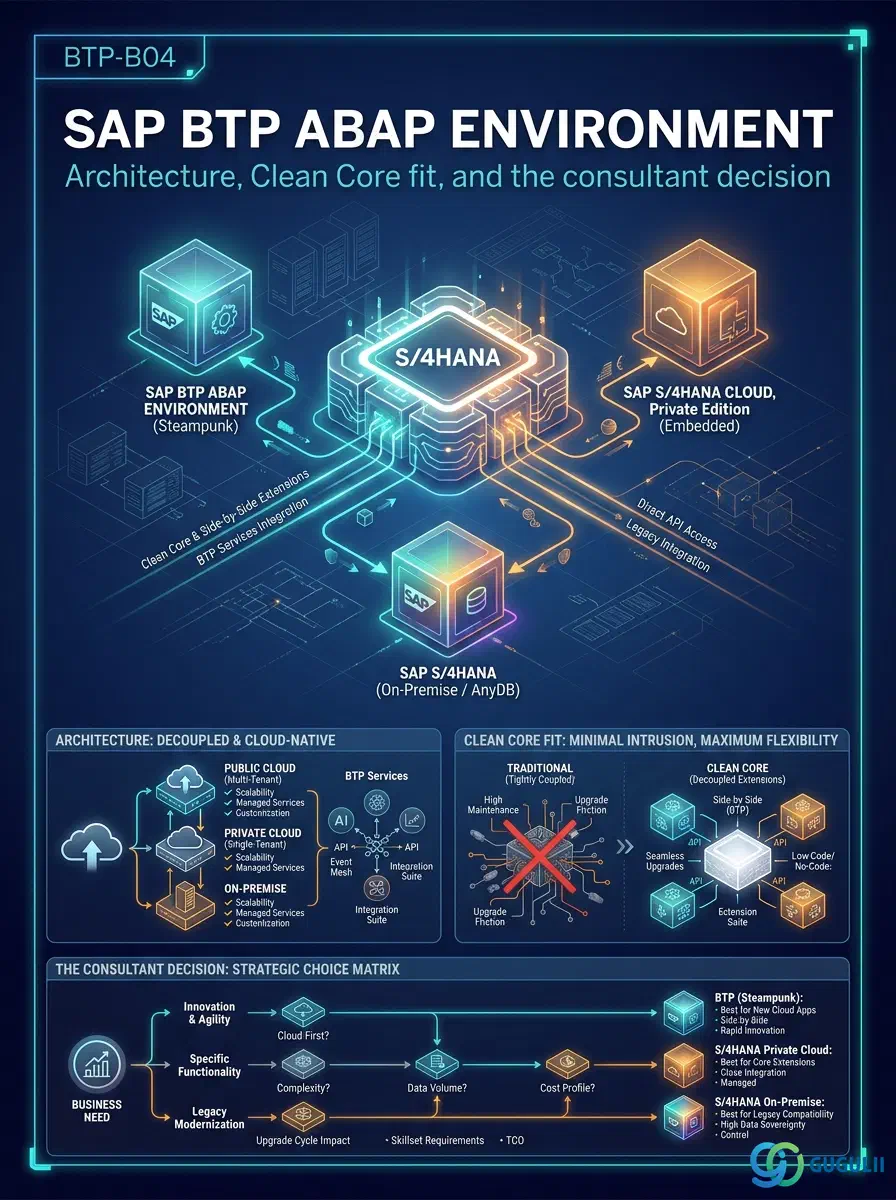
| ID | Category | Component | Scope |
|---|---|---|---|
| BTP-B01 | Overview | Application Development | Overview and Capability Map |
| BTP-B02 | Pro-code IDE | Business Application Studio | Architecture and Use |
| BTP-B03 | Pro-code framework | CAP and Build Code | Architecture and Use |
| BTP-B04 | ABAP runtime | ABAP Environment | Architecture and Use (this article) |
| BTP-B05 | Low-code | Build Apps | Architecture and Use |
| BTP-B06 | Process automation | Build Process Automation | Architecture and Use |
| BTP-B07 | Front-end shell | Build Work Zone | Architecture and Use |
| BTP-B08 | Decision | Use Cases | Decision Patterns |
| Resource | URL |
|---|---|
| SAP Help Portal — ABAP Environment (BTP) | help.sap.com → |
| SAP Product Page — ABAP environments | sap.com → |
| SAP Help Portal — RAP Business Object Contract | help.sap.com → |
| SAP Help Portal — ABAP Language Versions and APIs | help.sap.com → |
| SAP News — Extend SAP S/4HANA Cloud the Right Way (Aug 2025) | sap.com → |
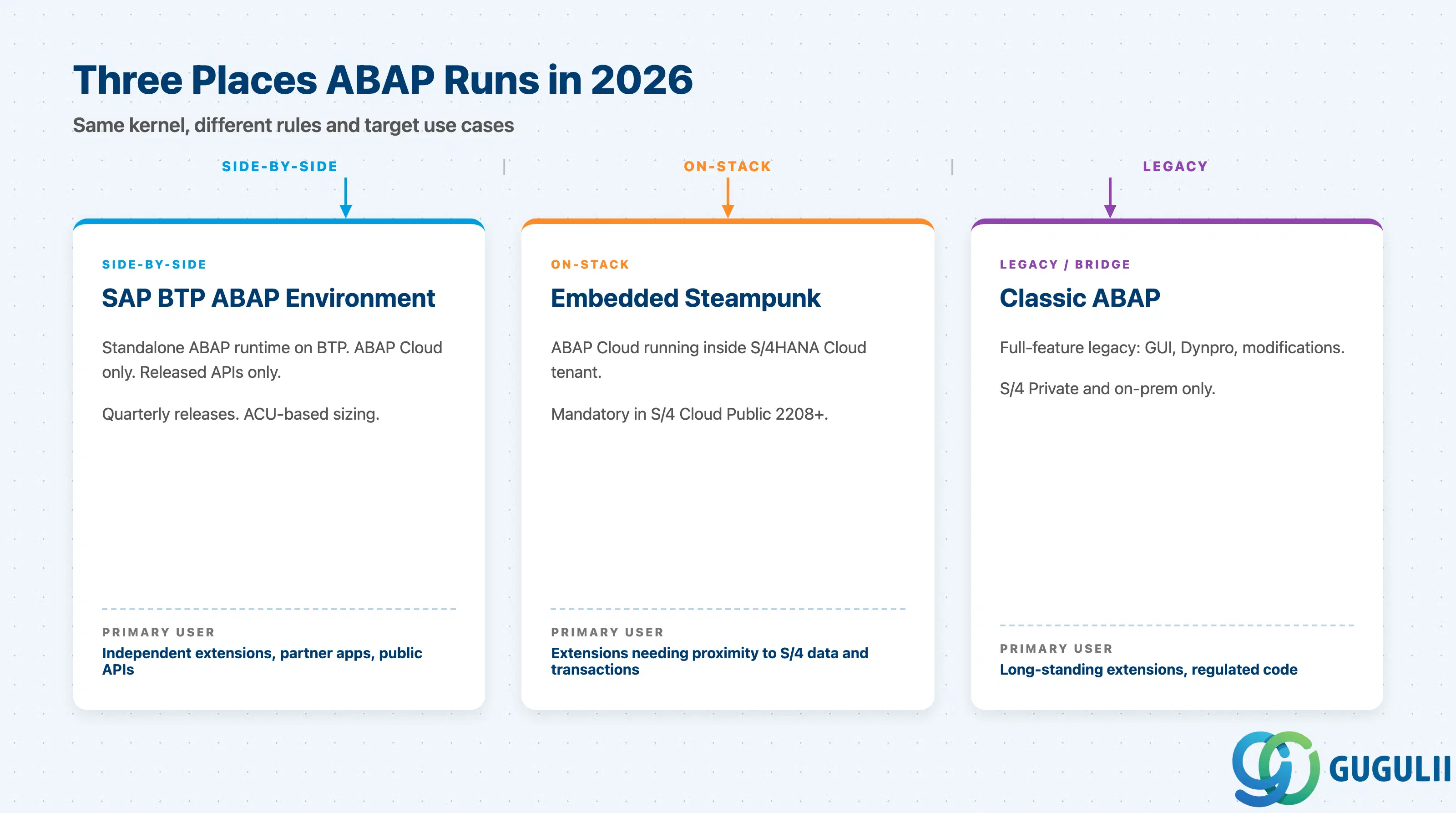
There are three places ABAP runs in 2026, and they are not interchangeable.
| Domain | What it does | Primary user |
|---|---|---|
| SAP BTP ABAP Environment (Steampunk) | Standalone cloud-native ABAP runtime on BTP, side-by-side with S/4HANA | ABAP teams building independent extensions, partner apps, public APIs |
| Embedded Steampunk (S/4HANA Cloud, public/private) | ABAP Cloud running on-stack inside S/4HANA Cloud | ABAP developers needing direct proximity to S/4 data, transactions, RAP objects |
| Classic ABAP (S/4 Private / on-prem) | Full-feature legacy ABAP, including GUI, Dynpro, modifications | Long-standing extensions, regulated/audited code, bridge during migration |
All three are based on the same ABAP Platform code line and the same ABAP kernel. The difference is which language version, which APIs, and which UI technology you are allowed to use. They are not substitutes.
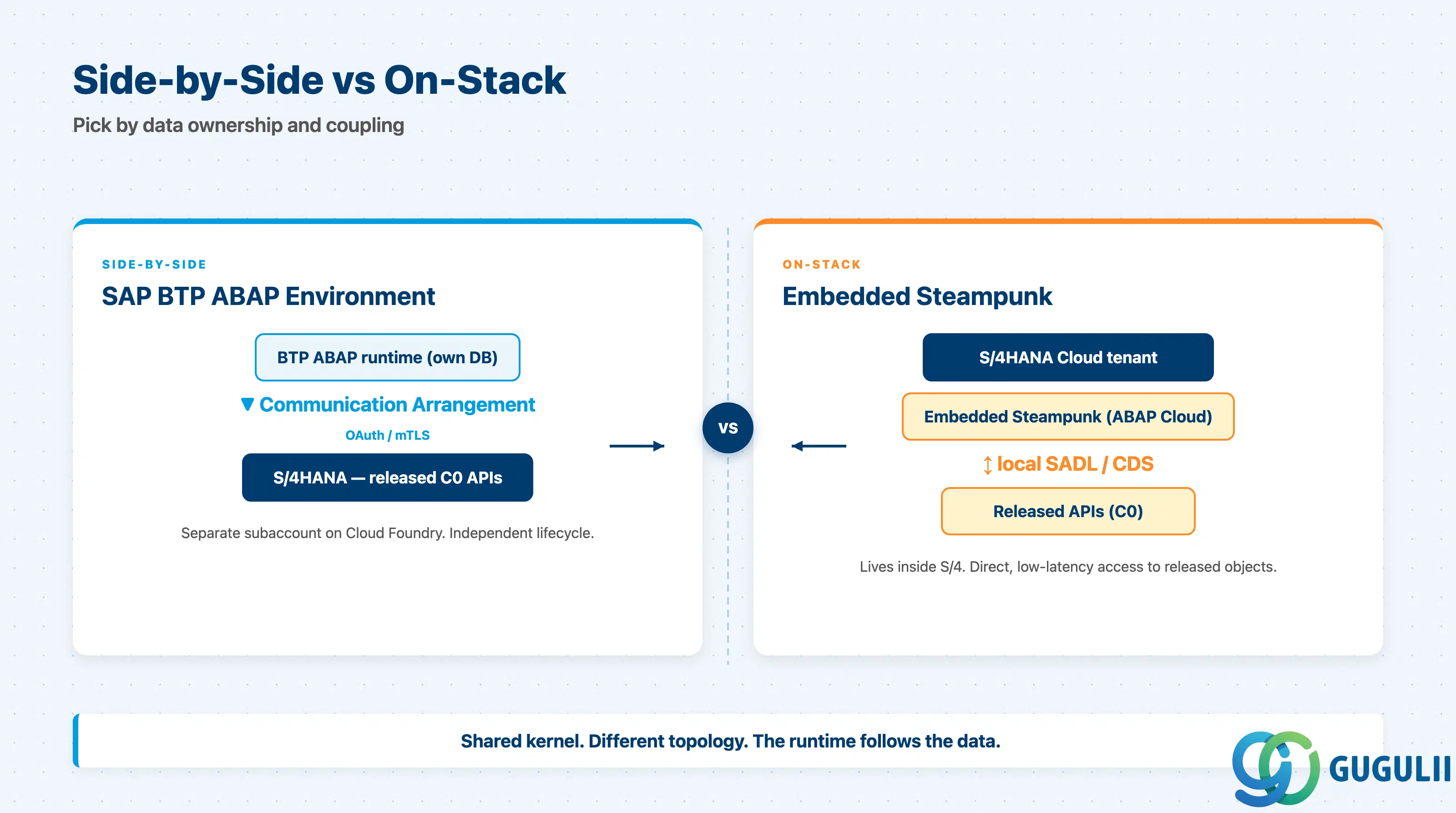
                +--------------------------+
                | SAP S/4HANA (any flavor) |
                |  ┌────────────────────┐  |
                |  │ Released APIs (C0) │◀─┼──── consumed by ABAP Cloud
                |  └────────────────────┘  |
                |  ┌────────────────────┐  |
                |  │ Embedded Steampunk │  |  ← on-stack, only Public/Private
                |  │  (ABAP Cloud only) │  |
                |  └────────────────────┘  |
                +─────────────▲────────────+
                              │ Communication
                              │ Arrangements
                              │ (OAuth / mTLS)
                              │
                +─────────────┴────────────+
                |  SAP BTP ABAP Environment |  ← side-by-side
                |  (subaccount / CF runtime)|
                |   - own DB (HANA)        |
                |   - own ABAP runtime     |
                +───────────────────────────+
BTP ABAP Environment is a separate system. It does not see S/4HANA tables; it consumes S/4 via Communication Arrangements that target released, C0-stable APIs. Embedded Steampunk sits inside S/4HANA Cloud and uses local SADL/CDS access, but is still bound by the same released-API rules.
Key point: Choose the runtime by who owns the data and how tightly the extension must be coupled — not by the developer’s preference.
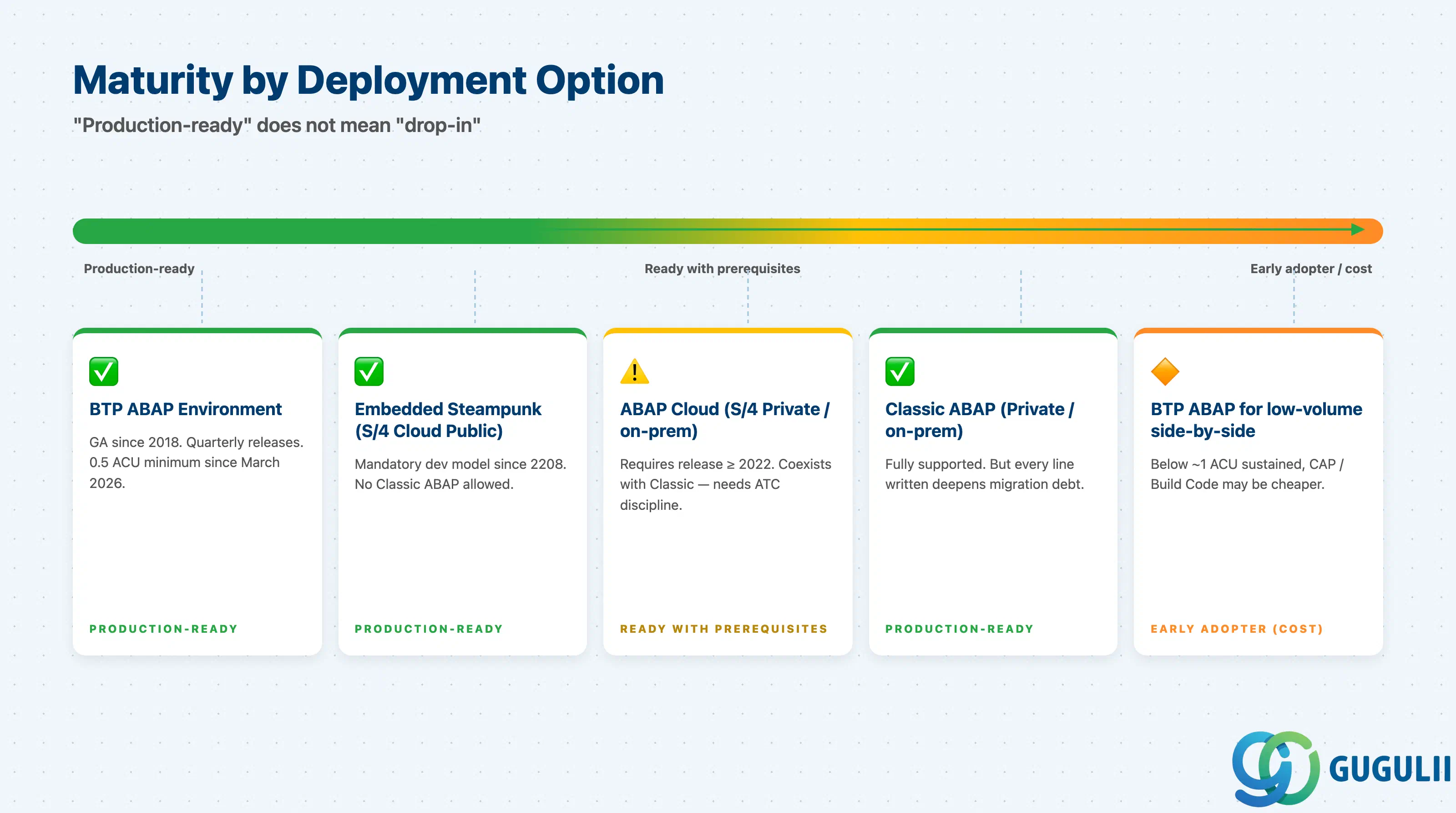
| Domain | Maturity | Notes |
|---|---|---|
| SAP BTP ABAP Environment | ✅ Production-ready | GA since 2018. Quarterly releases. ACU-based sizing; 0.5 ACU (8 GB) minimum since March 2026. |
| Embedded Steampunk in S/4HANA Cloud Public | ✅ Production-ready | Mandatory development model since 2208. No Classic ABAP allowed. |
| ABAP Cloud in S/4HANA Cloud Private / on-prem | ⚠️ Ready with prerequisites | Requires release ≥ 2022. Coexists with Classic ABAP — governance discipline required, otherwise teams quietly fall back to Classic. |
| Classic ABAP (Private / on-prem) | ✅ Production-ready | Still fully supported. But every new line written in Classic deepens future migration work. |
| SAP BTP ABAP Environment for low-volume side-by-side apps | 🔶 Early adopter for cost | Below ~1 ACU of sustained workload, side-by-side via CAP/Java may be cheaper than ABAP. |
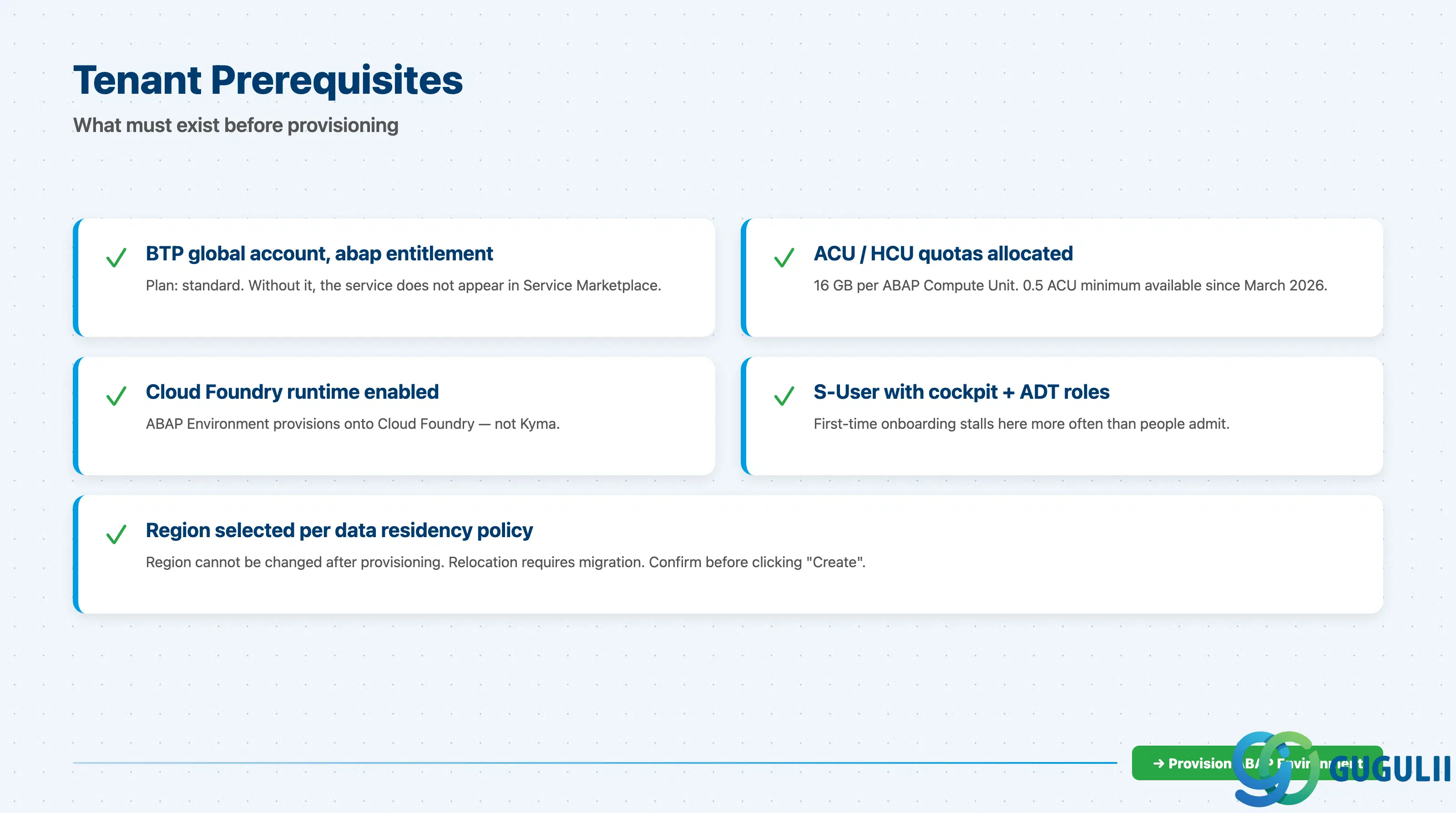
| Checklist item | Why it matters |
|---|---|
BTP global account with available entitlement for abap, plan standard | Without this, the service does not appear in Service Marketplace; procurement cycle is non-trivial |
Quotas allocated for abap_compute_unit and hana_compute_unit (16 GB units; 0.5 ACU available) | ACUs drive runtime cost; sizing too small forces re-creation rather than scale-out for some operations |
| Cloud Foundry environment enabled in the target subaccount | ABAP Environment provisions onto CF, not Kyma |
| S-User with the right authorizations for the BTP cockpit and ADT | First-time onboarding stalls here more often than people admit |
| Region selection aligned with data residency policy | Region cannot be changed after provisioning; relocations require migration |
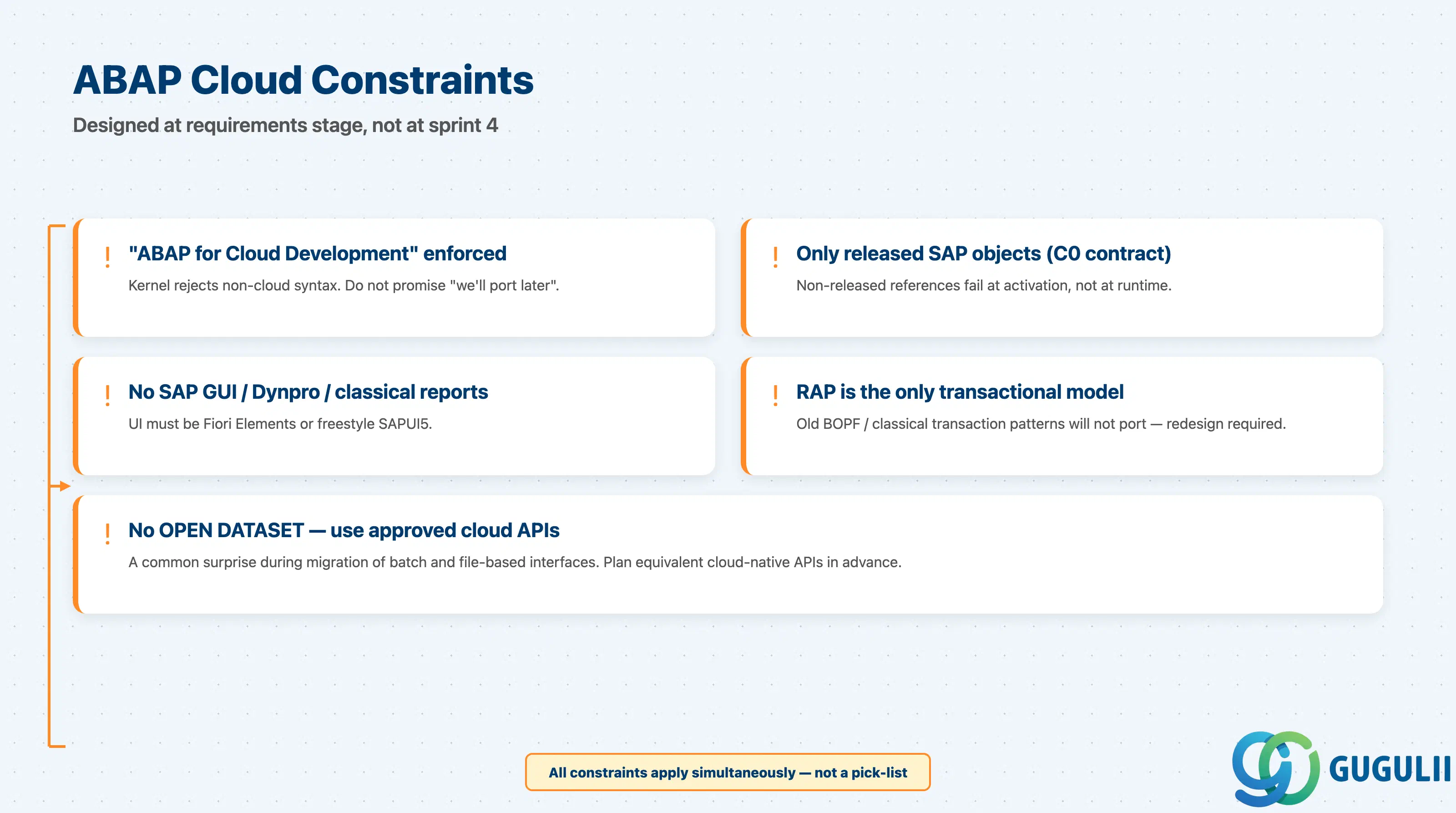
| Checklist item | Why it matters |
|---|---|
| All custom code uses ABAP language version “ABAP for Cloud Development” | The kernel rejects non-cloud syntax; do not promise “we’ll port later” |
| Only released SAP objects (C0 contract) are referenced in business code | Non-released objects cause syntax errors at activation, not at runtime |
| No SAP GUI / Dynpro / classical reports in scope | UI must be SAP Fiori Elements or freestyle SAPUI5 — confirm UX scope before sizing |
| RAP is the only supported transactional programming model | Old BOPF / classical transaction patterns will not port; redesign required |
File access uses approved cloud APIs (no OPEN DATASET) | A common surprise during migration of batch interfaces |
| Checklist item | Why it matters |
|---|---|
| Communication Arrangements designed for each external endpoint | Without them, RFC and HTTP destinations cannot be wired |
| OAuth or certificate-based authentication available on the S/4 side | Basic auth is acceptable for sandbox only; production needs proper trust |
| S/4HANA release ≥ 2022 for the released-API set used | Older S/4 releases do not expose the consumed C0 APIs |
| Network reachability from BTP to S/4 (Cloud Connector for on-prem) | Cloud Connector must be sized and operated by Basis, not assumed |
| Checklist item | Why it matters |
|---|---|
| ATC (ABAP Test Cockpit) variant for ABAP Cloud configured | Without ATC enforcement, teams drift back to non-released objects |
| Transport routes via gCTS / abapGit defined and trained | The classic SAP transport landscape is not used here |
| Sizing review at 3-month and 12-month marks | ACU cost is consumption-based on memory; under- or over-sizing both hurt |
| Licensing position confirmed with SAP account team | Trial entitlements are time-limited; production needs commercial agreement |
| DR and backup expectations documented | BTP service handles infra DR, but data export and tenant copy are customer responsibility |
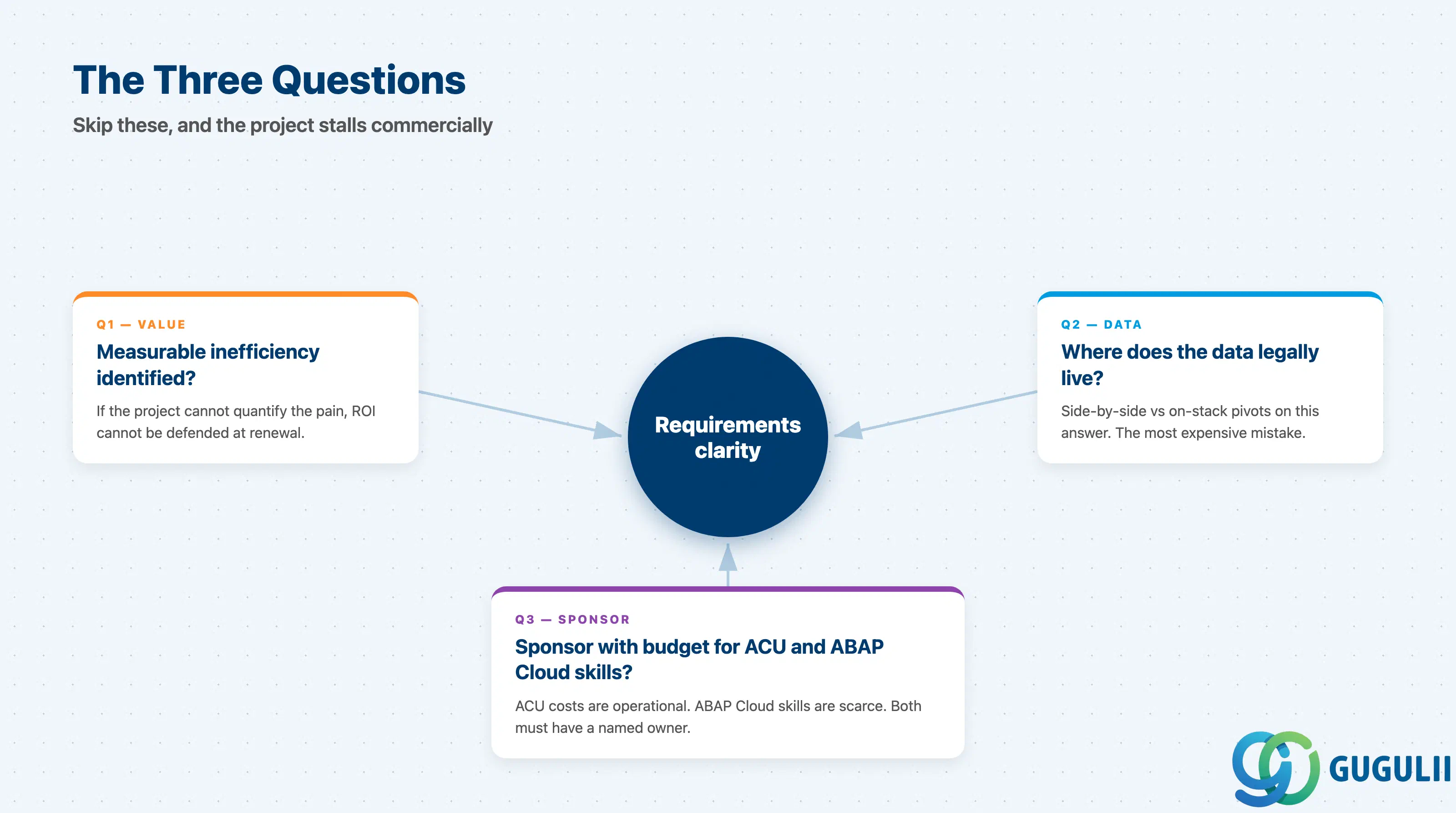
Q1. What measurable inefficiency does this extension remove, and is the business willing to write it down?
If the project cannot quantify the pain (“we want a portal”, “we want to modernize”) the right answer is to delay BTP ABAP Environment until the use case is sharpened. ABAP Cloud is not a refactoring tool — it is a runtime that costs money per ACU. Without a measurable target, ROI cannot be defended at renewal time.
Q2. Where does the data this extension processes legally live, and who owns its lifecycle?
If the extension primarily reads and writes S/4 master/transactional data, embedded Steampunk usually wins on latency, on transactional integrity, and on operational simplicity. If the data is owned by a third-party system or by the BTP application itself, side-by-side BTP ABAP is the better fit. The wrong answer to this question is the most expensive mistake in the whole guide.
Q3. Is there an internal sponsor with budget authority for both the ACU consumption and the ABAP Cloud-skilled team?
ACU costs are operational; ABAP Cloud skills are scarce. Without a named sponsor accountable for both, the project will succeed technically and stall commercially.
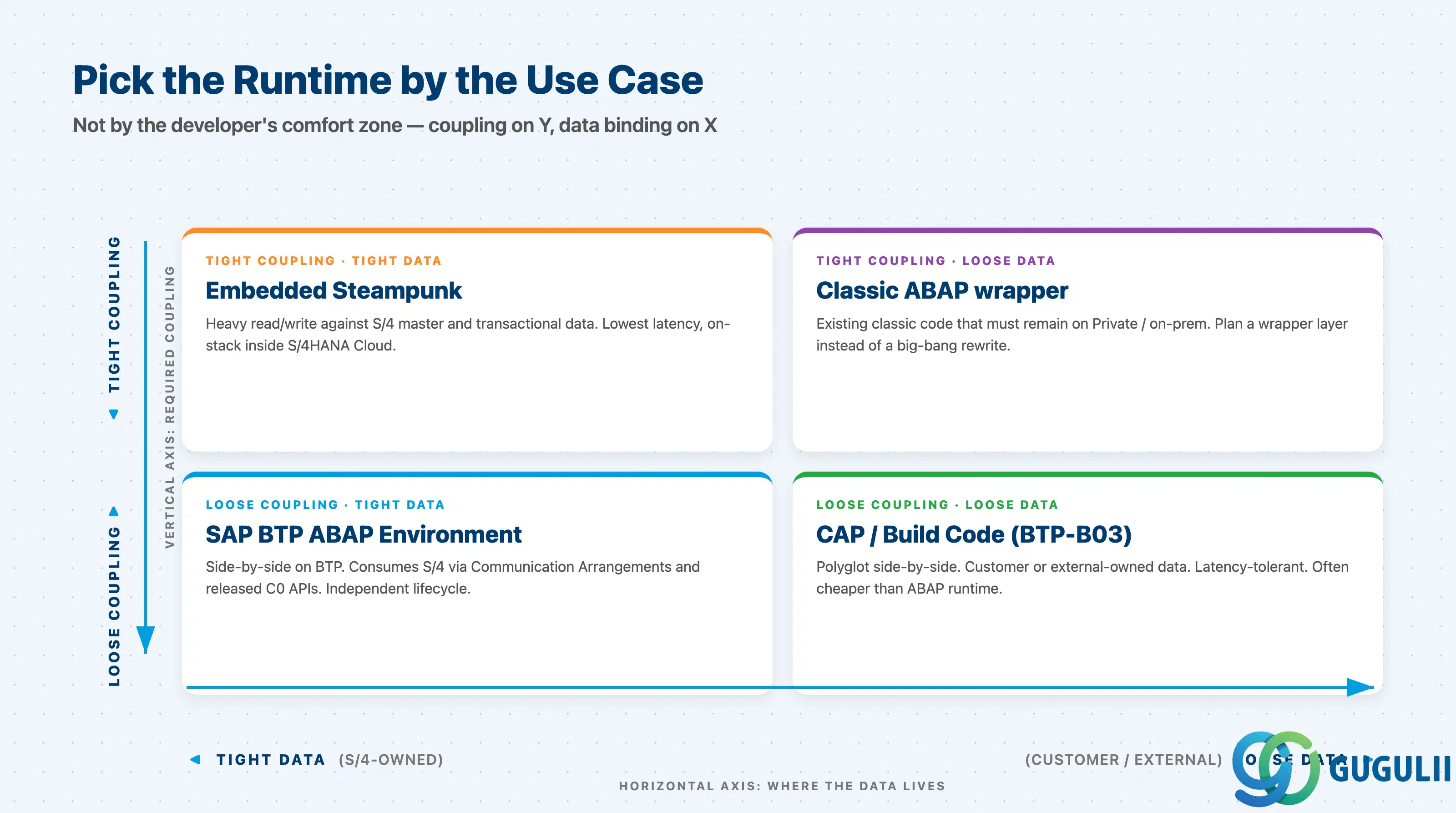
| Project context | Recommended starting domain/capability |
|---|---|
| Greenfield public-facing API or portal owned by the customer | SAP BTP ABAP Environment (side-by-side) |
| Heavy read/write against S/4 master and transactional data | Embedded Steampunk in S/4HANA Cloud |
| New extension on S/4HANA Cloud Public | Embedded Steampunk (only option) |
| New extension on S/4 Private / on-prem, can be decoupled | ABAP Cloud on-stack, with BTP ABAP as a fallback if isolation matters |
| Existing Classic ABAP that must remain — short term | Stay Classic; plan a wrapper layer instead of big-bang rewrite |
| Low-volume side-by-side workload, latency-tolerant, polyglot team | CAP on Cloud Foundry / Kyma (BTP-B03), not BTP ABAP — cheaper |
| No clear pain point identified yet | Stop. Go back to Q1. |
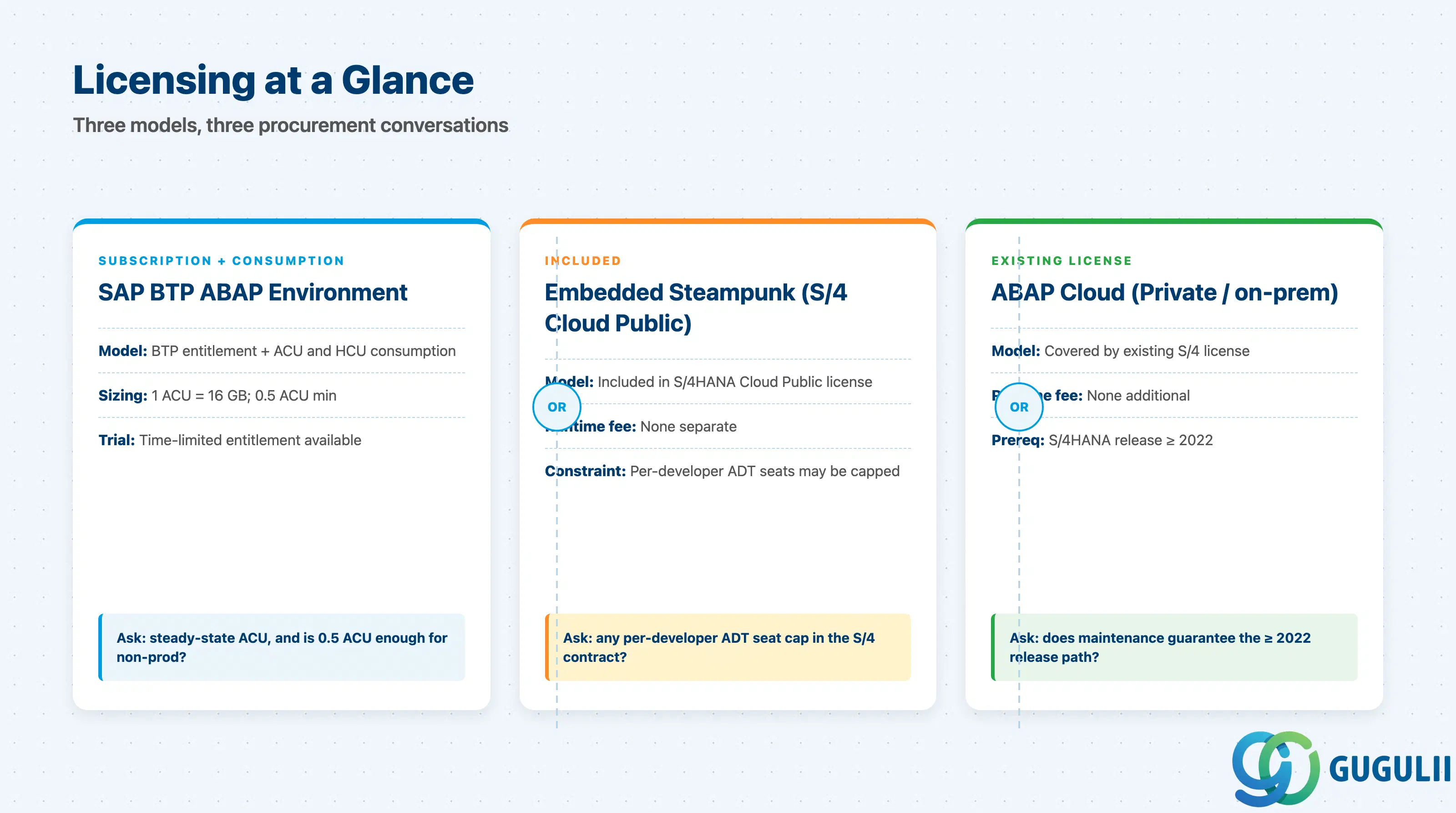
| Domain | Licensing model | Key question to ask |
|---|---|---|
| SAP BTP ABAP Environment | Subscription on BTP entitlement + consumption on ACU and HCU (HANA) | What is the steady-state ACU count, and is the 0.5 ACU minimum sufficient for non-prod? |
| Embedded Steampunk (S/4 Cloud Public) | Included in S/4HANA Cloud Public license; no separate ABAP runtime fee | Are there per-developer ADT seat constraints in the contract? |
| ABAP Cloud in S/4 Cloud Private / on-prem | Covered by existing S/4 license; no extra runtime fee | Does the maintenance contract guarantee the ≥ 2022 release path? |
| Classic ABAP | Existing S/4 license | What is the cost of not migrating — i.e., recurring upgrade work? |
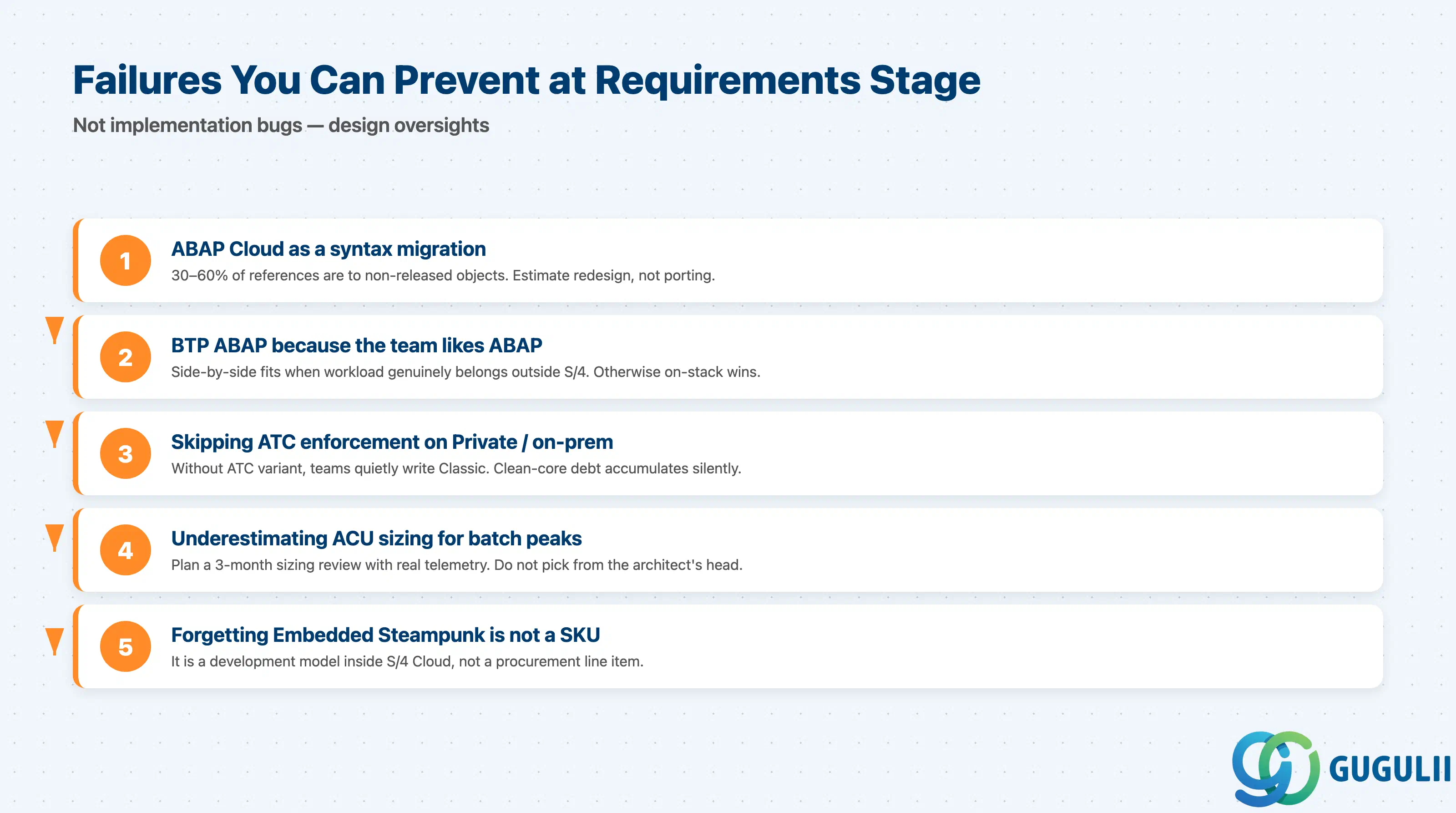
Failure 1: Treating ABAP Cloud as a syntax migration
Teams budget for “porting” classic code. They discover at build time that 30–60% of references are to non-released objects, GUI, or low-level DB. The work is redesign, not porting. Estimate accordingly at requirements stage, not at sprint 4.
Failure 2: Choosing BTP ABAP Environment because the team likes ABAP
Side-by-side is the right answer when the workload genuinely belongs outside S/4. If the workload reads and writes S/4 data on every request, embedded Steampunk is faster, cheaper, and has fewer moving parts. The runtime should follow the data, not the developer.
Failure 3: Skipping ATC enforcement on Private / on-prem
In Private and on-prem, ABAP Cloud and Classic ABAP coexist. Without an ATC variant blocking non-cloud constructs in cloud-flagged packages, teams quietly write Classic and call it done. The clean-core debt accumulates silently and surfaces at the next upgrade.
Failure 4: Underestimating ACU sizing for batch peaks
ACUs are sized for sustained memory, but month-end or year-end batch can spike. Plan a sizing review at the 3-month mark with real telemetry; do not pick a number from the architect’s head and never revisit it.
Failure 5: Ignoring transport and lifecycle
Classic SAP transports are not the model here. Teams that try to keep STMS habits stall. gCTS / abapGit need a CI plan, branch policy, and trained operators before the first deploy.
Failure 6: Forgetting that “Embedded Steampunk” is not a separate product
Procurement sometimes asks SAP for a quote for “Embedded Steampunk” as a SKU. It is a development model inside S/4HANA Cloud, not a line item. Frame the discussion as “we will use ABAP Cloud on our existing S/4 license” and proceed.
Failure 7: Promising on-prem GUI parity
Stakeholders sometimes hear “we still have ABAP” and assume SAP GUI screens will work. They will not — UI must be Fiori. Set this expectation in the requirements deck, not in the demo.
Q: Can we keep our SAP GUI transactions and just move the rest to ABAP Cloud?
Not on the same call stack. ABAP Cloud cannot call SAP GUI / Dynpro screens. You can keep GUI transactions in Classic ABAP on Private / on-prem and build new flows in ABAP Cloud, but the two cannot be mixed inside one transactional unit. Communication between them must go through released APIs.
Q: How is licensing different between BTP ABAP Environment and Embedded Steampunk?
BTP ABAP Environment is a separate BTP subscription, billed on ACUs (16 GB units of ABAP runtime memory, with a 0.5 ACU minimum) and HANA compute. Embedded Steampunk runs inside the existing S/4HANA Cloud license — no separate runtime fee — but you are still bound by per-tenant developer/seat constraints in your S/4 contract.
Q: When should we descope ABAP Cloud from a project?
When the use case is well served by a low-code path (Build Apps, BTP-B05) or by a polyglot CAP/Build Code service (BTP-B03), and there is no domain reason to stay in ABAP. ABAP Cloud is most defensible when ABAP skills are deep, the workload is transactional, and a clean-core extension is the explicit goal. Otherwise it is a runtime cost without a corresponding skill or compliance benefit.
Q: Does ABAP Cloud apply to S/4HANA on-premise?
Yes, but only as a development option and only on releases ≥ 2022. Classic ABAP remains supported. The strategic question is whether new development is allowed in Classic; the operational question is whether ATC is configured to enforce that decision.
Q: How do we document an ABAP Environment requirement properly?
Three artifacts: (1) the use-case statement with a measurable target (Q1 above), (2) the data ownership statement (Q2 above) that justifies side-by-side vs. on-stack, (3) the API and integration list, naming the released objects consumed and any communication arrangements needed. Without these three, no architect can size or price the work credibly.
Q: What if the released APIs we need do not exist?
This is common and it is usually a real blocker. Options: file an SAP Influence request, design a wrapper using a different released API path, or accept that this extension stays Classic for now. Do not assume “released soon” without a roadmap commitment in writing.
Q: How does Joule fit into ABAP Environment work?
SAP positions Joule as a developer assistant for ABAP Cloud — code generation, business object scaffolding, documentation. Useful for productivity, but it does not change the architectural decision. Joule cannot turn a wrongly-placed extension into a correctly-placed one.
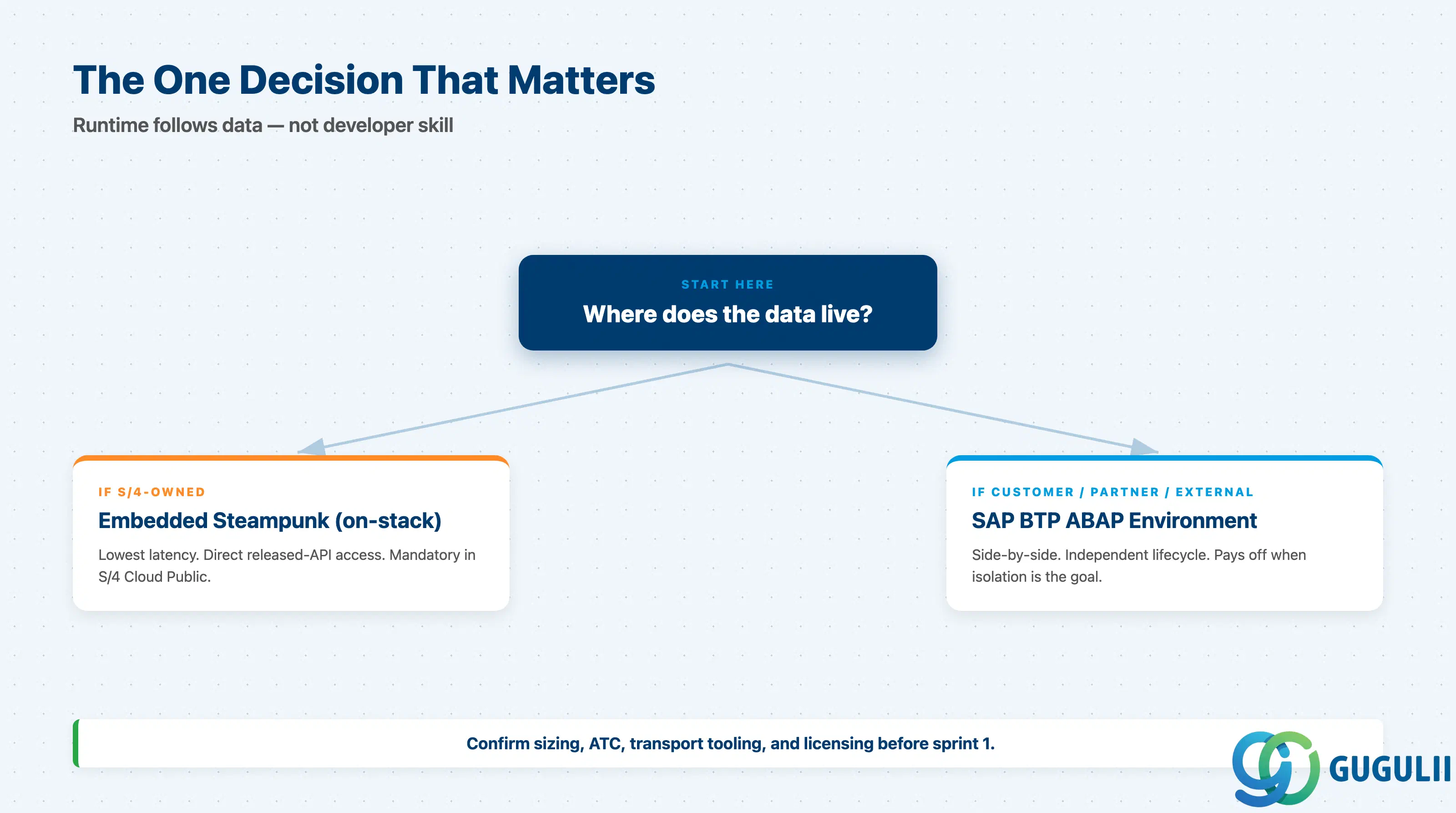
SAP BTP ABAP Environment is a mature, supported, cloud-native ABAP runtime — but its successful use depends on requirements-stage decisions, not coding skill. The runtime choice (side-by-side BTP ABAP vs. on-stack Embedded Steampunk vs. legacy Classic) should follow data ownership and coupling, not developer preference. ABAP Cloud’s restrictions are real and known: only released APIs, RAP only, Fiori only, no low-level DB. Plan for redesign, not porting. Confirm sizing, ATC enforcement, transport tooling, and licensing position before the first sprint, and the rest of the project usually unblocks itself.
| ID | Category | Component | Scope |
|---|---|---|---|
| BTP-B01: Application Development Overview and Capability Map | Overview | Application Development | Overview and Capability Map |
| BTP-B02: Business Application Studio: Architecture and Use | Pro-code IDE | Business Application Studio | Architecture and Use |
| BTP-B03: CAP and Build Code: Architecture and Use | Pro-code framework | CAP and Build Code | Architecture and Use |
| BTP-B04 | ABAP runtime | ABAP Environment | Architecture and Use (this article) |
| BTP-B05: Build Apps: Architecture and Use | Low-code | Build Apps | Architecture and Use |
| BTP-B06: Build Process Automation: Architecture and Use | Process automation | Build Process Automation | Architecture and Use |
| BTP-B07: Build Work Zone: Architecture and Use | Front-end shell | Build Work Zone | Architecture and Use |
| BTP-B08: Use Cases and Decision Patterns | Decision | Use Cases | Decision Patterns |