Title here
Summary here

| ID | Category | Component | Scope |
|---|---|---|---|
| BTP-C01 | Overview | Data and Analytics | Overview and Capability Map |
| BTP-C02 | Architecture and Use | HANA Cloud | Architecture and Use (this article) |
| BTP-C03 | Architecture and Use | SAP Datasphere | Architecture and Use |
| BTP-C04 | Architecture and Use | SAP Analytics Cloud | Architecture and Use |
| BTP-C05 | Architecture and Use | Data Integration | Architecture and Use |
| BTP-C06 | Architecture and Use | Data Governance | Architecture and Use |
| Resource | URL |
|---|---|
| SAP HANA Cloud — Getting Started Guide (BTP Integration) | help.sap.com → |
| SAP HANA Cloud Multitenancy — Introduction | help.sap.com → |
| SAP HANA Cloud — Backups and Recovery | help.sap.com → |
| SAP HANA Cloud — HDI Container Reference | help.sap.com → |
| SAP HANA Cloud Features (Product Page) | sap.com → |
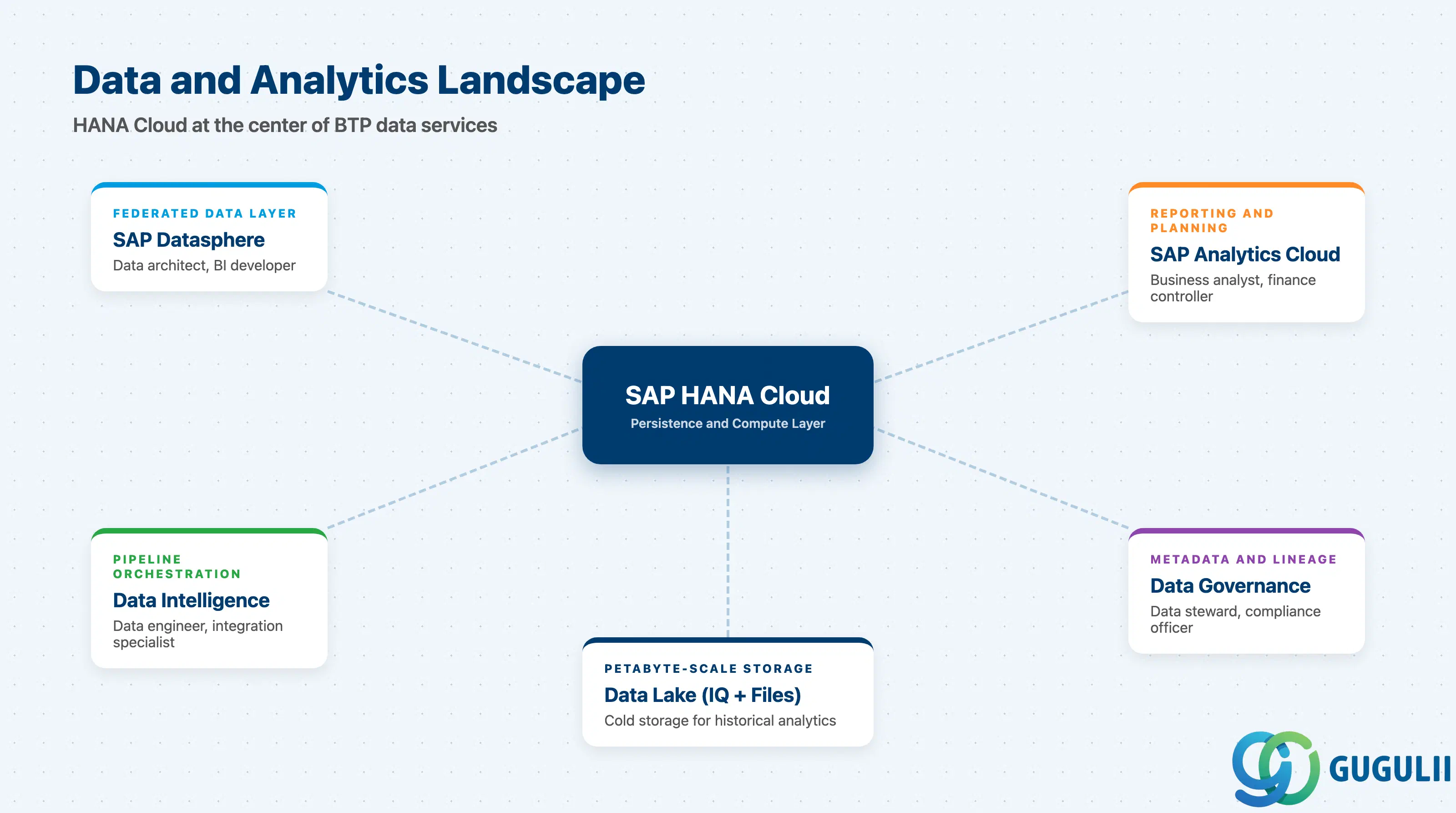
The L2-C domain covers the services that store, move, model, and visualize data within SAP BTP. Each component plays a different role, and they are designed to complement each other. Source: SAP HANA Cloud Features.
| Capability | What it does | Primary user |
|---|---|---|
| SAP HANA Cloud | In-memory database platform for transactional and analytical workloads; multi-model data engine | App developer, data engineer, DBA |
| SAP Datasphere | Federated data layer for enterprise-wide data modeling and semantic layer management | Data architect, BI developer |
| SAP Analytics Cloud (SAC) | Reporting, planning, and predictive analytics front-end | Business analyst, finance controller |
| SAP Data Intelligence / Integration | Data pipeline orchestration and integration across cloud and on-premise systems | Data engineer, integration specialist |
| Data Governance | Metadata catalog, data quality, and lineage for trusted data assets | Data steward, compliance officer |
They are not substitutes. HANA Cloud is the persistence and compute layer; the others depend on it, sit beside it, or consume from it.
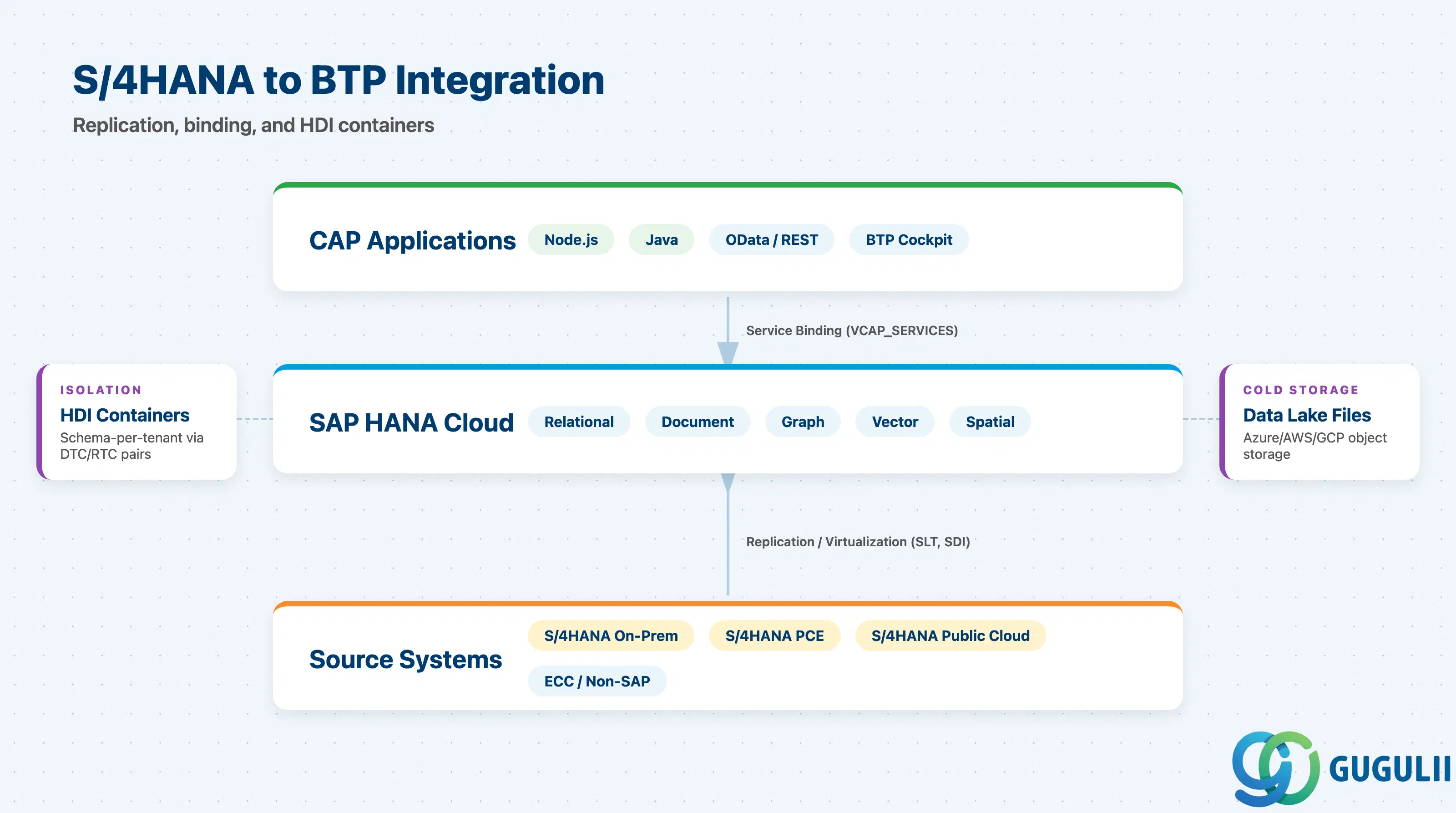
SAP S/4HANA in any deployment model (Public Cloud Edition, Private Cloud Edition, or on-premise) generates transactional data that BTP-hosted services consume. SAP HANA Cloud sits at the center of this integration.
┌─────────────────────────────────────────────────────────────────┐
│                        SAP BTP Subaccount                        │
│                                                                   │
│  ┌────────────┐    BTP Service     ┌──────────────────────────┐  │
│  │  CAP App   │◄──── Binding ─────►│   SAP HANA Cloud         │  │
│  │ (Node/Java)│   (VCAP_SERVICES)  │   - Relational Store     │  │
│  └─────┬──────┘                    │   - Document Store       │  │
│        │                           │   - Graph Engine         │  │
│        │ OData / REST              │   - Vector Engine        │  │
│        ▼                           │   - Spatial Engine       │  │
│  ┌─────────────┐                   └───────────┬──────────────┘  │
│  │  SAP BTP    │                               │                  │
│  │  Cockpit /  │                    HDI        │  Data Lake IQ    │
│  │  HANA Cloud │◄──── Admin ───────►Containers │  (petabyte-scale │
│  │  Central    │                               │   analytics)     │
│  └─────────────┘                   ┌───────────▼──────────────┐  │
│                                    │   SAP Data Lake Files     │  │
│                                    │   (Azure/AWS/GCP object   │  │
│                                    │    storage, SAP-managed)  │  │
│                                    └──────────────────────────┘  │
└─────────────┬───────────────────────────────────────────────────┘
              │
     Replication / Virtualization
              │
┌─────────────▼───────────────────────────────────────────────────┐
│  SAP S/4HANA (on-premise / PCE / Public Cloud)                   │
│  SAP ECC / non-SAP sources                                       │
└─────────────────────────────────────────────────────────────────┘
Data flows from SAP and non-SAP source systems into HANA Cloud through replication (SLT, SDI) and virtualization services ( SAP HANA Cloud Getting Started Guide). Applications built with SAP Cloud Application Programming Model (CAP) receive database credentials automatically at runtime via BTP service binding (VCAP_SERVICES), eliminating manual credential management. HDI containers provide schema-per-tenant isolation within the same HANA Cloud instance.
Key point: HANA Cloud is not an isolated database — it is the data persistence hub for the entire BTP application and analytics ecosystem, and its provisioning decisions (region, size, multitenancy model) affect every downstream service.
| Capability | Maturity | Notes |
|---|---|---|
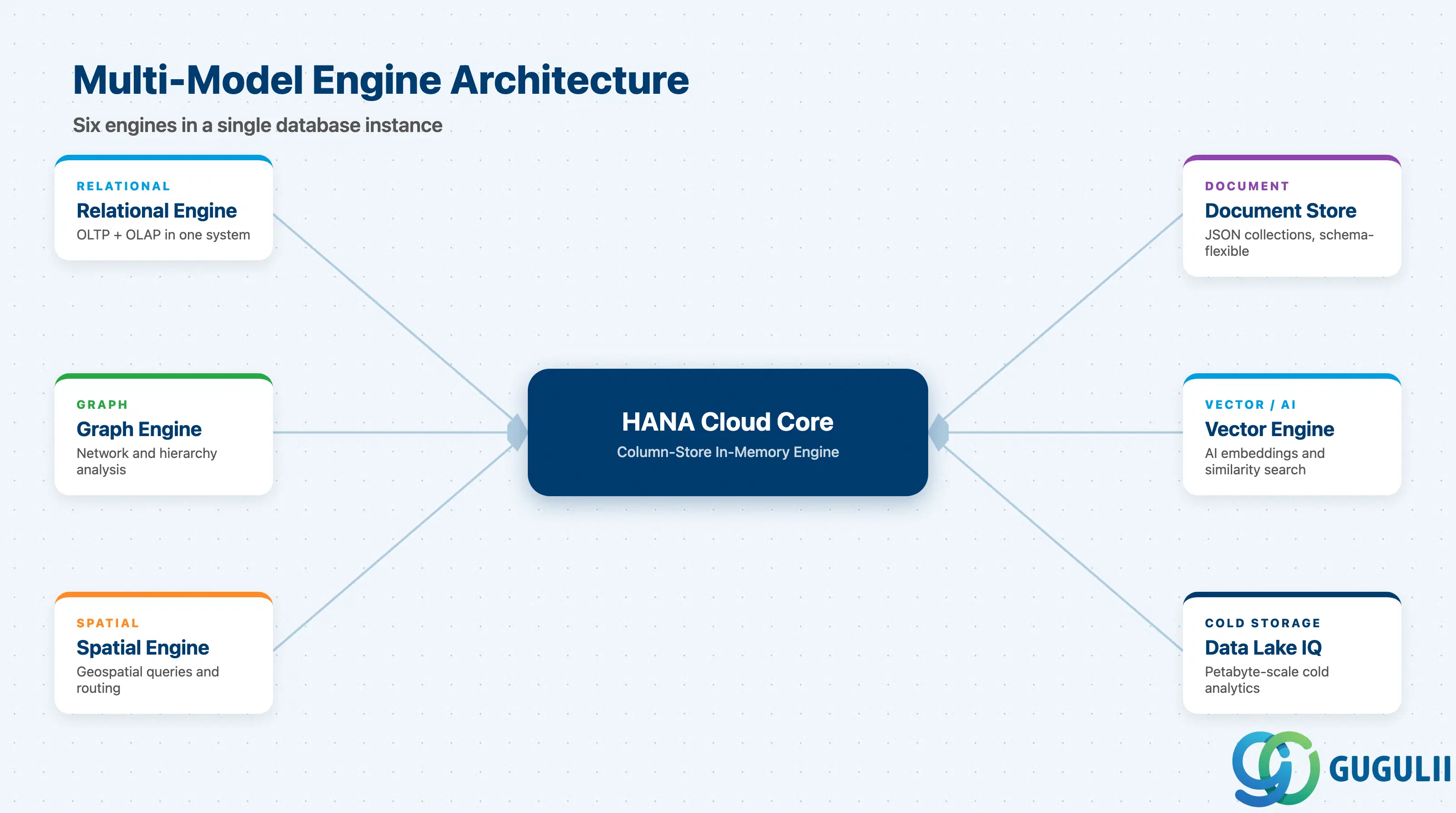
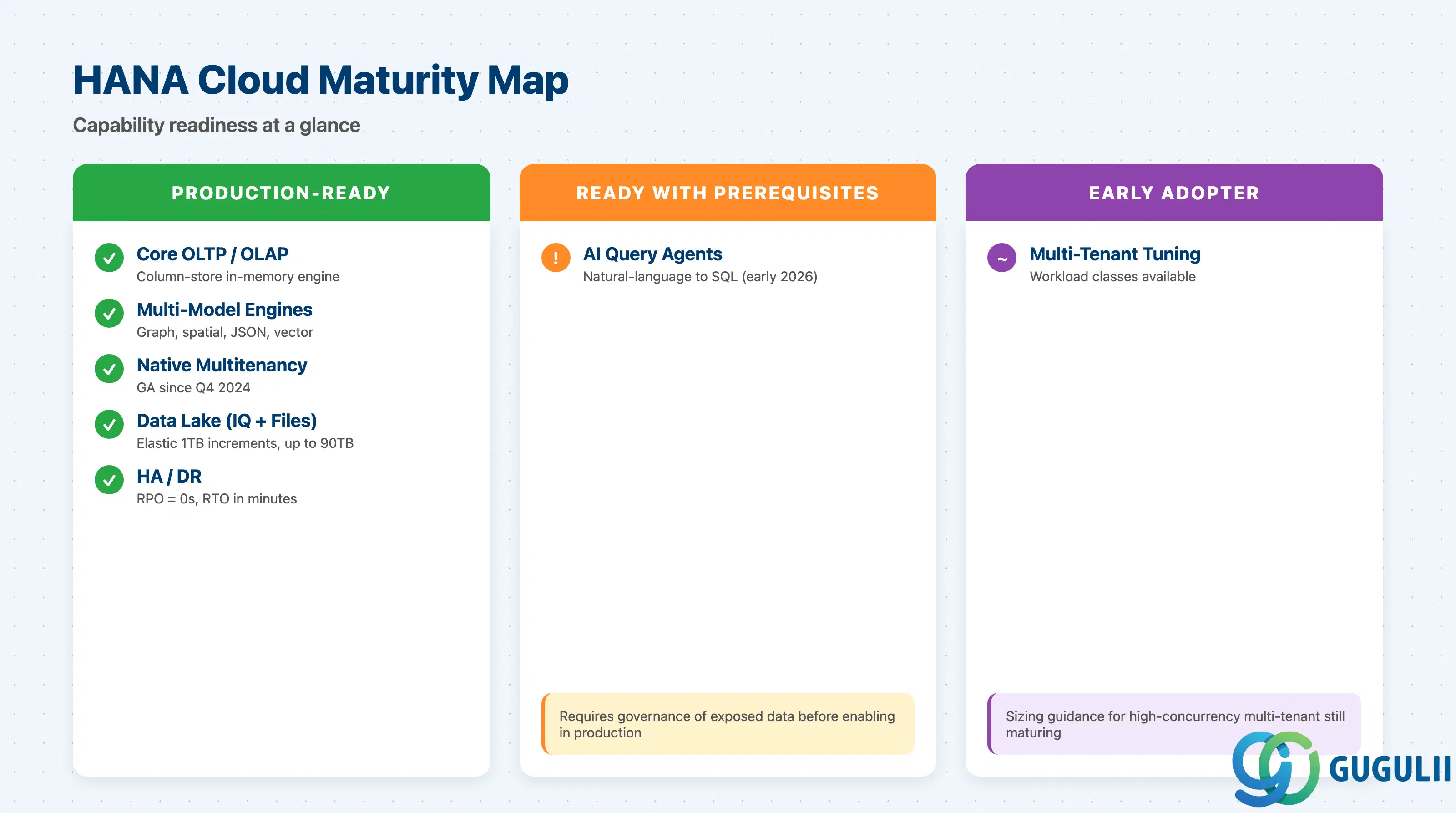
| Core relational OLTP/OLAP | ✅ Production-ready | Column-store in-memory engine; up to 10,000x speed improvement cited for specific workloads ( SAP HANA Features) |
| Multi-model engines (graph, spatial, JSON) | ✅ Production-ready | Relational, document, geospatial, knowledge graph, and time-series engines all generally available; vector engine added in recent releases |
| Native multitenancy (database-level) | ✅ Production-ready | GA since Q4 2024; each tenant encrypted with customer-specific keys; tenant-level admin, backup, and recovery supported ( SAP TechEd 2025) |
| Data Lake (IQ + Files) | ✅ Production-ready | Elastic storage in 1TB increments; current limit 90TB (expandable on request); no pre-provisioning required |
| HA/DR (System Replication) | ✅ Production-ready | RPO = 0 seconds, RTO in minutes; synchronous and asynchronous replication options ( HA/DR blog) |
| AI-driven query agents (Discovery / Data Agent) | ⚠️ Ready with prerequisites | Natural-language to SQL query generation introduced in early 2026; requires careful governance of which data is exposed ( SAP TechEd 2025; What’s New March 2026) |
| Detailed performance tuning for multi-tenant workloads | 🔶 Early adopter | Workload classes available for resource management; sizing guidance for high-concurrency multi-tenant deployments is still maturing |
| Checklist item | Why it matters |
|---|---|
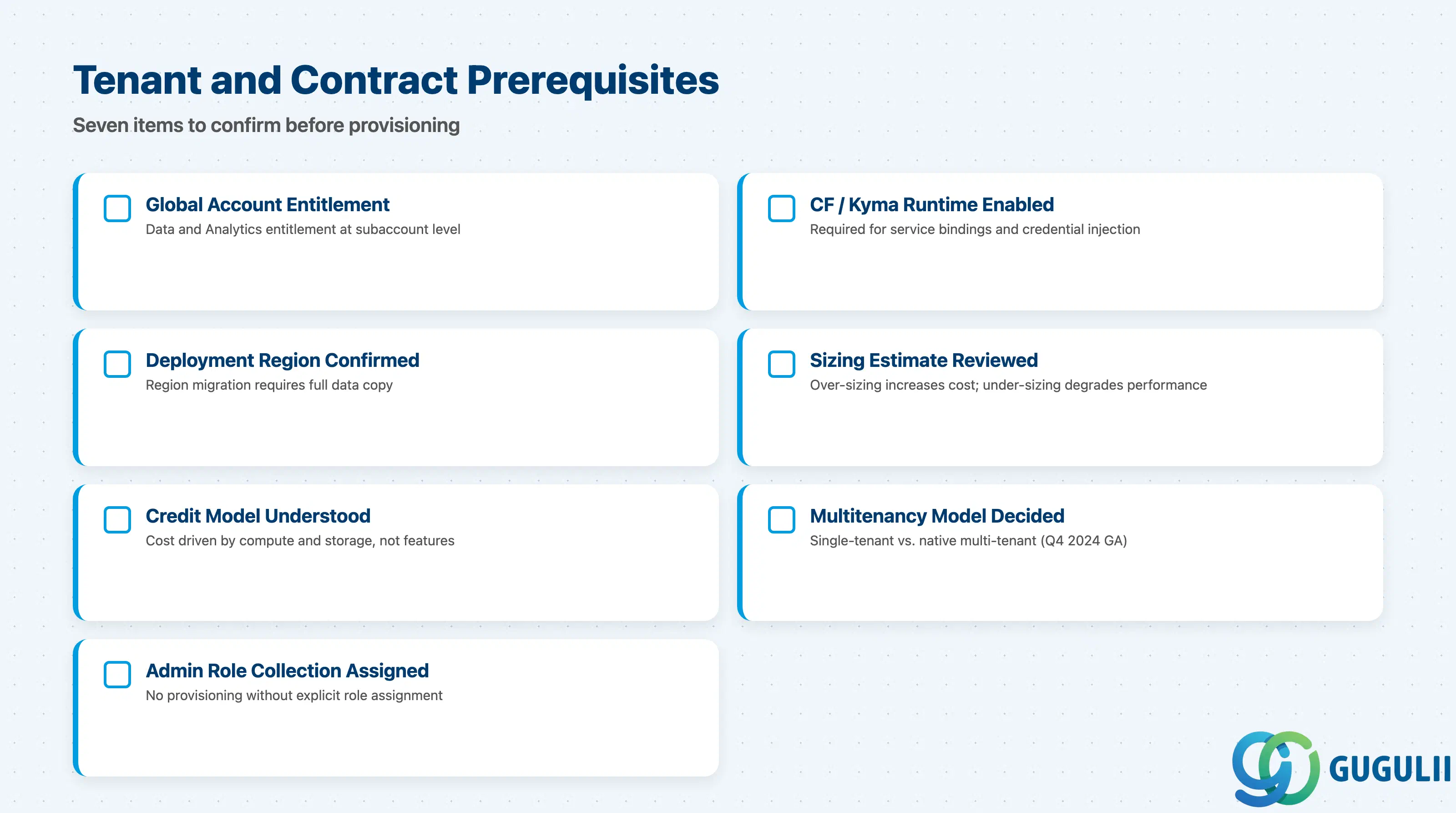
| BTP global account and subaccount confirmed with Data & Analytics entitlement | HANA Cloud cannot be provisioned without the entitlement assigned at subaccount level |
| Cloud Foundry or Kyma runtime enabled in target subaccount | Service bindings are delivered through CF or Kyma; runtime choice affects credential injection |
| Target deployment region confirmed and data residency signed off | Once provisioned, migrating regions requires a full service copy — not a reconfiguration |
| Sizing estimate (memory / storage / vCPUs) reviewed against workload profile | Credit-based licensing means over-sizing increases cost directly; under-sizing causes performance degradation |
| Credit consumption model understood by budget owner | All engines (graph, spatial, etc.) are included; cost driver is compute and storage size, not feature selection |
| Multitenancy model decided (single-tenant vs. native multi-tenant) | Native multitenancy (Q4 2024 GA) allows logical isolation within one instance; schema separation recommended for most balanced tradeoffs ( Multitenancy docs) |
| HANA Cloud Administrator role collection assigned to named operations team | Without explicit role collection assignment in BTP, no one can provision or manage instances |
| Checklist item | Why it matters |
|---|---|
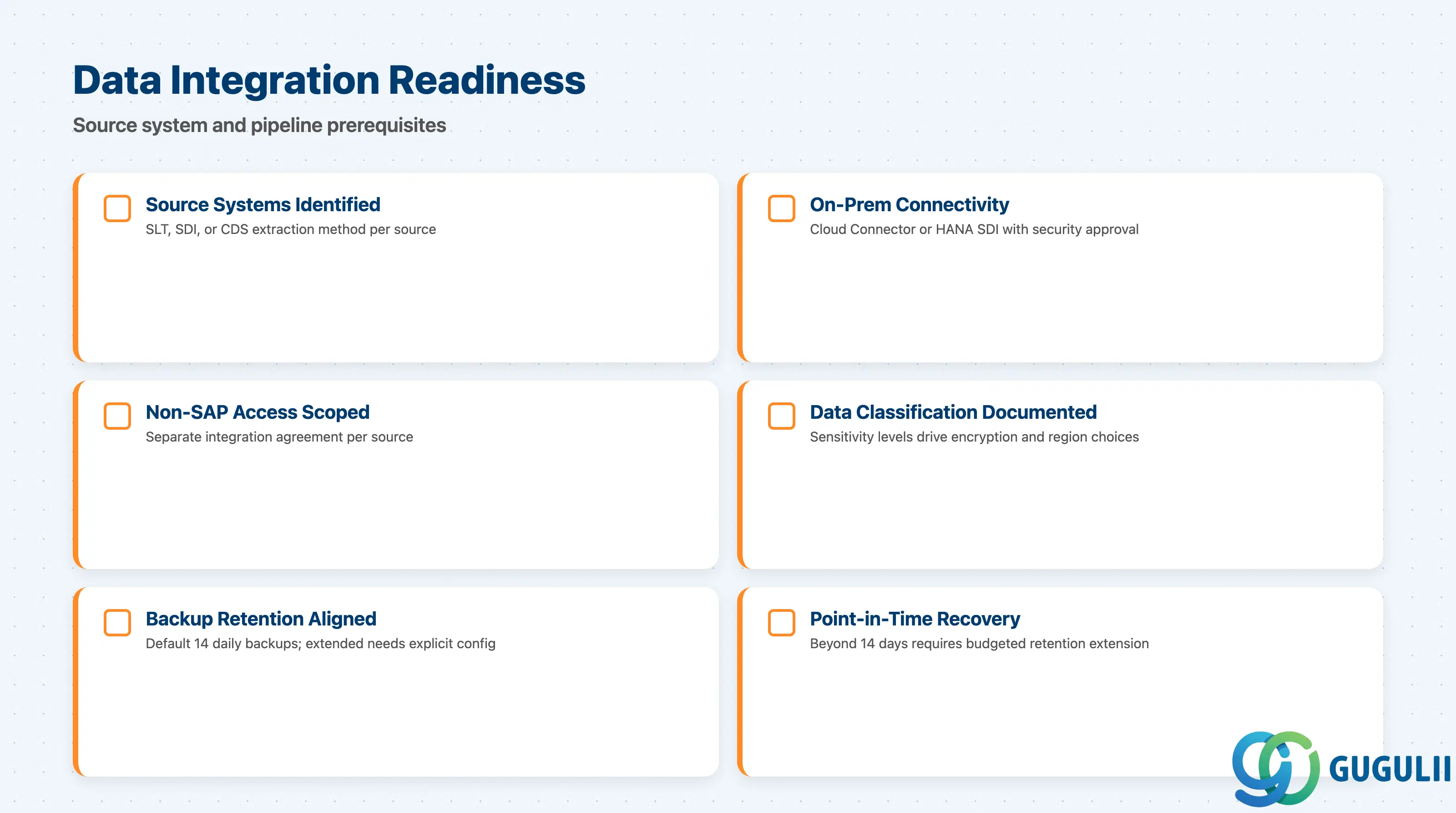
| Source systems and replication mechanisms identified (SLT, SDI, CDS extraction) | Integration method determines latency profile; real-time replication has different infrastructure prerequisites than batch |
| On-premise HANA connectivity confirmed (if applicable) | Federation requires Cloud Connector or HANA smart data integration; network topology needs security approval before project start |
| Non-SAP source access scoped and owner identified | Each non-SAP source requires a separate integration agreement; ownership gaps delay go-live more than technical issues |
| Data classification and sensitivity levels documented for all source datasets | Determines encryption requirements and whether Data Lake Files can be used for that data type |
| Backup retention policy aligned with recovery requirements | Default is 14 daily backups (RPO ≤ 15 minutes for log backups); extended retention must be explicitly configured ( Backups and Recovery) |
| Point-in-time recovery requirement confirmed | Recovery beyond 14 days requires retention period extension that must be budgeted explicitly |
| Checklist item | Why it matters |
|---|---|
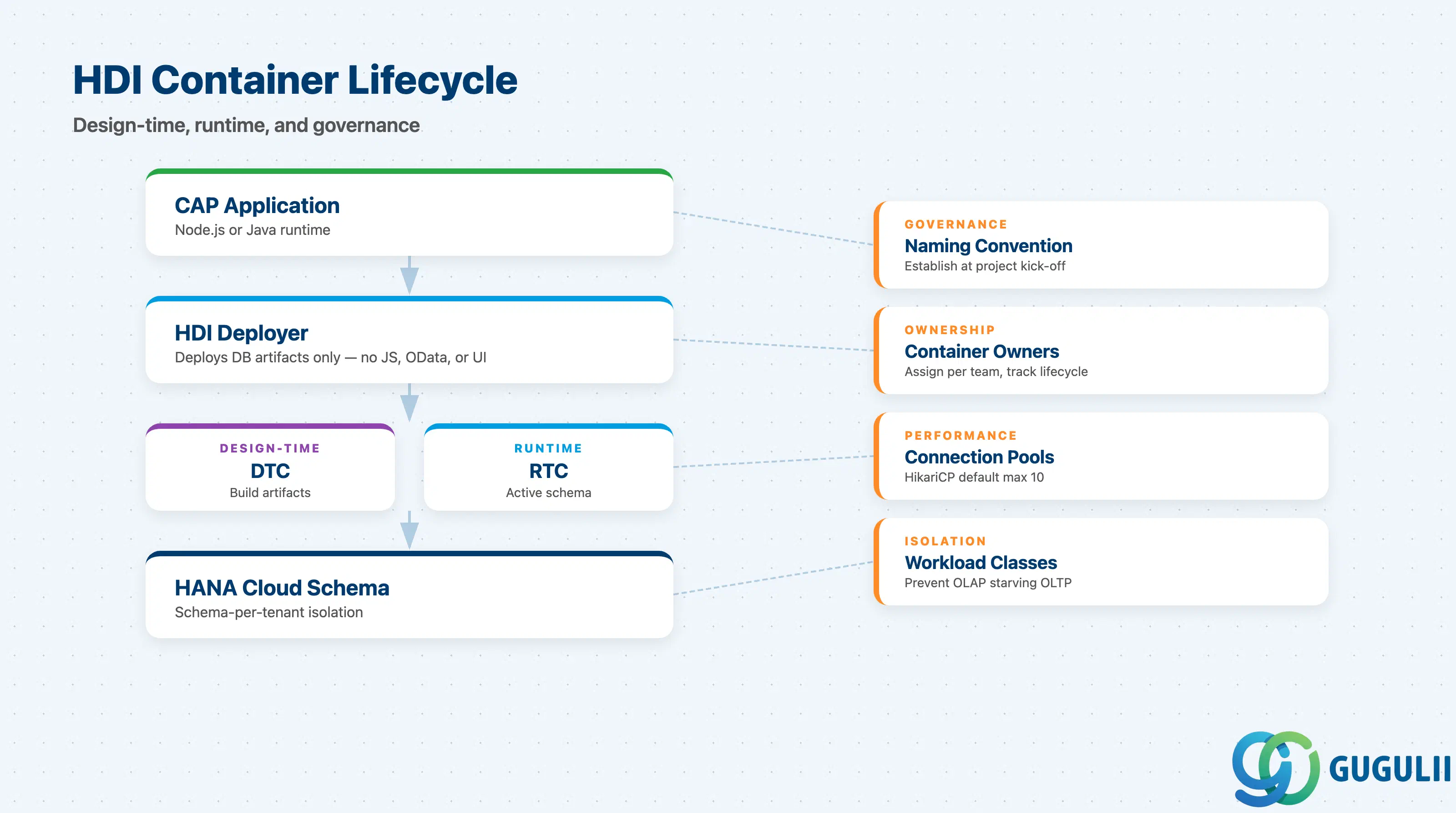
| HDI container naming and ownership convention established before development begins | Uncontrolled proliferation makes lifecycle management unmanageable in multi-team projects |
| Design-time (DTC) and runtime container (RTC) lifecycle documented | HDI always creates DTC/RTC pairs; deployment pipelines must account for both ( HDI Reference) |
| Database object scope confirmed: HDI deploys only DB objects (no JS, OData, UI layers) | Developers new to CAP often expect HDI to deploy application logic; this misunderstanding wastes sprint capacity |
| BTP service binding strategy confirmed per application | Credential injection method must match the runtime; mistakes cause authentication failures |
| Connection pool size reviewed per application tier (CAP Java defaults to HikariCP max 10) | Under-sized pools cause connection exhaustion at production load; must be validated against concurrent user estimates ( Connection pool sizing) |
| Workload class definitions planned for mixed OLTP/OLAP usage | Without workload classes, a runaway analytical query can starve transactional workloads ( Workload Classes) |
| Checklist item | Why it matters |
|---|---|
| Encryption at rest confirmed as default (communication, backup, and data-at-rest included) | Confirm with security team whether customer-managed keys are required via SAP Data Custodian |
| Customer-managed key (BYOK) requirement assessed | Root keys can be stored in Instance SSFS or SAP Data Custodian; BYOK adds operational complexity and must be scoped early |
| Access control model designed (privilege levels, HDI container owners, schema separation) | Cross-tenant access requires explicit grants and must be documented for audit purposes |
| Regional compliance requirements mapped to available BTP regions | Data residency constraints may eliminate some of the 40+ regions; confirm before locking in subaccount structure |
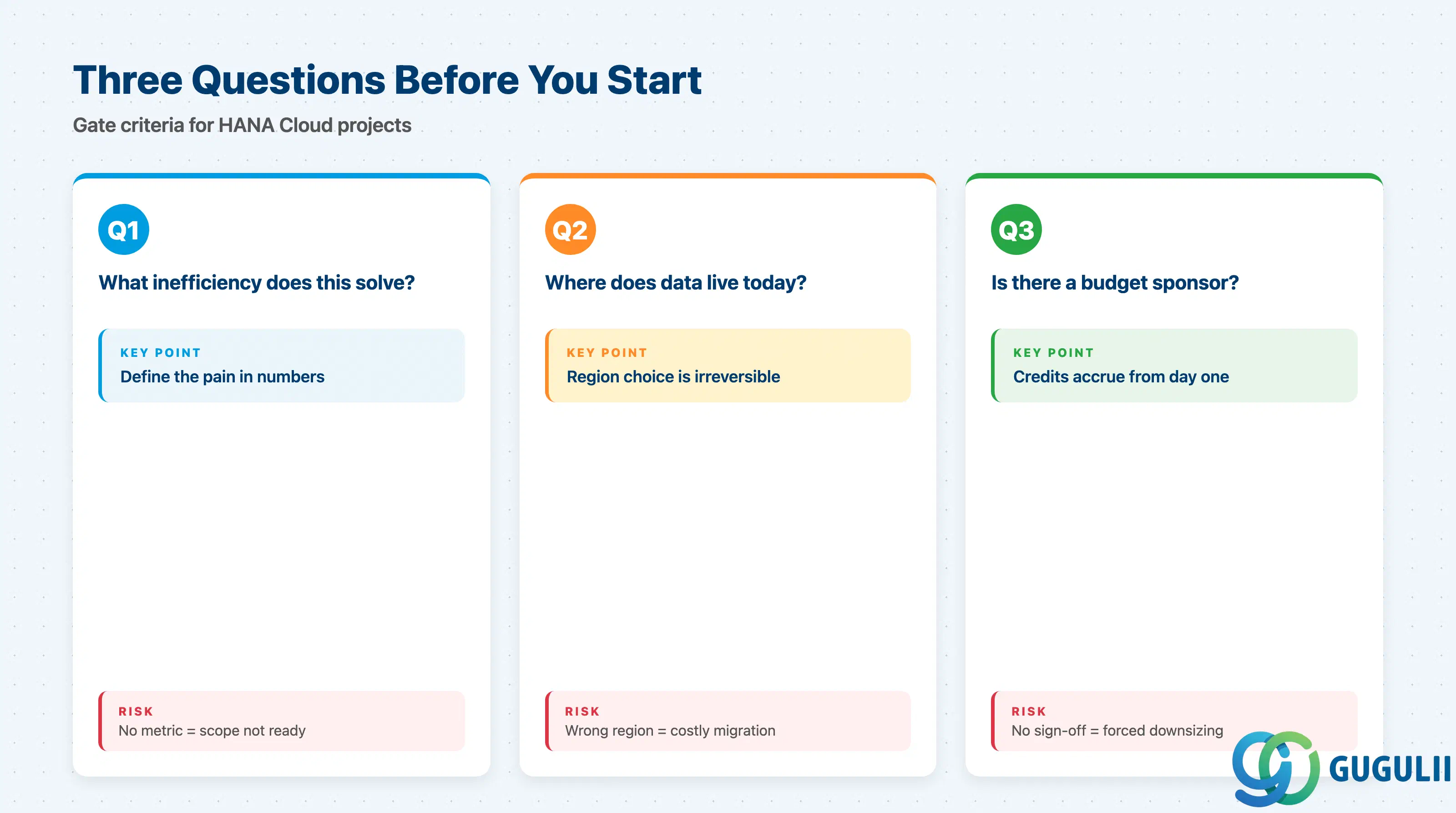
Q1. What measurable inefficiency or performance bottleneck does this solve?
Define the pain point in numbers: query latency (current vs. target), reporting delay (batch window vs. real-time requirement), or data silo count. If the answer is “we want to modernize the data platform” without a specific metric, the project scope is not ready to proceed. HANA Cloud’s in-memory architecture eliminates the need for separate OLTP and OLAP systems, but this benefit is only realized when both workloads have been quantified.
Q2. Where does the data live today, and who owns residency decisions?
HANA Cloud region selection is effectively irreversible after initial provisioning — moving to a different region requires a full data copy, not a configuration change ( SAP HANA Cloud Getting Started Guide). Data residency approvals from legal and compliance must be in hand before subaccount and instance creation. For EU data residency requirements, confirm which region option applies and verify that the cloud infrastructure provider (Azure, SAP Cloud Infrastructure, AWS, or Google Cloud) meets the applicable standard.
Q3. Is there an internal sponsor with budget authority and a committed go-live date?
HANA Cloud’s credit-based pricing means ongoing cost accrues from the moment an instance is running ( SAP Tutorials — HANA Cloud vs. On-Premise). Projects that start provisioning without signed cost approval face forced downsizing or instance deletion mid-development, losing environment state and adding re-setup cost. Confirm budget holder sign-off before any instance is provisioned in a productive or near-productive subaccount.
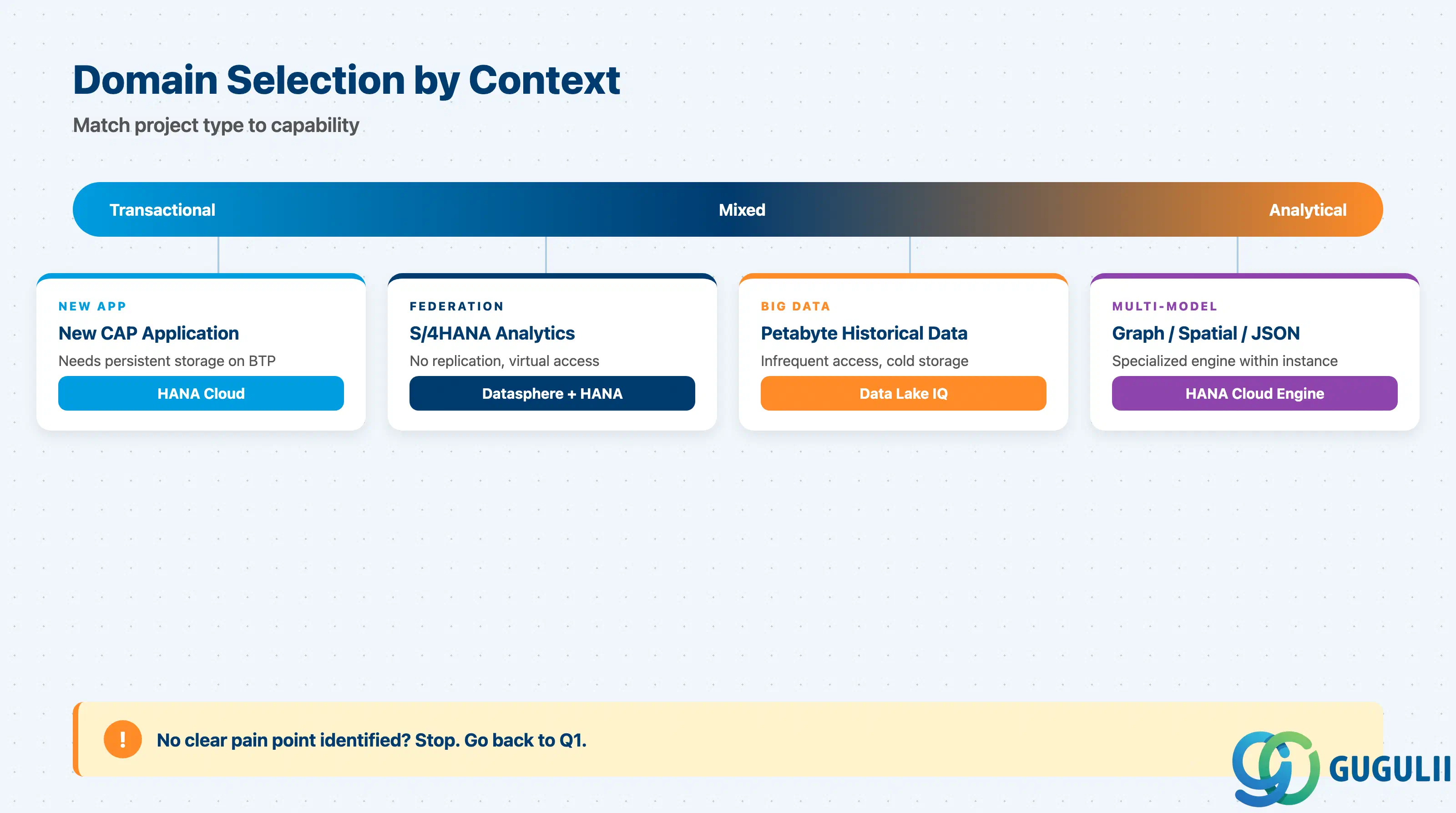
| Project context | Recommended starting capability |
|---|---|
| New CAP application needing persistent storage on BTP | SAP HANA Cloud (single-tenant or multi-tenant depending on isolation requirement) |
| Analytics layer on top of S/4HANA data without replication | SAP Datasphere (virtual federation) + HANA Cloud for local aggregation |
| Petabyte-scale historical data with infrequent access | SAP HANA Cloud Data Lake IQ |
| Semi-structured or document-like data alongside relational | HANA Cloud Document Store (JSON) within existing HANA Cloud instance |
| Highly connected data (org hierarchies, network analysis) | HANA Cloud Graph Engine within existing HANA Cloud instance |
| Location-based business logic (delivery routes, proximity search) | HANA Cloud Spatial Engine within existing HANA Cloud instance |
| No clear pain point identified yet | Stop. Go back to Q1. |
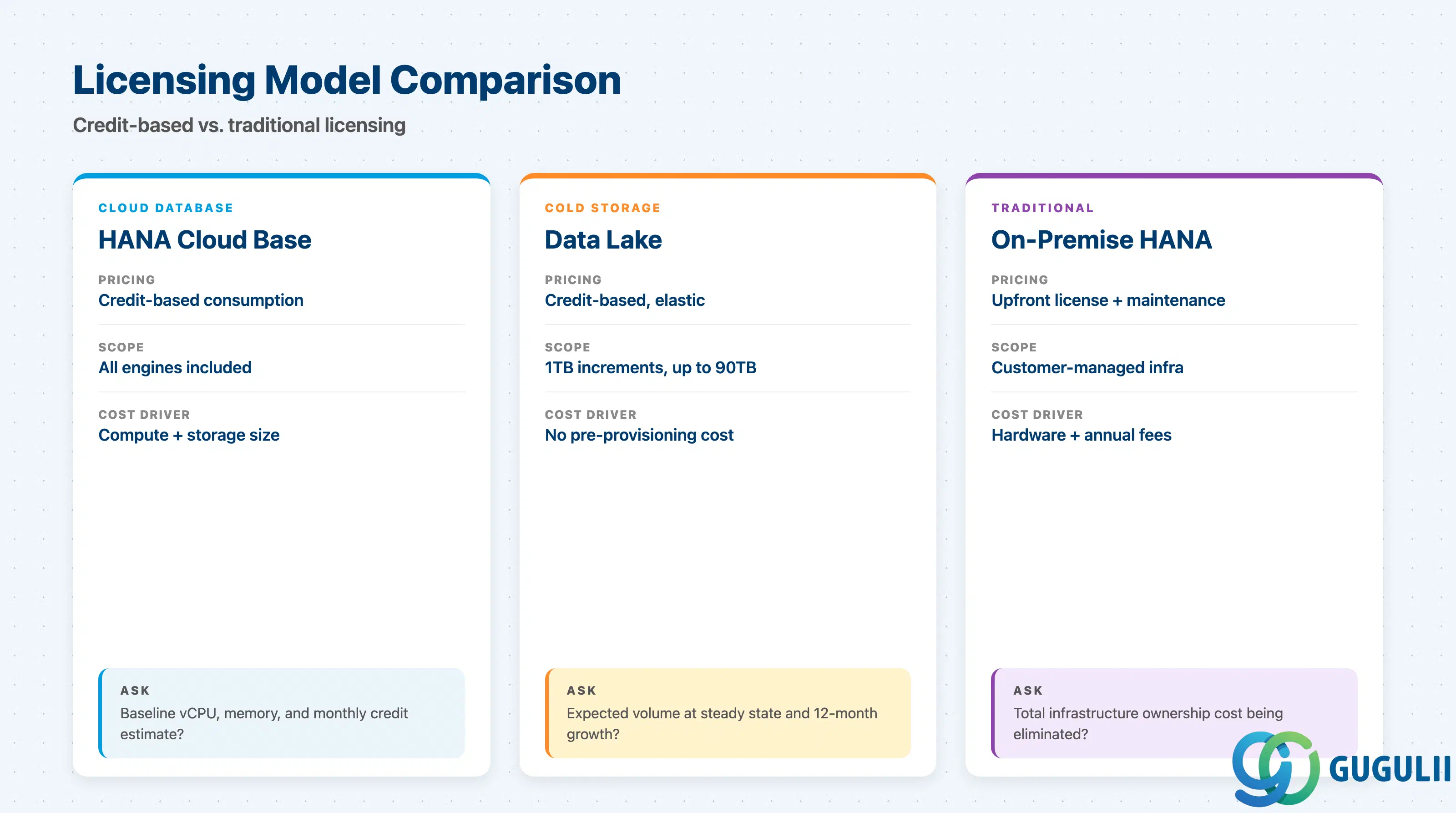
| Capability | Licensing model | Key question to ask |
|---|---|---|
| SAP HANA Cloud (base instance) | Credit-based consumption; feature-inclusive — all engines included; cost driven by compute and storage size ( SAP Tutorials) | What is the baseline vCPU and memory configuration, and what is the expected monthly credit consumption? |
| SAP HANA Cloud Data Lake | Credit-based; storage scales in 1TB increments; no pre-provisioning cost | What is the expected data volume at steady state and growth trajectory over 12 months? |
| On-premise SAP HANA (comparison) | Traditional license: upfront purchase + annual maintenance + customer-managed infrastructure | If migrating from on-premise, what is the total infrastructure ownership cost being eliminated? |
| Native multitenancy | Included in base subscription; no per-tenant licensing fee | How many application tenants are planned, and does schema separation fit the isolation requirements? |
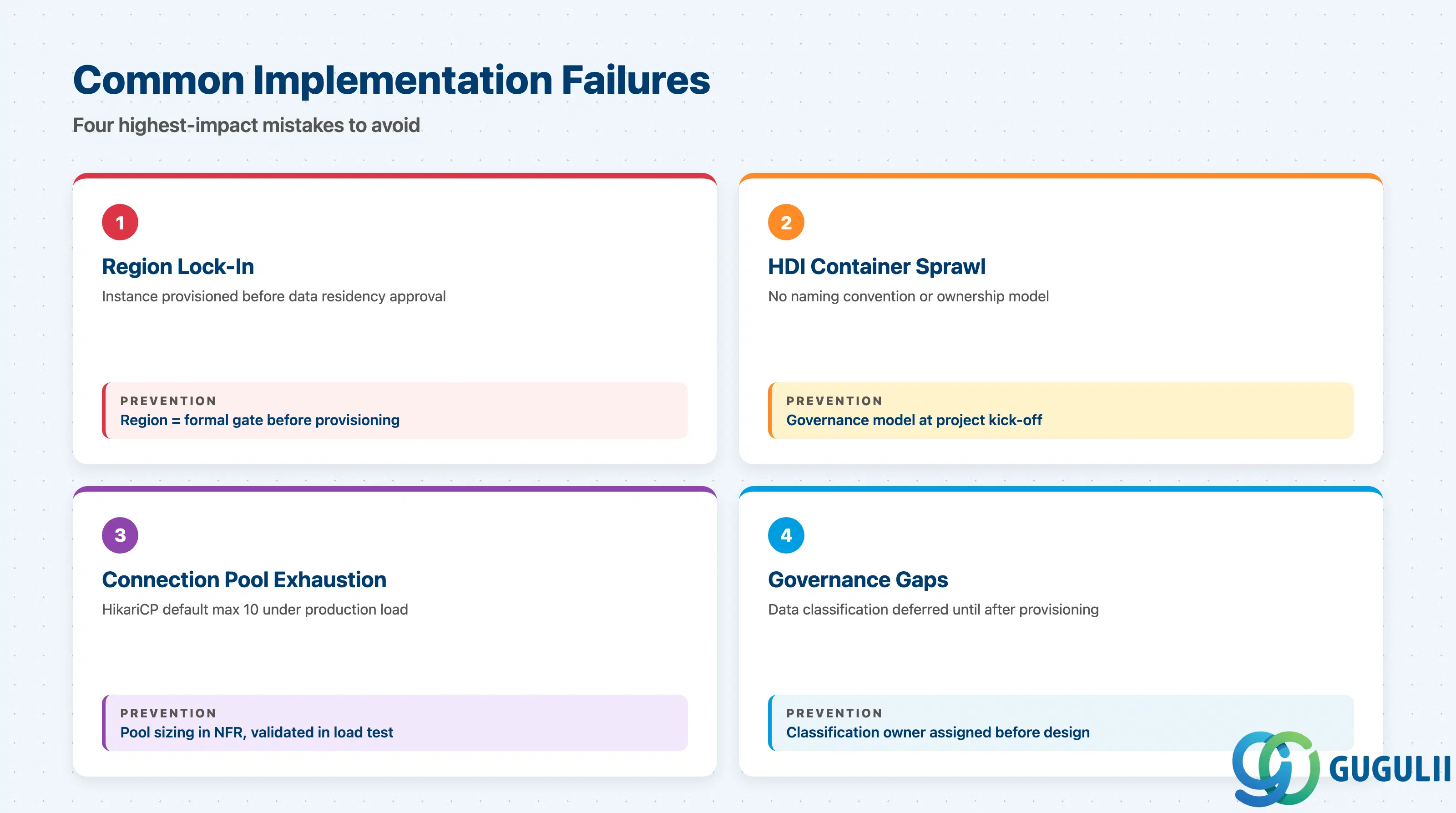
Failure 1: Region lock-in from premature instance provisioning
A subaccount and HANA Cloud instance provisioned before data residency approval forces a choice between a costly migration and a compliance violation. Migrating to a different region after provisioning requires a full data copy. Make region confirmation a formal gate before any instance is created.
Failure 2: Treating HANA Cloud as a drop-in replacement for on-premise HANA
HANA Cloud shares a common SQL codebase with on-premise HANA ( SAP Tutorials), but the operational model is fundamentally different. OS-level access, manual backup configuration, and custom kernel parameter tuning are unavailable. Projects that assume these capabilities exist on the cloud version discover the limitation late, when redesign is expensive.
Failure 3: HDI container proliferation without governance
In multi-team projects, HDI containers multiply when there is no naming convention or ownership model. Each container is a DTC/RTC pair with a dedicated schema owner. Uncontrolled proliferation makes it impossible to track what is deployed where and complicates upgrade sequencing. Establish the HDI container governance model at project kick-off.
Failure 4: Connection pool sizing omitted from non-functional requirements
CAP for Java defaults to a HikariCP pool with a maximum of 10 connections. In production with hundreds of concurrent sessions, this causes connection exhaustion and cascading timeouts. Pool sizing — per service, per expected concurrent load — must appear in the requirements checklist and be validated in load testing before production cutover ( Connection pool sizing insight).
Failure 5: Data governance and classification delayed until after provisioning
When data sensitivity levels are not defined before integration pipelines are built, the team discovers mid-project that certain datasets cannot be placed in the selected region or require customer-managed encryption keys. Each discovery requires architectural rework. Data classification is a business responsibility — assign an accountable owner before design begins.
Failure 6: Workload isolation not designed for mixed OLTP/OLAP
Without workload class definitions, a long-running analytical query can consume all available threads and starve transactional processes. Projects that deploy mixed workloads without configuring workload classes will experience unpredictable latency spikes in production. Workload class design belongs in the requirements phase.
Failure 7: Budget approval deferred while development instances accrue cost
HANA Cloud credits accrue from instance start time. Development environments left running without stop/start automation generate unplanned cost. Confirm the stop/start policy for non-production instances, and ensure continuous-run cost is explicitly approved before provisioning.
Q: Can we use SAP HANA Cloud for an S/4HANA on-premise extension project, or does it only apply to cloud deployments?
HANA Cloud is suitable for S/4HANA extension scenarios regardless of deployment model (Public Cloud Edition, Private Cloud Edition, or on-premise). Extensions built with CAP on BTP can federate or replicate data from an on-premise S/4HANA system via Cloud Connector and SAP HANA smart data integration. The key prerequisite is network connectivity between the BTP subaccount and the on-premise landscape, which requires security team approval before project design is finalized.
Q: How is HANA Cloud licensing different from on-premise HANA, and what should I communicate to the CFO?
On-premise HANA uses a traditional upfront license purchase plus annual maintenance, with the customer owning all infrastructure. HANA Cloud uses a credit-based consumption model — no upfront license purchase, but ongoing credits accrue based on the size of the running instance. The practical message for finance: no large upfront capital expenditure, but the operating cost is perpetual and tied to instance size and run-time hours. Stopping non-production instances outside working hours reduces cost; right-sizing matters more than it does on-premise.
Q: When should we descope HANA Cloud from a project and use a different persistence option?
Descope HANA Cloud if the workload is pure object storage (unstructured files only, no SQL queries), if the budget does not support ongoing credit consumption, or if the use case can be fully served by a standard database in the target cloud provider. HANA Cloud’s value is highest when the workload combines transactions, analytics, and multi-model data in a single system. If the project is purely analytical with no transactional requirement and petabyte-scale volumes, evaluate whether SAP HANA Cloud Data Lake alone is sufficient and more cost-effective.
Q: How do I document the HANA Cloud requirement properly for a solution proposal or blueprint?
The requirement document should specify: (1) workload type (OLTP, OLAP, or mixed), (2) expected data volume at go-live and 12-month growth, (3) concurrency profile (peak simultaneous users and query types), (4) data residency and encryption requirements, (5) HA/DR tier required (backup-only vs. system replication), and (6) multitenancy model (single-tenant vs. native multi-tenant with schema separation). These six parameters map directly to the sizing, region, and configuration decisions that determine both technical fit and cost.
Q: Is SAP HANA Cloud the same as SAP S/4HANA Cloud?
No. SAP HANA Cloud is the database and data platform service within SAP BTP. SAP S/4HANA Cloud is the ERP application (successor to SAP ECC), which runs on top of an SAP HANA database. The two are related — S/4HANA Cloud uses HANA internally — but they are different products with different licensing, administration, and integration points. In the BTP context, “HANA Cloud” means the standalone database service, not the ERP.
Q: What administration tools are available for HANA Cloud, and do we need separate training?
HANA Cloud uses three layered tools: SAP HANA Cloud Central (instance-level administration shared with Analytics Cloud and Data Lake), SAP HANA Cockpit (database-level monitoring and administration), and SAP HANA Database Explorer (SQL query execution and catalog inspection). Cockpit and Database Explorer functionality is being progressively integrated into HANA Cloud Central ( Admin Tools). Administrators familiar with on-premise HANA Cockpit will find the cloud equivalents recognizable; the main learning curve is BTP-level access management (role collections, subaccount structure).
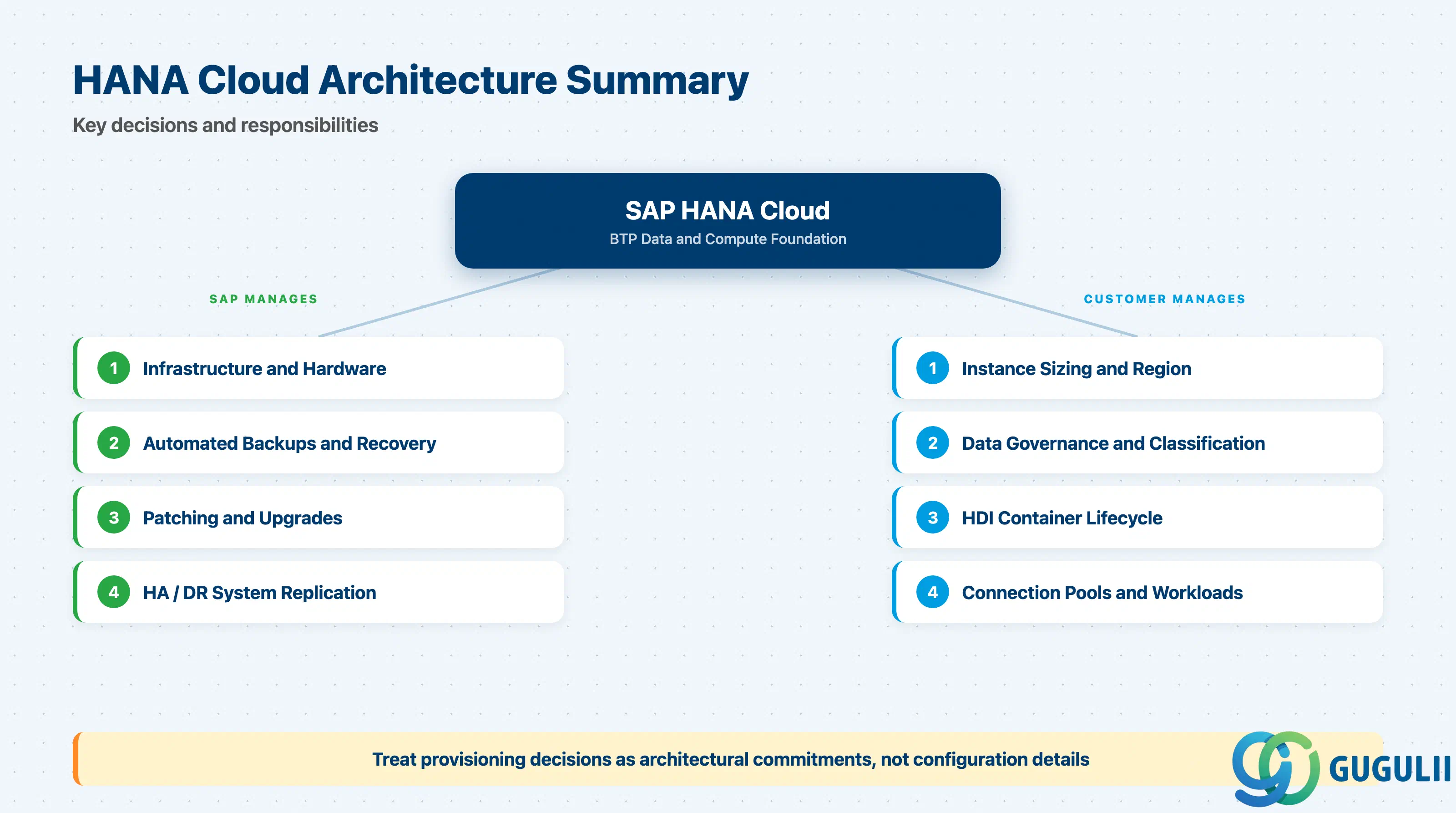
SAP HANA Cloud is the persistence and compute foundation for the SAP BTP Data and Analytics domain. Its in-memory column-store engine, multi-model support (relational, graph, spatial, JSON, vector), native multitenancy, and SAP-managed HA/DR make it production-ready for a wide range of workloads. The shift from on-premise HANA to HANA Cloud is primarily operational: SAP manages infrastructure, backups, and patching, while the customer’s responsibility moves to sizing, data governance, HDI container lifecycle, and connection pool management. The most common project failures happen at the requirements stage — when region, data residency, and workload class decisions are deferred. Treat HANA Cloud provisioning decisions as architectural commitments, not configuration details.
| ID | Category | Component | Scope |
|---|---|---|---|
| BTP-C01 | Overview | Data and Analytics | BTP-C01: Data and Analytics: Overview and Capability Map |
| BTP-C02 | Architecture and Use | HANA Cloud | BTP-C02: HANA Cloud: Architecture and Use (this article) |
| BTP-C03 | Architecture and Use | SAP Datasphere | BTP-C03: SAP Datasphere: Architecture and Use |
| BTP-C04 | Architecture and Use | SAP Analytics Cloud | BTP-C04: SAP Analytics Cloud: Architecture and Use |
| BTP-C05 | Architecture and Use | Data Integration | BTP-C05: Data Integration: Architecture and Use |
| BTP-C06 | Architecture and Use | Data Governance | BTP-C06: Data Governance: Architecture and Use |