Title here
Summary here

| ID | Title |
|---|---|
| BTP-D01 | Business AI: Overview and Capability Map (this article) |
| BTP-D02 | Joule: Architecture and Use |
| BTP-D03 | AI Core and GenAI Hub: Architecture and Use |
| BTP-D04 | Document AI: Architecture and Use |
| BTP-D05 | Responsible AI: Principles and Implementation |
| BTP-D06 | Business AI: Use Cases and Decision Patterns |
| Resource | URL |
|---|---|
| Business AI on SAP BTP | sap.com → |
| SAP AI Core Service Guide | help.sap.com → |
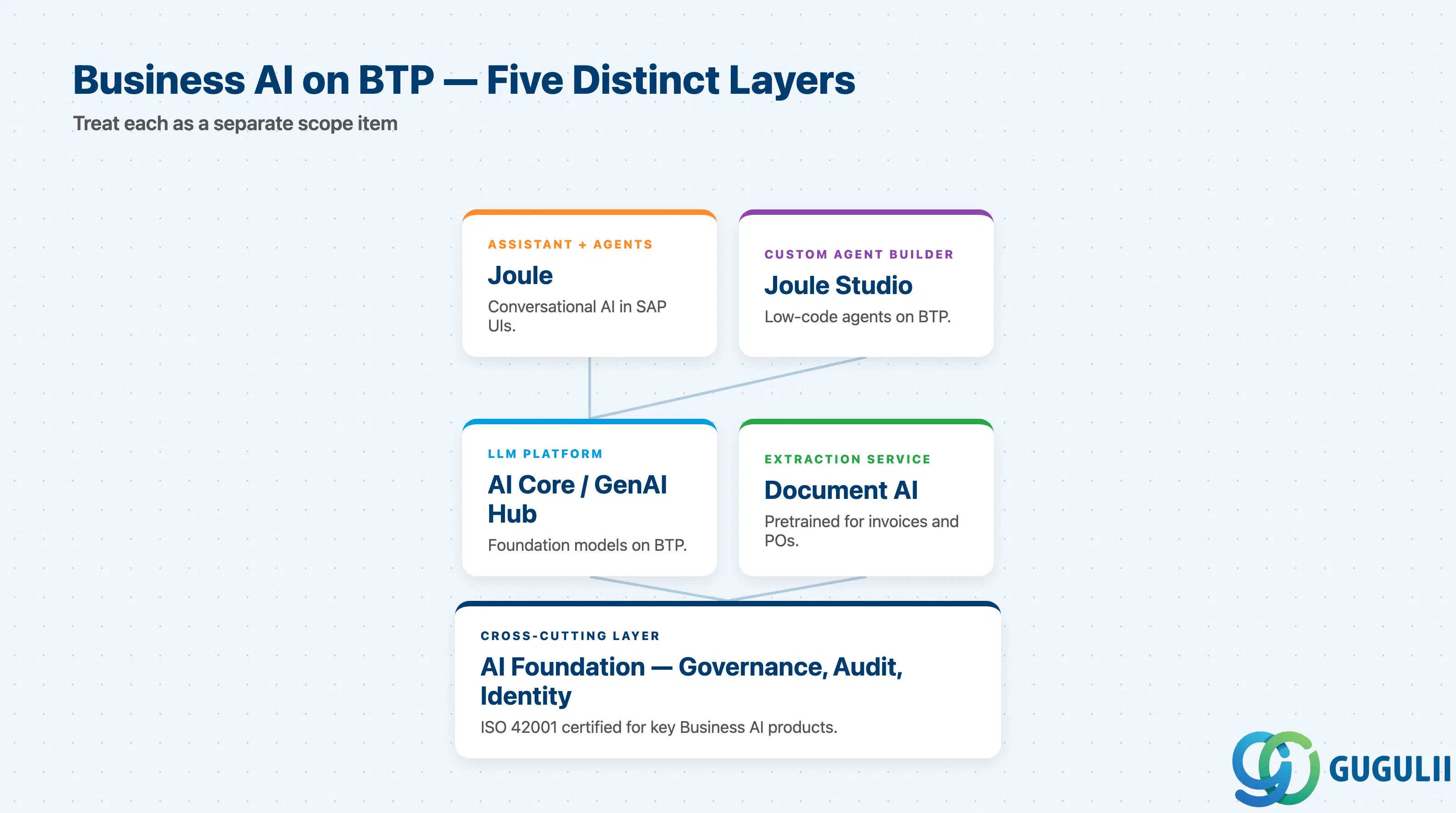
SAP’s “Business AI” umbrella covers four functional layers that consultants tend to confuse with each other. Treat them as separate scope items in your project plan.
| Capability | What it does | Primary user |
|---|---|---|
| Joule (Base + Premium) | Conversational assistant and agents inside SAP UIs (Fiori, S/4HANA Cloud, SuccessFactors, etc.). | Business end-users and process owners |
| Joule Studio | Low-code builder for custom agents grounded in SAP business context. | Functional consultants and citizen developers |
| AI Core / Generative AI Hub | Managed runtime for foundation models (OpenAI, IBM Granite, open-source) on BTP. | Developers and ML engineers |
| Document AI | Pretrained extraction service for invoices, payment advices, and POs. | Finance / shared-service automation teams |
| AI Foundation | Cross-cutting governance, audit, and identity layer (ISO 42001 certified). | Architects, security, and compliance |
They are not substitutes.
                   ┌──────────────────────────────────────────────┐
                   │                SAP BTP (subaccount)          │
                   │                                              │
                   │   ┌──────────┐   ┌────────────────────────┐  │
                   │   │  Joule   │   │  AI Core / GenAI Hub   │  │
   ┌─────────┐     │   │ Premium  │   │  (Azure / AWS / GCP /  │  │
   │  User   │────►│   │ + Studio │   │   IBM / open-source)   │  │
   └─────────┘     │   └────┬─────┘   └────────────┬───────────┘  │
                   │        │                      │              │
                   │   ┌────┴───────┐    ┌─────────┴─────────┐    │
                   │   │ Document AI│    │  AI Foundation:   │    │
                   │   │ (extract)  │    │  identity, audit, │    │
                   │   └─────┬──────┘    │  Knowledge Graph  │    │
                   │         │           └───────────────────┘    │
                   └─────────┼─────────────────────┼──────────────┘
                             │                     │
                             ▼                     ▼
                ┌──────────────────────┐  ┌─────────────────────┐
                │ S/4HANA Public Cloud │  │   S/4HANA Private   │
                │ S/4HANA PCE 2023+    │  │   Edition (PCE)     │
                └──────────────────────┘  └─────────────────────┘
                             │
                             ▼
                ┌──────────────────────┐
                │ Classic On-Premise   │
                │ S/4HANA              │  ← Joule NOT supported,
                │ (and ECC)            │     not on roadmap (2026)
                └──────────────────────┘
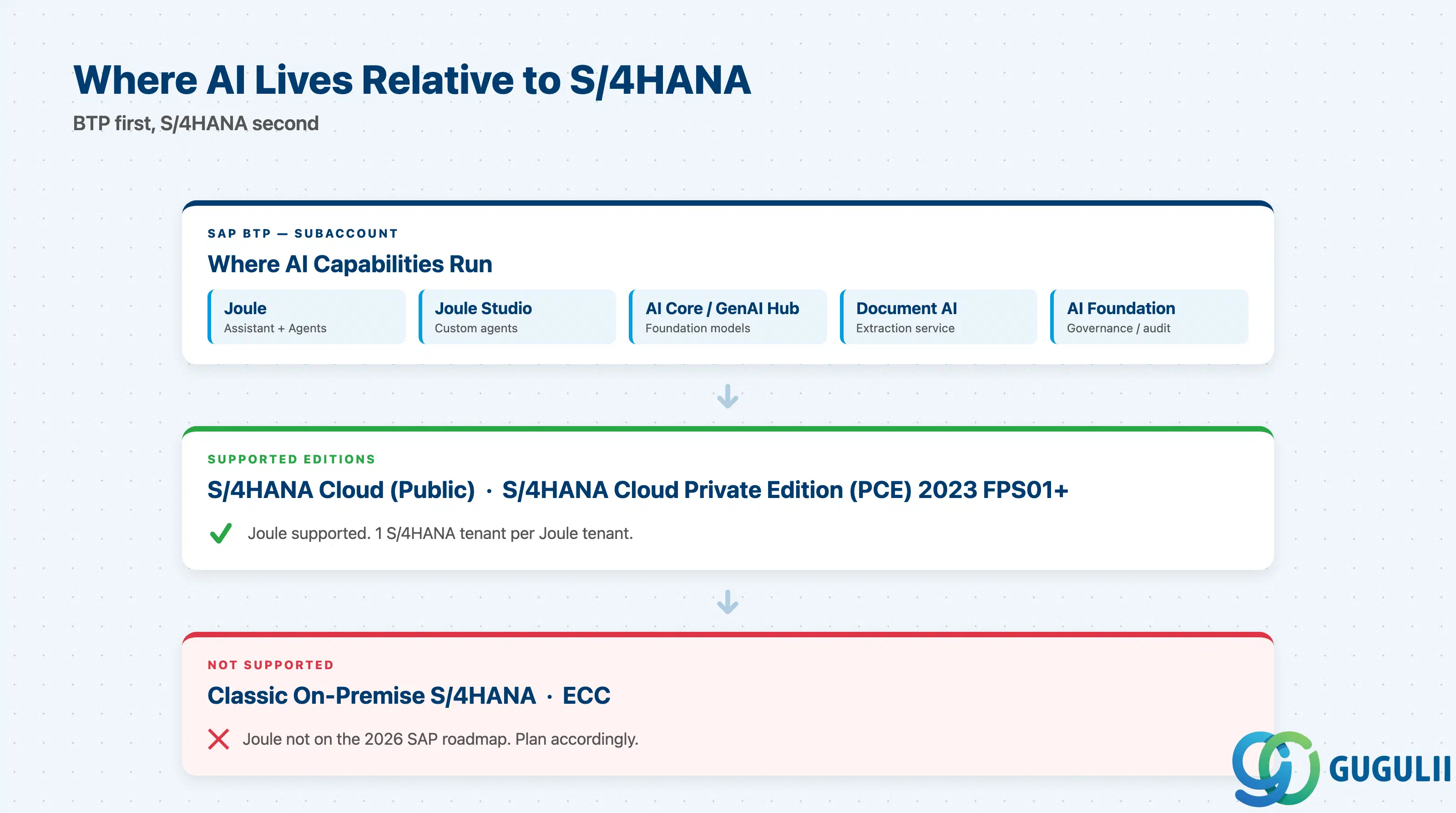
Key point: every Joule deployment is a BTP project first and an S/4HANA project second. You need an Enterprise Global Account on BTP, a single SAP Cloud Identity Services tenant for everything that talks to Joule, and S/4HANA Cloud or PCE 2023 FPS01+. Classic on-premise customers will not get Joule on this roadmap. Source: SAP Help Portal, Constraints for Joule in S/4HANA Cloud Private Edition ( https://help.sap.com/docs/joule/integrating-joule-with-sap/constraints).
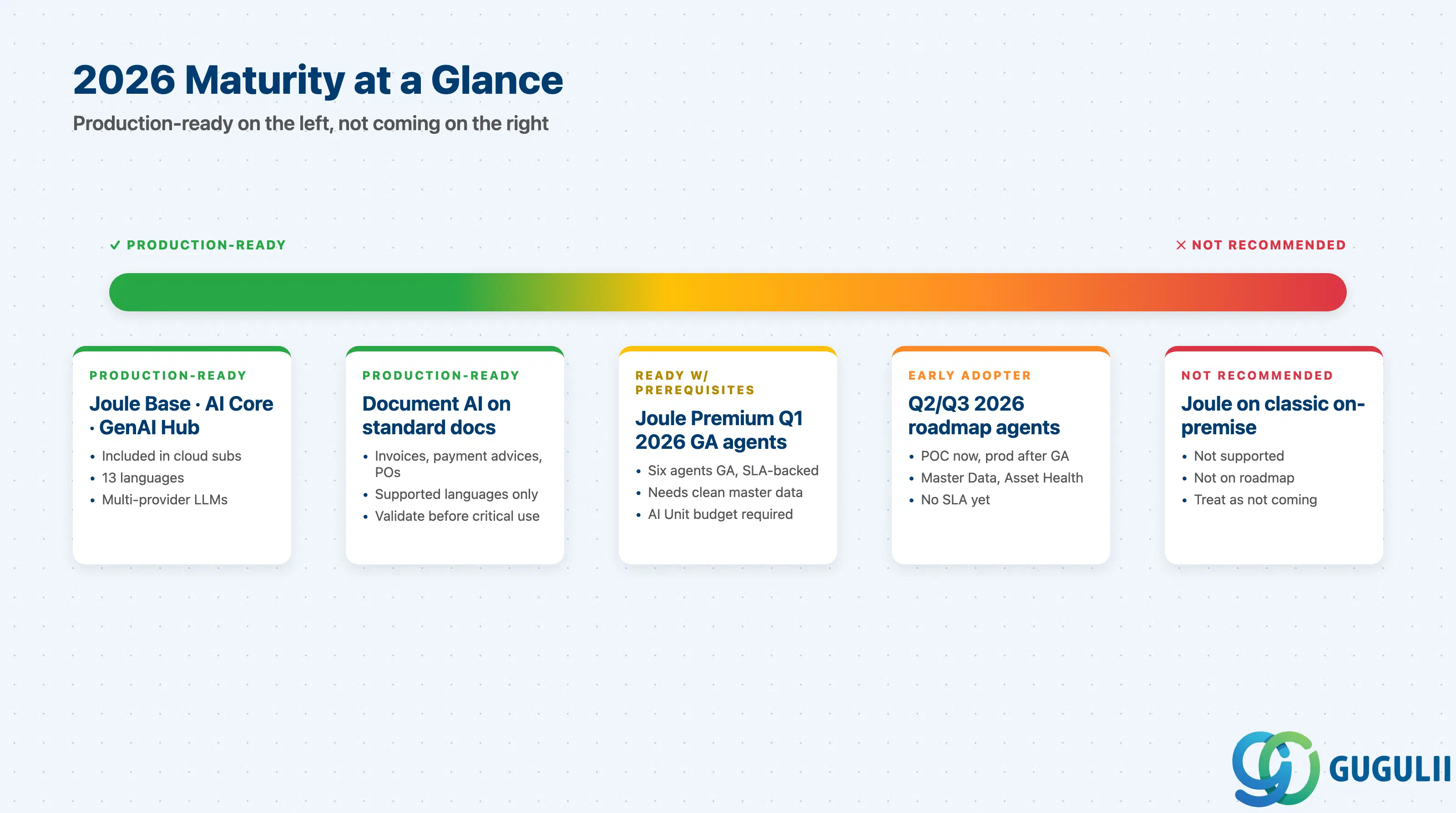
Honest 2026 readiness for the standard SAP customer (not a TechEd demo).
| Capability | Maturity | Notes |
|---|---|---|
| Joule Base (navigation, search, Q&A) | ✅ Production-ready | Included in cloud subscriptions. 13 languages. Limited transactional scope. |
| Joule Premium agents (Q1 2026 GA agents) | ⚠️ Ready with prerequisites | Six agents reached GA in Q1 2026. SLA-backed. Requires clean master data and AI Unit budget. |
| Joule Premium agents (Q2/Q3 2026 roadmap) | 🔶 Early adopter | Production Master Data Agent, Asset Health Agent, etc. — plan POC now, production after GA. |
| Joule Studio (custom agents) | ✅ Production-ready (the runtime) | Studio itself is GA Q1 2026. Quality of resulting agents depends entirely on prompt and data. |
| Joule on classic on-premise S/4HANA | ❌ Not recommended | Not supported. Not on SAP roadmap. Treat as “not coming” for 2026 plans. |
| AI Core (training, deployment) | ✅ Production-ready | Mature service. Standard on extended plan. |
| Generative AI Hub (LLM access) | ✅ Production-ready | OpenAI (Azure), IBM Granite, Falcon, multi-provider. Token-based metering. |
| Document AI — invoices / POs / payment advices in supported languages | ✅ Production-ready | Pretrained model, high accuracy on standard layouts. |
| Document AI — non-standard layouts / handwritten / niche document types | 🔶 Early adopter | Requires schema customization and human-in-the-loop validation. |
| AI Foundation governance (audit logs, IAM, ethics) | ✅ Production-ready | ISO 42001 certified for key Business AI products. |
The hardest part of any Business AI project on BTP in 2026 is not enabling the service — it is meeting the prerequisites the service assumes. One sub-table per capability follows.
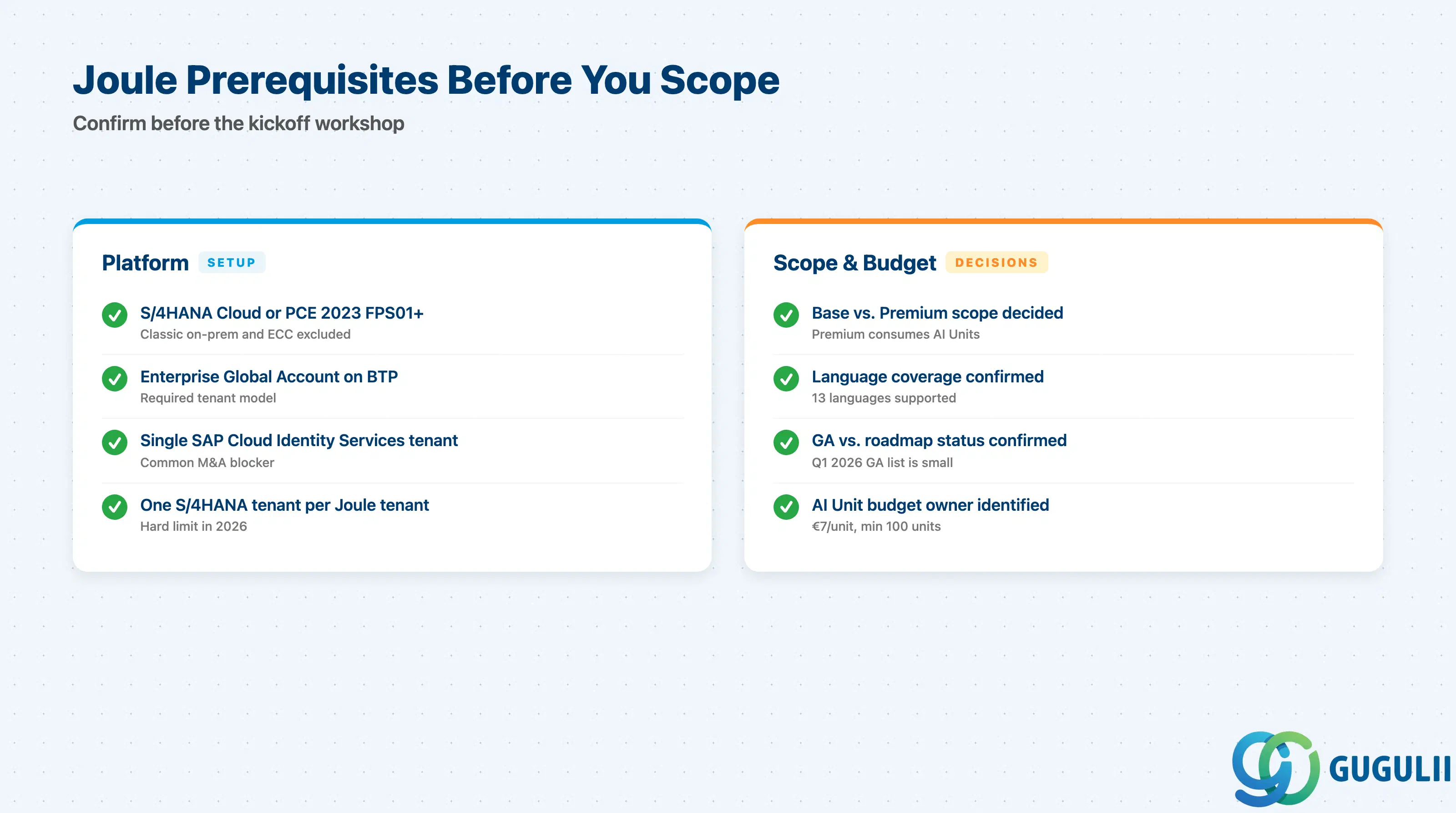
| Checklist item | Why it matters |
|---|---|
| Confirm S/4HANA edition is Cloud (Public) or PCE 2023 FPS01+ | Joule does not run on classic on-premise; ECC is excluded. |
| Establish Enterprise Global Account on BTP | Required tenant model for Joule subscription. |
| Consolidate identity onto a single SAP Cloud Identity Services (IAS) tenant | All integrated apps must share the IAS tenant — common blocker on M&A landscapes. |
| Decide Joule Base vs. Joule Premium scope per business unit | Premium consumes AI Units (€7/unit, min 100). Base is included. |
| Confirm only one S/4HANA tenant per Joule tenant | Today’s hard limitation. Multi-tenant S/4HANA landscapes cannot share one Joule. |
| Define language coverage requirement | Joule supports 13 languages in 2026. Confirm coverage matches the business population. |
| List target Joule Skills / Agents and verify GA status | Q1 2026 GA list ≠ Q2/Q3 roadmap. Do not scope a Q3 agent into a Q2 go-live. |
| Plan AI Unit consumption budget (annual) | Premium is consumption-based. Without a budget owner, projects stall at gate. |
| Checklist item | Why it matters |
|---|---|
| Subscribe to AI Core extended service plan | GenAI Hub is delivered through the extended plan, not standard. |
| Provision SAP AI Launchpad | Required, no extra service cost, but a separate provisioning step. |
Choose foundation-model scenario(s): azure-openai, aws-bedrock, gcp-vertexai, aicore-opensource | Model availability and data routing depend on the scenario you enable. |
| Validate residency rules per provider | Cross-region routing rules differ for Azure, AWS, GCP — customer due diligence required. |
| Establish a token consumption baseline before go-live | Pricing is per-token, varies by model. Without a baseline, cost forecasting fails. |
| Define model selection policy (when to use which LLM) | Granite, OpenAI, Falcon have different cost / capability / data-handling trade-offs. |
| Plan prompt and response logging for audit | Required for ISO 42001 conformance and internal governance. |
| Checklist item | Why it matters |
|---|---|
| Confirm document types in scope are invoices, payment advices, or purchase orders | These are the document types where the pretrained model is highly accurate. |
| Confirm source language and country are in the supported list | Outside the supported list, accuracy drops materially. |
| Define page-count distribution of inbound documents | Metering charges per page. Multi-page invoices multiply cost. |
| Define field count requirement (must be ≤ 50 to stay in one billable document) | >50 fields per document is metered as multiple documents. |
| Plan schema customization effort if non-standard fields are needed | Up to 500 fields per schema technically, but each custom field is tuning effort. |
| Mandate human-in-the-loop validation for critical workflows | SAP guidance is explicit: extracted data must be validated before use in critical processes. |
| Define exception handling for low-quality scans | OCR accuracy degrades on poor scans; without exception path, AP processing stalls. |
| Checklist item | Why it matters |
|---|---|
| Identify the specific business decision the custom agent will make | Without a single, named decision, an agent becomes a chatbot. |
| Inventory the SAP master and transactional data the agent will read | Studio agents are only as good as the SAP context they can ground on. |
| Define the action surface: read-only vs. transactional | Transactional agents need separate authorization and audit treatment. |
| Plan Joule Studio version-control strategy | Custom agents are configuration assets that need release management like ABAP transports. |
| Confirm AI Unit consumption assumption for the agent’s expected traffic | Custom agents fall under Premium consumption — needs a budget owner. |
| Plan acceptance testing including adversarial prompts | Agents that pass demo scenarios often fail on edge cases users will produce. |
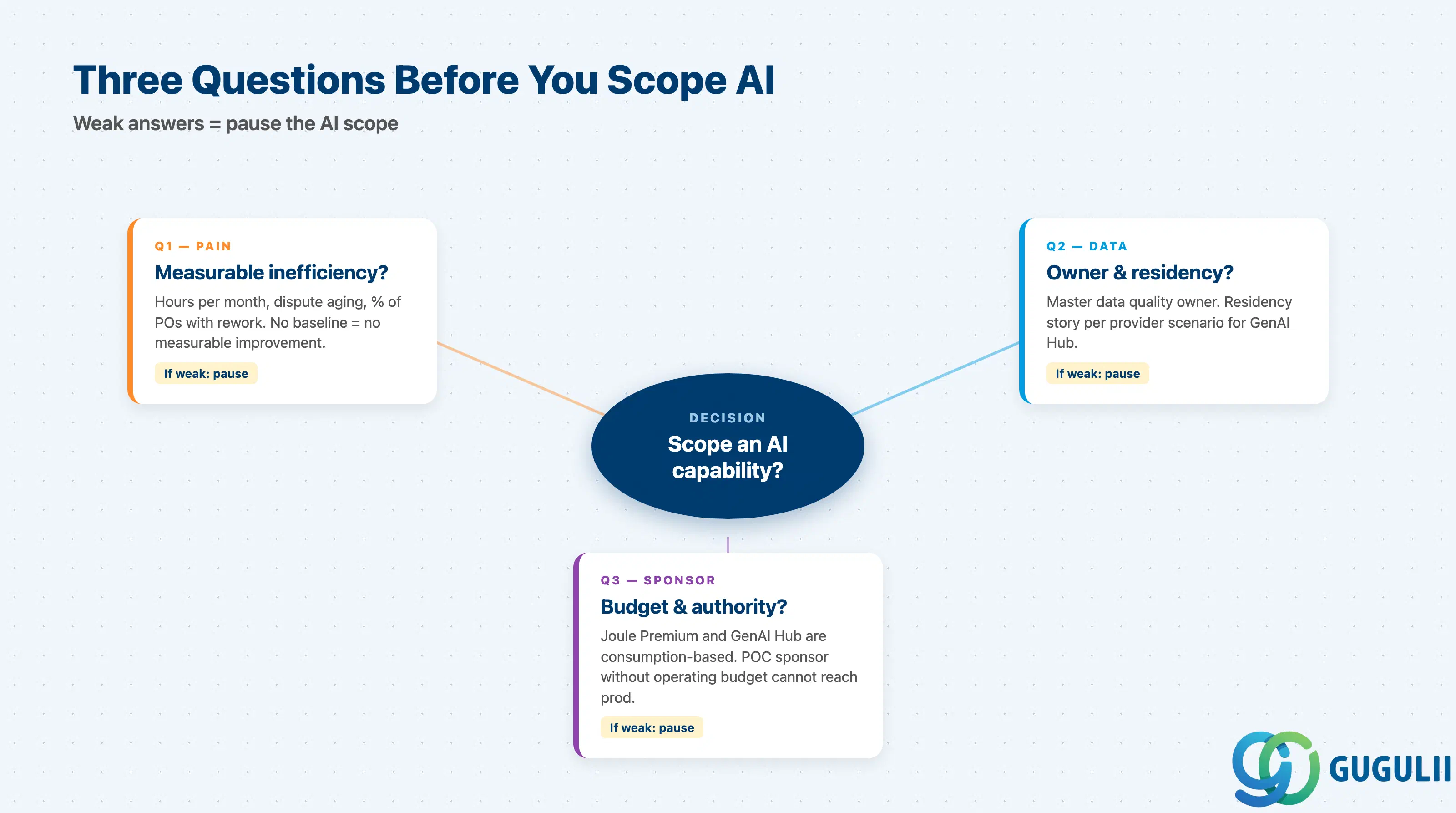
Use these in the very first conversation with a sponsor. If any answer is weak, pause the AI scope until it is strong.
Q1. What is the measurable inefficiency we are removing, and how do we count it today?
Concrete numbers: hours per month spent on invoice exception handling, average days-sales-outstanding for disputed invoices, percent of POs requiring manual rework. If the team cannot produce a baseline, an AI project will not produce a measurable improvement either.
Q2. Who owns the data the AI will read, and where does it have to live?
Joule, Document AI, and any agent grounded on SAP context need clear ownership of master data quality and a clear residency story. For GenAI Hub, residency depends on which provider scenario you enable. For Joule, residency follows your SAP cloud tenant.
Q3. Who is the internal sponsor with the budget and authority to operate this in production?
Joule Premium and GenAI Hub are consumption-based — somebody must own the AI Unit budget and the per-token cost. A POC sponsor without an operating budget cannot take an agent into production.
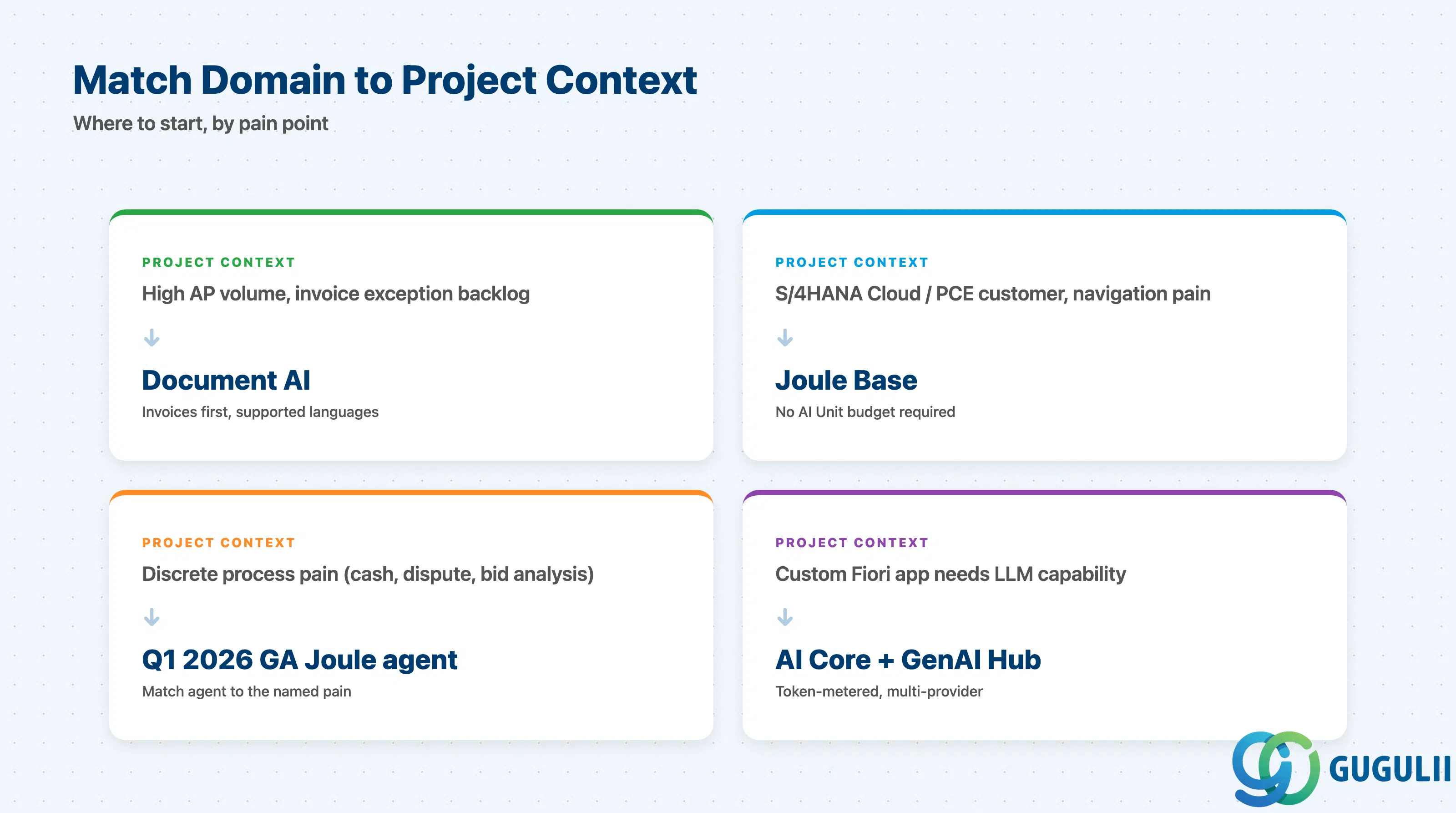
| Project context | Recommended starting capability |
|---|---|
| AP automation backlog, high invoice volume | Document AI (invoices first) |
| S/4HANA Cloud / PCE customer, high-friction navigation pain | Joule Base (no AI Unit budget needed) |
| Discrete process pain (cash management, dispute handling, bid analysis) | Q1 2026 GA Joule agent in that domain |
| LLM-powered application embedded in a custom Fiori app | AI Core + GenAI Hub |
| Need to enforce policy on autonomous actions | AI Foundation governance + Joule Studio guardrails |
| No clear pain point identified yet | Stop. Go back to Q1. |
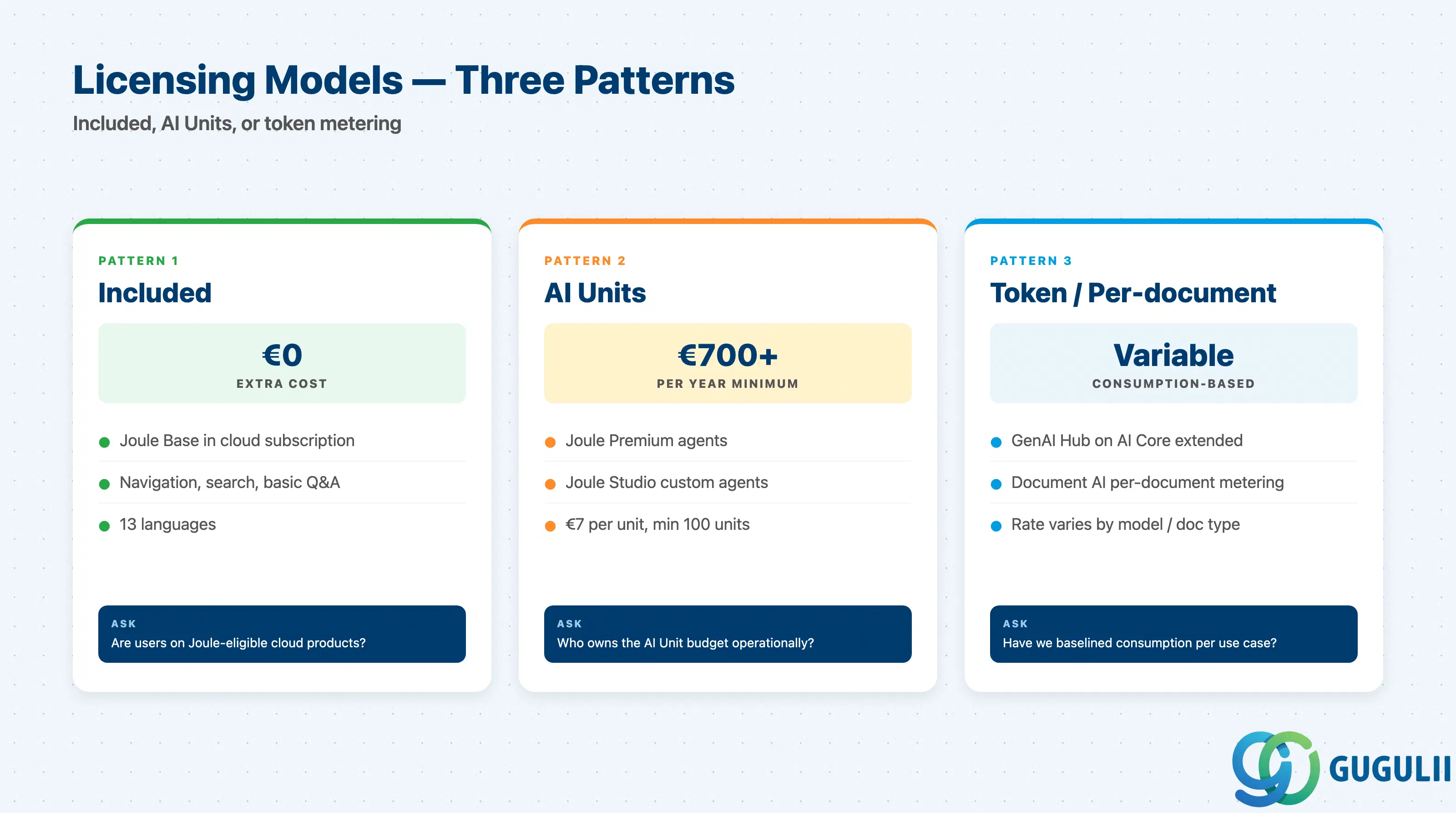
| Capability | Licensing model | Key question to ask |
|---|---|---|
| Joule Base | Included in SAP cloud subscription | Are all targeted users on a Joule-eligible cloud product (S/4HANA Cloud, SuccessFactors, etc.)? |
| Joule Premium / Studio agents | Consumption (SAP AI Units, €7/unit, min 100 units) | Who owns the AI Unit budget operationally, and how is consumption forecast? |
| AI Core (standard plan) | Subscription | Is the standard plan enough, or do we need extended for GenAI Hub? |
| AI Core extended plan + GenAI Hub | Subscription + token-based metering | Have we baselined token consumption per use case before contracting? |
| Document AI | Per-document metering (1 page, 50 fields cap per document) | Does our document mix fit inside the 1-page / 50-field unit, or does it metering-multiply? |
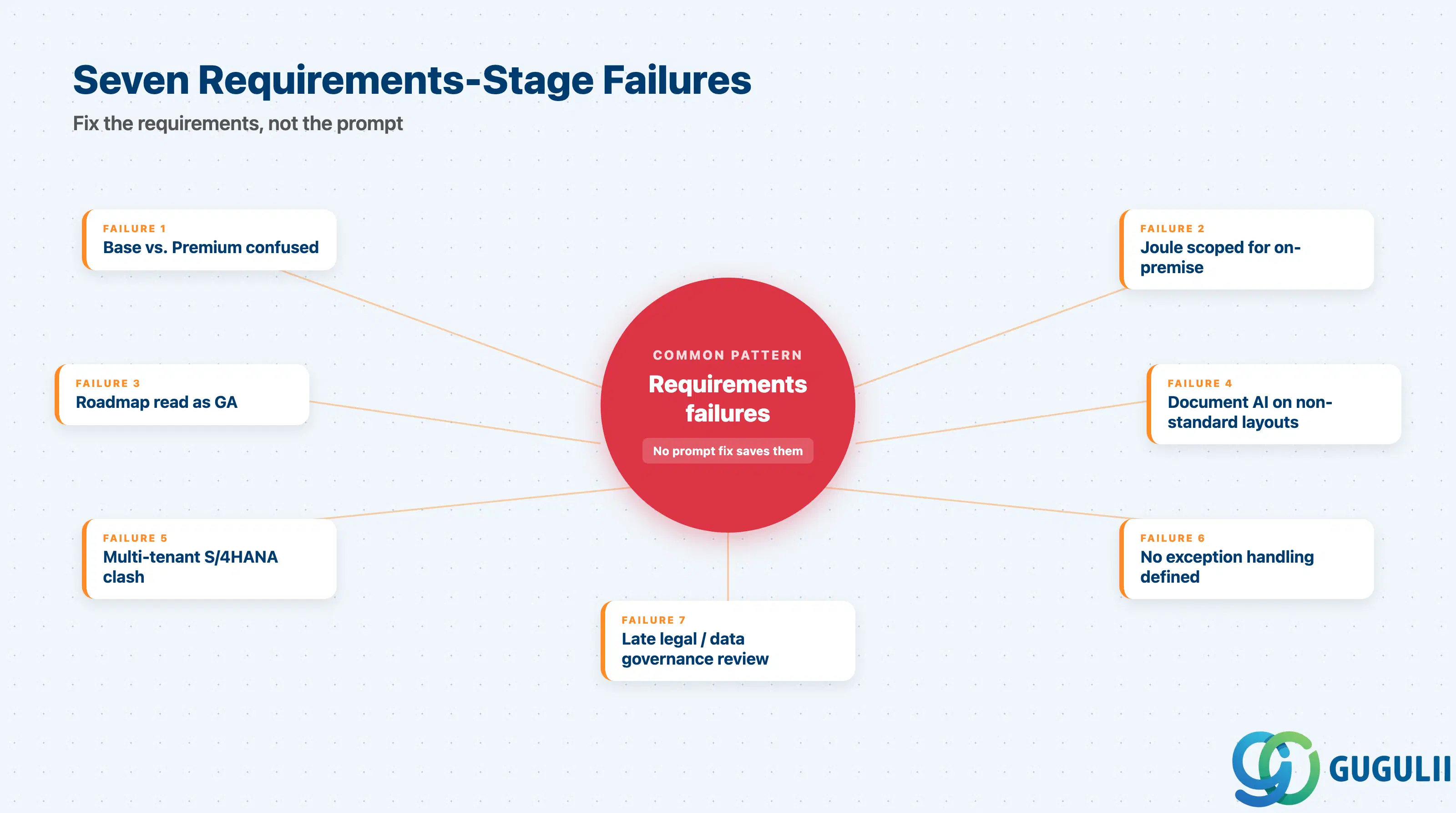
These are requirements-stage failures, not implementation bugs. The fix is the requirements work, not better prompts.
Failure 1: Confusing Joule Base with Joule Premium during scoping
Many proposals say “we will deploy Joule.” Joule Base is included; Premium agents need AI Units and a budget owner. Treating them as one item produces a project that has no plan for the consumption cost and no clear value boundary between the included assistant and the paid agents.
Failure 2: Scoping Joule for a classic on-premise S/4HANA customer
It does not run there and is not on the roadmap. If the customer is classic on-premise, the only viable BTP AI scope in 2026 is GenAI Hub via custom integration, plus Document AI as a standalone service — not Joule.
Failure 3: Assuming a Q2/Q3 2026 roadmap agent for a Q2 go-live
The Q1 2026 GA list is small. Production Master Data Agent, Asset Health Agent, and others are post-Q1. Reading a press release as a roadmap commitment is a contract risk. Always anchor scope to the agents that are GA today.
Failure 4: Document AI for non-standard layouts without schema work
The pretrained model is excellent on invoices, payment advices, and POs in supported languages. On utility bills, customs documents, or handwritten forms it is much weaker, and SAP’s own guidance requires human validation before critical use. Scoping “Document AI for all inbound documents” without a per-document-type accuracy plan creates rework.
Failure 5: Multi-tenant S/4HANA landscape, single Joule tenant assumption
The current limit is one S/4HANA tenant per Joule tenant. M&A landscapes, regional carve-outs, and shared-services models routinely violate this assumption. Detect it during requirements, not during configuration.
Failure 6: No exception handling defined for AI-driven actions
When Joule resolves a dispute or Document AI extracts a field, the corner case (low confidence, malformed input, partial match) must route somewhere. Projects that scope “AI does it” without defining the exception path produce a quiet backlog of failed automations.
Failure 7: Data governance approval treated as a late-stage formality
ISO 42001 audit, prompt logging, and data-residency review are part of AI Foundation. They are not blockers SAP imposes — they are blockers your own legal and security teams will impose, and late legal review has stalled more Joule rollouts than any technical issue.
Q: Can we run Joule against a classic on-premise S/4HANA system?
No. Joule supports S/4HANA Cloud (Public) and S/4HANA Cloud Private Edition starting at 2023 FPS01. SAP has confirmed classic on-premise is not on the current roadmap. For on-premise customers, the practical 2026 path is to use AI Core / Generative AI Hub directly (custom integrations) and Document AI as a standalone service, not Joule.
Q: What is the minimum viable license footprint for a Joule POC?
Joule Base in your existing SAP cloud subscription (no extra cost), plus SAP AI Units if you want to test Premium agents. The AI Unit floor is 100 units (€700 annually) at €7 per unit. Below Premium, Joule Base is free at point of use.
Q: When should we descope AI from a project?
When any of the three first-questions are weak: no measurable baseline (Q1), no data ownership or residency answer (Q2), or no operating sponsor with budget (Q3). Also descope when the targeted Joule agent is on a roadmap rather than GA today, when the document mix does not fit Document AI’s strong cases, or when the S/4HANA edition does not support Joule.
Q: How do we document a Business AI requirement properly?
Treat each AI capability as a discrete requirement item. For each item, capture: the business decision being supported, the source data and its owner, the action surface (read-only vs. transactional), the licensing model and budget owner, the GA / roadmap status, the residency story, and the exception path. Reusing a generic “implement Joule” line item across business units is the most common documentation antipattern.
Q: How does SAP’s responsible-AI framework affect our project?
SAP runs AI capabilities through its AI Ethics Office, with high-risk scenarios reviewed by an AI Ethics Committee. AI Foundation provides ISO 42001 audit logging, IAM via SAP Cloud Identity Services, and end-to-end encryption. Practically, this gives your security and compliance teams artifacts to sign off on — but you still need an internal AI policy that maps to them.
Q: What is a sensible prioritization order for a customer starting with Business AI in 2026?
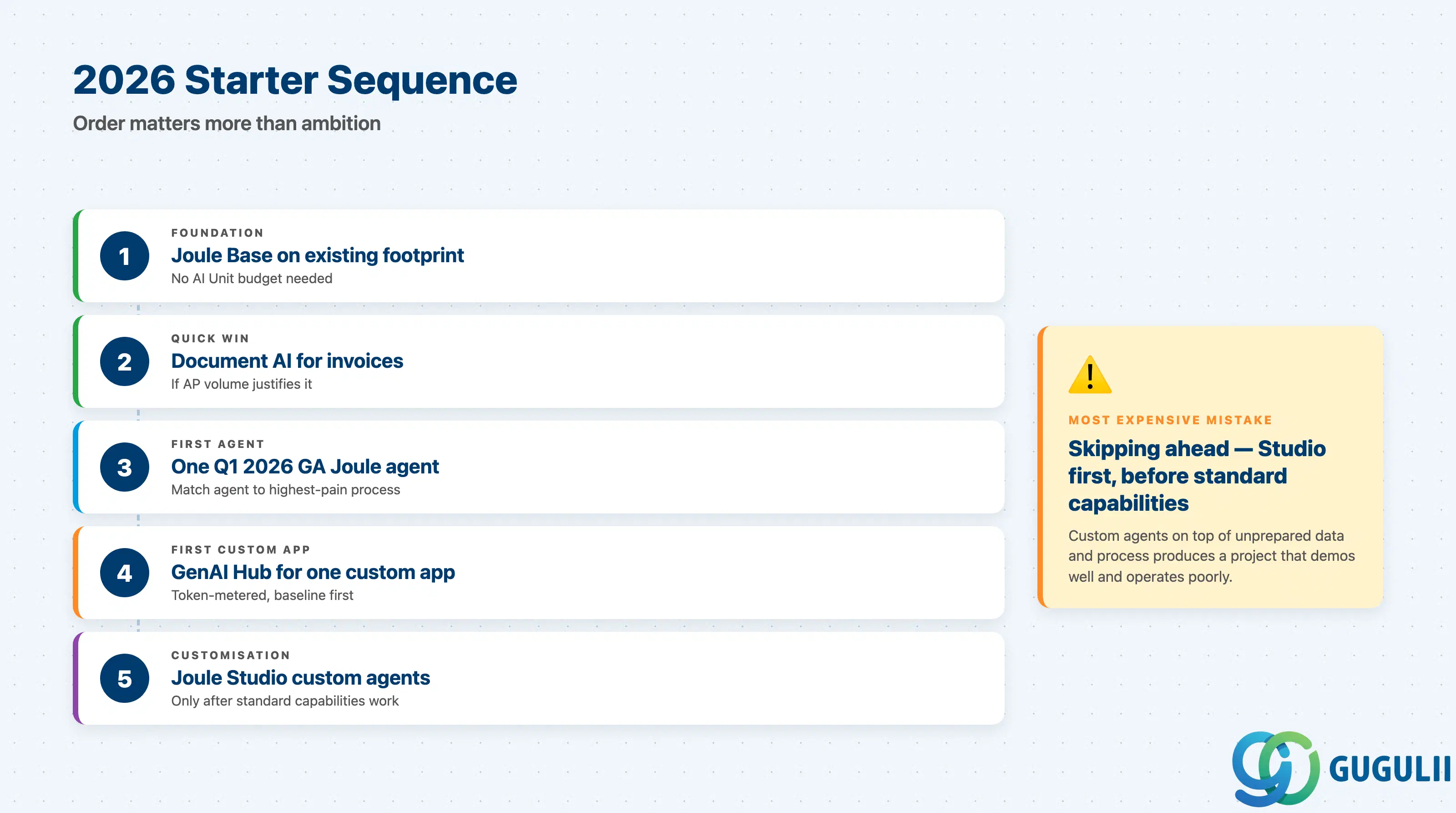
Business AI on BTP in 2026 is real, partly production-ready, and partly still demoware — and the line between the two is not where the marketing slides put it. Joule Base, Joule Studio’s runtime, AI Core, GenAI Hub, and Document AI on standard document types are production-ready today. Many premium agents, custom Studio agents, and Document AI on non-standard layouts are pre-production for most enterprises until the data and process work is done. For classic on-premise S/4HANA customers, Joule is not coming. The differentiator on a real project is requirements discipline: clear baselines, clear data ownership, clear budget, and an honest GA-versus-roadmap scope. Get those right and the platform delivers. Get them wrong and no model upgrade will save the project.
| L1. Big Picture | L2. Functional Domains |
|---|---|
| BTP-001: What is BTP | L2-A. Integration |
| BTP-002: BTP Architecture | L2-B. Application Development |
| BTP-003: BTP Capability Map | L2-C. Data & Analytics |
| BTP-004: Deployment Models | L2-D. AI — BTP-D01 Overview (this article) |
| BTP-005: Licensing Models | L2-E. Foundation Services |
| BTP-006: Clean Core Strategy | L2-F. Architecture & Operations |