Title here
Summary here

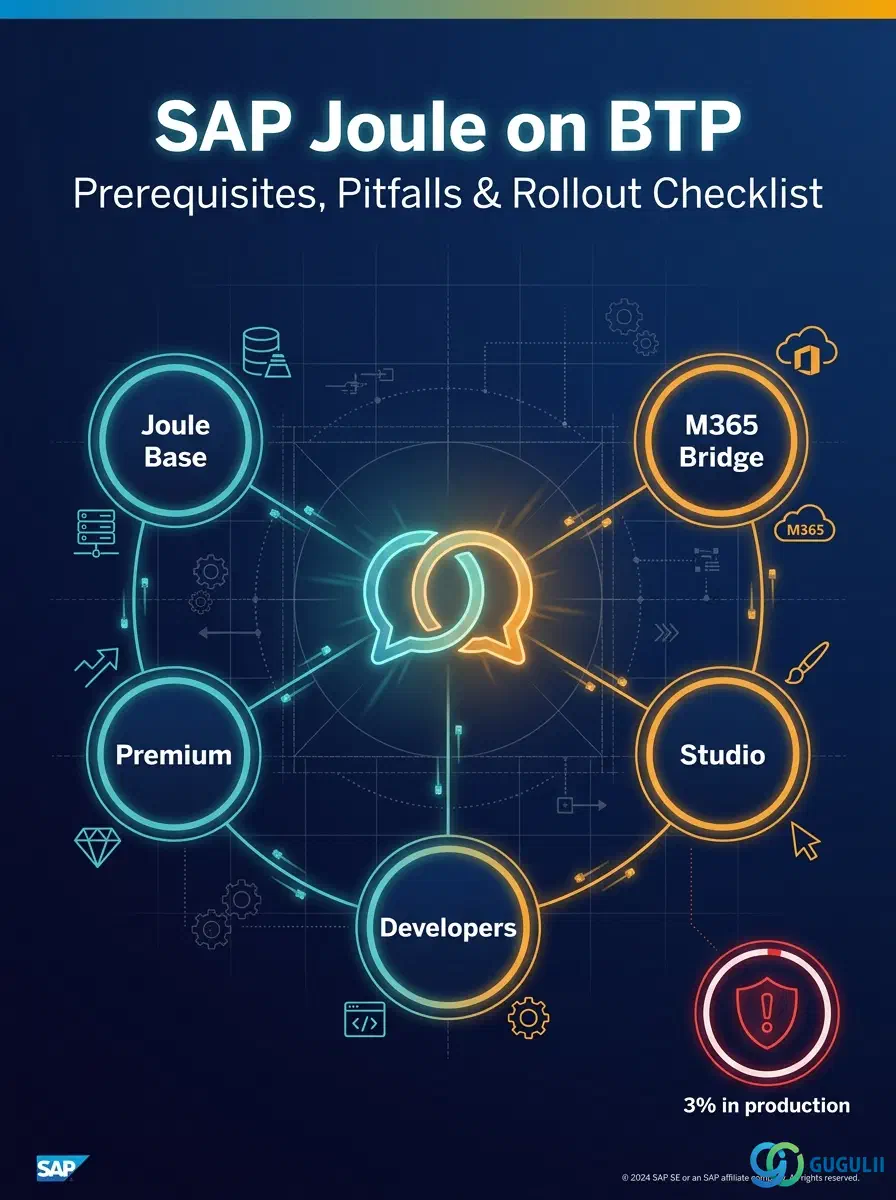
| ID | Title |
|---|---|
| BTP-D01 | Business AI: Overview and Capability Map |
| BTP-D02 | Joule: Architecture and Use (this article) |
| BTP-D03 | AI Core and GenAI Hub: Architecture and Use |
| BTP-D04 | Document AI: Architecture and Use |
| BTP-D05 | Responsible AI: Principles and Implementation |
| BTP-D06 | Business AI: Use Cases and Decision Patterns |
| Resource | URL |
|---|---|
| Joule Capabilities Guide (PDF) | help.sap.com → |
| Joule Integration Guide (PDF) | help.sap.com → |
| Joule on SAP Help Portal | help.sap.com → |
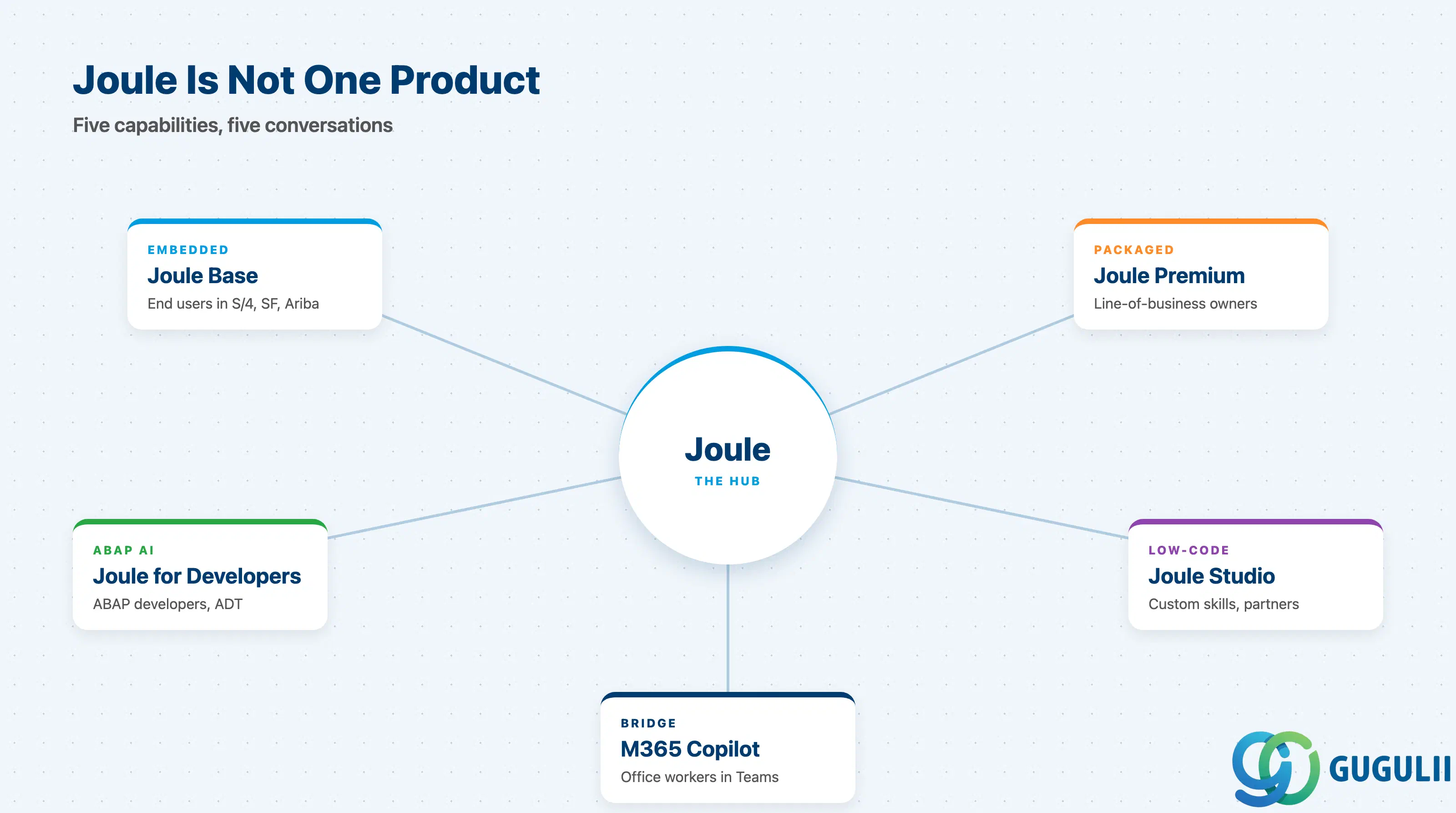
Joule is delivered as a family of capabilities, not a single SKU. Treating it as one product is the first mistake.
| Capability | What it does | Primary user |
|---|---|---|
| Joule Base | Embedded copilot inside S/4HANA, SuccessFactors, Ariba, etc. — Q&A, navigation, transactional shortcuts | End users (functional) |
| Joule Premium / Agents | Pre-built domain agents (Finance, Supply Chain, HR) sold as packaged use cases | Line-of-business owners |
| Joule for Developers | ABAP AI in ABAP Development Tools / Eclipse, powered by SAP-ABAP-1 | ABAP developers |
| Joule Studio | Low-code agent builder on BTP for custom skills and agents | SAP developers, partners, citizen developers |
| Joule + M365 Copilot | Bi-directional bridge into Teams, Outlook, Microsoft 365 Copilot | Office workers |
They are not substitutes.
+------------------------------------------------------------+
|              Microsoft 365 Copilot / Teams                 |
+----------------------------+-------------------------------+
                             |  (28KB chat post limit, no SVG)
+----------------------------v-------------------------------+
|                       SAP BTP (Cloud Foundry)              |
|  +---------------+   +-------------------+   +-----------+ |
|  | Joule Runtime | <-> AI Foundation /   |   | Joule     | |
|  | (UI + skills) |   | Generative AI Hub |   | Studio    | |
|  +-------+-------+   +---------+---------+   +-----+-----+ |
|          | IAS SSO + Principal Propagation        |       |
+----------|----------------------------------------|-------+
           v                                        v
+--------------------+                   +---------------------+
| S/4HANA Cloud      |                   | SuccessFactors,     |
| (PCE 2023 FPS01+   |                   | Ariba, Build,       |
|  or Public Edition)|                   | SAC, ...            |
+--------------------+                   +---------------------+
           ^
           |  (NO native Joule for on-premise S/4HANA)
+----------+---------+
| On-Prem S/4HANA     |
+--------------------+
Key point: Joule is a BTP application that talks to S/4HANA via IAS-trusted, principal-propagated destinations — not a feature that lives inside the ERP itself. That single architectural fact explains every prerequisite that follows.
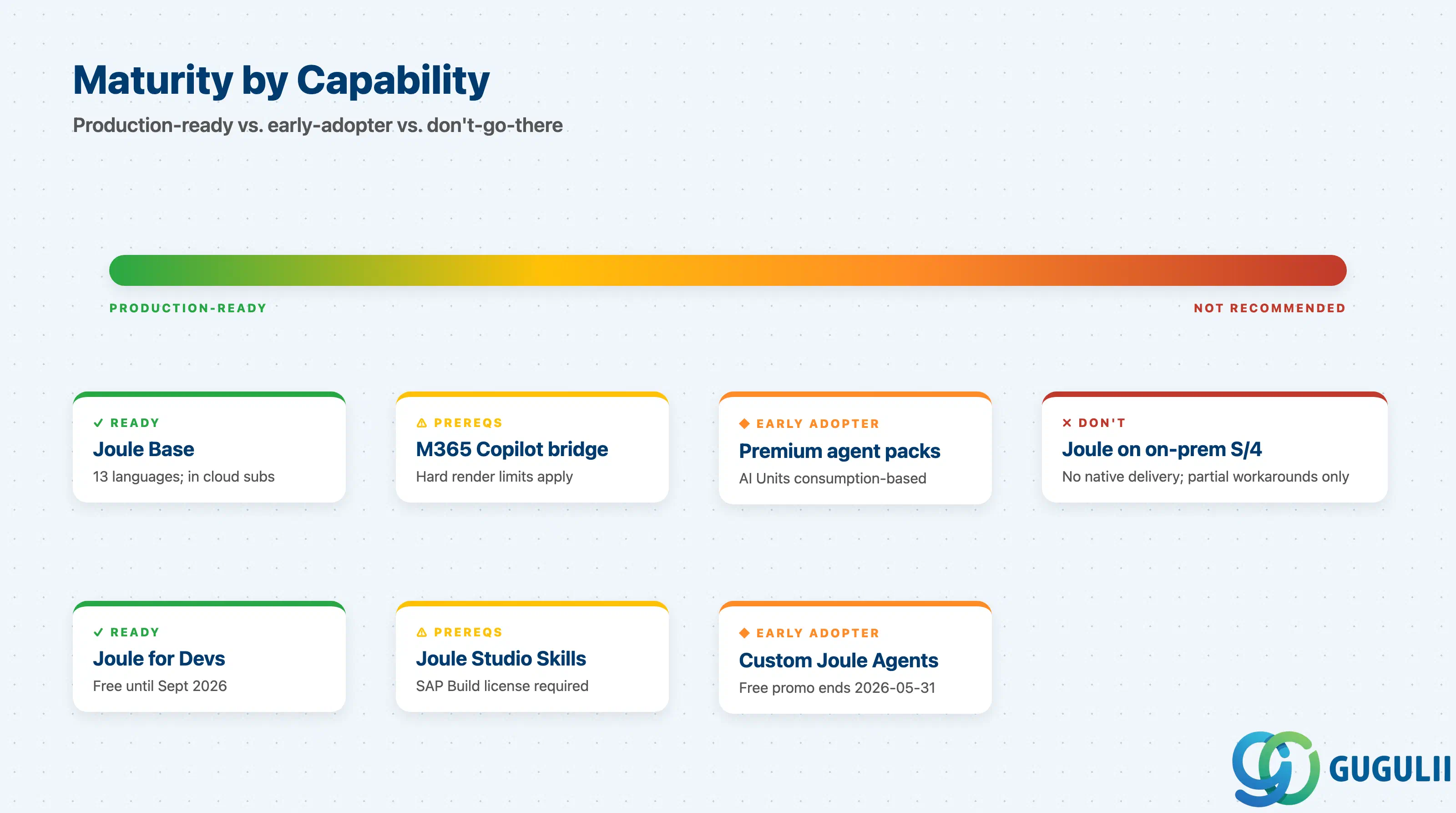
| Capability | Maturity | Notes |
|---|---|---|
| Joule Base (S/4 Cloud, SF, Ariba) | ✅ Production-ready | 13 official languages; included in cloud subs; some scope still EN-only |
| Joule for Developers (ABAP-1) | ✅ Production-ready | Free promo through Sept 2026; needs SAP for Me service request to enable |
| M365 Copilot ↔ Joule | ⚠️ Ready with prerequisites | Hard limits: 28 KB chat post, 10-item list cap, no SVG, max 6 Adaptive Card actions |
| Joule Studio (custom Skills) | ⚠️ Ready with prerequisites | GA Q1 2026; orchestration is free, but SAP Build developer license required |
| Joule Premium agent packages | 🔶 Early adopter | Consumption-based AI Units; forecasting spend is non-trivial |
| Custom Joule Agents (Studio) | 🔶 Early adopter | Free promo ends 2026-05-31; then AI Units per agent step |
| Joule on on-premise S/4HANA | ❌ Not recommended | No native delivery; partial workarounds via Cloud Connector are read-only Q&A at best |
The §4 checklists are intentionally requirements-stage. If your client cannot answer “yes” to these before kickoff, you are not ready to start.
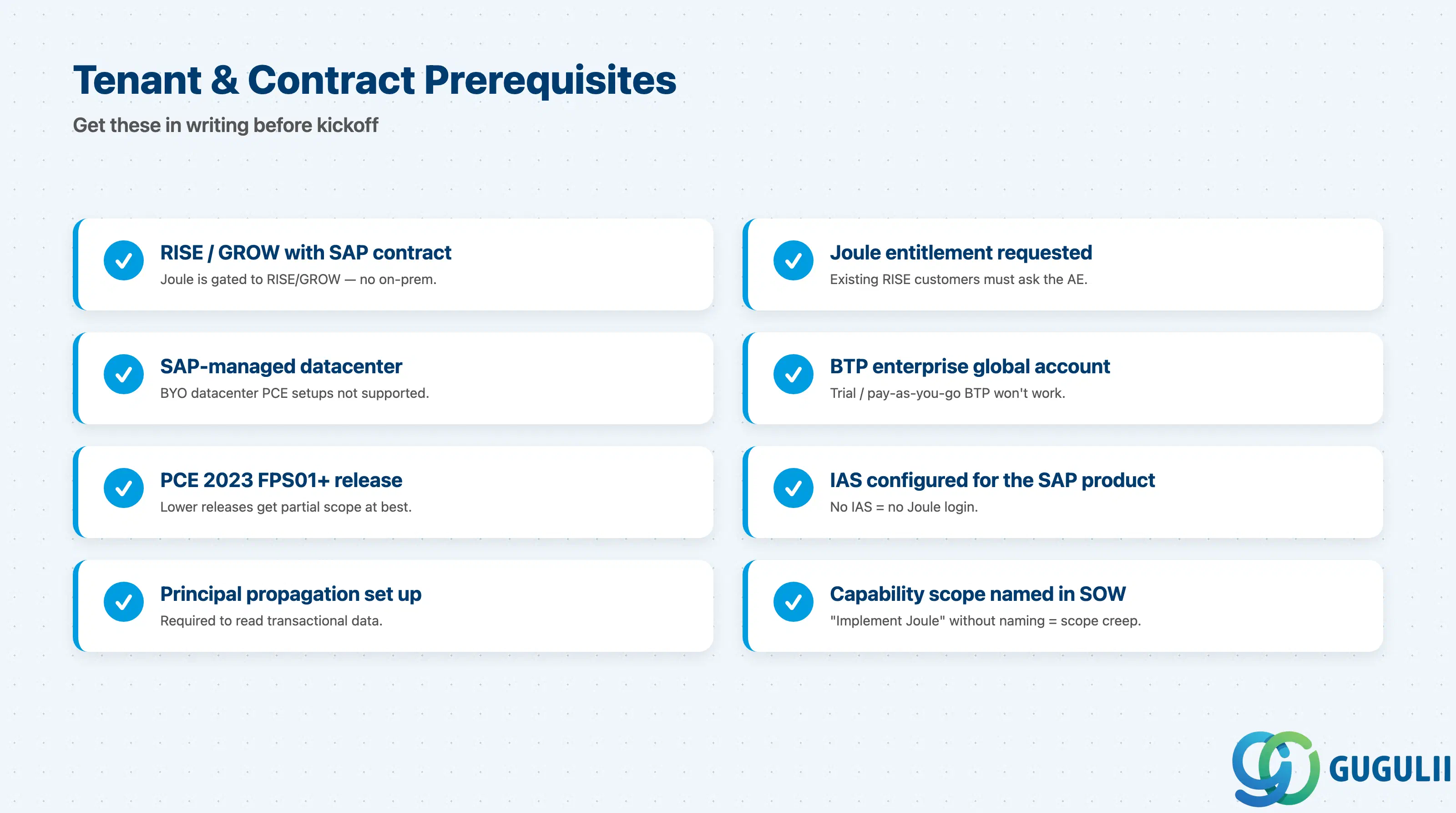
| Checklist item | Why it matters |
|---|---|
| RISE with SAP or GROW with SAP contract in place | Joule is gated to RISE/GROW — no exceptions for on-premise. |
| Joule entitlement requested via Account Executive (existing RISE) | Existing contracts are not auto-entitled; new contracts are. Confirm in writing. |
| SAP-managed datacenter (not customer-managed) | Customer-managed (BYO datacenter) PCE setups are explicitly unsupported for Joule. |
| Enterprise global account on SAP BTP | Joule is a BTP app; trial / pay-as-you-go BTP accounts will not work. |
| S/4HANA Cloud Private Edition 2023 FPS01+ (or Public Edition) | Lower releases get a partial scope at best; some agents need newer FPS. |
| Identity Authentication Service (IAS) configured for the SAP product | Joule reuses IAS for SSO; no IAS = no Joule login. |
| Principal propagation between BTP and S/4HANA tenant | Mandatory; Joule cannot read transactional data without it. |
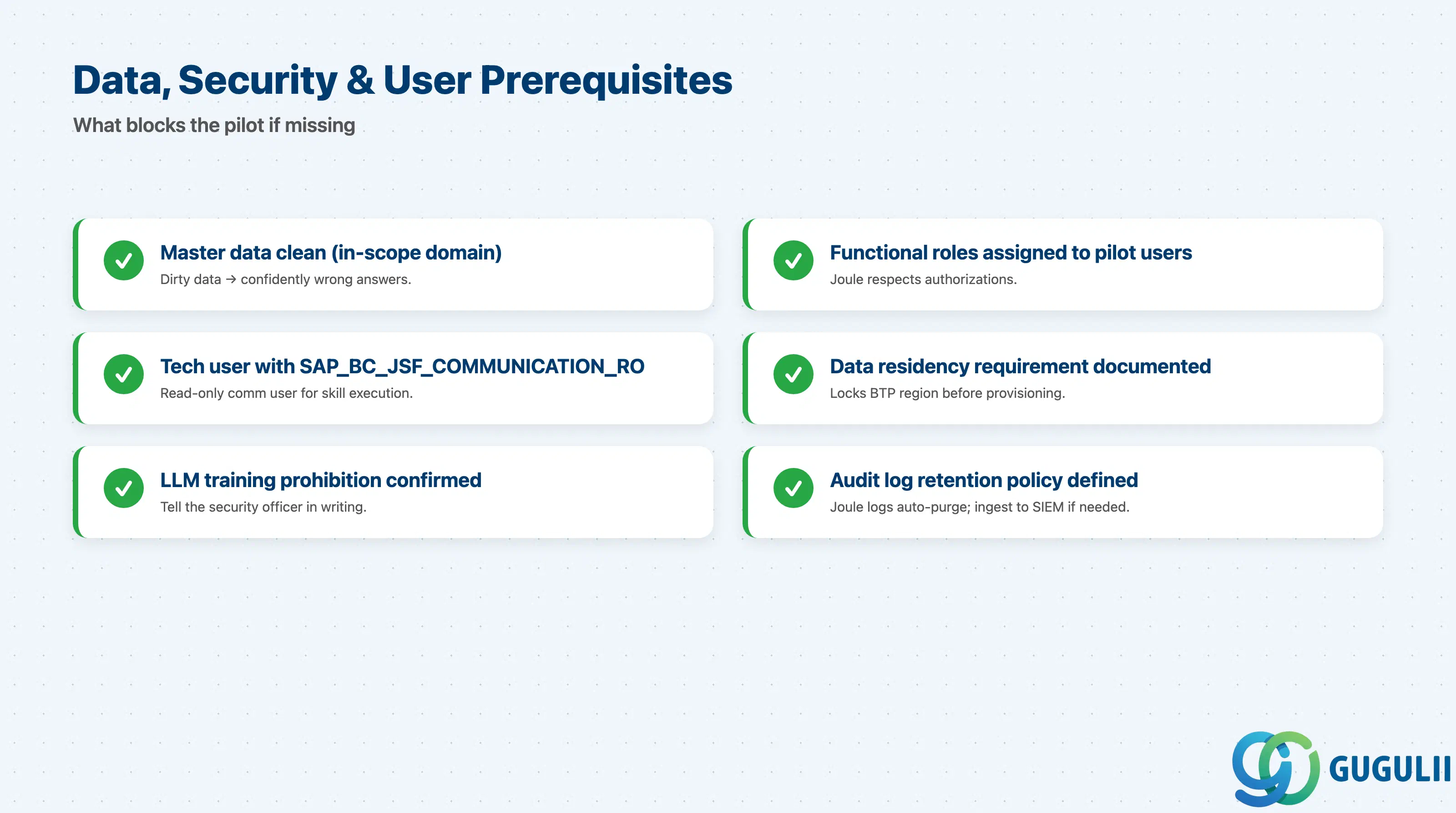
| Checklist item | Why it matters |
|---|---|
| Master data clean for the in-scope domain (customer, vendor, GL) | Garbage data → confidently wrong AI answers. Finance/Procurement scenarios are most exposed. |
| Functional roles assigned to pilot users in S/4HANA | Joule respects authorizations; missing roles silently degrade answers. |
Technical user with SAP_BC_JSF_COMMUNICATION_RO in S/4 | Joule’s read-only communication user — required for skill execution. |
| Data residency requirements documented (EU sovereign region?) | If GDPR-sensitive, you must lock the BTP region before provisioning. |
| Confirmed: customer data is not used to train third-party LLMs | SAP contracts forbid it; tell the security officer this in writing, not verbally. |
| Audit/log retention requirement defined | Joule logs auto-purge after rotation; if compliance needs longer, plan ingestion to SIEM. |
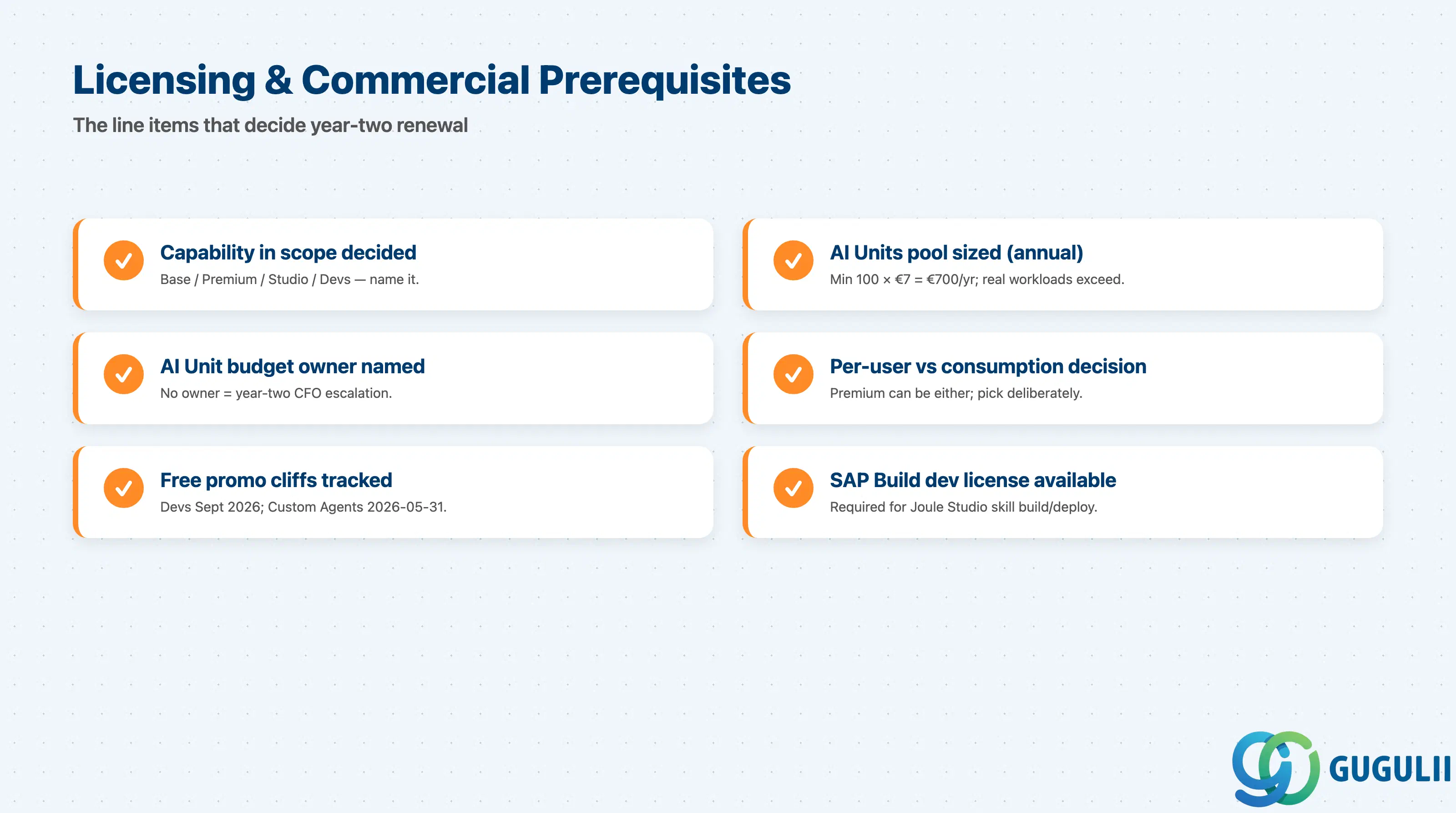
| Checklist item | Why it matters |
|---|---|
| Decided which AI is in scope: Base / Premium / Studio / Developers | Each is a different commercial conversation; conflating them sinks the BoM. |
| AI Units pool sized and budgeted (annual) | Minimum entry is 100 units × €7 = €700/year; real workloads can exceed this in weeks. |
| Owner of the AI Unit budget identified (named person) | Without a single budget owner, consumption surprises become support tickets. |
| Per-user-per-month vs. consumption decision made for Premium | Premium can be either model depending on the package; pick deliberately. |
| Free promo windows tracked (Joule for Devs Sept 2026; Custom Agents 2026-05-31) | Cliff-edge dates; missing them turns a free pilot into a billed line item overnight. |
| SAP Build developer license available if Joule Studio is in scope | Required to build, test, deploy custom Skills. |
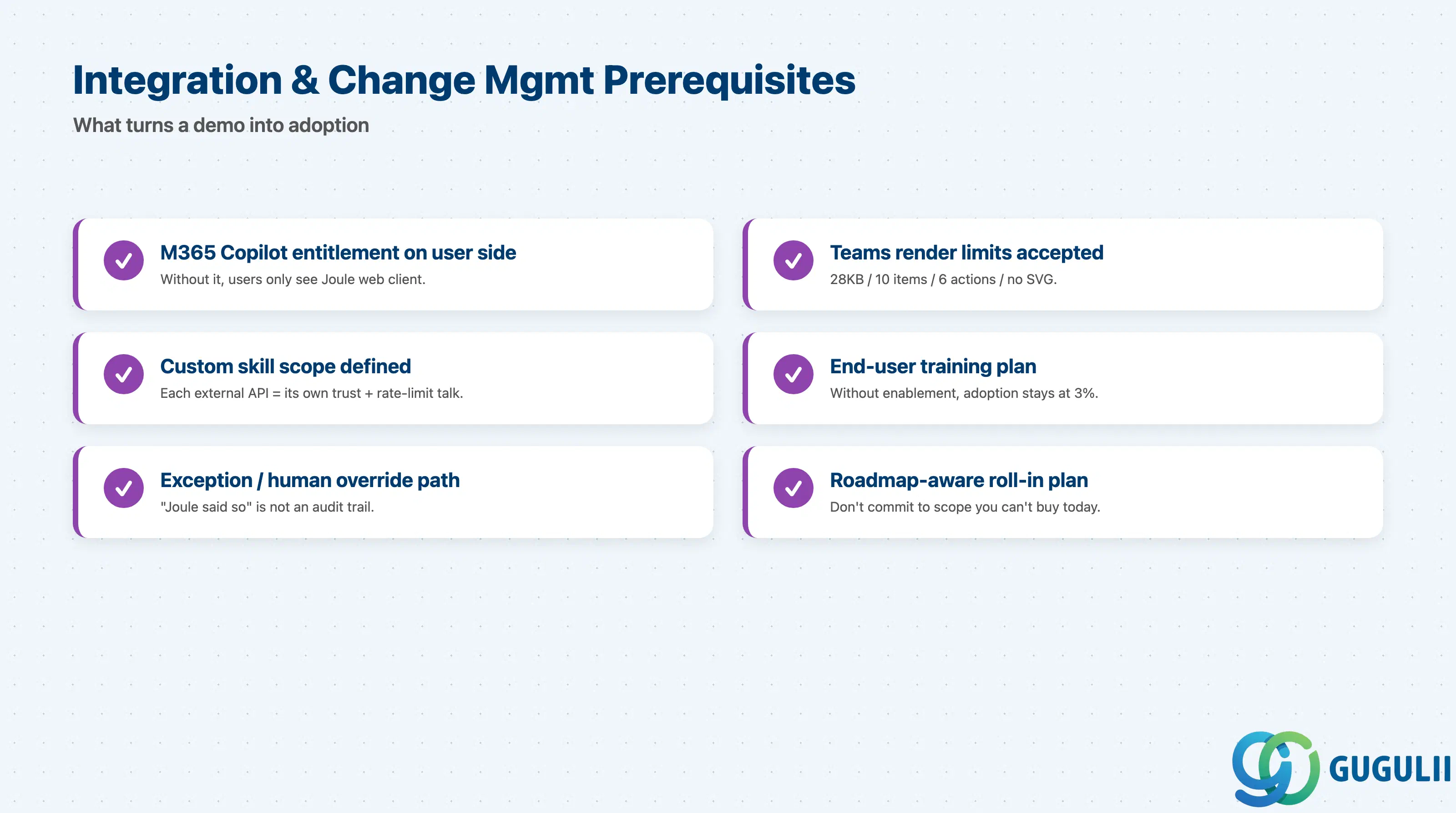
| Checklist item | Why it matters |
|---|---|
| Microsoft 365 Copilot / Teams entitlement on the user side | The integration is bi-directional; users without M365 Copilot only see Joule’s web client. |
| Adaptive Card / Teams render limits accepted by stakeholders | 6 actions, 10 items, no SVG — set expectations before the demo, not after. |
| Custom skill scoping done (which APIs, which destinations) | Joule Studio combines SAP-native skills with external APIs; each external API is a separate trust + rate-limit conversation. |
| Change-management plan for end users (training, help desk) | Joule changes how users transact — without enablement, adoption stays at the 3% mark. |
| Exception handling defined: what happens when Joule answers wrong? | “Joule said so” is not an audit trail; design the human override path before go-live. |
| Roadmap-aware roll-in plan (Sapphire 2026, Q2/Q3 GAs) | Some agents you want may not be GA yet; commit to scope you can actually buy today. |
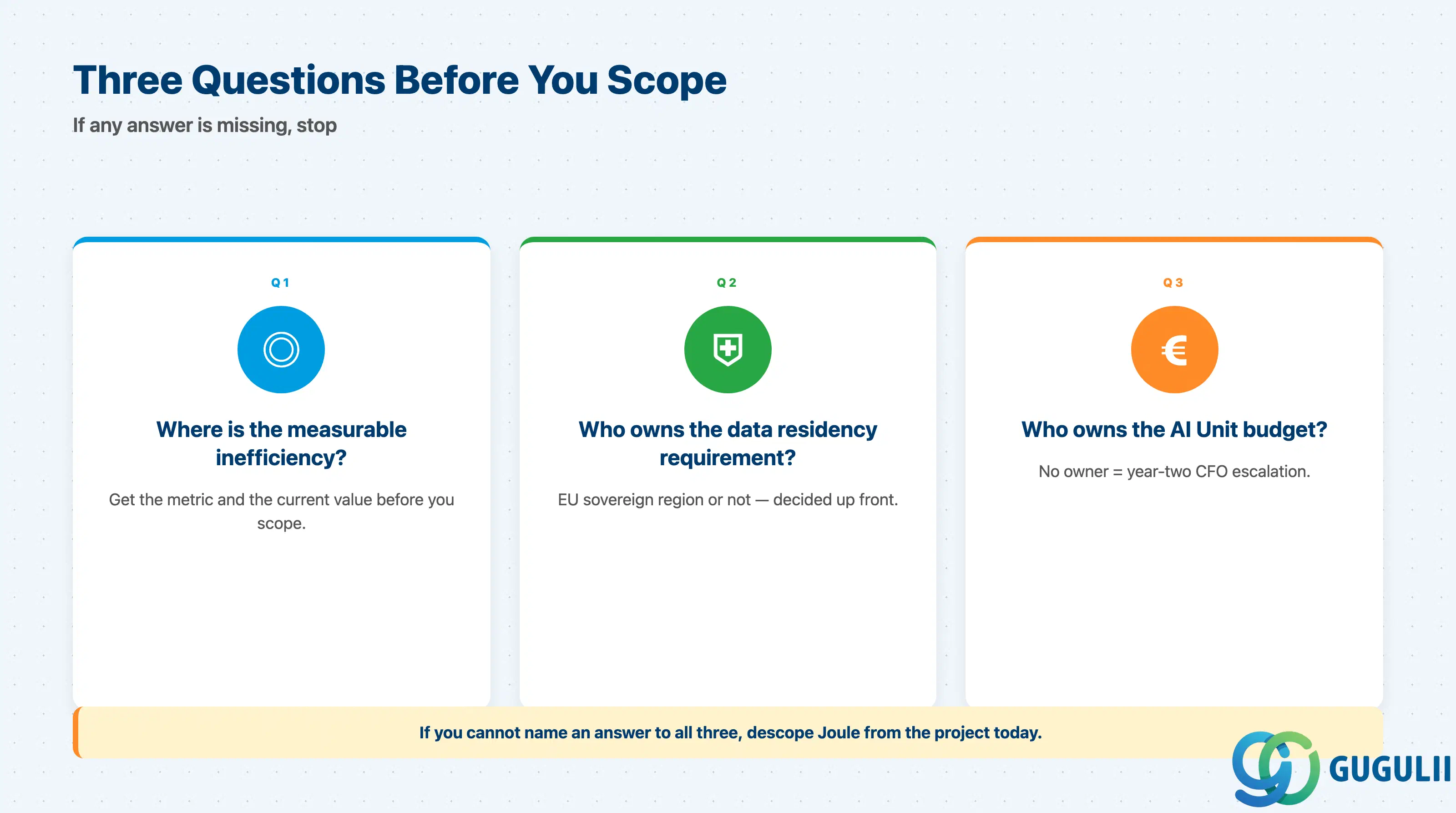
Q1. Where is the measurable inefficiency Joule is supposed to fix?
Joule is a tool, not a strategy. If the client cannot point at a specific process — “month-end close takes 12 days, we want 8” — it is a science project. Ask for the metric and the current value before scoping.
Q2. Where does the data live, and who owns the residency requirement?
In regulated industries, “EU sovereign region or not?” decides the BTP entitlement. Get the data residency officer in the room early. LLM access is governed via Generative AI Hub, but the region of execution is decided up front and is hard to change.
Q3. Who owns the AI Unit budget?
The question that breaks projects six months in. AI Units are a consumption pool — every agent step, every Premium invocation, draws from it. Without a named owner with renewal authority, the second-year invoice becomes a CFO escalation.
| Project context | Recommended starting capability |
|---|---|
| RISE customer doing greenfield S/4HANA Cloud rollout | Joule Base — bundled, low risk, immediate UX win |
| Mature S/4 Cloud customer wanting AI productivity | Joule Premium for Finance or Supply Chain, scoped to one process |
| ABAP-heavy private cloud customer | Joule for Developers — free through Sept 2026, immediate dev productivity |
| BTP-savvy customer with proprietary process | Joule Studio for custom skills (orchestration is free) |
| Customer already on M365 Copilot, wants SAP integrated | M365 Copilot ↔ Joule bridge — but accept the 28 KB / 6-action limits |
| On-premise S/4HANA only, not on RISE | Stop. Joule is not for them. Recommend RISE migration roadmap or non-Joule AI. |
| No clear pain point identified yet | Stop. Go back to Q1. |
| Capability | Licensing model | Key question to ask |
|---|---|---|
| Joule Base | Included in SAP cloud subscription | “Is the customer on a current cloud subscription that includes Joule Base?” |
| Joule Premium (packaged) | Per-user-per-month OR consumption AI Units (depends on package) | “How many users in the in-scope role, and which package?” |
| Joule Studio — custom Skills | Orchestration free; needs SAP Build developer license | “Who in the team holds Build licenses to build/test/deploy?” |
| Joule Studio — custom Agents | Free until 2026-05-31; then AI Units per step (Basic 0.005 / Standard 0.01 / Advanced 0.025) | “Have we modelled steps × invocations × users for year 1?” |
| Joule for Developers | Free through Sept 2026; AI Units thereafter (announced) | “Is the dev team large enough to justify the post-promo AI Unit cost?” |
| AI Units (any) | Annual pool, minimum 100 × €7 = €700 | “Does the AI Unit pool have a named owner with renewal authority?” |
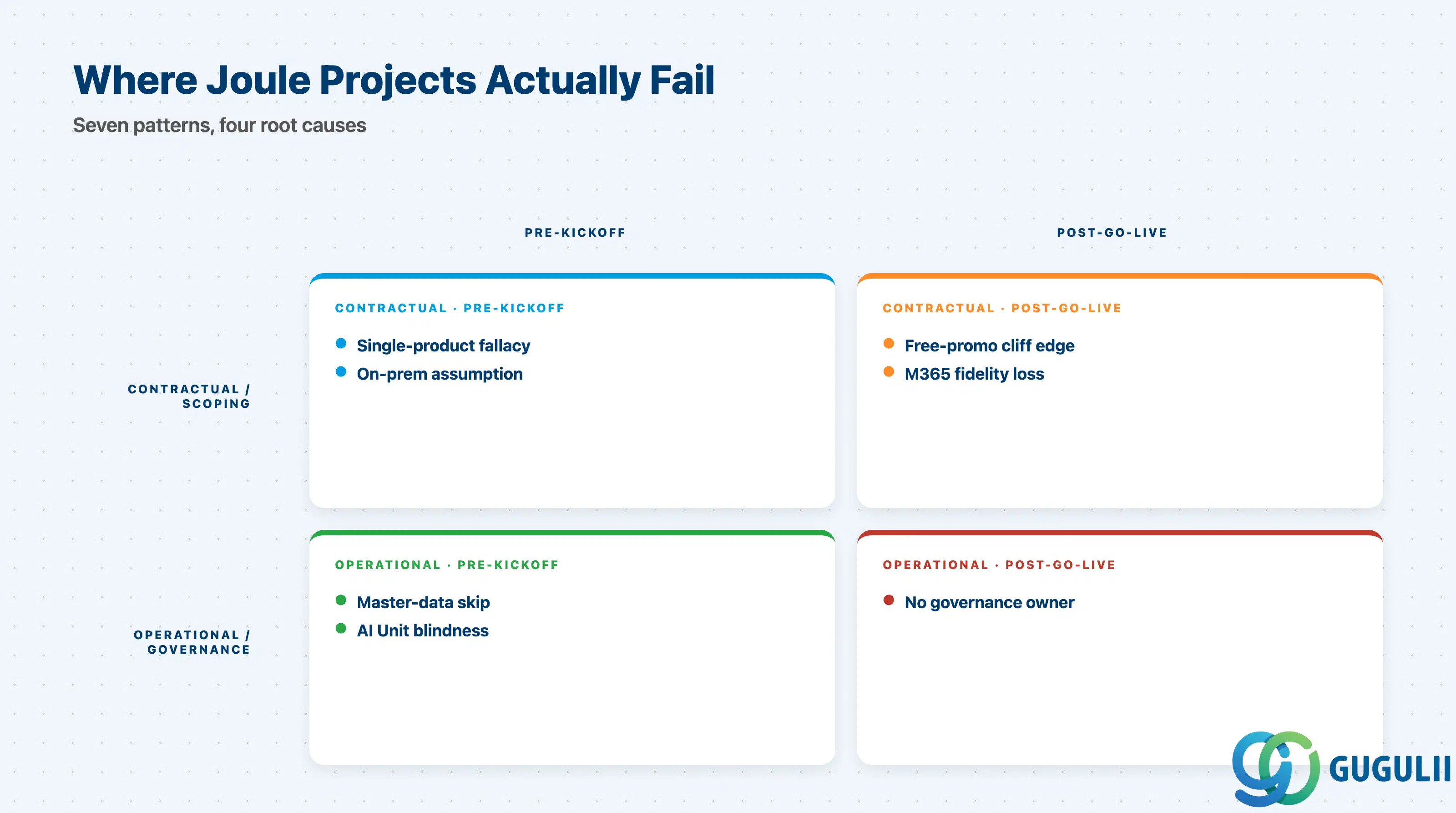
Failure 1: Treating Joule as a single product.
SOWs that say “implement Joule” without naming the capability are a red flag. Joule Base and Joule Studio are different conversations. Name the specific capability (and version) in the SOW or scope creep is built in from day one.
Failure 2: Assuming on-premise S/4HANA can use Joule “with some setup”.
It cannot — not natively. The on-premise installed base is structurally excluded. Workarounds via Cloud Connector exist but deliver mostly read-only Q&A and are unsupported for production. If the client is not on RISE/GROW, Joule is the wrong answer; recommend the RISE migration conversation instead.
Failure 3: Skipping the master data audit.
Joule’s Finance and Procurement scenarios return confidently incorrect answers when master data is dirty. A user asking “what is my open AP?” against bad vendor data gets a number — and it is wrong. The data audit must precede the pilot, not run in parallel.
Failure 4: Ignoring AI Unit consumption forecasting.
The €700/year entry pool does not survive contact with real workload. Standard-tier agents (0.01 AI Units/step) burn through 100 units in ~10,000 steps — a single workflow used by 50 users can hit that in a week. Build a consumption model in requirements, not after the first invoice.
Failure 5: Confusing M365 Copilot integration with full Joule.
The bridge is constrained: 28 KB per chat post, 10-item list cap, no SVG, max 6 Adaptive Card actions. Demos that look great in the Joule web client lose fidelity in Teams. Set this expectation in writing before the first stakeholder demo.
Failure 6: Greenlighting a custom Joule Agent in the free-promo window without budgeting for life after.
The custom-agent free promo ends 2026-05-31. Projects that build agents in the promo window without modelling post-promo AI Unit consumption either get cancelled (Gartner’s 40%-by-2027 forecast looms here) or trigger emergency renegotiations. The promo is enablement, not a cost-free runway.
Failure 7: No named owner for AI governance and budget.
Joule projects that fail at year two almost universally lack a single accountable owner for the AI Unit pool, the skill catalog, and exception handling. SAP’s Responsible AI guardrails apply contractually, but operational governance — who approves new skills, who signs off on cost increases — is the customer’s job.
Q: Can my on-premise S/4HANA customer use Joule?
Not natively. Joule is gated to RISE/GROW. Partial workarounds (Cloud Connector + read-only BTP) exist but are unsupported in production. The right conversation with on-premise customers is the RISE migration conversation — Joule is one of several reasons to have it.
Q: What does Joule actually cost?
Joule Base is included in the SAP cloud subscription — no extra line item. Everything else is either a per-user-per-month subscription (some Premium packages) or consumption-based AI Units (most agents, all Joule Studio agents post-promo). Entry-level AI Unit pool is €700/year. Real production workloads are typically multiples of that. Forecast carefully.
Q: When should we descope Joule from a project?
When any of these is true: (a) the client is on-premise and not committed to RISE; (b) there is no measurable inefficiency the AI is supposed to fix; (c) no one owns the AI Unit budget with renewal authority; (d) master data quality is too poor for the in-scope domain. Descope is not failure — it is risk management.
Q: How do we document a Joule requirement properly?
Name the specific capability (Base / Premium / Studio / Developers / M365 bridge). Specify the in-scope process and the metric being moved. State the contract (RISE/GROW), the IAS configuration assumption, and the AI Unit budget. List the languages required (default 13; preview adds 4). Document the human override path. If any line is “TBD”, the requirement is not ready.
Q: Is custom-agent development with Joule Studio a viable strategy in 2026?
For partners and large customers with SAP Build capacity, yes — but plan for the post-2026-05-31 shift to AI Unit consumption. For smaller customers, custom Skills (orchestration-free) are the safer entry point; agents are where pricing surprises live. Build a Skill first; escalate to an Agent only when you have a consumption baseline.
Q: What languages does Joule support?
13 officially as of Q1 2026 (Arabic and Indonesian added that quarter), plus 4 in preview. In a non-supported language Joule may still respond, but quality is not guaranteed and support tickets get deflected. Match the language list to rollout countries before sign-off.
Q: How do customers typically fail year-two renewals?
Pattern is consistent: a successful pilot, no consumption baseline, no named budget owner, an AI Unit invoice 4–8× larger than expected, CFO escalation. The cure is boring — a named owner, a quarterly consumption review, and a kill-switch documented in the original SOW.
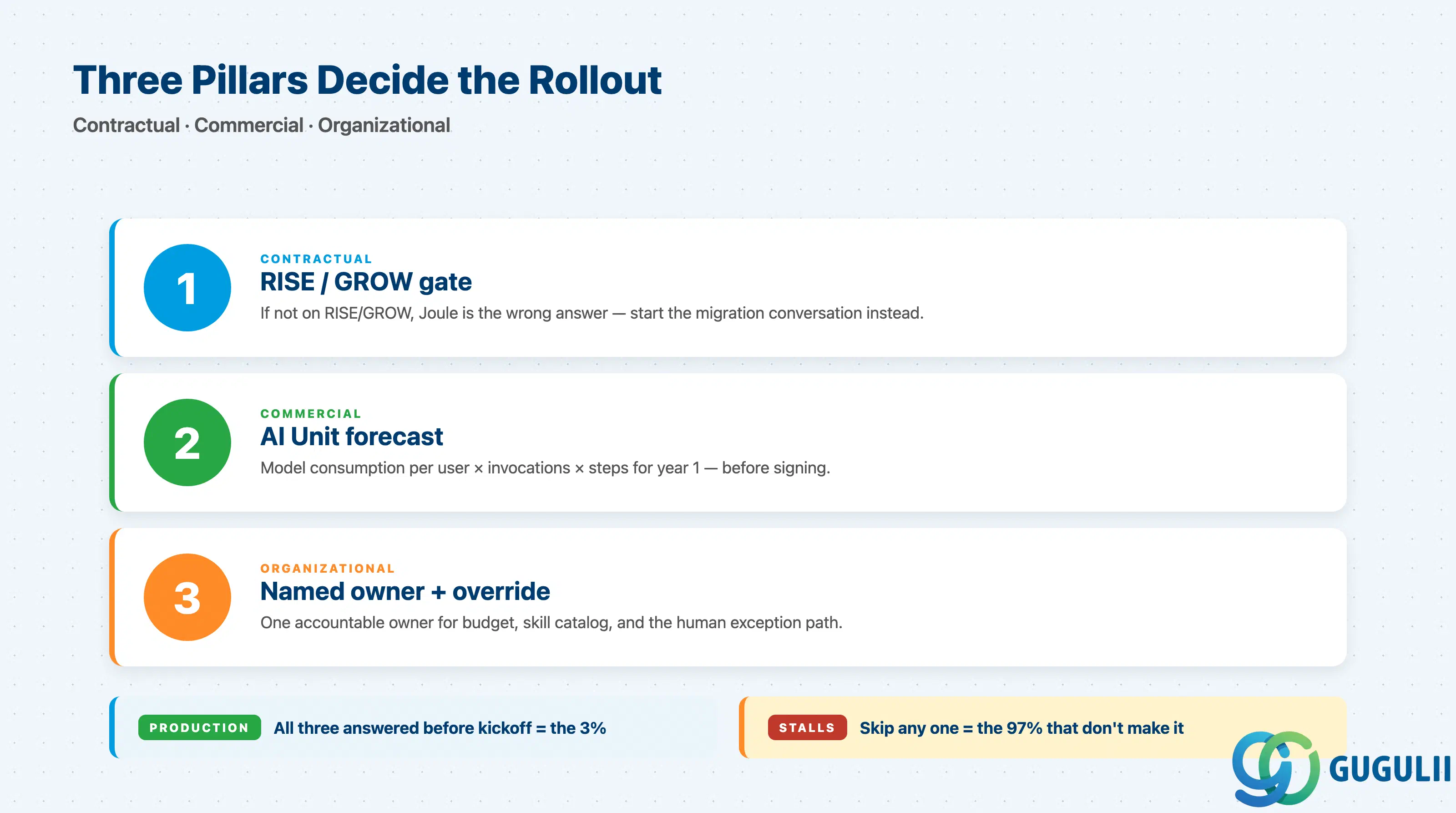
Joule is real, but it is not one thing. It is a family of capabilities, each with its own prerequisites, licensing model, and maturity. The technical setup — IAS, principal propagation, BTP enterprise account, S/4HANA Cloud release level — is well documented and not the hard part. The hard parts are contractual (RISE/GROW gating), commercial (AI Unit forecasting), and organizational (a named owner for budget and exceptions). Treat Joule as a BTP application that needs those three answered before kickoff and your rollout sits in the 3% that reach production. Treat it as “the AI feature we turn on” and it joins the 97% that do not.
| L1. Big Picture | L2. Functional Domains |
|---|---|
| BTP-001: What is BTP | L2-A. Integration |
| BTP-002: BTP Architecture | L2-B. Application Development |
| BTP-003: BTP Capability Map | L2-C. Data & Analytics |
| BTP-004: Deployment Models | L2-D. AI — BTP-D02 Joule (this article) |
| BTP-005: Licensing Models | L2-E. Foundation Services |
| BTP-006: Clean Core Strategy | L2-F. Architecture & Operations |