Title here
Summary here

| ID | Title |
|---|---|
| BTP-D01 | Business AI: Overview and Capability Map |
| BTP-D02 | Joule: Architecture and Use |
| BTP-D03 | AI Core and GenAI Hub: Architecture and Use |
| BTP-D04 | Document AI: Architecture and Use |
| BTP-D05 | Responsible AI: Principles and Implementation (this article) |
| BTP-D06 | Business AI: Use Cases and Decision Patterns |
| Resource | URL |
|---|---|
| SAP AI Ethics and Responsible AI | sap.com → |
| BTP Audit Log Service | help.sap.com → |
| GenAI Hub Orchestration | help.sap.com → |
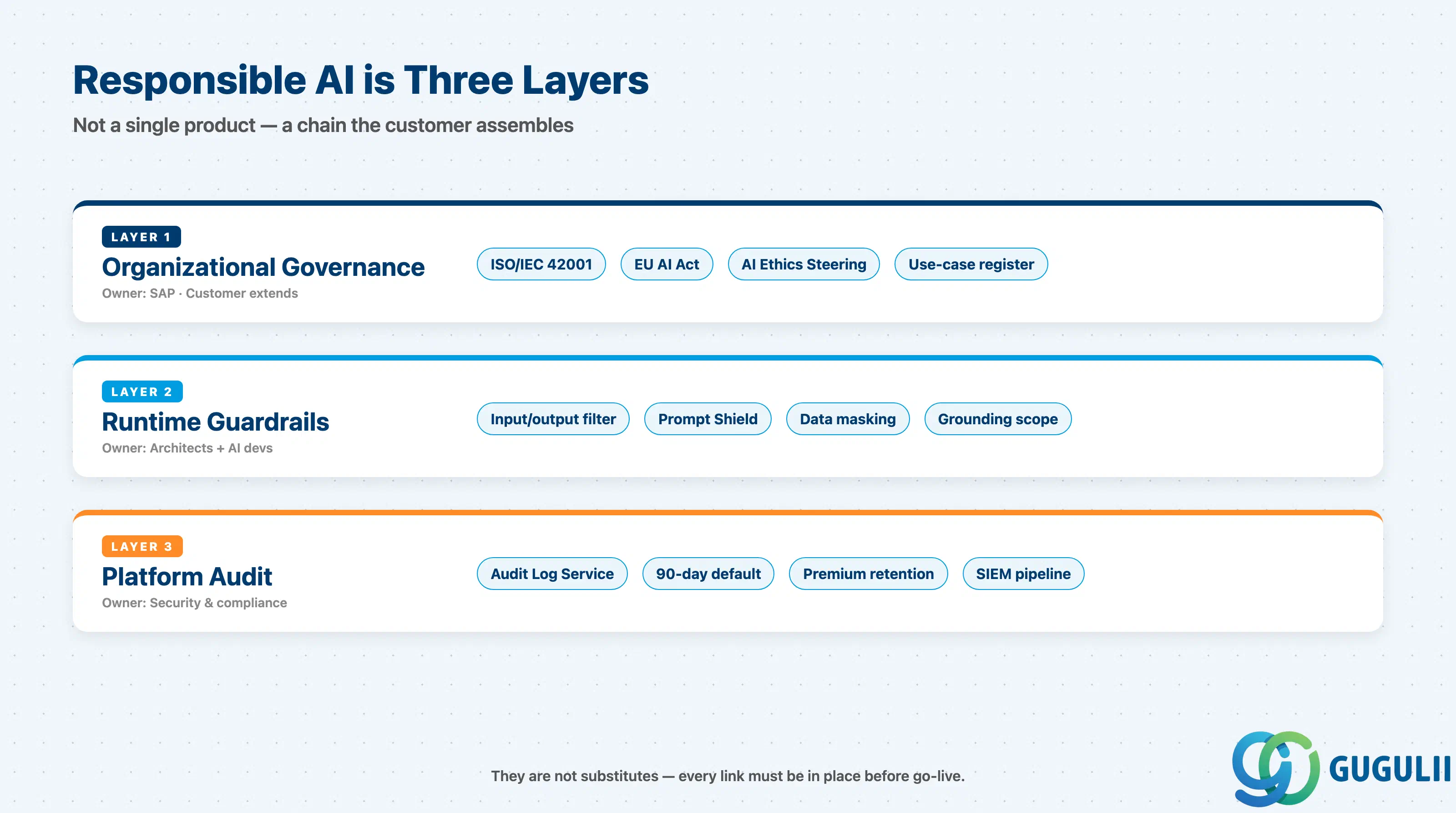
“Responsible AI” on BTP is not a single product. It is the layered combination of organizational governance, runtime guardrails, and platform audit. The most common scoping mistake is treating SAP’s certifications as customer-side controls.
| Layer | What it does | Primary user |
|---|---|---|
| Organizational governance | SAP Global AI Ethics Policy, AI Ethics Office, Steering Committee + external Advisory Panel, ISO/IEC 42001, EU AI Act alignment | SAP; customers inherit and extend |
| Runtime guardrails (GenAI Hub orchestration) | Input/output filtering, Prompt Shield, data masking, grounding, prompt registry with versioned orchestration configs | Customer architects + AI developers |
| Platform audit (BTP Audit Log Service) | Default 90-day retention of security, config, data access events; premium edition for longer retention and custom-app events | Customer security/compliance, internal audit |
They are not substitutes.
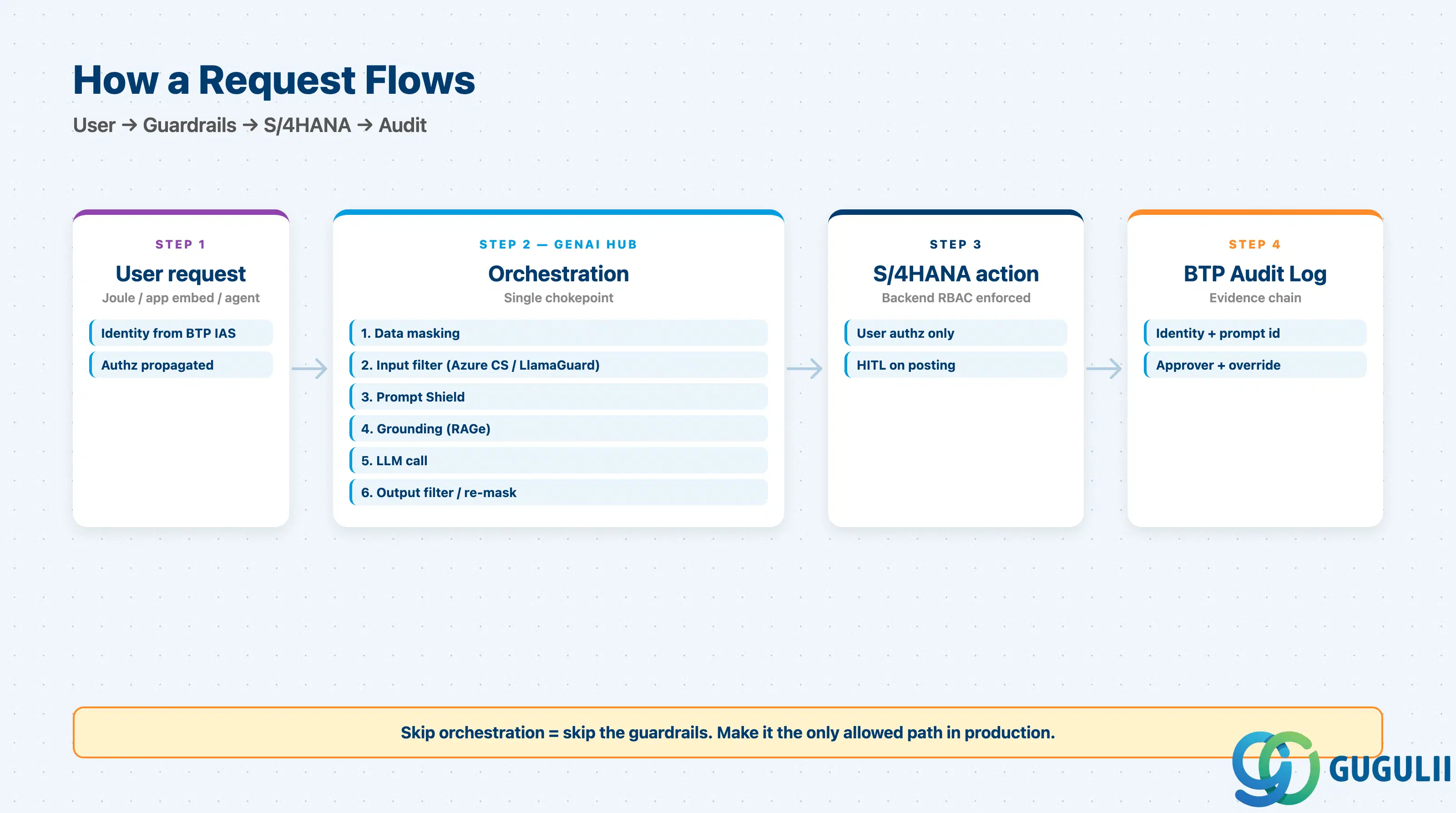
Responsible AI is not a feature that flows into S/4HANA. It is a set of controls that wrap any AI capability — Joule, GenAI Hub, Document AI — before and after that capability touches an S/4HANA business process.
   ┌──────────────────────────────────────────────────────────────┐
   │ Organizational governance                                    │
   │  SAP Global AI Ethics Policy + customer AI use-case register │
   └──────────────────────────┬───────────────────────────────────┘
                              ▼
   ┌──────────────────────────────────────────────────────────────┐
   │ User request (Joule chat / app embed / agent)                │
   │  Identity propagated from BTP IAS / IdP                      │
   └──────────────────────────┬───────────────────────────────────┘
                              ▼
   ┌──────────────────────────────────────────────────────────────┐
   │ Generative AI Hub — Orchestration                            │
   │  ① Data masking   → ② Input filter (Azure CS / Llama Guard)  │
   │  ③ Prompt Shield  → ④ Grounding (RAGe, customer docs)        │
   │  ⑤ LLM call       → ⑥ Output filter / re-mask                │
   └──────────────────────────┬───────────────────────────────────┘
                              ▼
   ┌──────────────────────────────────────────────────────────────┐
   │ S/4HANA action                                               │
   │  Permission-checked at backend (Joule = user authz only)     │
   │  Human-in-the-loop on transactional posting                  │
   └──────────────────────────┬───────────────────────────────────┘
                              ▼
   ┌──────────────────────────────────────────────────────────────┐
   │ BTP Audit Log Service                                        │
   │  Identity, prompt id, action, approver, override (premium)   │
   └──────────────────────────────────────────────────────────────┘
Joule executes only what the user is authorized to do in S/4HANA — RBAC is enforced in the backend, not the LLM layer. GenAI Hub orchestration is where customer-configurable guardrails run; skip orchestration and you skip the guardrails. Audit Log captures BTP events; S/4HANA application events are a customer build.
Key point: Responsible AI is a chain the customer assembles from SAP components. Treating ISO/IEC 42001 certification as a customer-side control is the single most common scoping error.
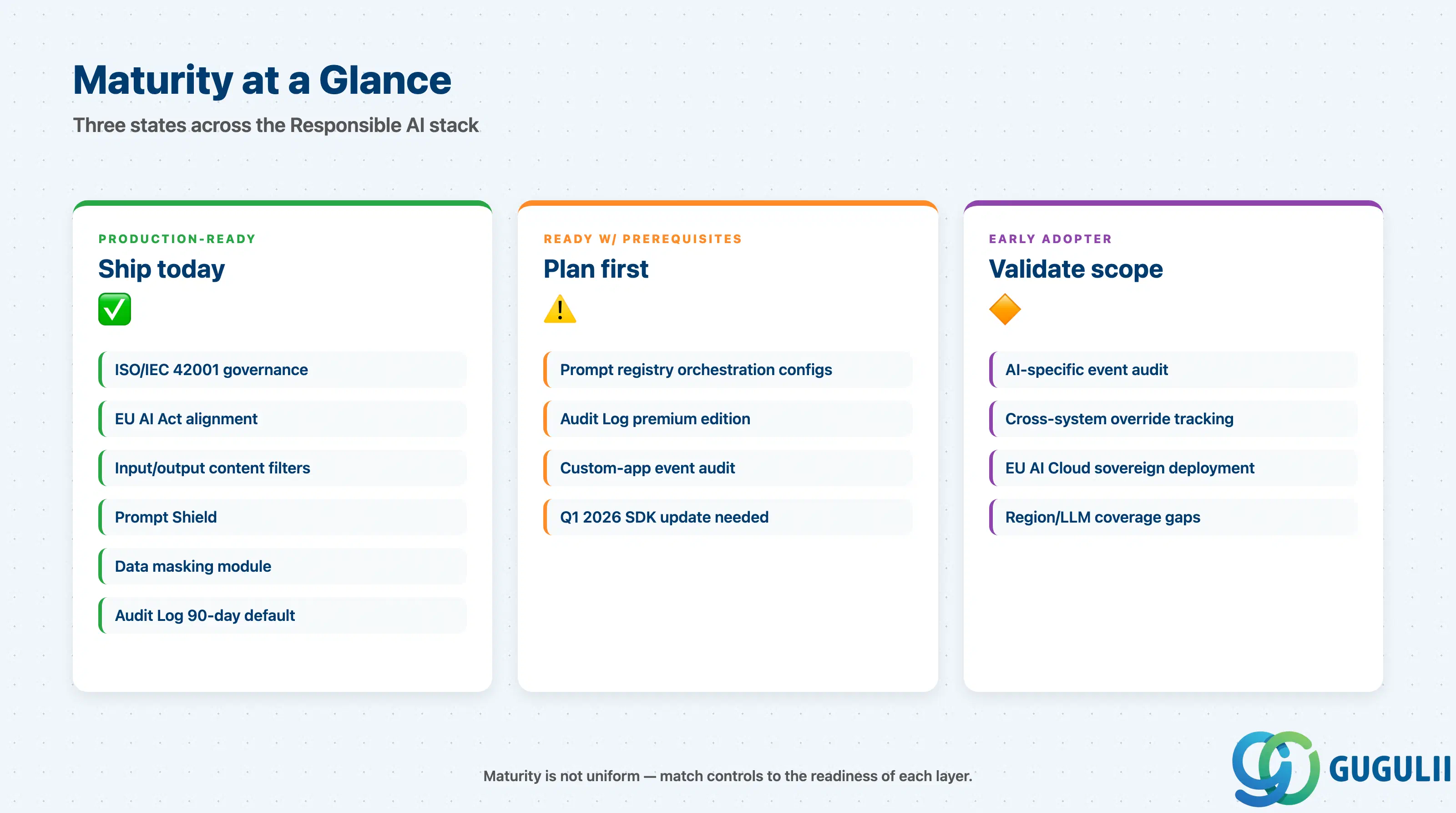
Maturity is not uniform. Policy framework is mature; runtime guardrails are production-ready but customer-configurable; AI-specific audit coverage is still partial.
| Layer / capability | Maturity | Notes |
|---|---|---|
| Organizational governance (ISO/IEC 42001, AI Ethics policy, Steering Committee) | ✅ Production-ready | Covers Joule, AI Core, AI Launchpad. |
| EU AI Act alignment (Joule = limited-risk) | ✅ Production-ready | Customer must still register own use cases under the AI Act. |
| GenAI Hub orchestration — input/output content filtering | ✅ Production-ready | Azure Content Safety + LlamaGuard38b; centrally enforced via orchestration. |
| GenAI Hub orchestration — Prompt Shield | ✅ Production-ready | Not auto-applied if you bypass orchestration. |
| GenAI Hub orchestration — data masking | ✅ Production-ready | Off by default; customer must enable. |
| Prompt registry — declarative orchestration configs | ⚠️ Ready with prerequisites | Q1 2026 enhancement; requires updated SDK. |
| BTP Audit Log — 90-day default retention | ✅ Production-ready | Free; covers BTP-side security, config, data access events. |
| BTP Audit Log — extended retention + custom-app events | ⚠️ Ready with prerequisites | Premium edition; quoted, not list-priced. |
| AI-specific audit events (prompt id, model version, override) | 🔶 Early adopter | Combining BTP Audit Log with app-side logging is a customer build. |
| EU AI Cloud (sovereign EU-only) | 🔶 Early adopter | Not all regions, not all LLMs. Validate before committing. |
§3 answers “is the layer ready?” This section answers “are we ready?” Build one per-layer checklist into every Business AI scoping document. These are requirements-stage items, not implementation tasks.
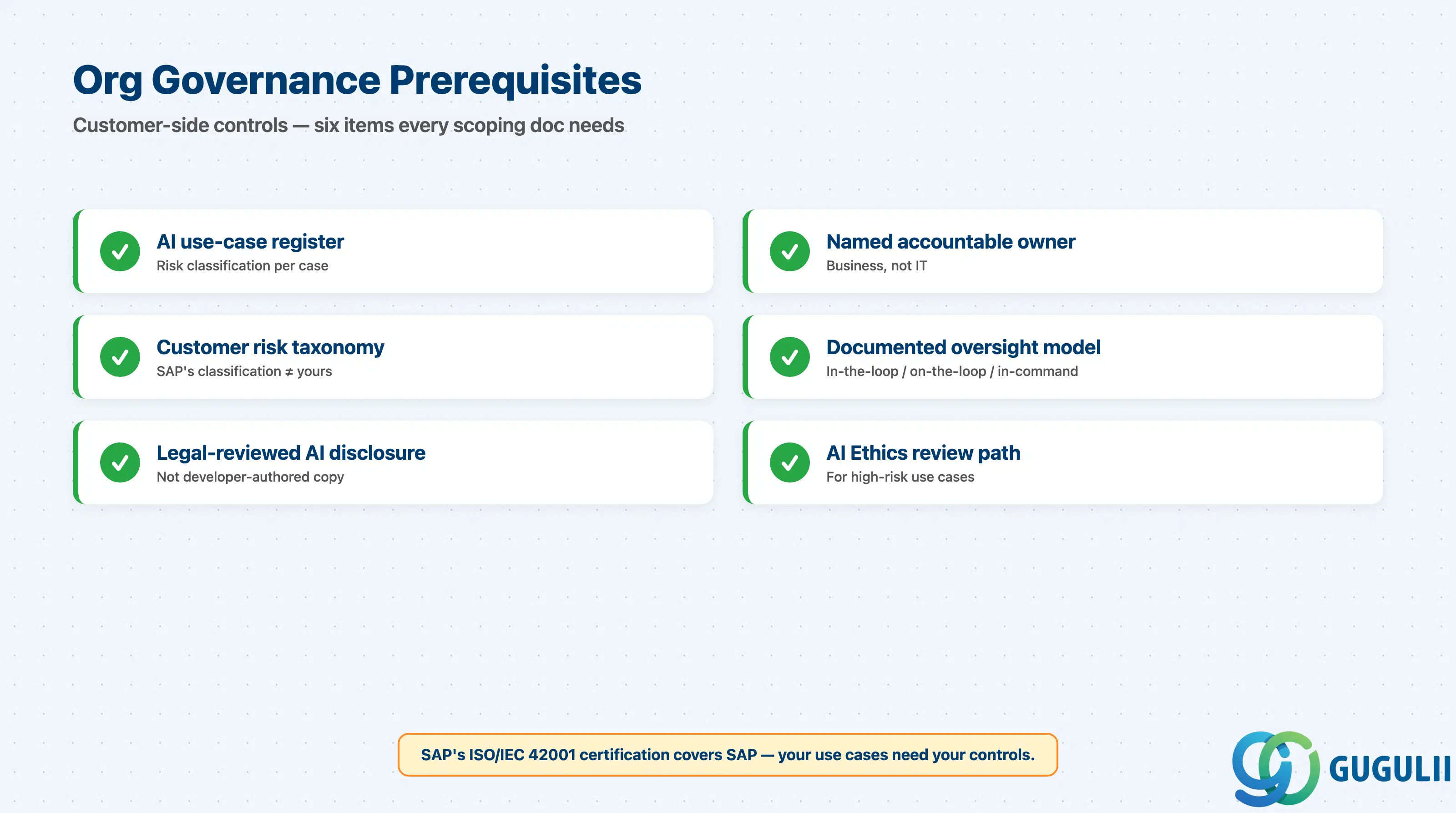
| Checklist item | Why it matters |
|---|---|
| AI use-case register maintained, with risk classification per case | Required by EU AI Act and ISO/IEC 42001; SAP’s certification covers SAP, not your use cases. |
| Named accountable owner per use case (business, not IT) | Without ownership, audits stall on residual-risk sign-off. |
| Use case classified against the customer’s own risk taxonomy | Joule’s limited-risk classification is SAP’s; your use cases need yours. |
| Human-oversight model documented (in-the-loop / on-the-loop / in-command) | “Human review” is too vague to audit. |
| User-facing AI disclosure implemented and reviewed by legal | Required for limited-risk under EU AI Act; not developer-authored copy. |
| AI Ethics review path for high-risk use cases | Needed for HR, finance, customer-facing impact. |
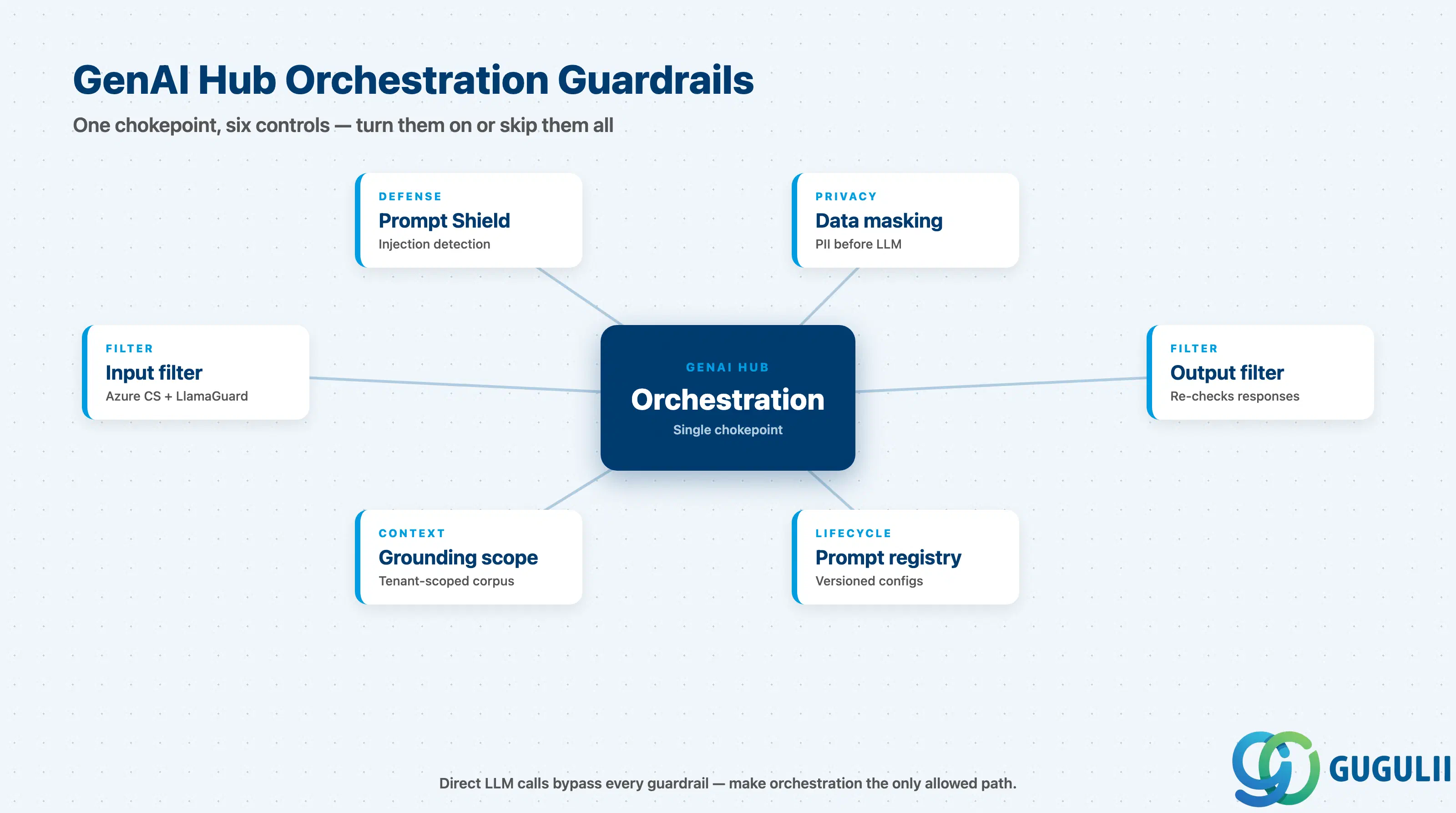
| Checklist item | Why it matters |
|---|---|
| All LLM calls go through orchestration, never direct endpoints | Direct calls bypass filtering, Prompt Shield, and masking. The single most important configuration choice. |
| Input content filter configured (Azure Content Safety or LlamaGuard38b), thresholds tuned per use case | Defaults are conservative; tuning prevents leakage and false-positive blocking. |
| Output content filter re-checks model responses | Catches drift and unsafe completions input filtering misses. |
| Prompt Shield enabled for agentic / tool-calling flows ingesting untrusted data | Prompt injection from emails, documents, tickets is real for agents. |
| Data masking enabled where prompts may include personal data | Without it, PII reaches the LLM and residency reviews block production. |
| Grounding sources scoped to the minimum-necessary corpus | Over-broad grounding leaks data across user populations. |
| Orchestration configurations stored in the prompt registry, versioned and declarative | Needed to evidence which guardrails were active at audit time. |
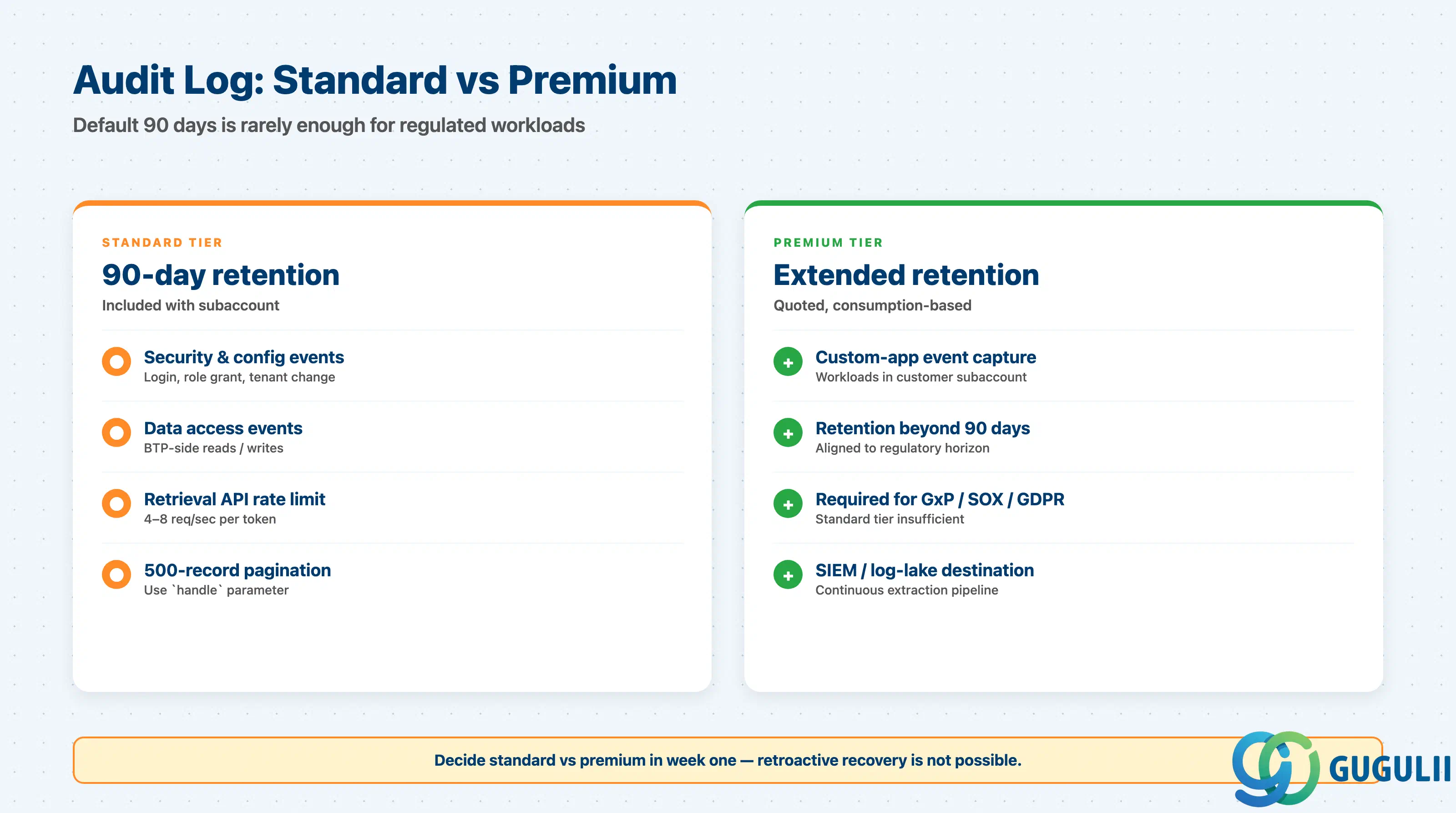
| Checklist item | Why it matters |
|---|---|
| Audit Log Service enabled, retrieval destination (SIEM / log lake) decided | Default 90 days is short for regulated workloads; extract continuously. |
| Premium edition licensed if retention > 90 days or custom-app events required | Standard covers neither; assume premium for GxP / SOX / GDPR. |
| Retrieval pipeline respects API rate limit (4–8 req/sec per token) and 500-record pagination | Naïve scrapers miss events or get throttled. |
| Application-side audit (prompt id, user, model version, approver, override) emitted by the app | BTP captures platform events; AI-specific events must come from the app. |
| Audit retention aligned to the longest applicable regulatory horizon (SOX 7y; sectoral varies) | The shortest retention you commit to is your effective ceiling. |
| Checklist item | Why it matters |
|---|---|
| AI Core / GenAI Hub tenant region matches the data-residency requirement | Cross-region traffic can violate residency; verify the chosen LLM is available in-region. |
| EU AI Cloud evaluated explicitly for EU-data-only workloads | Not every model is offered there; confirm coverage of the chosen LLM. |
| Sub-processor list (LLM, filter providers) approved by privacy and security | A privacy approval, not a developer choice. |
| Grounding documents stay tenant-scoped; cross-tenant grounding not used | Grounding crosses the RBAC boundary; tenant-scope is the safe default. |
| Checklist item | Why it matters |
|---|---|
| Prompt and orchestration changes go through change management with approval | Without change control, you cannot reconstruct what the system did on a given date. |
| Override / rejection rates reported regularly to the use-case owner | The most useful quality metric, and the one most often missing. |
| Decommissioning playbook exists for retiring the use case | Right-to-deletion does not pause for AI. |
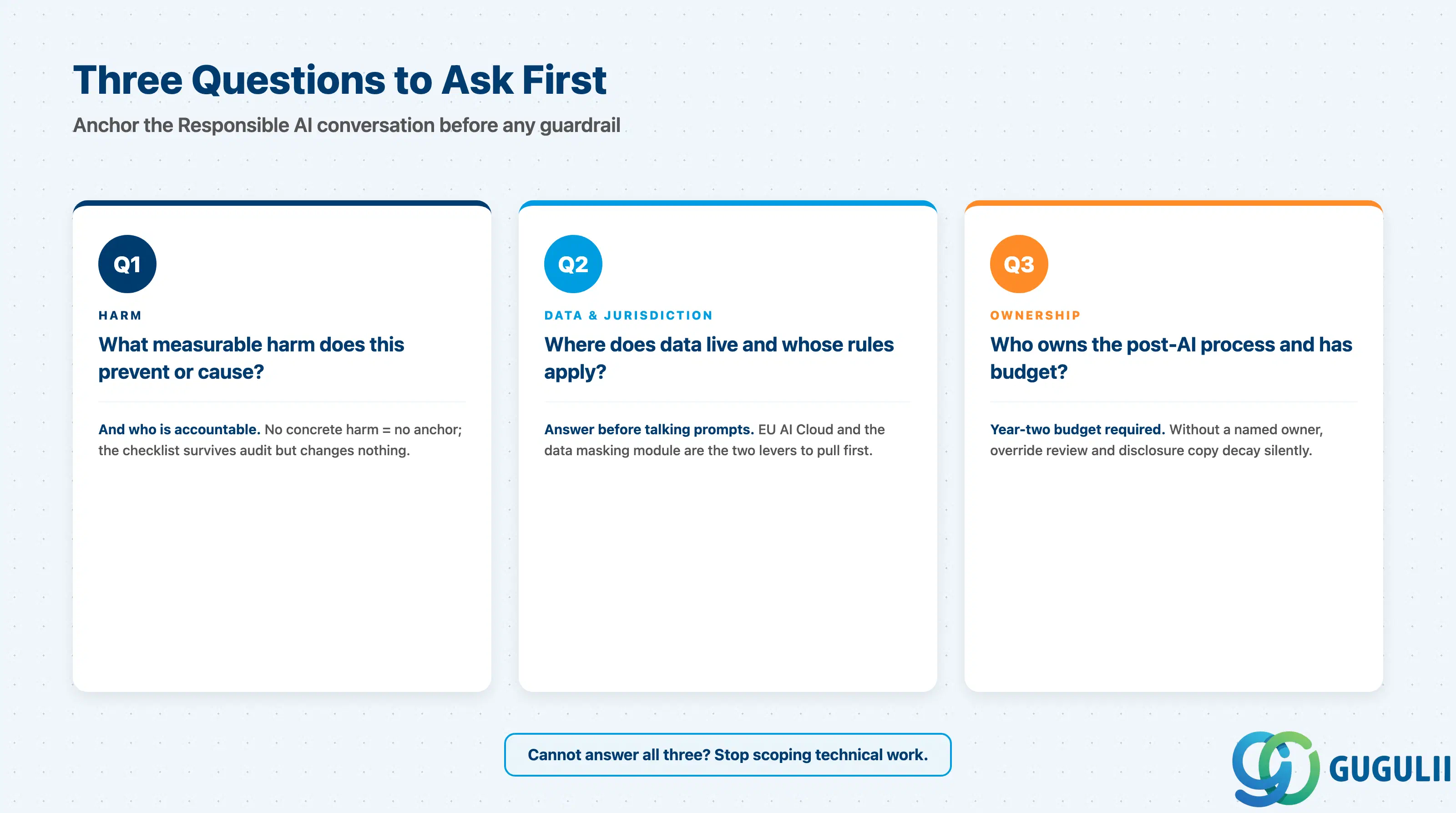
Q1. What measurable harm does this AI use case prevent or cause, and who is accountable for that harm?
If the customer cannot describe the harm concretely — wrong invoice posted, biased candidate filtering, mis-routed ticket reaching a regulator — Responsible AI work has nothing to anchor. A vague “we want to use AI responsibly” becomes a checklist that survives audit but does not change the system.
Q2. Where does the data live, where will the model run, and which jurisdiction’s rules apply?
Answer this before talking about prompts. EU data through a non-EU model endpoint, regulated finance data through an unmasked LLM call, PII reaching grounding without scoping — each is a residency or privacy decision. EU AI Cloud and the data masking module are the two levers to pull first.
Q3. Who owns the post-AI process — approver, override review, audit trail, disclosure copy — and do they have budget?
Responsible AI is not a one-time install. Override rates need monthly review, disclosure copy needs legal sign-off, and orchestration drifts. Without a named owner with year-two budget, the controls decay silently.
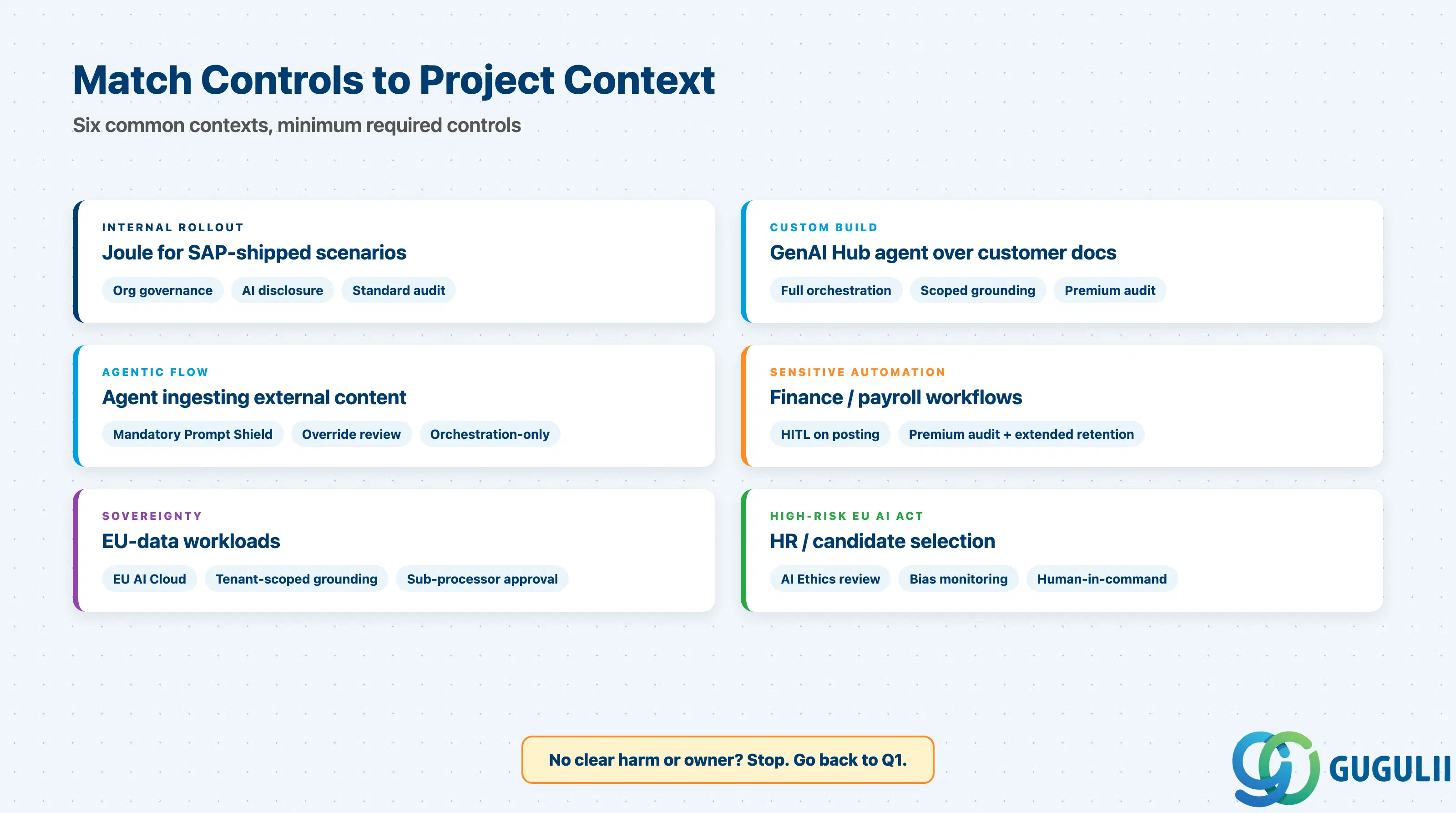
| Project context | Recommended starting controls |
|---|---|
| Internal Joule rollout for SAP-shipped scenarios | Org governance + AI disclosure + standard Audit Log |
| Custom GenAI Hub agent over customer documents | Full orchestration + scoped grounding + premium Audit Log |
| Agentic flow ingesting external content | Above + orchestration-only access + mandatory Prompt Shield + override review |
| Finance / payroll-sensitive automation | Above + HITL on every posting + premium Audit Log with extended retention |
| EU-data workloads with sovereignty requirement | EU AI Cloud + EU-region orchestration + sub-processor approval + tenant-scoped grounding |
| HR / candidate-selection AI | High-risk classification + AI Ethics review + bias monitoring + human-in-command |
| Regulated industry (GxP / banking), novel use case | Stop. Do AI Ethics review and DPIA before scoping technical work. |
| No clear harm or accountable owner identified yet | Stop. Go back to Q1. |
| Layer / capability | Licensing model | Key question to ask |
|---|---|---|
| Org governance & ISO/IEC 42001 | Included | Have use-case owners been trained on the AI Ethics Policy? |
| GenAI Hub orchestration (filters, Prompt Shield, masking, grounding) | SAP AI Units; third-party filter calls may meter separately | AI Unit cost per request with full orchestration enabled? |
| Prompt registry — versioned orchestration configs | Part of GenAI Hub | Using declarative configs, or hard-coding in app code? |
| BTP Audit Log — standard (90 days) | Included | Is 90 days enough for our longest retention requirement? Usually no. |
| BTP Audit Log — premium (extended retention, custom-app events) | Quoted, consumption-based | Projected event volume at year-two scale? |
| EU AI Cloud (sovereign EU-only) | Subscription / quoted | Is our chosen LLM offered in EU AI Cloud? |
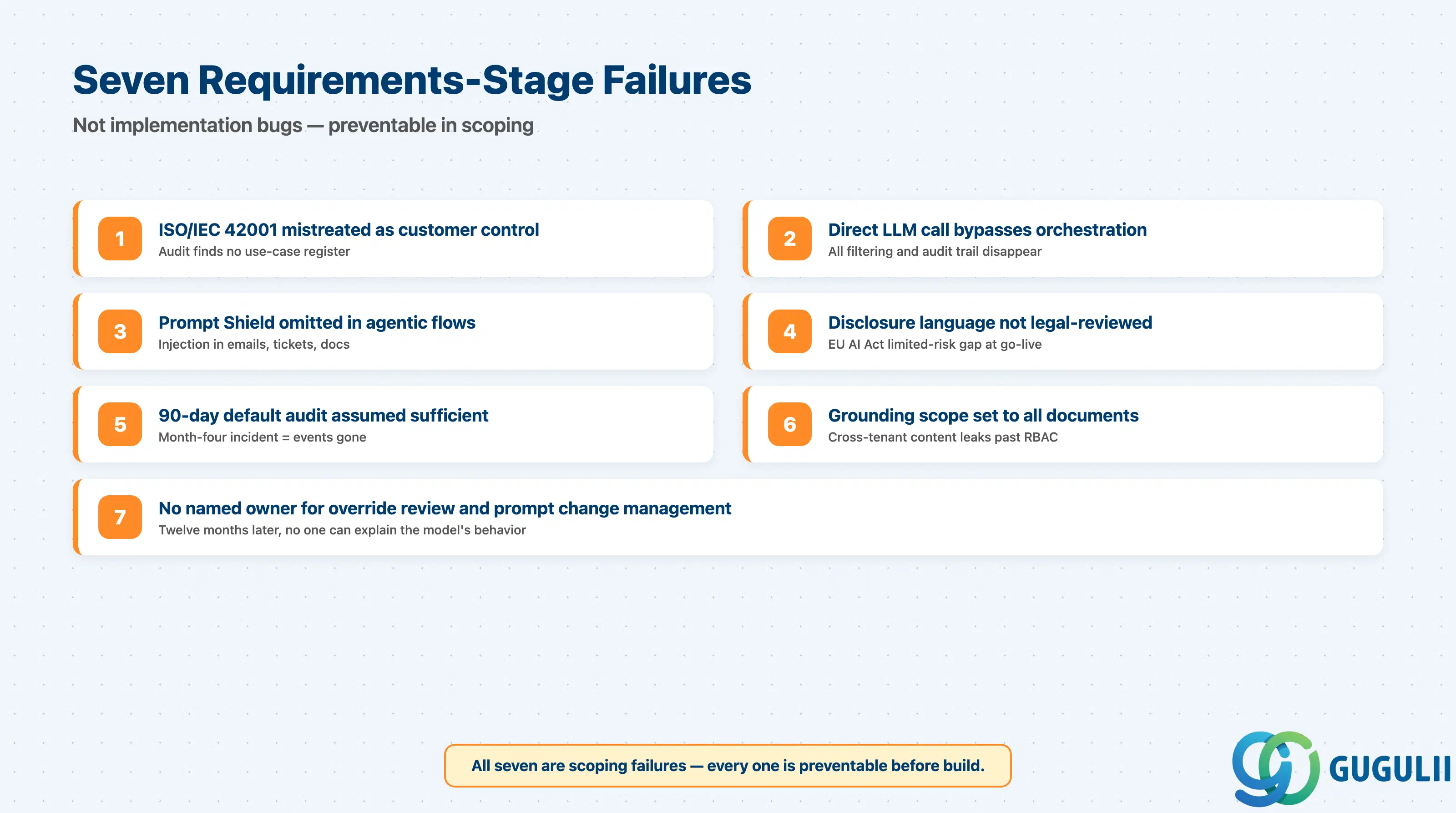
These are not implementation bugs. They are requirements-stage failures that cause Responsible AI to under-deliver after go-live, and every one of them is preventable in scoping.
Failure 1: Treating SAP’s ISO/IEC 42001 certification as a customer-side control
The use case is approved with “SAP is certified” as the only governance evidence. The first audit finds no customer-side risk classification, no oversight model, no use-case register. SAP’s certification covers SAP; customer use cases need customer-side controls.
Failure 2: Direct model calls bypassing Generative AI Hub orchestration
A developer calls a model endpoint directly because “orchestration adds latency.” Content filtering, Prompt Shield, data masking, and the prompt registry trail all disappear. Require orchestration as the only allowed access path in production.
Failure 3: Prompt Shield omitted in agentic or tool-calling flows
An agent reads customer emails or tickets and routes responses. A malicious input embeds a prompt-injection payload, and the agent acts on it. Prompt Shield exists for this pattern and is not enabled by default.
Failure 4: Disclosure language invented by the developer, not reviewed by legal
An “AI banner” ships with boilerplate copy. Legal review at go-live finds it incomplete for EU AI Act limited-risk; rollout is delayed. Treat AI disclosure as legal copy, not UX copy.
Failure 5: Audit Log default retention assumed sufficient
The 90-day default is treated as production-grade. After an incident in month four, the relevant events are gone. Premium edition with extended retention and a retrieval pipeline to a SIEM must be designed in week one.
Failure 6: Grounding scope set to “all customer documents” by default
Grounding is pointed at a broad store because “more context is better.” A user from another department sees content their RBAC would hide. Use the minimum corpus for the given user population.
Failure 7: No named owner for override review and prompt change management
The use case launches with no monthly review of override rates and no change record on prompts. Twelve months later the model behaves differently and no one can explain why. Name the owner up front.
Q: Does Responsible AI work the same on SAP S/4HANA on-premise as on S/4HANA Cloud?
Organizational governance and EU AI Act obligations are identical — they are about your use case, not your deployment. Runtime guardrails differ in shape: orchestration is the same, but the network path from on-prem is a customer build (Cloud Connector or approved egress), and Joule’s on-premise availability is narrower.
Q: How is Generative AI Hub orchestration licensed, and where is the surprise cost?
Orchestration is part of GenAI Hub on AI Core, consumed via SAP AI Units. Two surprises: (a) third-party content filter calls can meter separately; (b) AI Unit overage rates run 2×–4× the contracted unit cost. Budget for full-orchestration cost at year-two scale, not pilot.
Q: When should we descope an AI use case on Responsible AI grounds?
When any of the following is true: the use case sits in a high-risk EU AI Act category with no review board; required data residency cannot be met by any model + region combination; no named owner for monthly oversight; legal cannot approve disclosure copy in the project window; the customer cannot articulate the harm being prevented or caused. “Walk away” is a real consultant deliverable.
Q: How should we document a Responsible AI requirement so it survives handover to delivery?
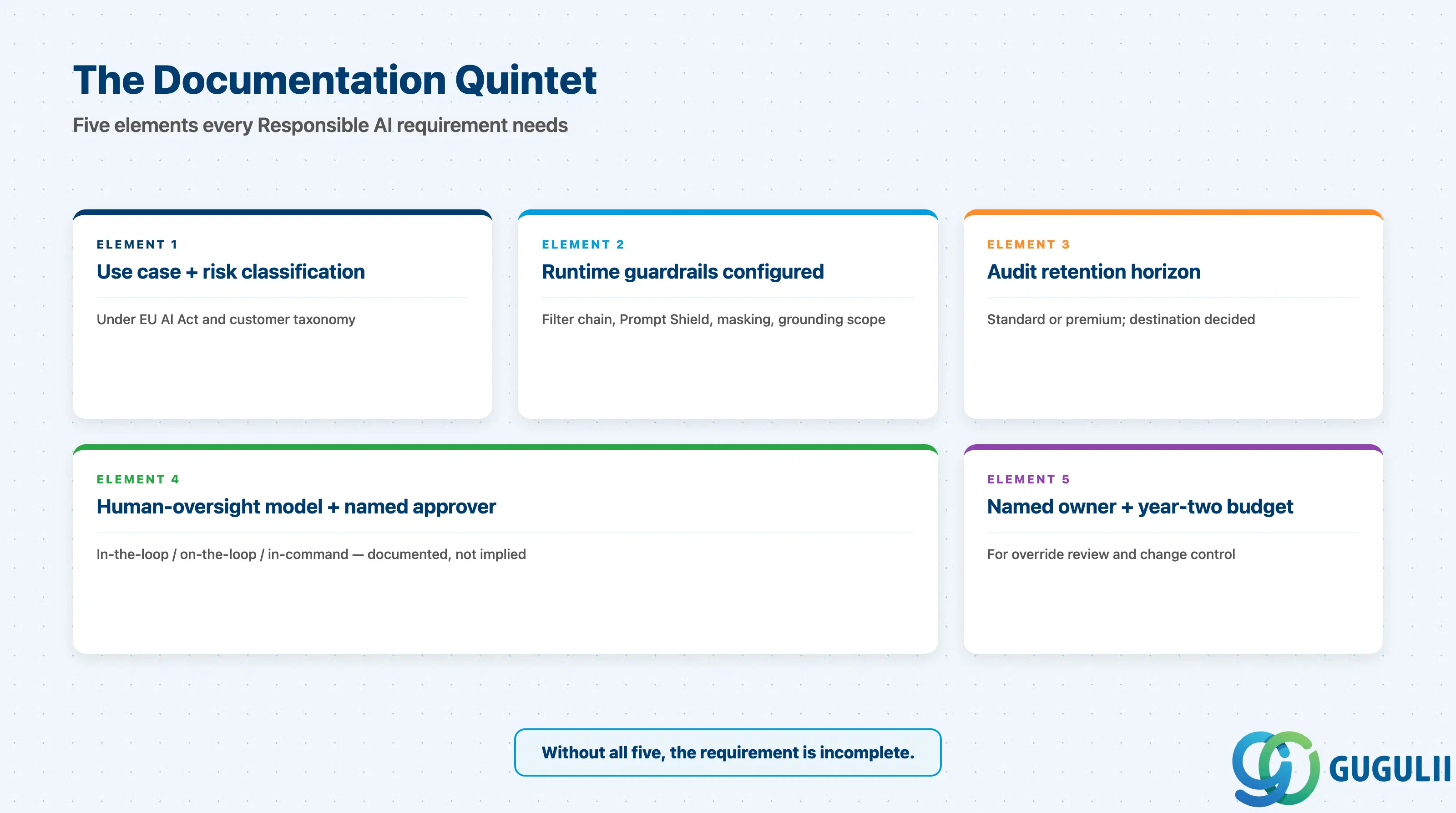
Write it as a quintet: (1) use case + risk classification under EU AI Act and customer taxonomy, (2) runtime guardrails configured (filter chain, Prompt Shield, masking, grounding scope), (3) audit retention horizon and destination, (4) human-oversight model and named approver, (5) named owner for override and change control with year-two budget. Without all five, the requirement is incomplete.
Q: Is Joule “responsible by default” because SAP runs it?
No. Joule is limited-risk under the EU AI Act, so the customer must disclose AI interaction, document the use case, and retain audit. “Joule alone does not resolve governance questions under the EU AI Act” is SAP’s own framing.
Responsible AI on BTP is a chain, not a feature. SAP delivers the upper layer (Global AI Ethics Policy, ISO/IEC 42001, EU AI Act alignment) and the runtime layer through GenAI Hub orchestration: filtering, Prompt Shield, masking, grounding, and a versioned prompt registry. Customers deliver the controls that turn that platform into a compliant deployment: use-case register, human-oversight model, AI disclosure copy, premium audit retention, override review, and a named owner with year-two budget. The consultant value is reading where each link belongs and refusing to ship until every link is in place.
| L1. Big Picture | L2. Functional Domains |
|---|---|
| BTP-001: What is BTP | L2-A. Integration |
| BTP-002: BTP Architecture | L2-B. Application Development |
| BTP-003: BTP Capability Map | L2-C. Data & Analytics |
| BTP-004: Deployment Models | L2-D. AI — BTP-D05 Responsible AI (this article) |
| BTP-005: Licensing Models | L2-E. Foundation Services |
| BTP-006: Clean Core Strategy | L2-F. Architecture & Operations |