Title here
Summary here

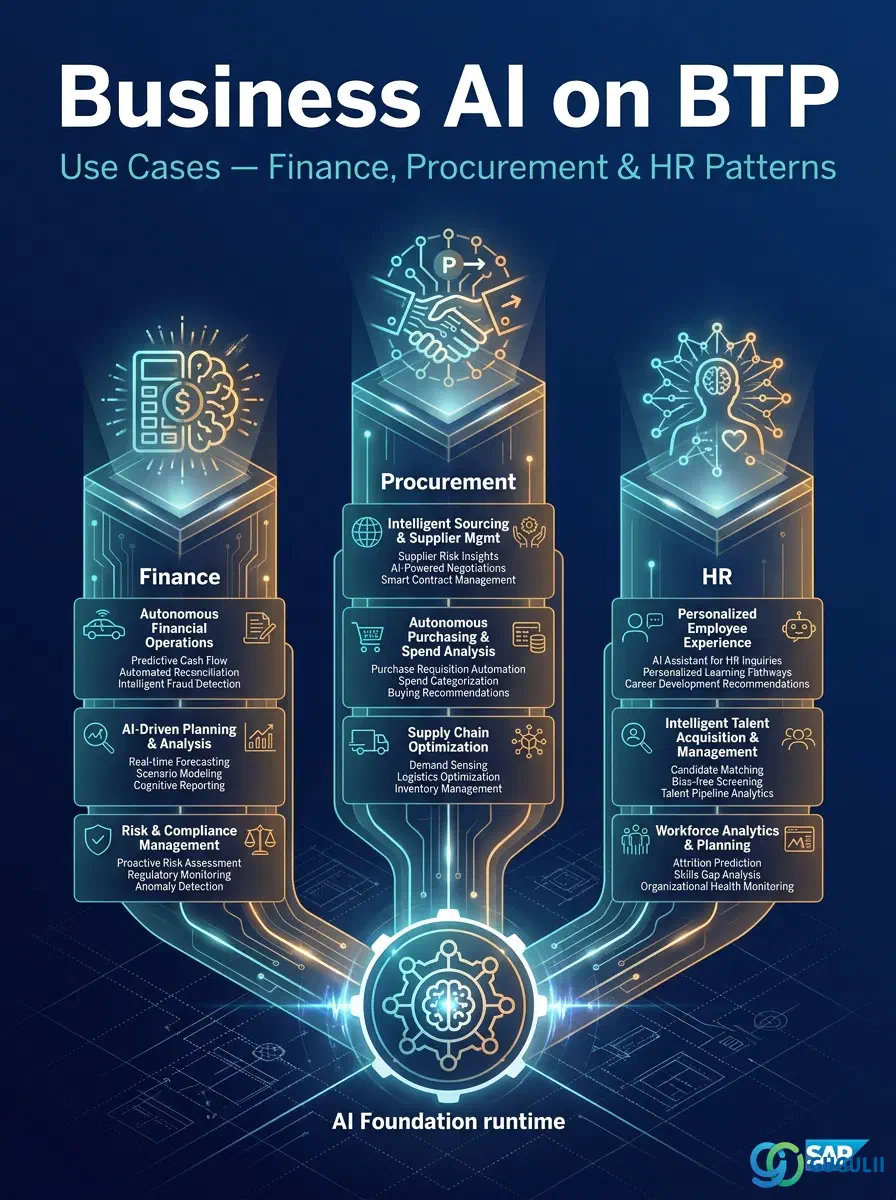
| ID | Title |
|---|---|
| BTP-D01 | Business AI: Overview and Capability Map |
| BTP-D02 | Joule: Architecture and Use |
| BTP-D03 | AI Core and GenAI Hub: Architecture and Use |
| BTP-D04 | Document AI: Architecture and Use |
| BTP-D05 | Responsible AI: Principles and Implementation |
| BTP-D06 | Business AI: Use Cases and Decision Patterns (this article) |
| Resource | URL |
|---|---|
| Joule Capabilities Guide (PDF) | help.sap.com → |
| Business AI on SAP BTP | sap.com → |
| SAP AI Core Service Guide (PDF) | help.sap.com → |
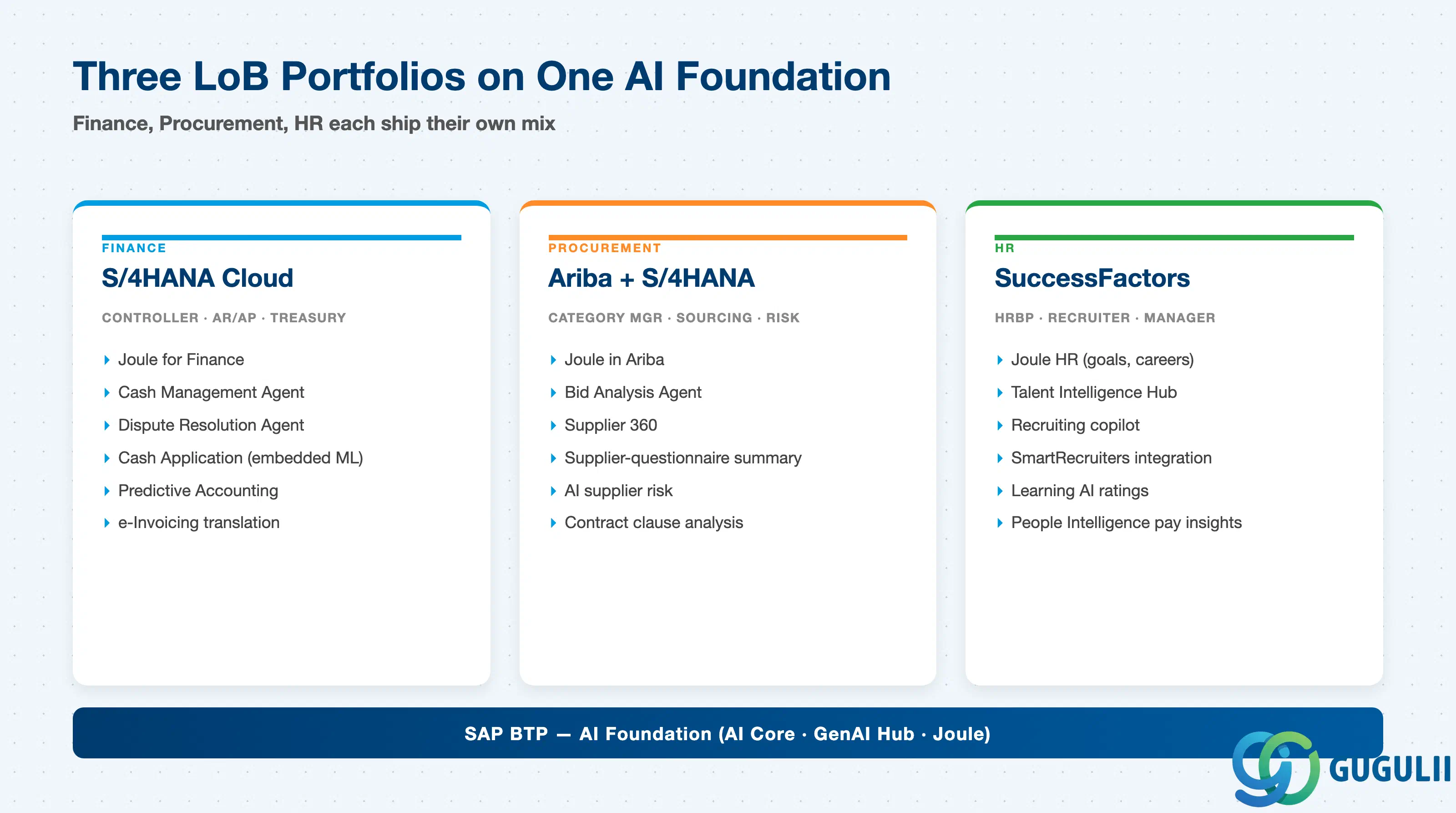
Business AI on BTP is not a single feature per LoB. Each LoB has its own mix of (a) Joule conversational/agentic capabilities, (b) embedded ML inside the application, and (c) custom extensions on AI Core / GenAI Hub. Knowing which mix a use case sits in determines licensing, prerequisites, and the realistic GA boundary.
| Domain | What it ships today | Primary user |
|---|---|---|
| Finance (S/4HANA Cloud) | Joule for finance, Cash Management Agent, Dispute Resolution Agent, e-invoicing translation, embedded ML in Cash Application / Predictive Accounting | Controller, AR/AP analyst, treasury |
| Procurement (Ariba + S/4HANA) | Joule in Ariba, Bid Analysis Agent, supplier 360, supplier-questionnaire summarization, AI-based supplier risk, contract clause analysis | Category manager, sourcing lead, supplier risk |
| HR (SuccessFactors) | Joule HR (goal drafting, career planning, internal mobility), Talent Intelligence Hub, recruiting copilot, Learning AI ratings, People Intelligence pay-transparency insights | HR business partner, recruiter, manager |
They are not substitutes.
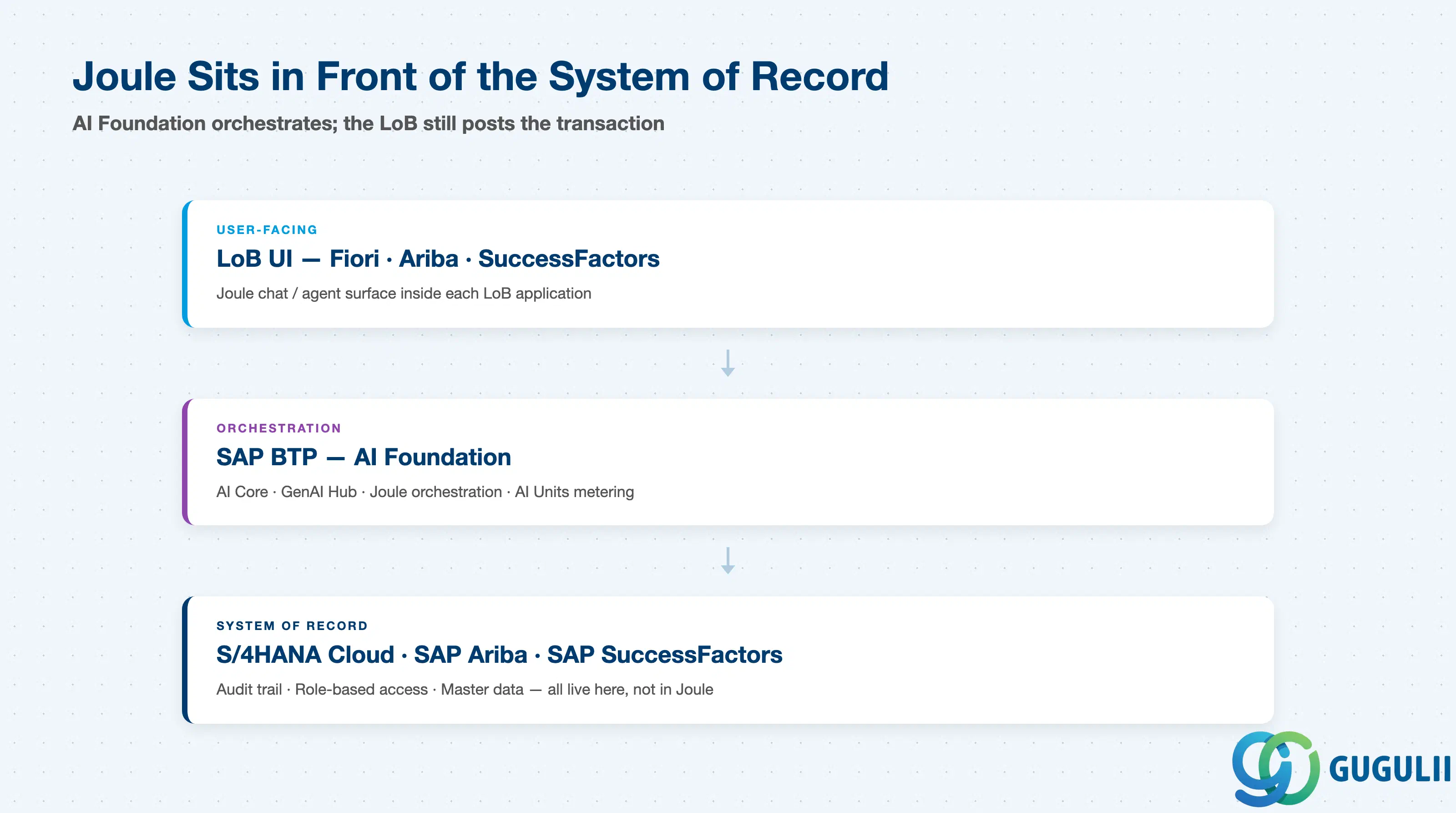
Every Business AI use case ultimately reads from or writes to a system of record — S/4HANA for Finance, Ariba and S/4HANA for Procurement, SuccessFactors for HR. The integration shape is the same: the LoB UI surfaces Joule, Joule calls AI Foundation through the BTP control plane, and the transactional posting happens in the application of record.
                     ┌──────────────────────────────┐
   User in           │ LoB UI                       │
   Fiori / Ariba ───►│  Joule chat / agent surface  │
   / SuccessFactors  └──────┬───────────────────────┘
                            ▼
                     ┌──────────────────────────────┐
                     │ BTP — AI Foundation          │
                     │   AI Core + GenAI Hub        │
                     │   Joule orchestration        │
                     └──────┬───────────────────────┘
                            ▼
   ┌───────────────────────────────────────────────────────┐
   │ System of record (one of)                             │
   │   • S/4HANA Cloud (Finance postings, MM, …)           │
   │   • SAP Ariba (sourcing, contracts, SLP, Buying)      │
   │   • SAP SuccessFactors (EC, RCM, P&G, LMS, TIH)       │
   │ Audit log, role-based access, master data live here.  │
   └───────────────────────────────────────────────────────┘
For RISE with SAP and GROW with SAP customers, the Joule assistant tier is included; agents and custom skills meter separately through AI Units. For S/4HANA private edition or non-SAP-cloud landscapes, BTP entitlement, IAS/IPS, and identity propagation must be set up before any LoB feature can call Joule.
Key point: Business AI does not replace the LoB transaction; it sits in front of it. The audit trail, role-based access check, and master data come from the application of record. Treating Joule as the system of record is the most common architectural mistake in 2026 AI scoping conversations.
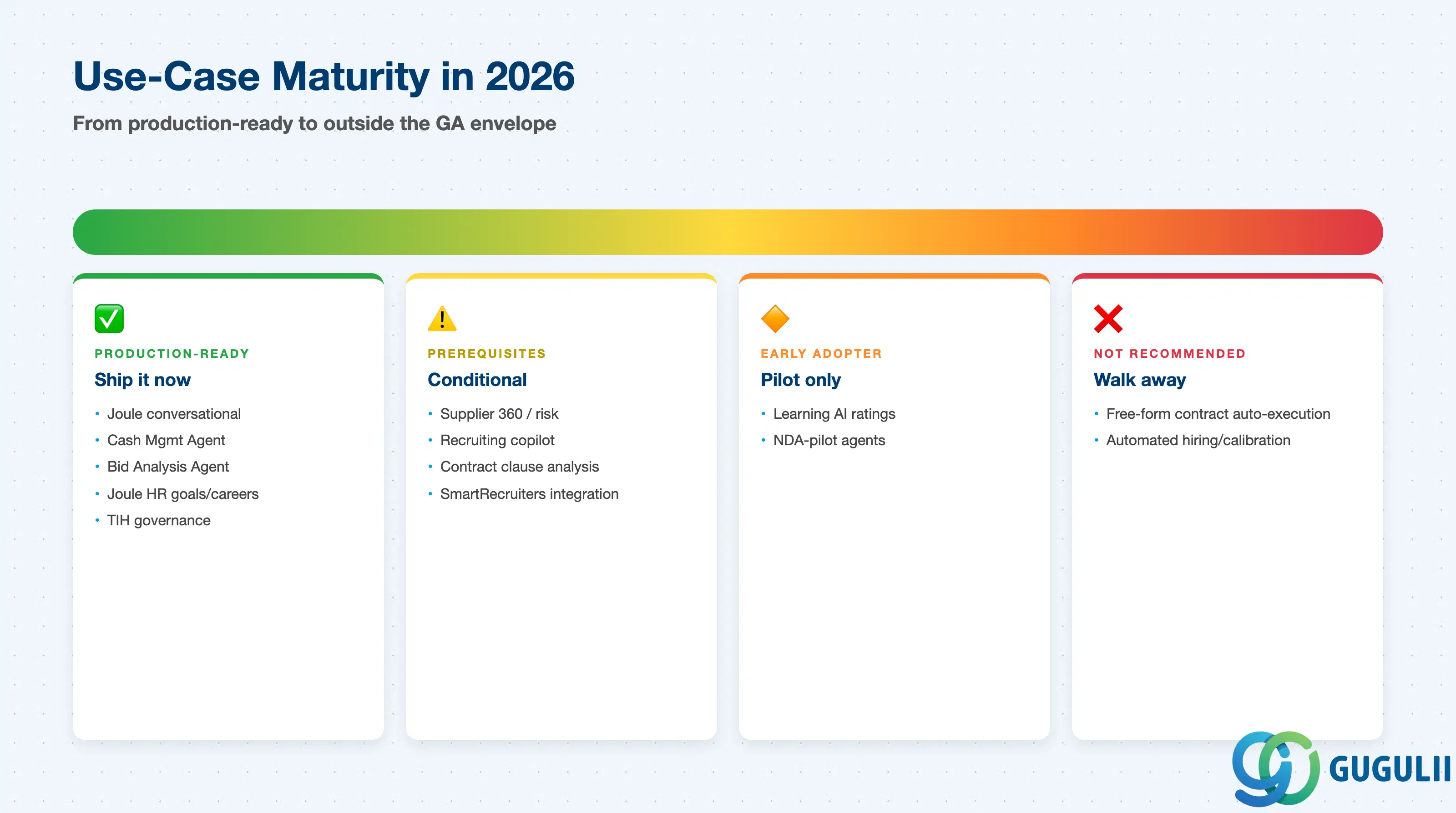
Maturity in 2026 is uneven across LoBs and within each LoB. Judge each agent on its own — the same project can ship one GA and one limited-release pilot side by side.
| Use case | Maturity | Notes |
|---|---|---|
| Joule conversational across S/4HANA, Ariba, SuccessFactors | ✅ Production-ready | GA across 35 SAP solutions, 30+ agents, 2,500+ skills as of Q1 2026. |
| Cash Management Agent / Dispute Resolution Agent | ✅ Production-ready | GA Q1 2026. Advisory output, not auto-post. |
| Cash Application / Predictive Accounting (embedded ML) | ✅ Production-ready | Pre-Joule; mature for high-volume AR matching and predictive postings. |
| Bid Analysis Agent + supplier-questionnaire summarization | ✅ Production-ready | GA Q1 2026 in Ariba Sourcing and SLP. |
| Supplier 360 / AI supplier risk | ⚠️ Ready with prerequisites | GA Feb 2026; phased 2026–2027 rollout by region and module. |
| Contract clause analysis (Icertis-deep integration) | ⚠️ Ready with prerequisites | GA Feb 2026; native authoring requires Icertis CI entitlement. |
| Joule HR (goals, career plans, internal mobility) + TIH skills governance | ✅ Production-ready | GA. RBP-bound; depends on TIH skills harmonization. |
| Recruiting copilot + SmartRecruiters integration | ⚠️ Ready with prerequisites | Native EC/Onboarding integration GA 1H 2026; validate fairness before auto-execution. |
| Learning AI-assisted skill ratings | 🔶 Early adopter | New in 1H 2026. Inferred ratings — design for human review. |
| Joule Studio custom agents (any LoB) | ✅ Production-ready | GA Q1 2026; AI Units metered. |
| Free-form contract auto-execution | ❌ Not recommended | Non-deterministic outputs cannot drive postings without HITL. |
| Fully automated hiring / calibration decisions | ❌ Not recommended | SAP and EU regulators require explainability and human accountability. |
The §3 map answers “is it ready?” This section answers “are we ready?” Build one per-domain checklist into every scoping document, plus the cross-cutting BTP one.
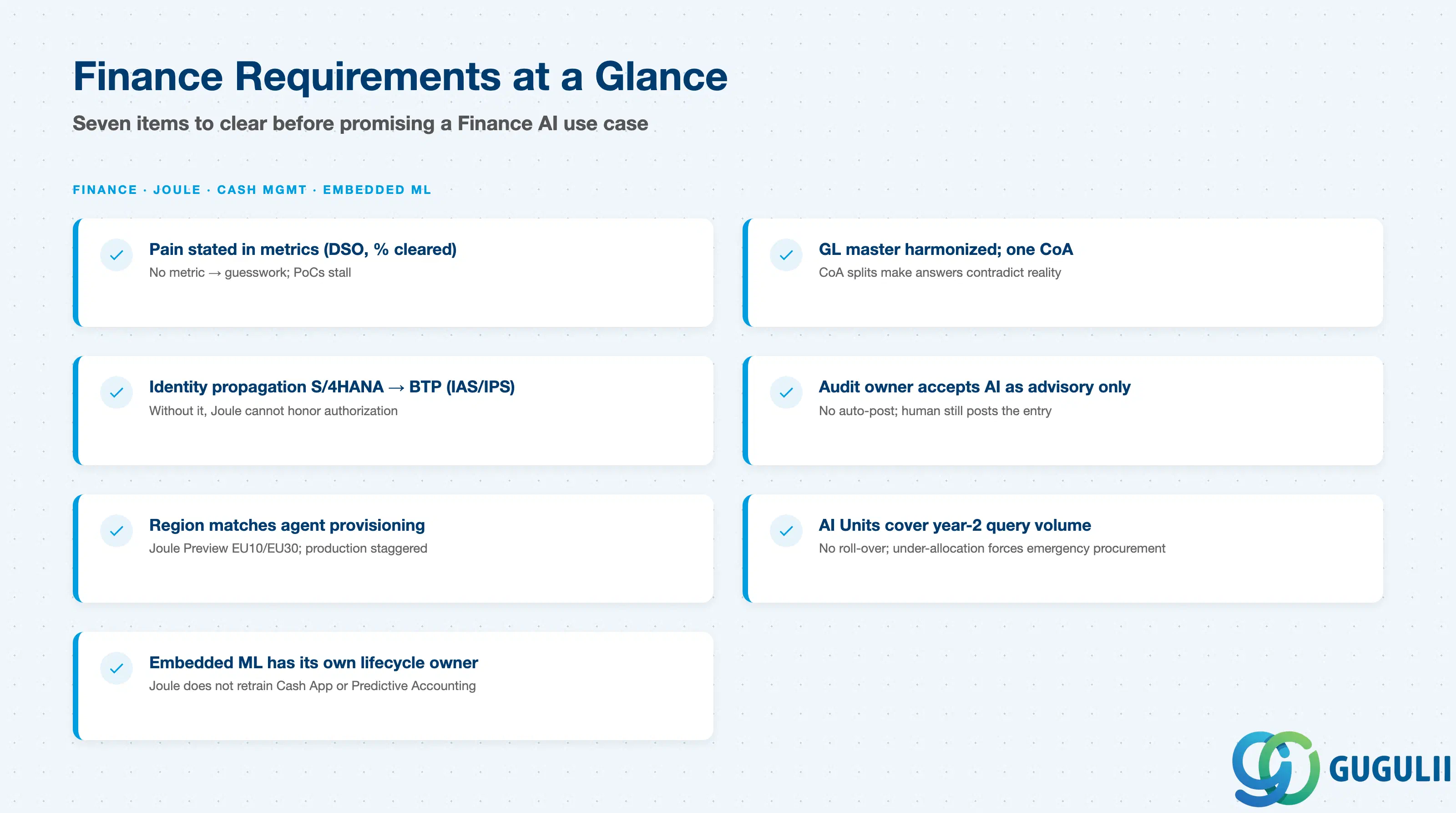
| Checklist item | Why it matters |
|---|---|
| Finance pain stated in measurable terms (DSO, % auto-cleared, dispute cycle time) | Without a metric, agent selection is guesswork and PoCs stall. |
| GL master data harmonized; chart of accounts is one version | Joule grounds in the same data Fiori uses; CoA splits make answers contradict reality. |
| Identity propagation S/4HANA Cloud → BTP configured (IAS/IPS) | Without it, Joule cannot honor S/4HANA authorization. |
| Audit owner accepts AI cash-app and dispute root-causes as advisory, not auto-post | Audit treats AI as input to a human posting, not the posting itself. |
| S/4HANA region matches the agent’s provisioned region | Joule Preview is EU10/EU30 only; production availability is staggered. |
| AI Unit allocation covers year-2 query volume | AI Units do not roll over; under-allocation forces emergency procurement. |
| Embedded ML (Cash Application, Predictive Accounting) has its own lifecycle owner | Joule does not retrain embedded models; they need a separate feedback loop. |
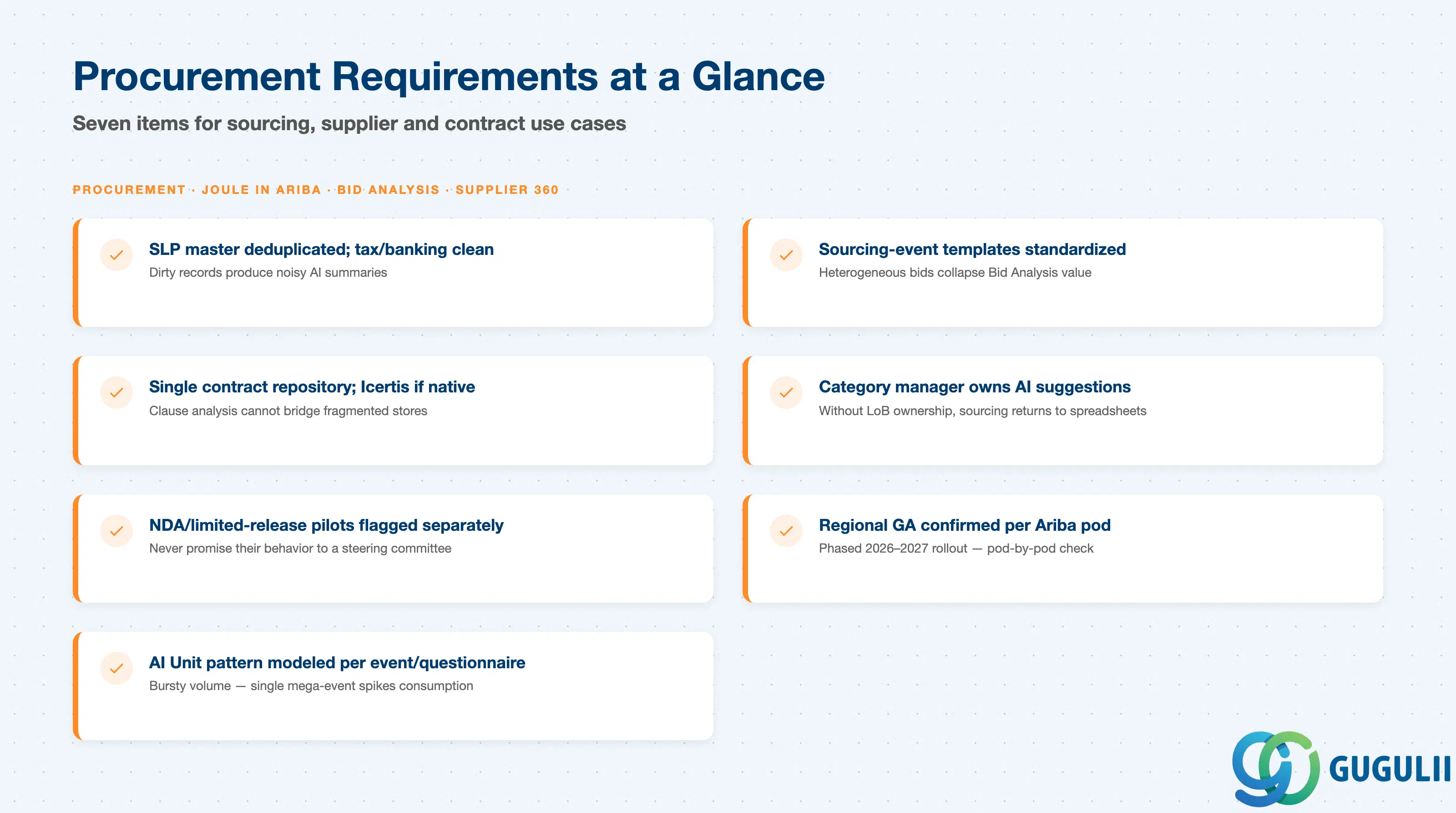
| Checklist item | Why it matters |
|---|---|
| Supplier master in SLP deduplicated; tax/banking fields clean | Supplier 360 and risk scoring inherit master quality; dirty records produce noisy summaries. |
| Sourcing-event templates standardized enough for Bid Analysis to normalize bids | Heterogeneous bid sheets collapse Agent value. |
| Contract repository is single source of truth; Icertis CI entitled if native authoring is in scope | Clause analysis cannot bridge fragmented stores. |
| Category manager owns AI suggestions, not IT | Without LoB ownership, sourcing AI returns to spreadsheets within two quarters. |
| Limited-release / NDA pilots flagged separately on the roadmap | Several Ariba agents are limited release; never promise their behavior to a steering committee. |
| Regional availability of supplier 360 / risk scoring confirmed per Ariba pod | Phased 2026–2027 rollout requires a pod check. |
| AI Unit pattern modeled per sourcing event and per questionnaire run | Procurement volume is bursty; a single mega-event can spike consumption. |
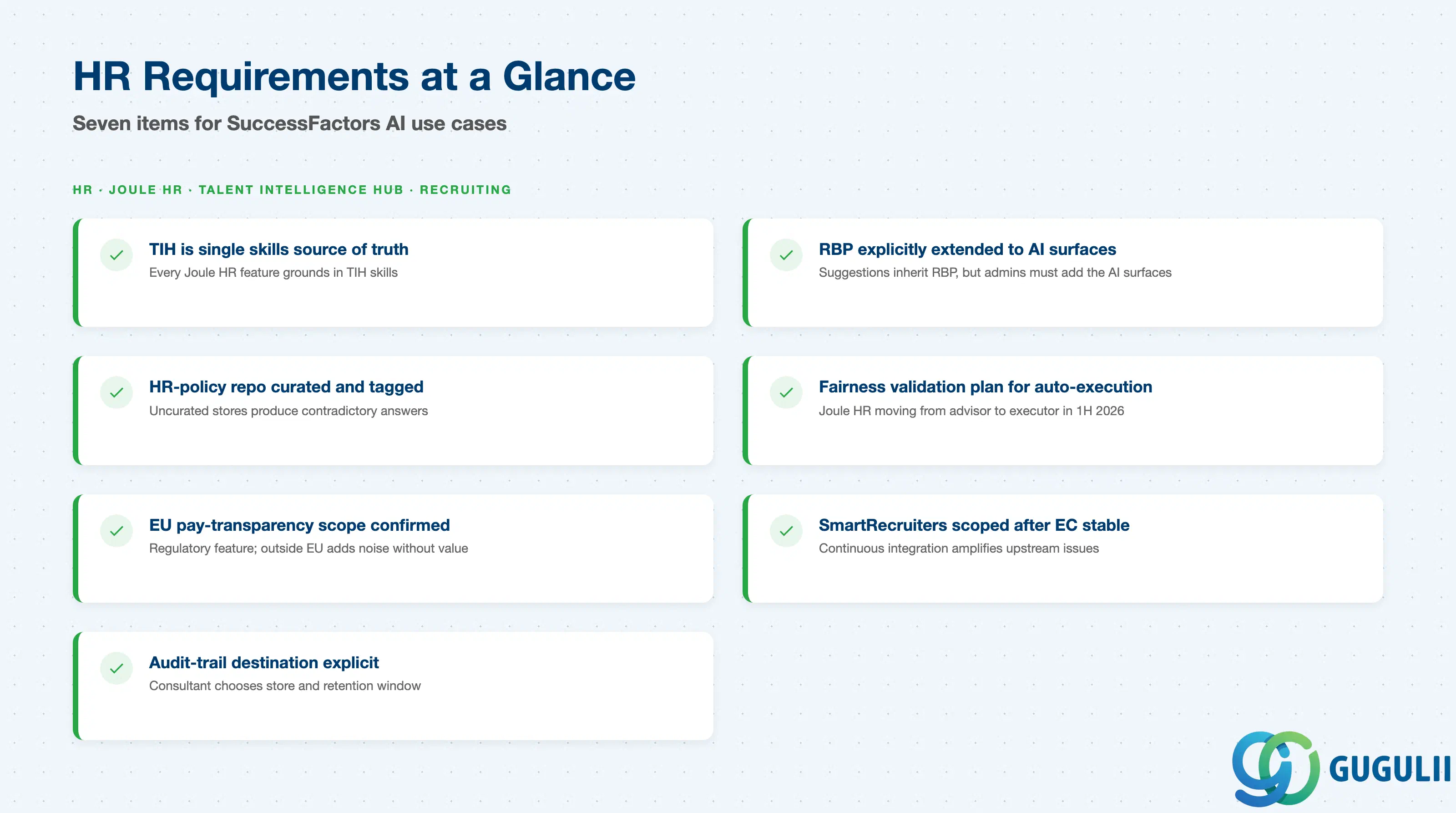
| Checklist item | Why it matters |
|---|---|
| TIH is the single skills source of truth; taxonomy governed | Every Joule HR feature grounds in TIH skills. |
| RBP explicitly extended to AI surfaces | Suggestions inherit RBP, but admins must add the AI surfaces. |
| Joule HR-policy repository (SharePoint or Google Drive) curated and metadata-tagged | Uncurated policy stores produce contradictory answers — an HR compliance issue. |
| Fairness validation plan exists for any auto-execution recruiting / calibration scenario | Joule HR shifts from advisor to executor in 1H 2026; unvalidated auto-execution is indefensible. |
| EU pay-transparency directive scope confirmed before enabling People Intelligence pay insights | Regulatory feature; outside EU it adds noise without compliance value. |
| SmartRecruiters integration scoped only after EC and Onboarding are stable | The 1H 2026 integration is continuous; unstable upstream amplifies data issues. |
| Audit-trail destination for AI-influenced HR decisions is explicit | SAP commits to audit trails; the consultant chooses store and retention. |
| Checklist item | Why it matters |
|---|---|
| BTP global account, subaccount, IAS, IPS provisioned before LoB rollout | Every Joule and AI Foundation feature depends on this baseline. |
| Licensing path (RISE / GROW vs. AI Units vs. BTPEA) mapped per use case | Mixing them up under-budgets the project. |
| Written HITL threshold per use case | Cash app, dispute root cause, supplier risk, hiring shortlist — each needs a written go/no-go. |
| Governance review (ISO 42001-aligned) before enabling auto-execution | SAP holds ISO 42001; the customer still owns its own review. |
| Written “the AI is wrong” failure plan | Manual fallback, escalation, suppression — must exist, named, in the project plan. |
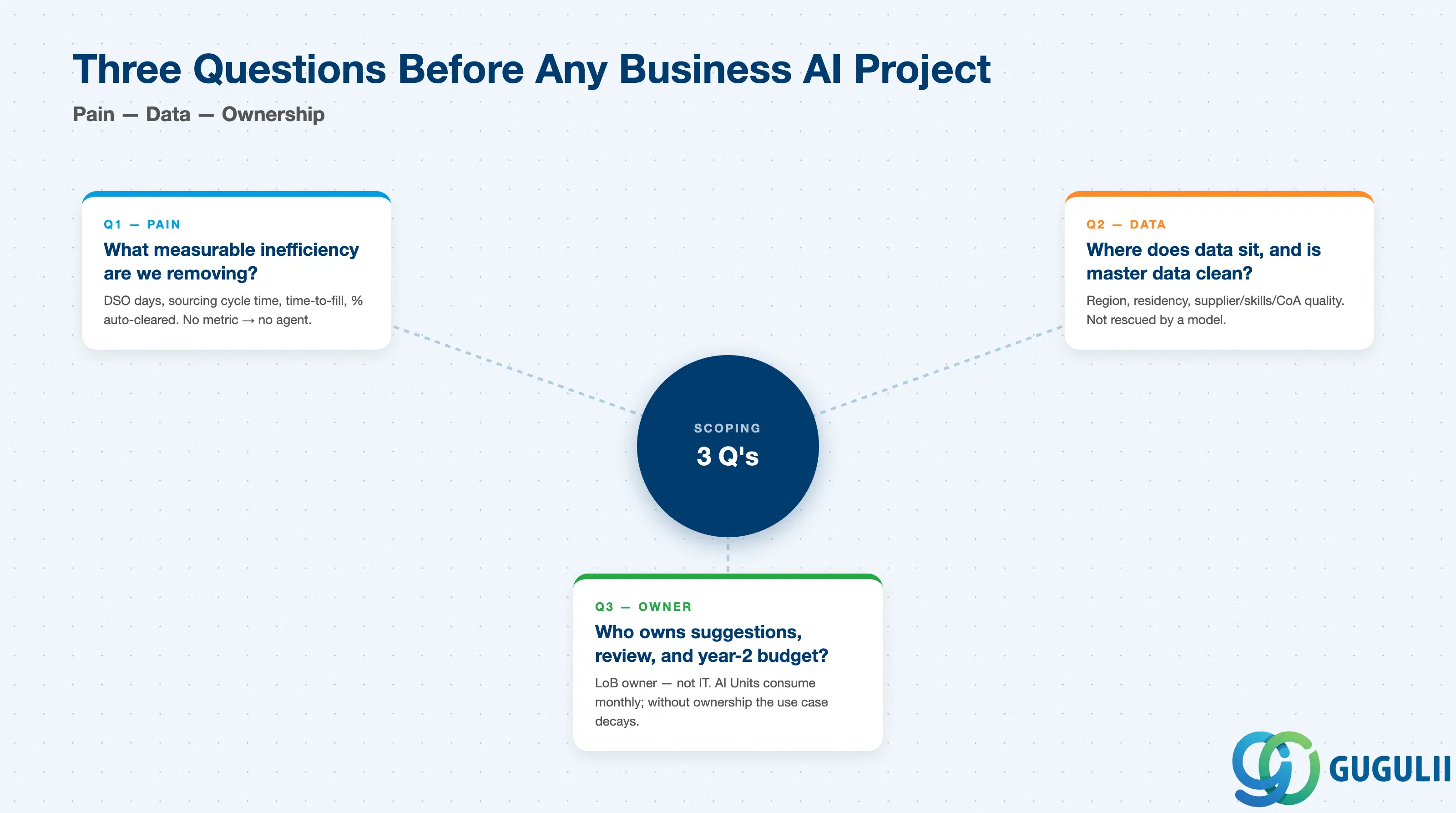
Q1. What measurable inefficiency in this LoB are we removing, and what is its current cost?
If the customer cannot describe the pain in numbers — DSO days, sourcing cycle time, time-to-fill, % of cash auto-cleared — Business AI is not the right project to start. A vague “we want AI in finance” stalls in PoC.
Q2. Where does the data sit, in what regions, and is the master data clean enough for grounded answers?
Answer this before talking about agents. Dirty supplier master and ungoverned skills taxonomies are not rescued by a model. If the data must remain in a region where the agent is not provisioned, the conversation is about regional rollout, not AI.
Q3. Who owns the use case after go-live — suggestions, review queue, fairness checks, AI Unit budget — and do they have year-two budget?
Business AI is not a one-time install. AI Units consume monthly, agents update each release, fairness expectations tighten with regulation. Without a named LoB owner with year-two budget, the use case decays silently.
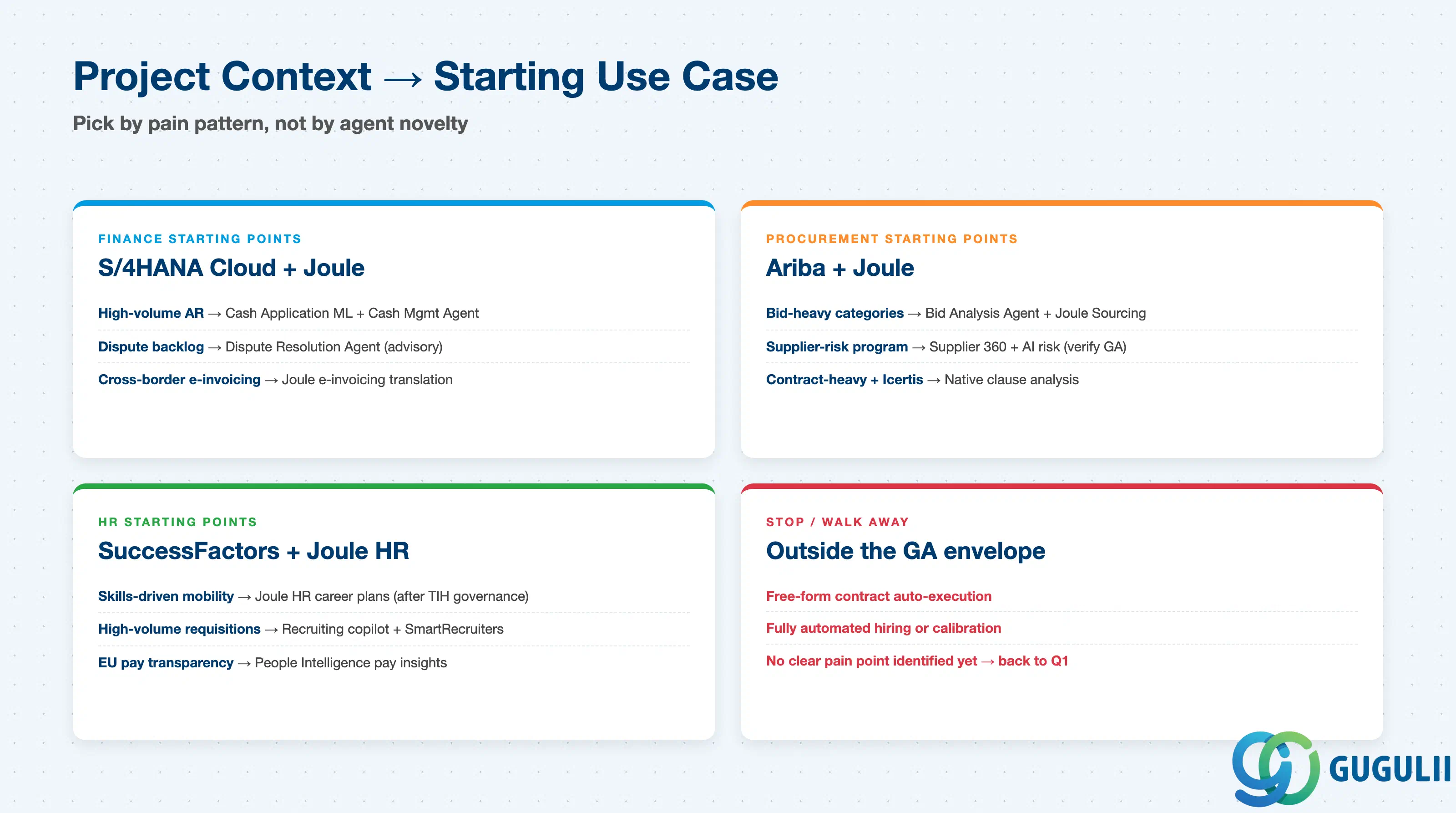
| Project context | Recommended starting use case |
|---|---|
| Finance: AR with high cash-application volume | Embedded Cash Application ML + Joule Cash Management Agent for queries |
| Finance: AR with disputed-invoice backlog | Dispute Resolution Agent (advisory) + named owner of resolution queue |
| Finance: cross-border e-invoicing operations | Joule e-invoicing error translation as the entry use case |
| Procurement: large bid-heavy categories | Bid Analysis Agent + Joule in Sourcing |
| Procurement: supplier-risk-driven program | Supplier 360 + AI supplier risk (verify regional GA) |
| Procurement: contract-heavy with Icertis CI | Contract clause analysis with native Icertis authoring |
| HR: skills-driven internal mobility | Joule HR career plan / internal mobility, after TIH governance |
| HR: high-volume requisition pipeline | Recruiting copilot + SmartRecruiters, with fairness validation |
| HR: EU pay-transparency compliance | People Intelligence pay-transparency insights on Business Data Cloud |
| Free-form contract auto-execution | Stop. Outside the GA envelope. |
| Fully automated hiring or calibration | Stop. Not allowed by SAP guidance or EU regulation. |
| No clear pain point identified yet | Stop. Go back to Q1. |
| Domain | Licensing model | Key question to ask |
|---|---|---|
| Finance — Joule assistant tier | Included in RISE / GROW with SAP entitlements | Is the customer on RISE/GROW, or do we need a separate Joule consumption path? |
| Finance — Cash Management Agent / Dispute Resolution Agent / custom agents | AI Units, metered per request, no roll-over | What is the projected agent-call volume in year 2, not just at go-live? |
| Procurement — Joule in Ariba, Bid Analysis, supplier 360 | AI Units, metered per request; some features require BTPEA tier | Is the customer at a BTPEA tier that covers the bursty sourcing-event volume? |
| HR — Joule HR, recruiting copilot, Learning AI ratings | AI Units, metered per request; SmartRecruiters integration has its own subscription | Has the SmartRecruiters subscription path been confirmed alongside AI Units? |
| Custom agents on Joule Studio (any LoB) | AI Units, plus token metering for foundation models invoked through GenAI Hub | What is the per-interaction token cost, and how many will the workflow trigger per month? |
| Embedded Document AI (any LoB attaching documents) | 0.1 AI Units per document request | What is the document volume contribution to the AI Unit budget in year 1 vs. year 2? |
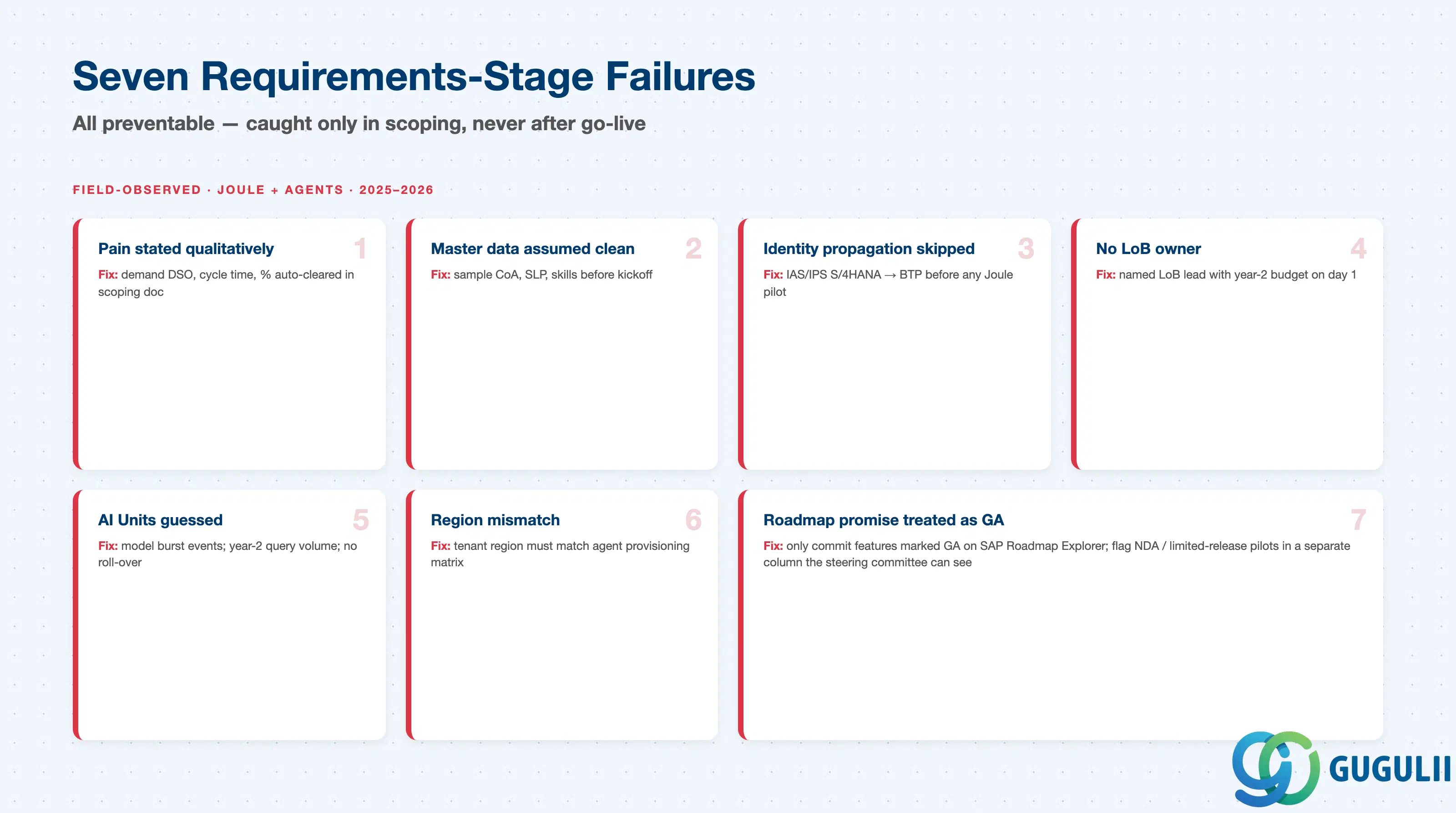
These are requirements-stage failures, not implementation bugs — every one is preventable in scoping.
Failure 1: Use case promised on a limited-release agent as if it were GA
A customer hears “Joule does X” from a roadmap deck; the consultant commits; X turns out to be limited release for another cycle. Always check the current Joule Capabilities Guide PDF version and flag NDA pilots separately.
Failure 2: Master data quality assumed at the level required for grounded answers
Ungoverned skills taxonomies yield inconsistent Joule HR suggestions; duplicates in SLP produce noisy supplier 360 summaries; a fragmented chart of accounts makes Cash Management Agent contradict Fiori reports. Master data quality is part of the AI requirement.
Failure 3: Auto-execution turned on without a fairness or HITL plan
Joule HR’s shift from advisor to executor in 1H 2026 invites this failure. Auto-execution on hiring shortlists, calibration, or contract changes without fairness validation and a human-review fallback is not defensible in 2026.
Failure 4: Region constraint discovered after entitlements are raised
The project assumes a Joule agent is GA in the customer’s region; the integration guide is read in week six and reveals EU-only or phased rollout. Read the region matrix in week one.
Failure 5: AI Unit budget modeled on go-live volume only
AI Units do not roll over; query volume scales with adoption. A go-live forecast under-allocates by year 2 and forces emergency procurement. Model year-2 volume per use case with at least 30% headroom.
Failure 6: No LoB owner for the AI suggestions after go-live
IT owns the platform; nobody owns the suggestions. The category manager, controller, or HRBP must own bad-suggestion suppression, SAP feedback, and year-two budget. Without a LoB owner, the suggestion stream becomes noise within two quarters.
Failure 7: Customizing Joule with Joule Studio before validating standard agents
Joule Studio is GA, so the temptation is to jump to custom agents. Standard agents (Cash Management, Bid Analysis, Joule HR) cover most pain points with SAP-owned lifecycles. Start standard; reach for Joule Studio only when one is genuinely missing.
Q: Do these Business AI use cases work on SAP S/4HANA on-premise, or only S/4HANA Cloud?
The cleanest fit is S/4HANA Cloud (public and, for many capabilities, private edition) plus cloud SuccessFactors and Ariba. On-prem S/4HANA can still use embedded Finance ML, but Joule and most LoB agents target cloud editions; hybrid landscapes need explicit BTP, IAS, and connector setup, and several agents will not light up without a cloud system of record. Read the integration guide per use case before promising parity.
Q: How is Business AI on BTP licensed across LoBs, and where is the surprise cost?
Joule’s assistant tier is included with RISE and GROW with SAP. Beyond that, agents, custom skills, GenAI Hub invocations, and embedded Document AI meter through AI Units (0.1 AI Units per Document AI request as a public reference point). AI Units do not roll over. The two surprises: year-two volume scales faster than year-one with adoption, and bursty Procurement events / HR cycles spike consumption that flat-rate budgets miss. Hard pricing is account-team-negotiated; build year-1 and year-2 forecasts per use case.
Q: When should we descope a Business AI use case from a project?
When any of the following is true: the customer cannot quantify the LoB pain; master data is not at the quality required for grounded answers; the use case sits on a limited-release / NDA agent the customer has not enrolled in; the region does not yet support the agent; auto-execution is required but no fairness or HITL plan exists; or no LoB owner has year-two budget. Promising free-form contract auto-execution or fully automated hiring is malpractice in 2026.
Q: Can Joule replace embedded ML like Cash Application or Predictive Accounting?
Not as of 2026, and SAP does not market it as a replacement. Embedded ML predates Joule, has its own training and feedback loops, and remains the production path for high-volume AR matching and predictive postings. Joule sits on top — answering queries, summarizing dispute root causes, translating e-invoicing errors — without retraining the embedded models. Treat them as a pair, not a migration.
Q: How do we document a Business AI use-case requirement so it survives handover to delivery?
Write it as a quintet: (1) the named capability (Cash Management Agent / Bid Analysis Agent / Joule HR career plan / etc.), (2) the LoB pain metric and target, (3) master-data and identity prerequisites with named owners, (4) the HITL or fairness pattern with a written threshold, (5) AI Unit budget with year-1 and year-2 forecasts. Without all five, the requirement gets reshaped during delivery — usually by removing scope.
Q: Should we wait for Joule Studio custom agents before starting?
No. Joule Studio is GA in Q1 2026, but standard agents cover most Finance, Procurement, and HR pain points with SAP-owned roadmaps. Start with standard agents, capture remaining gaps after a quarter of real usage, then design Joule Studio agents for the residual cases — owned by the LoB.
Q: How do regulatory considerations (EU AI Act, pay transparency, audit) shape use-case selection?
They tighten the boundary on auto-execution and on HR. Hiring, calibration, and pay-transparency use cases must keep an explicit human-accountability layer; SAP commits to audit trails and explanation surfaces, and the customer’s governance review (often ISO 42001-aligned) closes the loop. In Finance and Procurement the constraint is lighter but still real: AI suggestions are advisory until a named role accepts them.
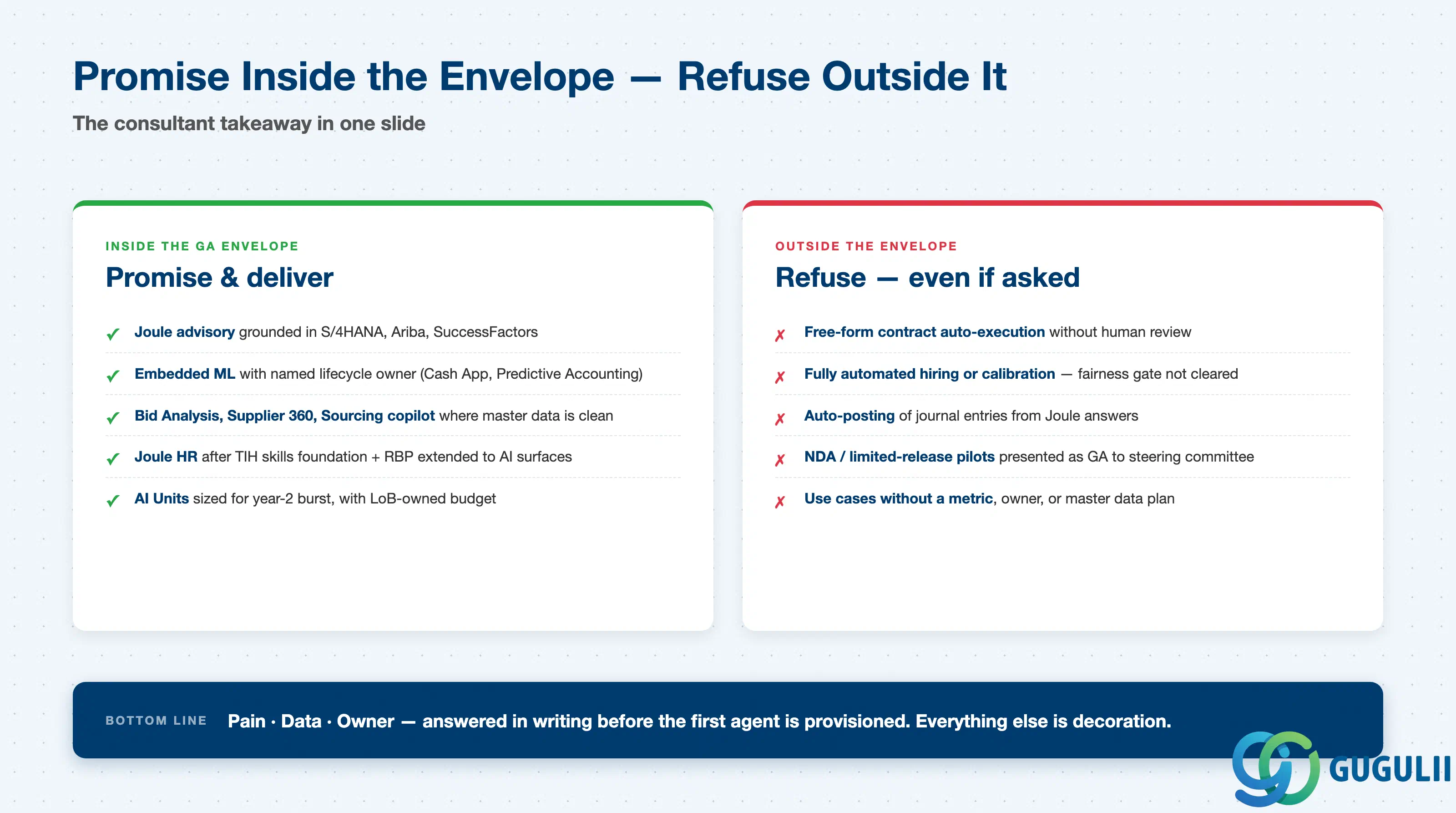
Business AI on BTP in 2026 is best read as three LoB-shaped portfolios on the same AI Foundation runtime — Finance (Cash Management Agent, Dispute Resolution Agent, Joule in S/4HANA, embedded ML), Procurement (Bid Analysis Agent, supplier 360, sourcing copilot in Ariba), and HR (Joule HR, Talent Intelligence Hub, recruiting copilot, Learning AI). The consultant value is reading the customer’s master data, region, role-based access, and human-review pattern and saying — accurately — which agents are GA today, which are limited release, which need prerequisites, and where the answer is “not in this phase.” Promise inside the GA envelope, refuse outside it, and ship the LoB owner and AI Unit year-two budget every time.
| L1. Big Picture | L2. Functional Domains |
|---|---|
| BTP-001: What is BTP | L2-A. Integration |
| BTP-002: BTP Architecture | L2-B. Application Development |
| BTP-003: BTP Capability Map | L2-C. Data & Analytics |
| BTP-004: Deployment Models | L2-D. AI — BTP-D06 Use Cases (this article) |
| BTP-005: Licensing Models | L2-E. Foundation Services |
| BTP-006: Clean Core Strategy | L2-F. Architecture & Operations |