Title here
Summary here

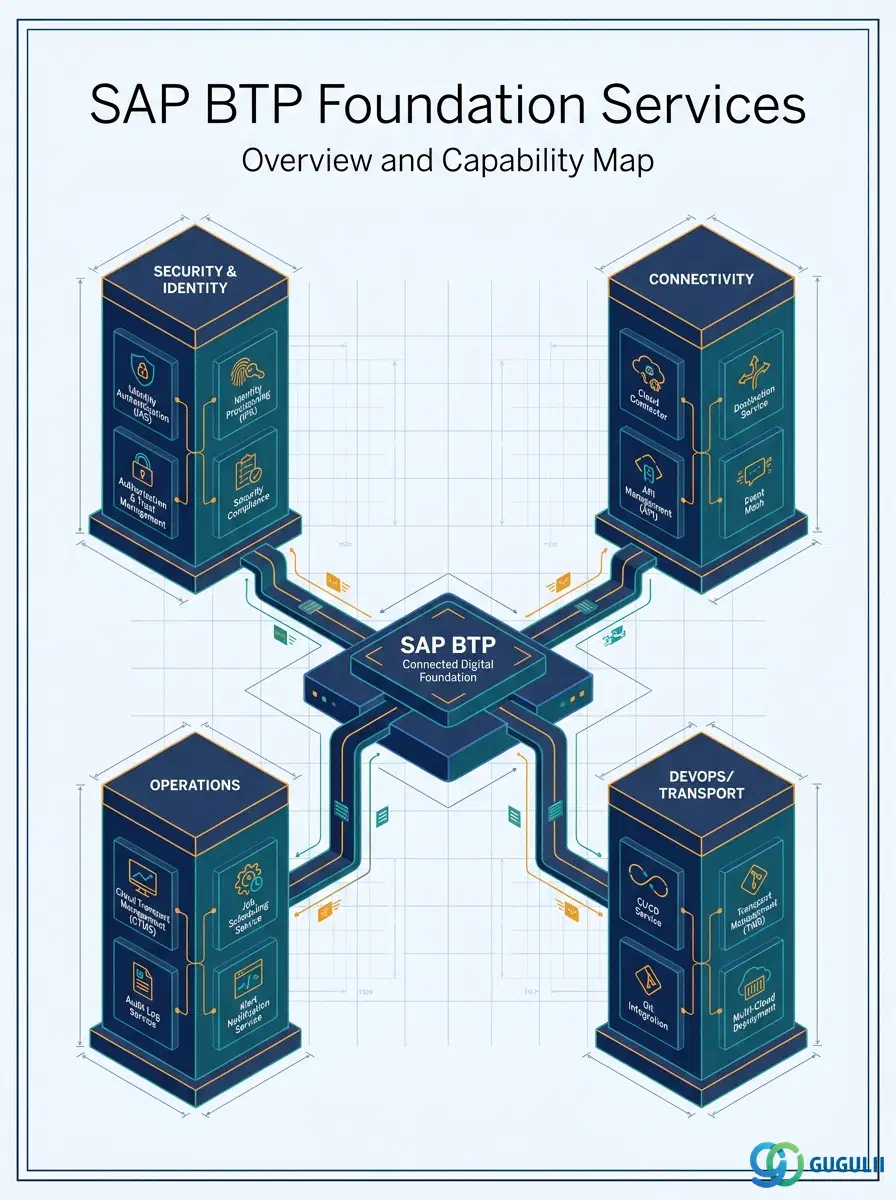
| ID | Category | Component | Scope |
|---|---|---|---|
| BTP-E01 | Overview | Foundation Services | Overview and Capability Map (this article) |
| BTP-E02 | Identity & Access | Identity and Access Management | Architecture and Use |
| BTP-E03 | Connectivity | Cloud Connector | Architecture and Use |
| BTP-E04 | Connectivity | Private Link | Architecture and Use |
| BTP-E05 | Operations | Cloud ALM | Architecture and Use |
| BTP-E06 | DevOps | Cloud Transport Management | Architecture and Use |
| BTP-E07 | Overview | Foundation Services | Use Cases and Decision Patterns |
| Resource | URL |
|---|---|
| SAP Cloud Identity Services — Product Documentation | help.sap.com → |
| SAP Authorization and Trust Management Service (XSUAA) | help.sap.com → |
| SAP BTP Connectivity — Cloud Connector | help.sap.com → |
| SAP Cloud ALM — Product Overview | support.sap.com → |
| SAP Cloud Transport Management — What Is | help.sap.com → |
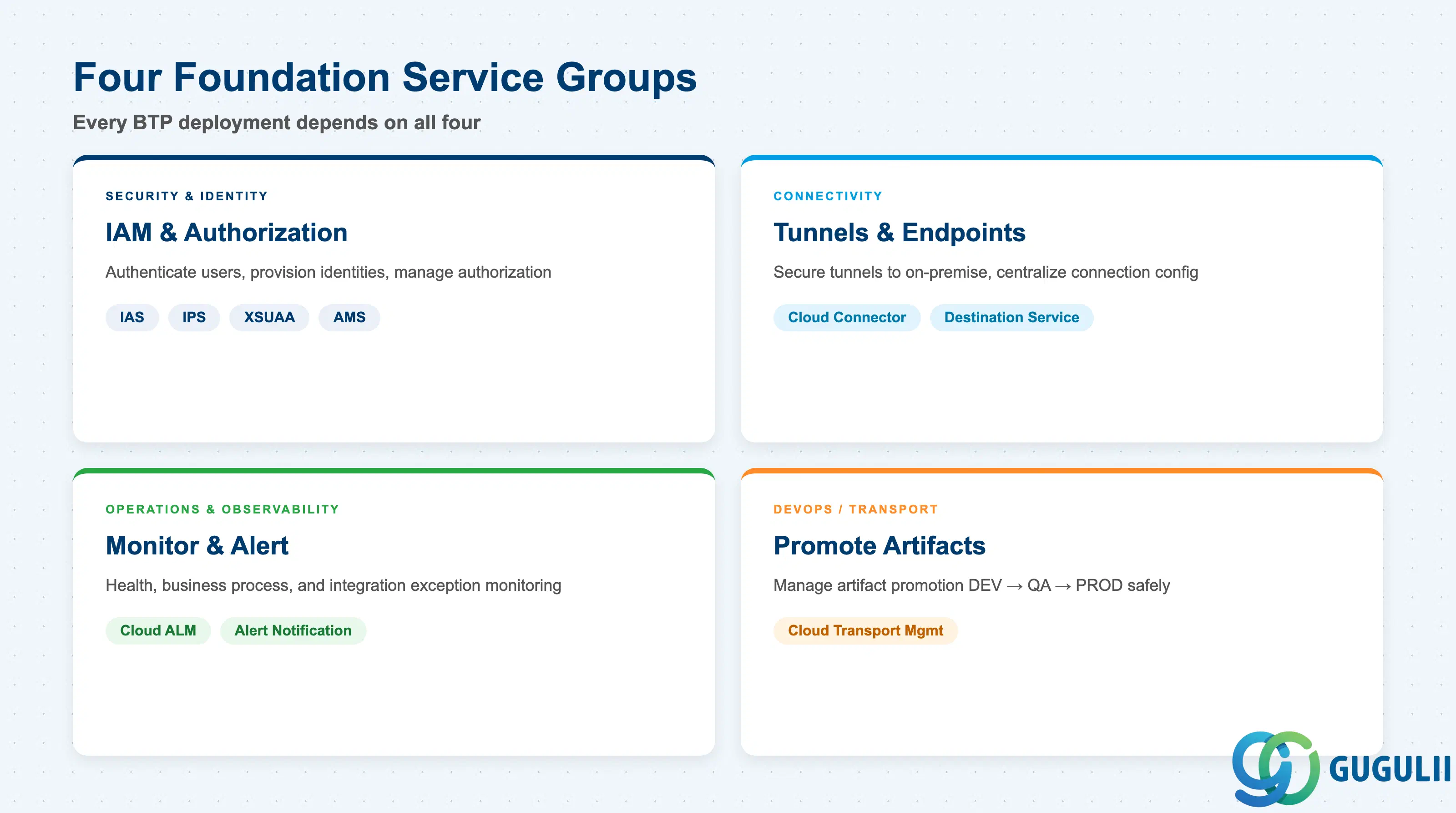
According to SAP Learning, Foundation Services are “a collection of essential, cross-cutting services that provide the fundamental capabilities required to run, manage, secure, and extend all applications and services on the platform.” They are not a separate product tier — they are bundled with SAP BTP accounts and exist as a prerequisite layer beneath every application domain.
| Service Group | What it does | Primary user |
|---|---|---|
| Security & Identity (IAS, IPS, XSUAA, AMS, Identity Directory) | Authenticates users, provisions identities, issues OAuth tokens, and manages authorization policies across the BTP landscape | Basis / security architects |
| Connectivity (Cloud Connector, Destination Service) | Creates secure tunnels to on-premise systems and centralizes outbound connection configuration | Integration architects |
| Operations & Observability (Cloud ALM, Alert Notification Service) | Monitors health, business processes, and integration exceptions across the entire SAP landscape including BTP | Operations / CoE teams |
| DevOps / Transport (Cloud Transport Management) | Manages artifact promotion across BTP environments from development through production | DevOps / release managers |
They are not substitutes — a project needs all four groups operational before any business application goes live.
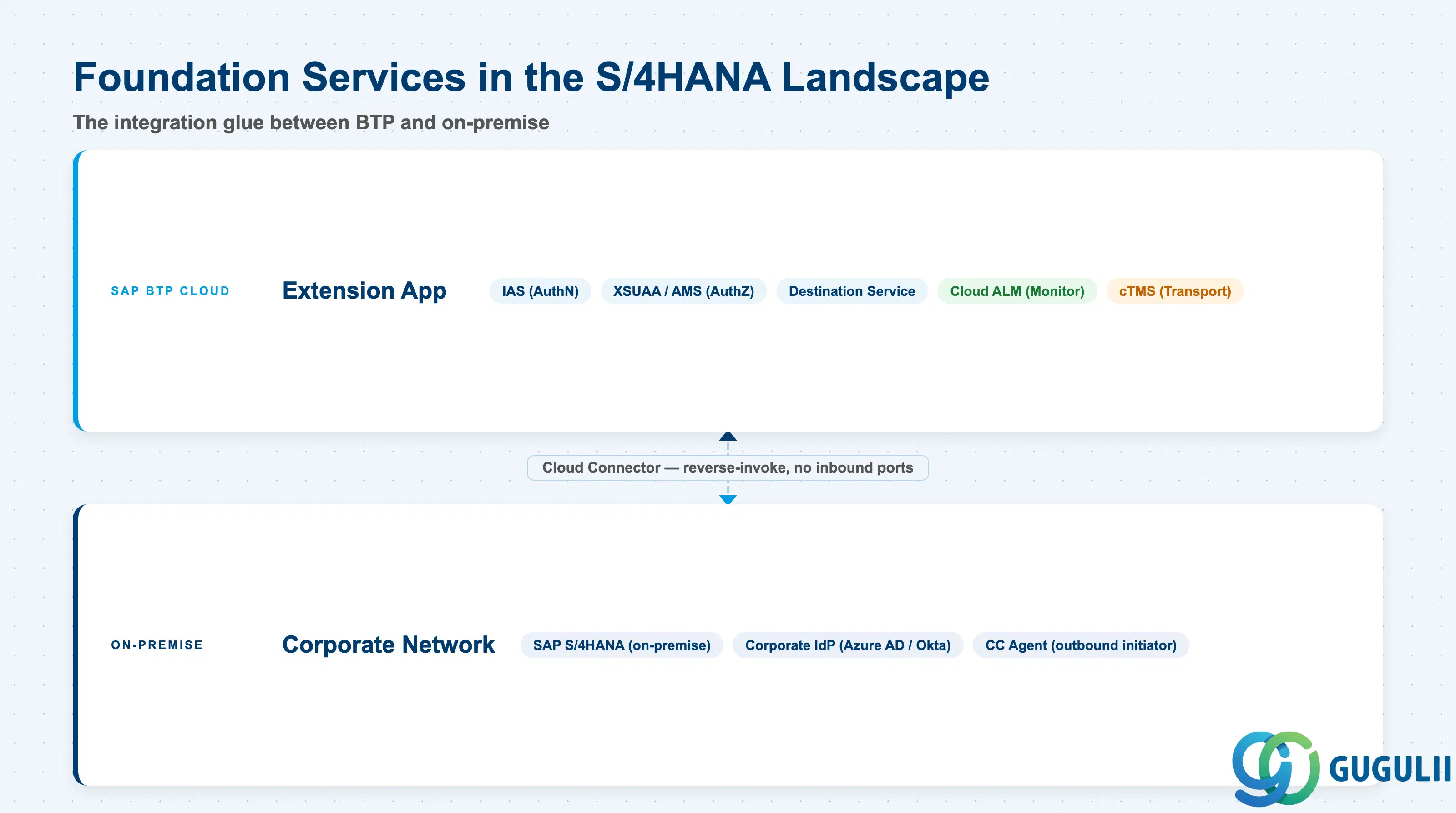
Foundation Services sit between the SAP BTP platform layer and the business applications (whether SAP S/4HANA Cloud, on-premise S/4HANA, or BTP extensions). The diagram below shows a typical SAP S/4HANA extension scenario and where each Foundation Service operates.
┌─────────────────────────────────────────────────────────────┐
│                    SAP BTP (Cloud)                          │
│                                                             │
│  ┌──────────────┐   ┌────────────────────────────────────┐  │
│  │ BTP Extension│   │       Foundation Services          │  │
│  │ Application  │◄──│  IAS (AuthN) → XSUAA/AMS (AuthZ)  │  │
│  │ (CF / Kyma)  │   │  Destination Svc → Cloud Connector │  │
│  └──────┬───────┘   │  Cloud ALM (Monitoring)            │  │
│         │           │  cTMS (Artifact Transport)         │  │
│         │           └────────────────────────────────────┘  │
│         │                                                   │
└─────────┼───────────────────────────────────────────────────┘
          │ Cloud Connector (outbound tunnel, no inbound ports)
          │
┌─────────▼───────────────────────────────────────────────────┐
│            On-Premise Network                               │
│                                                             │
│  ┌─────────────────┐    ┌──────────────────────────────┐   │
│  │  SAP S/4HANA    │    │  Corporate Identity Provider │   │
│  │  (on-premise)   │    │  (Azure AD, Okta, LDAP)      │   │
│  └─────────────────┘    └──────────────────────────────┘   │
└─────────────────────────────────────────────────────────────┘
As documented on the SAP BTP Connectivity Help page, Cloud Connector uses a reverse-invoke proxy pattern: the connection is always initiated from the on-premise side outward toward SAP BTP, so no inbound firewall rules are required on the corporate network. IAS can act as an identity proxy, federating the corporate IdP identity into BTP so that end-users get SSO without duplicate accounts. Cloud ALM receives telemetry from both BTP runtimes and on-premise SAP systems, giving operations teams a single monitoring console across the hybrid landscape.
Key point: Foundation Services are the integration glue between the customer’s existing on-premise SAP landscape and BTP — without them configured correctly, BTP extensions cannot authenticate users, call backend APIs, or be promoted to production safely.
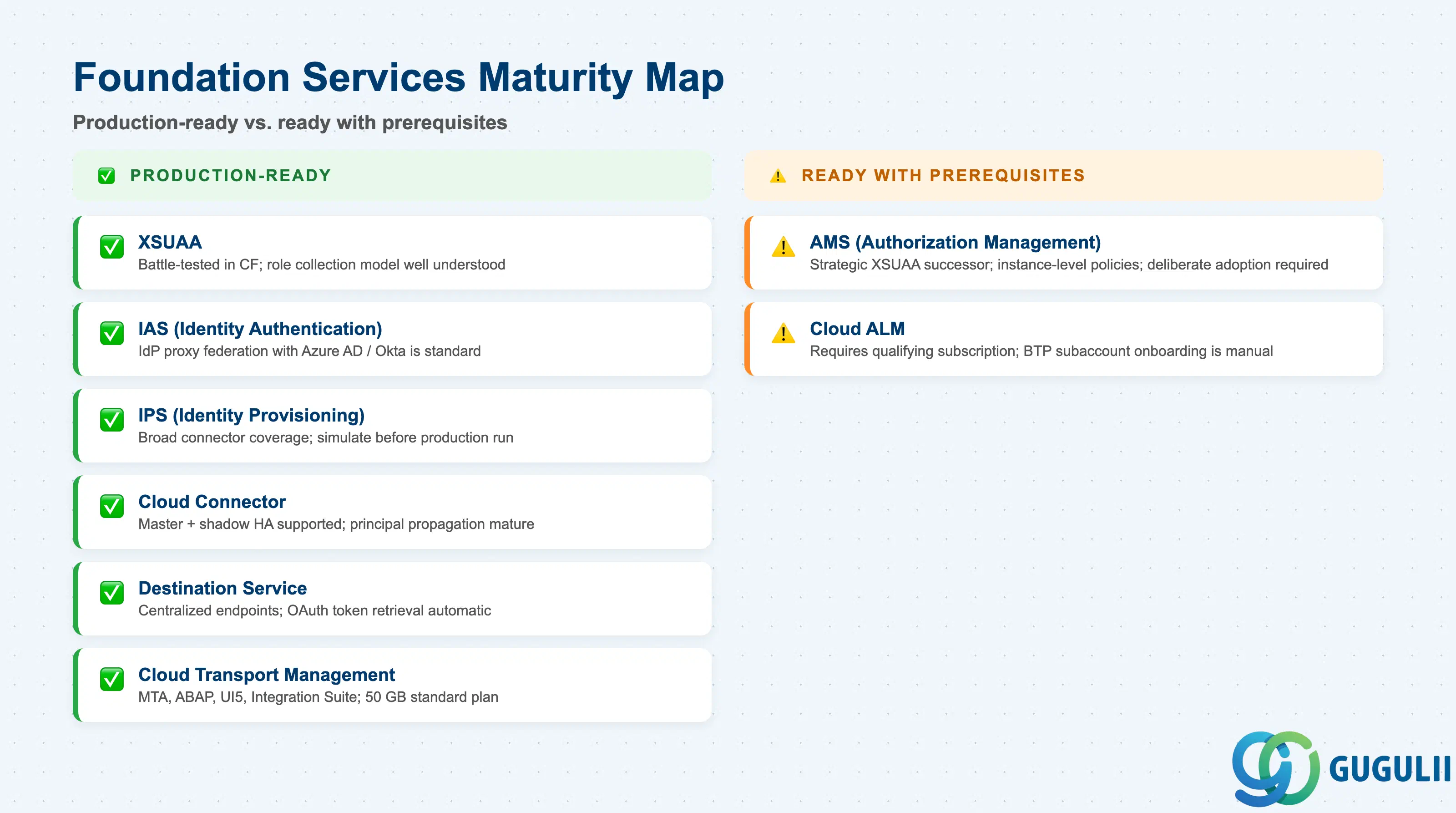
| Service | Maturity | Notes |
|---|---|---|
| XSUAA (Authorization & Trust Management) | ✅ Production-ready | Battle-tested in CF environments;
role collection model is well understood; static scope definitions in xs-security.json are the main design constraint |
| IAS (Identity Authentication Service) | ✅ Production-ready | Tenant entitlements are included with qualifying BTP global accounts; verify current terms with your SAP contract administrator; IdP proxy federation with Azure AD / Okta is a standard pattern |
| IPS (Identity Provisioning Service) | ✅ Production-ready | Broad connector coverage (Azure AD, S/4HANA Cloud, SuccessFactors, Ariba, BTP subaccounts); simulation/validation testing reduces provisioning risk |
| AMS (Authorization Management Service) | ⚠️ Ready with prerequisites | Strategic replacement for XSUAA authorization; instance-level policies are the key differentiator; requires deliberate adoption — existing XSUAA apps remain supported |
| Cloud Connector | ✅ Production-ready | Master + shadow HA is supported; principal propagation (X.509 forwarding) is mature; connector version compatibility should be validated per deployment |
| Destination Service | ✅ Production-ready | Centralized endpoint management; OAuth token retrieval handled automatically; complements Cloud Connector |
| Cloud ALM | ⚠️ Ready with prerequisites | Included with qualifying SAP cloud subscriptions; BTP health monitoring covers CF, ABAP, and Neo; onboarding a BTP subaccount requires deliberate configuration steps planned during project setup |
| Cloud Transport Management (cTMS) | ✅ Production-ready | Supports MTA, ABAP cloud objects, UI5, and Integration Suite content; 50 GB storage on standard plan; cross-region and cross-global-account transport supported |
| Checklist item | Why it matters |
|---|---|
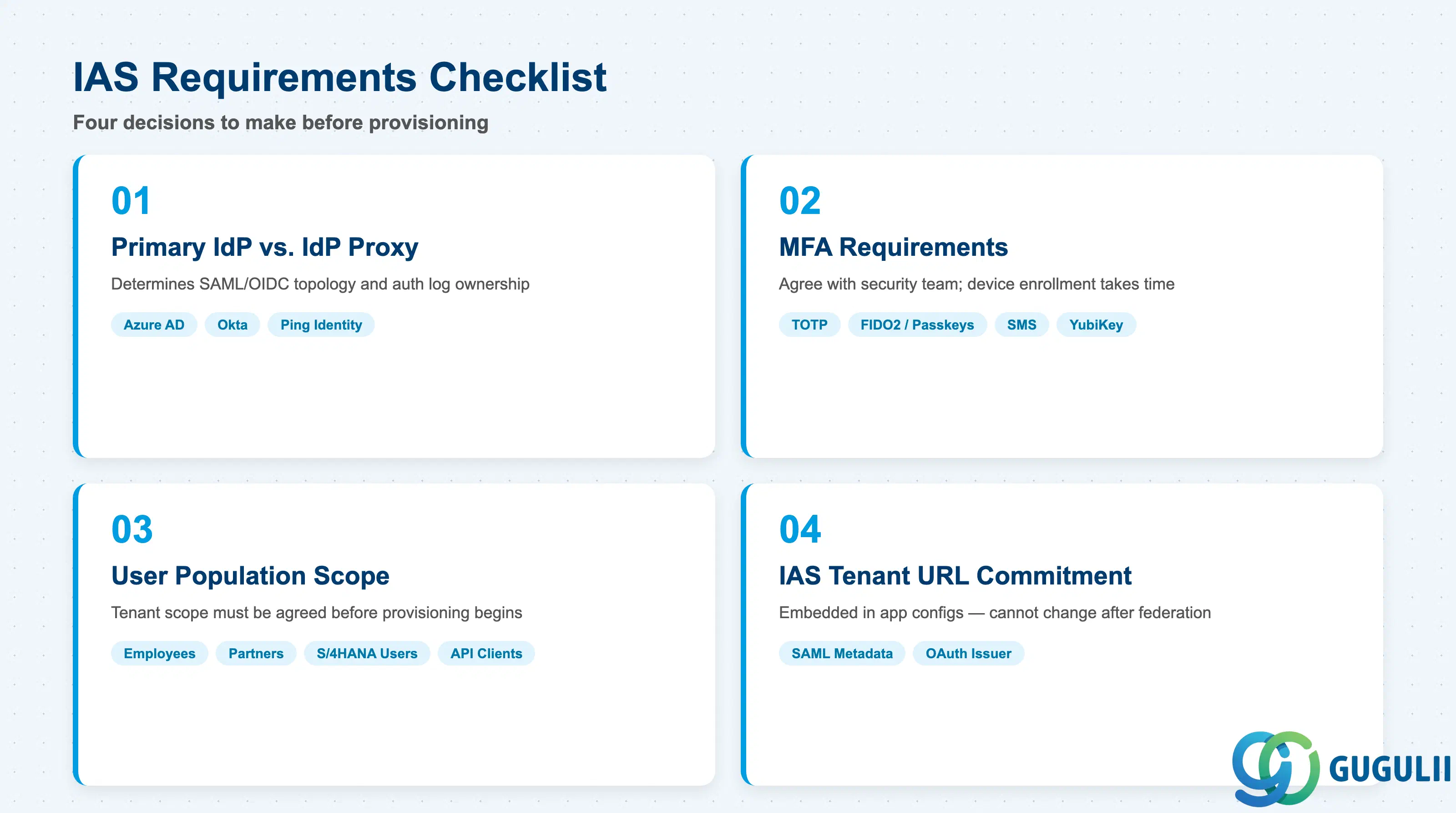
| Confirm whether IAS will act as primary IdP or as an IdP proxy to a corporate IdP (Azure AD, Okta, Ping Identity) | This choice determines the SAML/OIDC federation topology and who owns the authentication logs |
| Identify MFA requirements: TOTP, FIDO2/passkeys, SMS, YubiKey | MFA configuration requires advance agreement with the customer’s security team; some methods require device enrollment |
| Define which user populations need IAS accounts: employees, external partners, S/4HANA business users, API clients | IAS tenant scope must be agreed before provisioning begins — mixing populations without policy segmentation creates support complexity |
| Document risk-based authentication policy requirements (conditional access, concurrent session limits) | Risk-based authentication rules must be agreed with the customer’s CISO; implementing them post-go-live disrupts existing users |
| Confirm the IAS tenant URL that will appear in SAML metadata and OAuth token issuers | This URL is embedded in application configurations and cannot be changed after federation is established |
| Checklist item | Why it matters |
|---|---|
| Define the authoritative source system for user identities (IAS, Azure AD, HR system via SCIM) | IPS requires a single authoritative source per user population; conflicting sources cause provisioning conflicts and audit failures |
| Enumerate all target systems that need automated provisioning (BTP subaccounts, S/4HANA Cloud, SuccessFactors, Ariba, Concur) | Each target requires a configured IPS connector; missing a target means manual user management after go-live |
| Agree on deletion management policy: soft-delete (deactivate) vs. hard-delete when a user leaves | Accidental hard-deletes in production target systems are difficult to reverse; policy must be signed off by data governance stakeholders |
| Define transformation logic requirements: attribute mapping, conditional provisioning, group filtering | Transformation design requires understanding of both source and target schemas — allow time for design and simulation testing |
| Plan for simulation/validation testing before the first production provisioning job | Simulation prevents mass-provisioning errors; schedule this as a formal test milestone in the project plan |
| Checklist item | Why it matters |
|---|---|
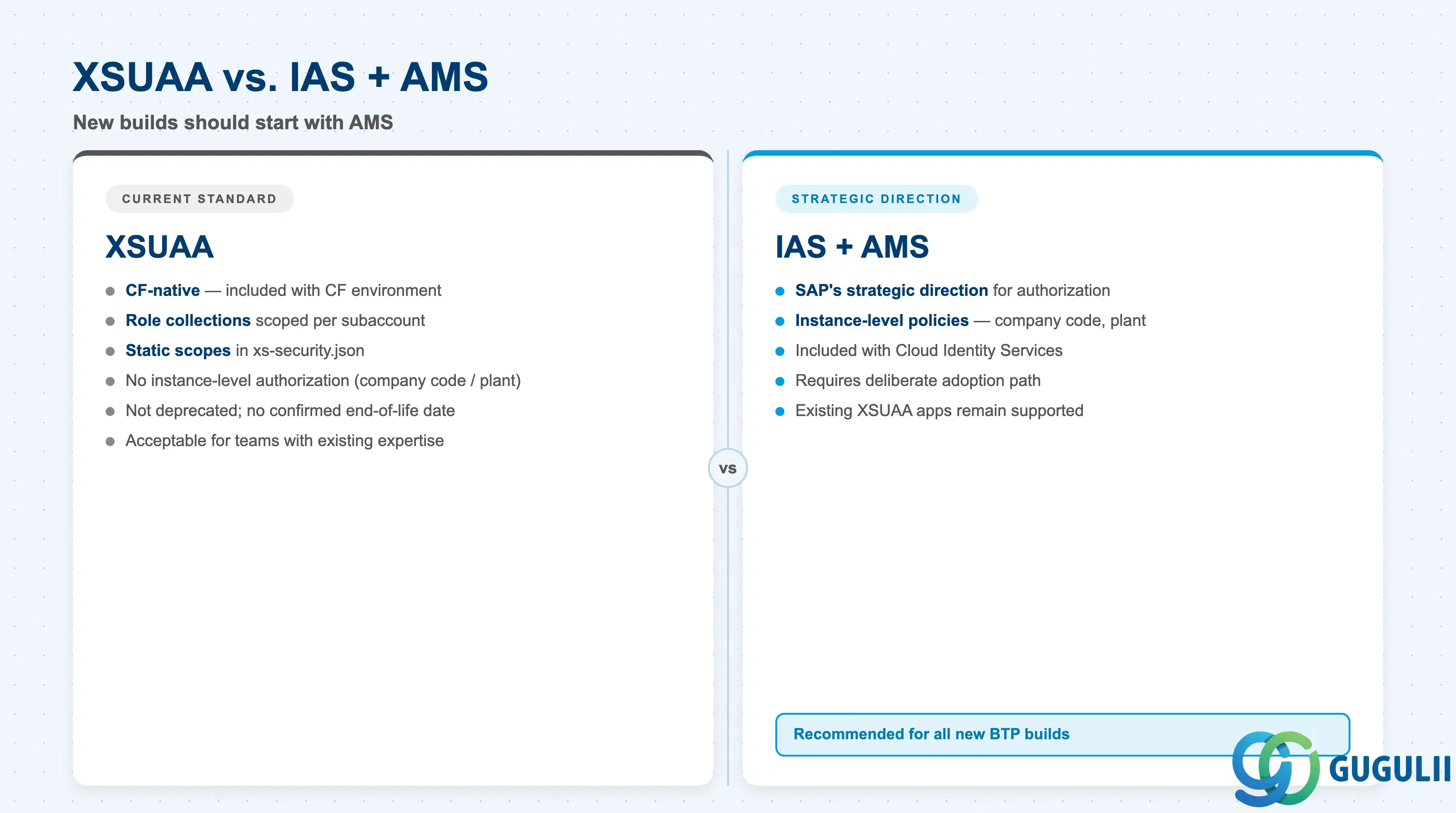
| Decide whether new BTP applications will use XSUAA role collections or adopt IAS + AMS from the start | SAP’s strategic direction is IAS + AMS; new applications should start with AMS to avoid future migration |
| Document all role collections required per subaccount and the business processes they gate | XSUAA role collections are scoped per subaccount; moving environments requires re-creating assignments |
| Identify whether instance-level authorization is required (access scoped to a specific company code or plant) | XSUAA’s static scope model cannot express instance-level authorization natively; this is the primary driver for AMS adoption |
Define the xs-security.json scope and role template design before development starts | Application scopes require a redeployment to change; late additions create CI/CD pipeline delays |
| Identify all service-to-service communication flows and the OAuth grant type to be used (Client Credentials, JWT Bearer Token) | Client credential secrets must be rotated; missing rotation schedules are a common audit finding |
| Checklist item | Why it matters |
|---|---|
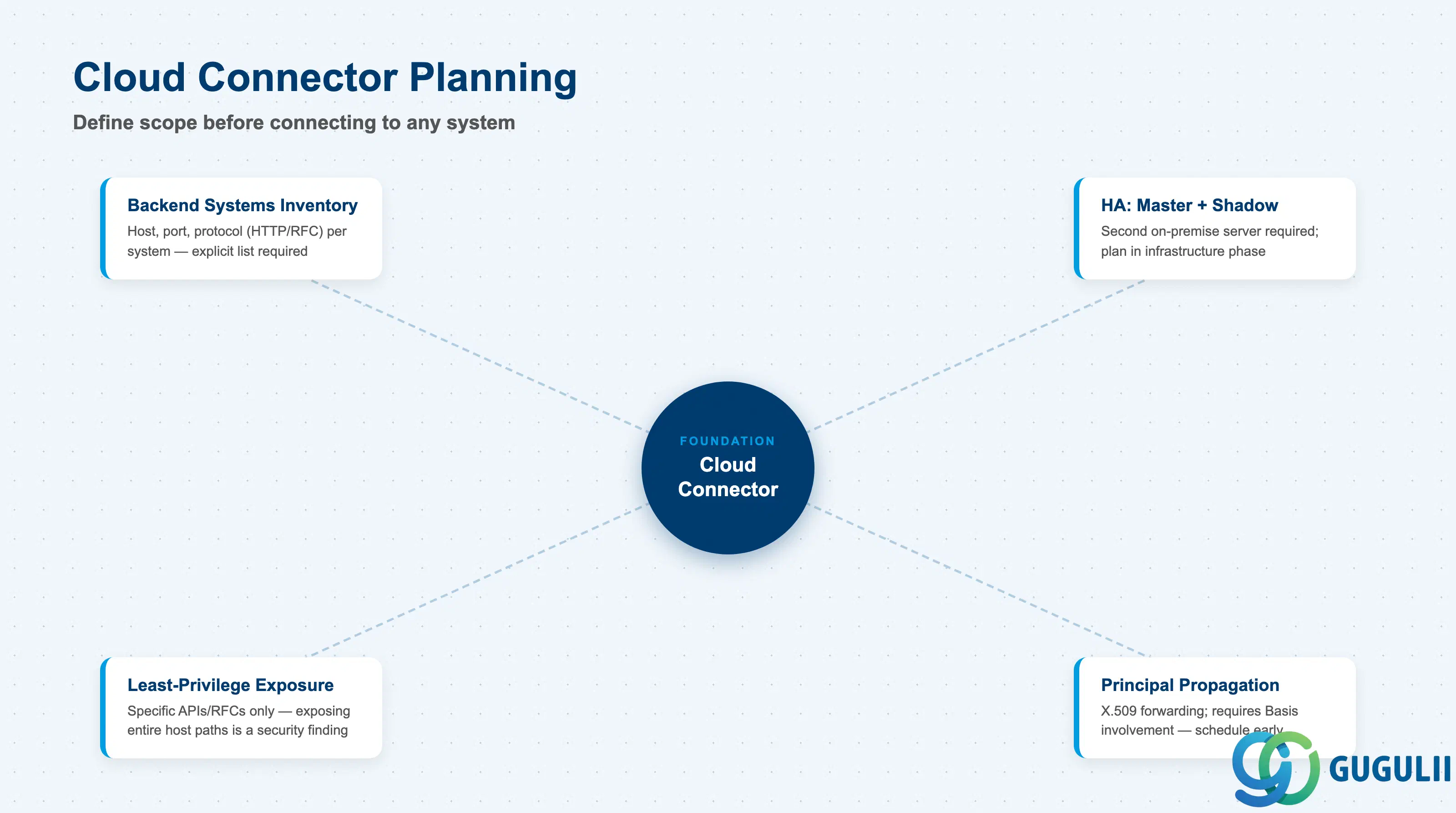
| Identify all on-premise backend systems BTP applications need to reach (host, port, protocol: HTTP/RFC) | Each system must be explicitly exposed in Cloud Connector; “connect to the whole network” is not the model |
| Determine HA requirements: master + shadow Cloud Connector configuration | Shadow instance requires a second on-premise server; must be included in infrastructure planning; one shadow per master maximum |
| Define which APIs and RFC function modules will be exposed, and confirm with the security team | Over-exposure (exposing entire host paths) is the most common Cloud Connector security misconfiguration |
| Confirm whether Principal Propagation is required (forwarding end-user identity to on-premise backend via X.509) | Principal Propagation requires certificate configuration on both BTP and ABAP sides (SM59, trust config); requires Basis involvement |
| Document all named Destination definitions (including auth type, proxy type, OAuth settings) | Undocumented destinations lead to configuration drift between environments |
| Checklist item | Why it matters |
|---|---|
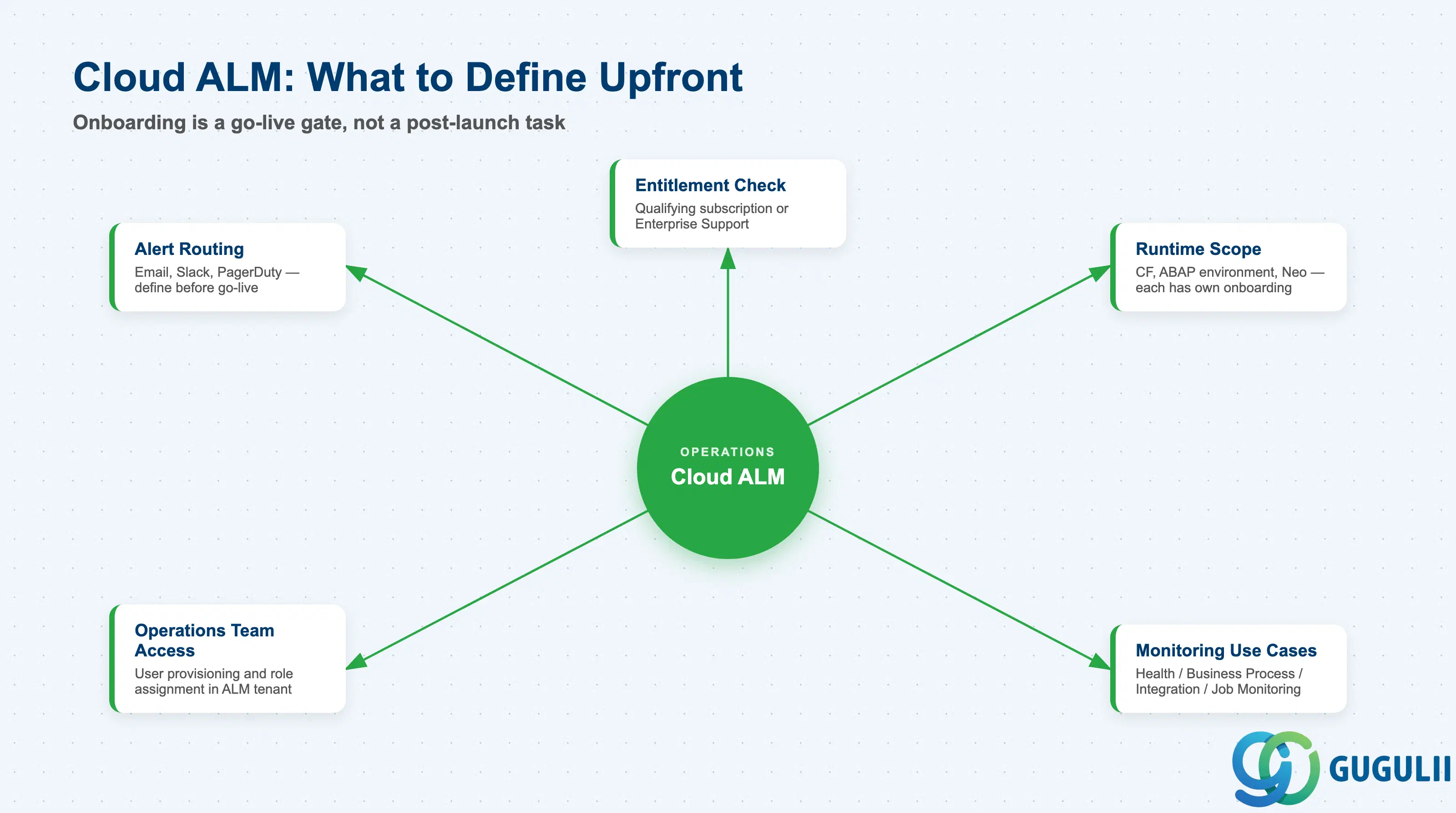
| Confirm the customer has a qualifying SAP cloud subscription or Enterprise Support agreement that entitles them to Cloud ALM | Cloud ALM is included at no additional cost with qualifying subscriptions; projects without this entitlement cannot use it |
| Identify which BTP runtimes (CF, ABAP environment, Neo) will be onboarded into Cloud ALM Health Monitoring | Each runtime type has its own onboarding procedure; missing a runtime creates blind spots in operational monitoring |
| Define which monitoring use cases are in scope at go-live: Business Process Monitoring, Integration & Exception Monitoring, Health Monitoring, Job Monitoring | Not all seven Cloud ALM monitoring use cases need to be active from day one; agree scope to avoid configuration sprawl |
| Identify the team responsible for Cloud ALM operations post go-live and document their access requirements | Cloud ALM requires its own user provisioning; operations team members need appropriate roles in the Cloud ALM tenant |
| Plan for Alert Notification Service configuration: who receives which alerts and via which channel (email, Slack, PagerDuty) | Alert routing must be defined before go-live; unrouted alerts mean incidents go undetected |
| Checklist item | Why it matters |
|---|---|
| Define the transport landscape: number of environments (DEV, QA, PROD), whether in the same global account or across multiple global accounts or regions | Cross-global-account transport requires additional authorization configuration; cross-region transport is supported but must be planned for |
| Enumerate all content types to be transported: MTA archives, ABAP cloud objects, UI5 apps, Integration Suite packages/iFlows | The full supported content-type list is maintained dynamically on the SAP Help Portal; confirm relevant types for the project |
| Define the CI/CD integration approach: SAP CI/CD service, Project Piper, or custom REST API pipelines | The choice of CI/CD toolchain determines how transport triggers are automated; custom REST API pipelines require more implementation effort |
| Confirm storage plan: standard (50 GB, 30-day artifact retention) vs. free tier (2 GB, 7-day retention) | Free-tier retention limits mean artifacts may expire before reaching production if the pipeline has manual approval gates |
| Define the transport approval workflow: who approves artifact promotion from QA to PROD | Uncontrolled promotion paths with no approval gate before PROD are a common audit finding in SAP change management reviews |
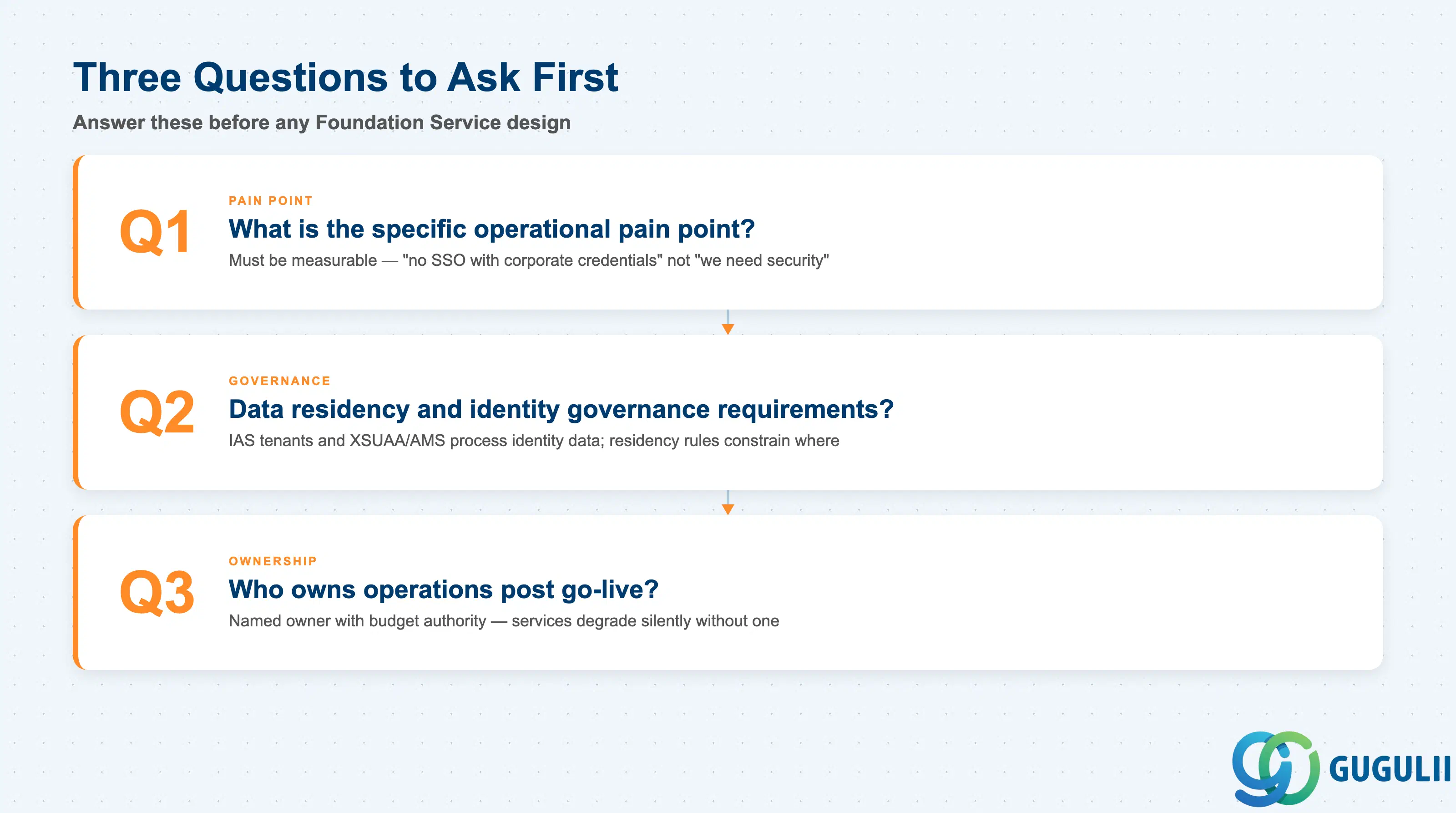
Q1. What is the specific operational pain point that Foundation Services configuration will solve?
The answer must be measurable. “We need security” is not a pain point — “end-users cannot log into the BTP extension using their corporate credentials” or “on-premise BAPI calls from the BTP app are failing because there is no secure tunnel” are pain points. Each Foundation Service maps to a specific operational need; projects that cannot articulate the need tend to over-configure or configure nothing until the last sprint.
Q2. What are the data residency and identity governance requirements for this deployment?
IAS tenants, Identity Directory, and XSUAA/AMS configurations store and process user identity data. Some customers have data residency requirements (EU data in EU regions only) or HR data classification rules that affect which IPS source systems can be used and where Cloud ALM telemetry is stored. These constraints must be identified before any Foundation Service is provisioned.
Q3. Who has budget authority and organizational responsibility for operating Foundation Services post go-live?
Foundation Services require ongoing administration — role collection reviews, IPS provisioning job monitoring, Cloud Connector version upgrades, Cloud ALM alert routing. If there is no named owner with budget authority, the services degrade silently. Confirm the internal sponsor and operating team before foundation design is finalized.
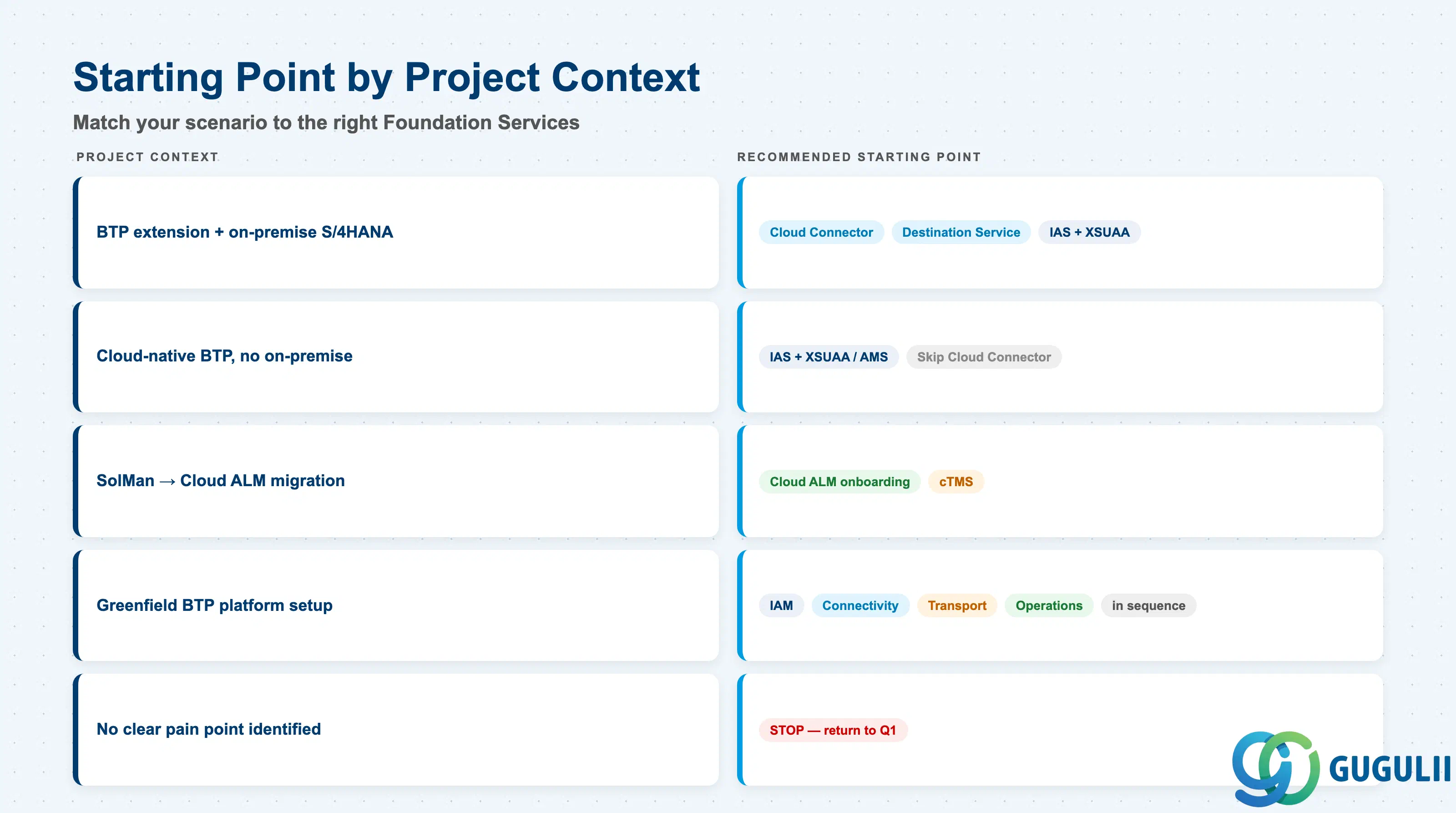
| Project context | Recommended starting point |
|---|---|
| BTP extension accessing on-premise S/4HANA APIs | Cloud Connector + Destination Service first; IAS + XSUAA for user authentication |
| New BTP application with no on-premise connectivity needed | IAS + XSUAA (or IAS + AMS for new builds); skip Cloud Connector |
| Customer migrating from SAP Solution Manager to cloud ALM | Cloud ALM onboarding; cTMS for transport if SAP Change Management is in scope |
| Greenfield BTP platform setup (first BTP project for the customer) | All four Foundation Service groups in sequence: IAM → Connectivity → Transport → Operations |
| Adding BTP to an existing SAP S/4HANA Cloud subscription | Verify IAS tenant entitlement with the customer’s SAP contract administrator; focus on IPS provisioning flows and BTP subaccount trust setup |
| No clear pain point identified yet | Stop. Go back to Q1. |
| Service | Licensing model | Key question to ask |
|---|---|---|
| IAS (Identity Authentication) | Included with qualifying BTP global accounts; additional tenant entitlements vary by contract — verify current terms on help.sap.com | Does the customer need more than one IAS tenant? (Multi-region or multi-brand scenarios may require this) |
| IPS (Identity Provisioning) | Bundled with Cloud Identity Services; provisioning volume limits apply at scale | What is the expected number of provisioned users and target systems? |
| XSUAA | Included with CF environment — no separate license | No separate licensing question; cost is absorbed into CF environment quota |
| AMS (Authorization Management) | Included with SAP Cloud Identity Services | Is the customer willing to adopt the AMS model for new applications, or will they stay on XSUAA for the project duration? |
| Cloud Connector | Free download; runs on customer-owned infrastructure | Who owns the server infrastructure? What HA tier is required? |
| Cloud ALM | Included at no additional cost with qualifying SAP cloud subscriptions and Enterprise Support | Does the customer’s current contract include the qualifying subscription? |
| Cloud Transport Management | Subscription-based (standard: 50 GB; free tier: 2 GB) | Is free tier adequate for the expected artifact volume and retention window, or is the standard plan required? |
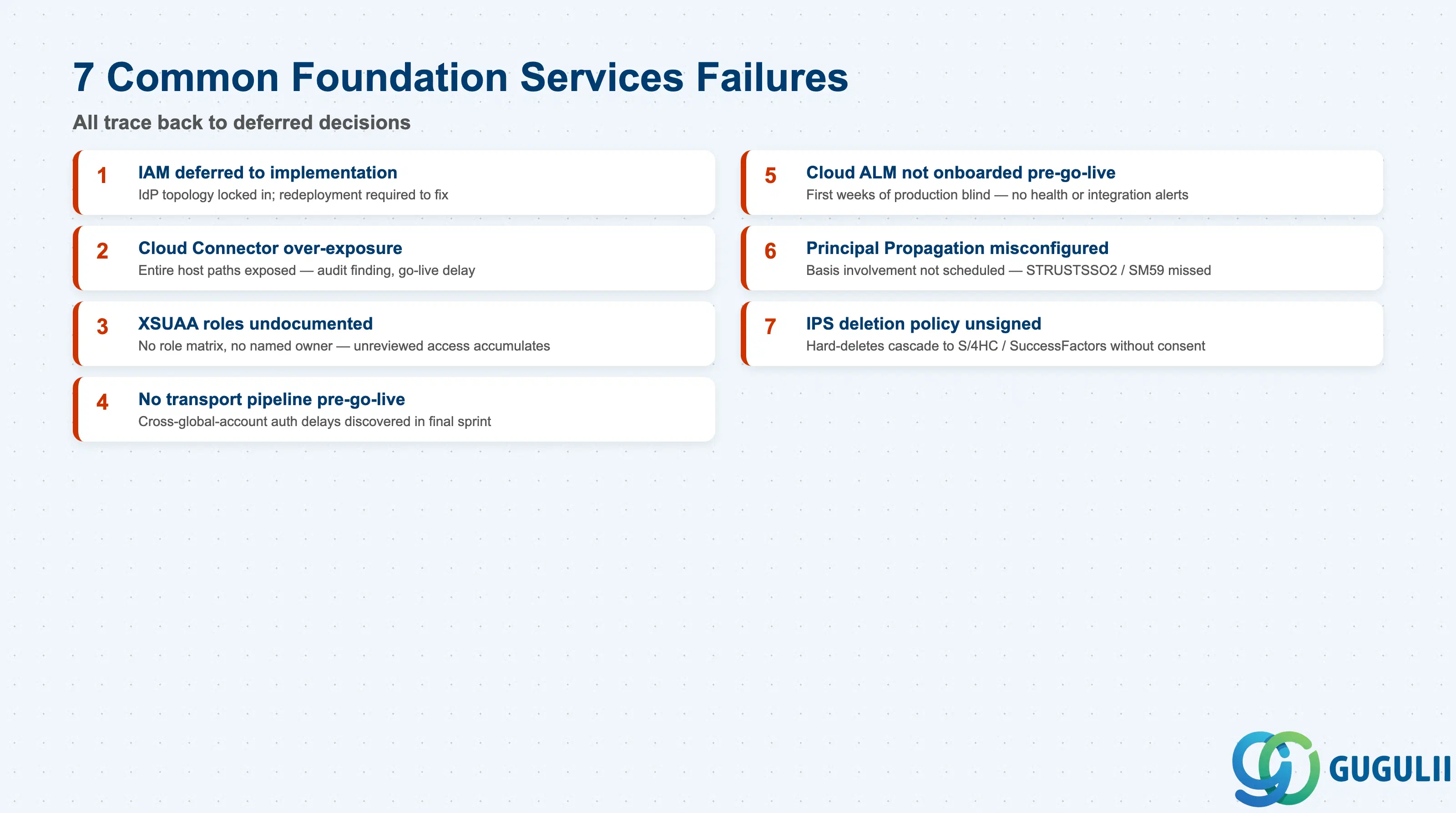
Failure 1: IAM design deferred to implementation phase
The most common Foundation Services failure is treating identity and access management as a configuration task rather than an architectural decision. Teams defer IAS/XSUAA/AMS design until after the application is built and then discover that the IdP federation topology, role model, or token issuer URL cannot be changed without redeployment. IAM design must be completed — and approved by the customer’s security team — before the first sprint of application development begins.
Failure 2: Cloud Connector scope over-exposure
Security teams reviewing Cloud Connector configurations routinely find that entire host paths have been exposed rather than specific API endpoints or RFC function modules. This violates the principle of least privilege and creates audit findings that delay go-live. The exposure list must be reviewed and approved by the customer’s security architect before the Cloud Connector is connected to any non-development system.
Failure 3: XSUAA role collections undocumented and unowned
Projects that go live without a documented role collection matrix and an assigned administrative owner per subaccount accumulate unreviewed access over time. The requirements phase must produce a role collection design document with named owners, and the handover to operations must include a formal review step.
Failure 4: No transport pipeline until the week before go-live
cTMS transport route design is consistently underestimated. Teams build the DEV → QA → PROD promotion path in the final sprint, discover that cross-global-account transport requires additional authorization involving the customer’s SAP contract administrator, and delay go-live. cTMS transport landscape design must be done in the first quarter of the project, not the last.
Failure 5: Cloud ALM not onboarded until post go-live
Cloud ALM onboarding is treated as an “operations task” that can be done after the application is live. The result is that the first weeks of production operation are blind — no health monitoring, no integration exception alerts, no business process visibility. Cloud ALM onboarding for all in-scope runtimes should be a go-live gate criterion.
Failure 6: Principal Propagation misconfigured for on-premise ABAP
Principal Propagation — forwarding the BTP end-user’s identity to the on-premise ABAP backend via X.509 certificates — is frequently scoped during requirements but never implemented correctly because the ABAP side configuration (STRUSTSSO2, SM59, certificate trust) requires Basis involvement that is not scheduled. Basis resource availability for this configuration must be confirmed as a project dependency during requirements.
Failure 7: IPS deletion policy not agreed before provisioning goes live
IPS can hard-delete user records in target systems when a source-side deletion event occurs. If the deletion management policy is not explicitly agreed with the customer’s data governance team before production provisioning jobs run, IPS may cascade a hard-delete to SAP S/4HANA Cloud or SuccessFactors — removing transaction history and audit trail. Deletion policy approval must be a formal sign-off item during requirements.
Q: Are Foundation Services relevant for customers using SAP BTP for cloud-native applications with no on-premise connectivity?
Yes. Even a purely cloud-native BTP deployment requires IAS for user authentication, XSUAA or AMS for application authorization, and Cloud Transport Management for promoting application artifacts through environments. Cloud Connector is the only Foundation Service that is genuinely optional when there are no on-premise backends.
Q: What is the licensing position for Foundation Services — do they require a separate purchase?
Most Foundation Services are bundled with SAP BTP accounts or qualifying SAP cloud subscriptions and Enterprise Support agreements. Cloud ALM is included at no additional cost with qualifying subscriptions. XSUAA and CF environment entitlements are included with the CF environment quota. Cloud Transport Management requires a subscription (standard or free tier). Cloud Connector is a free download that runs on customer-owned infrastructure. IAS tenant entitlements are included with qualifying BTP global accounts; verify the specific terms with your SAP contract administrator.
Q: When should we descope Foundation Services from a project?
Descope Cloud Connector when there are no on-premise backend systems in scope. Descope Cloud ALM when the customer’s contract does not include the qualifying subscription and there is no budget to add it — but document this as an operations risk. Do not descope IAS, XSUAA/AMS, or cTMS from any BTP project that will go to production; these are non-negotiable for a production-grade deployment.
Q: Is XSUAA being deprecated? Should we still use it for new projects?
XSUAA is not deprecated and there is no publicly confirmed end-of-life date as of 2026-05-12. SAP’s stated strategic direction is to migrate authorization from XSUAA to IAS + AMS, and SAP recommends that new applications adopt IAS + AMS from the start. For new BTP projects, the recommended starting point for authorization is IAS + AMS; XSUAA is acceptable if the customer’s BTP team has existing expertise and the authorization model does not require instance-level policies.
Q: How should requirements for Foundation Services be documented?
Foundation Services requirements should be captured in the project’s architecture decision record (ADR) or equivalent documentation, covering: (1) IAM topology — IdP federation diagram, role model, token issuers; (2) Connectivity map — all on-premise systems, exposed resources, Destination definitions; (3) Transport landscape — node topology, approval workflow, CI/CD integration; (4) Operations scope — which Cloud ALM use cases are in scope and who owns them. These four documents should be produced during the requirements phase and approved before detailed design begins.
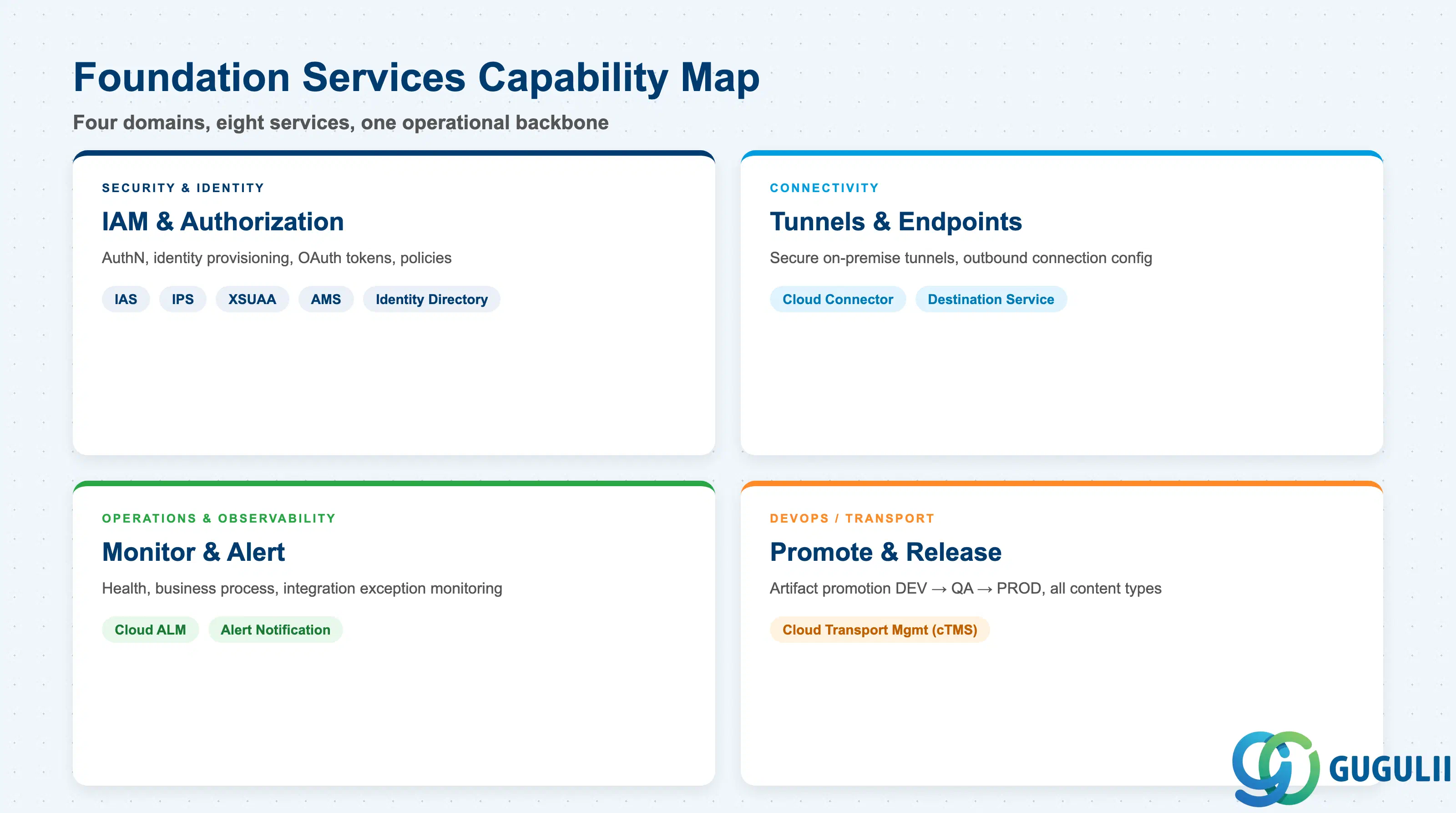
Foundation Services are not a single product — they are the operational backbone of every SAP BTP deployment. The capability map groups them into four areas: Security & Identity (IAS, IPS, XSUAA, AMS), Connectivity (Cloud Connector, Destination Service), Operations (Cloud ALM, Alert Notification), and DevOps (Cloud Transport Management). Each group has distinct requirements that must be addressed during the project’s requirements phase. The most expensive mistakes in BTP projects — delayed go-lives, security audit findings, untraceable user access — trace back to Foundation Services decisions that were deferred until implementation. The articles that follow in this series drill into each capability in depth.