Title here
Summary here

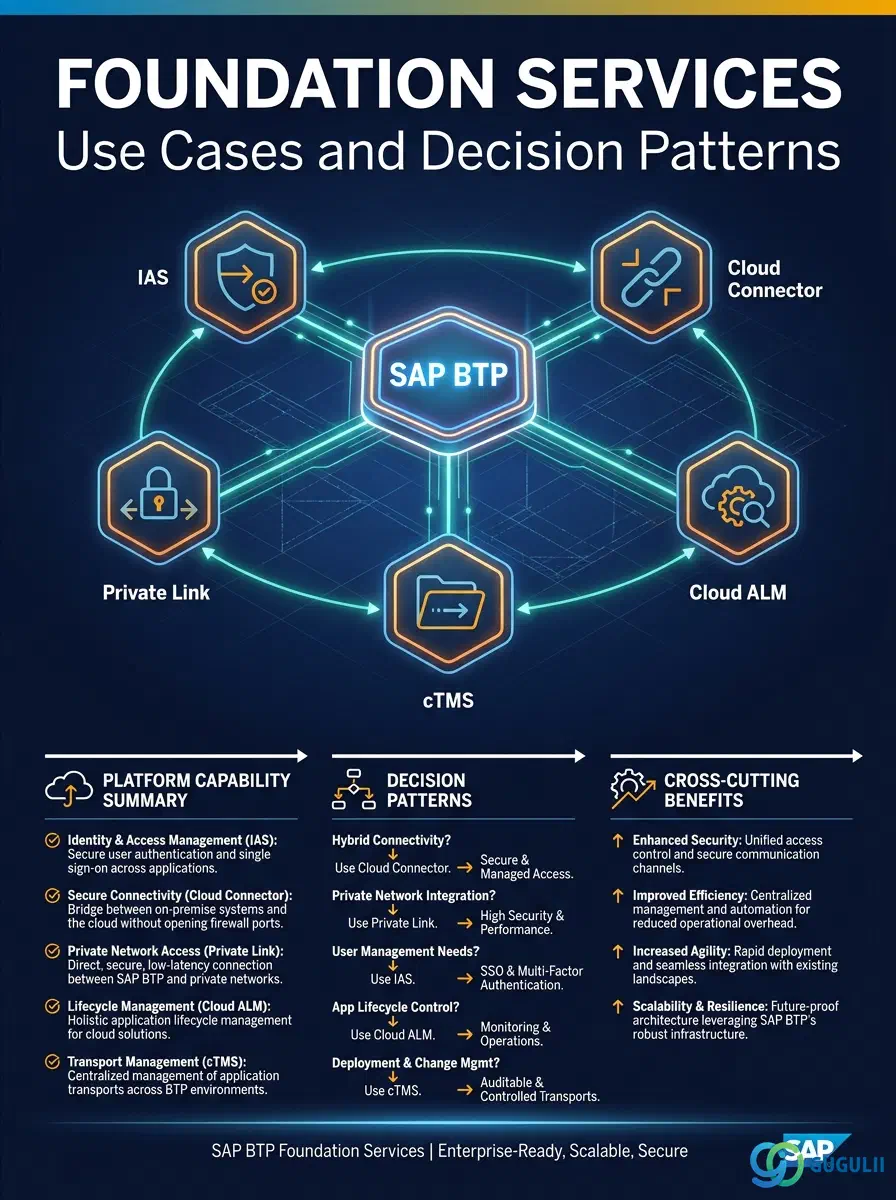
| ID | Category | Component | Scope |
|---|---|---|---|
| BTP-E01 | Overview | Foundation Services | Overview and Capability Map |
| BTP-E02 | Security | Identity and Access Management | Architecture and Use |
| BTP-E03 | Connectivity | Cloud Connector | Architecture and Use |
| BTP-E04 | Connectivity | Private Link | Architecture and Use |
| BTP-E05 | Operations | Cloud ALM | Architecture and Use |
| BTP-E06 | DevOps | Cloud Transport Management | Architecture and Use |
| BTP-E07 | Decision | Foundation Services | Use Cases and Decision Patterns (this article) |
| Resource | URL |
|---|---|
| SAP BTP Foundation Services — Learning | learning.sap.com → |
| Cloud Connector — SAP Help Portal | help.sap.com → |
| SAP Private Link Service — SAP Help Portal | help.sap.com → |
| SAP Cloud ALM — Support Portal | support.sap.com → |
| Cloud Transport Management FAQ — SAP Community | community.sap.com → |
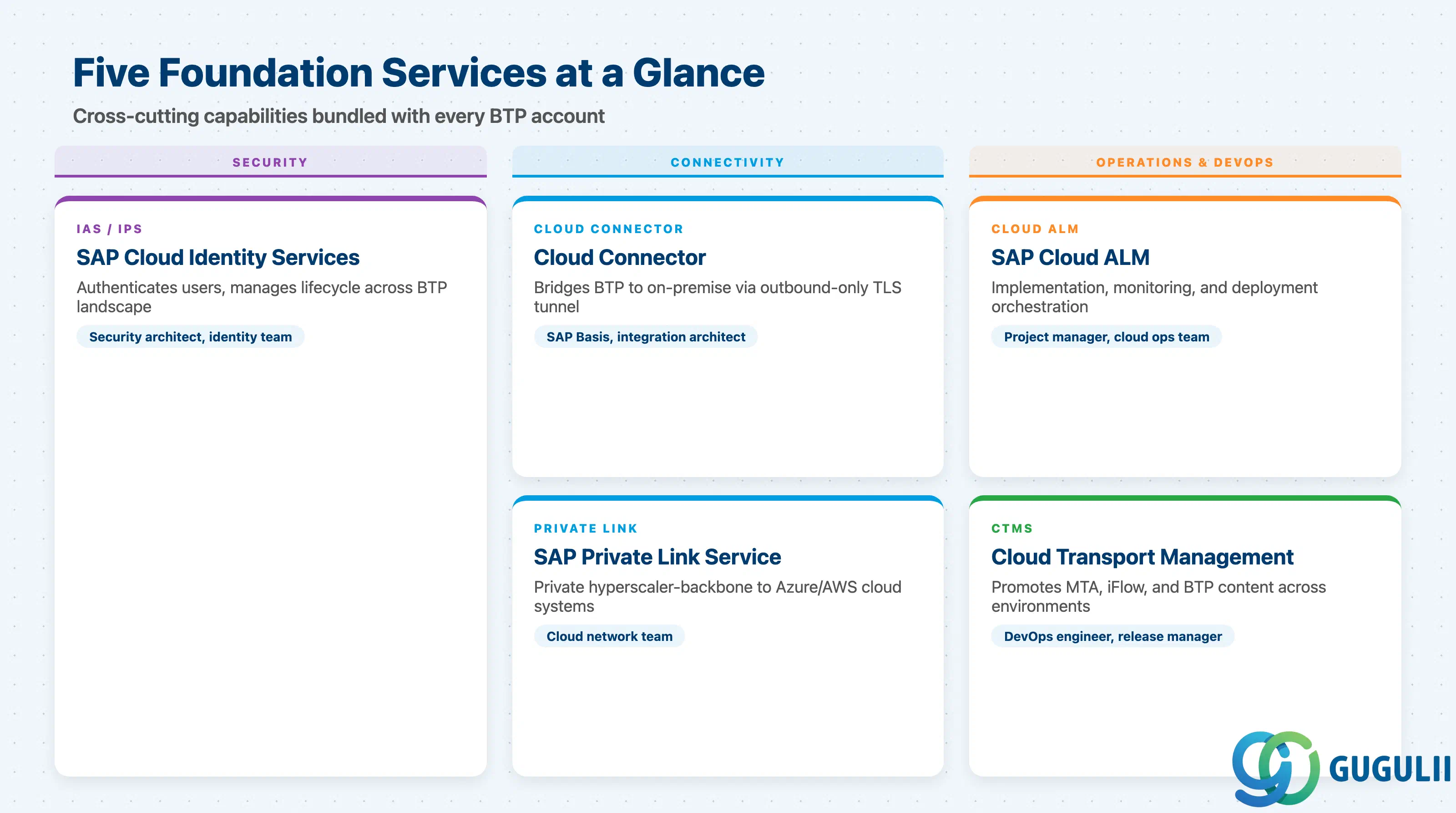
According to SAP’s BTP Solution Architect learning path, Foundation Services are “a collection of essential, cross-cutting services that provide the fundamental capabilities required to run, manage, secure, and extend all applications and services on the platform.” They are bundled with every SAP BTP account and are not separate subscriptions.
| Service | What it does | Primary user |
|---|---|---|
| SAP Cloud Identity Services (IAS/IPS) | Authenticates users and manages user lifecycle across the BTP landscape | Security architect, IT identity team |
| Cloud Connector | Bridges BTP applications to on-premise systems over an outbound-only TLS tunnel | SAP Basis, integration architect |
| SAP Private Link Service | Establishes private hyperscaler-backbone connections between BTP and cloud-hosted systems | Cloud network team, integration architect |
| SAP Cloud ALM | Manages implementation projects, monitors operations, and orchestrates deployment for cloud landscapes | Project manager, cloud operations team |
| SAP Cloud Transport Management (cTMS) | Controls promotion of MTA archives, iFlows, and other BTP content across subaccount landscapes | DevOps engineer, release manager |
They are not substitutes. Each service addresses a different concern; a production BTP landscape typically requires all five operating in coordination.
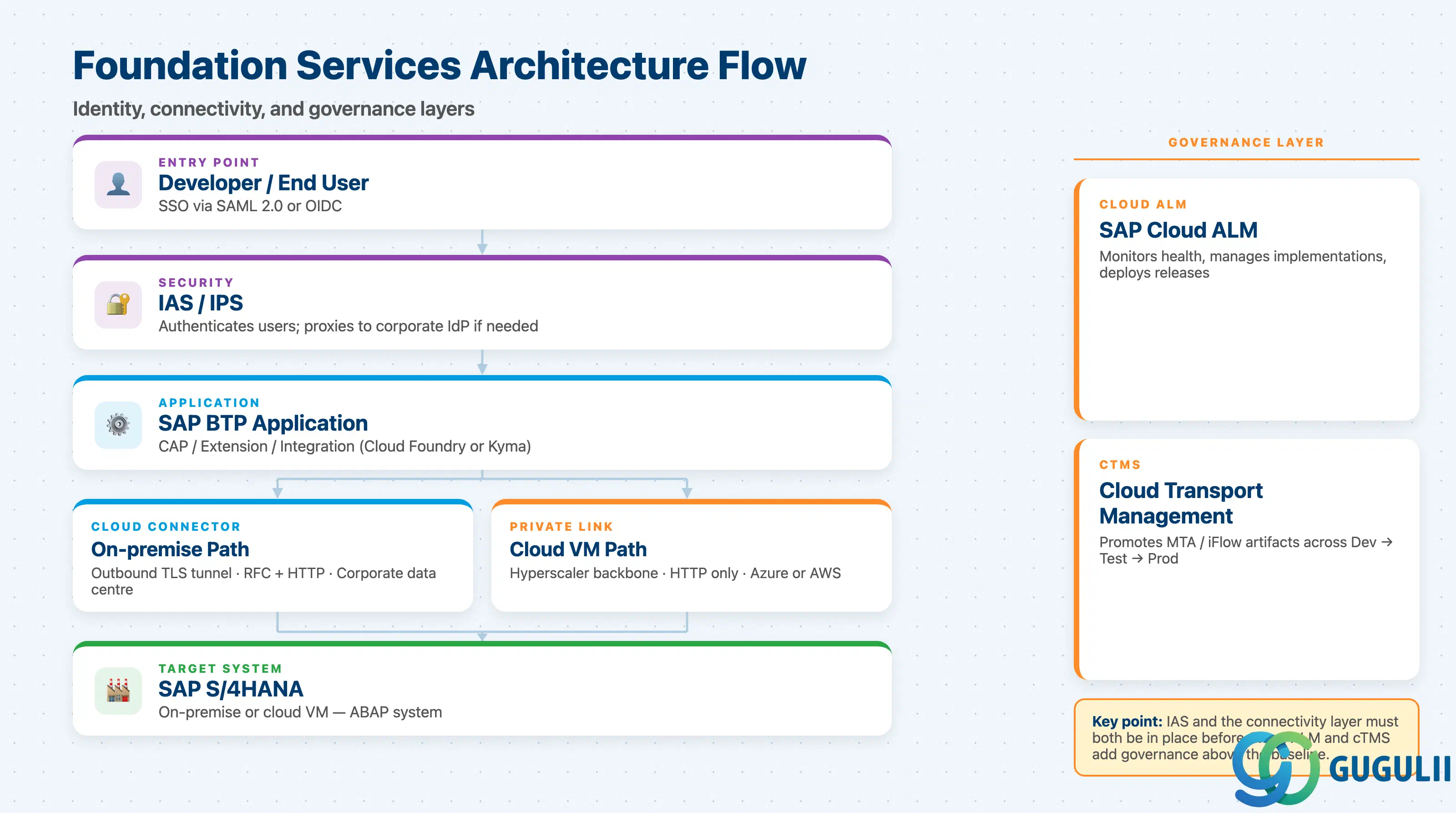
Foundation Services surround S/4HANA as enablers — they handle authentication, network path, content promotion, and operational visibility that make BTP-to-S/4HANA integration possible and governable. The SAP Architecture Center reference confirms that SAP Destination Service is always involved regardless of whether Cloud Connector or Private Link provides the network path.
  Developer / End User
         |
         | (SSO via SAML/OIDC)
         v
  ┌─────────────┐
  │  IAS / IPS  │ ← authenticates users; proxies to corporate IdP if needed
  └──────┬──────┘
         |
         v
  ┌─────────────────────────────────────┐
  │         SAP BTP Application         │
  │  (CAP / Extension / Integration)   │
  └──────────────────┬──────────────────┘
                     |
          ┌──────────┴──────────┐
          |                     |
          v                     v
  ┌──────────────┐     ┌──────────────────┐
  │Cloud Connector│     │ Private Link Svc │
  │(on-premise,   │     │(Azure/AWS VM,    │
  │RFC + HTTP)    │     │HTTP only)        │
  └──────┬───────┘     └────────┬─────────┘
         |                      |
         v                      v
  ┌──────────────────────────────┐
  │    SAP S/4HANA (ABAP system) │
  │  on-premise or cloud VM      │
  └──────────────────────────────┘
         ^
         |
  ┌──────────────────────────────┐
  │  Cloud ALM                   │ ← monitors health, deploys releases
  │  + cTMS                      │ ← promotes MTA/iFlow artifacts
  └──────────────────────────────┘
Key point: IAS and the connectivity layer (Cloud Connector or Private Link) must both be in place before a BTP application can authenticate users and reach S/4HANA. Cloud ALM and cTMS operate above this baseline to govern how and when changes are deployed.
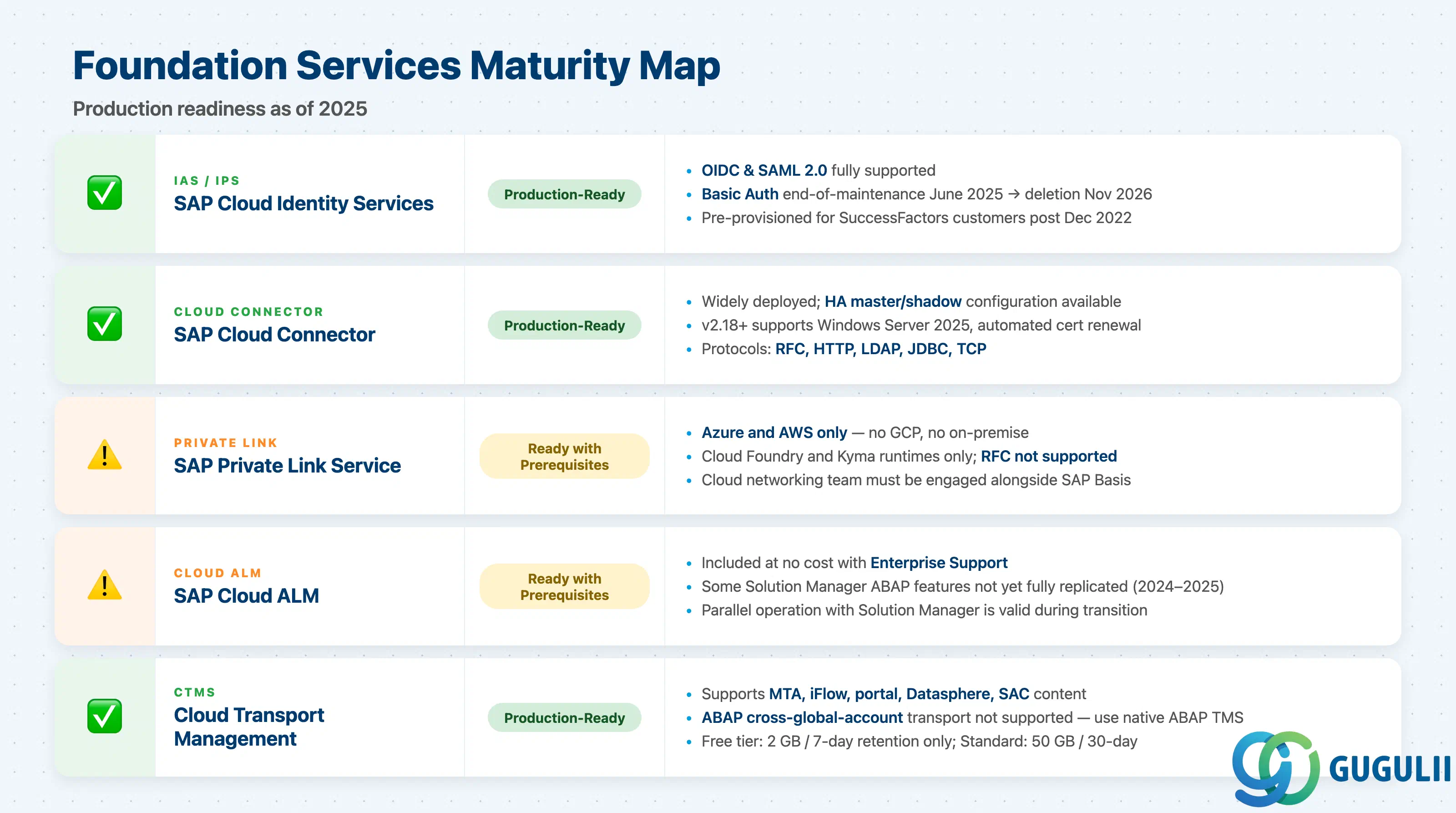
The table below reflects publicly documented capabilities and known limitations as of 2025. Consult the SAP Help Portal for Cloud Connector and Private Link for current version details.
| Service | Maturity | Notes |
|---|---|---|
| SAP Cloud Identity Services (IAS/IPS) | ✅ Production-ready | OIDC and SAML 2.0 fully supported; IAS/IPS are pre-provisioned for customers using SuccessFactors post Dec 2022. Basic Authentication end-of-maintenance June 2025; planned deletion November 2026. |
| Cloud Connector | ✅ Production-ready | Widely deployed; HA master/shadow configuration available. Version 2.18+ supports Windows Server 2025 and automated certificate renewal. RFC, HTTP, LDAP, JDBC, TCP all supported. |
| SAP Private Link Service | ⚠️ Ready with prerequisites | Production-ready for Azure and AWS only; Cloud Foundry and Kyma runtimes only; RFC not supported. Teams must engage cloud networking alongside SAP Basis. |
| SAP Cloud ALM | ⚠️ Ready with prerequisites | Included at no additional cost with Enterprise Support. Some Solution Manager deep-dive functionalities not yet fully replicated as of 2024–2025. Parallel operation with Solution Manager is valid during transition. |
| SAP Cloud Transport Management (cTMS) | ✅ Production-ready | MTA, iFlow, portal, Datasphere, and SAC content all supported. ABAP content cannot be transported across global accounts — use native ABAP TMS for that path. Free tier limited to 2 GB / 7-day retention. |
For full IAS/IPS capability reference, see SAP Cloud Identity Services on SAP Community.
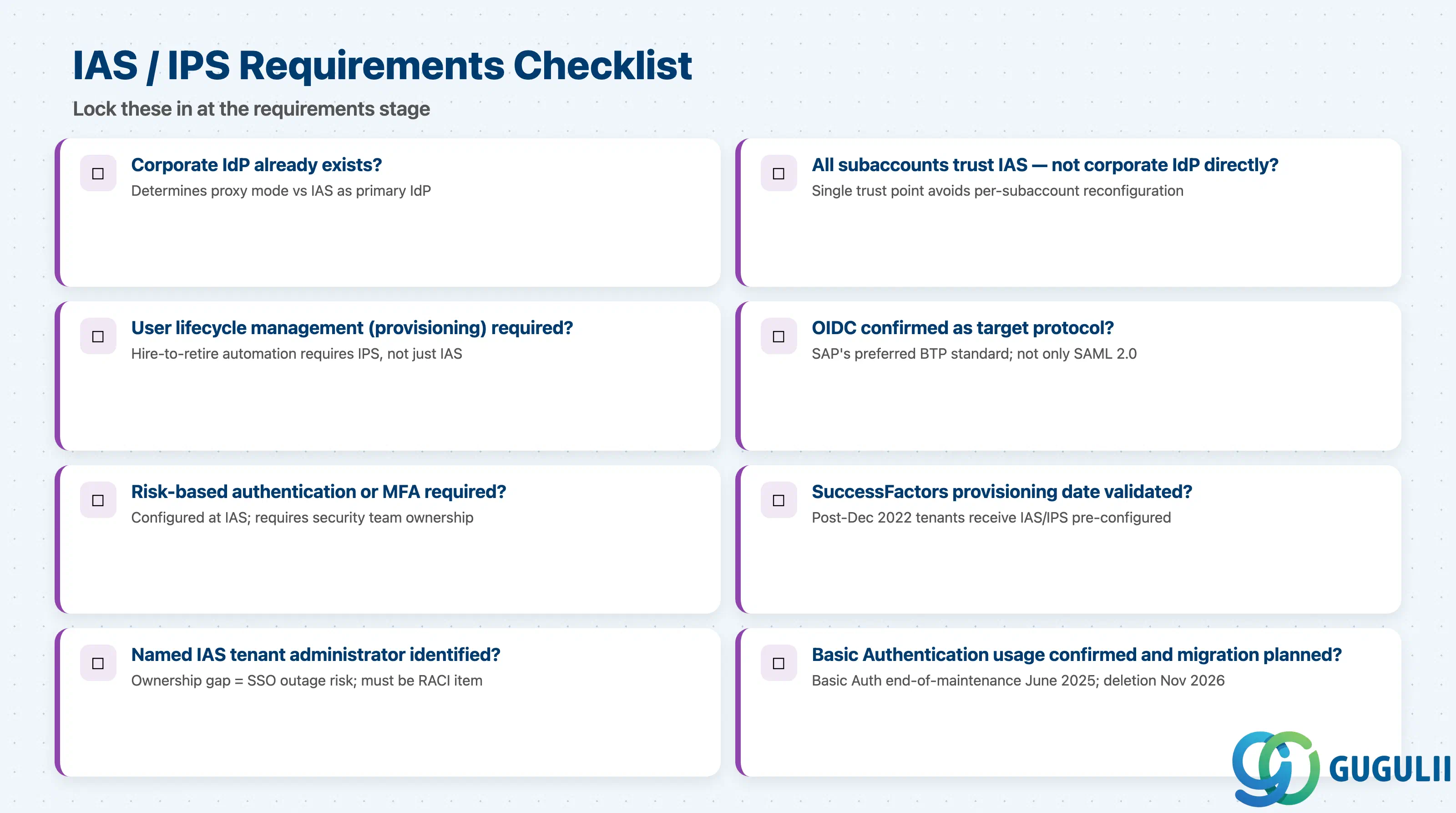
| Checklist item | Why it matters |
|---|---|
| Identify whether a corporate IdP (Entra ID, Okta, Google Workspace) already exists | Proxy vs. primary IdP mode decision. |
| Confirm all BTP subaccounts will trust IAS — not the corporate IdP directly | Single trust point; avoids per-subaccount reconfiguration. |
| Determine whether user lifecycle management (provisioning/deprovisioning) is required | Automated hire-to-retire requires IPS, not just IAS. |
| Confirm OIDC is the target protocol (not only SAML 2.0) | OIDC is SAP’s preferred BTP standard. |
| Check whether risk-based authentication or MFA is required | Configured at IAS; requires security team ownership. |
| Validate SuccessFactors provisioning date (if applicable) | Post-Dec 2022 tenants receive IAS/IPS pre-configured. |
| Document who owns IAS tenant administration | Ownership gap = SSO outage risk; RACI item. |
| Confirm Basic Authentication is not currently relied upon for any SAP integration | Basic Auth end-of-maintenance June 2025; migration scope required. |
For installation and configuration requirements, see Cloud Connector on the SAP Help Portal.
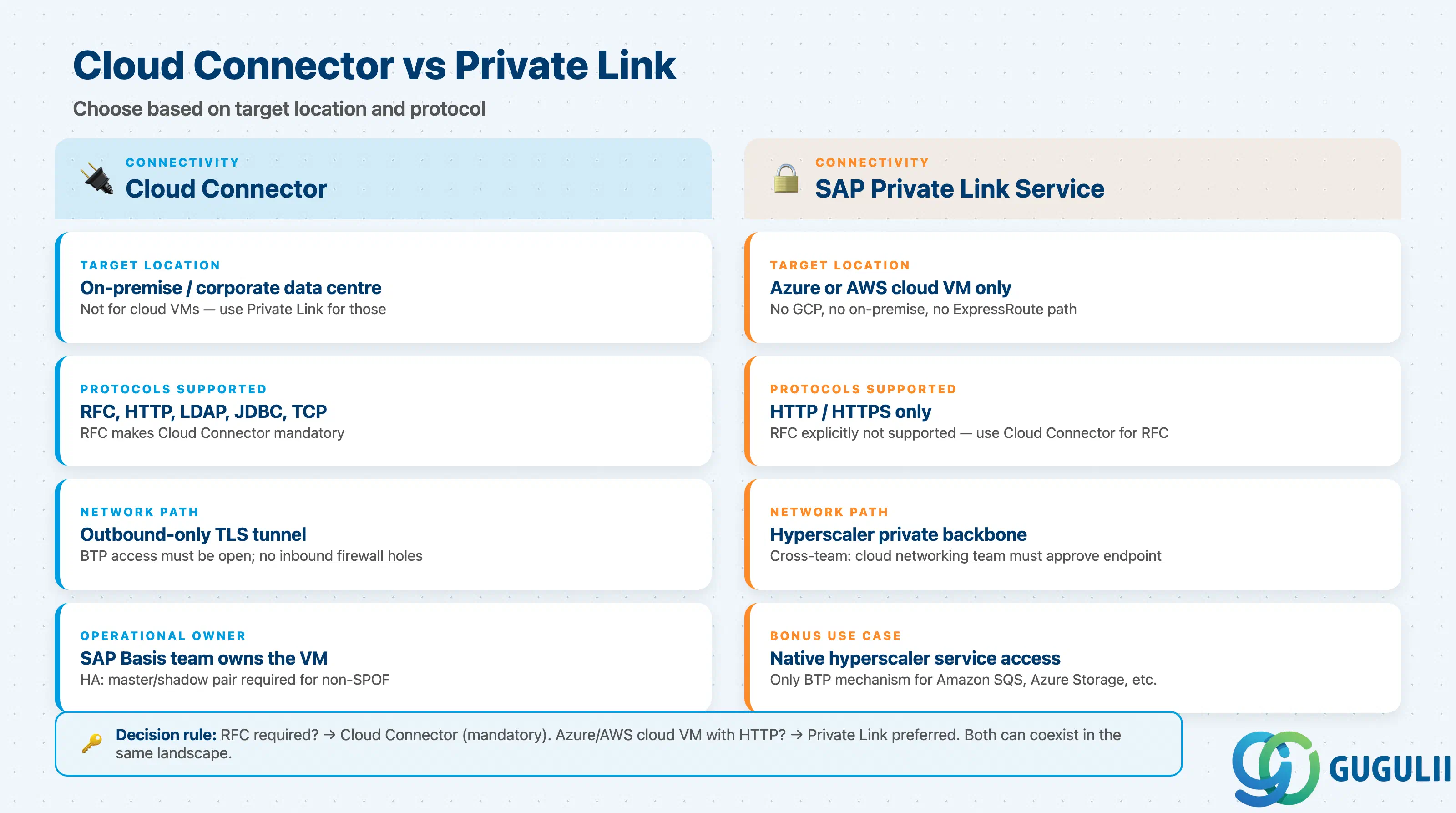
| Checklist item | Why it matters |
|---|---|
| Confirm target systems are on-premise or in a corporate data centre (not cloud VMs) | Cloud VMs should use Private Link instead. |
| Verify RFC is required for any integration scenario | RFC makes Cloud Connector mandatory; Private Link cannot handle it. |
| Confirm outbound HTTPS from the Cloud Connector host is unblocked | Outbound-only tunnel; BTP access must be open. |
| Identify the target host and port mappings (virtual host to internal host) | Core configuration artifact; must be defined at requirements stage. |
| Confirm SAP Basis team ownership and operational runbook | Basis owns patching and HA for the on-premise VM. |
| Assess whether High Availability (HA) is required | Single node = connectivity SPOF; HA needs master/shadow pair. |
| Confirm supported protocol for each integration point | HTTP, RFC, LDAP, JDBC, TCP — each must be mapped explicitly. |
| Validate internal network segmentation will permit Cloud Connector to reach target systems | Internal firewalls can block connector-to-ERP traffic. |
Full prerequisites and supported configurations are documented on the SAP Private Link Service Help Portal page.
| Checklist item | Why it matters |
|---|---|
| Confirm target system runs on Azure or AWS (not on-premise, not GCP) | GCP and on-premise require Cloud Connector instead. |
| Confirm BTP runtime is Cloud Foundry or Kyma | Neo and ABAP environment not supported. |
| Verify RFC is NOT required | Private Link is HTTP/HTTPS only; RFC must use Cloud Connector. |
| Identify the cloud networking team for approving private endpoint connections | Cross-team dependency; endpoint creation needs Azure/AWS approval. |
| Confirm network peering or VPC/VNet configuration is in scope | Region alignment required for endpoint routing. |
| Check whether native hyperscaler service access (e.g., Amazon SQS, Azure Storage) is in scope | Only BTP mechanism for hyperscaler-native-service connectivity. |
| Confirm Private Link pricing is budgeted | Rates require commercial confirmation; not publicly documented per GB. |
| Establish who maintains Private Link service instances when the target system moves | Target migration forces new instance creation. |
Cloud ALM entitlement and base tier limits are documented on the SAP Cloud ALM Support Portal page.
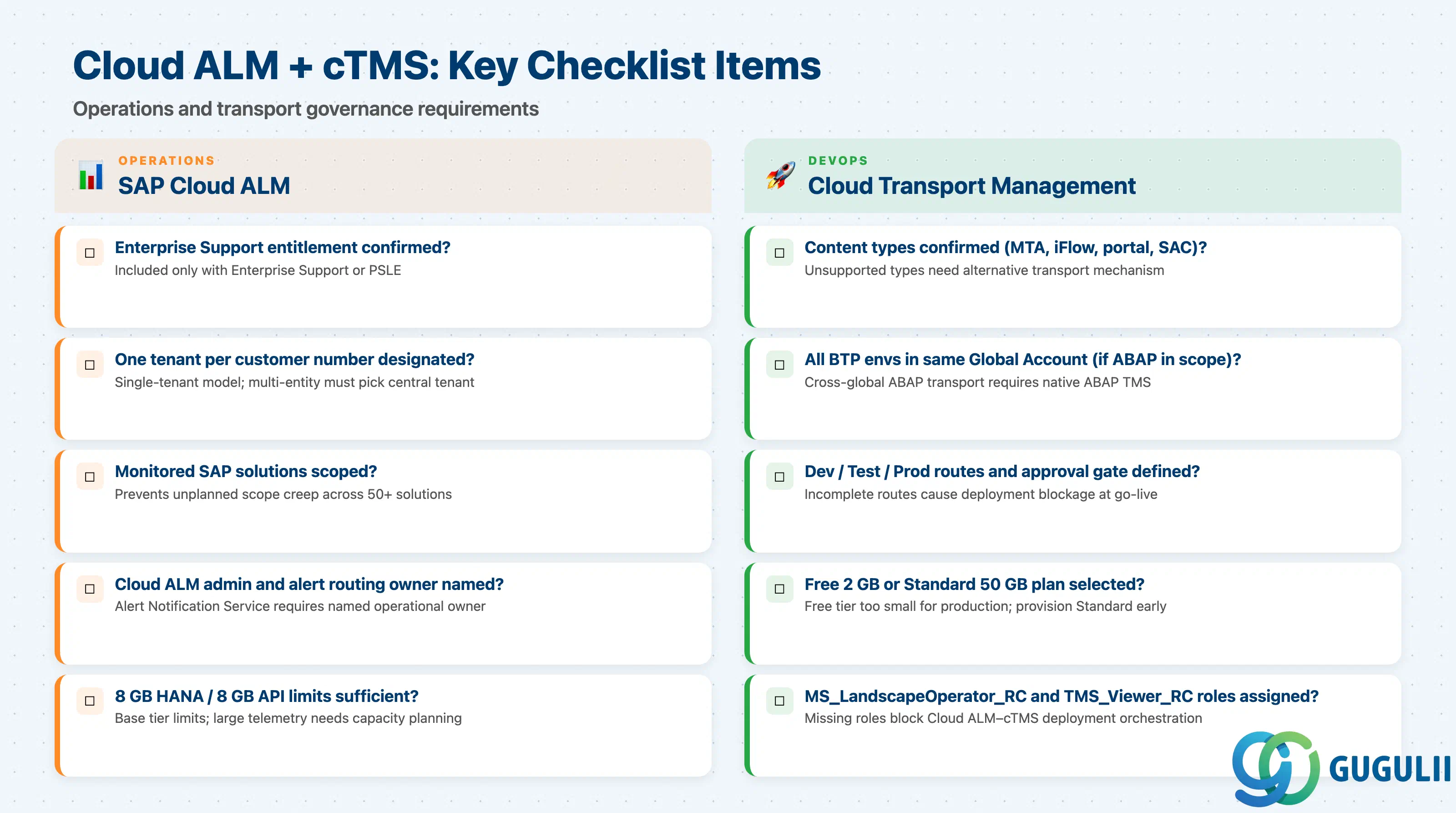
| Checklist item | Why it matters |
|---|---|
| Confirm customer has SAP Enterprise Support or Product Support for Large Enterprises | Included only at these support levels; others require procurement. |
| Verify one Cloud ALM tenant will be allocated per customer number | Single-tenant model; multi-entity customers must designate central tenant. |
| Confirm which SAP solutions are in scope for Cloud ALM monitoring | Prevents scope creep across 50+ supported solutions. |
| Determine whether OpenTelemetry instrumentation is required for custom BTP apps | Custom apps need developer instrumentation effort. |
| Assess whether Solution Manager ChaRM is currently active | Parallel operation is safest during ABAP change management transition. |
| Confirm Cloud ALM Deployment Management scope includes cTMS integration | cTMS must be in customer’s BTP Global Account, not Cloud ALM’s (deprecated). |
| Identify who owns Cloud ALM administration and alert routing | Alert Notification Service integration requires named operational ownership. |
| Validate 8 GB HANA memory and 8 GB monthly API transfer are sufficient | Base tier limits; large telemetry volumes need capacity planning. |
Supported content types, pricing, and integration patterns are covered in the cTMS FAQ on SAP Community.
| Checklist item | Why it matters |
|---|---|
| Confirm content types that need transport (MTA, iFlow, portal, Datasphere, SAC) | Unsupported types need an alternative transport mechanism. |
| Verify all BTP environments are within the same Global Account (if ABAP content is in scope) | Cross-global ABAP transport requires native ABAP TMS. |
| Confirm target subaccounts (Dev, Test, Prod) and transport routes are defined | Incomplete routes cause deployment blockage at go-live. |
| Determine whether a formal change approval gate is required between Test and Production | Approval gate = Cloud ALM + cTMS pattern; no gate = CI/CD auto-import. |
| Confirm cTMS plan (Free 2 GB / Standard 50 GB) fits artifact volume | Free tier too small for production; provision Standard early. |
| Identify whether CI/CD pipeline will upload to cTMS | Pipeline must target the correct transport request ID per landscape. |
| Confirm whether iFlow transport will use package-level or artifact-level | Package-level risks untested changes; artifact-level reduces that risk. |
Establish who has MS_LandscapeOperator_RC and TMS_Viewer_RC roles in Cloud ALM | Missing assignments block Cloud ALM–cTMS deployment orchestration. |
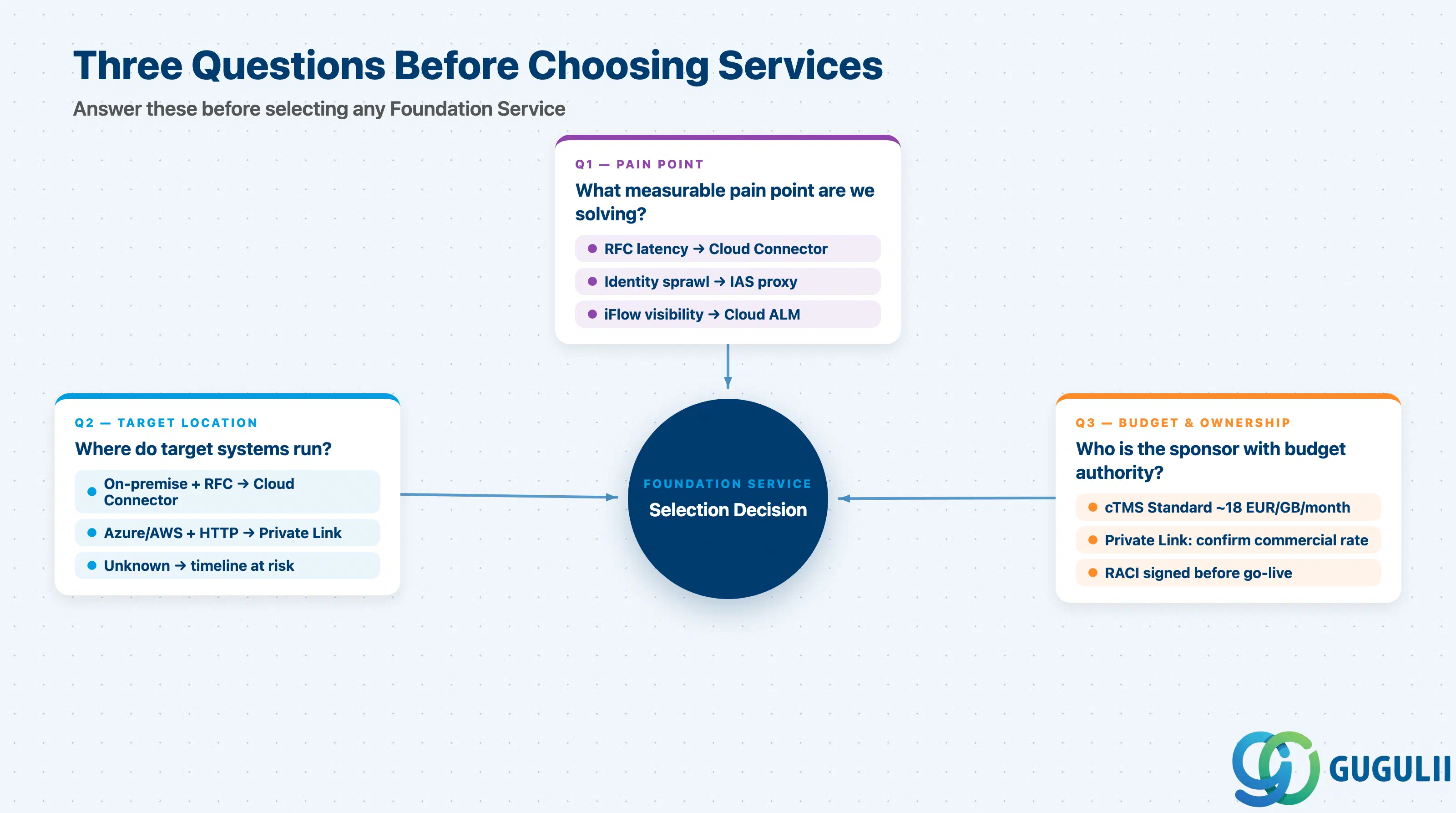
Q1. What is the measurable connectivity, identity, or operations pain point we are solving?
Without a clear pain point, Foundation Services default to being installed because “they are required” — leading to under-configured or incorrectly scoped services. The question forces specificity: Is the pain point RFC latency from BTP to on-premise ERP? Identity sprawl across 40 BTP subaccounts? No visibility into iFlow exceptions? Each answer points to a different primary service.
Q2. Where do the target systems run, and who owns the network path between BTP and those systems?
This is the connectivity decision’s single most important input. On-premise or data centre targets with RFC requirements point to Cloud Connector. Azure or AWS VM targets with HTTP requirements point to Private Link. If the answer is “we are not sure yet,” the connectivity architecture cannot be finalized and project timelines must account for this dependency.
Q3. Who is the internal sponsor with budget authority for Foundation Services licensing and operational ownership?
Cloud ALM is included with Enterprise Support — but its administration requires a dedicated team. cTMS Standard plan runs approximately 18 EUR/GB/month. Private Link endpoint pricing must be confirmed with SAP commercial. IAS tenant administration requires an identity team. Foundation Services are operationally owned, not just installed.
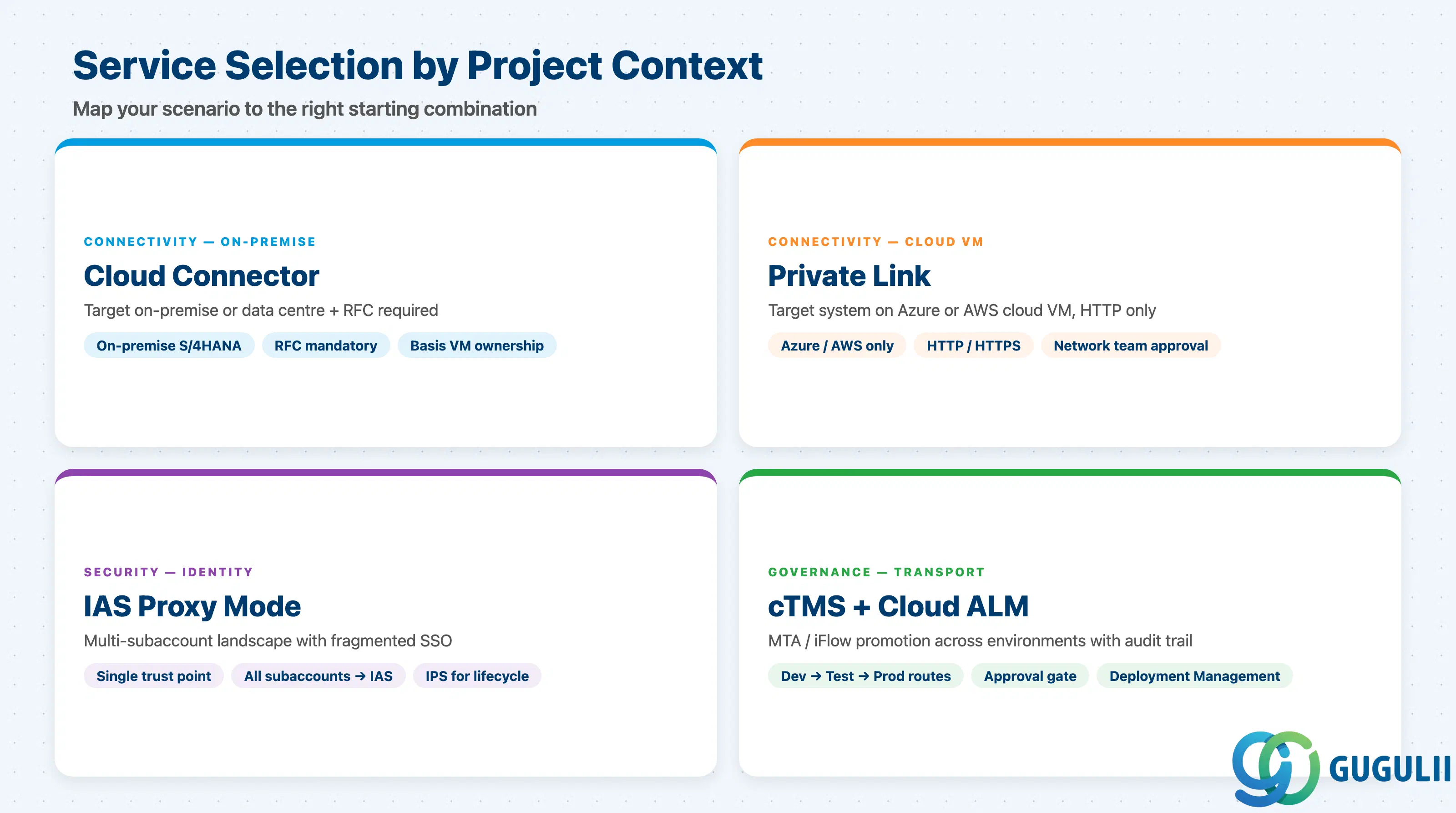
| Project context | Recommended starting service |
|---|---|
| New BTP extension connecting to on-premise S/4HANA with RFC | Cloud Connector (mandatory) |
| New BTP extension connecting to S/4HANA on Azure VM, HTTP only | Private Link (preferred over Cloud Connector for cloud VM targets) |
| Multi-subaccount landscape with fragmented SSO | IAS in proxy mode — single trust point for all subaccounts |
| No corporate IdP exists; new SAP BTP tenant only | IAS as primary IdP with IPS for provisioning |
| MTA-based BTP CF application needing Dev-to-Prod promotion | cTMS Standard plan |
| SAP Integration Suite iFlow transport across environments | cTMS with artifact-level transport |
| Cloud-native S/4HANA Cloud + BTP monitoring | Cloud ALM (included; deploy first) |
| On-premise S/4HANA still under active ABAP ChaRM | Solution Manager for change; Cloud ALM for BTP operations monitoring (parallel) |
| Greenfield Azure-based BTP project (all services in play) | IAS + Private Link + cTMS + Cloud ALM — see Pattern 1 |
| Hybrid on-premise + BTP extension | IAS + Cloud Connector + cTMS + Cloud ALM — see Pattern 2 |
| No clear pain point identified yet | Stop. Go back to Q1. |
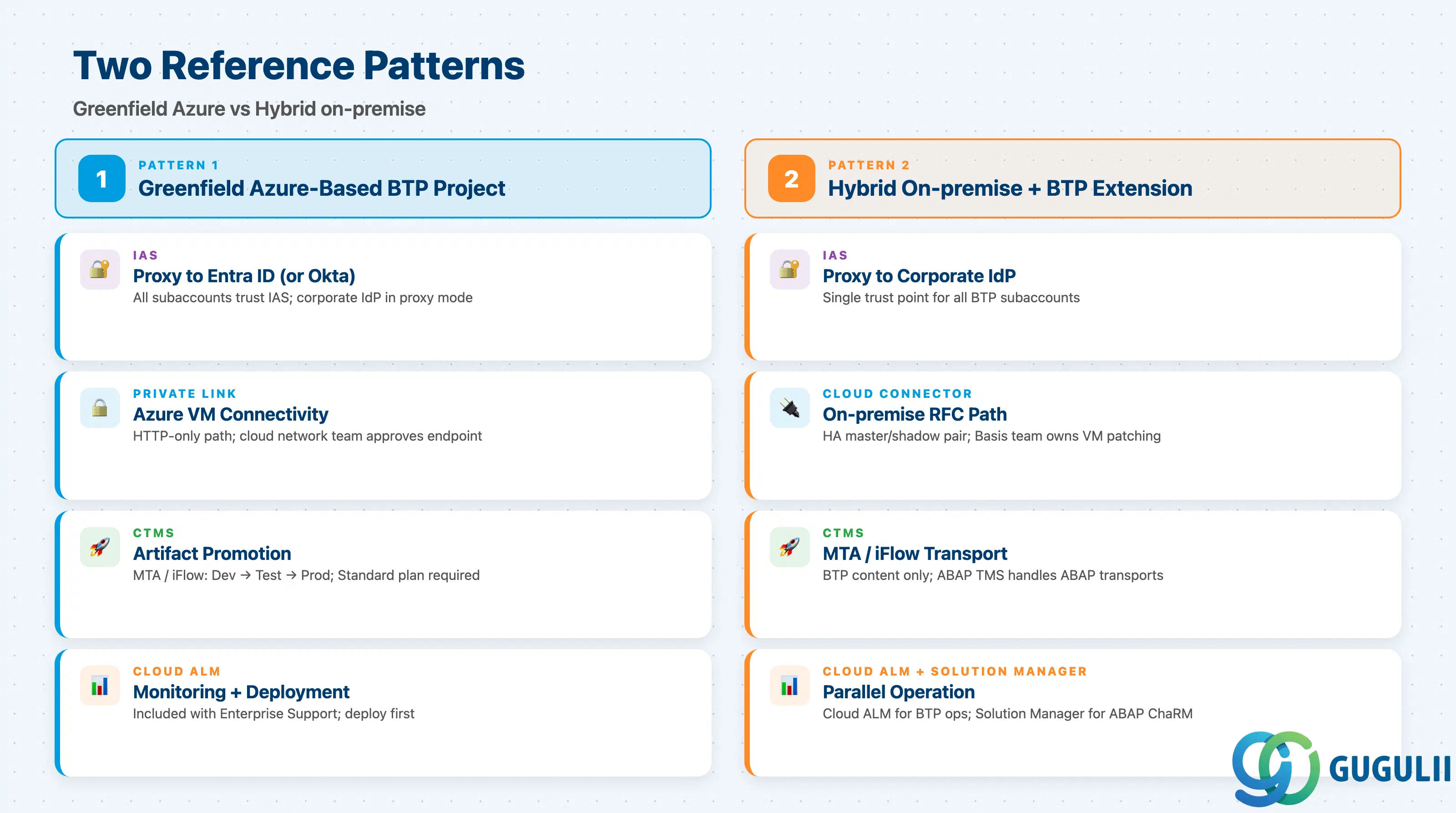
| Service | Licensing model | Key question to ask |
|---|---|---|
| SAP Cloud Identity Services (IAS/IPS) | Included with BTP entitlements; bundled as “SAP Cloud Identity Services” | Is IAS/IPS pre-configured (SuccessFactors post-Dec 2022)? If so, setup effort is reduced. |
| Cloud Connector | Free (included with SAP BTP Connectivity Service) | Is the customer’s Basis team available to install, configure, and operate the VM? |
| SAP Private Link Service | Consumption-based (endpoint-hour and/or GB); exact rates require commercial confirmation | Has procurement verified current Private Link pricing with SAP commercial? |
| SAP Cloud ALM | Included at no additional cost with Enterprise Support or PSLE | Does the customer have Enterprise Support? If not, a procurement discussion is required. |
| cTMS | Free tier: 2 GB, 7-day retention. Standard: 50 GB, 30-day retention, ~18 EUR/GB/month | Is the expected artifact volume within Free tier limits? If not, Standard must be provisioned before first import. |
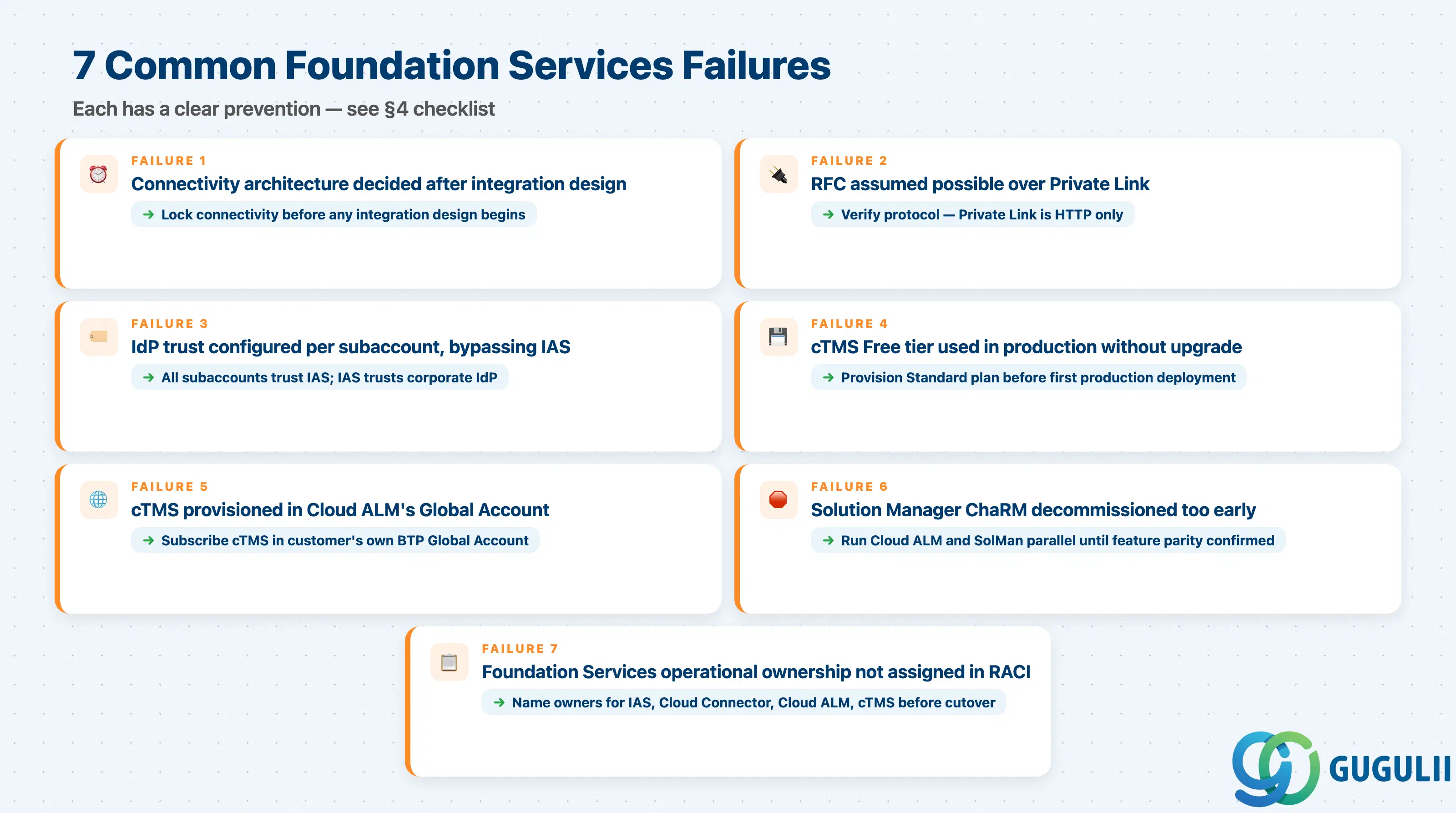
Failure 1: Connectivity architecture decided after integration design
Teams frequently finalize which APIs and function modules a BTP extension will call, then discover the connectivity layer has not been chosen. If the wrong option was prototyped, remediation requires reconfiguring destination services and firewall rules, and often re-deploying the application. Lock connectivity architecture before any integration design begins.
Failure 2: RFC assumed possible over Private Link
Project teams familiar with Cloud Connector’s RFC support assume Private Link works the same way — it does not. RFC is explicitly unsupported by Private Link. This is discovered late when developers attempt to configure an RFC destination against a Private Link endpoint, forcing a migration back to Cloud Connector or an OData/REST wrapper on the S/4HANA side.
Failure 3: Identity trust configured per subaccount instead of through IAS
In multi-subaccount landscapes, teams sometimes configure direct trust between each BTP subaccount and the corporate IdP rather than routing through IAS. When the corporate IdP certificate rotates, every subaccount trust configuration must be updated individually. The correct pattern — all subaccounts trust IAS; IAS trusts the corporate IdP in proxy mode — means changes happen in one place.
Failure 4: cTMS Free tier used in production without planning
Teams subscribe to the cTMS Free tier for prototyping and never upgrade before go-live. Free tier allows only 2 GB of artifact storage with 7-day retention — a single large MTA archive can hit this limit. Once retention expires, transport history is lost and re-imports require re-upload. Provision the Standard plan before the first production deployment.
Failure 5: Cloud ALM–cTMS integration built in the wrong Global Account
Early adopters configured cTMS inside Cloud ALM’s own Global Account rather than in the customer’s BTP Global Account. SAP has confirmed the embedded cTMS in Cloud ALM’s Global Account is planned for deprecation. The correct pattern: subscribe to cTMS in the customer’s own BTP Global Account, then connect it to Cloud ALM via service key and API endpoint.
Failure 6: Solution Manager ChaRM decommissioned before Cloud ALM change management matures
Organizations eager to move to cloud tooling decommission Solution Manager ChaRM before Cloud ALM is ready for their ABAP-heavy landscape. Cloud ALM has not fully replicated all Solution Manager deep-dive ABAP change management features as of 2024–2025. Run both in parallel — Cloud ALM for operations and BTP deployment; Solution Manager for ABAP change governance — until feature parity is confirmed.
Failure 7: Foundation Services operational ownership not assigned in RACI
IAS tenant administration, Cloud Connector VM patching, Cloud ALM alert routing, and cTMS transport approvals all require named owners. Without explicit RACI assignments, alerts are missed, connector certificates expire, and transport requests sit unapproved. RACI for Foundation Services operations must be signed off before cutover, not after.
Q: Do all SAP BTP projects need all five Foundation Services?
No. The required subset depends on project context. A pure SaaS monitoring project needs Cloud ALM and IAS but has no need for Cloud Connector, Private Link, or cTMS. A greenfield Azure extension project is likely to use all five. Use the decision table in §5 to map project context to required services rather than treating all five as mandatory defaults.
Q: Can Private Link replace Cloud Connector on an on-premise system?
No. Private Link requires target systems to run on Azure or AWS. Traditional on-premise systems connected via corporate network, VPN, or ExpressRoute require Cloud Connector. Private Link also does not support RFC protocol, which is common for ABAP-based on-premise integrations. Both services can coexist in the same landscape for different integration routes.
Q: Is Cloud ALM free, and what exactly is included?
Cloud ALM is included at no additional cost for customers with SAP Enterprise Support or Product Support for Large Enterprises, as documented on the SAP Cloud ALM support page. The base tier includes one tenant per customer number, 8 GB SAP HANA memory, and 8 GB monthly API data transfer. Customers on standard support must confirm entitlement with SAP before planning adoption.
Q: When should a project descope cTMS and use manual or CI-only deployment?
Descope cTMS when: (1) the project has a single BTP environment with no promotion path, (2) artifact types are not supported by cTMS, or (3) a fully automated CI/CD pipeline with no manual gate is sufficient. For enterprise projects with multiple environments and a regulatory or audit requirement for traceable change records, cTMS with Cloud ALM Deployment Management provides the necessary governance trail.
Q: How should the IAS proxy mode pattern be documented in a requirements document?
Document three items: (1) the source IdP (e.g., “Microsoft Entra ID tenant ID xxx”), (2) the federation protocol (SAML 2.0 or OIDC — SAP recommends OIDC for new setups), and (3) the list of BTP subaccounts that will trust IAS. State explicitly that no BTP subaccount will establish direct trust with the corporate IdP. Include MFA and conditional access policy requirements as IAS configuration items, not as BTP subaccount-level items.
Q: What happens if the customer has no existing corporate IdP?
IAS is used as the primary IdP, directly issuing identities to users rather than acting as a proxy. IPS is configured to provision users from an HR source system (e.g., SuccessFactors) or managed manually via the IAS admin console. Risk-based authentication and MFA are still configured at IAS. This is a simpler topology than proxy mode but requires the identity team to manage the IAS user store directly.
Q: How should combined ABAP and BTP transports be handled in a single project?
The recommended approach is to connect cTMS (in the customer’s BTP Global Account) to Cloud ALM Deployment Management and use Cloud ALM change documents to coordinate both ABAP and BTP transport steps. Cross-global-account ABAP transport must still use native ABAP TMS separately. The combined Cloud ALM change document provides a single audit trail.
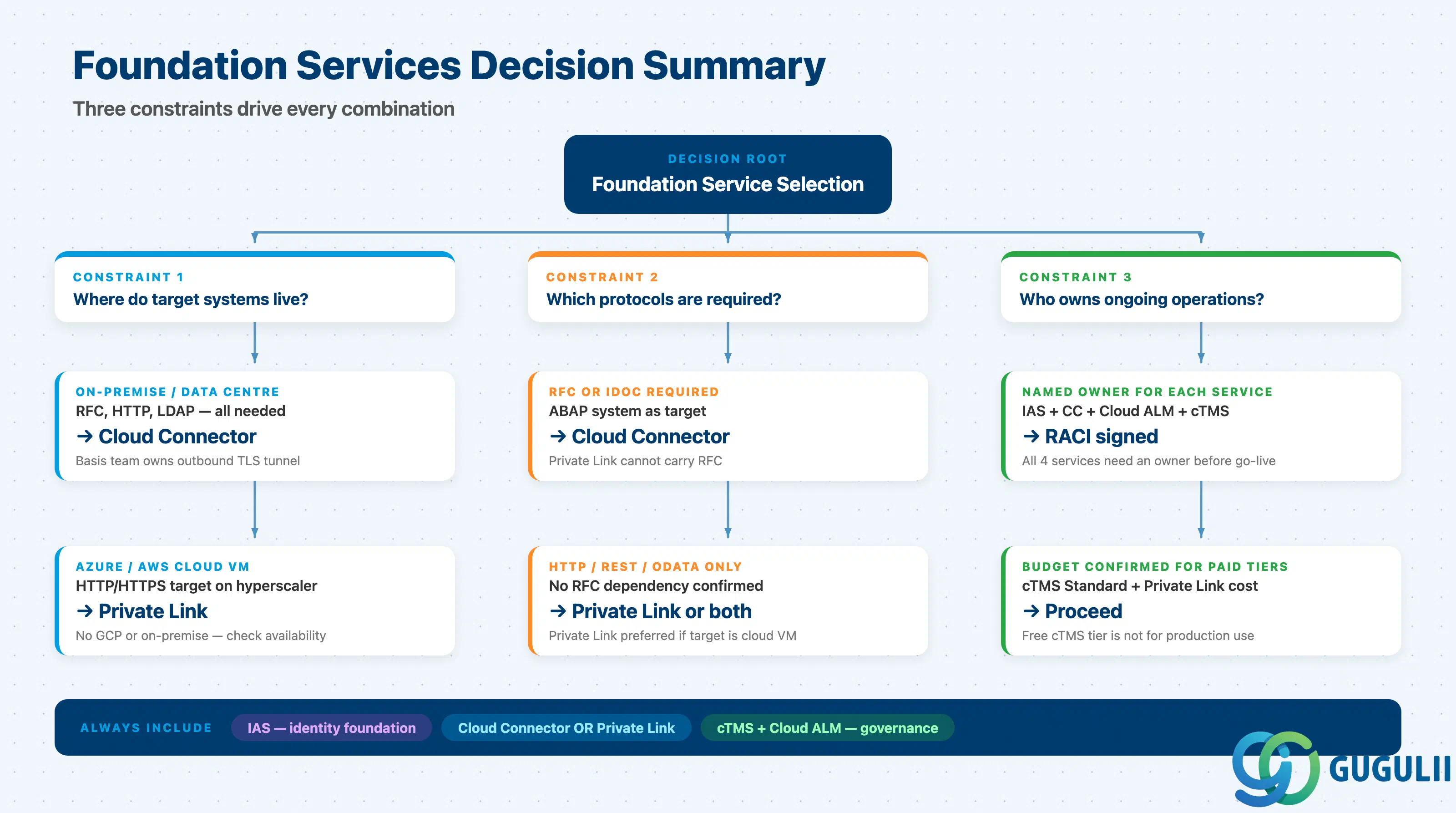
Foundation Services are not optional infrastructure — they are the identity, connectivity, transport, and operations substrate that every SAP BTP project runs on. Choosing the right combination requires understanding three fundamental constraints: where target systems live (on-premise vs. cloud VM), which protocols are required (RFC forces Cloud Connector; HTTP-only opens Private Link), and which team owns ongoing operations for each service.
The most expensive mistakes in this domain are made at requirements stage: connectivity architecture chosen too late, RFC assumed possible over Private Link, IAS trust configured per subaccount instead of centrally, cTMS Free tier not upgraded before production, and operational ownership left unassigned. Each of these failures has a clear prevention: the requirements checklist in §4 addresses them directly.
For most greenfield Azure-based BTP projects, the combination is IAS (proxy to corporate IdP) + Private Link (cloud VM connectivity) + cTMS (artifact promotion) + Cloud ALM (monitoring and deployment). For hybrid on-premise projects, substitute Private Link with Cloud Connector.