Title here
Summary here

| ID | Category | Component | Scope |
|---|---|---|---|
| BTP-F01 | Overview | BTP Architecture Design | Overview and Key Decisions |
| BTP-F02 | Account Design (1) | Subaccount Design | Patterns and Principles |
| BTP-F03 | Account Design (2) | Entitlement and Quota Management | Patterns and Principles |
| BTP-F04 | Authorization (1) | Role Collection Design | Patterns and Principles |
| BTP-F05 | Authorization (2) | Naming Conventions | Patterns and Principles |
| BTP-F06 | Dev & Transport | CI/CD and Transport Management | Patterns and Principles (this article) |
| BTP-F07 | Use Cases | BTP Architecture Design | Use Cases and Decision Patterns |
| Resource | URL |
|---|---|
| SAP Cloud Transport Management | help.sap.com → |
| SAP Continuous Integration and Delivery | help.sap.com → |
| Transport Routes and Nodes | help.sap.com → |
| ABAP CI/CD Pipelines (BTP ABAP Environment) | help.sap.com → |
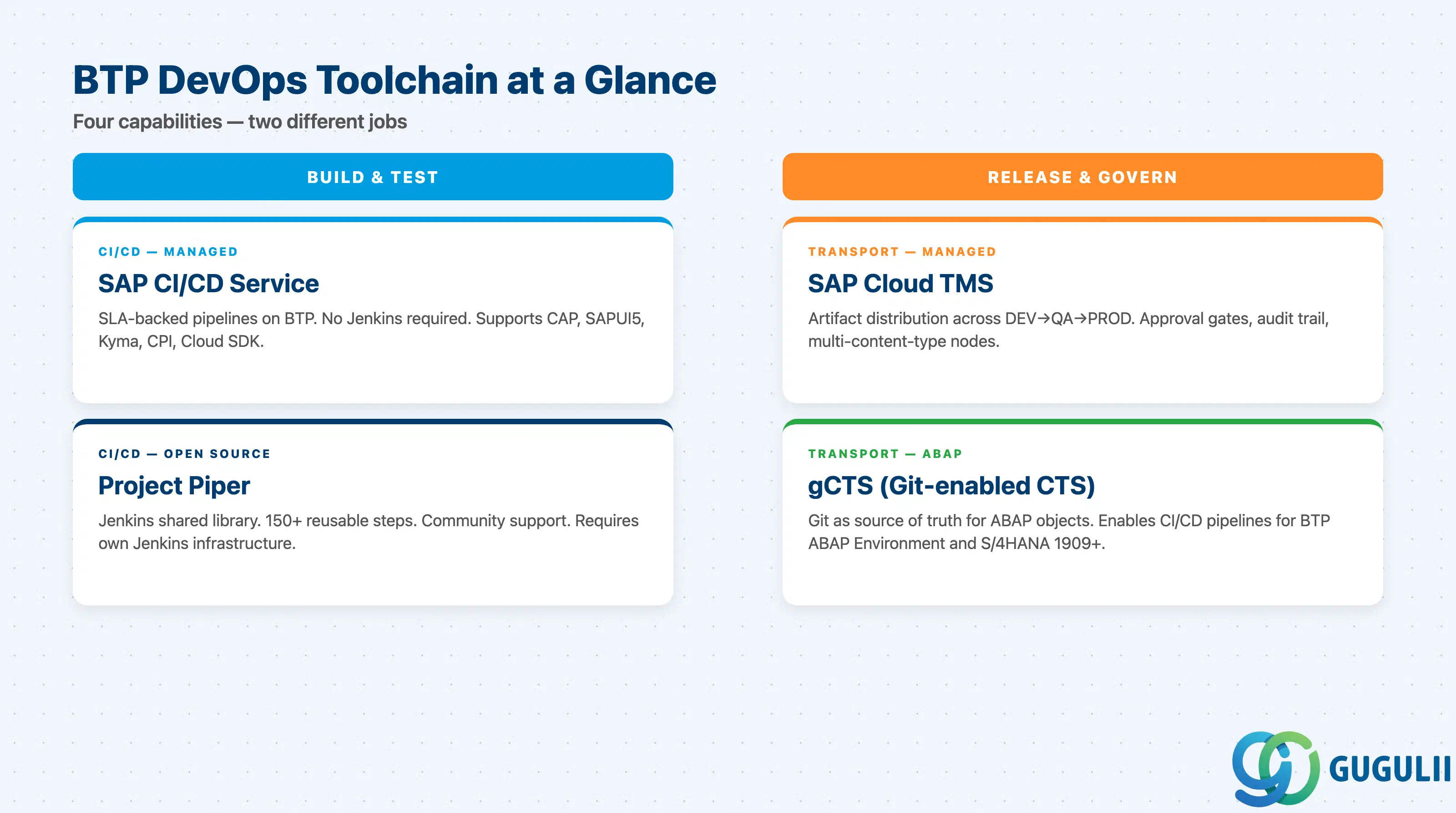
SAP BTP’s DevOps toolchain splits between two concerns: building and testing code (CI/CD), and promoting validated artifacts across environments (transport management). These tools work together — not as alternatives.
| Capability | What it does | Primary user |
|---|---|---|
| SAP CI/CD Service | Managed BTP service running SLA-backed pipelines without own Jenkins | Dev team + platform engineers |
| Project Piper | Open-source Jenkins library with 150+ reusable steps for SAP pipelines ( project-piper.io) | Platform engineers who operate Jenkins |
| SAP Cloud Transport Management | Controls artifact distribution across DEV→QA→PROD with approval gates and audit trail | Release managers + Basis/ops |
| gCTS (ABAP) | Git-enabled transport for ABAP objects in BTP ABAP Environment and on-premise S/4HANA | ABAP developers + Basis |
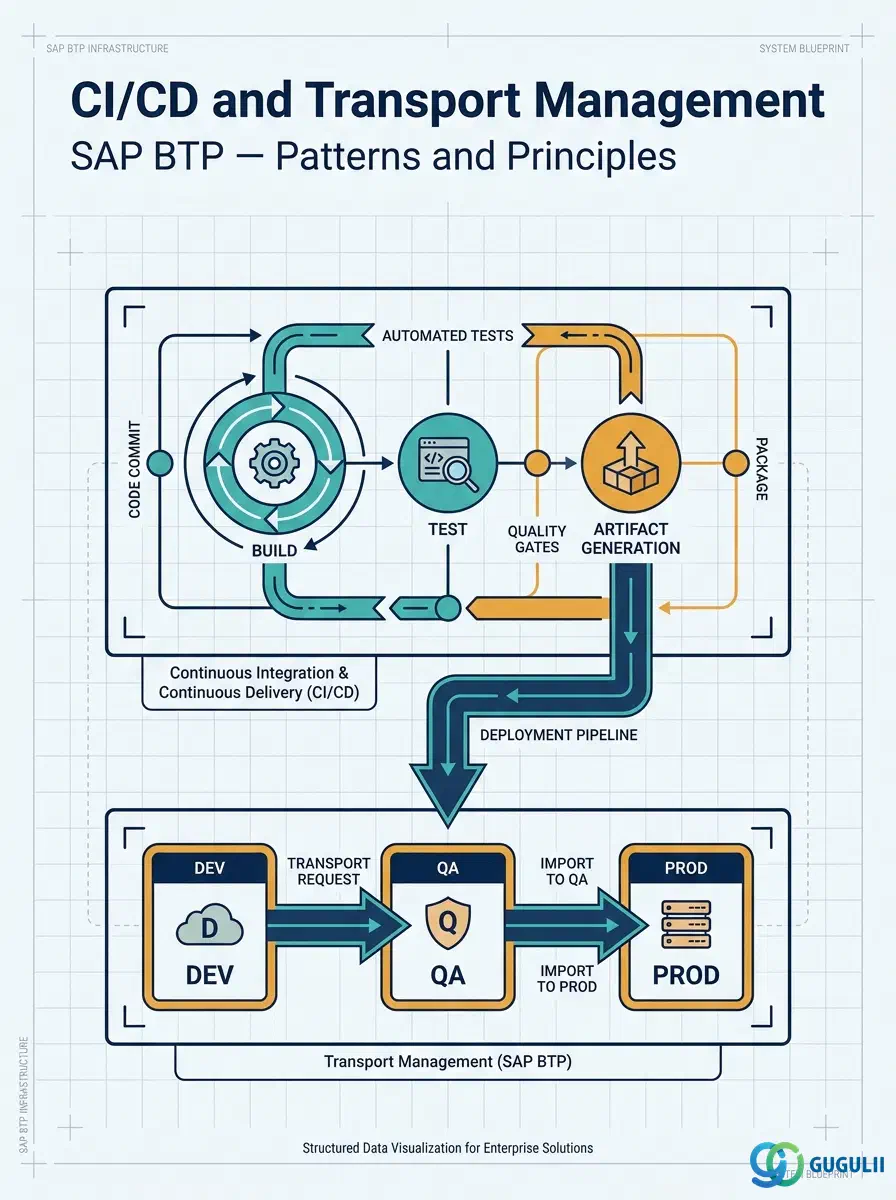
They are not substitutes. CI/CD handles build quality; Transport Management handles release governance. Skipping Transport Management and deploying directly from CI/CD to production loses the approval gate and transport audit trail.
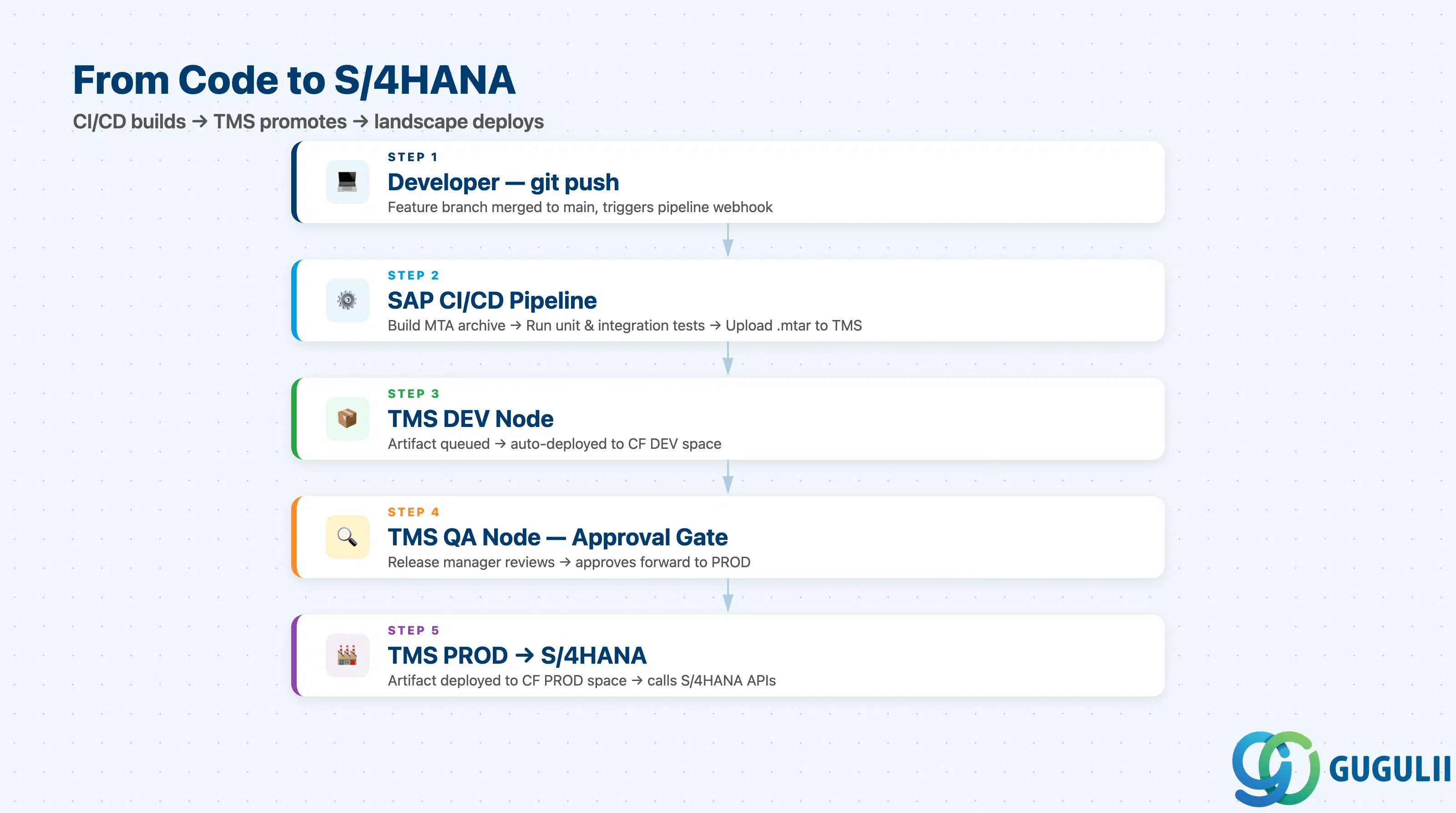
SAP BTP CI/CD and Transport Management connect to SAP S/4HANA through three primary integration paths:
[Developer Workstation]
        │  git push
        ▼
[SAP CI/CD Service / Project Piper]
        │  1) Build MTA (.mtar)  2) Run unit + integration tests
        │     against S/4HANA sandbox (OData sandbox / BTP API Hub)
        ▼
[SAP Cloud Transport Management — DEV Node]
        │  Approved → forward to QA node
        ▼
[SAP Cloud Transport Management — QA Node]
        │  Integration tests against S/4HANA QA system
        │  Approved → forward to PROD node
        ▼
[SAP Cloud Transport Management — PROD Node]
        │  Release to CF space / ABAP PROD / CPI PROD
        ▼
[SAP S/4HANA (on-premise or Cloud)]  ←── calls or receives data
Three connection patterns:
CAP/Cloud Foundry side-by-side: CI/CD builds the CAP application, runs integration tests against an S/4HANA sandbox, produces an MTA archive, and uploads it to TMS for landscape promotion. S/4HANA is a downstream dependency — not a node in the transport route.
CPI (Cloud Integration) iFlows: CPI content packages are transported via TMS CPI nodes. The pipeline tests the iFlow against a QA S/4HANA system; TMS promotes the approved package to the PROD CPI tenant.
ABAP side-by-side (Steampunk): gCTS uses Git as the source of truth for ABAP objects. The pipeline clones the software component, runs ABAP Unit Tests and ATC checks, then creates a transport request that TMS promotes through the Steampunk landscape.
Key point: SAP Cloud Transport Management ( help.sap.com →) does not replace the S/4HANA transport system (STMS) for core ABAP workloads — it extends landscape governance to BTP-hosted components sitting alongside S/4HANA.
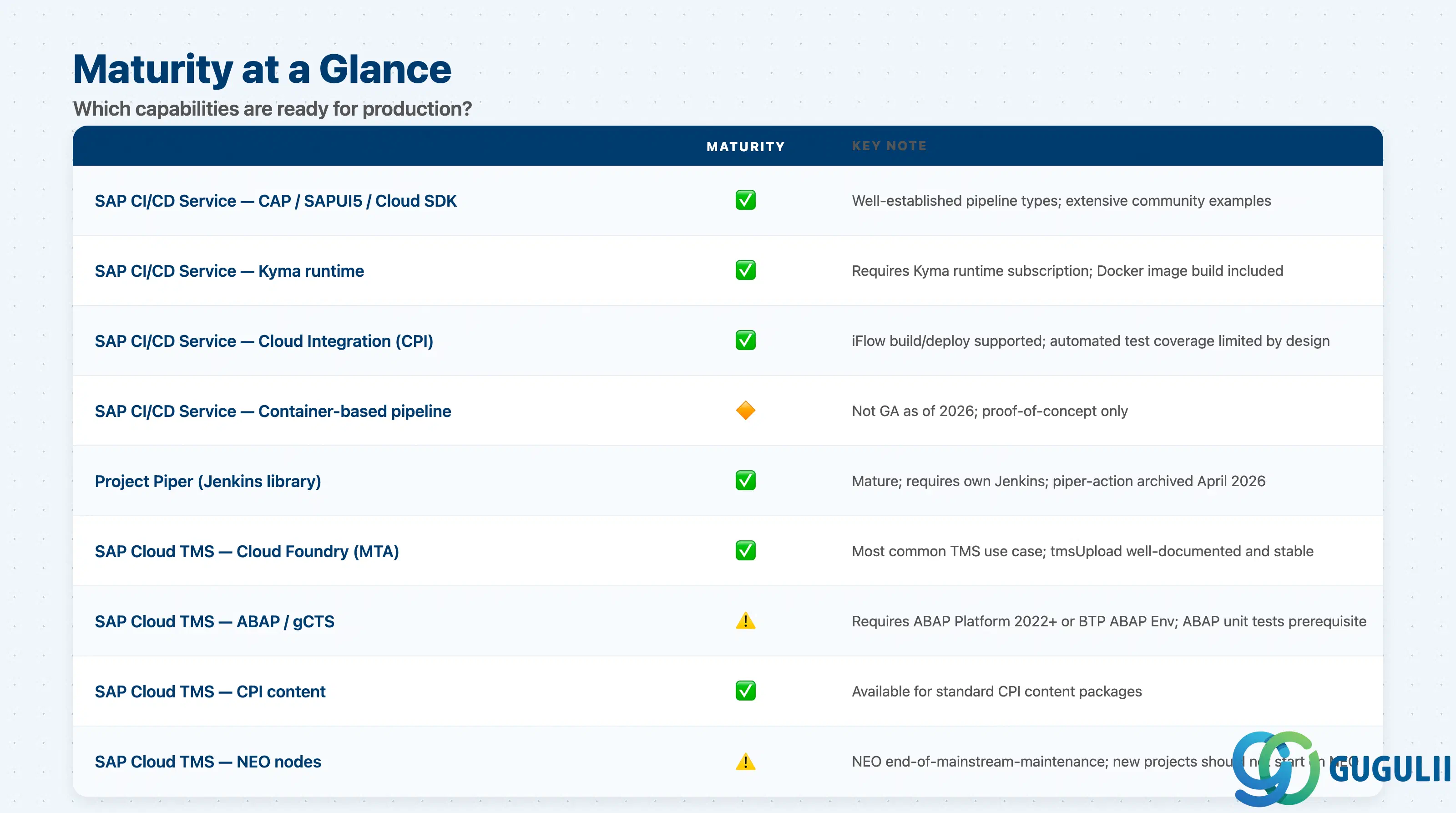
| Capability | Maturity | Notes |
|---|---|---|
| SAP CI/CD Service — CAP, SAPUI5, Cloud SDK pipelines | ✅ Production-ready | Standard pipeline types well-established |
| SAP CI/CD Service — Kyma runtime pipeline | ✅ Production-ready | Requires Kyma runtime subscription; Docker image build included |
| SAP CI/CD Service — Cloud Integration (CPI) pipeline | ✅ Production-ready | iFlow build/deploy supported; automated iFlow test coverage is limited by design |
| SAP CI/CD Service — Container-based general-purpose pipeline | 🔶 Early adopter | Not GA as of 2026; proof-of-concept only |
| Project Piper (Jenkins library) | ✅ Production-ready | Mature; requires own Jenkins. piper-action archived April 2026 ( github.com →); use piper/piper-action@main |
| SAP Cloud Transport Management — Cloud Foundry (MTA) | ✅ Production-ready | Most common TMS use case; tmsUpload well-documented ( project-piper.io →) |
| SAP Cloud Transport Management — ABAP/gCTS | ⚠️ Ready with prerequisites | Requires ABAP Platform 2022+ or BTP ABAP Environment; ABAP unit test automation is a prerequisite |
| SAP Cloud Transport Management — CPI content | ✅ Production-ready | CPI-TMS integration available for standard content packages |
| SAP Cloud Transport Management — NEO nodes | ⚠️ Ready with prerequisites | NEO is end-of-mainstream-maintenance; new projects should not start on NEO |
Build these checklists into your project blueprint. Missing any prerequisite causes pipeline or transport failures late in the project when they are expensive to fix.
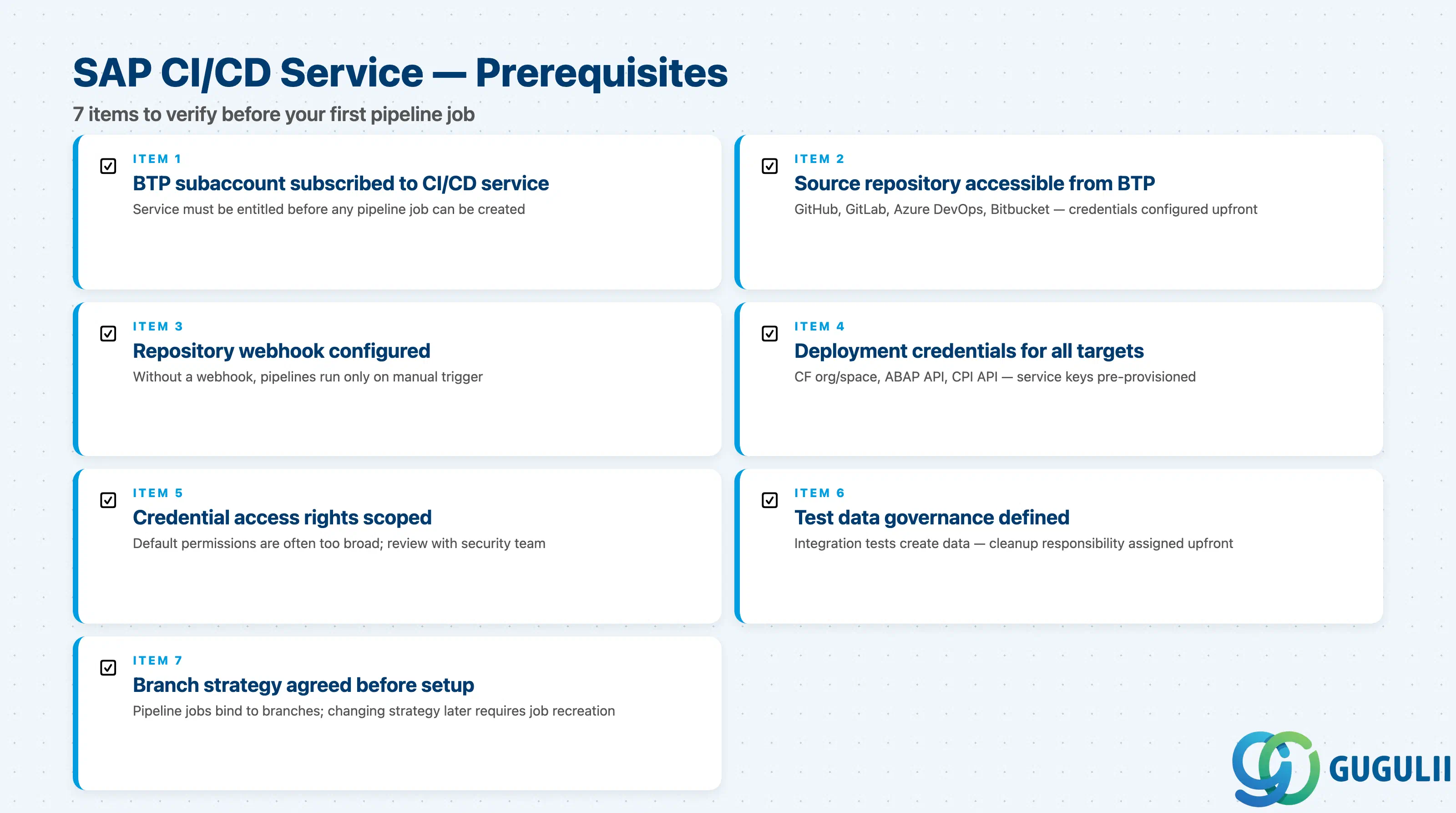
| Checklist item | Why it matters |
|---|---|
| BTP subaccount with CI/CD service subscribed | The managed service must be entitled and subscribed before any pipeline job can be created |
| Source code repository accessible from BTP network (GitHub, GitLab, Azure DevOps, Bitbucket) | Private repositories require credential configuration upfront; public repositories connect without credentials |
| Repository webhook configured for automated pipeline trigger | Without a webhook, pipelines run only on manual trigger — defeats continuous integration |
| Service keys or OAuth credentials for all deployment targets (CF org/space, ABAP API, CPI API) | Pipeline cannot deploy without authenticated access to each target environment |
| Pipeline credential access rights reviewed with security team | Credential store access must be scoped; default permissions are often too broad |
| Test data governance defined for integration tests | Integration tests hitting real SAP systems create data — cleanup responsibility must be assigned upfront |
| Branch strategy agreed before pipeline setup | Pipeline jobs bind to branches; changing the strategy later requires job recreation |
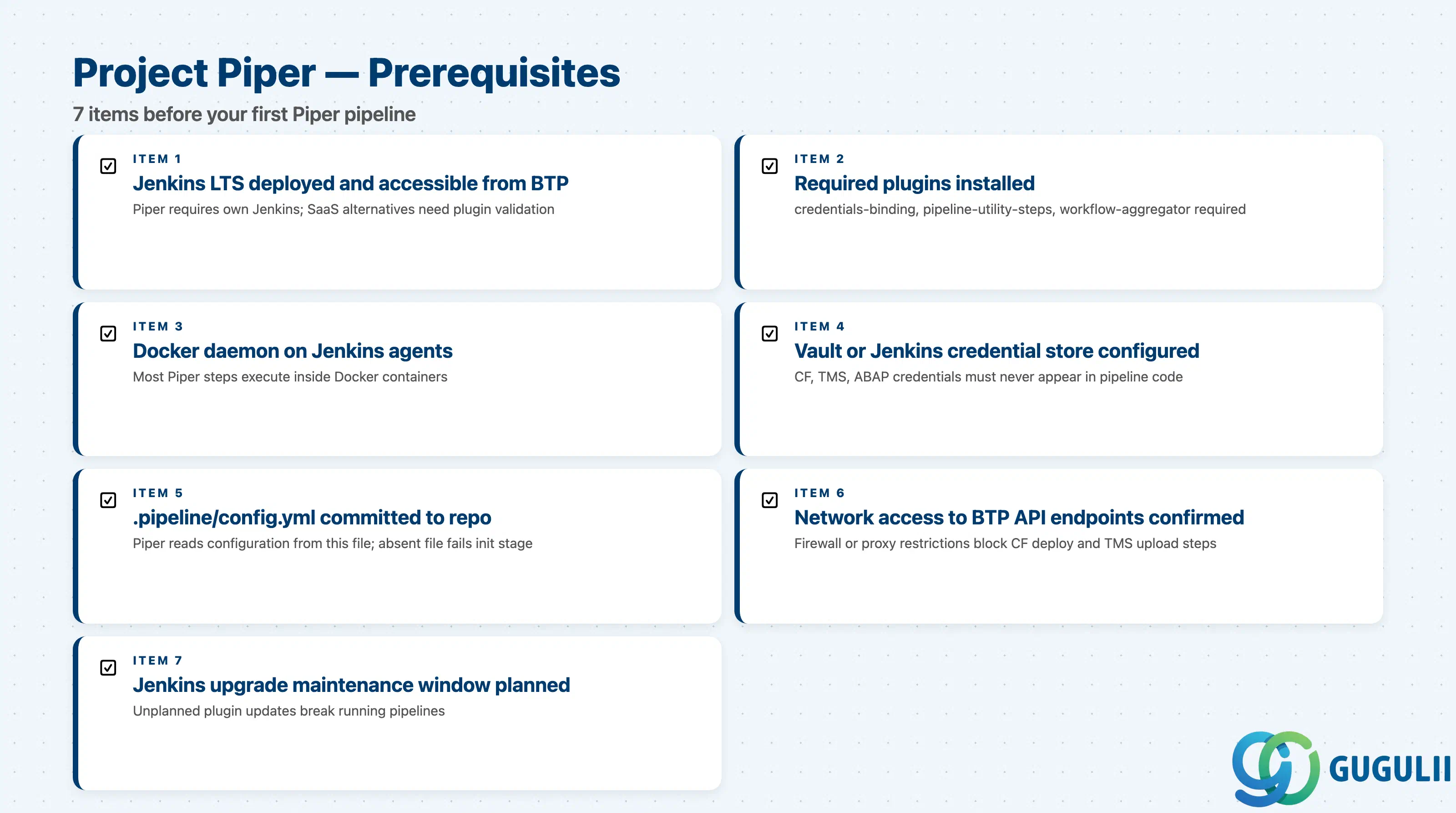
| Checklist item | Why it matters |
|---|---|
| Jenkins LTS instance deployed and accessible from BTP | Project Piper requires own Jenkins; SaaS Jenkins alternatives must be validated for Piper plugin compatibility |
| Required plugins installed: credentials-binding, pipeline-utility-steps, workflow-aggregator | tmsUpload and cloudFoundryDeploy declare explicit plugin dependencies ( project-piper.io →) |
| Docker daemon available on Jenkins agents | Most Piper steps execute inside Docker containers |
| Vault or Jenkins credential store configured | Credentials (CF, TMS service key, ABAP API key) must never appear in pipeline code |
.pipeline/config.yml committed to repository | Piper reads configuration from this file; absent file fails init stage |
| Network access from Jenkins to BTP API endpoints confirmed | Firewall or proxy restrictions between Jenkins and BTP block deployment steps |
| Jenkins upgrade maintenance window planned | Unplanned plugin updates break running pipelines; coordination is required |
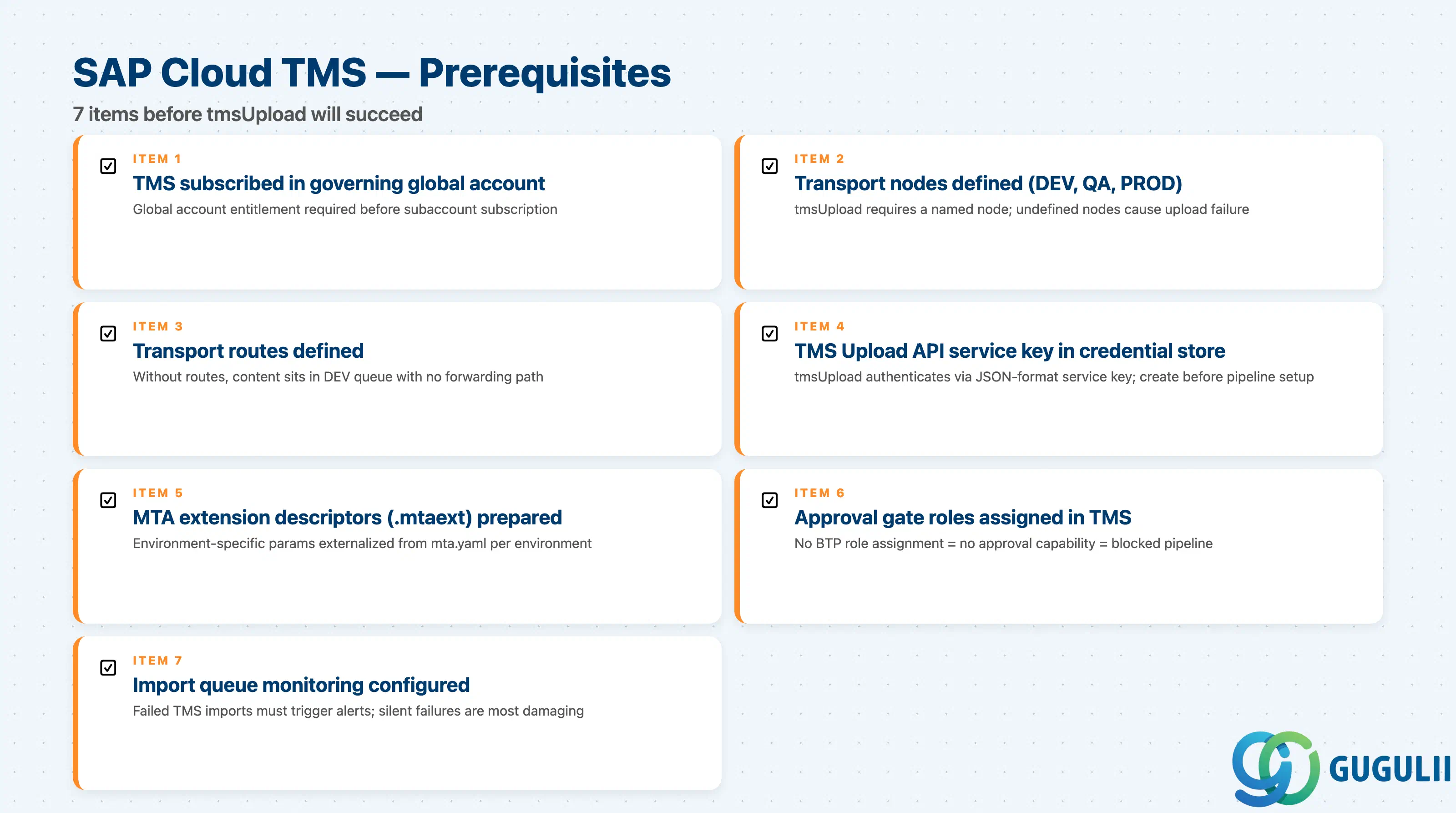
| Checklist item | Why it matters |
|---|---|
| TMS service subscribed in the governing global account | TMS requires global account entitlement before subaccount subscription is possible |
| Transport nodes defined for each target environment (DEV, QA, PROD CF spaces) | tmsUpload requires a named node; undefined nodes cause upload failure |
| Transport routes defined connecting source to destination nodes | Without routes, uploaded content sits in the DEV import queue with no forwarding path |
| TMS Upload API service key stored in pipeline credential store | tmsUpload authenticates with a JSON-format service key; must be created before pipeline setup |
| MTA extension descriptors (.mtaext) prepared for each environment | Environment-specific parameters must be externalized from mta.yaml into .mtaext files |
| Approval gate roles assigned in TMS | No BTP role assignment = no approval capability = blocked pipeline |
| Import queue monitoring and alert channel defined | Failed TMS imports must trigger alerts; silent failures are the most damaging |
| Checklist item | Why it matters |
|---|---|
| ABAP BTP Environment provisioned (or S/4HANA 1909+ with gCTS enabled) | gCTS requires BTP ABAP Environment or S/4HANA 1909+; older releases need an upgrade first |
| Software component created and cloned to the ABAP system | gCTS operates at the software component level; the pipeline clones/pulls at this granularity |
| ABAP Git repository reachable from the ABAP system | ABAP system must reach the Git remote for clone and pull operations |
| ABAP Unit Tests exist and pass at development time | Zero tests = zero pipeline value; ATC runs unit tests via the BTP ABAP API |
| ATC check variant configured and agreed with the team | Too strict = blocked pipeline; too loose = no quality signal |
| API credentials for ABAP Environment stored in pipeline | Pipeline calls ABAP API to trigger clone/pull/test; credentials must be pre-provisioned |
| Software component transport dependency order documented | Import order errors cause runtime failures in QA and PROD |
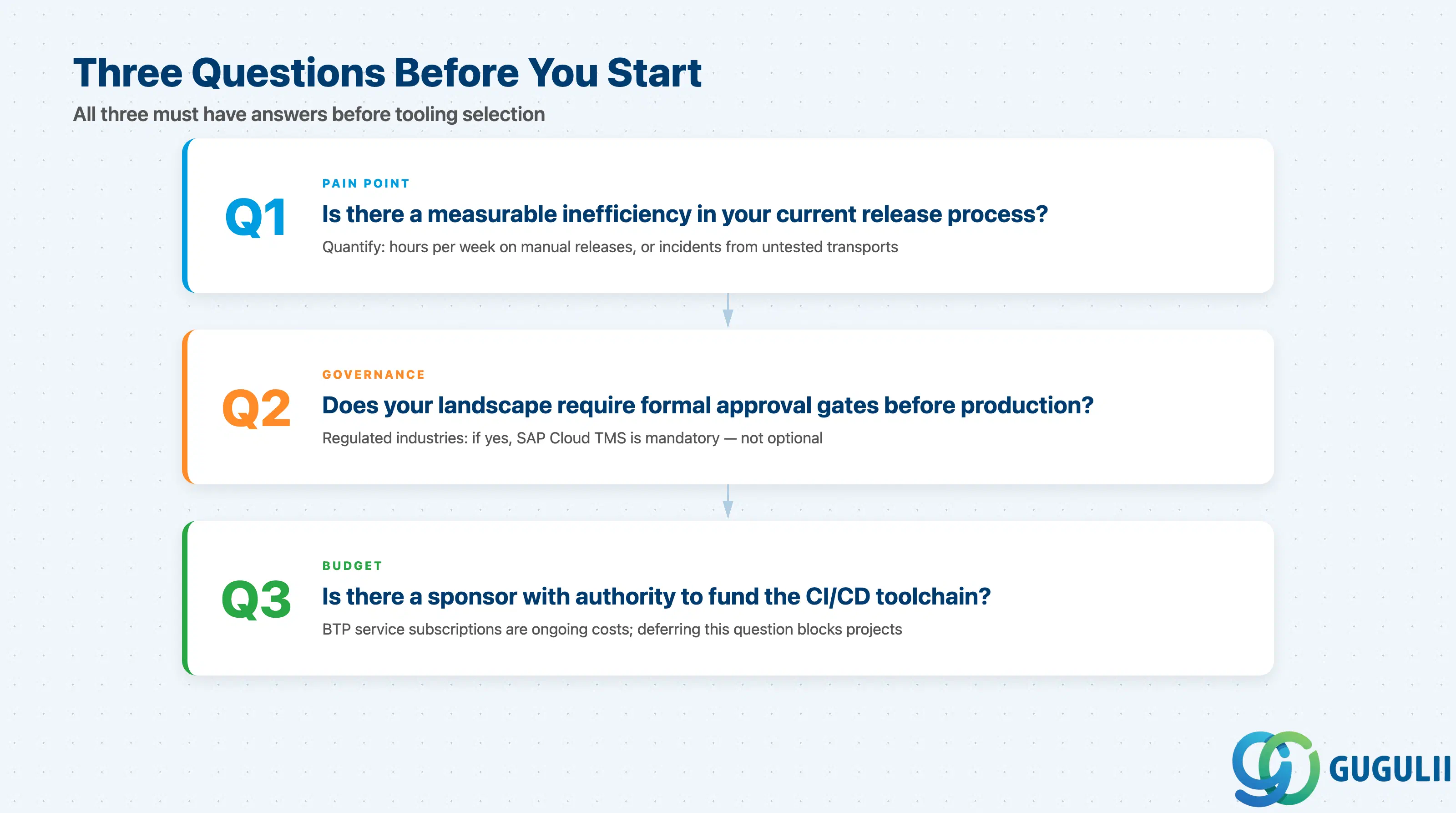
Q1. Is there a measurable inefficiency or pain point in your current release process?
If the team deploys manually via CF CLI, uploads CPI packages by hand, or runs STMS transports without automated tests, the inefficiency is already present — it just hasn’t been quantified. Ask: how many hours per week go to manual release steps, and how many production incidents trace back to untested transports? Without a clear answer, a CI/CD or TMS initiative will struggle for budget approval.
Q2. Who owns the deployment credentials, and does your landscape require formal approval gates?
In regulated industries (finance, healthcare, utilities), direct pipeline-to-production deployment may violate change management policy. Determine early whether IT governance requires a documented approval before promoting to production. If yes, SAP Cloud Transport Management is not optional — it is the approval control point. If the landscape has no regulated PROD, a direct CF deploy pipeline may be sufficient.
Q3. Is there an internal sponsor with budget authority for the CI/CD toolchain and TMS subscription?
SAP CI/CD Service ( help.sap.com →) and SAP Cloud Transport Management both require BTP subscription and entitlement. Project Piper requires Jenkins infrastructure. These are ongoing costs — someone must own them. Projects that defer this question regularly stall when BTP service subscription invoices arrive late in the engagement.
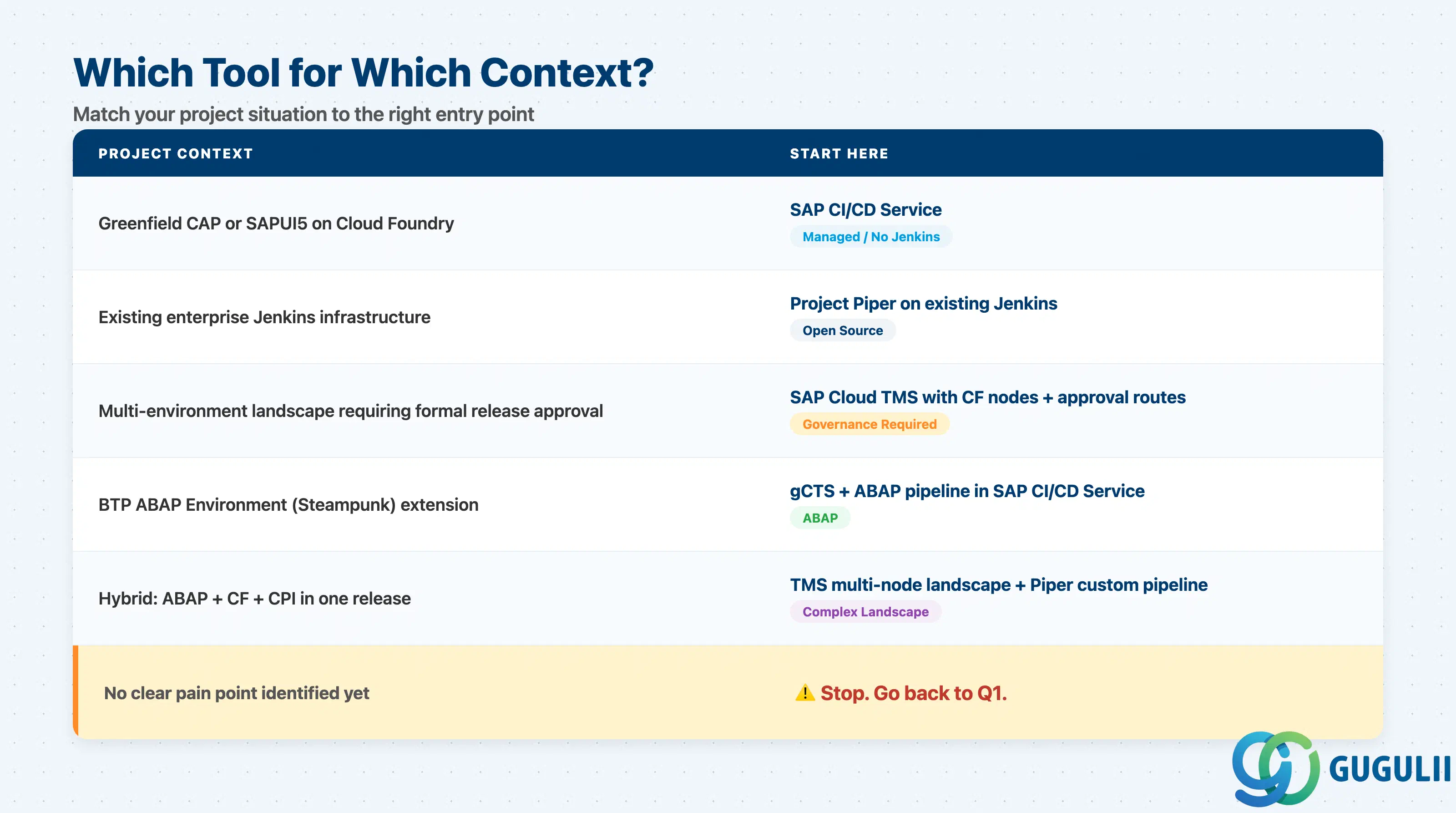
| Project context | Recommended starting point |
|---|---|
| Greenfield CAP or SAPUI5 on Cloud Foundry | SAP CI/CD Service — managed, no Jenkins, quick start |
| Existing enterprise Jenkins infrastructure | Project Piper on existing Jenkins |
| Multi-environment landscape requiring formal release approval | SAP Cloud Transport Management with CF nodes + approval routes |
| BTP ABAP Environment (Steampunk) extension project | gCTS + ABAP pipeline in SAP CI/CD Service |
| Hybrid landscape: ABAP + CF + CPI in one release | TMS multi-node landscape + Piper custom pipeline |
| Large enterprise with strict change management (ITSM) | TMS approval gates + ITSM webhook integration via TMS REST API |
| No clear pain point identified yet | Stop. Go back to Q1. |
| Tool | Licensing model | Key question to ask |
|---|---|---|
| SAP CI/CD Service | BTP service plan (consumption-based minutes); free tier with limits | How many pipeline minutes per month are needed, and does the free tier cover the dev cadence? |
| Project Piper | Open-source (Apache 2.0); Jenkins infrastructure costs apply | What is the total cost of operating own Jenkins — compute, plugin maintenance, and engineer time? |
| SAP Cloud Transport Management | BTP service plan; requires global account entitlement | Is TMS subscribed in the correct subaccount, and who controls the entitlement allocation? |
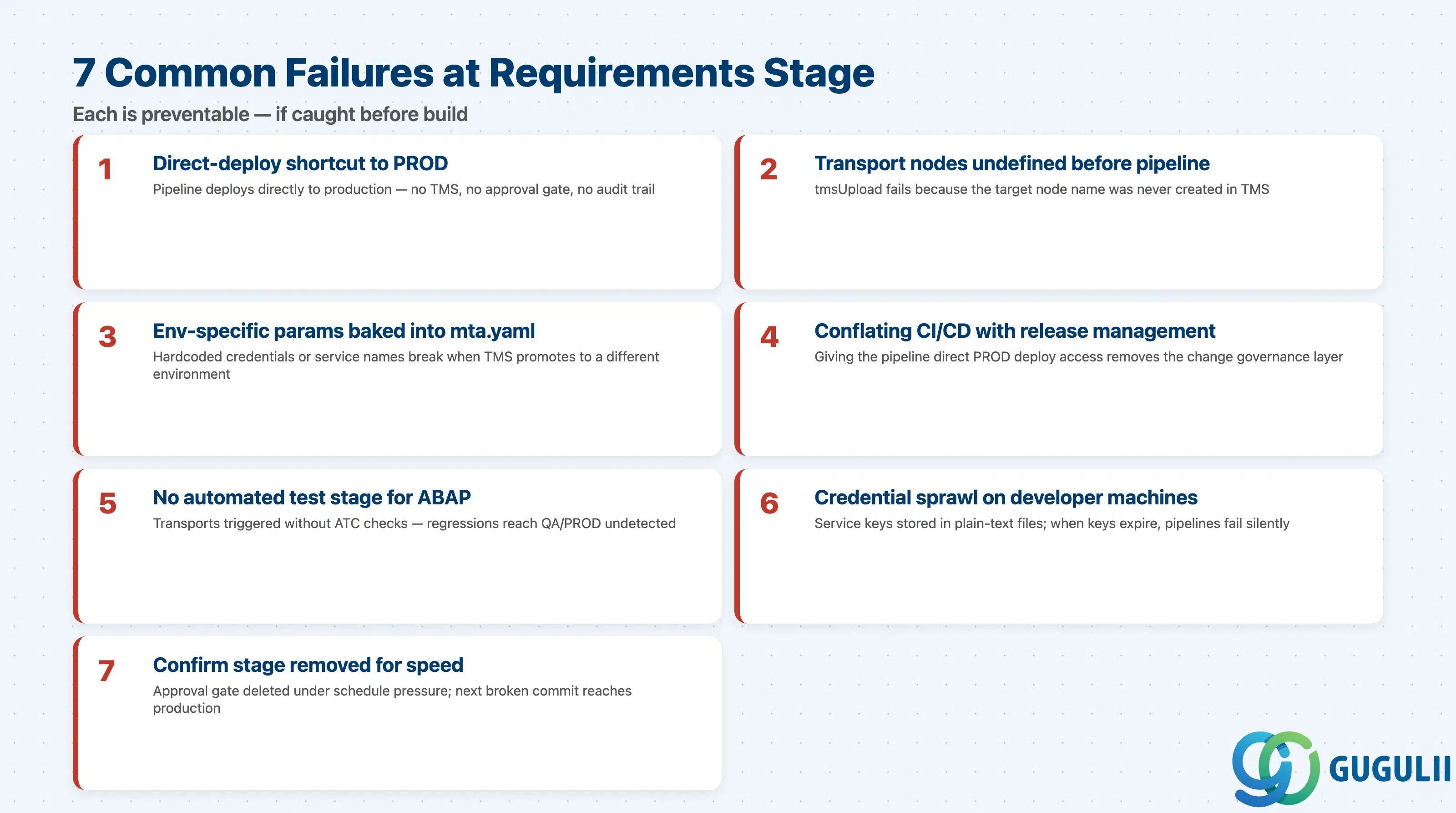
Failure 1: Direct-deploy shortcut to production
The pipeline deploys directly from the build to the production CF space — no TMS, no approval gate. In regulated environments this violates change management policy. Fix: route all production deployments through SAP Cloud Transport Management; even a minimal TMS landscape (one route, no parallel QA nodes) gives you a traceable approval record.
Failure 2: Transport nodes undefined before pipeline setup
The CI/CD pipeline is built including the tmsUpload step, but SAP Cloud Transport Management has no nodes configured. The upload fails because the node name does not exist. Fix: model the transport landscape (nodes and routes) during the architecture sprint — not as a follow-up after the pipeline is built.
Failure 3: Environment-specific parameters baked into mta.yaml
Connection credentials or service instance names are hardcoded in the MTA descriptor for one environment. When TMS promotes the same .mtar to a different environment, the hardcoded values break the deployment. Fix: externalize all environment-specific overrides into MTA extension descriptors (.mtaext) and map them to TMS nodes via nodeExtDescriptorMapping in the tmsUpload step (
project-piper.io →).
Failure 4: Conflating CI/CD with release management
Teams assign both build-quality and release-governance responsibilities to the CI/CD pipeline by giving it direct PROD deploy access. This loses the approval gate and audit trail that change management requires. CI/CD tools own the artifact; SAP Cloud Transport Management owns when and where it lands.
Failure 5: No automated test stage for ABAP
ABAP transports are triggered without running ABAP Unit Tests or ATC checks. Regressions reach QA or PROD undetected. Fix: add a pipeline stage that clones the software component and runs ATC checks before creating a transport ( help.sap.com →). Even a minimal check variant (syntax errors, security findings) eliminates the most common regression class.
Failure 6: Credential sprawl across developer workstations
Service keys for TMS, CF orgs, CPI tenants, and ABAP environments are stored in plain-text files on individual machines. When a developer leaves or a key expires, pipelines fail and no one knows where the credential was stored. Fix: store all pipeline credentials in Jenkins Vault integration, the SAP CI/CD Service credential store, or a BTP service binding — never in local files or Git.
Failure 7: Removing the Confirm stage to accelerate delivery
Under schedule pressure, the team removes the manual approval stage ( project-piper.io →) to speed up releases. The next run deploys a broken commit to production without review. Fix: replace a deleted Confirm stage with automated smoke tests and TMS approval rules — do not simply delete the gate.
Q: Can SAP CI/CD Service fully replace an on-premise Jenkins installation?
For teams using standard SAP stacks (CAP, SAPUI5, Cloud SDK, Kyma, CPI), yes. SAP CI/CD Service provides all required pipeline stages without operating Jenkins. Teams with highly customized pipelines — non-standard build tools or toolchain integrations not covered by Piper steps — will find Project Piper on Jenkins more flexible. The managed service trades customizability for operational simplicity.
Q: Does SAP Cloud Transport Management work for on-premise ABAP transports?
Partially. TMS can include CTS+ nodes that connect to on-premise S/4HANA and trigger standard ABAP transports, giving a unified landscape view across BTP content and on-premise ABAP. TMS does not replace STMS — it orchestrates when a transport is released; the actual ABAP transport still executes inside STMS.
Q: What happens if a TMS transport fails midway through a landscape?
The failed import stays in the import queue of the node where it failed. Content in upstream nodes that already imported is not automatically rolled back. Investigate the root cause (typically a deployment error in the target environment), fix it, and retry the import. Silent TMS failures are the most damaging — import queue monitoring and alerting is mandatory.
Q: When should I use gCTS instead of traditional ABAP transports (STMS)?
gCTS is appropriate when development is on BTP ABAP Environment (Steampunk) or S/4HANA 1909+ with gCTS enabled and the team wants Git-based workflows (feature branches, pull requests). Traditional STMS remains the default for on-premise systems where gCTS is not yet enabled. gCTS is a prerequisite for a meaningful ABAP CI/CD pipeline.
Q: How do I document transport requests for audit purposes?
The tmsUpload step defaults to the Git commit ID as the transport request description (
project-piper.io →), linking each transport to its source commit. For regulated environments, use the customDescription parameter to include the change ticket ID explicitly (e.g., "JIRA-4321: Add payment service endpoint"). TMS stores this in its transport history, giving auditors a traceable chain from ticket to commit to deployment.
Q: Is Project Piper free to use?
Project Piper is open-source (Apache 2.0) and free to use. The cost is infrastructure: you must run a Jenkins instance; SAP provides only community support. If your organization needs SLA-backed support, SAP CI/CD Service eliminates the Jenkins operational burden at the cost of a BTP service subscription.
Q: When should I descope CI/CD automation from a BTP project?
Descope when: (1) the project is a one-time migration with no ongoing code changes, (2) deployment cadence is under once per month with trivial change volume, or (3) the project delivers only configuration (role assignments, entitlement management) with no custom code. Any project delivering custom application logic — CAP services, SAPUI5 apps, CPI iFlows, ABAP extensions — pays back CI/CD investment within the first few release cycles.
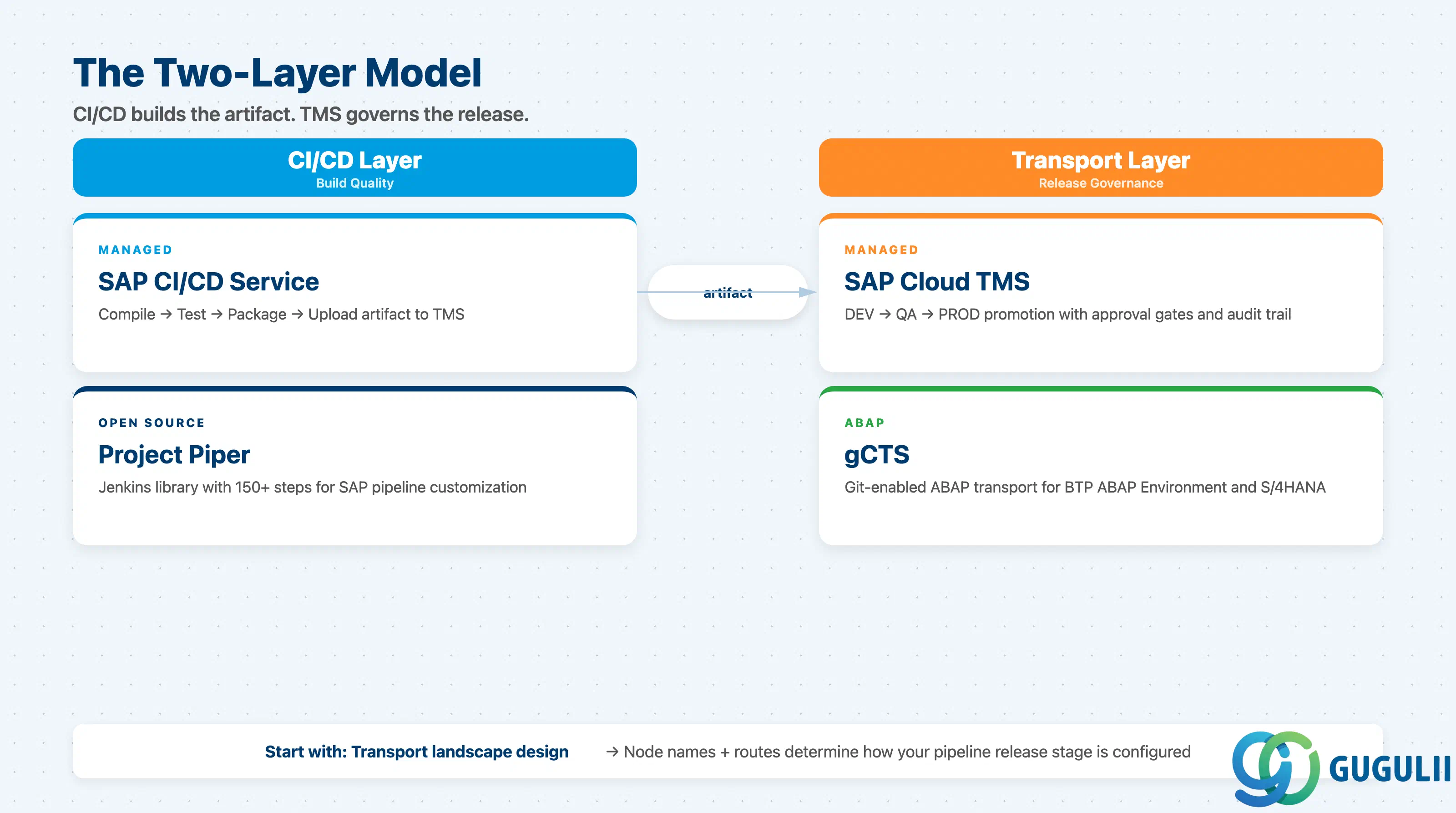
SAP BTP’s CI/CD and transport toolchain is a two-layer system: CI/CD tools (SAP CI/CD Service or Project Piper ( project-piper.io →)) own the build and test lifecycle; SAP Cloud Transport Management owns the release governance lifecycle. Mixing these responsibilities — or skipping the transport layer entirely — is the most common architecture mistake at requirements stage.
For Cloud Foundry-based projects the pattern is established: build MTA archive, upload to TMS DEV node, approve and promote through the landscape. For ABAP projects on BTP ABAP Environment, gCTS enables Git-based workflows and automated testing but requires upfront software component setup and unit tests. For hybrid landscapes, TMS’s multi-node architecture handles all content types in one promotion workflow.
Start with the transport landscape design before the pipeline — node names and route structure determine how the release stage is configured.