Title here
Summary here

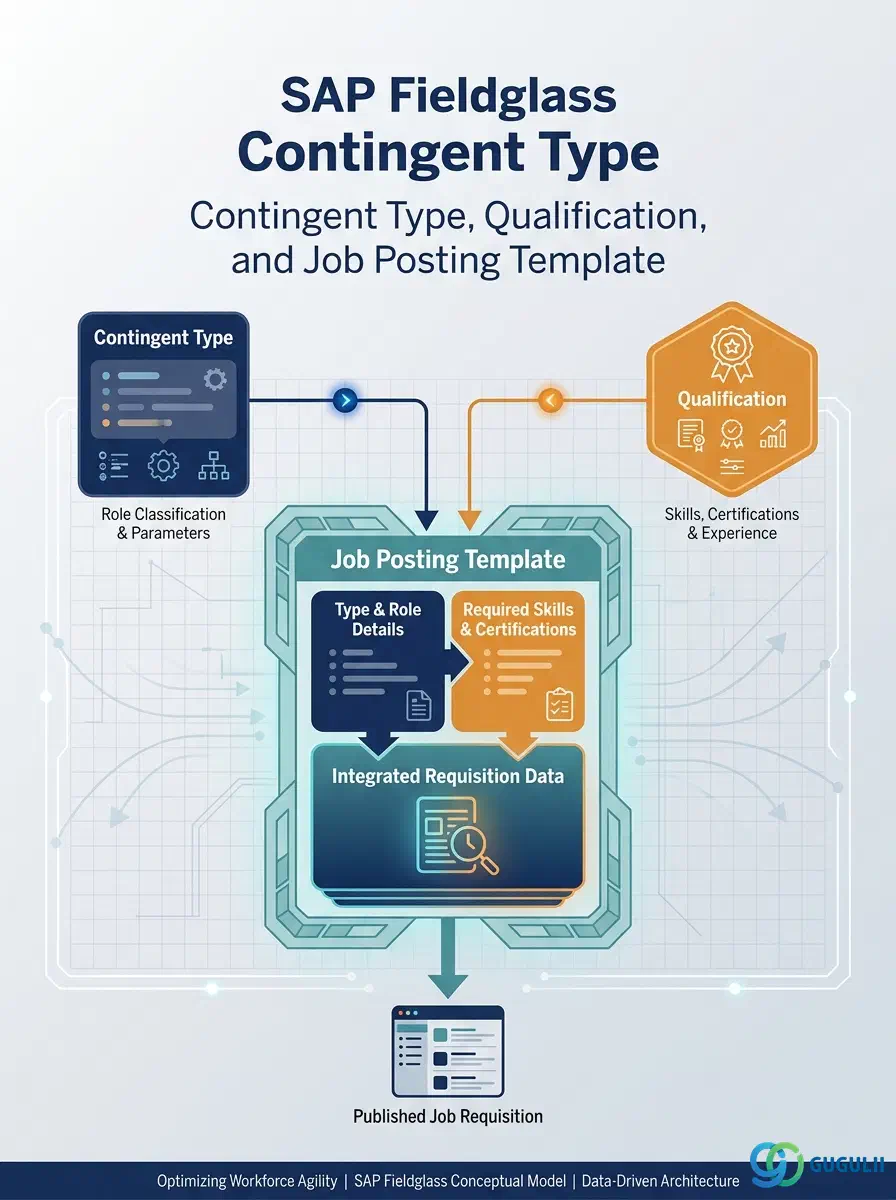
Contingent Type, Qualification, and Job Posting Template are the first Job Posting Configuration masters built in Phase 3, immediately after the Rate Structure objects covered in FG-A04-01 and FG-A04-02. Contingent Type classifies a requisition by engagement category and drives its approval workflow; Qualification defines a skill or certification requirement independently of any one Template; Job Posting Template is the reusable assembly point that pulls both together with a Rate Category to become the shell every hiring manager launches a new job posting from. This article first covers the concepts shared by all three objects across every Fieldglass process area that touches job posting, then moves into the field-level detail Fieldglass Administrators configure for each.
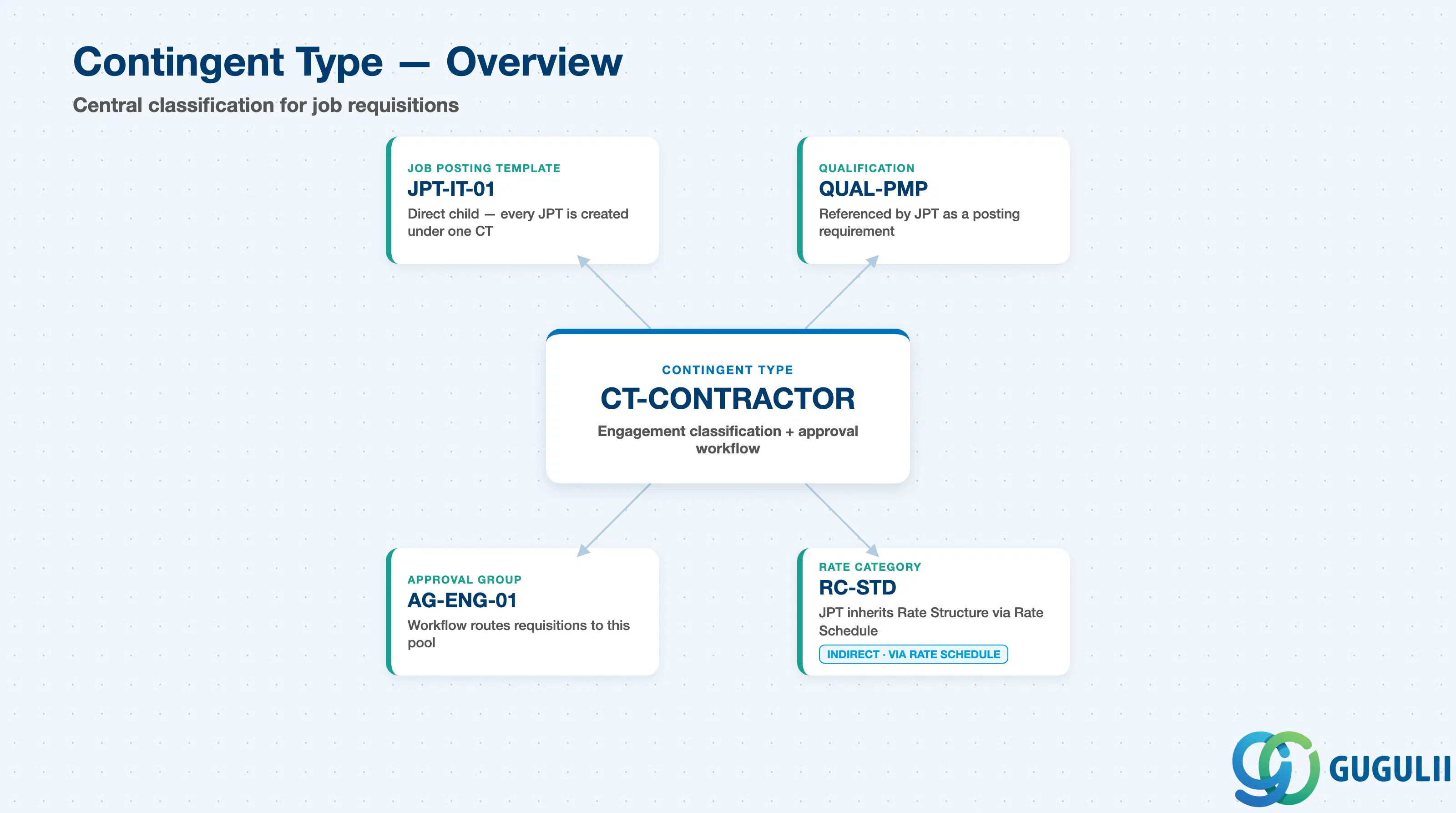
Contingent Type is a classification master that groups job requisitions by engagement category — contractor, temp staff, intern, or any other segmentation the tenant needs — and fixes the approval workflow every requisition of that type must pass through. It does not itself carry rate or skill data; those live on Rate Category (FG-A04-01) and Qualification respectively. Getting the Contingent Type design right up front (how many types, split by what dimension) determines how much approval friction hiring managers experience for the life of the tenant.
| Aspect | Details |
|---|---|
| Role | Classifies a job requisition by engagement type and defines the approval workflow every Job Posting Template built on it must follow |
| Modules using it | Contingent Workforce Management (primary — every Job Posting Template references exactly one Contingent Type) |
| Transactions | Admin > Contingent Types (create/maintain) — Fieldglass is a browser-based SaaS admin console; there are no ABAP-style transaction codes |
| Key Tables | Not applicable — Fieldglass is a multi-tenant SaaS platform. Contingent Type configuration is stored in the tenant’s Admin configuration layer, not in a client-accessible database table |
| Platform note | Contingent Type is Fieldglass-native with no S/4HANA counterpart. Unlike Site or Cost Center, it is never synchronized from S/4HANA — it must be configured directly in Fieldglass Admin |
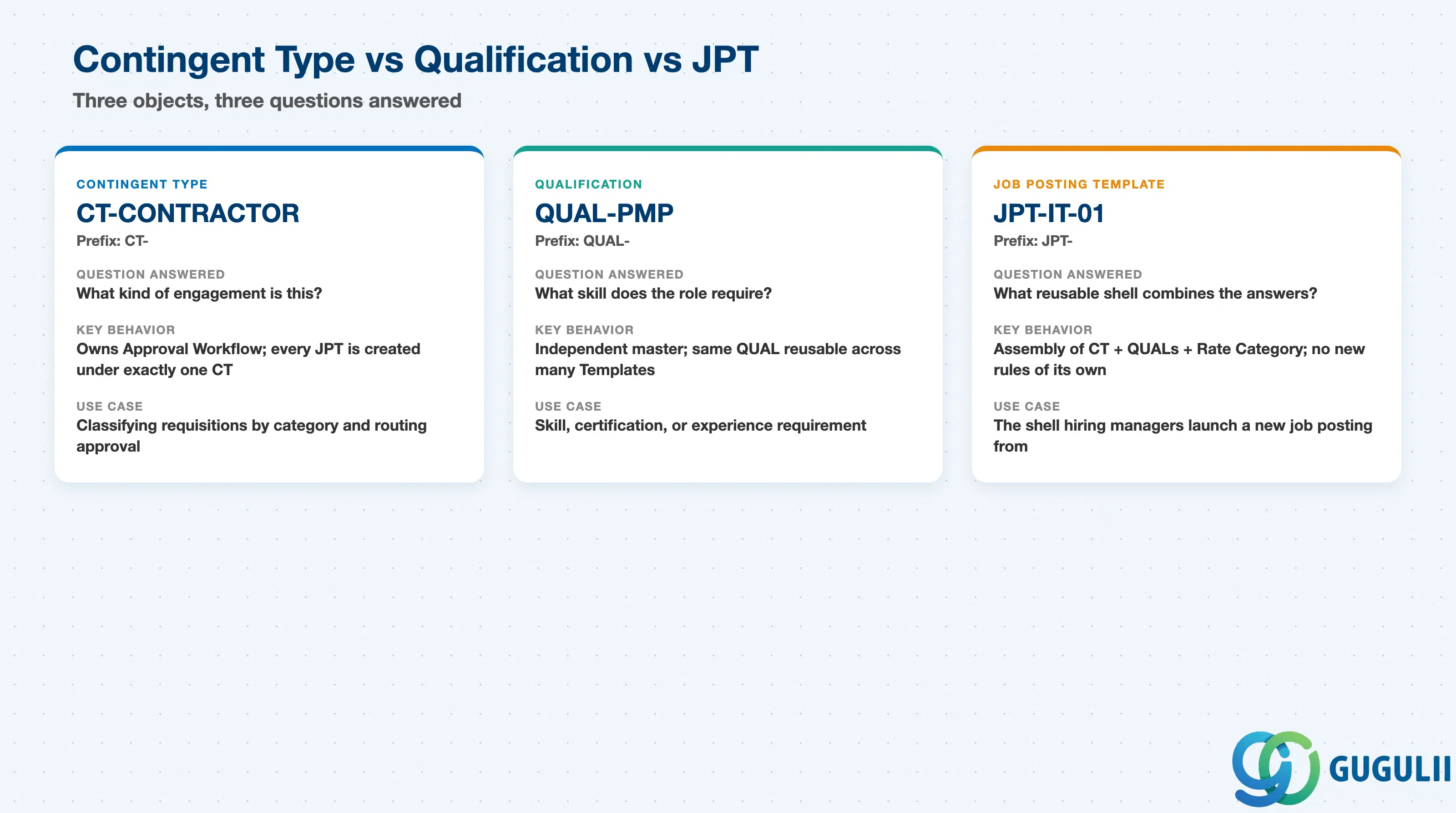
These three objects answer three different questions in job posting setup — what kind of engagement is this, what skill does it require, and what reusable shell combines the answers — and confusing their roles is a common cause of over-built Template libraries.
| Object | Code Prefix | Use Case | Key Behavior |
|---|---|---|---|
| Contingent Type | CT- | Classifying a requisition by engagement category and routing it through the correct approval chain | Owns the Approval Workflow; every Job Posting Template is created under exactly one Contingent Type. |
| Qualification | QUAL- | Stating a skill, certification, or experience requirement a candidate must meet | Maintained independently of any single Template; the same Qualification can be attached to many Templates across job families. |
| Job Posting Template | JPT- | The reusable requisition shell a hiring manager selects to launch a new job posting | Assembles a Contingent Type + one or more Qualifications + a Rate Category into one reusable configuration; holds no new business rules of its own. |
Design principle: A Job Posting Template is not itself a master record with independent behavior — it is an assembly of references (Contingent Type, Qualification, Rate Category) fixed at creation. Changing which Contingent Type or Rate Category a Template points to after live requisitions exist against it is not supported; a new Template must be created instead.
Zone D — Job Posting · SOW · MSP (this object’s own zone): Contingent Type owns Job Posting Template as a true 1:N parent, while Job Posting Template separately references Qualification as a requirement — a reference, not a child, since the same Qualification is reused across many Templates.
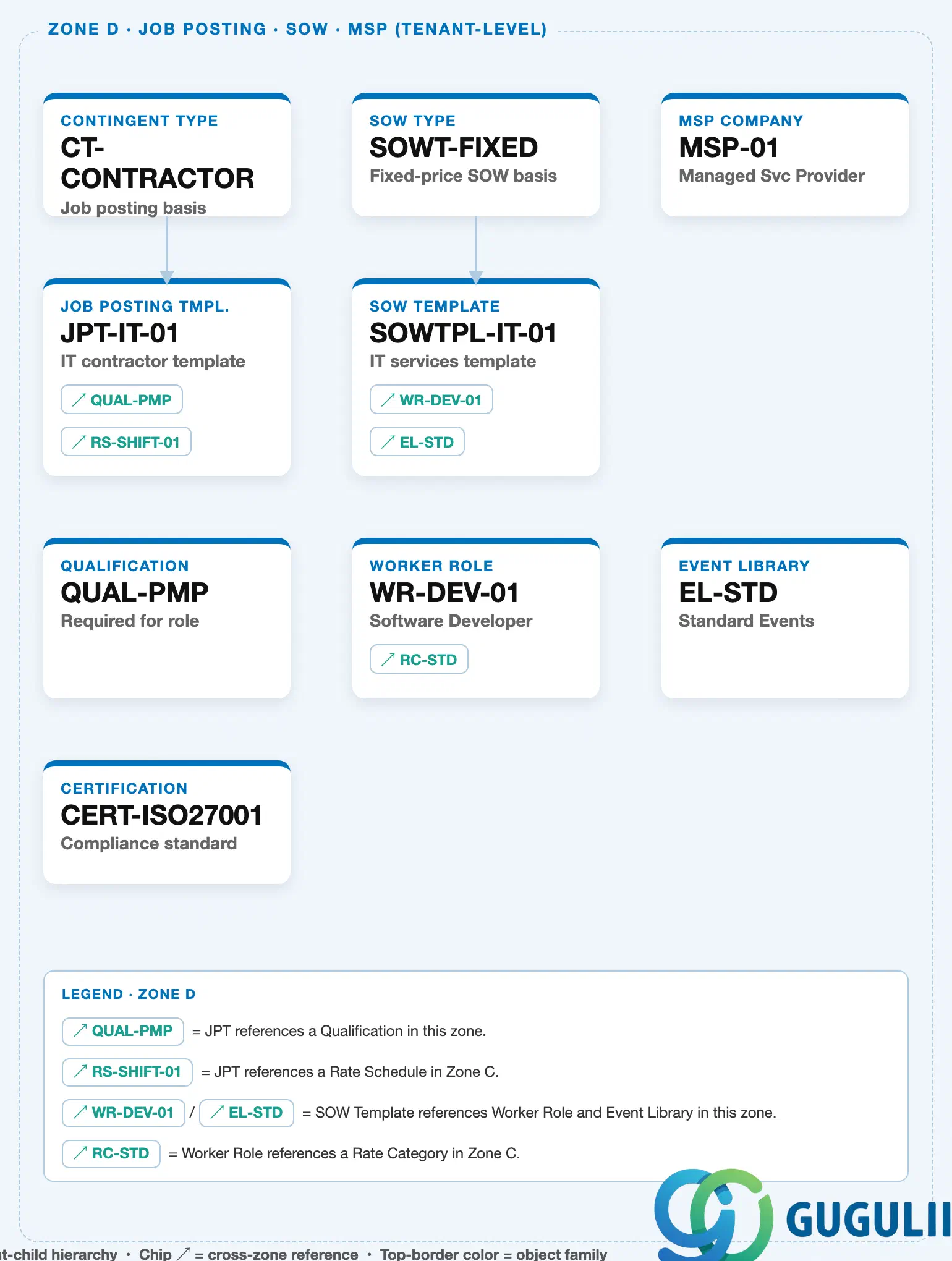
Data hierarchy with a concrete example
Contingent Type "CT-CONTRACTOR" — job posting basis
   │
   └── Job Posting Template "JPT-IT-01" — IT contractor template
          │
          ├── ── requires ──> Qualification "QUAL-PMP" — PMP certification (one or more Qualifications)
          │
└── ── references ──> Rate Schedule "RS-SHIFT-01" (Zone C) — inherits Rate Structure from Rate Category "RC-STD" at creationNote: Qualification is maintained as its own independent master, not nested under Contingent Type — the same Qualification (e.g. “QUAL-PMP”) is commonly attached to Job Posting Templates built on different Contingent Types.
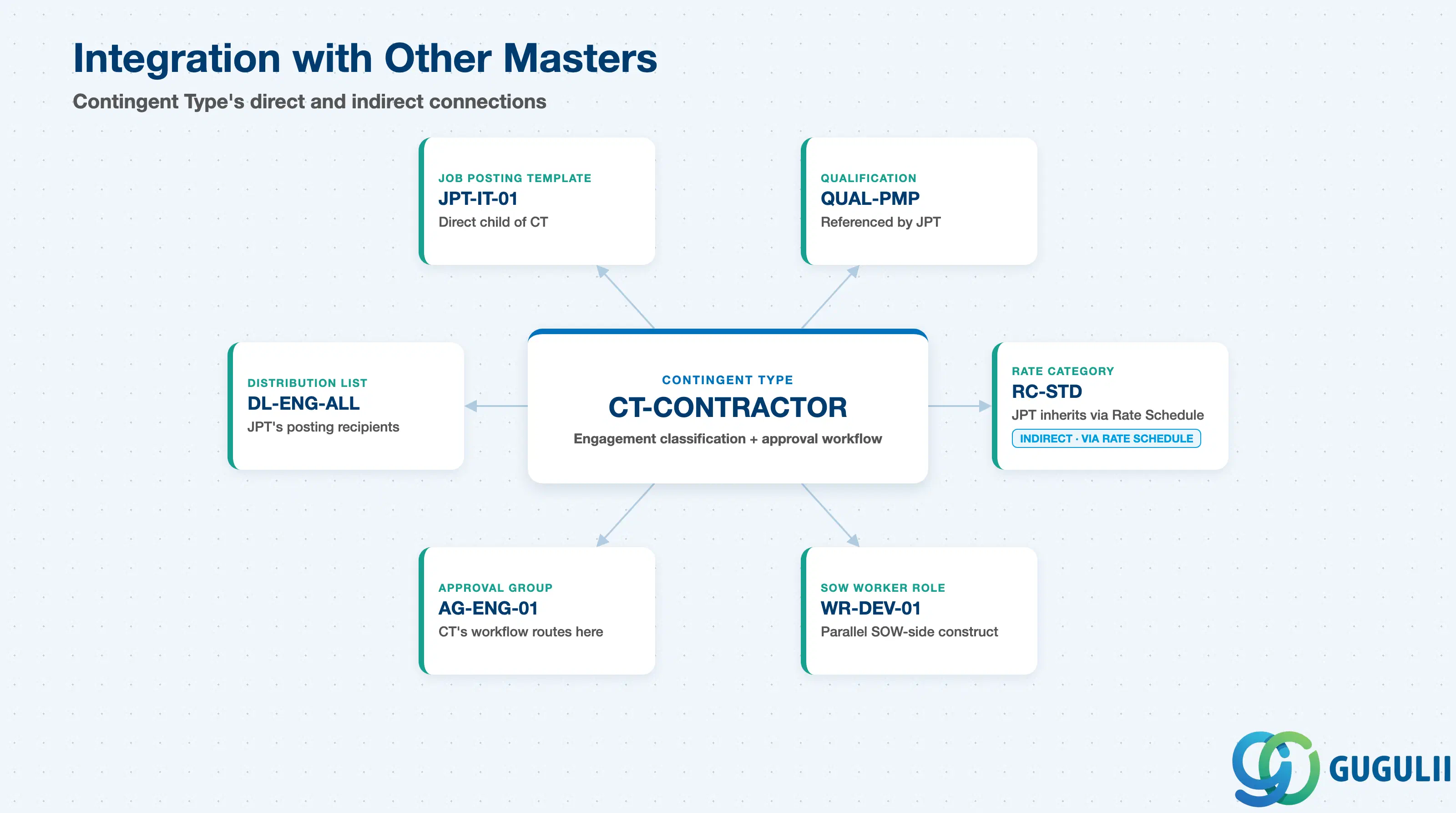
None of these three objects stand alone — Contingent Type reaches into User Management for its workflow, Job Posting Template reaches into Rate Structure for its pricing, and both eventually reach into Company Structure to determine who receives the posting.
| Object | Relationship | Practical Notes |
|---|---|---|
| Job Posting Template | Direct child of Contingent Type — every Template is created under exactly one Contingent Type | Inherits the Contingent Type’s Approval Workflow; the Contingent Type cannot be changed on a Template after live requisitions exist against it. |
| Qualification | Referenced by Job Posting Template, not owned by Contingent Type | One or more Qualifications can be attached to a single Template; the same Qualification is commonly reused across Templates in different job families. |
| Rate Category | Job Posting Template inherits its Rate Structure (Rate Type, Unit of Measure, Currency) from a Rate Category at creation | Fixed at Template creation and cannot be changed later — confirm the correct Rate Category (FG-A04-01) before a Template is cloned across job families. |
| Approval Group | Contingent Type’s Approval Workflow routes requisitions to one or more Approval Groups defined in User Management | A Contingent Type with a long approval chain directly slows time-to-fill; validate the workflow against the client’s actual sign-off policy during blueprint. |
| Distribution List | Job Posting Template’s Distribution Rules typically reference a Distribution List to determine which Suppliers receive the posting | Misconfigured Distribution Rules are a frequent go-live issue — validate against the Distribution List built in FG-A03-04 before go-live. |
| SOW Worker Role | A parallel, SOW-side construct that plays an analogous role to Contingent Type + Qualification for services procurement, but is configured entirely independently | Do not assume a Contingent Type and a Worker Role can be shared or cross-referenced — Contingent Labor and SOW job posting configuration are separate object trees. |
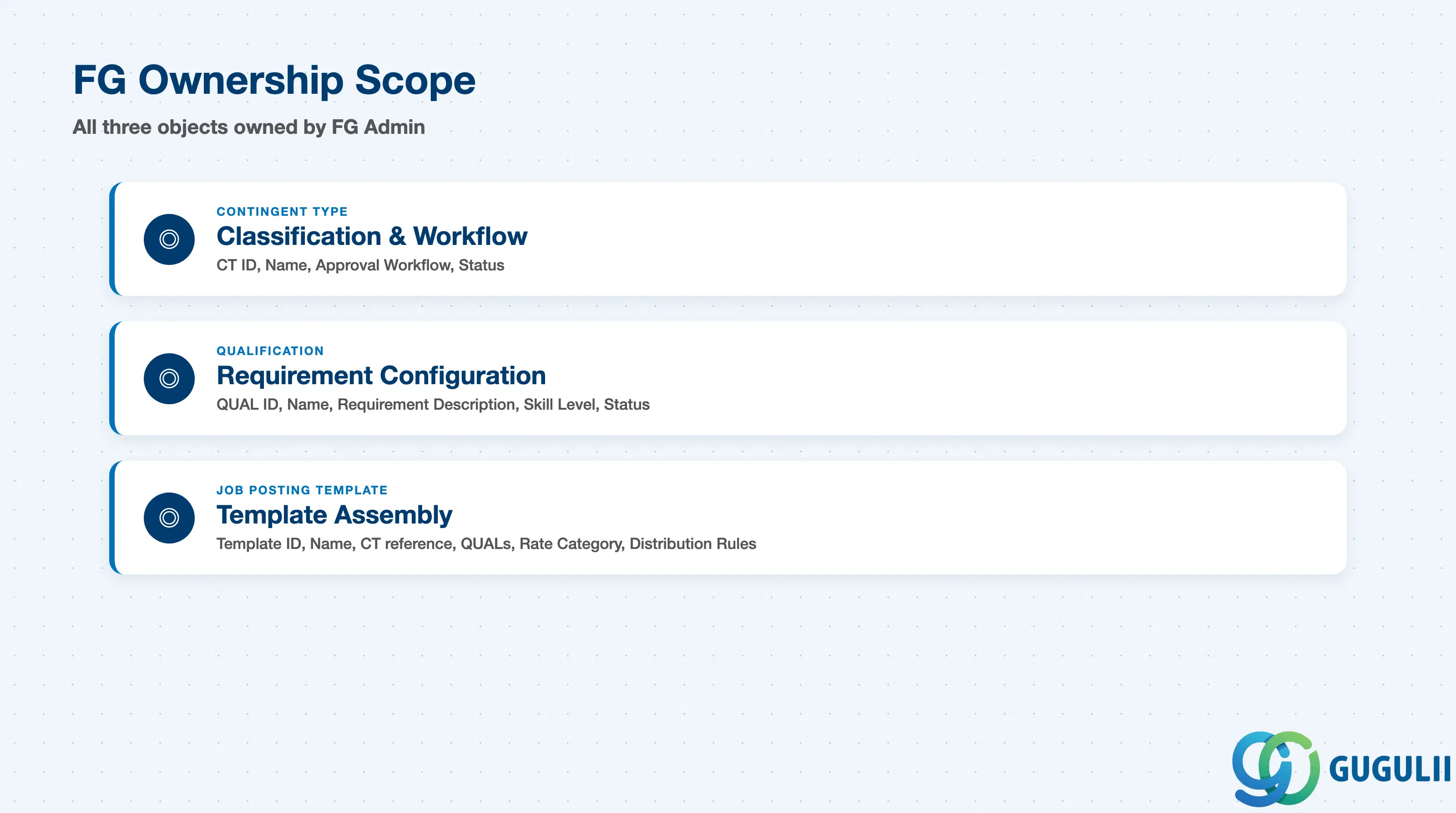
| Data Section | FG Involvement | Notes |
|---|---|---|
| Contingent Type — Classification & Workflow | ◎ Owner | Contingent Type ID, Name, Approval Workflow, Status — created and maintained entirely in Fieldglass Admin |
| Qualification — Requirement Configuration | ◎ Owner | Qualification ID, Name, Requirement Description, Skill Level, Status |
| Job Posting Template — Template Assembly | ◎ Owner | Template ID, Name, Contingent Type reference, Qualifications, Rate Category, Distribution Rules |
Legend: ◎ = Owner / Critical, ○ = Direct involvement
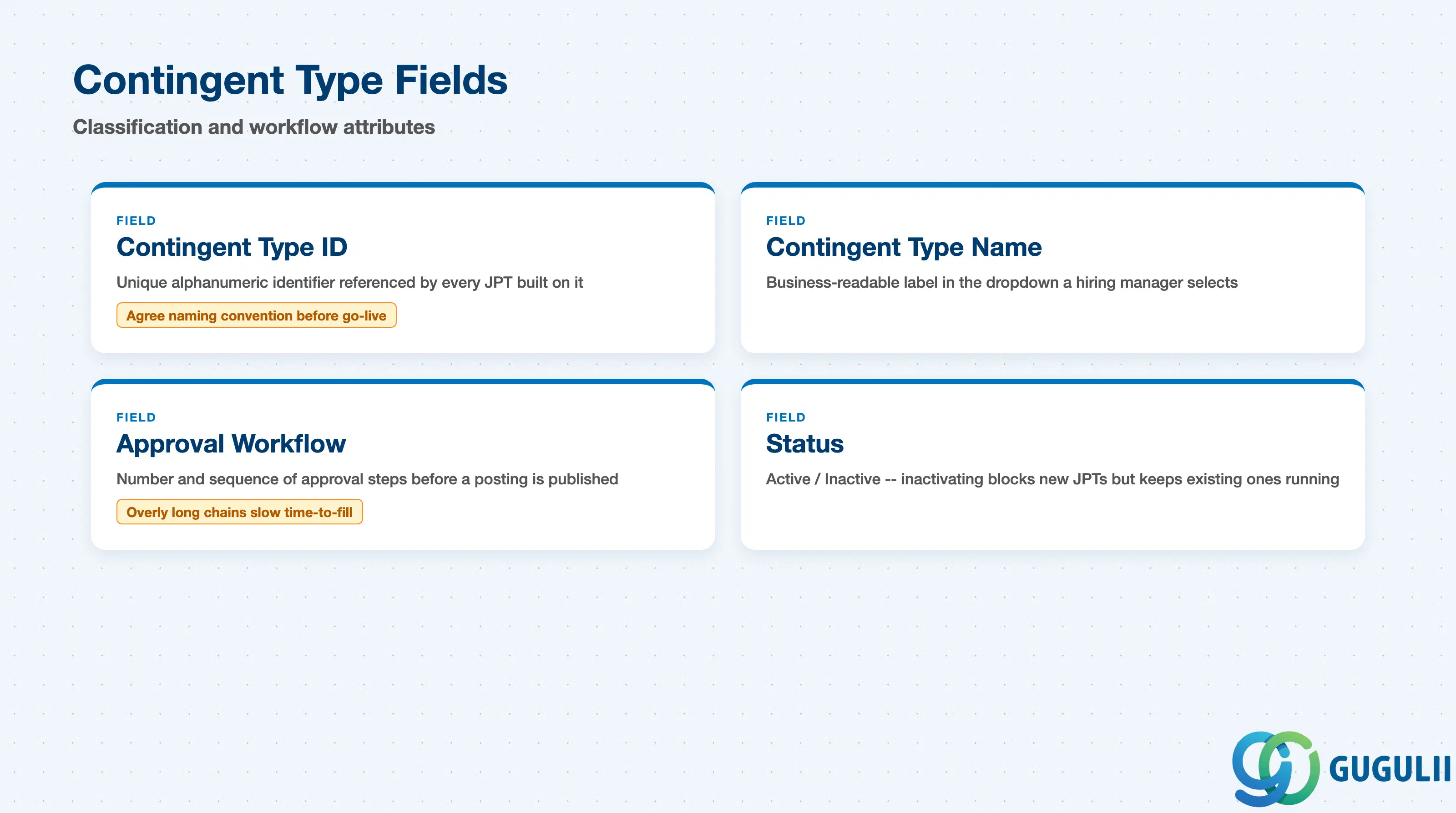
Contingent Type carries the fields that give a requisition its engagement category and its approval path — the two decisions that shape every downstream Job Posting Template built on it.
| Field | Description | Practical Usage |
|---|---|---|
| Contingent Type ID | Unique alphanumeric identifier for the Contingent Type (e.g. CT-CONTRACTOR) | Referenced by every Job Posting Template built on it; agree a naming convention (e.g. by engagement category — contractor, temp staff, intern) before multiple business units create types independently. |
| Contingent Type Name | Business-readable label shown throughout the Admin console | Appears in the dropdown a hiring manager sees when starting a new Job Posting Template; keep names distinguishable at a glance (e.g. “IT Contractor” vs “General Temp Staff”). |
| Approval Workflow | Number and sequence of approval steps a requisition must pass through before a Job Posting Template built on this type can be published | The single most consequential field on the record — an overly long workflow directly slows time-to-fill. Validate the approval chain against the client’s actual sign-off policy during blueprint, not after go-live. |
| Status | Active / Inactive | Inactivating a Contingent Type blocks it from being selected on new Job Posting Templates but does not retroactively affect Templates already built against it; open requisitions continue unaffected. |
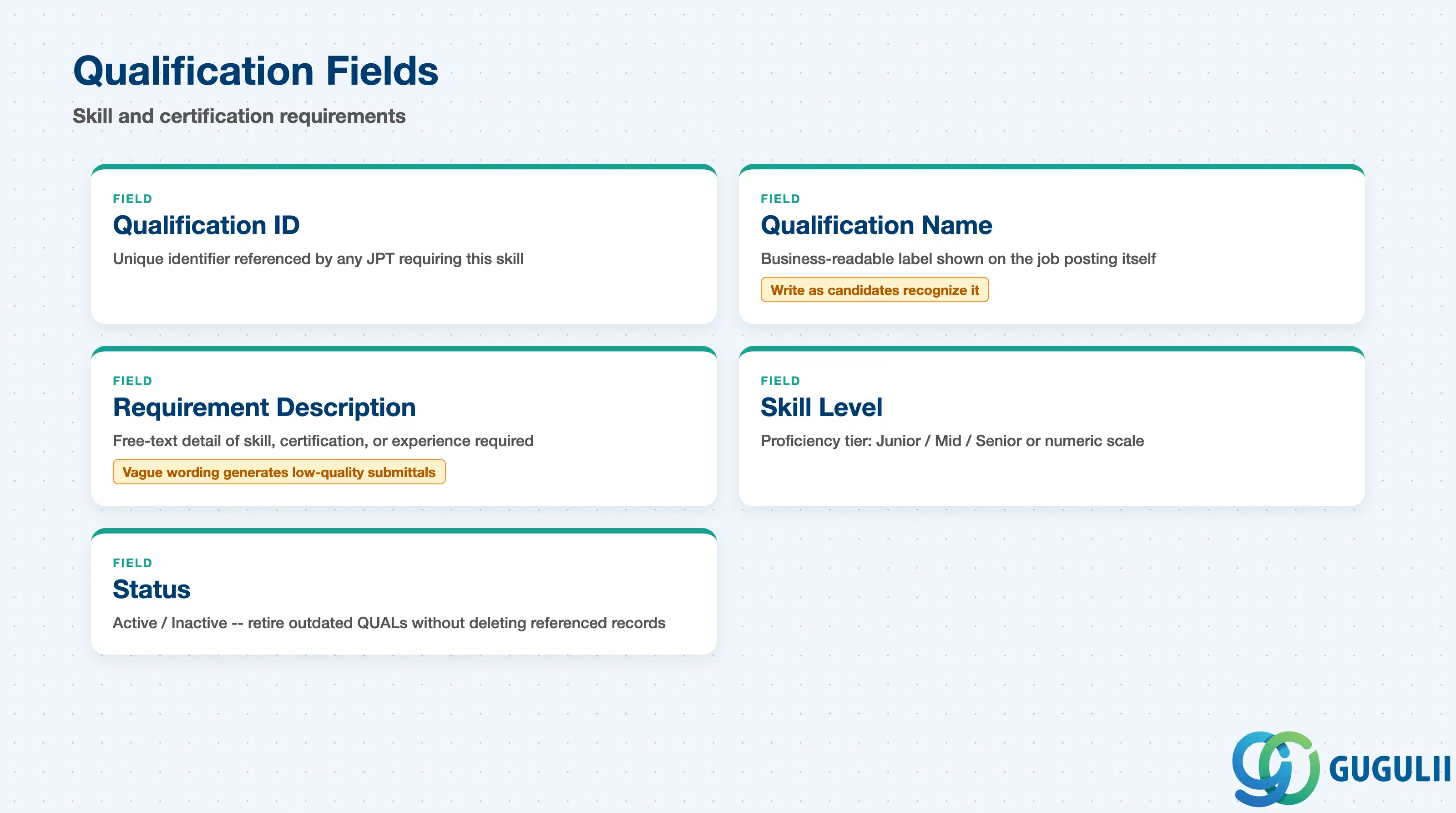
Qualification carries the fields that define a single skill or certification requirement — maintained once and reused across as many Job Posting Templates as apply.
| Field | Description | Practical Usage |
|---|---|---|
| Qualification ID | Unique identifier for the Qualification (e.g. QUAL-PMP) | Referenced by any Job Posting Template requiring this skill or certification; a consistent ID convention (e.g. by certification body or skill category) keeps large Qualification libraries searchable as the tenant matures. |
| Qualification Name | Business-readable label | Displayed on the job posting itself as a stated requirement — write it the way a candidate or supplier recognizes it (e.g. “PMP Certification”), not an internal code. |
| Requirement Description | Free-text detail of the skill, certification, or experience required | Suppliers and candidates read this directly during sourcing; vague wording (“some project experience”) generates low-quality submittals — validate the exact text with the hiring manager before publishing. |
| Skill Level | Proficiency tier tied to the requirement (e.g. Junior / Mid / Senior, or a numeric scale) | Feeds screening and, in some tenants, automated candidate-matching; keep the scale consistent across Qualifications so cross-posting comparisons remain meaningful. |
| Status | Active / Inactive | Retire an outdated Qualification (e.g. an expired certification standard) using Inactive rather than delete while any Job Posting Template still references it. |
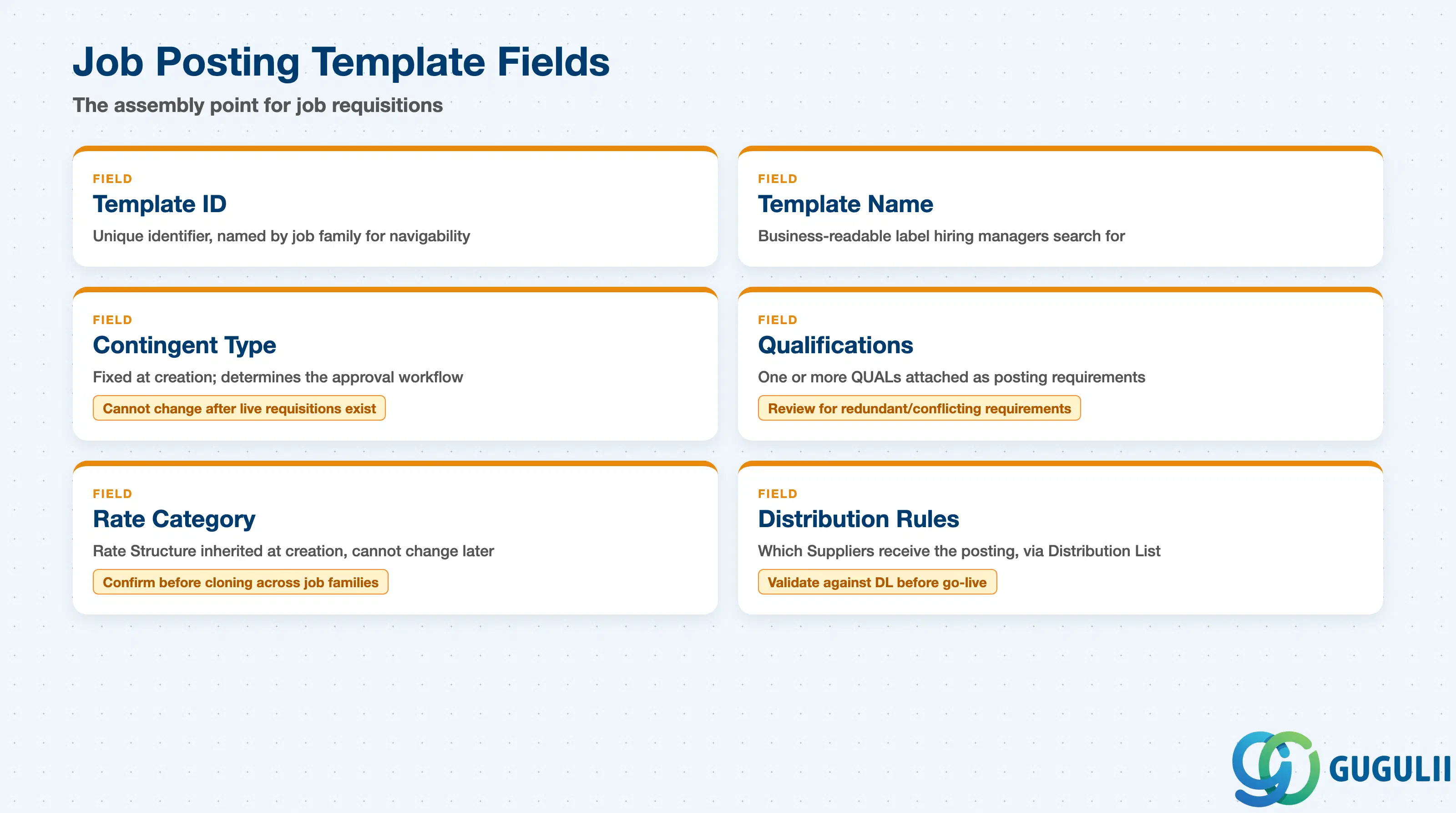
Job Posting Template is the assembly point — every field here either identifies the Template or points at one of the objects it pulls together, rather than defining new business logic of its own.
| Field | Description | Practical Usage |
|---|---|---|
| Template ID | Unique identifier for the Job Posting Template (e.g. JPT-IT-01) | Referenced whenever a hiring manager launches a new requisition from this Template; naming by job family (e.g. IT, Finance, Manufacturing) keeps large Template libraries navigable. |
| Template Name | Business-readable label | The name hiring managers actually search for and select when starting a requisition; write it to match how the business talks about the role, not an internal code. |
| Contingent Type | The Contingent Type this Template is built on | Fixed at Template creation; determines the Approval Workflow every requisition launched from this Template will follow. Confirm the correct Contingent Type before cloning a Template across job families with different approval needs. |
| Qualifications | One or more Qualifications attached as posting requirements | Multiple Qualifications can stack on one Template (e.g. a certification plus a minimum experience level); review the combined list for redundant or conflicting requirements before publishing — a common UAT finding. |
| Rate Category | The Rate Structure (Rates 1.0 or 2.0, see FG-A04-01/FG-A04-02) this Template’s pricing resolves through | Inherited at Template creation and cannot be changed later — confirm the correct Rate Category before Templates are cloned across job families, since a mismatch forces rebuilding the Template rather than editing it. |
| Distribution Rules | Determines which Suppliers, typically via a Distribution List, receive the posting | A frequent go-live issue — a Template pointed at the wrong Distribution List either floods irrelevant Suppliers or reaches none at all. Validate against the Distribution List built in FG-A03-04 before go-live. |
| ID | Category | Title |
|---|---|---|
| fg-001 | Overview | What is SAP Fieldglass? |
| ID | Category | Title |
|---|---|---|
| fg-a01 | Overview | SAP Fieldglass Master Data: Overview, Hierarchy & Relationships |
| fg-a02-01 | Master Data | SAP Fieldglass Site |
| fg-a02-02 | Master Data | SAP Fieldglass Location |
| fg-a02-03 | Master Data | SAP Fieldglass Business Unit |
| fg-a02-04 | Master Data | SAP Fieldglass Cost Center |
| fg-a03-01 | Master Data | SAP Fieldglass User Role |
| fg-a03-02 | Master Data | SAP Fieldglass User |
| fg-a03-03 | Master Data | SAP Fieldglass Approval Group |
| fg-a03-04 | Master Data | SAP Fieldglass Distribution List |
| fg-a04-01 | Master Data | SAP Fieldglass Rate Category |
| fg-a04-02 | Master Data | SAP Fieldglass Rate Grid |
| fg-a04-03 | Master Data | SAP Fieldglass Contingent Type 📍 |
| fg-a04-04 | Master Data | SAP Fieldglass SOW Template |
| fg-a05-01 | Master Data | SAP Fieldglass MSP Company |
| fg-a05-02 | Master Data | SAP Fieldglass Certification |
| ID | Category | Title |
|---|---|---|
| fg-b01 | Overview | SAP Fieldglass Transactions: Process Flow, Hierarchy & Relationships |