Title here
Summary here

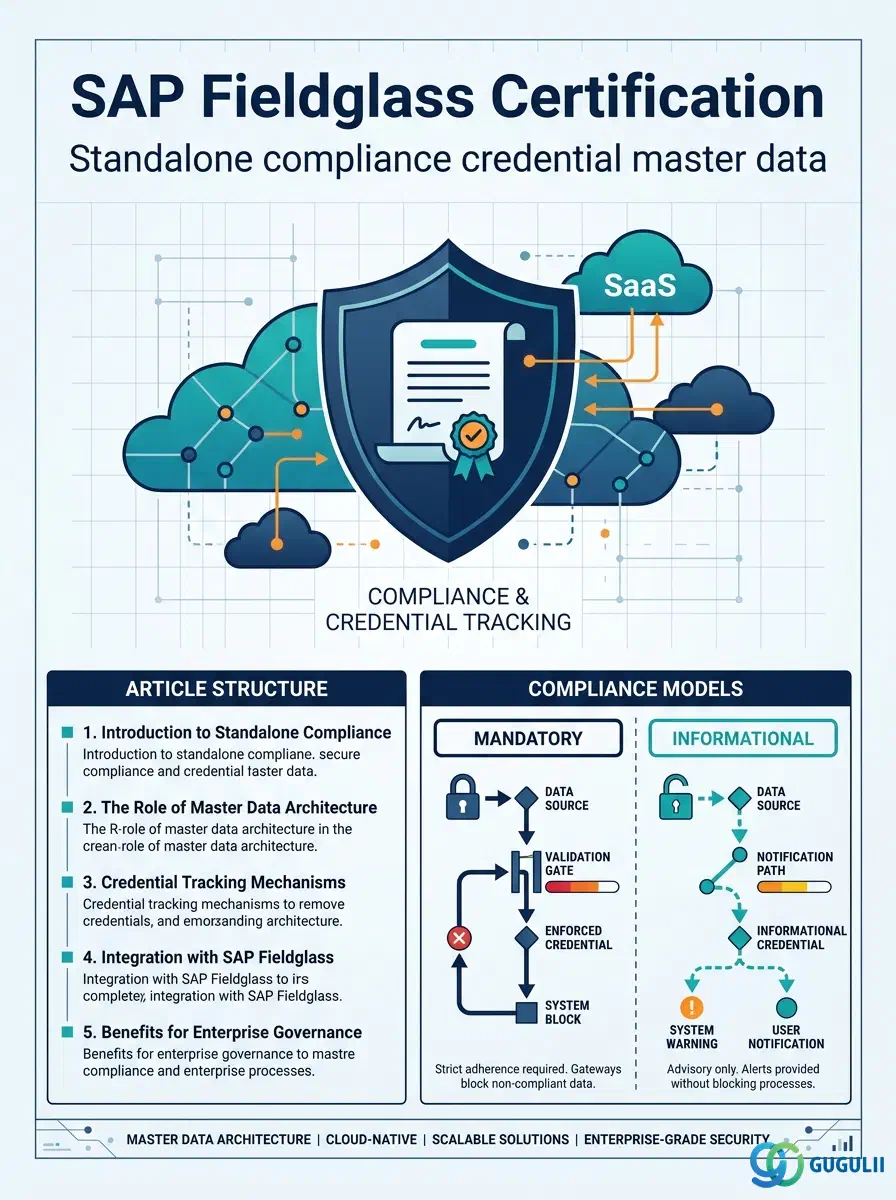
Certification is the second of two Phase 4 objects under MSP & Certification Settings — its sibling, MSP Company, is documented separately in FG-A05-01. Certification is Fieldglass’s compliance-tracking master data object: an Administrator defines the credential types the program needs to track (e.g. an information security certification, a background check, a safety qualification), along with each one’s expiration rule and whether it is a hard, Mandatory prerequisite (Compliance Required). Configuring it is optional: per the module’s own Required vs Optional Master classification, Certification applies only to tenants running an active compliance-tracking program. This article first covers the concepts shared across every Fieldglass process area Certification touches (Part 1) — including, in Section 1.3, why it is the most fully standalone master data object documented in this article series to date — then details every field a Fieldglass Administrator configures for it (Part 2).
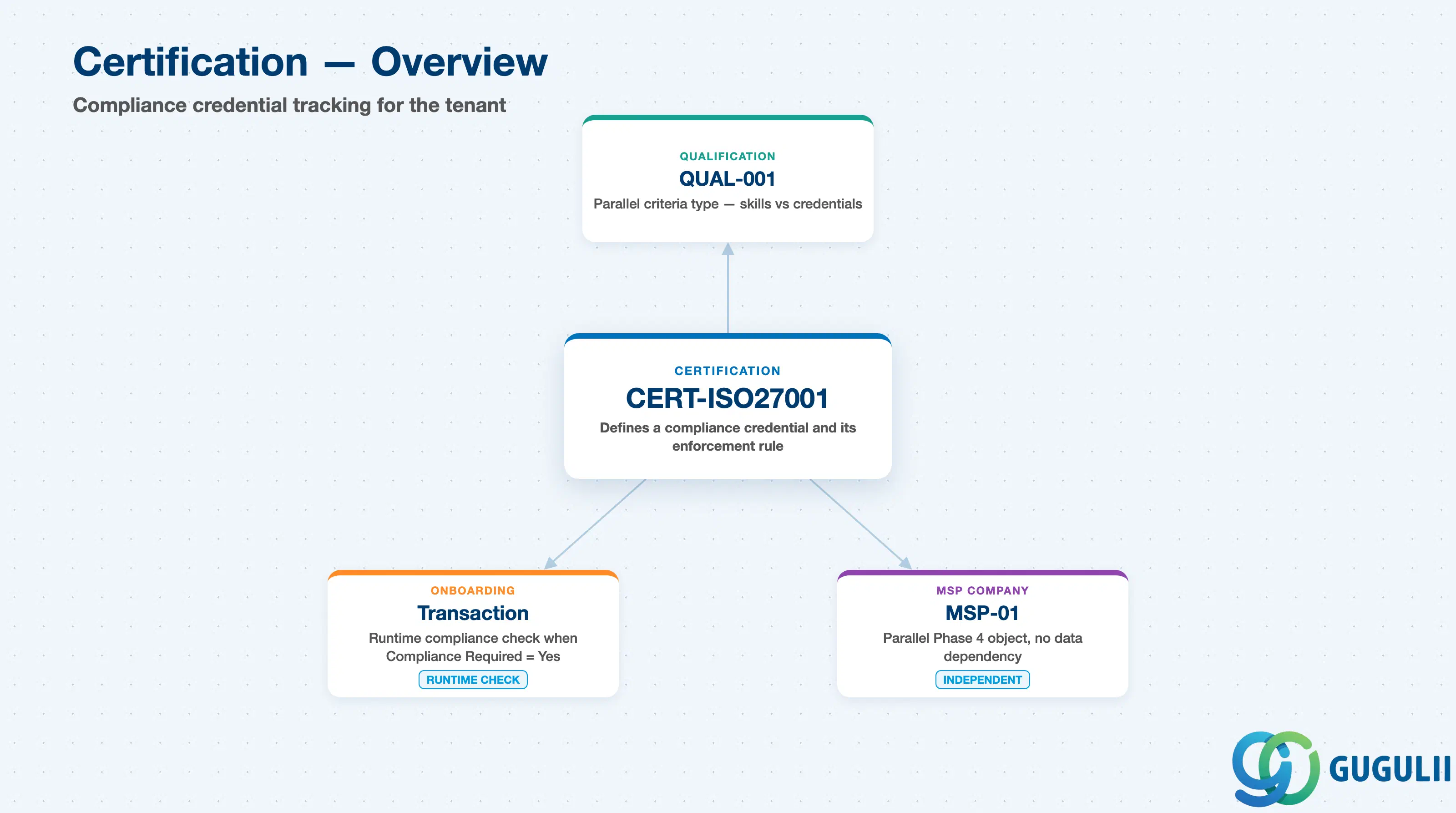
Certification is the record that formally defines a single compliance credential or license type the program tracks, along with the rule that determines whether that credential expires and whether holding a valid one is mandatory. It does not itself define who is eligible to work, what rate applies, or how a requisition is approved — those remain governed by the objects covered in earlier Phase 1–3 articles. Certification simply layers a compliance check on top of the workers and transactions that already flow through the platform.
| Aspect | Details |
|---|---|
| Role | Defines a certification, license, or compliance credential type the tenant tracks, including its expiration rule and whether it is a mandatory (Compliance Required) prerequisite |
| Modules using it | Compliance / Risk Management (applies only to tenants running an active compliance-tracking program; not present in a program that does not formally track worker certifications) |
| Transactions | Admin > Certifications (create/maintain) — Fieldglass is a browser-based SaaS admin console; there are no ABAP-style transaction codes |
| Key Tables | Not applicable — Fieldglass is a multi-tenant SaaS platform. Certification configuration is stored in the tenant’s Admin configuration layer, not in a client-accessible database table |
| Platform note | Certification is Fieldglass-native with no S/4HANA counterpart and, like MSP Company, is never synchronized from S/4HANA. Unlike MSP Company — whose Supplier dependency is real but not yet drawn in the landscape — Certification carries no documented master-data prerequisite at all; the module’s own ER Diagram marks it explicitly as standalone (“Certification (独立)”) — see Section 1.3 |
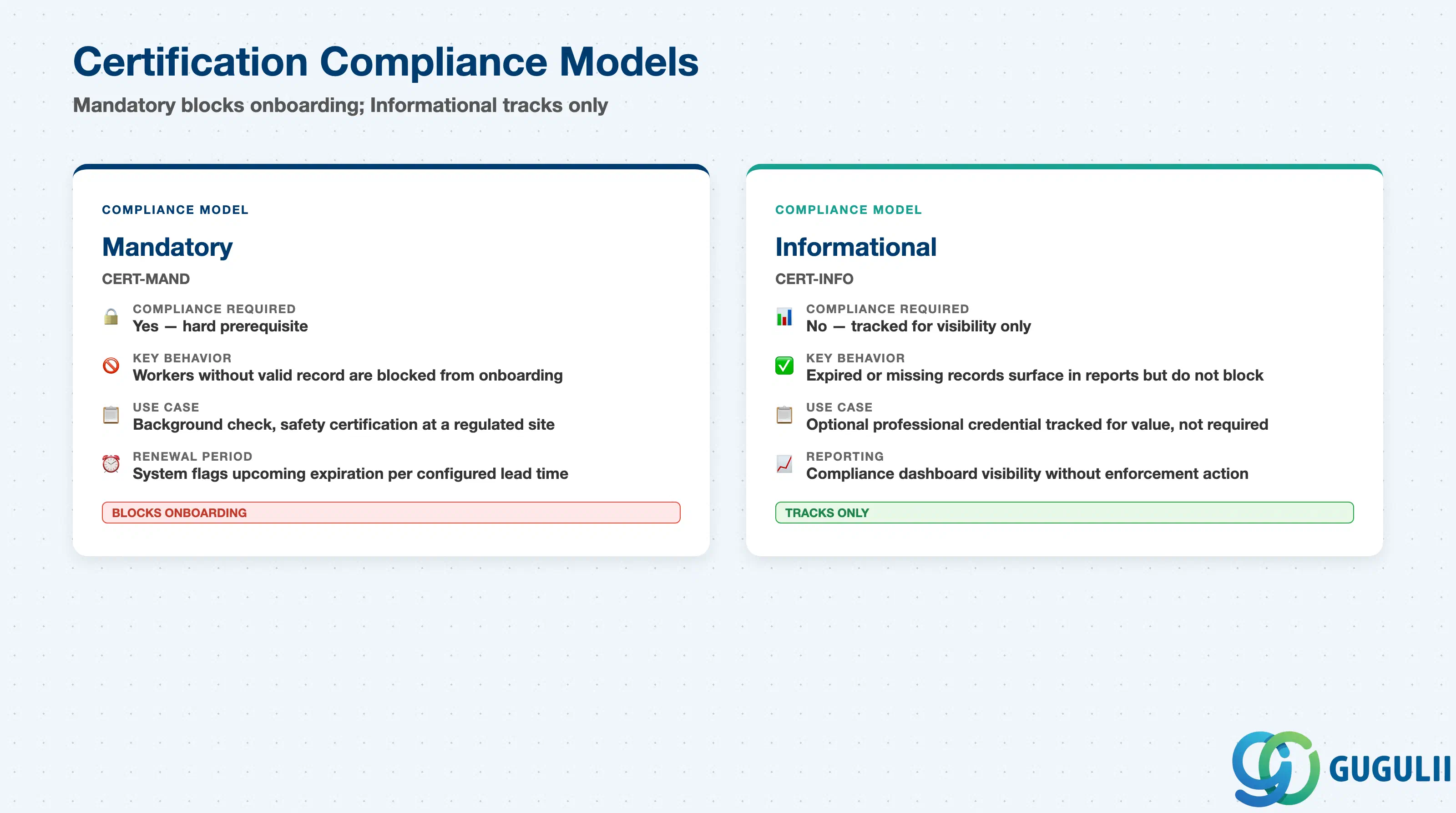
Certification does not carry a formal “Type” field the way Contingent Type or SOW Type do — instead, its Compliance Required field selects between two enforcement models, and getting this setting wrong either creates a silent compliance gap or an unnecessary onboarding blocker.
| Compliance Model | Code | Use Case | Key Behavior |
|---|---|---|---|
| Mandatory | CERT-MAND | Compliance Required = Yes — the credential is a hard prerequisite the program will not waive (e.g. a background check, or a safety certification required at a regulated site) | Workers without a valid, unexpired record of this Certification are blocked from onboarding or work order activation; Renewal Period governs how far in advance the system flags an upcoming expiration |
| Informational | CERT-INFO | Compliance Required = No — the credential is tracked for visibility and reporting but is not a hard onboarding gate (e.g. an optional professional credential) | Expired or missing records surface in compliance reporting but do not block onboarding or transaction processing; useful for tracking credentials that add value without being contractually or legally mandatory |
Design principle: Confirm with the client’s compliance or legal stakeholder which credentials are truly mandatory before configuration — flagging a certification as Informational when the underlying contract or regulation actually requires it as Mandatory creates a compliance gap that Fieldglass will not catch on its own.
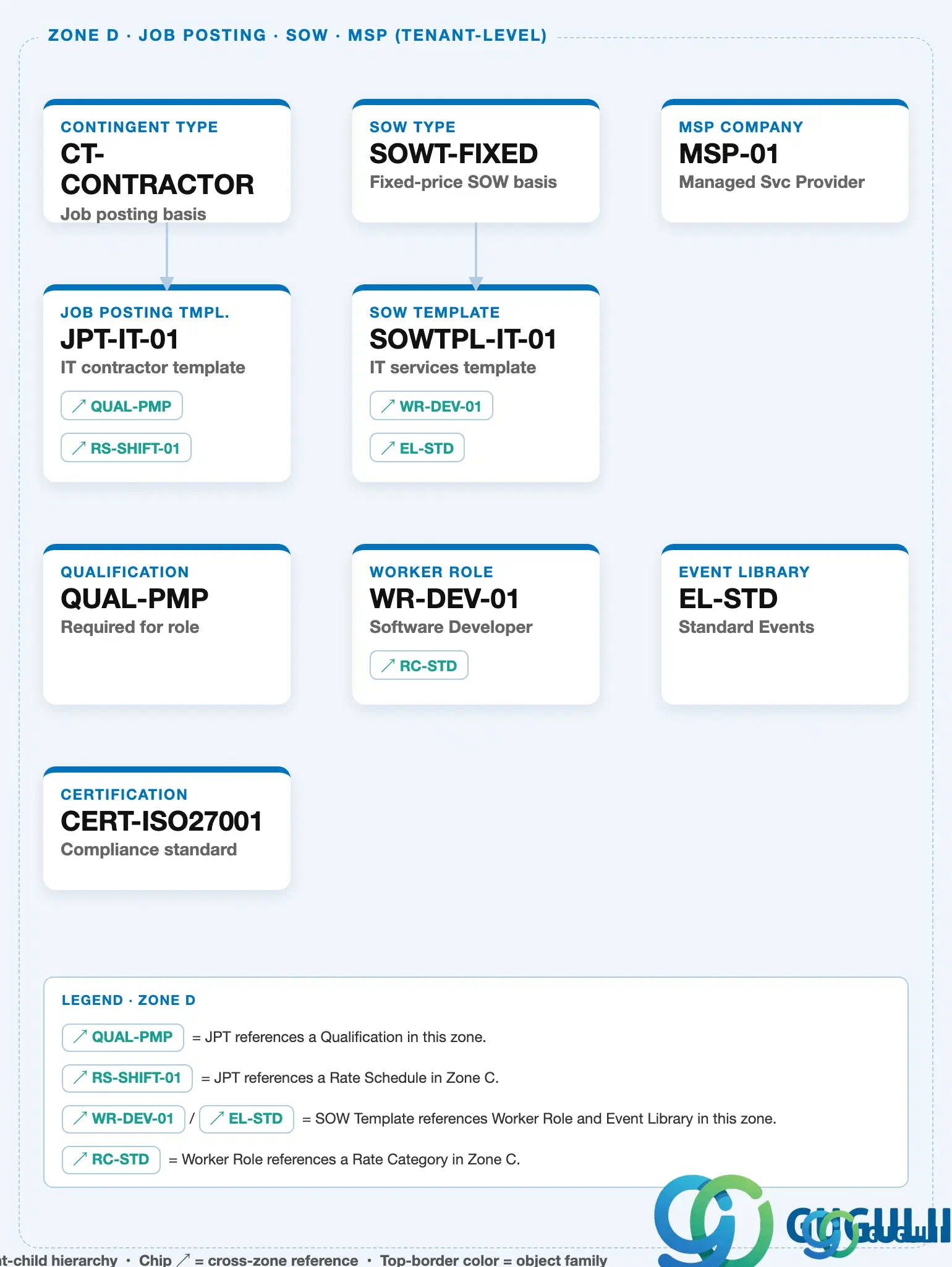
Zone D — Job Posting · SOW · MSP (this object’s own zone): Certification is a standalone tenant-level node at Row 4 of Zone D — it owns no children and carries no outbound line or chip to any other Zone D object, and — unlike MSP Company one row above it — no inbound chip from any other Zone D node either.
Data hierarchy with a concrete example
Zone D position (standalone tenant-level object — no children, no outbound chip,
no inbound chip from any other Zone D node)

Certification "CERT-ISO27001" — ISO 27001 Information Security  ◄── this article
Certification "CERT-BG-CHECK" — Background Check / Drug Screening  ◄── this article

No real-world master data prerequisite documented in the Setup Flow or ER Diagram
(Setup Flow: "25. Certification ← (-)"; ER Diagram: "Certification (独立)") —
genuinely standalone, unlike MSP Company's real Supplier dependency documented in FG-A05-01
Certification sits in Zone D of the Fieldglass Master Data Landscape as a standalone Row 4 card, below Contingent Type, SOW Type, and MSP Company — but unlike all three, it carries neither an outbound chip to another Zone D object nor an inbound chip from one. The corrected landscape confirms this directly: no solid line connects Certification to MSP Company (the two Phase 4 objects are configured independently of one another, exactly as already stated from the MSP Company side in FG-A05-01), and no dashed reference arrow points into or out of the Certification node from any other zone.
The module’s own Setup Flow entry — “25. Certification ← (-)” — and its ER Diagram entry — “Certification (独立)” — both confirm Certification has no documented real-world master-data prerequisite. This differs meaningfully from MSP Company (FG-A05-01), whose Supplier dependency is real but simply not yet drawn as a cross-zone chip on the current landscape; Certification genuinely has no prerequisite documented anywhere in the source data. It is the most fully standalone object covered in this article series to date — a tenant can create Certification records the moment the module is provisioned, with no other master data object needing to exist first.
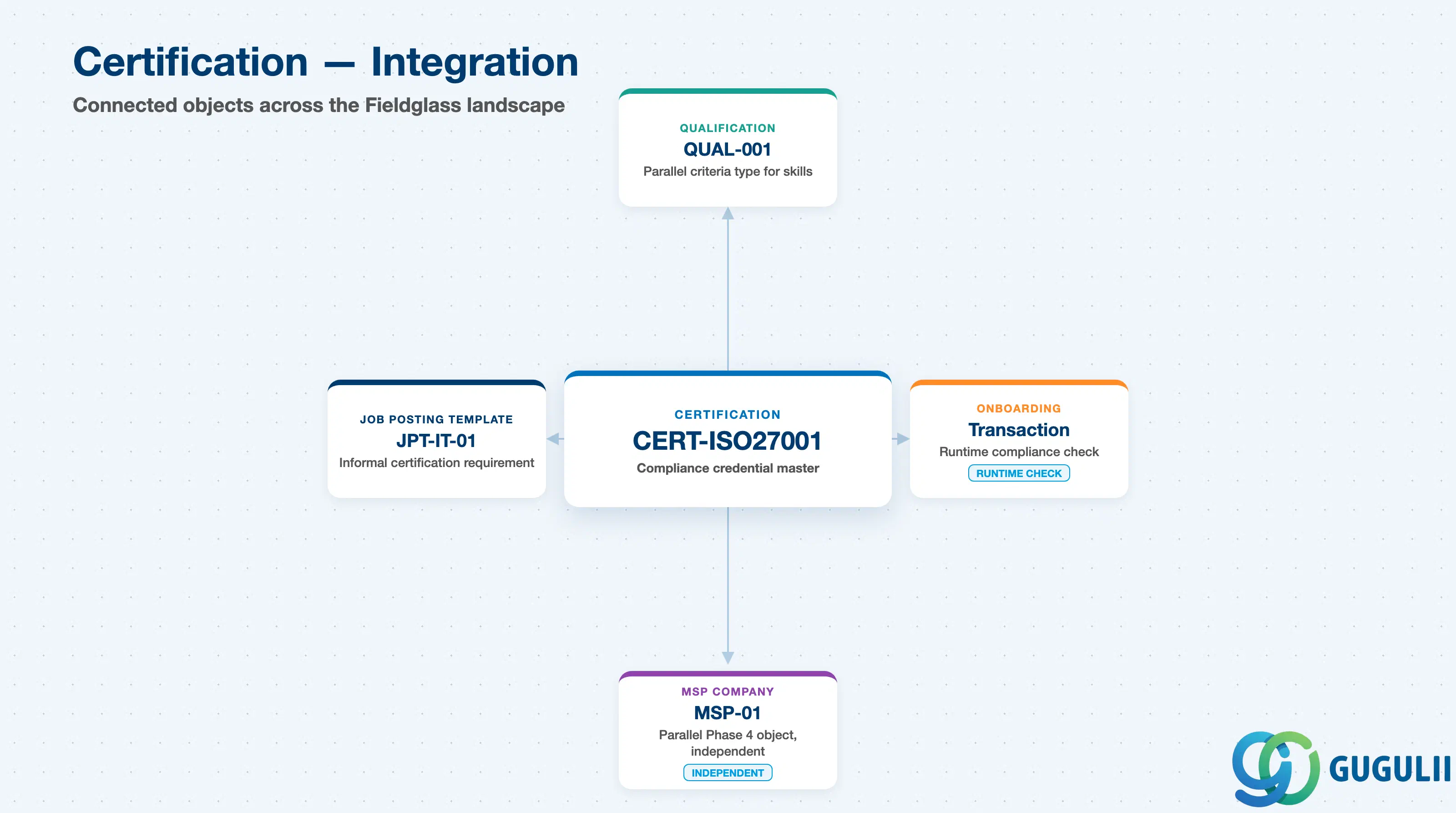
Certification does not attach to other master data objects through any formal, field-level reference documented in the Master Data source — but that does not mean it operates in isolation from the rest of the program. Its practical relationships run through transaction-level compliance checks and administrative grouping rather than configured object links.
| Object | Relationship | Practical Notes |
|---|---|---|
| Qualification (FG-A04-03) | Both represent criteria attached to job requirements — Qualification defines skill/experience requirements at the Job Posting Template level, Certification defines compliance/credential requirements — but no formal object reference exists between them in the Master Data source | Treat Qualification and Certification as parallel, independently-configured criteria types; do not assume configuring one populates or references the other |
| Onboarding (Transaction, FG-B02) | When Compliance Required = Yes, Certification records are checked against the individual worker during the Onboarding step of the Contingent Labor transaction flow | This is a runtime transactional check, not a master-data link — the current documented model has no standalone Worker master data object, so the check happens against the worker’s profile data at transaction time rather than through a configured field reference |
| Job Posting Template (FG-A04-03) | Job postings for roles requiring proof of a specific compliance credential (e.g. a safety certification for a regulated site) reference the certification requirement informally during candidate screening | No direct field-level link exists between Certification and Job Posting Template in the Master Data source; document the requirement in the posting’s free-text requirements or attached Qualification rather than expecting a native Certification field on the template |
| MSP Company (FG-A05-01) | A parallel, independently-configured Phase 4 object that shares the MSP & Certification Settings administrative grouping but has no data dependency on Certification | Do not assume Certification and MSP Company share configuration or that one is a prerequisite for the other — they are unrelated except by administrative grouping, the same pattern already seen between Contingent Type and SOW Type in FG-A04-03/FG-A04-04 |
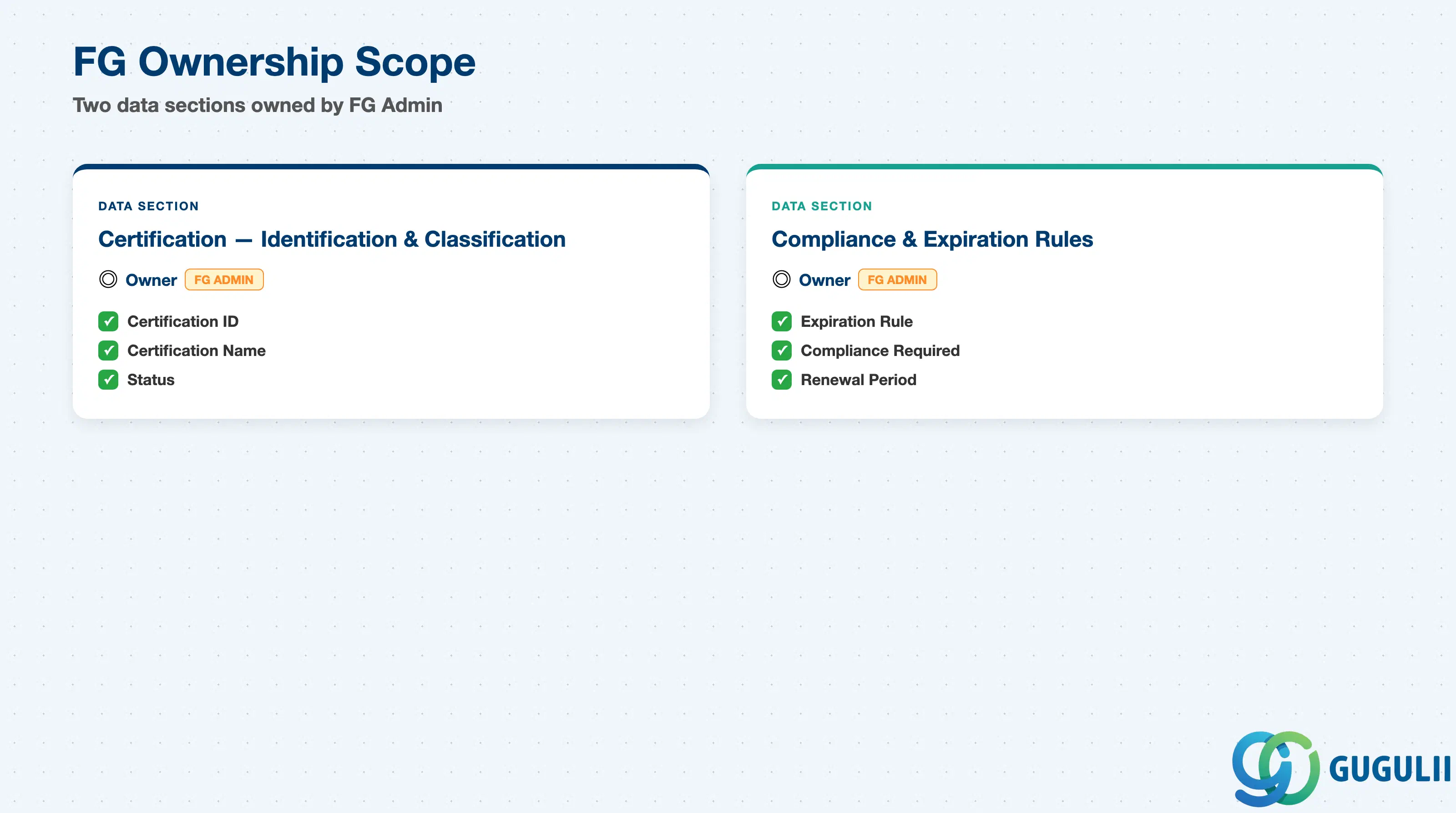
| Data Section | FG Involvement | Notes |
|---|---|---|
| Certification — Identification & Classification | ◎ Owner | Certification ID, Certification Name, Status — created and maintained entirely in Fieldglass Admin |
| Compliance & Expiration Rules | ◎ Owner | Expiration Rule, Compliance Required, Renewal Period — governs whether the certification blocks onboarding and how expirations are tracked |
Legend: ◎ = Owner / Critical, ○ = Direct involvement
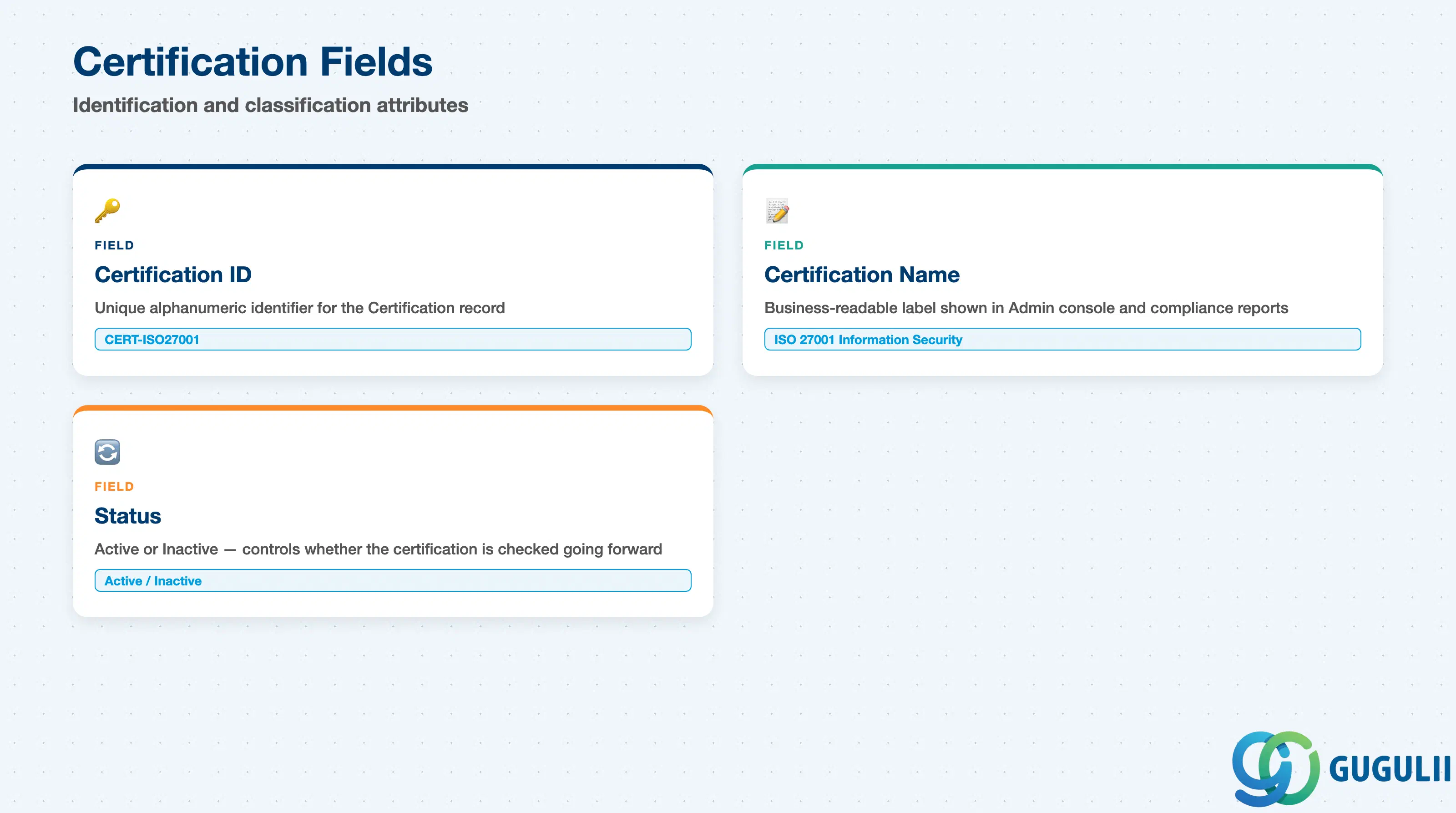
Certification carries the fields that identify the record and label it consistently across Admin, compliance reporting, and onboarding checks.
| Field | Description | Practical Usage |
|---|---|---|
| Certification ID | Unique alphanumeric identifier for the Certification record (e.g. CERT-ISO27001) | Reference this ID consistently across compliance reporting and any downstream integration; keep it stable even if the certification’s issuing body or exact name is updated later, since historical audit trails typically tie back to the ID |
| Certification Name | Business-readable label shown throughout the Admin console and in compliance reports | Use the credential’s actual industry or regulatory name (e.g. “ISO 27001 Information Security Management”), not an internal shorthand, since this name may surface directly in client-facing compliance audits |
| Status | Active / Inactive | Inactivating a Certification record stops it from being checked against new onboarding going forward but does not retroactively clear compliance flags already recorded against closed transactions; coordinate the inactivation date with the client’s compliance or legal team, particularly if the underlying regulation itself is still in force |
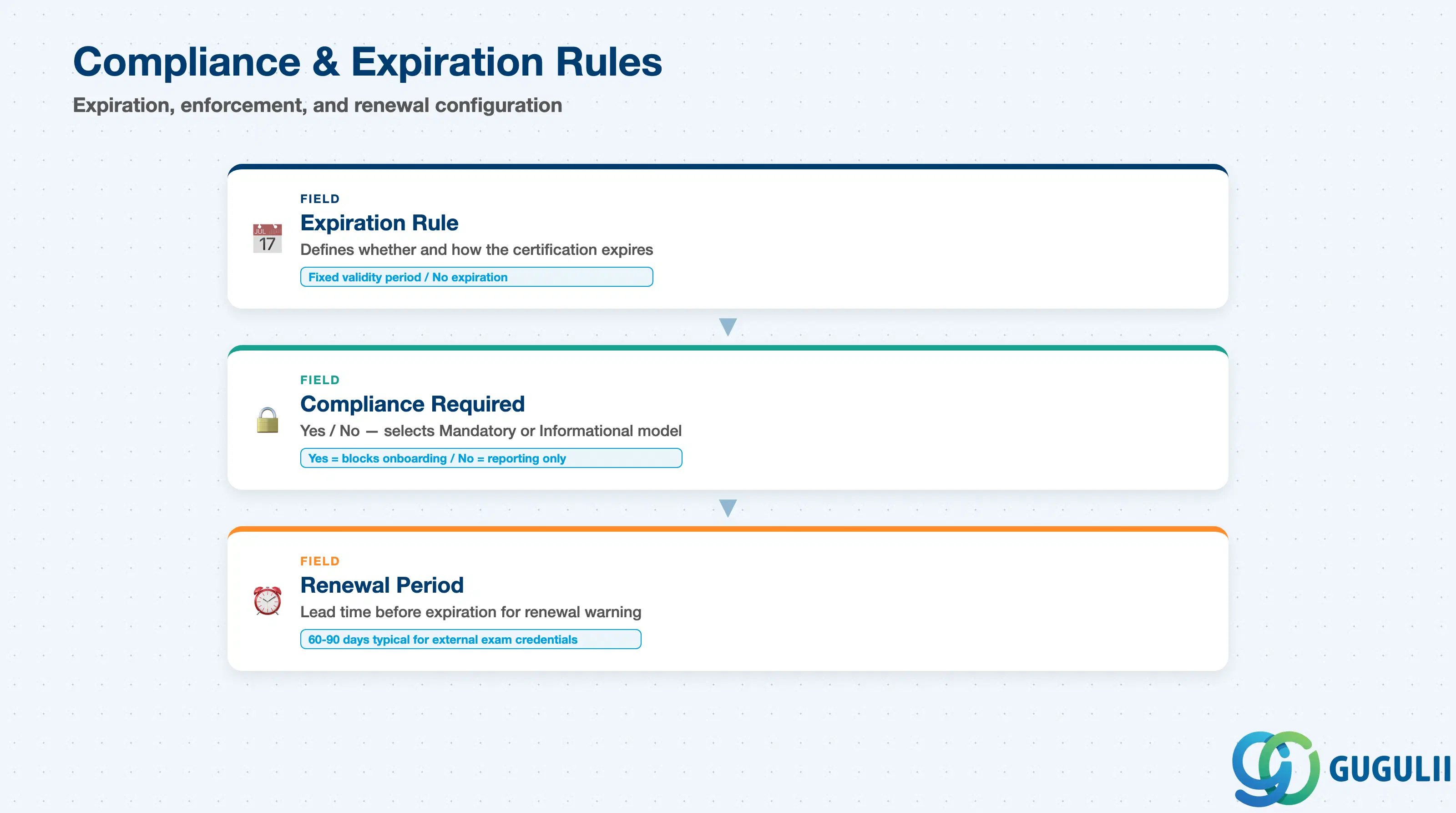
Compliance & Expiration Rules carries the three fields that determine whether a credential lapses, whether it blocks onboarding, and how far in advance the program is warned before it does — the enforcement core of the Certification record.
| Field | Description | Practical Usage |
|---|---|---|
| Expiration Rule | Defines whether and how the certification expires (e.g. a fixed validity period from the issue date, or no expiration) | Confirm the actual validity period against the certifying body’s own rules rather than an assumed default — getting this wrong either lets an expired credential silently remain “valid” in the system or flags a still-current one as expired |
| Compliance Required | Yes / No — determines whether this Certification follows the Mandatory or Informational compliance model (see Section 1.2) | Set this in direct alignment with the client’s actual contractual or regulatory obligation; a Yes value blocks onboarding for workers missing a valid record, so confirm the operational impact with the program stakeholder before enabling it broadly |
| Renewal Period | The lead time before expiration at which the system flags the certification for renewal | Align this with the client’s actual administrative lead time for renewal (e.g. 60–90 days for a credential requiring an external exam or audit), not a generic default — too short a Renewal Period risks a worker’s certification lapsing before a replacement can be processed |
| ID | Category | Title |
|---|---|---|
| fg-001 | Overview | What is SAP Fieldglass? |
| ID | Category | Title |
|---|---|---|
| fg-a01 | Overview | SAP Fieldglass Master Data: Overview, Hierarchy & Relationships |
| fg-a02-01 | Master Data | SAP Fieldglass Site |
| fg-a02-02 | Master Data | SAP Fieldglass Location |
| fg-a02-03 | Master Data | SAP Fieldglass Business Unit |
| fg-a02-04 | Master Data | SAP Fieldglass Cost Center |
| fg-a03-01 | Master Data | SAP Fieldglass User Role |
| fg-a03-02 | Master Data | SAP Fieldglass User |
| fg-a03-03 | Master Data | SAP Fieldglass Approval Group |
| fg-a03-04 | Master Data | SAP Fieldglass Distribution List |
| fg-a04-01 | Master Data | SAP Fieldglass Rate Category |
| fg-a04-02 | Master Data | SAP Fieldglass Rate Grid |
| fg-a04-03 | Master Data | SAP Fieldglass Contingent Type |
| fg-a04-04 | Master Data | SAP Fieldglass SOW Template |
| fg-a05-01 | Master Data | SAP Fieldglass MSP Company |
| fg-a05-02 | Master Data | SAP Fieldglass Certification 📍 |
| ID | Category | Title |
|---|---|---|
| fg-b01 | Overview | SAP Fieldglass Transactions: Process Flow, Hierarchy & Relationships |