Title here
Summary here

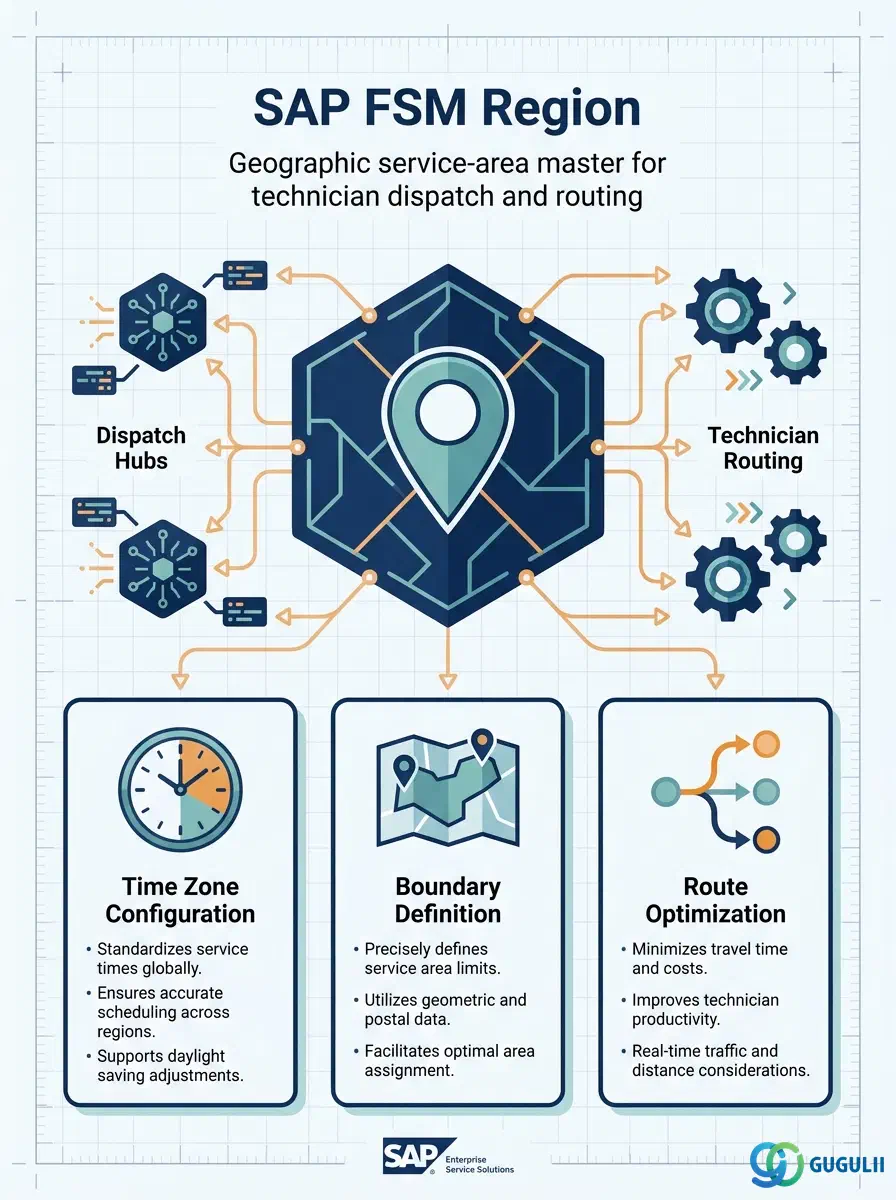
Region is FSM’s master record for a defined geographic service area — the boundary, time zone, and roster of assigned technicians that Assisted Scheduling and Route Optimization check when matching a Service Call to a candidate technician by location. It is configured independently at the tenant level, then assigned to Person/Technician records (FSM-A04-04) so that dispatch tools know which technicians actually cover a given geography, and to interpret the local time carried on each technician’s Work Time Pattern (FSM-A04-02). Region is flagged as a required master alongside Business Partner, Skill, and Person/Technician — an FSM tenant without at least one defined Region cannot scope technician dispatch geographically. Region is the third object in the Technician Management domain (Phase 3, Zone C) covered in this series, alongside Skill (FSM-A04-01), Work Time Pattern (FSM-A04-02), Person/Technician, Crew, Absence, and Skill Requirement. This article maps every field FSM consultants configure on a Region record, and how those fields connect to the Person/Technician master around it.
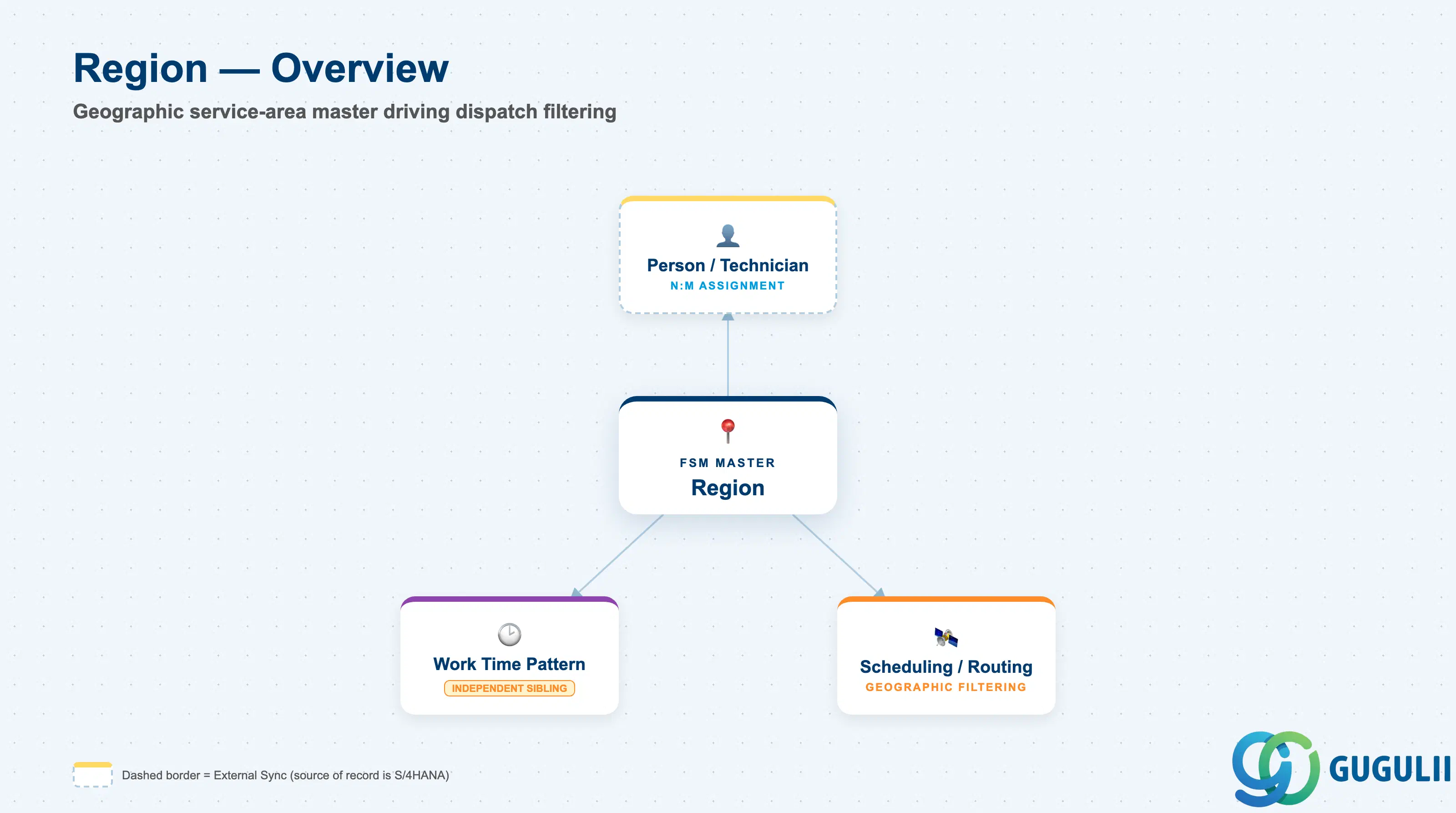
A Region represents a single, named geographic service area — a boundary, a time zone, and the roster of technicians assigned to cover it. It is a deliberately small, flat master carrying no organizational hierarchy of its own, and it means nothing in isolation: its purpose is entirely to be assigned to one or more technicians so that dispatch tools have a geography to filter candidates against.
| Aspect | Details |
|---|---|
| Role | Master record of a defined geographic service area; assigned to Person/Technician and read by Assisted Scheduling / Route Optimization to filter and route technicians by location |
| Modules using it | FSM (Technician Management — sole owner; Region is FSM-native with no S/4HANA source master) |
| Transactions | FSM Web UI “Master Data Management” app (same area used for Skill and most other Technician Management masters, distinct from the “Settings and Configuration” area used for Work Time Pattern) |
| Key Tables | FSM: Region business object (Core API / OData entity) — FSM is a multi-tenant cloud solution and does not use classical ABAP tables; there is no S/4HANA table equivalent |
| S/4HANA note | Region is not replicated in from S/4HANA — it is created and maintained natively in FSM. Unlike Work Time Pattern (an optional master), Region is listed as a required master alongside Business Partner, Skill, and Person/Technician: an FSM tenant cannot geographically scope technician dispatch without at least one Region defined |
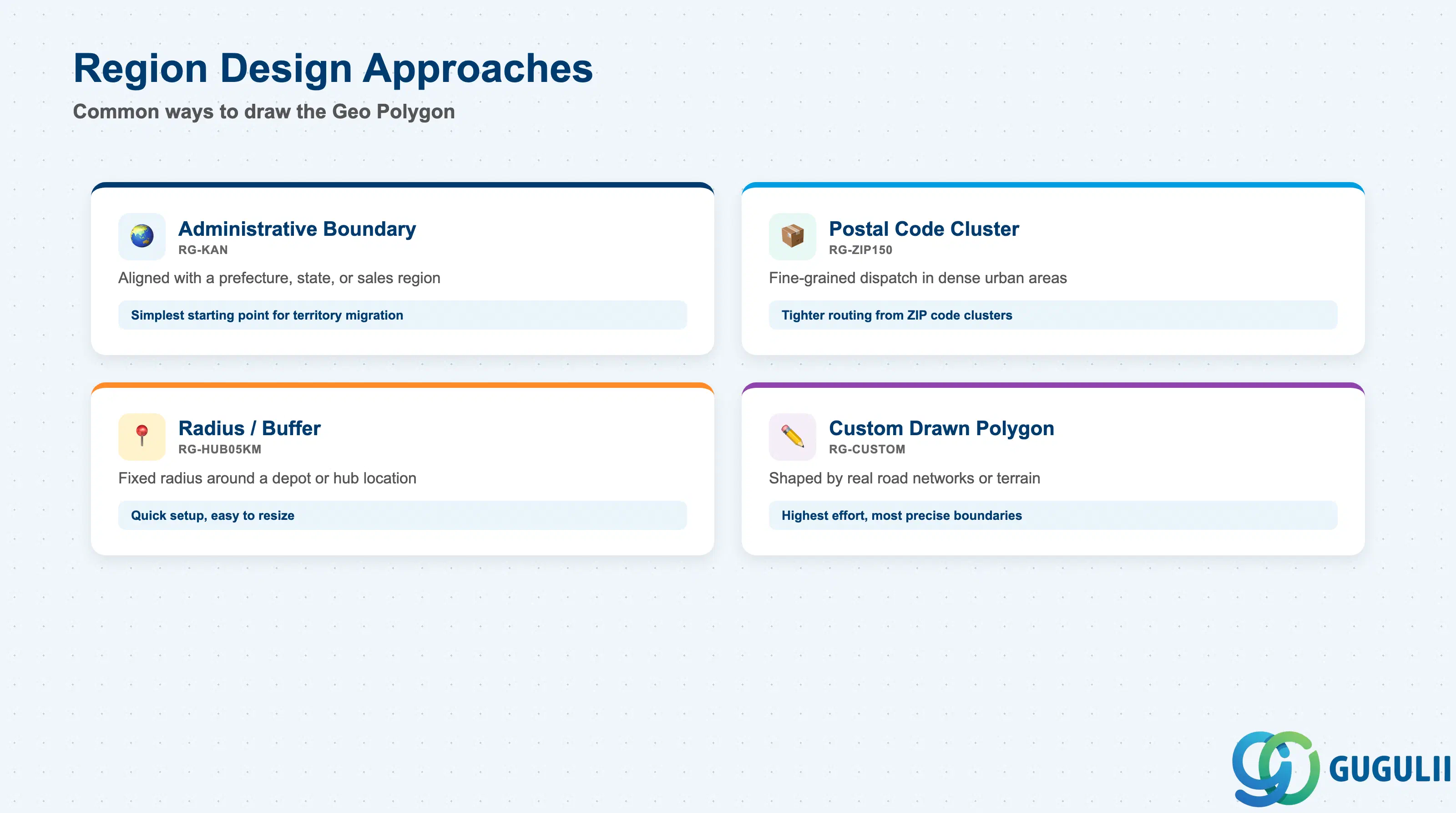
Region carries no separate classification field of its own — Region ID, Region Name, and Geo Polygon are configured directly, and any of the approaches below is expressed through the same Geo Polygon field. What varies in practice is how consultants draw that boundary to match the business’s real dispatch geography. Getting this design choice wrong doesn’t corrupt any field — it just produces geographic dispatch filtering that doesn’t match how the service organization actually covers the ground.
| Design Approach | Example Region ID | Use Case | Key Behavior |
|---|---|---|---|
| Administrative Boundary Region | RG-KAN | Service territory aligned with an existing prefecture, state, or sales region | Geo Polygon traces a recognized administrative boundary; simplest to communicate to dispatchers and the most common starting point when migrating from a paper or spreadsheet-based territory map |
| Postal Code Cluster Region | RG-ZIP150 | Fine-grained dispatch tuning in dense urban areas where administrative boundaries are too coarse | Geo Polygon is built up from a cluster of postal/ZIP code areas rather than one contiguous administrative shape; requires more setup but supports tighter urban routing |
| Radius / Buffer Region | RG-HUB05KM | Service area centered on a single depot, warehouse, or hub location | Geo Polygon is generated as a fixed-radius buffer around one coordinate; quick to set up and easy to resize, but can straddle unrelated administrative or transport boundaries |
| Custom Drawn Polygon Region | RG-CUSTOM | Irregular coverage area shaped by real road networks, rivers, or terrain rather than any standard boundary | Geo Polygon is hand-drawn point-by-point in the Region editor; highest setup effort but the only approach that captures dispatch-relevant terrain constraints precisely |
Design principle: Region Geo Polygon defines the geographic filter Assisted Scheduling and Route Optimization check against — it does not by itself guarantee a technician is qualified or available. Skill and Work Time Pattern still gate whether a technician found inside the boundary is actually eligible for the job.
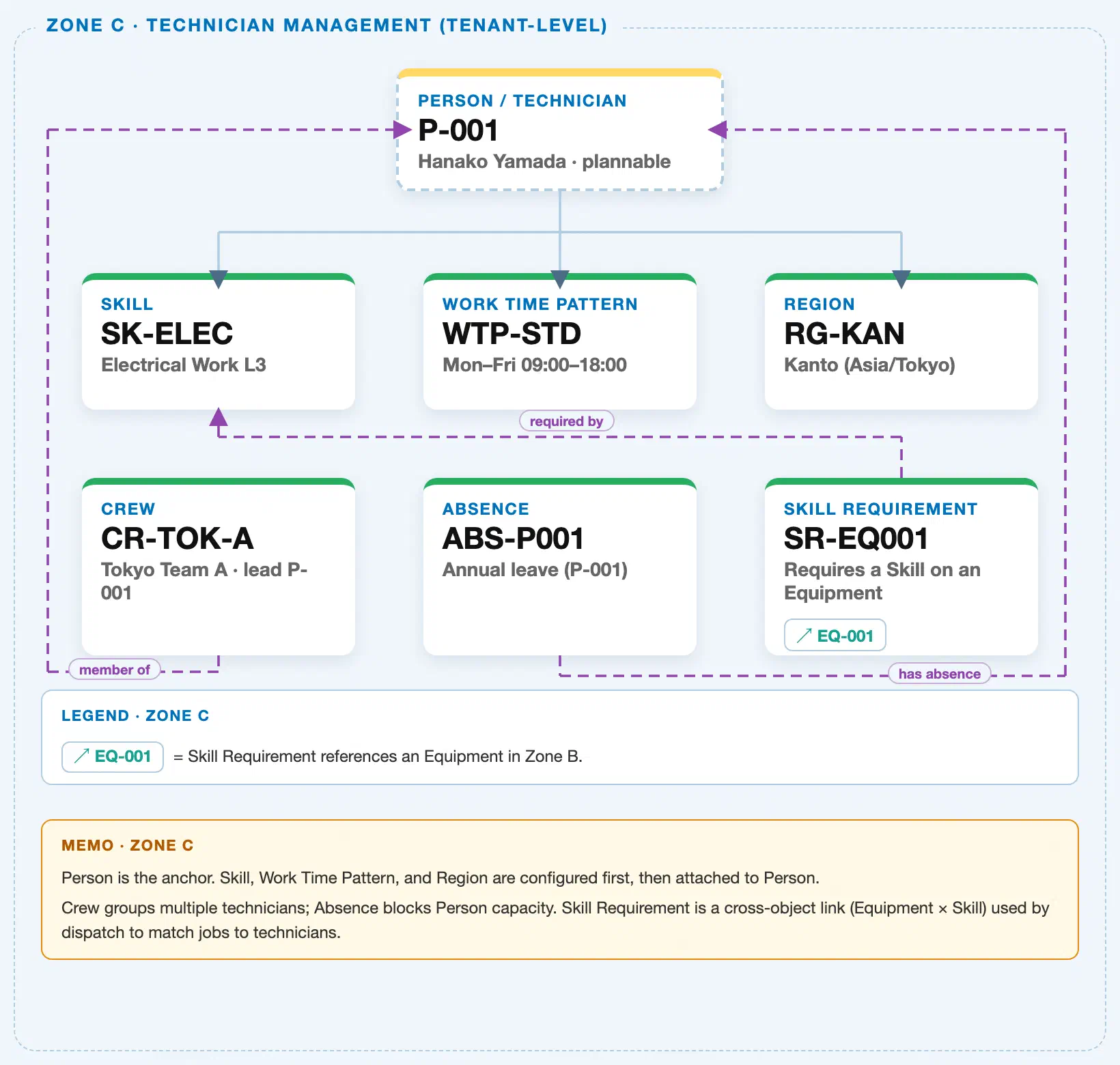
Data hierarchy with a concrete example (Zone C · Technician Management — tenant-level; FSM has no Company Code / Plant scoping above these objects)
Client (FSM Tenant)
   │
   ├── Skill SK-ELEC — Electrical Work L3               (configured independently; tenant-level catalog)
   ├── Work Time Pattern WTP-STD — Mon–Fri 09:00–18:00   (configured independently; tenant-level catalog)
   ├── Region RG-KAN — Kanto (Asia/Tokyo)                 (configured independently; tenant-level catalog)
   │
   └── Person / Technician P-001 — Hanako Yamada (Plannable)
          ── assigned to ──▶ Region RG-KAN — Kanto (Asia/Tokyo)         (N:M — a technician may cover more than one Region)
          ── assigned to ──▶ Skill SK-ELEC — Electrical Work L3
          ── assigned to ──▶ Work Time Pattern WTP-STD

Crew CR-TOK-A — Tokyo Team A (reference — groups technicians, does not own Person):
   Crew CR-TOK-A ── led by ──▶ Person P-001

Absence ABS-P001 — Annual leave (reference — blocks capacity within the Person's Work Time Pattern window):
   Absence ABS-P001 ── blocks ──▶ Person P-001

Skill Requirement SR-EQ001 — Requires a Skill on an Equipment (unrelated cross-object link, shown for zone completeness):
   Skill Requirement SR-EQ001 ── requires ──▶ Skill SK-ELEC
   Skill Requirement SR-EQ001 ── applies to ──▶ Equipment EQ-001 (Zone B)
Design principle: Region, Skill, and Work Time Pattern are independent tenant-level masters configured before Person/Technician — Person is assigned to Region via an N:M reference, not the reverse, and Region never owns Person. A single technician can be assigned to more than one Region (e.g. covering two adjacent service areas), which is why the assignment is drawn N:M rather than the simple one-way arrow used for Skill or Work Time Pattern.
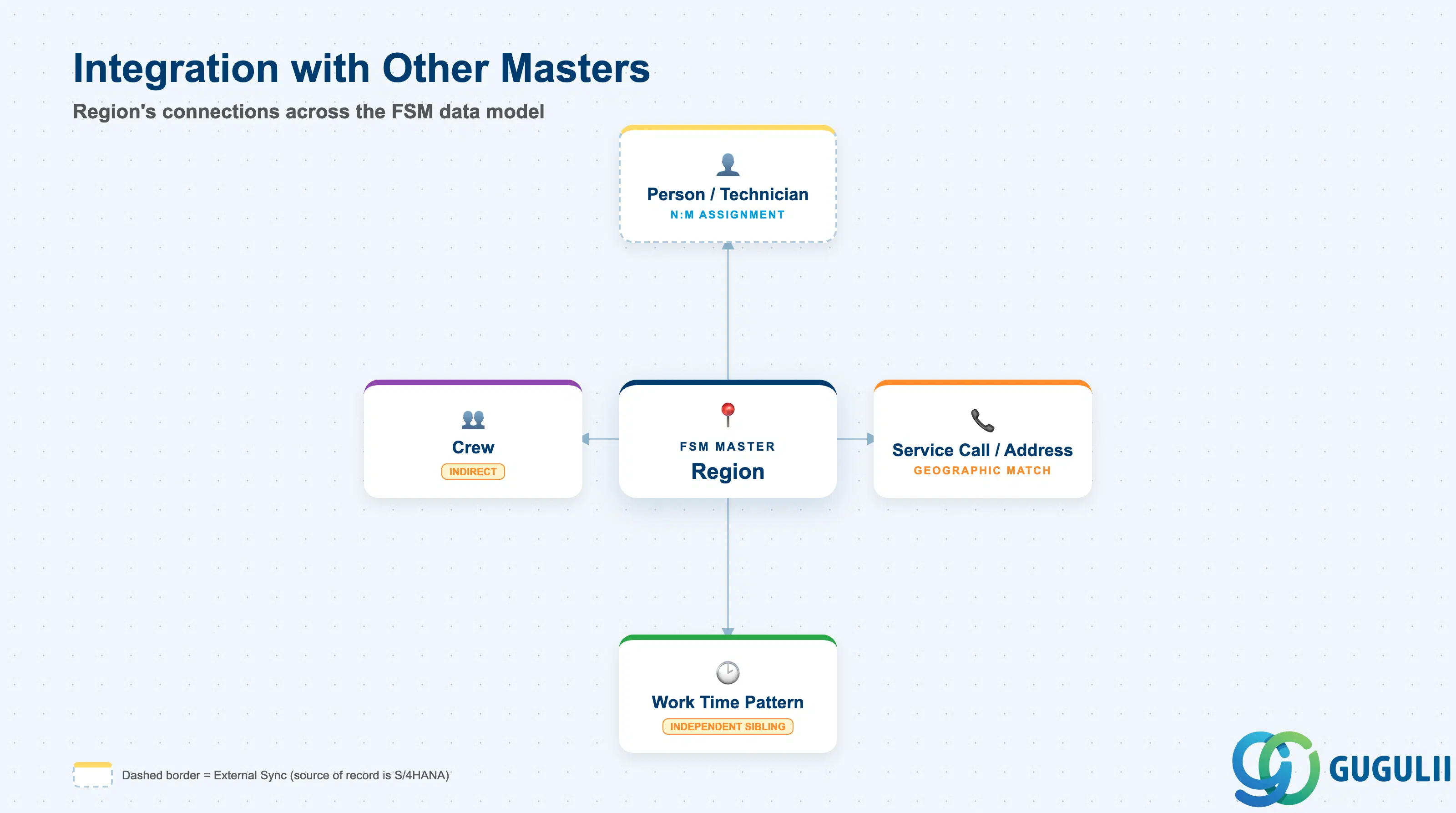
Region does not stand alone. Every field on it exists so that Assisted Scheduling and Route Optimization can determine, for a given Service Call location, which technicians are geographically in scope.
| Object | Relationship | Practical Notes |
|---|---|---|
| Person / Technician (FSM-A04-04) | Many-to-many: a technician can be assigned to more than one Region, and a Region can have many technicians assigned to it | Assigned via the Manage Technician app; this assignment is exactly what Assisted Scheduling and Route Optimization read to narrow candidate technicians for a Service Call by geography. |
| Service Call / Address (Transaction domain, FSM-B03/B04) | Geographic match: a Service Call’s geocoded address location is checked against each candidate Region’s Geo Polygon | Geocoding accuracy on the underlying Business Partner Address (FSM-A02-03) directly determines whether this match succeeds — a poorly geocoded address can silently exclude an otherwise-eligible technician from consideration. |
| Crew (FSM-A04-05) | Indirect: Crew has no Region field of its own — a crew’s effective coverage is simply the union of each individual member’s own assigned Region(s) | When crew-level dispatch eligibility looks wrong on the Planning Board, check each member’s individual Region assignment rather than looking for a setting on the Crew record itself. |
| Work Time Pattern (FSM-A04-02) | Independent sibling: no direct field links Region to Work Time Pattern — both are configured independently and referenced separately by the same Person/Technician record | Work Time Pattern’s Start Time / End Time carry no Time Zone of their own; they are interpreted using the Time Zone carried on the technician’s assigned Region. Confirm the two stay consistent whenever a technician’s Region changes, since there is no automatic recalculation. |
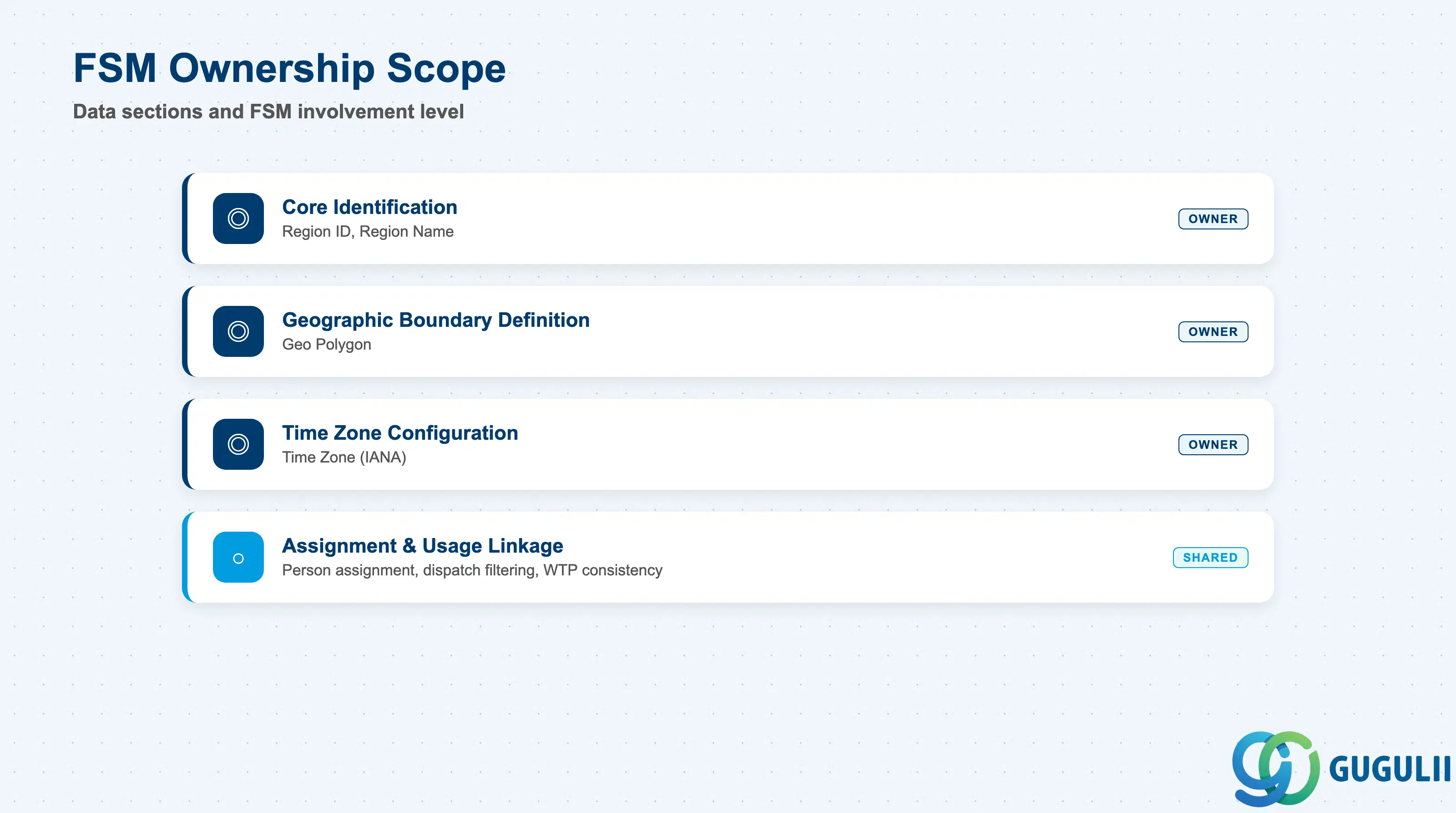
| Data Section | FSM Involvement | Notes |
|---|---|---|
| Core Identification | ◎ Owner | Region ID, Region Name — the fields that identify this specific service area |
| Geographic Boundary Definition | ◎ Owner | Geo Polygon — the boundary Assisted Scheduling and Route Optimization filter candidate technicians against |
| Time Zone Configuration | ◎ Owner | Time Zone — the reference used to interpret every assigned technician’s Work Time Pattern hours |
| Assignment & Usage Linkage | ○ Shared with Technician Management | How a Region is picked up by Person/Technician assignment and used in geographic dispatch filtering |
Legend: ◎ = Owner / Critical, ○ = Direct involvement
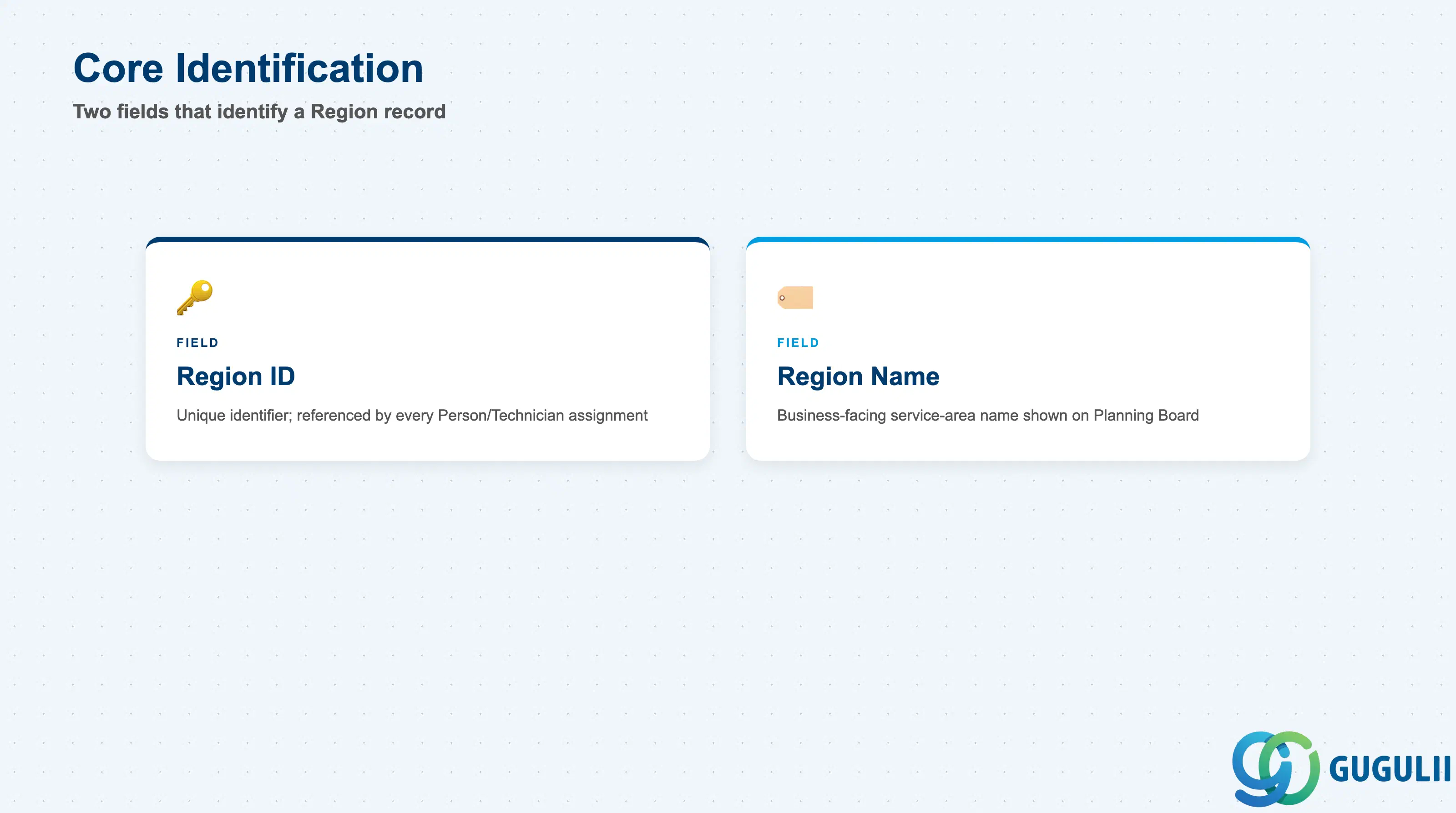
These two fields are the whole identity of a Region record — FSM keeps this master deliberately lean, with the actual boundary and time zone detail living in the fields covered in the next two sections.
| Field | Description | Practical Usage |
|---|---|---|
| Region ID | FSM’s internal unique identifier for the record | Auto-generated or entered at creation depending on tenant configuration; referenced by every Person/Technician assignment that covers this Region. Never reuse a retired Region ID for an unrelated service area — Planning Board history and dispatch audit trails depend on it staying unique. |
| Region Name | Business-facing name of the service area | Displayed on the technician’s profile and in the dispatcher’s Planning Board and Route Optimization views. Keep names descriptive of the actual geography covered (e.g. “Kanto” or “Tokyo Central Wards”) since the record carries no separate free-text description field. |
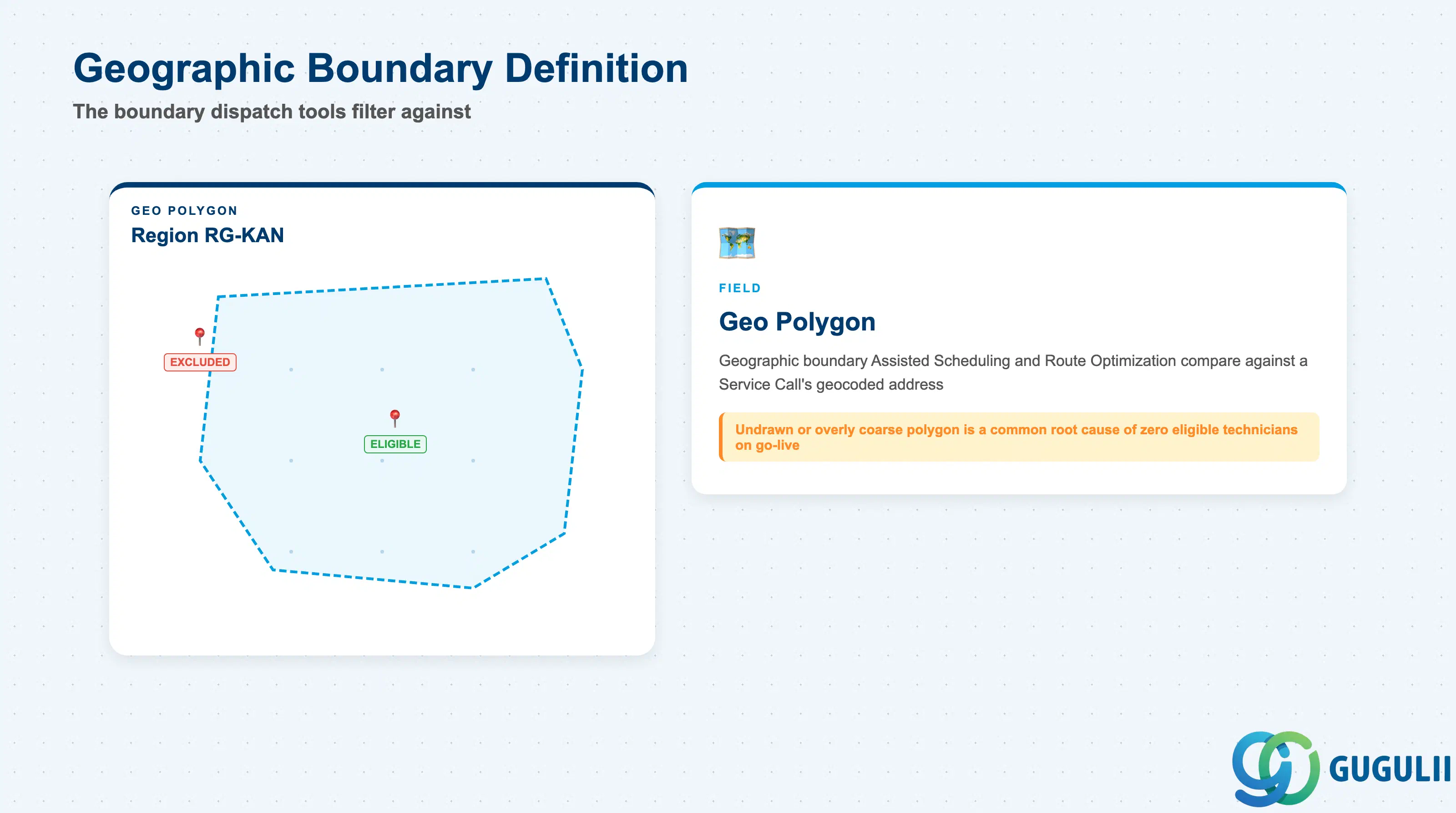
This single field is what turns a named Region into an actual, checkable geography — every geographic dispatch decision in FSM ultimately traces back to it.
| Field | Description | Practical Usage |
|---|---|---|
| Geo Polygon | Geographic boundary defining the Region’s coverage area, drawn or generated per one of the design approaches in 1.2 | The field Assisted Scheduling and Route Optimization compare against a Service Call’s geocoded address to determine which technicians are geographically eligible. An undrawn or overly coarse Geo Polygon is one of the most common root causes of a Service Call showing zero eligible technicians on go-live — verify boundary coverage against real service addresses during data load, not just against a map at a glance. |
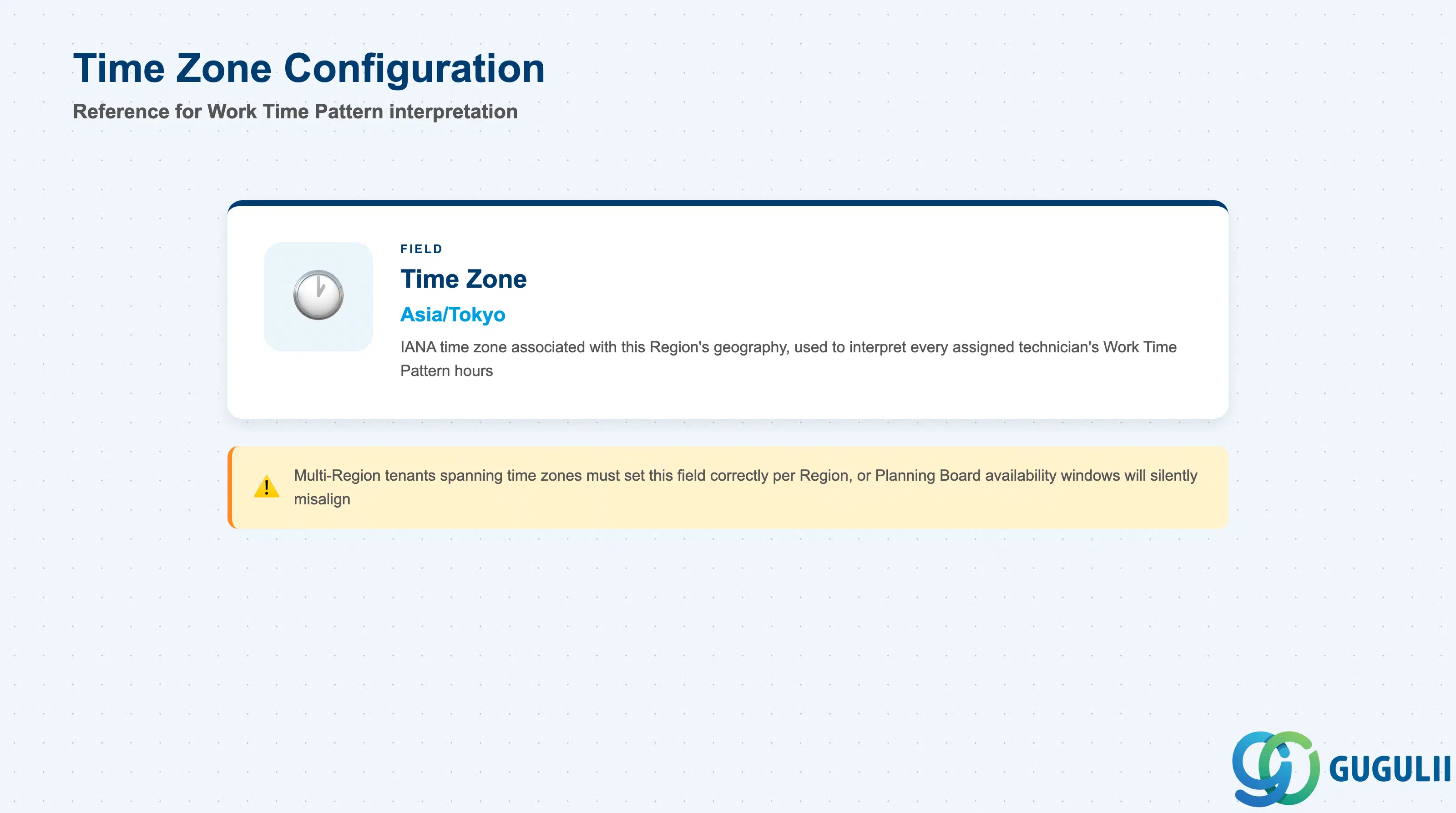
Time Zone is the field that gives every other time-based master in Technician Management a common reference point — without it, Work Time Pattern’s hours have no fixed meaning.
| Field | Description | Practical Usage |
|---|---|---|
| Time Zone | The IANA time zone (e.g., Asia/Tokyo) associated with this Region’s geography | Carried by the Region rather than by Person/Technician or Work Time Pattern directly — a technician’s Start Time / End Time is only ever meaningful once interpreted against the Time Zone of their currently assigned Region. Multi-Region tenants spanning more than one time zone must set this field correctly per Region, or Planning Board availability windows will silently misalign for technicians assigned to a Region outside the tenant’s default zone. |
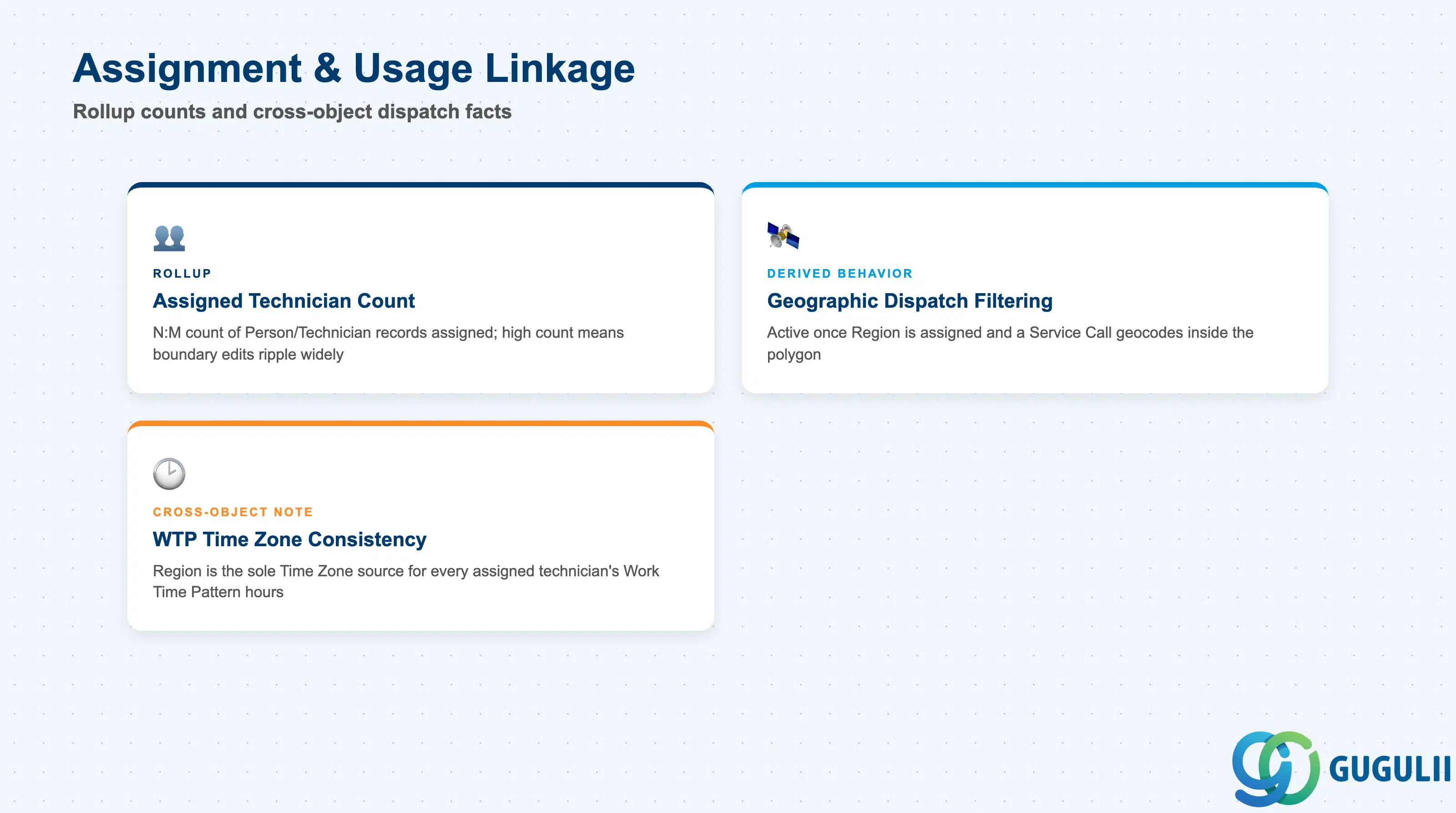
Region has no effect until it is picked up by at least one technician and at least one Service Call falls inside its boundary. These are the linkage facts consultants check most often when a geographic dispatch decision looks wrong.
| Field | Description | Practical Usage |
|---|---|---|
| Assigned Technician Count (rollup) | Count of Person/Technician records currently assigned to this Region | A quick data-quality signal before editing a widely-used Region’s boundary or time zone — a high count means the change ripples to every technician assigned to it simultaneously, unlike editing one technician’s individual record. Because the assignment is N:M, the same technician can contribute to more than one Region’s count. |
| Route Optimization / Geographic Dispatch Filtering (derived behavior) | Whether this Region’s Geo Polygon is actively narrowing candidate technicians for Service Calls whose geocoded address falls inside it | FSM applies this filter automatically once a Region is assigned to at least one technician and a Service Call address geocodes inside the polygon; there is no separate publish or activation step beyond saving the Region and the assignment. |
| Work Time Pattern Time Zone Consistency (cross-object note) | Whether this Region’s Time Zone still correctly reflects the geography it represents, given that it is what every assigned technician’s Work Time Pattern hours are interpreted against | Region carries the only Time Zone field in this part of the data model. When a Region’s boundary is redrawn to cover a different geography (e.g. extended into a neighboring time zone), confirm the Time Zone field is re-checked, since there is no automatic recalculation and every assigned technician’s Work Time Pattern interpretation depends on it. |
Prerequisite: A Region with an undefined or empty Geo Polygon cannot be used for geographic dispatch filtering — Assisted Scheduling and Route Optimization simply skip the geographic check for any Service Call whose location falls outside every defined boundary, rather than blocking dispatch outright.
| ID | Category | Title |
|---|---|---|
| fsm-001 | Overview | What is SAP FSM? |
| ID | Category | Title |
|---|---|---|
| fsm-a01 | Overview | SAP FSM Master Data: Overview, Hierarchy & Relationships |
| fsm-a02-02 | Master Data | SAP FSM Contact |
| fsm-a02-03 | Master Data | SAP FSM Address |
| fsm-a03-01 | Master Data | SAP FSM Equipment |
| fsm-a03-02 | Master Data | SAP FSM Equipment Hierarchy |
| fsm-a03-03 | Master Data | SAP FSM Service History |
| fsm-a04-01 | Master Data | SAP FSM Skill |
| fsm-a04-02 | Master Data | SAP FSM Work Time Pattern |
| fsm-a04-03 | Master Data | SAP FSM Region 📍 |
| fsm-a04-04 | Master Data | SAP FSM Technician |
| fsm-a04-05 | Master Data | SAP FSM Crew |
| fsm-a04-06 | Master Data | SAP FSM Absence |
| fsm-a04-07 | Master Data | SAP FSM Skill Requirement |
| fsm-a05-02 | Master Data | SAP FSM Generic Tool |
| fsm-a05-03 | Master Data | SAP FSM Serialized Tool |
| fsm-a05-04 | Master Data | SAP FSM Warehouse |
| fsm-a05-05 | Master Data | SAP FSM Van Stock |
| fsm-a06-01 | Master Data | SAP FSM Partner Invitation |
| fsm-a06-02 | Master Data | SAP FSM Partner Registration |
| fsm-a06-03 | Master Data | SAP FSM Crowd Partner |
| fsm-a06-04 | Master Data | SAP FSM Partner Technician |
| ID | Category | Title |
|---|---|---|
| fsm-b01 | Overview | SAP FSM Transactions: Process Flow, Hierarchy & Relationships |