Title here
Summary here

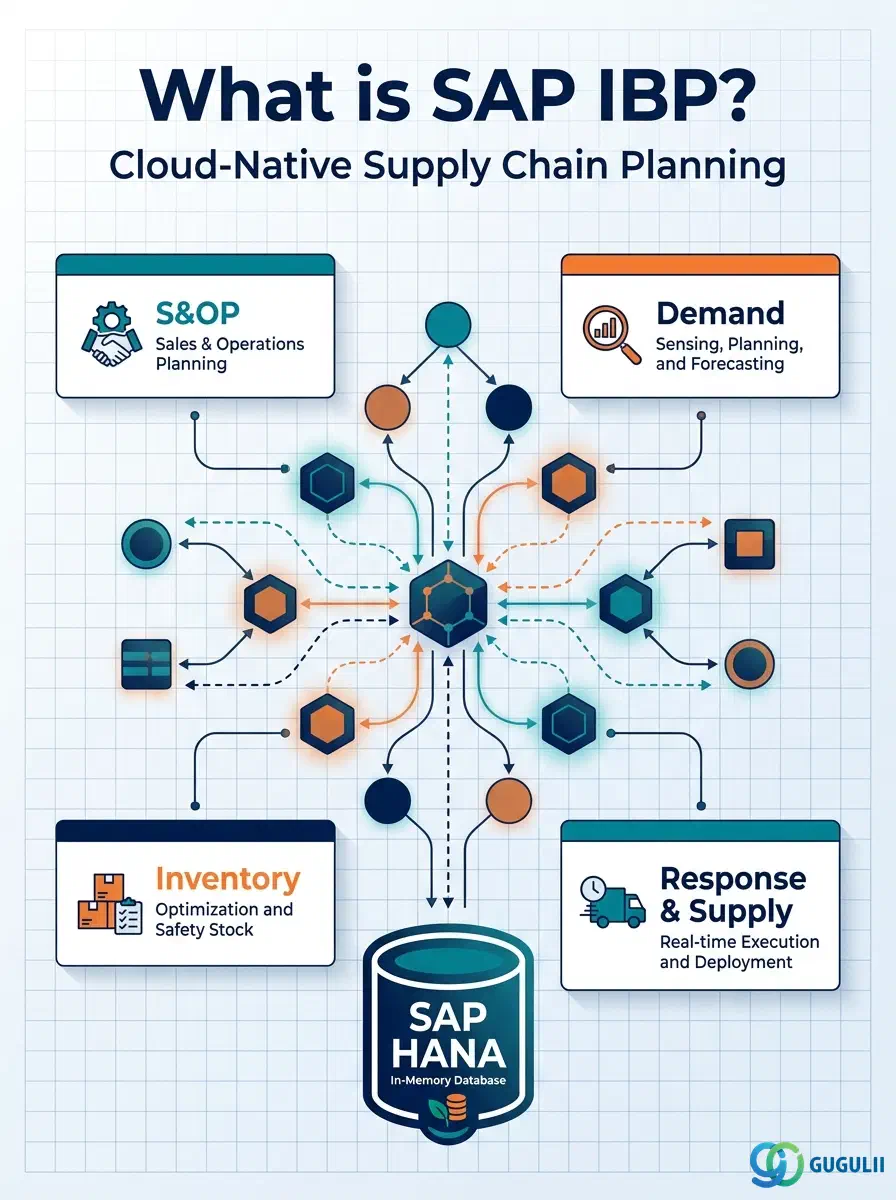
SAP Integrated Business Planning (SAP IBP) is SAP’s cloud-native supply chain planning platform, delivered as a SaaS solution on SAP Business Technology Platform (SAP BTP). It consolidates multiple planning disciplines — demand forecasting, inventory optimization, supply planning, and executive S&OP — that were previously managed in separate tools such as APO (Advanced Planner and Optimizer) and SNP.
IBP is powered by the SAP HANA in-memory database, enabling real-time aggregation, disaggregation, and scenario simulation across large planning datasets. AI and advanced analytics are embedded throughout: machine learning forecast algorithms, statistical demand sensing, multi-echelon inventory optimization, and constrained supply heuristics all operate within the same data model.
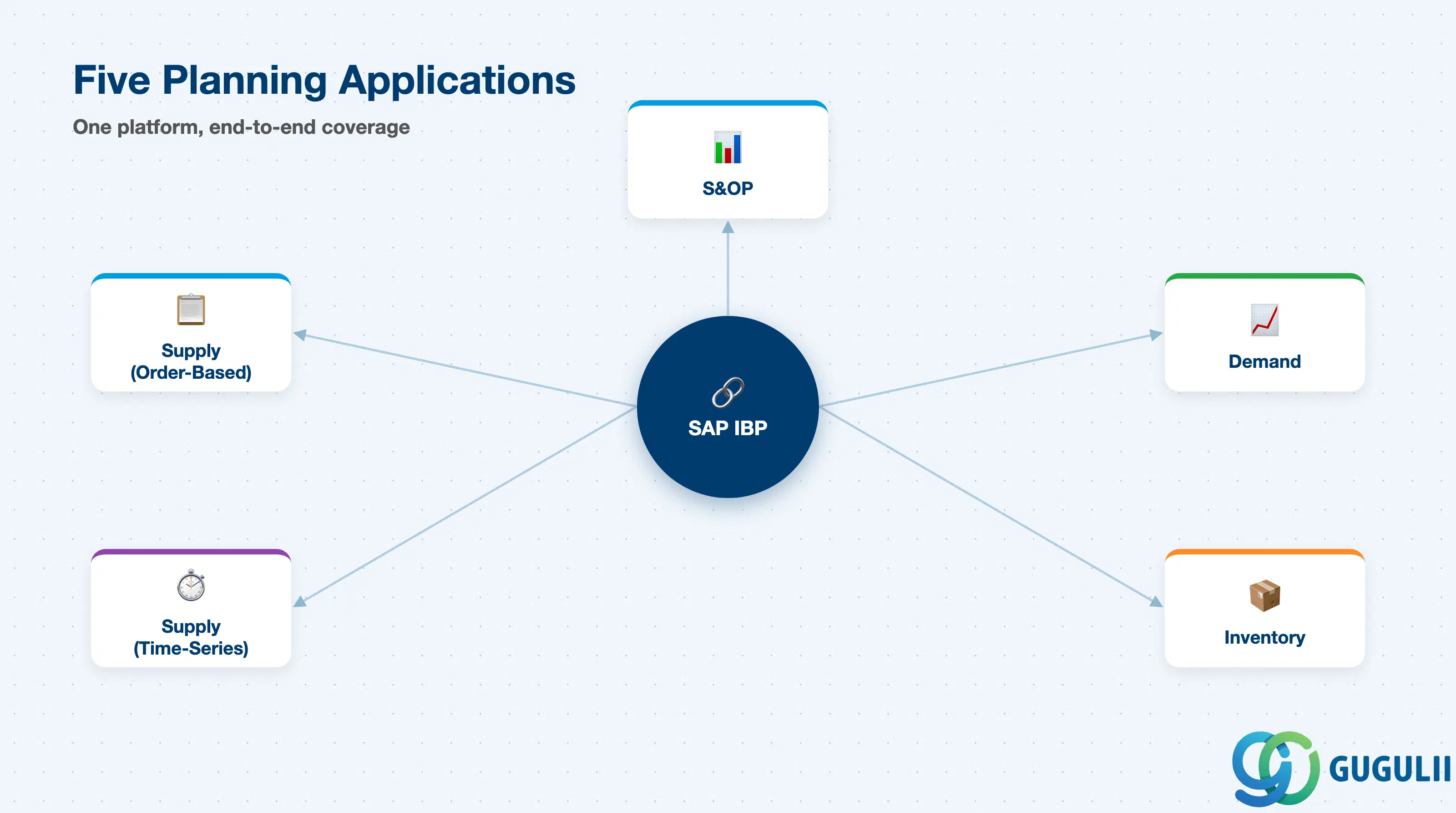
The five planning applications below can be adopted independently or combined into a unified planning process.
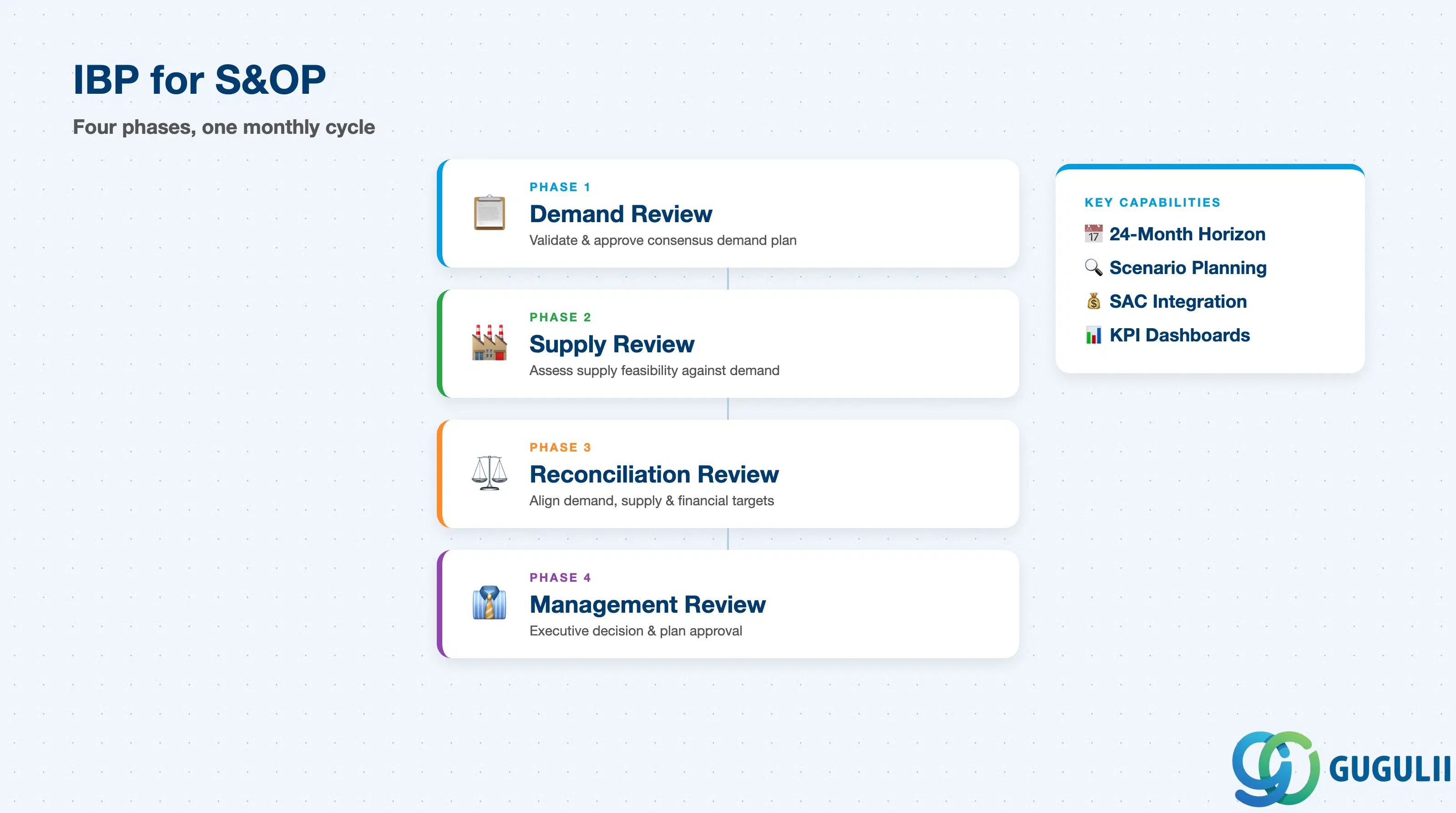
IBP for S&OP integrates demand, supply, operations, and financial planning into a unified monthly process. It supports the four canonical S&OP phases:
| Phase | Description |
|---|---|
| Demand Review | Validate and approve the consensus demand plan |
| Supply Review | Assess supply feasibility against the demand plan |
| Reconciliation Review | Align demand, supply, and financial targets |
| Management Review | Executive decision and plan approval |
Scenario planning (what-if analysis) allows planners to simulate market conditions and evaluate KPI impact before committing to a plan. Standard global dashboards provide a 24-month planning horizon. IBP for S&OP integrates with SAP Analytics Cloud (SAC) for financial planning alignment.
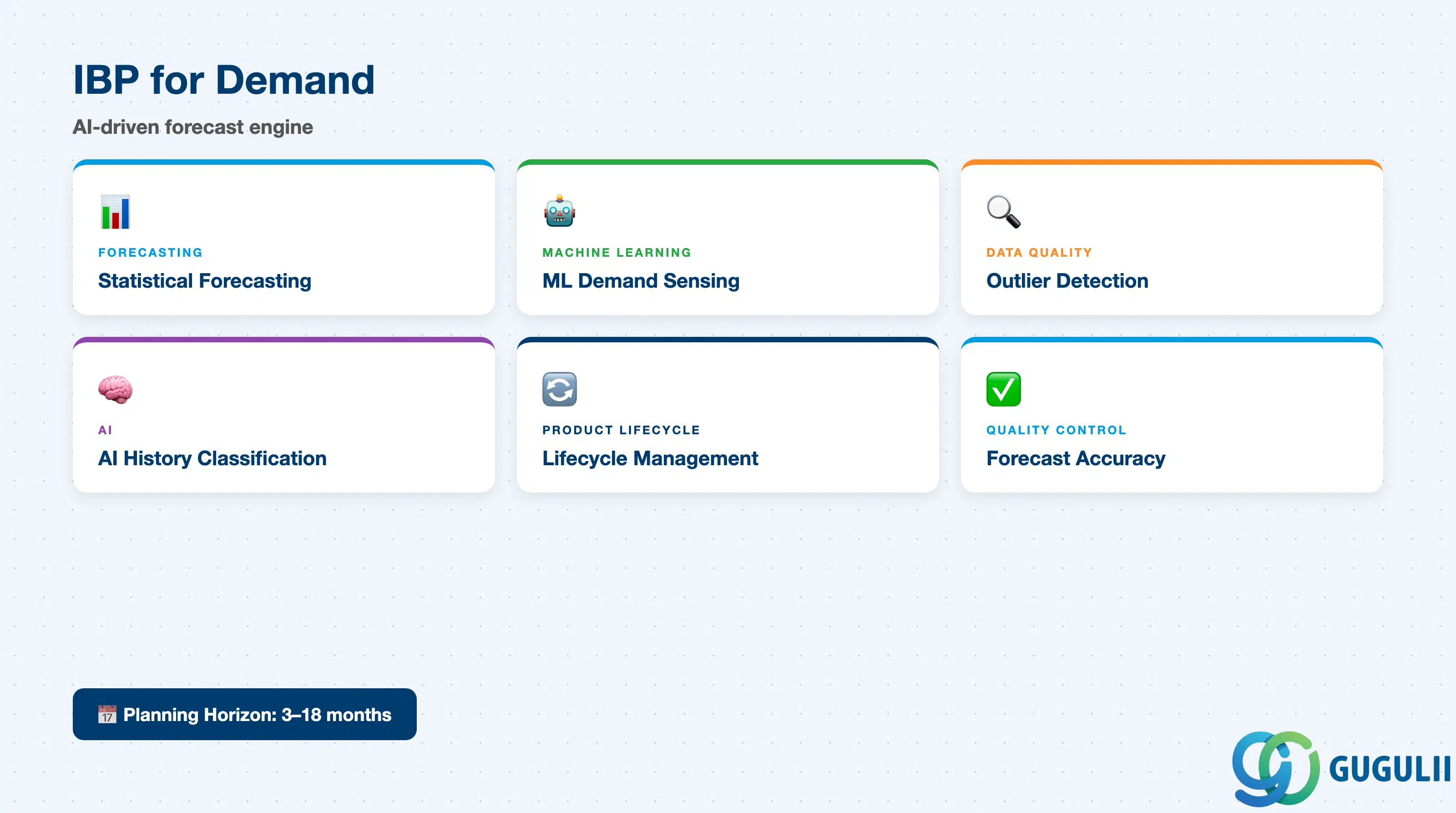
IBP for Demand generates statistically-driven forecasts of future customer demand and refines them through machine learning.
| Capability | Description |
|---|---|
| Statistical Forecasting | Runs multiple algorithms; selects best-fit model per product |
| ML Demand Sensing | Adjusts short-term forecast using order patterns and downstream signals (e.g., point-of-sale data) |
| Outlier Detection | Identifies and corrects historical demand anomalies before modeling |
| AI History Classification | Classifies demand history type (e.g., intermittent, lumpy) to guide algorithm selection |
| Lifecycle Management | Manages Phase-In and Phase-Out stages for new and discontinuing products |
| Forecast Accuracy | Automatically verifies forecast accuracy against actuals |
Planning horizon: 3–18 months. Supported algorithms include Gradient Boosting, exponential smoothing variants, and other ML methods preconfigured in SAPIBP1.
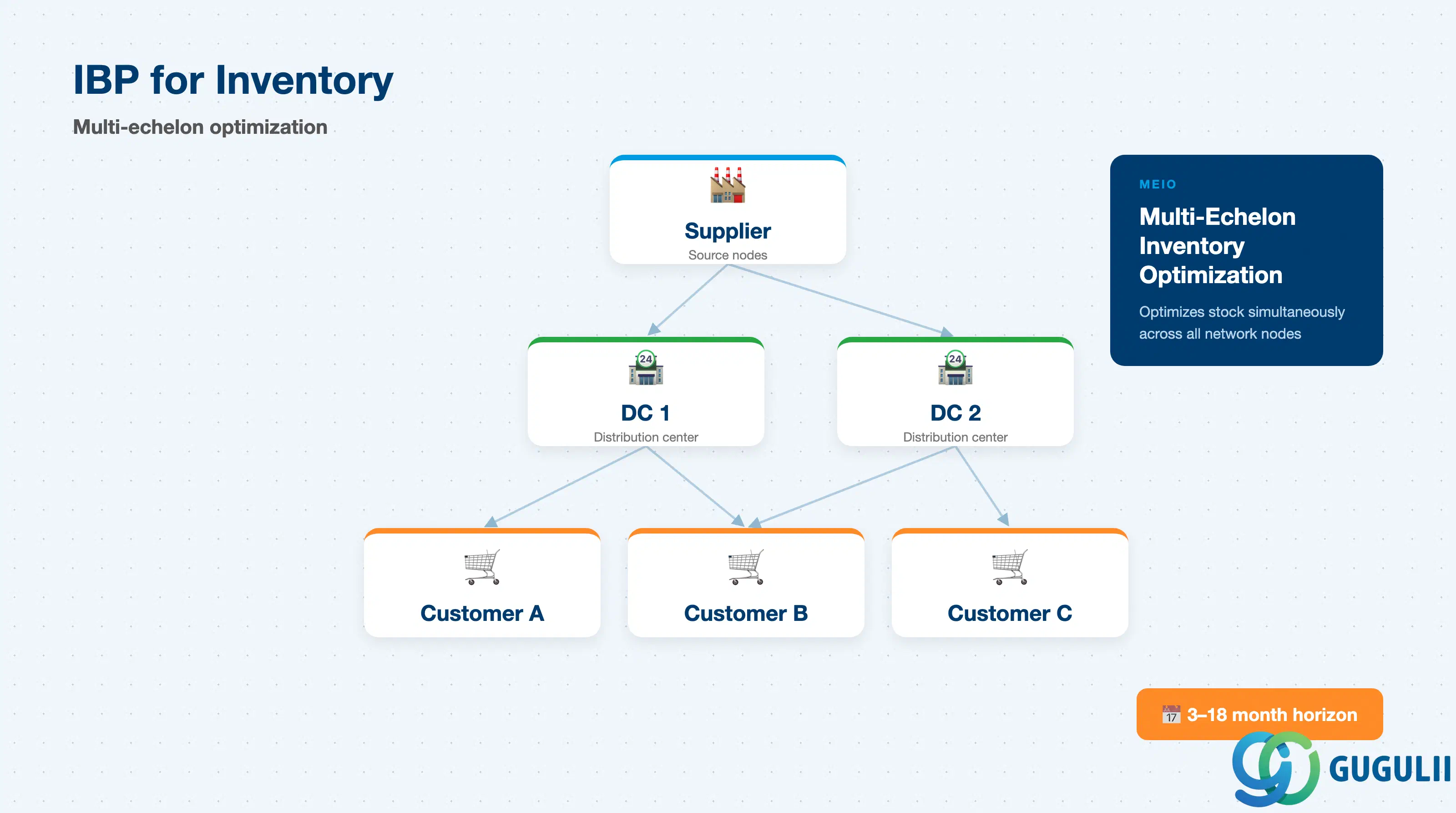
IBP for Inventory determines safety stock targets across the full supply chain network using multi-echelon inventory optimization (MEIO).
| Capability | Description |
|---|---|
| Multi-Echelon Optimization (MEIO) | Optimizes stock simultaneously across all network nodes — from suppliers to distribution centers to customers |
| Stochastic Algorithms | Uses mathematical methods (not simple rules) to derive lowest-cost stocking levels at item-location-period granularity |
| Service Level Prediction | Predicts customer service level by product-location given a proposed safety stock plan |
| Simulation | Supports what-if analysis for different service level targets, inventory policies, and supply chain configurations |
| Full BOM Coverage | Creates an inventory plan spanning the complete bill of materials and entire supply chain network |
Planning horizon: 3–18 months. Targets are expressed at item-location-time period granularity and fed into the supply planning process.
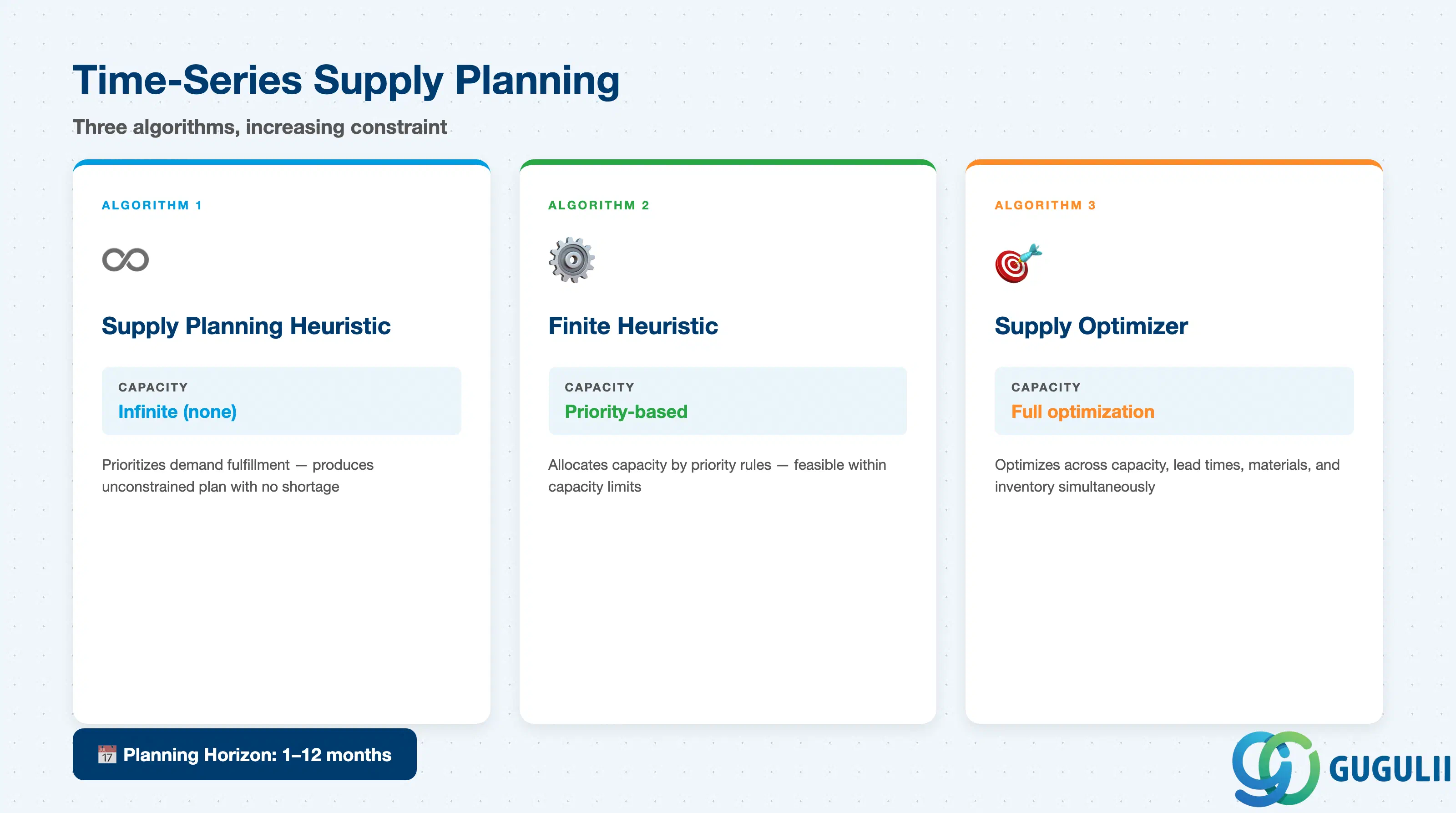
IBP for Response and Supply covers tactical supply planning using time-series buckets (weekly, monthly, quarterly).
| Algorithm | Capacity Constraint | Description |
|---|---|---|
| Supply Planning Heuristic | None (infinite) | Produces an unconstrained plan with no shortage — prioritizes demand fulfillment |
| Finite Heuristic | Priority-based | Allocates capacity by priority rules; feasible within capacity limits |
| Supply Optimizer | Full constraint optimization | Optimizes across capacity, lead times, material availability, and inventory simultaneously |
The time-series supply plan consumes inventory targets from IBP for Inventory and produces a constrained supply plan covering production, procurement, and distribution. BOM explosion and capacity constraint checking are included. Planning horizon: 1–12 months.
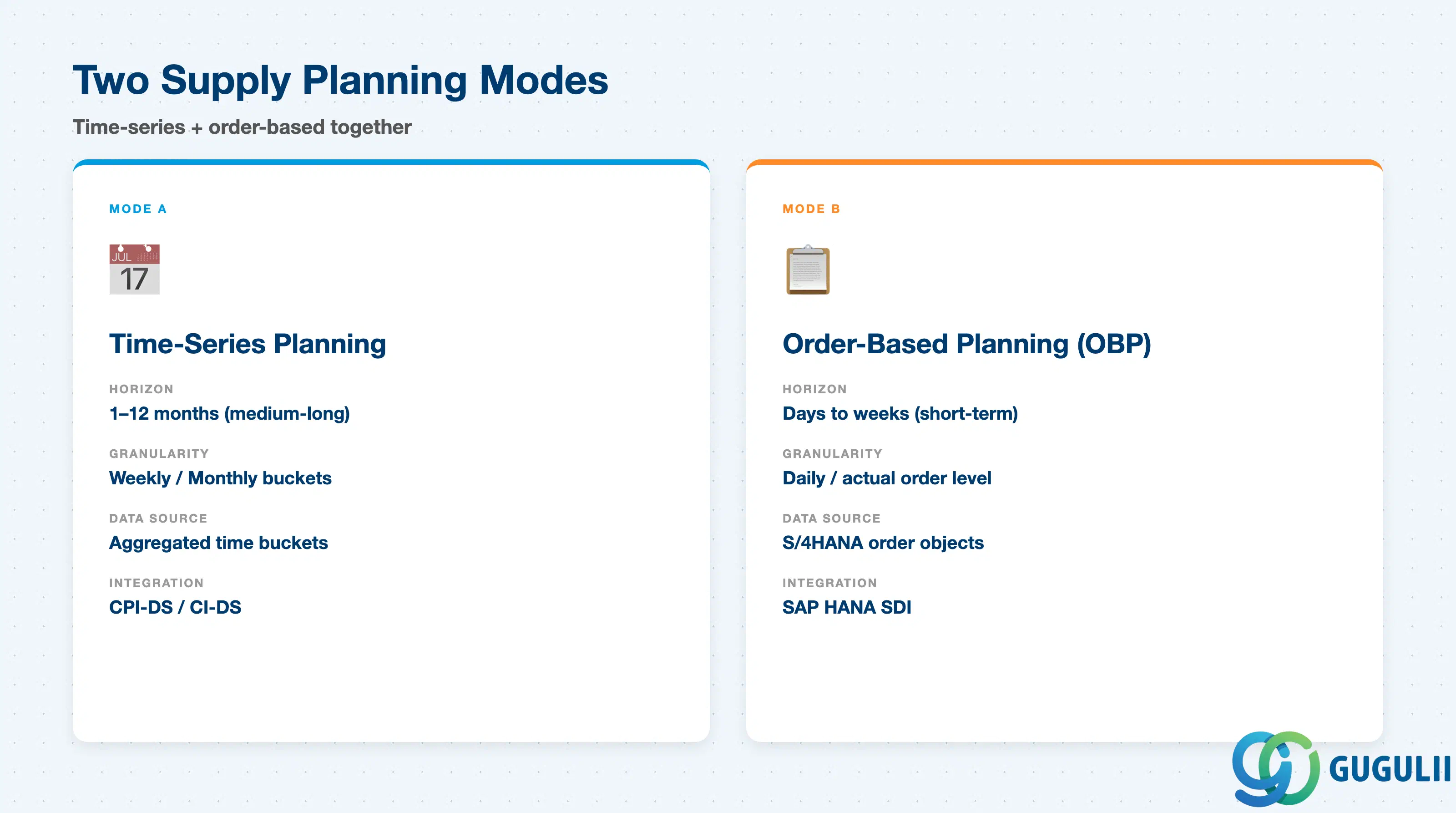
Order-Based Planning (OBP) operates at short time horizons using actual order objects from SAP S/4HANA rather than time-bucket aggregates.
| Attribute | Detail |
|---|---|
| Data Source | Actual orders: sales orders, planned orders, production orders, purchase orders from S/4HANA |
| Time Horizon | Days to weeks (daily/weekly granularity) |
| Integration | SAP HANA Smart Data Integration (SDI) — distinct from the CPI-DS path used by time-series |
| Key Use Cases | Operational order confirmation, Available-to-Promise (ATP), short-term production scheduling |
OBP complements time-series planning: time-series sets the medium-to-long-term plan; OBP executes it at the order level in the near term.
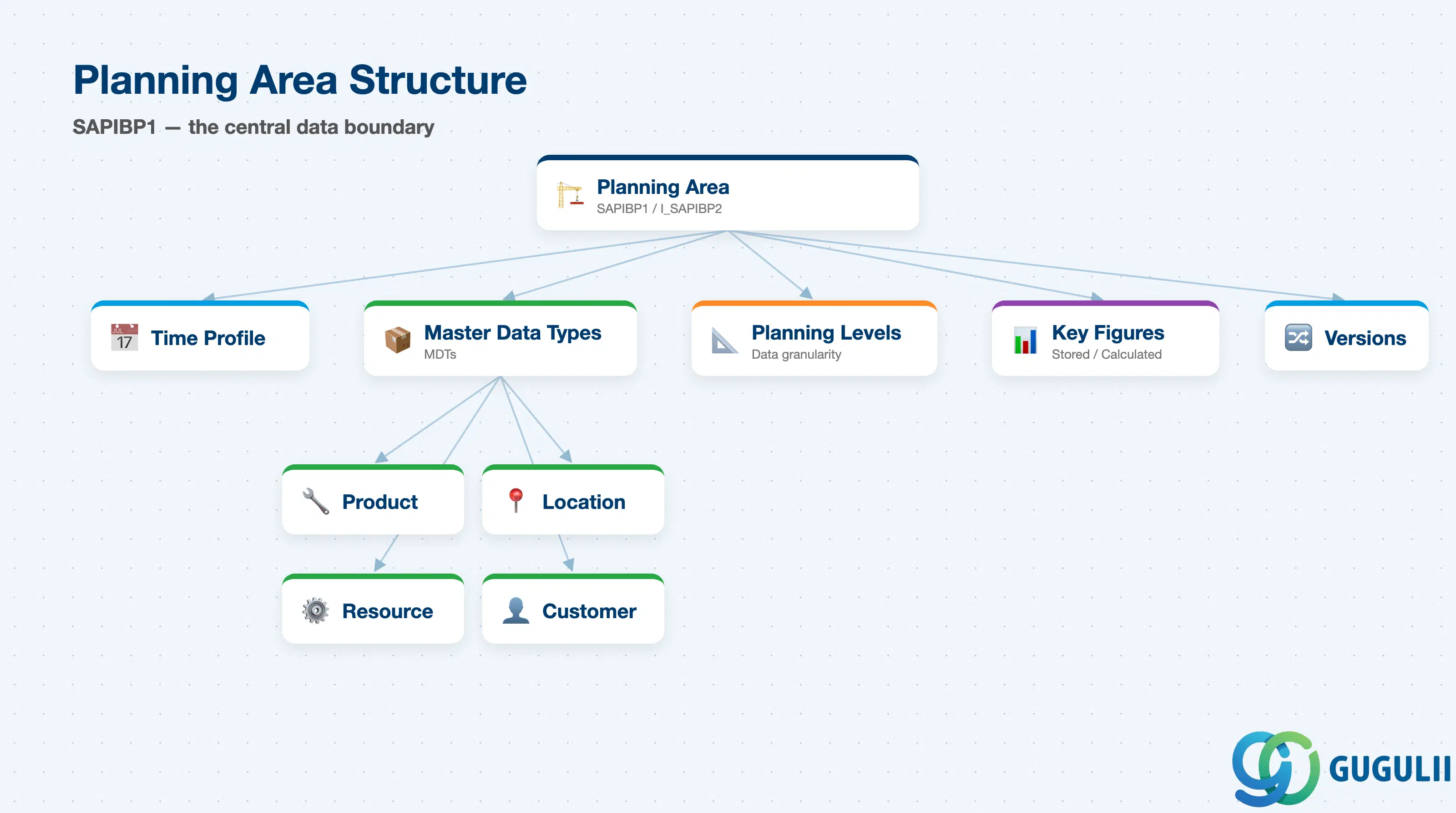
All planning data in SAP IBP is organized within a Planning Area — the central configuration boundary of any IBP implementation. Every master data record, key figure, planning level, and version belongs to exactly one Planning Area.
SAP delivers SAPIBP1 as the standard Planning Area template, pre-configured for S&OP, Demand, Supply, Inventory, and Control Tower. SAP recommends using SAPIBP1 as the starting point for greenfield IBP implementations rather than building a custom Planning Area from scratch.
As of IBP release 2508 (August 2025), SAP introduced I_SAPIBP2, the Harmonized Planning Area (HPA), which unifies time-series and order-based planning into a single data model — previously requiring separate configurations.
Planning Area (e.g., SAPIBP1 / I_SAPIBP2)
├── Time Profile           (Day → Week → Month → Quarter → Year)
├── Master Data Types (MDTs)
│   ├── Product            (materials, SKUs)
│   ├── Location           (plants, DCs, customers)
│   ├── Resource           (production lines, capacities)
│   └── Customer
│       └── Attributes     (Product Family, Plant Region, Customer Segment, ...)
├── Planning Levels        (named attribute combinations — data granularity definitions)
│   ├── MTHPRODLOC         (Month × Product × Location)
│   ├── MTHPRODCUST        (Month × Product × Customer)
│   └── ...
├── Key Figures            (measures: demand plan, safety stock target, confirmed supply, ...)
│   ├── Stored             (persisted in HANA; input-capable; delta-load target)
│   └── Calculated         (derived at runtime; not stored; cannot be disaggregated)
└── Versions               (Baseline + simulation copies for scenario comparison)
Design decision: The base planning level assigned to each key figure is irreversible once data has been loaded. Choosing the wrong granularity (e.g., Month × Product instead of Month × Product × Location) requires re-architecting the planning area. This decision must be resolved during requirements definition — before any data migration begins.
The SAPIBP1 template contains approximately 100 planning levels, 50 attributes, and 485 key figures across all domains (as of IBP 2211). Domain-level counts: Demand ~50–100 KFs, Supply ~120–150 KFs, S&OP ~50–100 KFs.
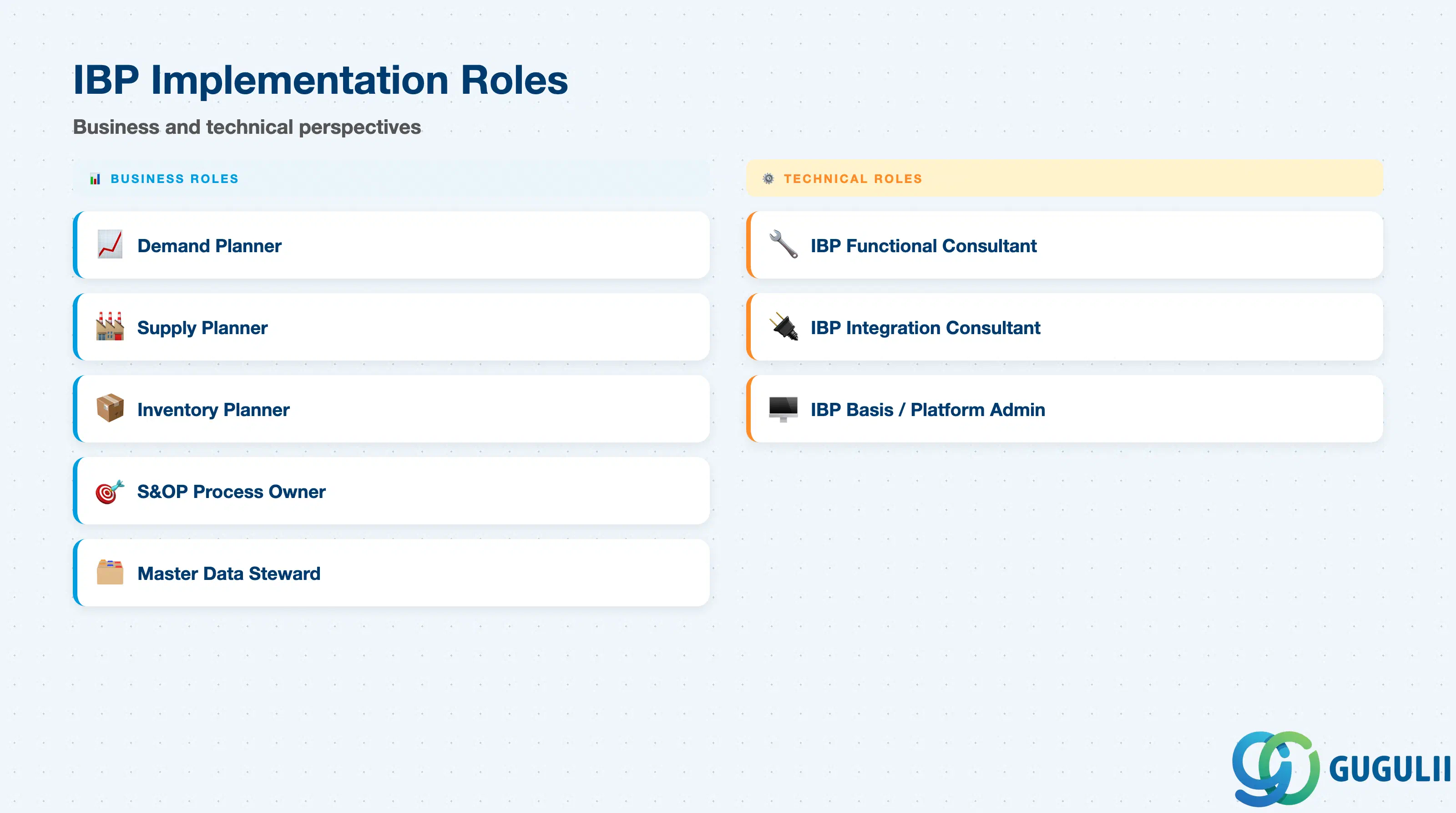
IBP implementations involve business planning roles (who use the planning applications daily) and technical/configuration roles (who build and maintain the system).
| Role | Primary Activities |
|---|---|
| Demand Planner | Runs statistical forecasts, validates demand signals, adjusts consensus demand plan, manages product lifecycle entries |
| Supply Planner | Executes supply planning runs (heuristic or optimizer), reviews capacity exceptions, releases supply plan to ERP |
| Inventory Planner | Runs safety stock optimization, reviews MEIO results, sets service level targets by product-location |
| S&OP Process Owner | Orchestrates the monthly S&OP cycle, coordinates Demand, Supply, and Finance reviews, facilitates management review |
| Master Data Steward | Maintains product, location, resource, and customer master data; ensures clean master data before planning runs |
| IBP Functional Consultant | Configures planning area, key figures, planning levels, disaggregation rules, and alert profiles; designs data model during implementation |
| IBP Integration Consultant | Configures CPI-DS / CI-DS connectivity, BW Extractor activation, iFlow field mapping, and SDI for OBP; manages Initial and Delta Load schedules |
| IBP Basis / Platform Admin | Manages IBP tenant administration, user provisioning, planning run scheduling, and SAP BTP connectivity settings |
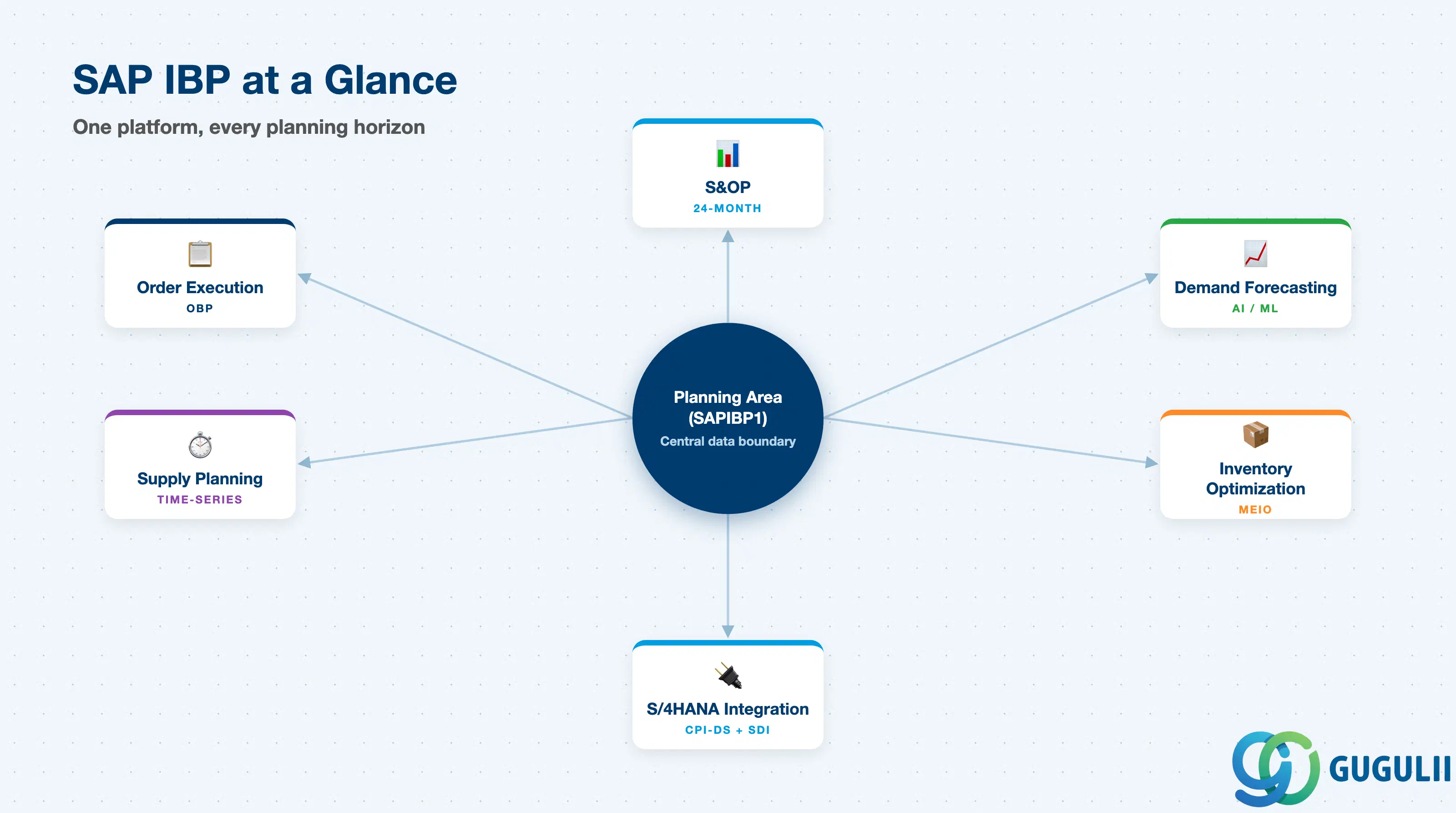
SAP IBP addresses a long-standing challenge in supply chain management: the fragmentation of planning data across disconnected tools. By consolidating demand, inventory, supply, and S&OP into a single SAP HANA-powered platform, IBP enables planners at every horizon — from the 24-month executive S&OP cycle down to day-level order confirmation — to work from a consistent, real-time data model.
For organizations implementing IBP, the Planning Area configuration is the foundational deliverable. Decisions made during requirements definition — which master data types to include, at what granularity to store each key figure, and how to design planning levels — shape system performance and flexibility for years after go-live. Understanding these structural concepts before diving into individual planning module configurations is the essential starting point.
The next L1 article in this series covers the Business Processes and Integration patterns that connect IBP to the broader SAP landscape.
| ID | Category | Title |
|---|---|---|
| ibp-001 | Overview | What is SAP IBP? 📍 |
| ID | Category | Title |
|---|---|---|
| ibp-a01 | Overview | SAP IBP Master Data: Overview, Hierarchy & Relationships |
| ibp-a02-01 | Master Data | SAP IBP Master Data Types |
| ibp-a02-02 | Master Data | SAP IBP Attribute |
| ibp-a02-03 | Master Data | SAP IBP Time Profile |
| ibp-a02-05 | Master Data | SAP IBP Location Master |
| ibp-a03-01 | Master Data | SAP IBP Key Figure |
| ibp-a03-02 | Master Data | SAP IBP Planning Level |
| ibp-a03-03 | Master Data | SAP IBP Planning Area |
| ibp-a03-04 | Master Data | SAP IBP Planning Version |
| ibp-a03-05 | Master Data | SAP IBP Planning View |
| ibp-a04-01 | Master Data | SAP IBP Integration Model |
| ibp-a05-01 | Master Data | SAP IBP Planning Operator |
| ID | Category | Title |
|---|---|---|
| ibp-b01 | Overview | SAP IBP Transactions: Process Flow, Hierarchy & Relationships |