Title here
Summary here

Division is the third-level organizational master data object in SuccessFactors Employee Central, sitting directly below Business Unit and directly above Department in the standard organizational chain. It groups the Departments and Cost Centers of a Business Unit into a product line, functional area, or geographic sub-region — for example, an East Japan sales division, a Consumer Products division, or a Manufacturing division. Every Department that a consultant configures (when the Division level is enabled) is ultimately assigned to exactly one Division. This article covers what Division is, how it sits in the broader hierarchy, and every field an Employee Central consultant configures.
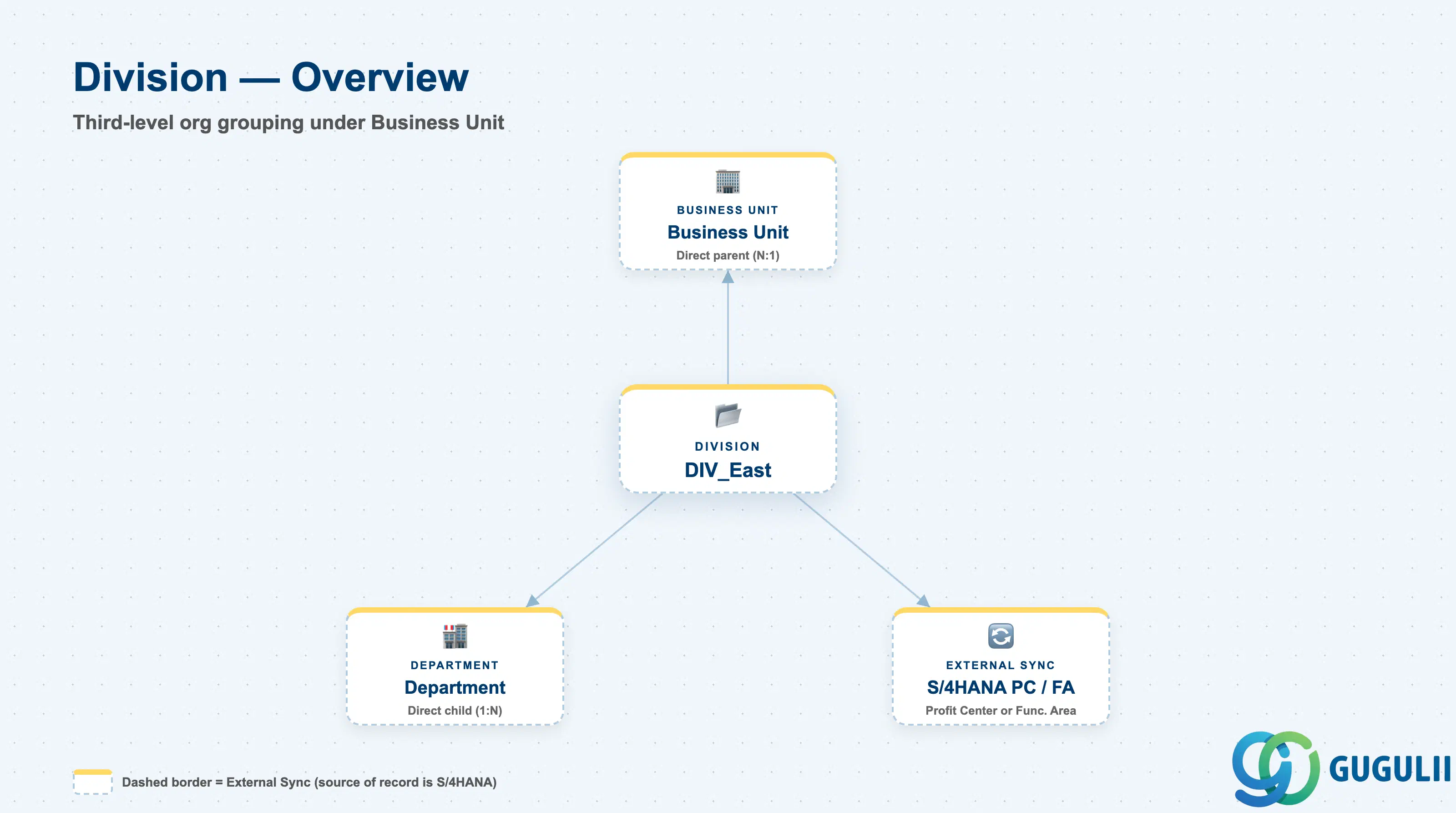
Division is a foundation object two levels below Business Unit — it does not represent the major business-line boundary itself, but a further subdivision of that boundary into a product line, functional area, or sub-region. Where Business Unit answers “which major line of business, or region, does this part of the organization belong to,” Division answers “which product line, function, or local sub-region within that business, does this part of the organization belong to.” Department and Cost Center are then nested beneath it to further subdivide that grouping.
| Aspect | Details |
|---|---|
| Role | Third level of the organizational hierarchy — groups one or more Departments under a single Business Unit, typically representing a product line, functional area, or geographic sub-region |
| Modules using it | Employee Central (owner — foundation object framework), Recruiting (job requisitions are frequently scoped or routed by Division), Compensation (eligibility rules and budget pools are frequently segmented by Division), People Analytics / Reporting (Division is commonly the default org-chart display and headcount-reporting level) |
| Transactions | Admin Center → “Manage Organization, Pay and Job Structures” (create/edit foundation object records); “Import and Export Data” (mass load via CSV); Business Rules can auto-derive Division from other Employment fields |
| Key Tables | OData API entity FODivision (Foundation Object) — SuccessFactors has no classic ABAP table; each record is effective-dated rather than table-row based |
| S/4HANA note | Division has no single universal S/4HANA counterpart — clients variously map it to a Functional Area, a Profit Center, or leave it SuccessFactors-native when no equivalent grouping exists in S/4HANA |
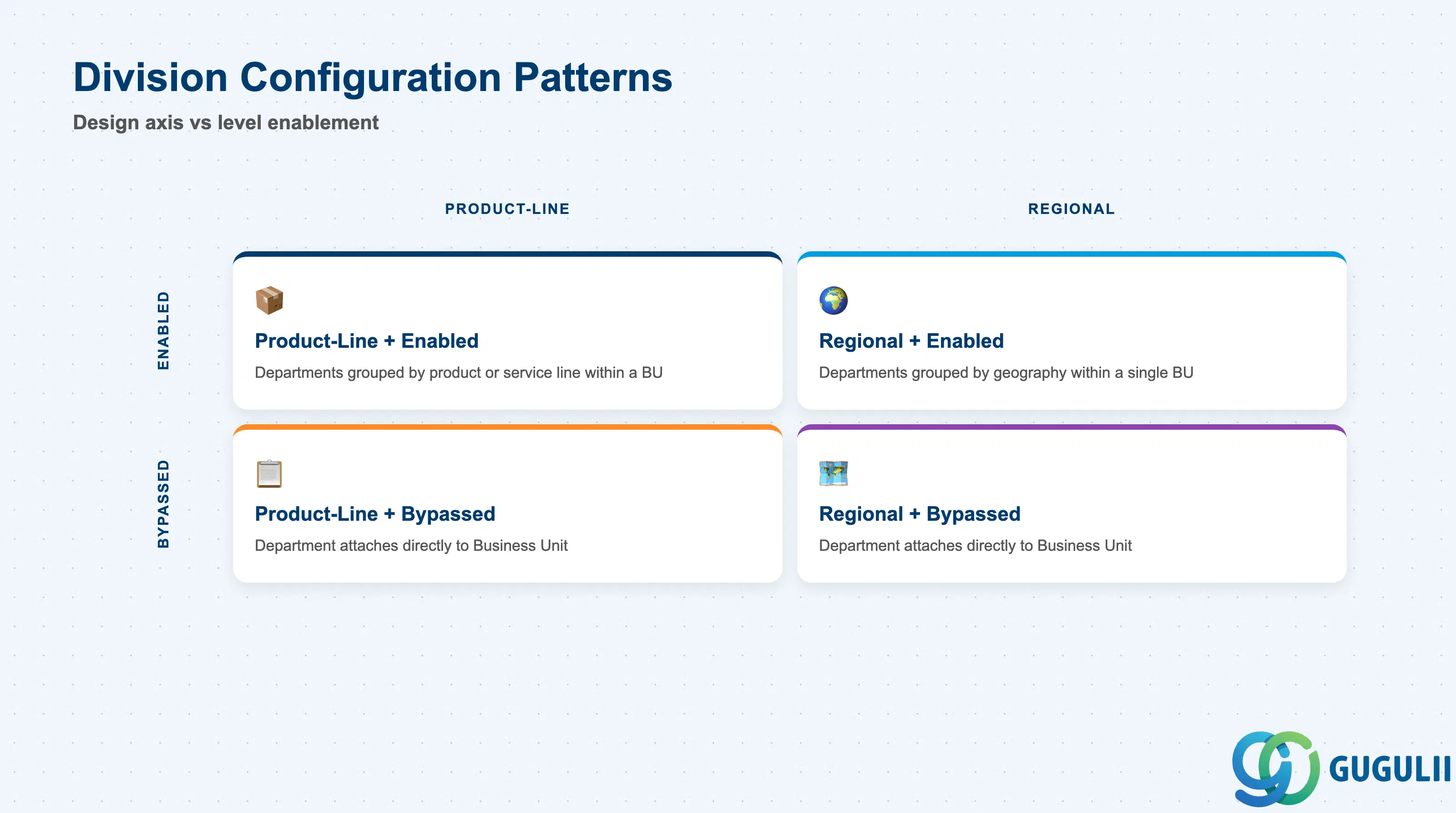
Division is not selected from a fixed SAP type code — but every implementation still has to decide two independent dimensions before go-live: the design axis the level is organized around, and whether the level is used at all.
| Pattern | Marker | Use Case | Key Behavior |
|---|---|---|---|
| Product-Line Division | Product-Line | Client organizes Departments primarily by product or service line within a Business Unit | Division name reflects a product/service line (e.g. “Consumer Products Division”); Departments beneath it typically represent functional teams within that line |
| Regional Division | Regional | Client organizes Departments primarily by geography within a single Business Unit | Division name reflects a sub-region (e.g. “East Japan Division”); Departments beneath it typically represent functions or product teams within that region |
| Enabled Division Level | Enabled | Business Unit has enough organizational complexity to warrant an intermediate grouping above Department | Every Department must be assigned to a Division; Division becomes a mandatory link in the chain |
| Bypassed Division Level | Bypassed | Simpler organizations where Department attaches directly to Business Unit | The Division foundation object type remains configured in the system but has zero active records referencing it; the org chart and reporting skip straight from Business Unit to Department |
Design principle: Decide the design axis (product-line vs. regional) and whether the level is enabled once, at blueprint. Every Department created afterward inherits that axis — retrofitting either decision later means re-parenting every Department under new Division codes.
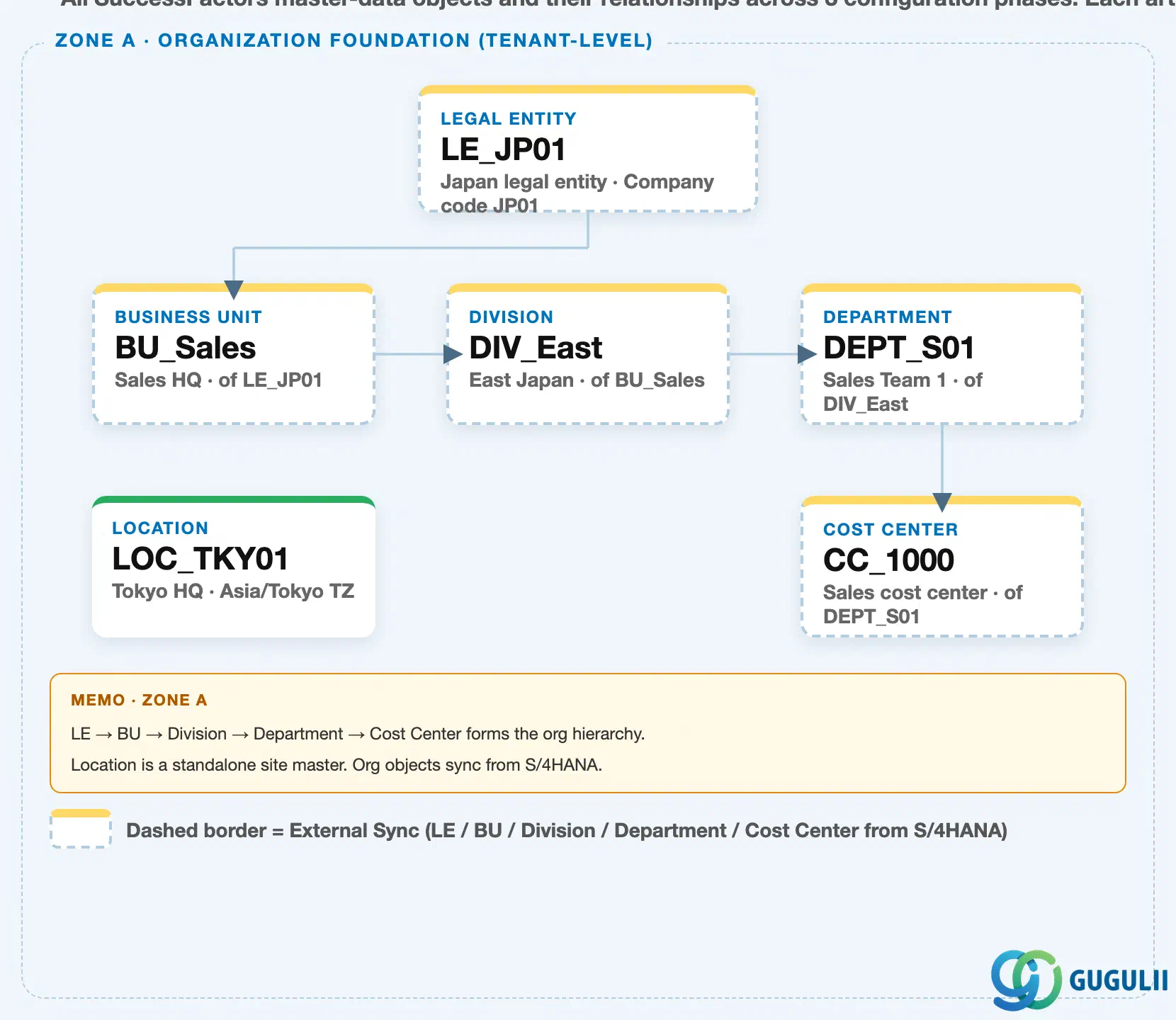
Data hierarchy with a concrete example
Client (SuccessFactors Instance)
   │
   └── Legal Entity "LE_JP01" — Japan Legal Entity, Company Code JP01
          │
          └── Business Unit "BU_Sales" — Sales HQ, of LE_JP01
                 │
                 └── Division "DIV_East" — East Japan, of BU_Sales
                        │
                        ├── Department "DEPT_S01" — Sales Team 1, of DIV_East
                        │      │
                        │      └── Cost Center "CC_1000" — Sales cost center, of DEPT_S01
                        │
                        └── (external sync) ──> S/4HANA Profit Center / Functional Area

Location "LOC_TKY01" — Tokyo HQ, Asia/Tokyo TZ
   (independent tenant-level master — not nested under Division)
Design principle: Business Unit → Division → Department → Cost Center is a strict single-parent chain below Business Unit. When the Division level is bypassed (see 1.2), Department attaches directly to Business Unit instead — but the chain below whichever level is used remains single-parent throughout.
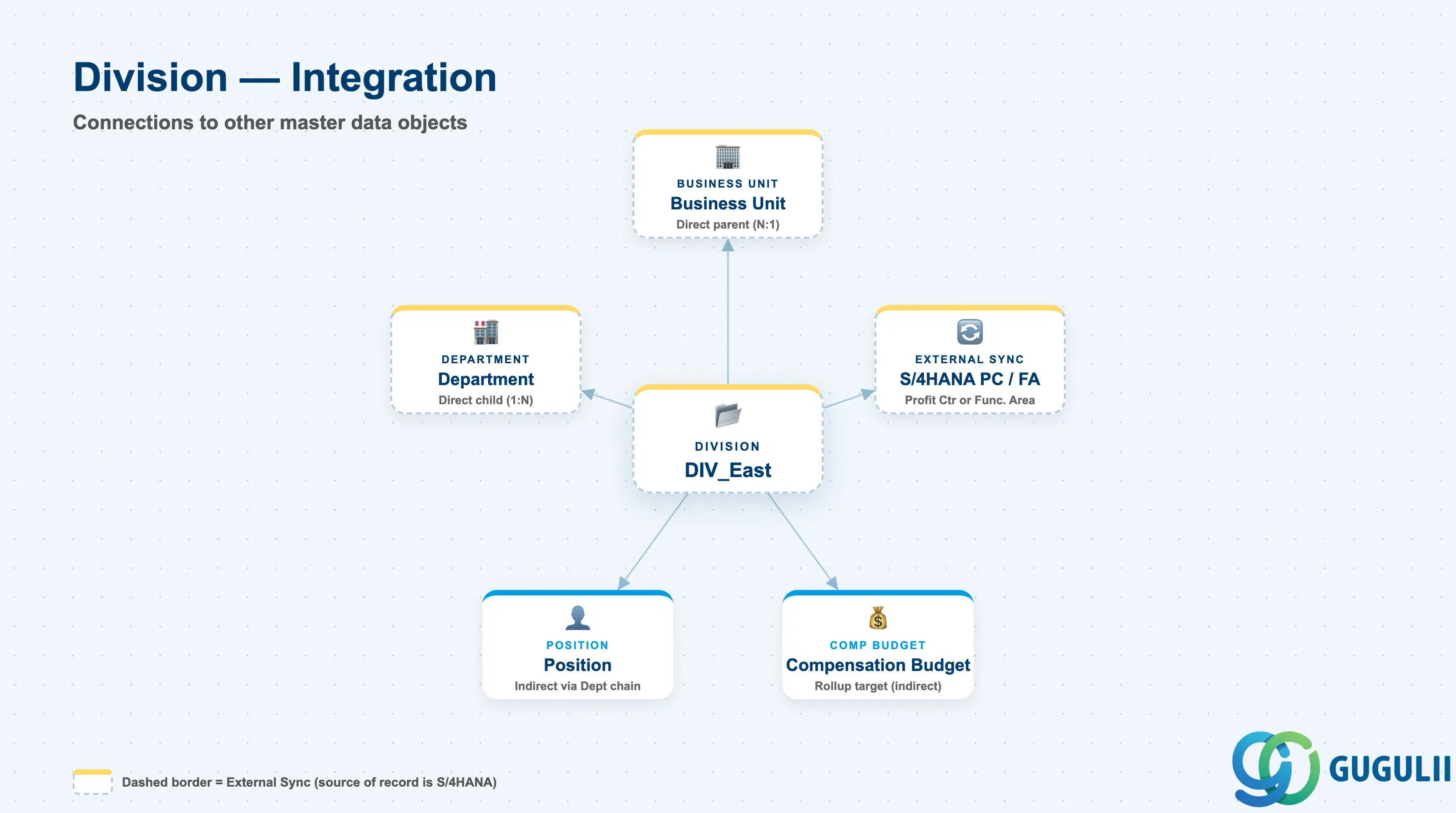
Division does not stand alone — it is the mandatory upward link to Business Unit and the mandatory downward grouping for everything organized beneath it.
| Object | Relationship | Practical Notes |
|---|---|---|
| Business Unit | Direct parent (N:1) — every Division must be assigned to exactly one Business Unit | Changing a Division’s Business Unit assignment after go-live re-parents every Department and Cost Center beneath it, and should be treated as a formal reorganization rather than a routine edit |
| Department | Direct child (1:N) — every Department must belong to exactly one Division, when the Division level is enabled | The first mandatory step below Division; if the Division level is bypassed instead, Department attaches one level higher, directly to Business Unit |
| Position | Indirect, via the Department chain — Position itself references Department, not Division directly | Relevant when building headcount or requisition reports segmented by Division; the rollup path runs through Department, not a direct field on Position |
| Compensation Budget | Frequently allocated and reported at Division level, though the Budget object itself references Department | Compensation teams commonly roll Department-level budgets up to Division for annual planning-cycle reporting, even though the system field points to Department, not Division |
| S/4HANA Profit Center / Functional Area | External sync source/target for clients running S/4HANA CO, when a mapping exists | Confirm during blueprint which S/4HANA object the client’s Division maps to (a Profit Center, a Functional Area, or none at all), since Division lacks Legal Entity’s clean 1:1 Company Code equivalent |
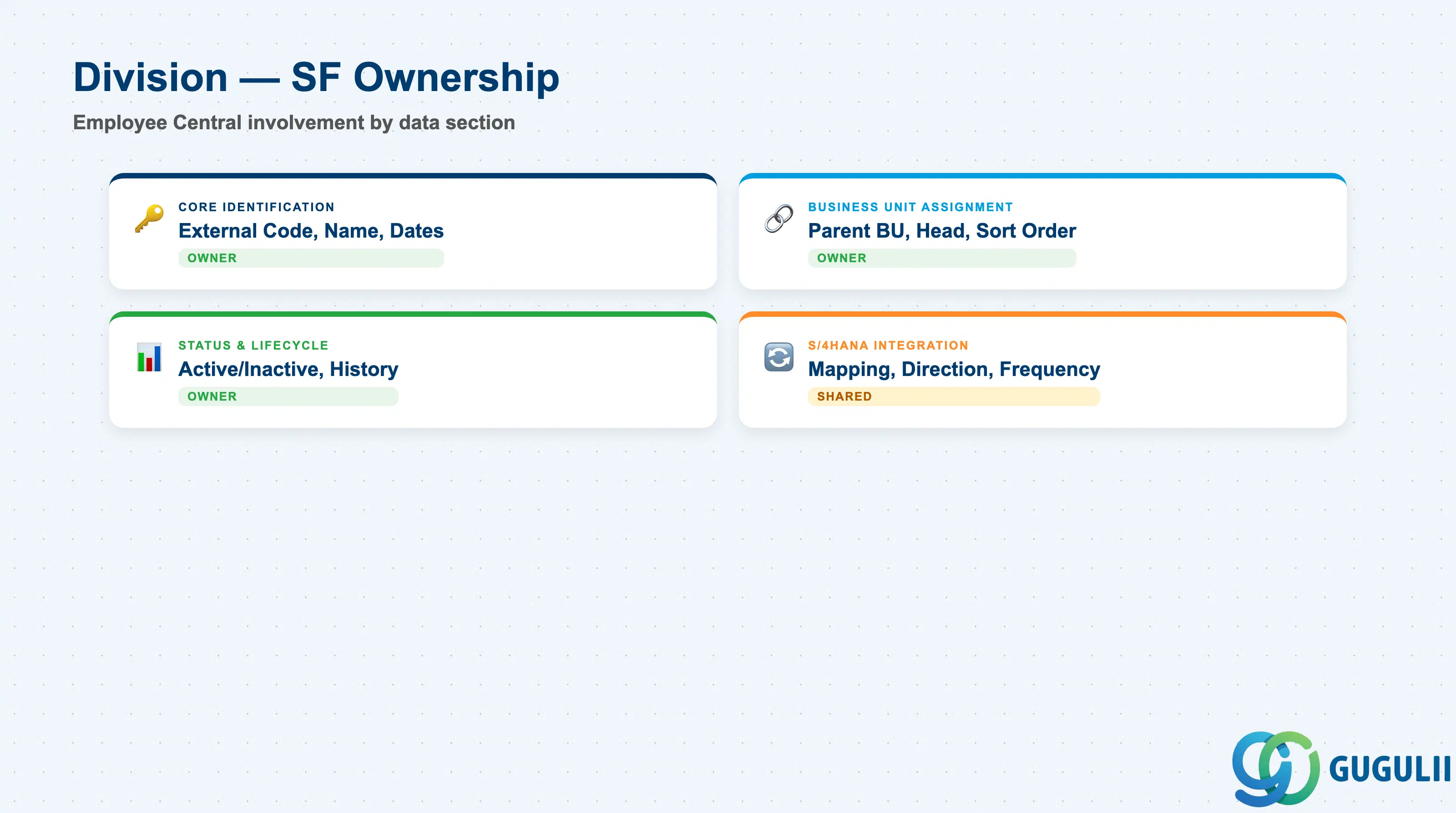
| Data Section | SF Involvement | Notes |
|---|---|---|
| Core Identification | ◎ Owner | External Code, Name, Effective Start Date |
| Business Unit Assignment | ◎ Owner | Parent Business Unit, Division head, sort order |
| Status & Lifecycle | ◎ Owner | Active/Inactive status, effective-dated change history |
| S/4HANA Integration | ○ Shared with FI/CO/Basis | External Code mapping, sync direction, sync frequency |
Legend: ◎ = Owner / Critical, ○ = Direct involvement
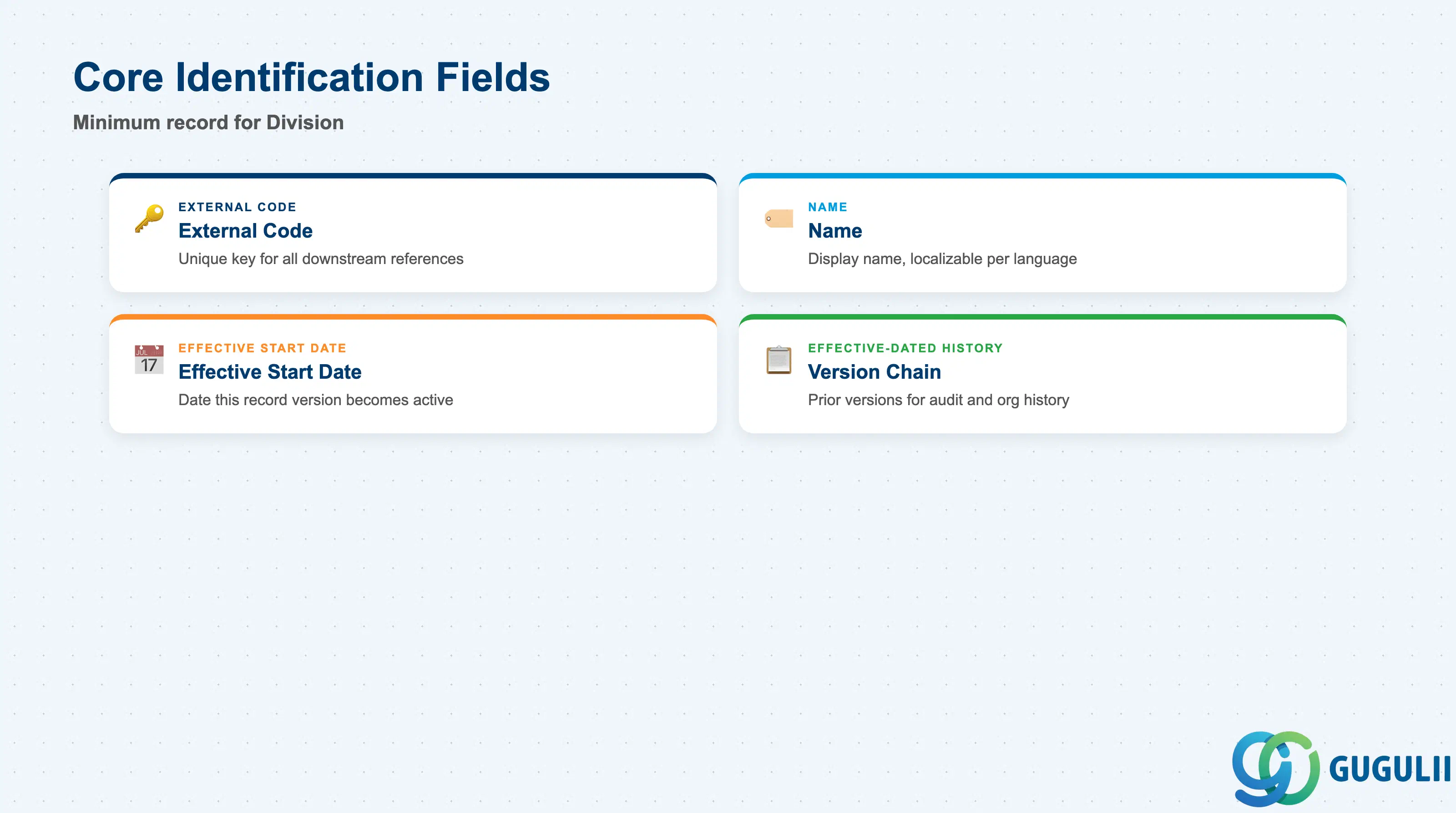
Core Identification is the minimum record a Division needs to exist — it is what every Department that belongs to it references when it points “up” to a Division.
| Field | Description | Practical Usage |
|---|---|---|
| External Code | Unique identifier for the Division | The key value every downstream reference (Department, integration payloads) points to. Decide the coding convention once with the integration team — changing it after go-live breaks any middleware mapping keyed on the old value. |
| Name | Display name of the Division | Localizable per language pack in a global instance. If a synced S/4HANA Profit Center or Functional Area exists, keep the naming convention aligned so Finance and HR teams recognize the same grouping across systems. |
| Effective Start Date | Date this version of the record becomes active | Every field change is captured as a new effective-dated row, not an overwrite. This is what allows an org-chart-as-of-date query to reconstruct historical structure — critical for audit and reorganization history. |
| Effective-Dated History | Chain of prior versions of this Division record | Used to answer “what was this Division’s name/status/Business Unit on date X.” Consultants should avoid deleting history rows; correct forward with a new effective-dated entry instead. |
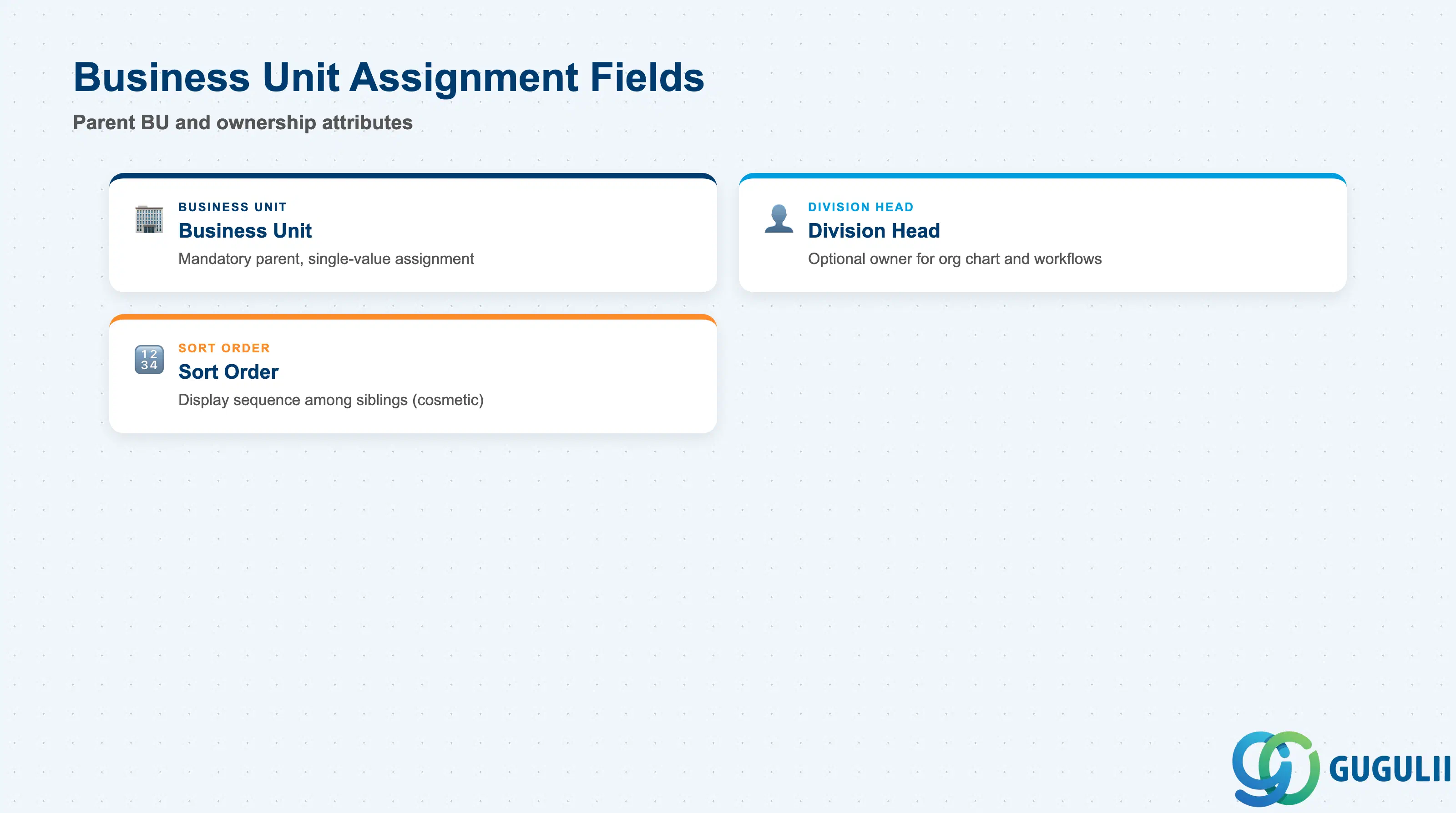
This section ties the Division record to its parent Business Unit and to the display/ownership attributes consultants set for org chart purposes.
| Field | Description | Practical Usage |
|---|---|---|
| Business Unit | The parent Business Unit this Division belongs to | Mandatory single-value assignment; every Department created under this Division inherits the same Business Unit context indirectly. Re-assigning a Division to a different Business Unit should be modeled as a formal reorganization, since it retroactively changes the business-line context implied for every downstream Department/Cost Center. |
| Division Head | Employee designated as the head/owner of the Division (if configured) | Commonly used to drive Position-based org chart displays and to designate an escalation approver in workflow foundation rules; leave blank if the client does not model a formal Division-level owner role. |
| Sort Order | Display sequence used when rendering the Division alongside its siblings | Purely cosmetic — controls ordering in org chart and picklist displays, not the data hierarchy itself. Useful to keep consistent when a client wants flagship product-line Divisions listed before support functions, for example. |
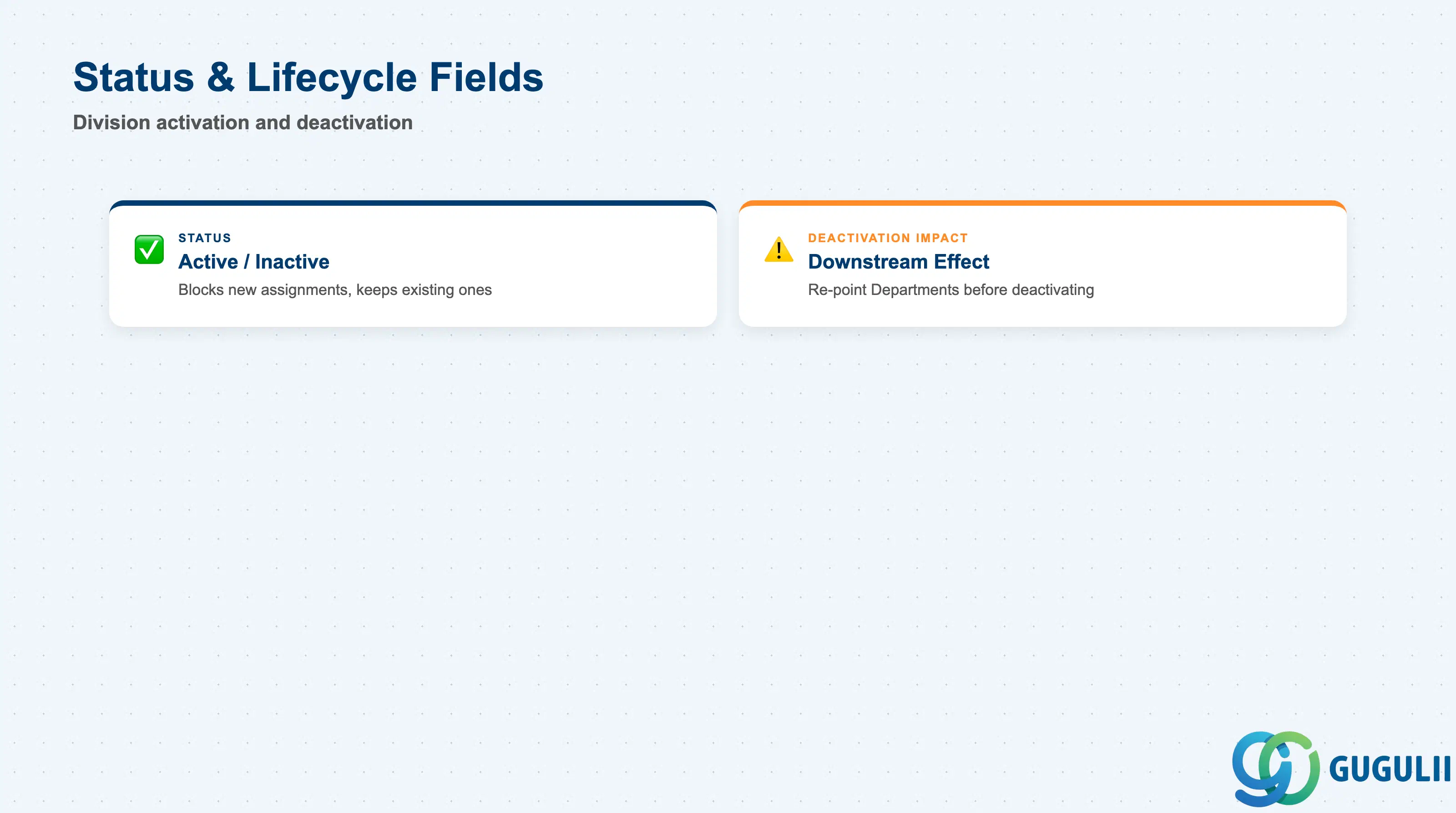
Status governs whether a Division is available for new assignments — this section is where consultants handle reorganizations, mergers, and product-line consolidations.
| Field | Description | Practical Usage |
|---|---|---|
| Status | Active / Inactive flag | Setting a Division Inactive does not remove existing Department assignments — it only blocks the Division from being selected on new records going forward. Deactivation should always be effective-dated to match the actual reorganization date, not the date the admin makes the change in the system. |
| Deactivation Impact | Downstream effect of an Inactive Division | Before deactivating, check for any Department still pointing to the Division — those need to be re-pointed to the surviving Division first in a restructuring or product-line consolidation scenario. |
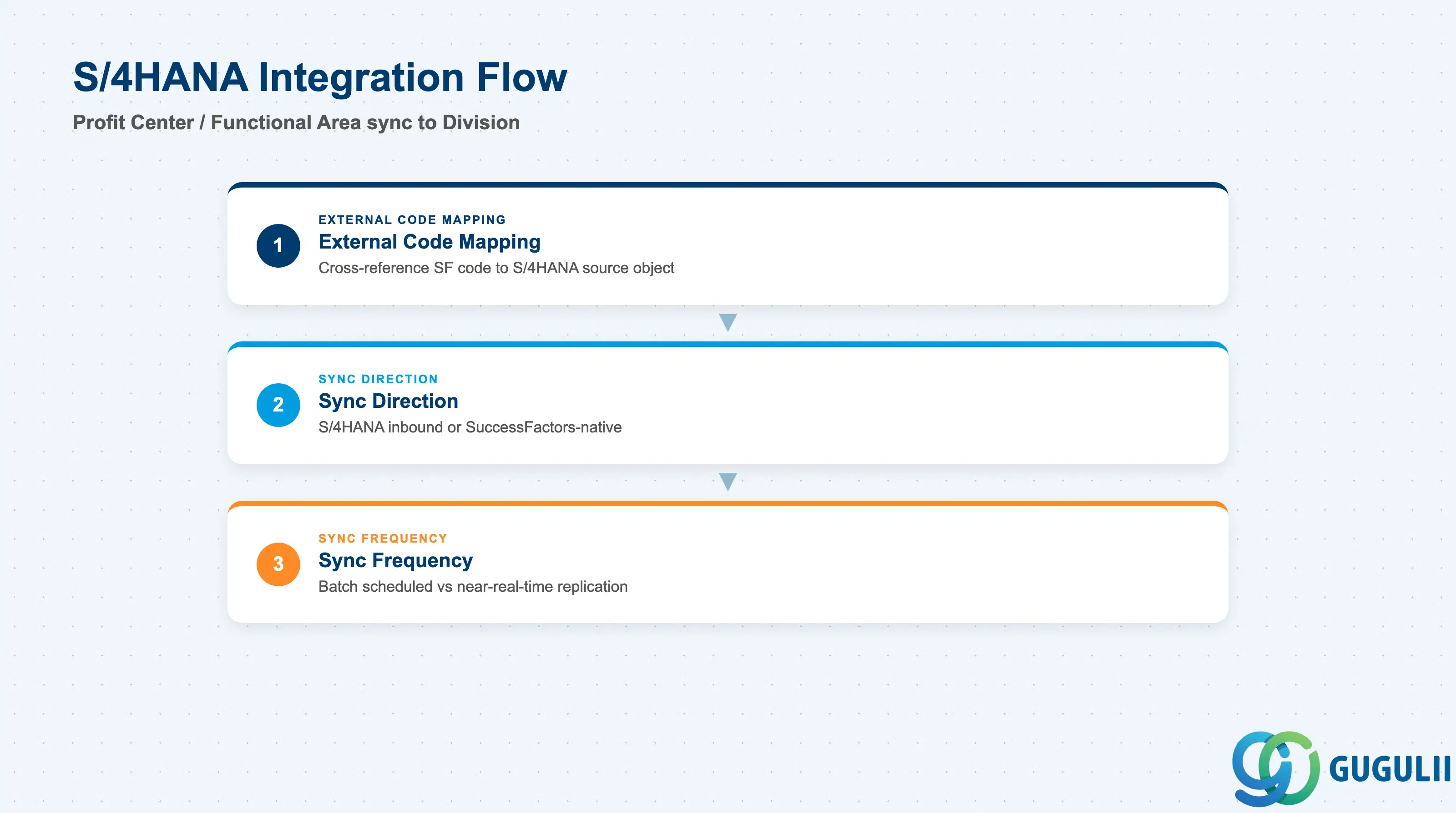
For clients running S/4HANA CO alongside SuccessFactors Employee Central, Division reconciliation is less standardized than Legal Entity’s, since S/4HANA has no single dedicated “Division” object.
| Field | Description | Practical Usage |
|---|---|---|
| External Code Mapping | Cross-reference between SuccessFactors External Code and the S/4HANA source object value | Confirm during blueprint which S/4HANA object the client’s Division maps to (a Profit Center, a Functional Area, or none at all) — this decision drives whether the mapping table is even needed. |
| Sync Direction | Whether S/4HANA is the system of record (inbound to SF) or the Division is SuccessFactors-native | Many clients treat Division as SF-native even when Legal Entity and Cost Center are synced, since S/4HANA doesn’t always carry a clean equivalent grouping at this level. Confirm ownership explicitly to avoid ambiguity during maintenance. |
| Sync Frequency | Batch (scheduled) vs. near-real-time replication, when sync is used | Typically delivered via the same integration content or middleware used for Legal Entity/Cost Center sync. Batch-only sync means a newly created S/4HANA source object is not immediately usable in Employee Central — plan reorganization go-lives around the sync schedule. |
| ID | Category | Title |
|---|---|---|
| sf-001 | Overview | What is SAP SuccessFactors? |
| ID | Category | Title |
|---|---|---|
| sf-b01 | Overview | SAP SuccessFactors Transactions: Process Flow, Hierarchy & Relationships |